
Sonic Homes: The Sonic/Racial Intimacy of Black and Brown Banda Music in Southern California


This series listens to the political, gendered, queer(ed), racial engagements and class entanglements involved in proclaiming out loud: La-TIN-x. ChI-ca-NA. La-TI-ne. ChI-ca-n-@. Xi-can-x. Funded by an Andrew W. Mellon Foundation as part of the Crossing Latinidades Humanities Research Initiative, the Latinx Sound Cultures Studies Working Group critically considers the role of sound and listening in our formation as political subjects. Through both a comparative and cross-regional lens, we invite Latinx Sound Scholars to join us as we dialogue about our place within the larger fields of Chicanx/Latinx Studies and Sound Studies. We are delighted to publish our initial musings with Sounding Out!, a forum that has long prioritized sound from a queered, racial, working-class and “always-from-below” epistemological standpoint. —Ed. Dolores Inés Casillas
—
No tengo nada de sangre de Mexico. Soy afro americano.
(I have no Mexican blood. I am African American.)
El Compa Negro (Ryhan Lowery)
The grain is the body in the singing voice, in the writing hand, in the performing limb.
Roland Barthes (The Grain of the Voice,1971)
***This post is co-authored by Sara Veronica Hinojos and Alex Mireles
Sarah La Morena (Sarah the Black woman), or Sarah Palafox, was adopted and raised by a Mexican family in Mexico. At the age of five, she moved to Riverside, California, a predominantly Mexican city an hour east of Compton. Palafox started singing as a way to express the racism she faced as a child in Southern California, feeling caught between her Black appearance and her Mexican sound. She found her voice in church, a nurturing environment where she could be herself, surrounded by her family’s love. She gained attention with a viral video of her rendition of Jenni Rivera’s “Que Me Vas a Dar.” Palafox delivers each note with profound emotion and precision, leaving even the accompanying mariachi violinist in awe.
Similarly, El Compa Negro (The Black Friend/Homie) or Rhyan Lowery heard the sounds of banda coming from his neighbor’s backyard in Compton; a historically Black-populated city with a current Mexican majority. Lowery couldn’t shake the song out of his head and learned the song’s Spanish-language lyrics. Like Palafox, videos of him singing in Spanish during high school made him a viral sensation. “They called me ‘el compa negro’ (…) All I heard was ‘blah blah blah negro or negro’ and I wasn’t having it until they explained to me what it meant. And I was like ‘ok, cool’.”
The sonic stylings of El Compa Negro and Sarah La Morena within the banda genre enable transcultural connections beyond the pan-Chicano-Mexican-Central American popularity of tecnobanda and la quebradita. The 1990s banda craze, writes George Lipsitz “challenged traditional categories of citizenship and culture on both sides of the US-Mexico border.” Banda music might sound like it was established south of the border, but multicultural listeners and dancers continue to influence its vibrations. Pop stars like Snoop Dogg, Shakira, Bad Bunny, and Karol G have released (tokenized) songs with Mexican-tinged, banda-recognizable beats. Yet, both El Compa and Sarah demonstrate a form of musical Black/Brown, working-class intimacy. Their respective musics are much less about a pop star (duet) kind of solidarity and much more about a deep knowing, a sensibility among working-class cultures and othered people that resonates through the aesthetics of sound. As Karen Tongson writes in Relocations: Queer Suburban Imaginaries, about her experience of “queer, brown, immigrant musical discovery” in Riverside, the hometown she shares with Sarah La Morena: “It is the music that inspires us to ask questions” (26).
Certainly, US Mexican immigrant culture does not have the same (mainstream) cultural caché as African American culture, unless somehow softened or filtered. Jalapeños get “de-spicifed“; pre-made Día de Los Muertos altares are now at Wal-Mart, and huipiles are available as fast-fashioned “peasant blouse;” filtering out their Mexican-indigenous origins. Thus, classics like “La Yaquesita” and originals like “Yo Soy Compton” heard through the grain of Black voices affirm the possibilities of U.S. Mexican belonging or what D. Travers Scott characterizes as a form of “intimate intersubjectivities;” rooted in long-established Black/Brown co-existences across the borderlands and city barrios. Turning the volume up on these artists serves an important counterpoint to Latino anti-Black racism.
Their voices, blending with brass and tambora, embody a Black-Brown sonic and symbolic solidarity, or spatial entitlement. As theorized by Gaye Theresa Johnson in Spaces of Conflict, Sounds of Solidarity, innovative applications of technology, creativity, and space foster new collectives which, even when “unheard” by historians, assert social citizenship and pave the way for new working-class political futures. In the contested neighborhoods of greater Los Angeles, Black and Brown communities are often pitted against one another through processes of containment and confinement leading to competitions for jobs, housing, status, and political power. Yet, they share the experiences of labor exploitation, housing segregation, and cultural vilification. Filmed in the intimate settings of backyards, the viral videos underscore Black/Brown hood/barrio soundscapes as multi-generational, familial, and culturally hybrid. Home is where shared class, racial, and gender politics are negotiated and resolved.
Asserting Black identity and the choice to perform in Spanish creates a unique visual and auditory experience within the Mexican-dominant world of banda. In fact, in 2024, Lowery made history as the first Spanish-language artist signed by Death Row Records, a label known primarily for hip hop. The lively rhythms of banda – oompah-oompah-oompah – offers both banda and hip hop listeners a new orientation to discern the racial-cultural politics of broader Los Angeles.
Like the mid-century Haitian-Mexican bolero singer Antonia del Carmen Peregrino Álvarez, alias “Toña La Negra,” the added tags “Negro” and “la Morena” signals Black singers’ recognition of the meaning(s) of their racial difference within the transnational Mexican music scene. The auditory discomfort that their vocal grain might cause is named and thus recognized as the persistent colorism of listeners at large. Lowery describes his initial unease with the given “Compa Negro” nickname. “My Mexican friends always tell me ‘Hey, compa negro, you’re Mexican, man. God just left you in the oven a little too long.’” The harassment came from both Black peers and Mexicans alike, for liking banda, dating Latinas, or dressing “like a Mexican.” “They would say, ‘You hate being Black. Self-hate. Self-hate. I’m like man it ain’t that I self-hate, it’s just that I embrace something. I took the time to have an open mind and study something, you know?” His way of being made sense in the context of a Compton teenage experience. “Becoming Mexican” by way of musical/cultural engagement surpassed skin tone-deep and nationalist differences.
Or, as Mexican ranchera singer Chavela Vargas–born in Costa Rica–famously asserted, “Mexicans are born wherever the hell they want!” Try listening to Juan Gabriel’s “Amor Eterno” to find out. Black creatives like Evander, Vaquera Canela, and Terry Turner are just a few more examples of Black mexicanidad. Yessica Garcia Hernandez reminds us that Black and Brown sonic solidarities have been the driving pulse of US popular music. She argues, “Home and sound is acknowledging that both corridos, hip-hop, and G-funk relationally, has formed paisas.”
El Compa Negro’s “Verde es Vida,” a tribute to California’s weed culture, lowriders, and corridos, booms loudly. The song begins with an accordion playing reggae rhythms, soon interrupted by percussion, guitars, and El Compa’s fast-paced verses. About a minute in, the accordion slows the tempo with a few reggae notes before the vocals return, reintroducing the corrido rhythm: “Hoy andamos en LA bien tranquilitos. En el lowrider escuchando corridos.” The reggae-corrido fusion ends with the familiar “pom pom pom pom!” of the drums, typical of banda and corrido finales, as the accordion plays its last note. Through Lowery’s reggae corrido, we hear his “sonic home” rooted in Black and Brown Los Angeles.
—
Featured Image: still from Sarah La Morena’s “La Llorona” (2020)
—
Sara Veronica Hinojos is an Assistant Professor of Media Studies and on the advisory board for Latin American and Latino Studies at Queens College, CUNY. Her research focuses on representations of Chicanx and Latinx within popular film and television with an emphasis on gender, race, language politics, and humor studies. She is currently working on a book manuscript that investigates the racial function of linguistic “accents” within media, called: GWAT?!: Chicanx Mediated Race, Gender, and “Accents” in the US.
Alex Mireles is a PhD student in the Department of Feminist Studies at UC Santa Barbara. She writes on Latinx identity and queerness, labor, and global capitalism through aesthetic movements in fashion, beauty, media, and visual cultures. Her dissertation explores the queer potential and world-making capabilities of Chicanx popular culture through Mexican regional music, social media, queer nightlife, and film.
—

REWIND!…If you liked this post, you may also dig:
Boom! Boom! Boom!: Banda, Dissident Vibrations, and Sonic Gentrification in Mazatlán—Kristie Valdez-Guillen
Listening to MAGA Politics within US/Mexico’s Lucha Libre –Esther Díaz Martín and Rebeca Rivas
Ronca Realness: Voices that Sound the Sucia Body—Cloe Gentile Reyes
Echoes in Transit: Loudly Waiting at the Paso del Norte Border Region—José Manuel Flores & Dolores Inés Casillas
Sounding Out! Podcast #28: Off the 60: A Mix-Tape Dedication to Los Angeles–Jennifer Stoever
Share this:

Listening to Digitized “Ratatas” or “No Sabo Kids”

This series listens to the political, gendered, queer(ed), racial engagements and class entanglements involved in proclaiming out loud: La-TIN-x. ChI-ca-NA. La-TI-ne. ChI-ca-n-@. Xi-can-x. Funded by an Andrew W. Mellon Foundation as part of the Crossing Latinidades Humanities Research Initiative, the Latinx Sound Cultures Studies Working Group critically considers the role of sound and listening in our formation as political subjects. Through both a comparative and cross-regional lens, we invite Latinx Sound Scholars to join us as we dialogue about our place within the larger fields of Chicanx/Latinx Studies and Sound Studies. We are delighted to publish our initial musings with Sounding Out!, a forum that has long prioritized sound from a queered, racial, working-class and “always-from-below” epistemological standpoint. —Ed. Dolores Inés Casillas
—
This post is co-authored by Sara Veronica Hinojos and Eliana Buenrostro
Cardi B eloquently reminds us that our español, as US Latinxs, might seem “muy ratata;” an apt phrase, heard lyrically within her music, used here to characterize inventive, communicative Spanglish word play. Yet, the proliferation of hashtags used to shame and silence second and later generations of Latinx kids runs counter to Cardi B’s ratata blessings.
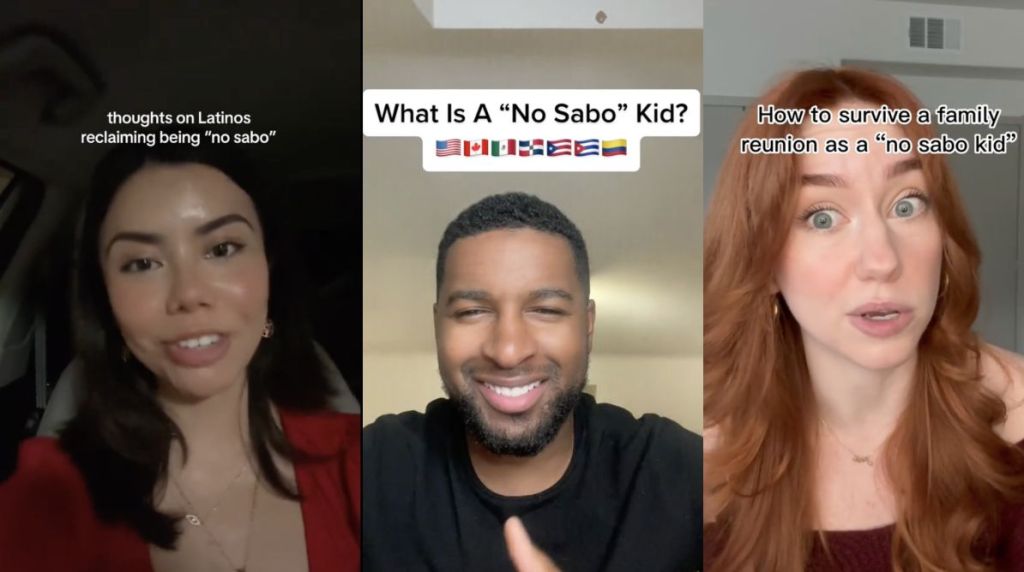
The hashtags #nosabokid #nosabokids #nosabokidsbelike #nosabokidsorry #iamanosabokid represents a collective acknowledgment of Gloria Anzaldúa’s “linguistic terrorism.” Featured on NBC News, Locatora Radio, the Los Angeles Times and, surely, referenced within familial discussions, #nosabo has brought, once again, to the fore the coupling and, we fiercely argue, the need to decouple language (“proficiency”) from that of Latinx identities. The phrase “no sabo” – a non-standard Spanish conjugation of the phrase “no sé” for “I don’t know” – has become a stand-in as both a linguistic (bad) sign of Americanization and/or a (good) marker of ethnic, bicultural pride.
Anzaldúa has long warned us that, “[e]ven our own people, other Spanish speakers nos quieren poner candados en la boca [want to put locks on our mouths]” (1999, 76). In many ways, the “no sabo” label silences or “locks” one’s mouth. The institutional attempts to Americanize Spanish-speaking individuals constitute a form of violence that has led to the erosion of Spanish spoken among Mexican and Latino families in the United States. Today, children of immigrants are ridiculed for speaking “broken” Spanish, yet, for decades Mexicans raised in the United States experienced harsh consequences and blatant discrimination for speaking Spanish in public; this racism continues today.
As scholars of Latinx listening, these social media posts can be incredibly frustrating. They remind us of the sad reality that many Latinx people do not know their own history or better yet futures. Anzaldúa would describe the intraethnic linguistic policing as, “peleando con nuestra propia sombra” (fighting with our own shadow) (1999, 76); it’s both unproductive and self-inflicting. Poet Michele Serros describes her experiences being policed in her 1993 poem “Mi Problema”:
Eyebrows raise
My sincerity isn’t good enough
when I request:
“Hable mas despacio por favor.”
My skin is brown
just like theirs,
but now I’m unworthy of the color
‘cause I don’t speak Spanish
the way I should.
Then they laugh and talk about
mi problema
in the language I stumble over [. . .]
–Opening stanza of “Mi Problema” from Chicana Falsa
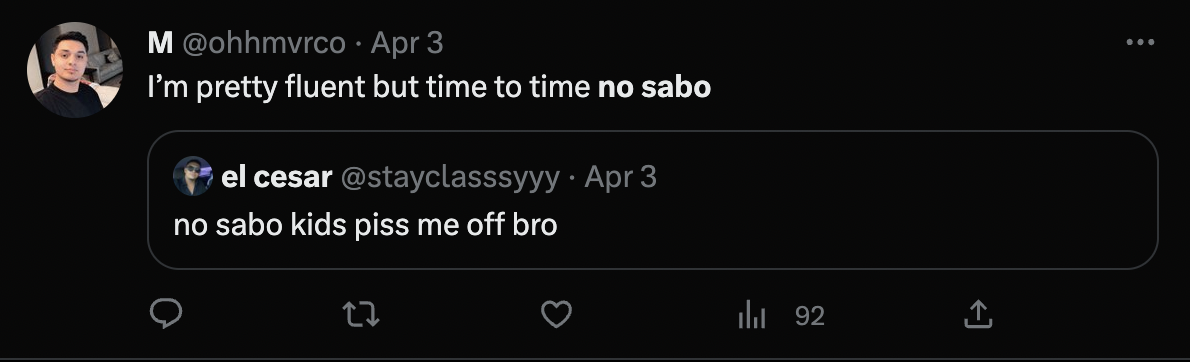
Applied to speakers (mostly kids) whose Spanish is identified as grammatically wrong or heard with an Anglicized accent, “no sabo” hashtags can encourage people to police each other’s tongues. Social media videos even show parents testing their children’s Spanish. When a child cannot remember or (mis)pronounces a Spanish word, or worse, uses a Spanglish iteration, they are disparagingly called “no sabo kids” (Stransky et al. 2023). Other posts reveal Latinx users’ fear of having and raising a “no sabo kid” or not wanting to date a “no sabo kid.”
Lastly, other posts proudly admit to being a “no sabo kid.” The latest series of “no sabo kids” hashtags are also unapologetic declarations that their language does not define the totality of their being or experiences.
Indeed, speaking Anglicized Spanish as Latinx can surface feelings of embarrassment, disappointment, and mockery from presumed “perfect” Spanish speakers or self-appointed “real” Spanish-English bilinguals. Televised instances of Latin Americans chastising the Spanish spoke of Latinx speakers or the public praise thrown at Ben Affleck for his spoken Spanish in comparison to the public side eyes given to wife, Bronx-raised, Jennifer Lopez are both hyper-mediated instances of #nosabokids.
White people might be praised for learning Spanish – no matter how Anglicized their accent – yet Latinx people whose Spanish is detected as Anglicized, are (racially whitewashed) “no sabo kids” (Urciuoli 2013). And yes, the use of the word “kids” alone infantilizes the speaker as some social media posts point to both children and adults as “no sabo.”
Irrespective of the proficiency in English or Spanish, Latinx individuals share experiences of being corrected in educational settings, at home, or online. The misuse of verb conjugation, such as using “sabo” instead of “sé,” is a developmental challenge encountered even by Spanish-speaking children who are learning solely Spanish. In other words, it is not an exclusive practice among Spanish-English bilingual speakers, despite what social media posts insist. The public discourse that some Latinx social media users are battling is what Jonathan Rosa calls “looking like a language” and, in this case, not “sounding like a race” (Rosa 2019).
Speaking, listening, and living “muy ratata” with inventive modes of Spanish and English in the U.S. is clearly heard as threatening. For instance, knowledge of another language has always challenged monolingual conservative speakers. Bilingual speakers and listeners routinely teach us how to resignify language practices and ultimately, the meaning of being a “no sabo kid.” (Or how Nancy Morales argues about Los Jornaleros del Norte and Radio Ambulante in the ways they offer new forms of belonging by understanding themselves and respecting each other.)
Entrepreneurs with Chicana and Latina feminist identities are modeling refashioned ways of belonging. For example, Los Angeles-based brand Hija de tu Madre created t-shirts and crewneck sweatshirts with the words “no sabo” to counter the ridicule heard and circulated within social media and to loudly claim a racial, linguistic identity that has nothing to do with shame. Similarly, the card game “Yo Sabo,” founded by a first generation college student of Mexican descent, Carlos Torres, looks for ways to improve his Spanish and simultaneously creates another way to connect with immigrant family members. Labels like “no sabo ” that are intended to categorize people in harmful ways are being repurposed to build community.
The podcast Locatora Radio: A Radiophonic Novela released an episode on April 12, 2023, Capítulo 160: No Sabo Kids, detailing historical reasons why Latinx ethnicities have structurally been banned from learning and speaking Spanish. Perhaps most importantly, Locatora Radio shares with listeners lengthy listener-recorded testimonios.
They provide diverse personal reasons for identifying as a “no sabo kid.” One listener, Paula, is a transracial adoptee whose first language was Spanish. However, because of forced family separation and the foster care system in Virginia, she “lost” her Spanish. Paula was enrolled in Spanish language classes throughout her formal schooling and accepts that her reclaiming of culture and language is a lifelong process. The use of verbal testimonios, a format that makes it possible for podcast listeners to listen to fellow listeners, moves away from posts above that wag their digital finger at “no sabo kids” and instead gives them a space to speak for themselves.
The intense personal and communal fear of losing aspects of culture or language makes it difficult to understand how shifts in language practices and accents are important new forms of belonging as Latinx in the U.S. If we cannot accept our own linguistic diversity, how do we expect others to listen to us?
—
Featured Image: A selection of TikTok #nosabo memes from @marlene.ramir, @yospanishofficial, and @saianana
—
Sara Veronica Hinojos is an Assistant Professor of Media Studies at Queens College, CUNY. Her research focuses on representation of Chicanx and Latinx within popular film and television with an emphasis on gender, race, language politics, and humor studies. She is currently working on a book manuscript that investigates the racial function of linguistic “accents” within media, called: GWAT?!: Chicanx Mediated Race, Gender, and “Accents” in the US.
Eliana Buenrostro is a Ph.D. student at the University of California, Riverside in the Department of Ethnic Studies. She received her master’s in Latin American and Latino Studies from the University of Illinois at Chicago. Her research examines the criminalization, immigration, and deportation of Chicanes and Latines through the lens of music and other forms of cultural production. She is a recipient of the Crossing Latinidades Mellon Fellowship.
—
—
REWIND!…If you liked this post, you may also dig:
Ronca Realness: Voices that Sound the Sucia Body—Cloe Gentile Reyes
From Spanish to English to Spanish: How Shakira’s VMA Performance Showcases the New Moment in Latin Music “Crossover”—Petra Rivera-Rideau and Vanessa Díaz
Echoes in Transit: Loudly Waiting at the Paso del Norte Border Region—José Manuel Flores & Dolores Inés Casillas
Xicanacimiento, Life-giving Sonics of Critical Consciousness—Esther Díaz Martín and Kristian E. Vasquez
“Don’t Be Self-Conchas”: Listening to Mexican Styled Phonetics in Popular Culture*–Sara Hinijos and Inés Casillas
Share this:


Current Top Posts





April 2021

January 2020

November 2019

October 2019

August 2019

April 2014

November 2017

March 2015

December 2017

October 2015
 Sounding Out!
Recent Comments