
Live Through This: Sonic Affect, Queerness, and the Trembling Body


Marginalized bodies produce marginalized sounds to communicate things that escape language. The queer body is the site of sounds that engage pleasure, repression, rage, isolation, always somehow outside of dominant language. Sound Studies tells us that we should trust our ears as much as our eyes, justifying our trust in sound, and of the resonating body. Affect Theory goes further, saying that all senses play into a body that processes input through levels of response, experience, and anticipation. Affect is the vibrational space that is both bodily memory and anticipation. So where do sound and affect meet in queer bodies? How do marginalized peoples use sound and the body to express liberation, objectification, joy, and struggle?
Our writers in Sound and Affect tackle these questions across a spectrum of the marginalized experience. Next week, Kemi Adeyemi, sloooooooows thingggggggggs doooooooooownnnnn so that we can hear the capitalist connections between the work expected of black bodies and the struggle for escape from this reality through the sonic affects, temporal shifts, and corporeal elsewhere of purple drank. Then, Maria Chaves explores the connection between voice, listening, and queer Chicana community formation: through space, across time, and with laughter. The series finishes with Justyna Stasiowska bringing the noise in a discussion of the trans body and the performance work of Tara Transitory. Today, I open by offering the concept of the tremble, a sonic form of affect that is necessarily queer in its affective reach. Live through this. Get life from this. —Guest Editor Airek Beauchamp
—
I first became interested in the intersections of sound studies and affect theory when, in graduate school, I began to research alternative rhetorics of the AIDS Crisis. ACT UP!, the noisiest and most politically effective of the AIDS advocacy groups from 1987 through 1995, posited noise as presence and silence as loss throughout their campaigns. ACT UP! was notorious for their actions in which they invaded public spaces, from the FDA to the White House and used militaristic chants to create a disruptive cacophony that ran counter to the official silence of government policy. The organization harnessed noise as powerful weapon to shake the status quo.
The ACT UP! equation led me to a critique of AIDS-era politics in which sound and affect became the predominant modes of inquiry, allowing me to investigate how the situated body and the senses experience and invoke rhetorics of marginialization. This maneuver proved to be intellectually difficult, particularly because my post-structuralist training stubbornly insisted on a discursively constructed universe in which only language constructed reality. Instead, what sound and affective rhetoric allow for is exactly that which is beyond the text, that which communicates without strictly-defined language. Theorizing the AIDS crisis as a social event might be necessary in terms of understanding how our culture processes or catalogues such an event, but as I engaged with its archive, I felt bereft when facing the limits of such an approach. It offered nothing to soothe the pain or express the terror of those whose bodies disintegrated in the cruel grasp of the disease.
Rather than relying on abstracted theory to force the affect of the plague into a logical form, I needed something like Antonin Artaud’s work on the plague to explore the cultural but embodied affect of the disease. When Artaud was invited to speak about his essay “The Theater and the Plague” at the Sorbonne, he decided to actually incorporate his ideas about ‘liquefying boundaries” into his speech. Artaud began with a standard oratory but slowly devolved into a theatrical performance of the plague, eventually ending in shrieks of physical pain. By the end of his speech, the only people left in the lecture hall were a minor contingent of his close friends, including Anais Nin, who recounted the tale (Eshleman, 12). Artaud’s shrieks and howls engaged the whole body in the process of making sound, while also erasing semantic and syntactical codes. Here is a video compilation of Artaud performances, to provide the smallest hint of his vocal performances:
To continue my research, I realized, I needed to understand bodies as instruments for processing, producing, and receiving sonic stimuli, while, at the same time, rethink how feeling, quite literally, moves bodies. Artaud led me to connect the sound and affect of AIDS in the 1980s through the unspeakable and the pre-semantic language of the body, deeply embedding these sound/feelings in a network of past experience, present and anticipatory states of being. His work gave me a different way to theorize, to grasp, to listen, to scream—to tremble and tremble in return.
I continued to connect the sinews between sound and affect in my February 2013 post for Sounding Out!, “Queer Timbres, Queered Elegy: Diamanda Galás’s The Plague Mass and the First Wave of the AIDS Crisis.” Through Galás’s visceral interactions with the unendurable pain embedded in history, I keenly felt the presence of the material body so lacking from post-structuralist critique of lived experience, alongside an urgent sense of agency. Galás’s performances made fascinating use of the “tactile effect of layered sound that is felt with the skin, in the bones, as well as with the ears, communicating a palpable experience that lies beyond the barely-nuanced music it is seductively easy to grow accustomed to.” The experience of listening to Galás helps us to realize that the body is a series of machines of input and output—processor and producer—systems that often forego semantic language and instead listen and speak in tremblings.
In what follows, I flesh out the notion of sonic tremblings: how it links what we call sound studies and affect studies, of course, but more importantly, how it speaks past the post-structuralist insistence on a world confined to text, and how we might build upon this notion in future theory and research. Our bodies’ materiality, a site of constant unfolding, engages with the world via a series of shimmers and impulses—such as the synesthetic vibration I am calling sonic tremblings—rather than with concrete events or objects in and of themselves. These tremblings, always intersectional, encompass past lived experiences, social and cultural constructions that restrict interpretation, and interpretations falling outside social or cultural codes. I understand the trembling body as both processor and producer of sound, a connection of trembling nodes eschewing the patriarchal structures of language. And, though I write through and about the particular tremblings of my own white, queer, cis male body, that experience is by no means universal or at the center of my theorizations. Instead, I hope that the way I experience and understand sound studies and affect theory will open up new ways of hearing the world, especially for people whose experiences are not mine and who can add depth, nuance, and texture to the conversation. It is in fact through their variety and unique resonances that tremblings speak simultaneously to and against the limitations placed on queer bodies.
My articulation of affect with sound studies is necessarily queer, as it rejects binaries and speaks without definitive vocabulary, syntax, or grammar. Marta Figlerowicz, in “Affect Theory Dossier: An Introduction,” offers a good primer on the widely divergent ways in which scholars use the idea of affect. In Figlerowitz’s explanation, affect is always a self in motion, be it “the self running ahead of itself,” “the self catching up with itself,” “the self as self-discursive and always constantly mutating and adapting to ambient stimuli,” and/or “celebrations of Proustian moments when the self and the sensory world, or the conscious and the unconscious self, or the self and another person, fall in step with each other… to make a sliver of experience more vivid and more richly patterned than willful analysis could ever have” (4). In all of these cases, the body’s perception and the discourse of the self remain in motion, trembling with identifications that are at best fleeting, though richly communicative and expressive. Sound, as an always-present stimulus, works affectively in such a form of communication.

Image by Flickr User Graham Campbell, “Goosebumps”
Queer bodies are inherently intertwined in theorizing sound and affect. The actual concept of affect itself is queer, implicating the unknowable, but concretely felt phenomena of the body. But rather than forming a linear narrative, affect is produced, and received, in a web of physical and neural processes that rejects the linear concept of time and instead are never static but self-referential and constantly evolving in response to our environment. To navigate this space I adopt the term “affective field,” used by Marie Thompson and Ian Biddle in their introductory essay to Sound, Music, Affect. An affective field describes a textural field of play between stimulus, meaning, and response; it relies on reproduction and broadcast, a field of listening/emitting/processing machines all working in a sort of continuous flow, always already present. The affective field model encourages the removal of emphasis on subject/object but instead focuses on interfacial relationships as a point of contact. Eradicating =the subject/object dualism is vital to exchange, as Yvon Bonenfant says in “Queer Listening to Queer Vocal Timbres“: “We cannot exchange with an object, only other subjects” (76).

Image From Flickr User Alvaro Sasaki, From Brasília Queer Fest!, 31 March 2013
Finding a theory that worked with the body and with subject/subject communication allowed me to make more sense of the ways in which ACT UP! used noise and silence as a way to build community, and allowed me to dig deeper into the idea of queer communication. The silent scream of the slogan Silence = Death succinctly articulated ACT UP!’s most definitive tactic: manipulation of the affective field. Their chants initially filled the streets, of New York, but by 1990 their actions had united them with Europe, creating world-wide noise in protest of the now-global epidemic, creating a distinct disjuncture to the silent death falling over gay communities. Noise offered the queer community both a form of protest and community, becoming an affective mechanism of agency. ACT UP!’s use of noise not only speaks to the dire need of queer bodies to exercise agency and demonstrate social worth, but it also helps break down the essential binary between encoded language and un-encoded sound. Rather than syntactical sound, noise communicates in trembles, resonating in both the psyche and in the actual body. Noise worked to unify disparate parts of identity–and disparate identities–a coalescing rather than normalizing process, a trembling vital to queer identity.
However, while ACT UP! worked to create noise—and to develop community through the trembling of their rage—they also communicated affectively with silence. Staging their now infamous die-ins, ACT UP! manipulated the affective field through the deafening buzz that accompanies silence, a somber quiet that refused to go ignored. These actions were not done to—but instead with—people, a disruption of the subject/object, or perhaps the subject/abject. But, it is the unexpected noise of the die-ins that I find most interesting. Not just the ambient noise of occupying bodies in space—people moving, coughing, breathing—but the loud silence created by the protest itself: a hushed roar that trembles through the room, the microphones, and the bodies of the listeners, a disruptive noise crafted from intentional silence. This silence itself resonates in the body, enabling them to erupt in tremblings of loss, of mourning, and of rage, the painfully loud silence of marginalized bodies at war with an epidemic about which no one in power seemed to care.
ACT-UP’s die-ins reclaimed agency within silence’s palpable materiality, using its noise to disrupt the affective field and reclaim space within it. Using the material body as both receptor and transmitter of the affective field, their noise created tremblings and spoke in associations both somatic and psychic. In the case of the die-ins, the silence mediated the noise of the voices of the dead, all talking at once through the trembling bodies of the living.
Adapting silence and the noise it brings, one of ACT UP!’s historical legacies, offers contemporary listeners agency over our marginalized bodies. We must make some noise, and then “listen out” for particular affects of noise and silence in turn, as Bonenfant suggests, seeking the tremblings that touch our skins and resonate in our brains, bone, and flesh. The affective field permeates queer communication and offers to the marginalized an opportunity, through sound, to make noise, establish self, and establish communities.
At once subversive and coalescent, noise resists the codification of what our culture might traditionally consider to be “music” or other codified sounds, making it a necessarily affective communication. The discordant, unruly strains of Throbbing Gristle’s “Discipline,” for example, jarred, shaken, and trembled me into a powerful feeling of community amid dissonance and difference, of community through difference at key moments in my life.
At other moments, the shriek, fuzz, and wail of riot grrrrl punk act Bikini Kill, in particular, Kathleen Hanna’s growl in “Suck My Left One,” has awakened in me a strain of tremblings that move freely associative in their rage against the marginalization of women and the ways in which socially constructed gender roles also marginalize and demonize queer folks. While post-structuralism maintains that the self is necessarily disunified and can only be defined by its difference to others, I have to disagree. While academic methodologies make it difficult to form an argument based on my lived experience, when I feel the tremblings connecting me to Genesis Breyer P-Orridge or Kathleen Hanna and to their audiences, I am hard pressed to feel them as anything but real.
In fact, it might just be in endurance that I can best articulate tremblings as a sonic, somatic, affective phenomenon. Born of present stimuli, always connected to past experiences and anticipatory of the future, tremblings are unruly, unable to be pinpointed. They do not just express the order or pleasure that we find in traditional music, though they can encompass this as well. Instead, tremblings are communicative, they move through the I, the subject, while unifying other subjects through their rich and unnamable identifications. It speaks simultaneously to and against the limitations placed on queer bodies, expressing joy, pain, pleasure.
—
Featured Image: Genesis P-Orridge by Flicker User Jessica Chappell
—
Airek Beauchamp is a Visiting Assistant Professor at Arkansas State University and a Ph.D. candidate at SUNY Binghamton, where he specializes in Writing Studies. Airek is currently working on his dissertation, which details ways that universities can offer social and academic writing support to graduate students to better help them professionalize in their fields. His other areas of research include queer theory, affect theory, and trauma in the LGBTQ community.
—
 REWIND!…If you liked this post, check out:
“Music to Grieve and Music to Celebrate: A Dirge for Muñoz”-Johannes Brandis
“Music Meant to Make You Move: Considering the Aural Kinesthetic”-Imani Kai Johnson
“Hearing Queerly: NBC’s ‘The Voice’”-Karen Tongson
“One Nation Under a Groove?: Music, Sonic Borders, and the Politics of Vibration“–Marcus Boon
Share this:

The Eldritch Voice: H. P. Lovecraft’s Weird Phonography

 Welcome to the last installment of Sonic Shadows, Sounding Out!’s limited series pursuing the question of what it means to have a voice. In the most recent post, Dominic Pettman encountered several traumatized birds who acoustically and uncannily mirror the human, a feedback loop that composes what he called “the creaturely voice.” This week, James Steintrager investigates the strange meaning of a “metallic” voice in the stories of H.P. Lovecraft, showing how early sound recording technology exposed an alien potential lingering within the human voice. This alien voice – between human and machine – was fodder for techniques of defamiliarizing the world of the reader.
— Guest Editor Julie Beth Napolin
—
A decade after finding itself downsized to a dwarf planet, Pluto has managed to spark wonder in the summer of 2015 as pictures of its remarkable surface features and those of its moon are delivered to us by NASA’s New Horizons space probe. As scientists begin to tentatively name these features, they have drawn from speculative fiction for what they see on the moon Charon, giving craters names including Spock, Sulu, Uhuru, and—mixing franchises—Skywalker . From Doctor Who there will be a Tardis Chasma and a Gallifrey Macula. Pluto’s features stretch back a bit further, where there will also be a Cthulhu Regio, named after the unspeakable interstellar monster-cum-god invented by H. P. Lovecraft.
We can imagine that Lovecraft would have been thrilled, since back when Pluto was first discovered in early 1930 and was the evocative edge of the solar system, he had turned the planet into the putative home of secretive alien visitors to Earth in his short story “The Whisperer in Darkness.” First published in the pulp magazine Weird Tales in 1931, “The Whisperer in Darkness” features various media of communication—telegraphs, telephones, photographs, and newspapers—as well as the possibilities of their manipulation and misconstruing. The phonograph, however, plays the starring role in this tale about gathering and interpreting the eerie and otherworldly—the eldritch, in a word—signs of possible alien presence in backwoods Vermont.
In the story, Akeley, a farmer with a degree of erudition and curiosity, captures something strange on a record. This something, when played back by the protagonist Wilmarth, a folklorist at Lovecraft’s fictional Miskatonic University, goes like this:
Iä! Shub-Niggurath! The Black Goat of the Woods with a Thousand Young! (219)
The sinister resonance of a racial epithet in what appears to be a foreign or truly alien tongue notwithstanding, this story features none of the more obvious and problematic invocations of race and ethnicity—the primitive rituals in the swamps of Louisiana of “The Call of Cthulhu” or the anti-Catholic immigrant panic of “The Horror at Red Hook”—for which Lovecraft has achieved a degree of infamy. Moreover, the understandable concern with Lovecraft’s social Darwinism and bad biology in some ways tends to miss how for the author—and for us as well—power and otherness are bound up with technology.
 The transcription of these exclamations, recorded on a “blasphemous waxen cylinder,” is prefaced with an emphatic remark about their sonic character: “A BUZZING IMITATION OF HUMAN SPEECH” (219-220). The captured voice is further described as an “accursed buzzing which had no likeness to humanity despite the human words which it uttered in good English grammar and a scholarly accent” (218). It is glossed yet again as a “fiendish buzzing… like the drone of some loathsome, gigantic insect ponderously shaped into the articulate speech of an alien species” (220). If such a creature tried to utter our tongue and to do so in our manner—both of which would be alien to it—surely we might expect an indication of the difference in vocal apparatuses: a revelatory buzzing. Lovecraft’s story figures this “eldritch sound” as it is transduced through the corporeal: as the timbral indication of something off when the human voice is embodied in a fundamentally different sort of being. It is the sound that happens when a fungoid creature from Yuggoth—the supposedly native term for Pluto—speaks our tongue with its insectile mouthparts.
Yet, reading historically, we might understand this transduction as the sound of technical mediation itself: the brazen buzz of phonography, overlaying and, in a sense, inhabiting the human voice.
For listeners to early phonographic recordings, metallic sounds—inevitable given the materials used for styluses, tone arms, diaphragms, amplifying horns—were simply part of the experience. Far from capturing “the unimaginable real” or registering “acoustic events as such,” as media theorist Friedrich Kittler once put the case about Edison’s invention, which debuted in 1877, phonography was not only technically incapable of recording anything like an ambient soundscape but also drew attention to the very noise of itself (23).
For the first several decades of the medium’s existence, patent registers and admen’s pitches show that clean capture and reproduction were elusive rather than given. An account in the Literary Digest Advertiser of Valdemar Poulsen’s Telegraphone, explains the problem:
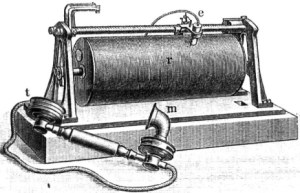 The talking-machine records sound by the action of a steel point upon some yielding substance like wax, and reproduces it by practically reversing the operation. The making of the record itself is accompanied by a necessary but disagreeably mechanical noise—that dominating drone—that ‘b-r-r-r-r’ that is never in the human voice, and always in its mechanical imitations. One hears metallic sounds from a brazen throat—uncanny and inhuman. The brittle cylinder drops on the floor, breaks—and the neighbors rejoice!
The Telegraphone, which recorded sounds “upon imperishable steel through the intangible but potent force of electromagnetism” such that no “foreign or mechanical noise is heard or is possible,” of course promised to make the neighbors happy not by breaking the cylinder but rather by taking the inhuman ‘b-r-r-r-r’ out of the phonographically reproduced voice. Nonetheless, etching sound on steel, the Telegraphone was still a metal machine and unlikely to overcome the buzz entirely.
In his account of “weird stories” and why the genre suited him best, Lovecraft explained that one of his “strongest and most persistent wishes” was “to achieve, momentarily, the illusion of some strange suspension or violation of the galling limitations of time, space, and natural law which forever imprison us and frustrate our curiosity about the infinite cosmic spaces beyond the radius of our sight and analysis.” In “The Whisperer in Darkness,” Lovecraft put to work a technology that was rapidly becoming commonplace to introduce a buzz into the fabric of the everyday. This is the eldritch effect of Lovecraft’s evocation of phonography. While we might wonder whether a photograph has been tampered with, who really sent a telegram, or with whom we are actually speaking over a telephone line—all examples from Lovecraft’s tale—the central, repeated conundrums for the scholar Wilmarth remain not only whose voice is captured on the recorded cylinder but also why it sounds that way.
 The phonograph transforms the human voice, engineers a cosmic transduction, suggesting that within our quotidian reality something strange might lurk. This juxtaposition and interplay of the increasingly ordinary and the eldritch is also glimpsed in an account of Charles Parson’s invention the Auxetophone, which used a column of pressurized air rather than the usual metallic diaphragm. Here is an account of the voice of the Auxetophone from the “Matters Musical” column of The Bystander Magazine from 1905: “Long ago reconciled to the weird workings of the phonograph, we had come to regard as inevitable the metallic nature of its inhuman voice.” The new invention might well upset our listening habits, for Mr. Parson’s invention “bids fair to modify, if not entirely to remove,” the phonograph’s “somewhat unpleasant timbre.”
What the phonograph does as a medium is to make weird. And what making weird means is that instead of merely reproducing the human voice—let alone rendering acoustic events as such—it transforms the latter into its own: an uncanny approximation, which fails to simulate perfectly with regard to timbre in particular. Phonography reveals that the materials of reproduction are not vocal chords, breath, labial and dental friction—not flesh and spirit, but vibrating metal.
Although we can only speculate in this regard, I would suggest that “The Whisperer in Darkness” was weirder for readers for whom phonographs still spoke with metallic timbre. The rasping whisper of the needle on cylinder created what the Russian Formalist Viktor Shklovsky was formulating at almost exactly the same time as the function of the literary tout court: defamiliarization or, better, estrangement. Nonetheless, leading the reader to infer an alien presence behind this voice was equally necessary for the effect. After all, if we are to take the Auxetophone as our example—an apparatus announced in 1905, a quarter of a decade before Lovecraft composed his tale, and that joined a marketplace burgeoning with metallic-voice reducing cabinets, styluses, dampers, and other devices—phonographic listeners had long since become habituated to the inhumanity of the medium. That inhumanity had to be recalled and reactivated in the context of Lovecraft’s story.
 To understand fully the nature of this reactivation, moreover, we need to know precisely what Lovecraft’s evocative phonograph was. When Akeley takes his phonograph into the woods, he adds that he brought “a dictaphone attachment and a wax blank” (209). Further, to play back the recording, Wilmarth must borrow the “commercial machine” from the college administration (217). The device most consistent with Lovecraft’s descriptions and terms is not a record player, as we might imagine, but Columbia Gramophone Company’s Dictaphone. By the time of the story’s setting, Edison Phonograph’s had long since switched to more durable celluloid cylinders (Blue Amberol Records; 1912-1929) in an effort to stave off competition from flat records. Only Dictaphones, aimed at businessmen rather than leisure listeners, still used wax cylinders, since recordings could be scraped off and the cylinder reused. The vinyl Dictabelt, which eventually replaced them, would not arrive until 1947.
Meanwhile, precisely when the events depicted in “The Whisperer in Darkness” are supposed to have taken place, phonography was experiencing a revolutionary transformation: electronic sound technologies developed by radio engineers were hybridizing the acoustic machines, and electro-acoustic phonographs were in fact becoming less metallic in tone. Yet circa 1930, as the buzz slipped toward silence, phonography was still the best means of figuring the sonic uncanny valley. It was a sort of return of the technologically repressed: a reminder of the original eeriness of sound reproduction—recalled from childhood or perhaps parental folklore—at the very moment that new technologies promised to hide such inhumanity from sensory perception. Crucially, in Lovecraft’s tale, estrangement is not merely a literary effect. Rather, the eldritch is what happens when the printed word at a given moment of technological history calls up and calls upon other media of communication, phonography not the least.
I have remarked the apparent absence of race as a concern in “The Whisperer in Darkness,” but something along the lines of class is subtly but insistently at work in the tale. The academic Wilmarth and his erudite interlocutor Akeley are set in contrast with the benighted, uncomprehending agrarians of rural Vermont. Both men also display a horrified fascination with the alien technology that will allow human brains to be fitted into hearing, seeing, and speaking machines for transportation to Yuggoth. These machines are compared to phonographs: cylinders for storing brains much like those for storing the human voice. In this regard, the fungoid creatures resemble not so much bourgeois users or consumers of technology as scientists and engineers. Moreover, they do so just as a discourse of technocracy—rule by a technologically savvy elite—was being articulated in the United States. Here we might see the discovery of Pluto as a pretext for exploring anxieties closer to home: how new technologies were redistributing power, how their improvement—the fading of the telltale buzz—was making it more difficult to determine where humanity stopped and technology began, and whether acquiescence in this changes was laudable or resistance feasible. As usual with Lovecraft, these topics are handled with disconcerting ambivalence.
—
James A. Steintrager is a professor of English, Comparative Literature, and European Languages and Studies at the University of California, Irvine. He writes on a variety of topics, including libertinism, world cinema, and auditory cultures. His translation of and introduction to Michel Chion’s Sound: An Acoulogical Treatise will be published by Duke University Press in fall of 2015.
—
Featured image: Taken from “Global Mosaic of Pluto in True Color” in NASA’s New Horizons Image Gallery, public domain. All other images courtesy of the author.
—
 REWIND! . . .If you liked this post, you may also dig:
Sound and Sanity: Rallying Against “The Voice” — Mark Brantner
DIANE… The Personal Voice Recorder in Twin Peaks — Tom McEnaney
Reproducing Traces of War: Listening to Gas Shell Bombardment, 1918 — Brían Hanrahan
Share this:


Current Top Posts





April 2021

January 2020

November 2019

October 2019

August 2019

April 2014

November 2017

March 2015

December 2017

October 2015
 Sounding Out!
Recent Comments