
Or Does it Explode?: Sounding Out the U.S. Metropolis in Hansberry’s A Raisin in the Sun

 Editor’s Note: Cars. Trains. Festivals. Music. Noise. Sound. The concept of the city is inherently aural. Cities are always thought of in opposition to quiet, to stillness. However, representing cities as noisy is not without its problems; in fact, one thing we have tried to do here at Sounding Out! is question what ideas of quiet and noise carry with them. They are social constructions, like race and gender. We cannot talk about urban sounds in a vacuum.
Cities are an essential part of the scholarly work I do; cities are also an intrinsic part of who I am. So when I started thinking about what I wanted February Forum #3 to be about, I felt it was time to edit a series on city sounds. This month Sounding Out! is thrilled to bring you a collection of posts that will change the way you hear cities. Regular writer Regina Bradley will discuss the dichotomy of urban and suburban in the context of sound (noisy versus quiet, respectively), guest writer Linda O’ Keeffe will take readers on a soundwalk of the Smithfield Horse Fair in Dublin, and CFP winner Lilian Radovac will share with us a photoessay on the sound installation Megaphóne in Montreal. The forum will prompt readers to think through ideas about urban space and sound. Are cities as noisy as we think they are? Why are cities described as “loud”? Who makes these decisions about nomenclature and why?
I’ll be kicking things off in the forum with a critical reading of sound in Lorraine Hansberry’s A Raisin in the Sun, a play about African Americans in Chicago that still rings/stings true today. Take your headphones off and listen up because you might miss your train…—Liana M. Silva-Ford, Managing Editor
—
Lorraine Hansberry’s groundbreaking play A Raisin in the Sun starts with the Younger family waking up and getting ready for work. Ruth Younger wakes her son, Travis Younger, to get ready for school. Her husband, Walter Lee Younger, is as reluctant to get up as his son does. After a brief tense exchange with his wife, Walter Lee turns to the paper:
WALTER (…vaguely reads the front page) Set off another bomb yesterday.
RUTH (Maximum indifference) Did they? (Hansberry 26)
With those two lines, seemingly thrown in amid a marital spat, Hansberry evokes the last line of Langston Hughes’s poem “Harlem”: the aural image, in italics, Or does it explode? Inserting this poem as an epilogue, together with these lines in Act I, Scene 1, foreshadow the race riots of the 50s and 60s. However, these lines could easily fall out of earshot of the audience, or get swallowed up in the tension between Ruth and Walter Lee. In fact, the power of Hansberry’s play lies not just in her focus on the complexities of African Americans’ lives in then-contemporary Chicago, but that much of the action happens off stage, outside of the apartment. The audience must pay close attention to actually hear the story of urban racial violence. Sonic cues become an alternative to talking directly about the racialization of space.

“RaisinInTheSun” by Wikipedia user GrahamHardy, fair use under copyright law
Broadway audiences will soon get the chance to relive those opening lines when A Raisin in the Sun comes back to theaters later this year, starring Denzel Washington and Diahann Caroll. Contemporary audiences will encounter the Younger family’s struggles in the Southside of Chicago. In the play, Lena (Mama) Younger receives a life insurance check after the death of her husband, which lays bare the aspirations and desires of the characters: Lena wants a new home for the family, Beneatha wants to become a doctor, and Walter Lee wants to open up a business. Lena decides to use the money for a down payment of a home in a working-class neighborhood called Clybourne Park. (This neighborhood later inspired the 2010 Bruce Norris play Clybourne Park.) The only problem is that the neighborhood houses only whites. However, Broadway (and Hollywood for that matter) frequently stages revivals; why is A Raisin in the Sun still relevant?
Robert Nemiroff, in the Introduction to the 1994 Vintage Books edition of the play, recognizes that part of the allure of Raisin is that race relations are just as strained as they were in the mid-twentieth century. However, according to Nemiroff the play also holds sway because it holds a mirror up to very human emotions that go beyond race (13-14). James Baldwin, on the other hand, believes its staying power lies in how it showcased the raw fear African Americans felt (and still feel) in a racist society. He mentions in his Introduction to Hansberry’s autobiography To Be Young, Gifted and Black titled “Sweet Lorraine“,
In Raisin, black people recognized that house and all the people in it—the mother, the son, the daughter, and the daughter-in-law, and supplied the play with an interpretative element which could not be present in the minds of white people: a kind of claustrophobic terror, created not only by their knowledge of the house but by their knowledge of the streets. (xii)
Baldwin values the context that African American theatergoers brought to the play. For them, the play would already have a soundtrack of terror to go along with it, a soundtrack that African Americans knew by heart. White audiences, on the other hand, would not; they more than likely had to rely on what was on stage. Instead of staging the racial violence on Chicago’s streets, Hansberry renders audible the contours of racialized urban spaces through the people who become the focus of that violence.

“Chicago community areas map” by Wikimedia user Peterfitzgerald, CC BY-SA 3.0
Hansberry’s play was inspired by her family’s own situation in moving to Woodlawn in Chicago, which was for the most part white and middle class until the 1950s when racially restrictive zoning ordinances were struck done. In this neighborhood they faced violence and anger from their white neighbors, and were ultimately mandated to vacate the area. Carl Hansberry, father of the playwright, would take this case to the Supreme Court, which later overruled the injunction. George Lipsitz discusses the sociohistorical context surrounding A Raisin in the Sun in his book How Racism Takes Place (2011). He focuses on racialized spaces, and Chicago in Hansberry’s play is a prime example of that. Lipsitz points out, “[m]ore than any other single work of expressive culture, it called (and still calls) public attention to the indignities and oppressions of racialized space in the United States at mid-century” (Loc. 2747). For Lipsitz, A Raisin in the Sun didn’t just represent how race operated in urban spaces but took a stand against it. He states, “Hansberry’s play staged a symbolic rebuke of the white spatial imaginary” (Loc. 2883). In my reading of the textual references to talking, coupled with Hansberry’s choice to stage the play inside the apartment at all times, they call audiences to not just look but listen to how spatialized racism affected African Americans.
It is important to point out the sounds that theater-going audiences in the 1950s, many white and middle/upper-class, would not have heard in the play. A Raisin in the Sun evokes bombings (as seen in the quotation that started this piece), protests, and racial slurs. Although these sounds would be evocative and almost expected in a play about race and urban space in the 1950s, Hansberry stays away from those sounds. The only sounds Hansberry inserts in the stage directions are the sounds of music, children playing on the street, doorbells, and an alarm. In fact, the alarm clock opens the screenplay: “An alarm clock sounds from within the bedroom at right, and presently RUTH enters from that room and closes the door behind her” (24). The presence of alarms, in addition to the ring of the doorbell, is indicative of the busy city life: apartment buildings need bells to announce the arrival of someone downstairs, and alarms coax workers to get up. However, they are the only sonic indicators that Hansberry points out in her play. These sounds makes the apartment seem common, homely; they do not give way to what is happening in Southside Chicago—or in the United States, for that matter—at the moment.
The indications of the urban violence and racism outside of the Younger’s apartment door are in the interactions between the characters. However, it is not just in the events they describe but also in their speech. In that sense, when Hansberry inserts rhetorical cues such as “talking” and “listening,” they do not just refer to plot lines but also as a call for audience members to listen to what is being said (and what is not being said) in the play. For example, Hansberry introduces the three main characters in terms of their diction, their voices. Although this is to be expected in a playwright’s directions to the director, it is also an indication of the importance of speech in this play. Hansberry describes Walter Lee as “inclined to quick nervous movements and erratic speech habits–and always in his voice there is a quality of indictment.” Walter constantly vocalizes frustrations about being a black man in America—particularly his frustrations that his family second-guesses his aspirations. His voice carries the stern accusation against racism, but he seems unsure.

“A Raisin in the Sun 1959 3” in the public domain, via Wikimedia Commons
Beneatha and Lena also seem wary in their tone. When Hansberry describes Beneatha, she mentions
her speech is a mixture of many things; it is different from the rest of the family’s insofar as education has permeated her sense of English—and perhaps the Midwest rather than the South has finally—at last—won out in her inflection; but not altogether, because over all of it is a soft slurring and transformed use of vowels which is the decided influence of the Southside. (35)
Beneatha’s voice shows a confluence of speech patterns, but also a struggle. The description brings to mind respectability politics, which judge others based on their appearance or their speech patterns. When it comes to Lena, Hansberry describes her as such: “Her speech, on the other hand, is as careless as her carriage is precise—she is inclined to slur everything—but her voice is perhaps not so much quiet as simply soft.” (39). As with Beneatha, Mama’s voice signals a tension: carelessness versus precision. Her softness makes way for the hard truth often in the play. The tension in their voices point to the stress of experiencing racialized urban space. Walter Lee’s experience of racialized space comes from the point of view of a chauffeur for a white businessman, Lena experiences it as a Southern migrant (also, someone who fled the racial violence of the South only to find it again in the North), and Beneatha sees it in her interactions with black men: George Hutchinson, the upper class African American and Joseph Asagai, the international student from Nigeria.

“A Raisin in the Sun 1959 4” in the public domain, via Wikimedia Commons
The characters also reference talking in their dialogue. There always seems to be someone who does not want to listen or who feels they are not being heard. For example, when Walter Lee asks Lena about the insurance check that’s supposed to arrive, Lena chastises him: “Now don’t you start, child. It’s too early in the morning to be talking about money. It ain’t Christian” (Hansberry 41). Mama prevents Walter Lee from starting another conversation about his business ideas. In another scene, Walter Lee is annoyed that Ruth dislikes his late-night chat sessions with his buddies in their living room: “the things I want to talk about with my friends just couldn’t be important in your mind, could they?” (27). Later in the play, after Lena finds out Ruth put a down payment for an abortion, she tells Walter, “Son—I think you ought to talk to your wife…” to which he responds, “I can talk to her later.” I read these thwarted efforts to speak and be heard, as vocal metaphors for how African Americans were being ostracized and ghettoized in cities, especially when I consider that the play is set in Chicago.
However, the most pressing example of how talking is representative of racial relations in urban spaces is the visit of Karl Lindner, the representative of the Clybourne Park Improvement Association. Although violence had become an unsanctioned form of policing African Americans in urban space, in the play Hansberry opts instead to represent that violence through the presence—and the voice—of Karl Lindner. Initially, Lindner has the attention of Ruth and Walter Younger, and they listen to him talk about the virtues of Clybourne Parks’ neighbors. He gains their sympathy by invoking their sense of equality: “we don’t try hard enough in this world to understand the other fellow’s problem” (117). However, Lindner soon reveals his intentions: he comes bearing an offer to buy the house back from the Youngers to keep them from moving to the neighborhood. The Youngers show shock, to which Lindner replies, “I hope you’ll hear me all the way through” (118). His request is the request of the privileged though, and tries to make it seem like the Youngers are being unreasonable. In Lindner the audience hears the threat of white supremacy.

“A Raisin in the Sun 1959” in the public domain, via Wikimedia Commons
In A Raisin in the Sun, Hansberry focuses on rendering the city audible through the characters. Listening brings a deeper engagement with what is happening in the lives of the characters. Talking marks the bodies of the characters as sites of struggle, as microcosms for what is happening in Chicago in the 1950s—and what would happen later, as Lipsitz discusses in his book. In depictions of the city as noisy, it is often forgotten that part of that noise comes from human bodies, from people. Hansberry breaks through that noise by toning down the hum of the city on stage and focusing on making her audience listen to people. Perhaps a revival of A Raisin in the Sun can make a different generation of Americans tune in to how urban space continues to be racialized today.
—
Featured image: “VCRasin__DSC7414_Panorama” by Flickr user kabelphoto, CC BY-NC-ND 2.0
—
Liana Silva-Ford is co-founder and Managing Editor of Sounding Out!.
—
 REWIND! . . .If you liked this post, you may also dig:
“I’m on my New York s**t”: Jean Grae’s Sonic Claims on the City -Liana Silva
“Hearing the Tenor of the Vendler/Dove Conversation: Race, Listening, and the ‘Noise’ of Texts”-Christina Sharpe
“Sound-politics in São Paulo, Brazil”-Leonardo Cardoso
Share this:

“HOW YOU SOUND??”: The Poet’s Voice, Aura, and the Challenge of Listening to Poetry
This post is dedicated to the memory of Amiri Baraka, who passed away on January 9, 2014 in Newark, New Jersey.
I began writing this post while my wife, Sarah, was at a conference on writing curriculum for high school literature. Over the phone one night she asked how to help students better understand the language of Shakespeare, and at a loss for suggestions (not only because I don’t study early modern drama), I recalled my own adolescent struggles with Macbeth, Hamlet, and Julius Caesar. I recalled well-intentioned teachers who gave me recordings, telling me that they would help me get an “ear” for Shakespeare’s language—yet all I remember, maybe all I learned, while listening to the Caedmon recording of Macbeth on vinyl, was that, to my mid-1990s ear, Shakespeare (anachronistically) sounded like Star Wars (which appeared 15 years after the 1960 Caedmon album).
My high school confusion has not completely faded when it comes to the sound of recorded poetic language, even more so when the notion of the poet’s voice is thrown into the mix. As opposed to verse recited by actors (the Caedmon Macbeth featured Anthony Quayle), or the sound of the syllables when we read a poem silently to ourselves, I find it tough to parse the idea of the sound of the poem in terms of the poet’s voice because “voice” is a slippery category—a constructed one, contingent upon the given historical moment of inscription and reception. It is tough because this idea of the sound of the poem, located in the voice of the poet, gets complicated with sonic technologies where voice is subject to the shifting conditions of fidelity.
“Record Player” by DeviantArt user SomeAreLove, CC-BY-NC-ND-3.0
The act of listening to recorded poetry thus poses particular analytic challenges, which become more complex when the politics of identity are brought to bear on these questions of voice and poetry. As a site for identity production, the recorded poetry performance projects a mediated voice that is a potential self. The “sound” of this poetic subjectivity is different from recording to recording, even of the same poem. In an effort to work through these complexities, this post takes up three different recordings of Amiri Baraka’s poem “Black Dada Nihilismus,” which offer variations in delivery and performance that each depend upon the social, political, and aesthetic dimensions of the soundscape that each recording is embedded within.
“Black Dada Nihilismus” is an excellent opportunity to consider the overlapping challenges of voice, performance and the politics of identity in recorded poetry. Published in the early 1960s, this poem was written before Baraka’s shift in politics, which was precipitated by the assassination of Malcolm X in 1965, yet the poem anticipates the intersection of aesthetics and politics during the Black Arts Movement in the late 1960s into the 70s. This shift can be tracked in the sonic details of the first two recordings, made in 1964 and 1965. In the third version, a 1993 remix by DJ Spooky, we can hear how this shift reverberates beyond its historical moment.
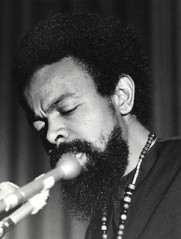
In a statement of poetics included in Donald Allen’s classic 1959 anthology The New American Poetry, Baraka (then Leroi Jones) asked: “HOW YOU SOUND??” How a poet’s poem sounded mattered most for him: “you have to start and finish there … your own voice … how you sound” (425). Primarily referencing the poem on the page, he wasn’t whistling in the dark: often thought of as a vocal performance of language, poetry has a long history with sound. One thread of this history is the Homeric tradition of an “oral poetics,” a tradition where, as Albert Lord notes in The Singer of Tales, socialized performances of poetry were simultaneously modes of composition. The feel of language in the body remained inseparable from the poetry that relayed the heroic tales of the ancient world. In The Sounds of Poetry, Robert Pinsky offers a similar account of sound and voice, suggesting that the “sound” of language, the sensuous play of speech, is the material for poetic composition. Or as Charles Bernstein has it in Close Listening, “poetry needs to be sounded” because it is a way to understand it better (7).
“Le Roi Jones” by Flickr user UIC Digital Collections, CC BY-NC-ND 2.0
Poetry is often said to be difficult—but how would a poet’s “sounding” of a poem help a listener better understand it, as Bernstein suggests? How is the recorded voice resonating in air different from inert marks on a page? What is the status of that difference? Why or how would the sound recording signify differently than the poem on the silent page? In short, is listening easier than reading? My answer to the final question is a resounding “no.” For me, the challenge is how to consider the recorded poetry performance in both formal and aural terms so as to remain tuned in to the aesthetic and the poetic as well as the social and historical dimensions of a particular poet’s work. This is not easily done.
“Black Dada Nihilismus” was first published in The Dead Lecturer (1964) and later included in Transbluesency (1995). Written in two parts, it asserts a black aesthetic by critiquing the dominance of (white) light in Western art and suggesting a connection between this light, ethnic violence, and religious ideology. This is how the poem opens:
.Against what light
is false what breath
sucked, for deadness.
Murder, the cleansed
purpose, frail, against
God, if they bring him
Bleeding, I would not
forgive, or even call him
black dada nihilismus.
The protestant love, wide windows,
color blocked to Modrian, and the
ugly silent deaths of jews […]
(Transbluesency 97)
Through critique the poem develops the connections between aesthetics and racial dominance and violence. These connections take on different inflections in each recorded version of the poem, and with each inflection another aspect of them is amplified.
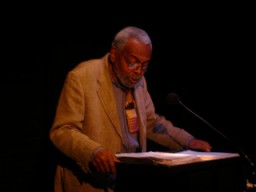
The first version is a bootleg of a reading at the Asilomar Negro Writers Conference that was held in Pacific Grove, California, in early August, 1964.
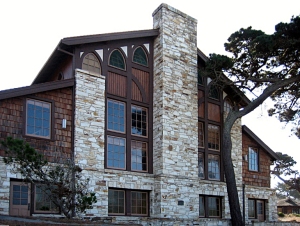
Asilomar Conference Grounds, site of 1964 Negro Writers Conference
In addition to the preamble, where Baraka explains some of the poem’s key terms such as Dada, which he describes as a movement in France (rather than Germany or Switzerland), another sonic detail that marks this as “live” is at the 2:59 minute mark when we hear the flap of a turning page, reminding us that Baraka is treating the poem as a script in these recordings. In this version, the opening lines are sharply delivered, the voice fully pausing at the linebreaks and acutely pronouncing the hard vowels (e.g. “sucked”). Against the continuous background hush of the original reel-to-reel recording, Baraka punches his words into the air, as if trying to find a rhythm between these harder vowels and the softer ones that often denote the poem’s object of critique (e.g. “light”).
The next version is off the A side of New York Art Quartet and Imamu Amiri Baraka (ESP Disk 1965), where the poem’s rhythm is immediately established by the musical accompaniment.
Between the first recording and this one a shift began in Baraka’s development as a poet. The assassination of Malcolm X pushed him to think even more about race, politics, and art. In this version the opening lines, delivered with punch and pause in the bootleg, take on a different register when juxtaposed with the smooth coolness of the quartet. Overall, though, the poem is delivered more militantly here. In the first version the opening lines are delivered forcefully, but ultimately this forcefulness subsides over the course of the reading. The opposite is the case in this studio version that slowly builds to the apex of the poem, the point of most force, this stanza:
Black scream
and chant, scream,
and dull, un
earthly
hollering.
(Transbluesency 99)
In the bootleg, the turn of the page—between “earthly” and “hollering”—interrupts this stanza, and Baraka hesitates and slowly finds his way toward the poem’s close, while in the studio version, the musical accompaniment reaches a fevered pitch here, making it feel as if it is at the edge of the scream that it names. This prepares us for the closing litany of names of black figures of “black dada nihilismus,” which goes like this:
For tambo, willie best, dubois, patrice, mantan, the
bronze buckaroos.
For Jack Johnson, asbestos, tonto, buckwheat,
billie holiday.
(Ibid.)
In the final version, which is DJ Spooky’s remix of the second one, included on the CD Offbeat: A Red Hot Soundtrip (TVT Records 1996), this litany feels more like the outro (that is meant as) against Spooky’s beats and moody reverb.
An aspect of the poem amplified in the remix is the stanzas leading up to the apex stanza of the “black scream.” In a series of tercets that open the second section, the speaker addresses the experience of racial oppression and a growing need to strike back:
The razor. Our flail against them, why
you carry knives? Or brutaled lumps of
heart? Why you stay, where they can
reach? Why you sit, or stand, or walk
in this place, a window on a dark
warehouse […]
(Transbluesency 98)
The “why” is significantly amplified in the remix, forcing us to hear the ironic indictment of the oppressive “light,” not as audible in the other two tracks, explicit in Baraka’s tercets.
“IMG_0433″ by Flickr user Beyond Baroque, CC-BY-NC-SA-2.0
The original recordings of these versions of “Black Dada Nihilismus” are each in a different format: vinyl LP, tape-to-tape reel, and CD. I have been working with digitized versions, so the way I am hearing these recordings—through a smooth digitized MP3 file or Youtube clip—is not the same as the crackle of a needle running an LP’s groove or a nearly noiseless laser tracing a CD. These variations in format mean that the different ways these versions individual signify—their respective “sounds”—are flattened out by compression. Despite this loss of material context, Baraka still sounds different in each of these tracks. Each version of Baraka’s poem offers us another iteration of his “voice,” and the poem, but listening to each of them does not necessarily provide a better understanding of it. We are, though, given different sonic experiences that depend upon the purpose of Baraka’s performance, the listener imagined during the reading, and the voice enunciated through the mediated environment.
Some of the voice details do remain consistent across these recordings. For example, the delivery of one of the poem’s most memorable phrase—“Hermes, the/the blacker art”—that occurs toward the close of the poem’s first section is steadily delivered in a lower register, in the hush of an aside, and might be taken as the motif of each of these variations.
“Stage Microphone TTV” by Flickr user Keith Bloomfield, CC-BY-NC-ND-2.0
A vast archive of recorded poetry exists. Mid-century recording projects by Caedmon and Folkways made “voices” of well-known poets, such as Robert Frost and Dylan Thomas, available for mainstream consumption. More recent anthologies and series like Poetry Speaks and The Voice of the Poet suggest that the “voice of the poet” still holds appeal. The proliferation of online sound archives such as Penn Sound and From the Fishouse further attest to an ongoing investment in recording, storing, and making available sound files of poets reading their work. And this fascination with the “sound” of poetry is not limited to mainstream cultural spheres or web-based archives. Several scholarly collections on this convergence of sound, voice, and poetry such as Bernstein’s already-mentioned Close Listening, Adelaide Morris’s Sound States, and Marjorie Perloff’s and Craig Dworkin’s The Sound of Poetry/The Poetry of Sound have appeared over the last decade.
The idea of the sound of the poem, located in the mediated voice of the poet, therefore remains relevant today. In many of these instances, however, the poet’s voice falsely takes on an authoritative “aura,” as Walter Benjamin used that word in his (recently re-translated) “The Work of Art in the Age of Its Technological Reproducibility.” Benjamin uses “aura” to talk about authenticity in art and how that is lost when images (or sounds) can be reproduced and widely distributed, and this is not a bad thing: “technological reproducibility emancipates the work of art from its parasitic subservience to ritual. To an ever-increasing degree, the work produced becomes the reproduction of work designed to be reproduced” (24). When Benjamin’s concept is applied to recorded poetry, two key points emerge. First, the “sound” of a poet’s voice is the product of technological conditions. Second, just as a book editor makes aesthetic judgments based on a perceived audience, a listener is imagined when a poetry performance is recorded. Too bad I didn’t know this in high school.
“A Poem for Speculative Hipsters by Amiri Baraka” by Flickr user Shawn Calhoun, CC-BY-NC-2.0
—
Featured image: “Paula Varjack” by Flickr user Very Quiet, CC-BY-SA-2.0
—
John Hyland recently completed his dissertation on sound, poetics, and the black diaspora, titled “Atlantic Reverberations: The Sonic Performances of Black Diasporic Poetries,” at the University at Buffalo, SUNY. His poems, essays, and reviews have appeared (or are forthcoming) in a range of journals, such as The Journal of Postcolonial Writing, College Literature, and Borderlands. Recently, he has enjoyed performing with the Buffalo Poets Theater and co-edited a special issue of the poetry journal kadar koli on the relationship between violence and the expressive arts.
—
 REWIND! . . .If you liked this post, you may also dig:
Hearing the Tenor of the Vendler/Dove Conversation: Race, Listening, and the “Noise” of Texts-Christina Sharpe
Pretty, Fast, and Loud: The Audible Ali–Tara Betts
The Sounds of Anti-Anti-Essentialism: Listening to Black Consciousness in the Classroom-Carter Mathes
Share this:


Current Top Posts





April 2021

January 2020

November 2019

October 2019

August 2019

April 2014

November 2017

March 2015

December 2017

October 2015
 Sounding Out!
Recent Comments