
The Eldritch Voice: H. P. Lovecraft’s Weird Phonography

 Welcome to the last installment of Sonic Shadows, Sounding Out!’s limited series pursuing the question of what it means to have a voice. In the most recent post, Dominic Pettman encountered several traumatized birds who acoustically and uncannily mirror the human, a feedback loop that composes what he called “the creaturely voice.” This week, James Steintrager investigates the strange meaning of a “metallic” voice in the stories of H.P. Lovecraft, showing how early sound recording technology exposed an alien potential lingering within the human voice. This alien voice – between human and machine – was fodder for techniques of defamiliarizing the world of the reader.
— Guest Editor Julie Beth Napolin
—
A decade after finding itself downsized to a dwarf planet, Pluto has managed to spark wonder in the summer of 2015 as pictures of its remarkable surface features and those of its moon are delivered to us by NASA’s New Horizons space probe. As scientists begin to tentatively name these features, they have drawn from speculative fiction for what they see on the moon Charon, giving craters names including Spock, Sulu, Uhuru, and—mixing franchises—Skywalker . From Doctor Who there will be a Tardis Chasma and a Gallifrey Macula. Pluto’s features stretch back a bit further, where there will also be a Cthulhu Regio, named after the unspeakable interstellar monster-cum-god invented by H. P. Lovecraft.
We can imagine that Lovecraft would have been thrilled, since back when Pluto was first discovered in early 1930 and was the evocative edge of the solar system, he had turned the planet into the putative home of secretive alien visitors to Earth in his short story “The Whisperer in Darkness.” First published in the pulp magazine Weird Tales in 1931, “The Whisperer in Darkness” features various media of communication—telegraphs, telephones, photographs, and newspapers—as well as the possibilities of their manipulation and misconstruing. The phonograph, however, plays the starring role in this tale about gathering and interpreting the eerie and otherworldly—the eldritch, in a word—signs of possible alien presence in backwoods Vermont.
In the story, Akeley, a farmer with a degree of erudition and curiosity, captures something strange on a record. This something, when played back by the protagonist Wilmarth, a folklorist at Lovecraft’s fictional Miskatonic University, goes like this:
Iä! Shub-Niggurath! The Black Goat of the Woods with a Thousand Young! (219)
The sinister resonance of a racial epithet in what appears to be a foreign or truly alien tongue notwithstanding, this story features none of the more obvious and problematic invocations of race and ethnicity—the primitive rituals in the swamps of Louisiana of “The Call of Cthulhu” or the anti-Catholic immigrant panic of “The Horror at Red Hook”—for which Lovecraft has achieved a degree of infamy. Moreover, the understandable concern with Lovecraft’s social Darwinism and bad biology in some ways tends to miss how for the author—and for us as well—power and otherness are bound up with technology.
 The transcription of these exclamations, recorded on a “blasphemous waxen cylinder,” is prefaced with an emphatic remark about their sonic character: “A BUZZING IMITATION OF HUMAN SPEECH” (219-220). The captured voice is further described as an “accursed buzzing which had no likeness to humanity despite the human words which it uttered in good English grammar and a scholarly accent” (218). It is glossed yet again as a “fiendish buzzing… like the drone of some loathsome, gigantic insect ponderously shaped into the articulate speech of an alien species” (220). If such a creature tried to utter our tongue and to do so in our manner—both of which would be alien to it—surely we might expect an indication of the difference in vocal apparatuses: a revelatory buzzing. Lovecraft’s story figures this “eldritch sound” as it is transduced through the corporeal: as the timbral indication of something off when the human voice is embodied in a fundamentally different sort of being. It is the sound that happens when a fungoid creature from Yuggoth—the supposedly native term for Pluto—speaks our tongue with its insectile mouthparts.
Yet, reading historically, we might understand this transduction as the sound of technical mediation itself: the brazen buzz of phonography, overlaying and, in a sense, inhabiting the human voice.
For listeners to early phonographic recordings, metallic sounds—inevitable given the materials used for styluses, tone arms, diaphragms, amplifying horns—were simply part of the experience. Far from capturing “the unimaginable real” or registering “acoustic events as such,” as media theorist Friedrich Kittler once put the case about Edison’s invention, which debuted in 1877, phonography was not only technically incapable of recording anything like an ambient soundscape but also drew attention to the very noise of itself (23).
For the first several decades of the medium’s existence, patent registers and admen’s pitches show that clean capture and reproduction were elusive rather than given. An account in the Literary Digest Advertiser of Valdemar Poulsen’s Telegraphone, explains the problem:
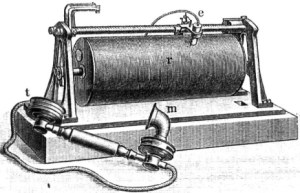 The talking-machine records sound by the action of a steel point upon some yielding substance like wax, and reproduces it by practically reversing the operation. The making of the record itself is accompanied by a necessary but disagreeably mechanical noise—that dominating drone—that ‘b-r-r-r-r’ that is never in the human voice, and always in its mechanical imitations. One hears metallic sounds from a brazen throat—uncanny and inhuman. The brittle cylinder drops on the floor, breaks—and the neighbors rejoice!
The Telegraphone, which recorded sounds “upon imperishable steel through the intangible but potent force of electromagnetism” such that no “foreign or mechanical noise is heard or is possible,” of course promised to make the neighbors happy not by breaking the cylinder but rather by taking the inhuman ‘b-r-r-r-r’ out of the phonographically reproduced voice. Nonetheless, etching sound on steel, the Telegraphone was still a metal machine and unlikely to overcome the buzz entirely.
In his account of “weird stories” and why the genre suited him best, Lovecraft explained that one of his “strongest and most persistent wishes” was “to achieve, momentarily, the illusion of some strange suspension or violation of the galling limitations of time, space, and natural law which forever imprison us and frustrate our curiosity about the infinite cosmic spaces beyond the radius of our sight and analysis.” In “The Whisperer in Darkness,” Lovecraft put to work a technology that was rapidly becoming commonplace to introduce a buzz into the fabric of the everyday. This is the eldritch effect of Lovecraft’s evocation of phonography. While we might wonder whether a photograph has been tampered with, who really sent a telegram, or with whom we are actually speaking over a telephone line—all examples from Lovecraft’s tale—the central, repeated conundrums for the scholar Wilmarth remain not only whose voice is captured on the recorded cylinder but also why it sounds that way.
 The phonograph transforms the human voice, engineers a cosmic transduction, suggesting that within our quotidian reality something strange might lurk. This juxtaposition and interplay of the increasingly ordinary and the eldritch is also glimpsed in an account of Charles Parson’s invention the Auxetophone, which used a column of pressurized air rather than the usual metallic diaphragm. Here is an account of the voice of the Auxetophone from the “Matters Musical” column of The Bystander Magazine from 1905: “Long ago reconciled to the weird workings of the phonograph, we had come to regard as inevitable the metallic nature of its inhuman voice.” The new invention might well upset our listening habits, for Mr. Parson’s invention “bids fair to modify, if not entirely to remove,” the phonograph’s “somewhat unpleasant timbre.”
What the phonograph does as a medium is to make weird. And what making weird means is that instead of merely reproducing the human voice—let alone rendering acoustic events as such—it transforms the latter into its own: an uncanny approximation, which fails to simulate perfectly with regard to timbre in particular. Phonography reveals that the materials of reproduction are not vocal chords, breath, labial and dental friction—not flesh and spirit, but vibrating metal.
Although we can only speculate in this regard, I would suggest that “The Whisperer in Darkness” was weirder for readers for whom phonographs still spoke with metallic timbre. The rasping whisper of the needle on cylinder created what the Russian Formalist Viktor Shklovsky was formulating at almost exactly the same time as the function of the literary tout court: defamiliarization or, better, estrangement. Nonetheless, leading the reader to infer an alien presence behind this voice was equally necessary for the effect. After all, if we are to take the Auxetophone as our example—an apparatus announced in 1905, a quarter of a decade before Lovecraft composed his tale, and that joined a marketplace burgeoning with metallic-voice reducing cabinets, styluses, dampers, and other devices—phonographic listeners had long since become habituated to the inhumanity of the medium. That inhumanity had to be recalled and reactivated in the context of Lovecraft’s story.
 To understand fully the nature of this reactivation, moreover, we need to know precisely what Lovecraft’s evocative phonograph was. When Akeley takes his phonograph into the woods, he adds that he brought “a dictaphone attachment and a wax blank” (209). Further, to play back the recording, Wilmarth must borrow the “commercial machine” from the college administration (217). The device most consistent with Lovecraft’s descriptions and terms is not a record player, as we might imagine, but Columbia Gramophone Company’s Dictaphone. By the time of the story’s setting, Edison Phonograph’s had long since switched to more durable celluloid cylinders (Blue Amberol Records; 1912-1929) in an effort to stave off competition from flat records. Only Dictaphones, aimed at businessmen rather than leisure listeners, still used wax cylinders, since recordings could be scraped off and the cylinder reused. The vinyl Dictabelt, which eventually replaced them, would not arrive until 1947.
Meanwhile, precisely when the events depicted in “The Whisperer in Darkness” are supposed to have taken place, phonography was experiencing a revolutionary transformation: electronic sound technologies developed by radio engineers were hybridizing the acoustic machines, and electro-acoustic phonographs were in fact becoming less metallic in tone. Yet circa 1930, as the buzz slipped toward silence, phonography was still the best means of figuring the sonic uncanny valley. It was a sort of return of the technologically repressed: a reminder of the original eeriness of sound reproduction—recalled from childhood or perhaps parental folklore—at the very moment that new technologies promised to hide such inhumanity from sensory perception. Crucially, in Lovecraft’s tale, estrangement is not merely a literary effect. Rather, the eldritch is what happens when the printed word at a given moment of technological history calls up and calls upon other media of communication, phonography not the least.
I have remarked the apparent absence of race as a concern in “The Whisperer in Darkness,” but something along the lines of class is subtly but insistently at work in the tale. The academic Wilmarth and his erudite interlocutor Akeley are set in contrast with the benighted, uncomprehending agrarians of rural Vermont. Both men also display a horrified fascination with the alien technology that will allow human brains to be fitted into hearing, seeing, and speaking machines for transportation to Yuggoth. These machines are compared to phonographs: cylinders for storing brains much like those for storing the human voice. In this regard, the fungoid creatures resemble not so much bourgeois users or consumers of technology as scientists and engineers. Moreover, they do so just as a discourse of technocracy—rule by a technologically savvy elite—was being articulated in the United States. Here we might see the discovery of Pluto as a pretext for exploring anxieties closer to home: how new technologies were redistributing power, how their improvement—the fading of the telltale buzz—was making it more difficult to determine where humanity stopped and technology began, and whether acquiescence in this changes was laudable or resistance feasible. As usual with Lovecraft, these topics are handled with disconcerting ambivalence.
—
James A. Steintrager is a professor of English, Comparative Literature, and European Languages and Studies at the University of California, Irvine. He writes on a variety of topics, including libertinism, world cinema, and auditory cultures. His translation of and introduction to Michel Chion’s Sound: An Acoulogical Treatise will be published by Duke University Press in fall of 2015.
—
Featured image: Taken from “Global Mosaic of Pluto in True Color” in NASA’s New Horizons Image Gallery, public domain. All other images courtesy of the author.
—
 REWIND! . . .If you liked this post, you may also dig:
Sound and Sanity: Rallying Against “The Voice” — Mark Brantner
DIANE… The Personal Voice Recorder in Twin Peaks — Tom McEnaney
Reproducing Traces of War: Listening to Gas Shell Bombardment, 1918 — Brían Hanrahan
Share this:

Deaf Latin@ Performance: Listening with the Third Ear

 This is the fourth and final post in Sounding Out!’s 4th annual July forum on listening in observation of World Listening Day on July 18th, 2015. World Listening Day is a time to think about the impacts we have on our auditory environments and, in turn, their effects on us. For Sounding Out! World Listening Day necessitates discussions of the politics of listening and listening, and, as Trevor Boffone prescribes, a much wider and more corporeal understanding of the practice that goes beyond an emphasis on the ear and even on sound itself. –Editor-in-Chief JS
—
As Kent, a Deaf man, stands on stage in Tamales de Puerco, signing his story of struggling and growing up in a hearing family, the only aural sounds in the theater come from the audience: the sounds of crying. Performed in English, Spanish, and American Sign Language (ASL), Tamales offers a glimpse into the seldom seen realities of life as a single mother to a Deaf child as it intersects with Latinidad. The play presents the story of Norma, a young mother who confronts her abusive husband and challenges a country that rejects and oppresses her as an undocumented immigrant. She overcomes the hardships of being Latina, undocumented, and having a Deaf child (Mauricio) without any support from her husband, her mother, and local and state institutions. Ultimately, Norma must negotiate cultural citizenship and notions of belonging to the Deaf Latin@ community so that her son can have more opportunities. The play uses—and calls attention to—silence as an essential building block in the process of constructing, remixing, and performing the complexities of Latin@ identity.

Listening to the silences in Latin@ theatre performance offers crucial insight into how the Latin@ population and Latinidad fit into the fabric of the United States in the 21st Century, as Marci R. McMahon notes in “Soundscapes of Narco Silence.” In Tamales, the staging of Deafness creates a particular kind of silence that promotes new listening strategies. What I find most compelling is how Deafness on stage–and the particular silences Deafness can create–opens up a space for what Steph Ceraso calls “multimodal listening,” listening as a full-bodied event not solely linked to the ears, but rather connected to “bodies, affects, behaviors, design, space, and aesthetics.” Calling attention to the body as it does, the silences in the play give weight to Kent’s story and affects the viewer beyond the limits of voiced acting by encouraging spectators to concentrate on the actors’ physical emotions and how actors’ bodies work to transmit messages without verbal cues. I argue Tamales promotes multimodal listening by forcing spectators to use their “Third Ear”—a mode of listening across domains of silence, sound, and the moving body—as a device to understand a seemingly silent world.
To do this, I engage with the playscript and recordings of the 2013 production of Mercedes Floresislas’s Tamales de Puerco at CASA 0101 Theater under Edward Padilla’s direction. While Floresislas’s script raised many complex issues surrounding the Deaf Latin@ community, Padilla’s staging focused on the intersections of Deafness and Latinidad by foregrounding the use of silence in the production. [Note: I use the capitalized versions of Deaf and Deafness. A standard dictionary definition of “deaf” represents one who is partially or unable to hear (deaf and hearing impaired are essentially interchangeable). Deaf with a capital D, however, refers to the community that self-identifies as belonging to the Deaf culture. Deafness, therefore, is a sign of health and prognosis of well-being among sign language dependent hearing-impaired people. Likewise, hearing versus Hearing represents a similar biological/cultural binary.]
In Hearing Difference: The Third Ear in Experimental, Deaf, and Multicultural Theater, one of the few studies to devote critical attention to Deaf theater as it relates to multicultural experience and identity, Kanta Kochhar-Lindgren introduces the “Third Ear,” a useful term that facilitates focusing one’s attention on the performative forms of expression. Blending sensory, spatial, and visual elements generates a Third Ear that acts as a “Deaf-gain,” a hybrid mode of hearing and coming to know the world. When specific senses are lost, the mind becomes dynamic in such a way that continues to allow affected individuals to actively engage with their surroundings, with their community. Deaf people, therefore, do not lack a vital sense, but rather they gain a new sense—one typically inaccessible to hearing individuals– that enables them to successfully navigate their surroundings. Kochhar-Lindgren’s work focuses attention on the “sense” of performance and the different movements that work together to form speech sensed by the “Third Ear.” For audience members, learning to perceive the mixing of forms together as communication is fundamental to understanding the messages presented on stage; inevitably, the Third Ear promotes auditory silence yet it establishes that a lack of sound does not necessarily correspond with a lack of understanding. By removing all sound, silence gains power.

The evocation of the Third Ear separates Tamales from the majority of Latin@ theater productions grounded in aural languages such as English, Spanish, and Spanglish. Deafness is seldom represented onstage in any type of theater, aside from revivals of William Gibson’s The Miracle Worker and Mark Medoff’s Children of a Lesser God, more contemporary works such as Suzan Zeder’s Ware Trilogy and Bruce Norris’s Clybourne Park, and the work of Deaf West Theatre in Hollywood, whose most recent production, Spring Awakening received rave reviews and will move Broadway in September 2015. The work of Deaf West has been of particular interest to Sound Studies scholars for its unique contributions to the American Theatre. In Cara Cardinale’s 2012 SO! post, she discusses Deaf West’s production of Tennessee Williams’ A Streetcar Named Desire in which the roles were reversed. The production’s interpreters were for the hearing audience and, thus, sign language took center stage. Yet, all of these more well-known works focus on Anglo experiences, neglecting the specific intersectional challenges that Deaf people of color face such as limited access to state-funded resources such as counseling services, educational inequality and the achievement gap, not to mention that the majority of Deaf Latin@s do not have parents who can sign with them (re: effectively communicate).
The Third Ear, as evoked in Tamales, seems especially suited for representing Latin@ Deafness onstage and evoking a concomitant visceral understanding in audiences. Floresislas’s writing and Padilla’s direction work together to strategically allow audience members to develop a Third Ear at key moments in the play, enabling them to fill silences they might have otherwise perceived as gaps. Entering Tamales’ silent world not only compels hearing audiences to recognize their supposed privilege, but pushes toward a deeper understanding of the relativity of hearing-as-privilege. In a Deaf world, hearing is not a privilege, but rather one of many ways to come to know the world. In this regard, Tamales reiterates Liana Silva’s argument that “deafness complicates what it means to listen” by calling attention to the many non-auditory signals that are vital to the act.
 In addition, Tamales deliberately fosters moments of uncomfortable silences that are one of the production’s strengths. For example, silence plays a key role in an early scene in which Norma decides to leave her abusive husband, Reynaldo. In this violent episode–either by a deafening blow or disassociation–everything in her world goes silent. While Reynaldo yells at her and throws things around the house, his voice fades out. However, as Norma sits in silence, she becomes better able to navigate her abusive marriage. Norma hears the silence. Her hypervigilance increases her ability to identify potential threat(s) and, ultimately, she takes her son and flees from the situation. While Norma taps into her Third Ear on stage, the audience also enters a silent world in which they must seek alternative methods to actively engage with the production. By “losing” their hearing along with Norma, the audience must pay a different kind of attention to her to gain an understanding of the scene.
Along with recognizing certain hearing privileges, listening with the Third Ear both connects and separates the audience. For instance, in the scene in which Norma attends an AA meeting for Deaf people, Padilla’s direction activates the Third Ear by removing sound from the stage. In the original playscript, Floresislas wanted Kent’s monologue to include a voice-over, but during rehearsals, Padilla saw the potential to foreground the silence in this scene (and throughout the piece, as well); his direction transformed the staging from an aural scene to a silent one. Listening with the Third Ear enables the audience to blend sensory and visual hearing in order to understand the emotional depth of the action transpiring on stage. As Kent stands in silence, signing his story about the difficulties of connecting with his hearing father, many in the audience were audibly moved. During Kent’s monologue, the actor remained silent while supertitles revealed his speech:
Yesterday, my father had a heart attack and I got called to his bedside at the hospital. I had not seen him for almost 15 years! I had never had a conversation with my father; yes, he was hearing and I was his only deaf child. (…) I always believed by dad hated me; nothing I did was ever good enough. He was always watching me and looking angry for everything I ever did or asked. I actually wished he’d ignore me like the rest of the family! (15)

Particularly gripping, this scene acts as a crucial building block in the necessity of creating opportunities for her son that drives Norma’s story forward, not to mention that it calls attention to the fact that reading isn’t necessarily a silent act. Kent’s story reveals much to a hearing audience who may be unfamiliar with the Deaf Latin@ community. Kent’s experience is typical of Deaf Latin@s, only 20% of whom have parents that can sign. It compels an understanding of the reasons why Norma learns ASL and pushes for a better life for her son. She does not want him to be in the same position that Kent finds himself in. And, she does not want to have the regret of having never learned to communicate with him. Kent continues:
Yesterday, he looked frail; he was paralyzed on one side. When he saw me, he moved his hand like this (brushes his left hand up the center of his chest then points at). At first, I didn’t understand what he was doing. But when he did it again, I understood. He said, “I’m proud of you.” Then he signed “I love you.” (…) My niece told me he had been learning ASL for the last 3 months because he wanted to tell me how sorry he was for not being able to talk to me. My dad didn’t hate me; he hated himself for not being able to talk to me! (…) But yesterday, I also had my first and last conversation with my dad he signed for me! That…makes me feel very proud! (15-16)
As Kent stands in silence, his emotional journey is given life through his hands and body. Interestingly, the silences enacted onstage by Tamales actually create sound, amplifying the sobbing that emanates from the audience in both its auditory and visual manifestations. The way in which silence allows the audiences’ sonic reactions to become part of the play itself suggests that how—and why–the audience responds may actually be more important than the performance itself. How much are the sobs about the heartbreaking nature of Kent’s story and how much of it is recognizing one’s own privileges? How much of it is the audience connecting with the story? How much of it is about seeing themselves represented? And how does silence amplify “listening” to Kent’s story?
.

.
While not exhaustive, my reading of Tamales widens the conversation about the intricacies of Deaf Latin@ performance. The 2013 production of Tamales best hints at the possibilities of Latin@ performance in Boyle Heights and how community-based theater companies such as CASA 0101 can work to provide more access to Deaf people, thus forging both an inclusive community and theater company. More plays featuring Deaf characters, incorporating Deaf actors, and Deaf dramatists are needed, something Floresislas is already exploring. Still, much research remains as to how Deaf Latinidad is heard and how this identity fits into a performance framework. Through multimodal listening, Tamales urges spectators to leave the theater considering how they may or may not alter their actions to better benefit underprivileged and underrepresented communities such as the Latin@ Deaf community. Quite frankly, Tamales opens the “eyes and ears” of audiences. Now is the time to listen to Deaf Latinidad. What will we choose to hear in the silence?
—
Still Images from Tamales de Puerco, permission courtesy of CASA 0101 Theatre. Featured Image: Olin Tonatiuh and Cristal Gonzalez in “Tamales De Puerco.” Photo by Ed Krieger.
—
Trevor Boffone is a Houston-based scholar, educator, dramaturge, and producer. He is a co-founder of Amaranto Productions and a member of the Latina/o Theatre Commons Steering Committee. Trevor is a doctoral candidate in the Department of Hispanic Studies at the University of Houston where he holds a Graduate Certificate in Women’s, Gender, & Sexuality Studies. His dissertation, Performing Eastside Latinidad: Josefina López and Theater for Social Change in Boyle Heights, is a study of theater and performance in East Los Angeles, focusing primarily on Josefina López’s role as a playwright, mentor, and community leader. He has published and presented original research on Chicana Feminist Teatro, the body in performance, Deaf Latinidad, Queer Latinidad, as well as the theater of Adelina Anthony, Nilo Cruz, Virginia Grise, Josefina López, Cherríe Moraga, Monica Palacios, and Carmen Peláez. Trevor recently served as a Research Fellow at LLILAS Benson Latin American Studies and Collections at the University of Texas at Austin for his project Bridging Women in Mexican-American Theater from Villalongín to Tafolla (1848-2014).
Share this:


Current Top Posts





April 2021

January 2020

November 2019

October 2019

August 2019

April 2014

November 2017

March 2015

December 2017

October 2015
 Sounding Out!
Recent Comments