
“In My Life”: Loving Queerly and Singing Across Generations

December 1975.
The cold winds staked their claim over Toronto, where my parents had recently arrived from the Philippines. They were underdressed and making their way down Parliament Street. Despite being warned of a shift in temperature, they were not expecting the brutal intensities of Canadian winter. I’m not sure how anyone anticipates the sharp sting of negative temperatures when they are arrivants used to tropical climates. Undeterred, my mother and father headed to a small Filipino grocer, hoping to encounter a semblance of domestic familiarity. Pressed against the biting winds, my mother abruptly stopped, looked at my father and said, “Tumutolo ang sipon” – you have a runny nose. To which my father replied, “Ikaw din” – you do too! They both started laughing and laughed again when they retold me this story 48 years later. When faced with the challenges of migrating to a new and very cold country, they managed to mine humour from a deep well of difficult circumstances. We had been listening to the song “In My Life” by the Beatles (Lennon & McCartney 1965). Something in its expression, melody, and feeling caused my parents to be transported to this small but important moment.
In her conversation with Christine Bacareza Balance, “‘Revolutions in Sound’: Keynote Duet” (2022) Alexandra T. Vazquez writes: “The popular…leaves so much room for engagement with sound artists (musicians without the gallery). None of them need theorists to argue for them, to argue for their mattering because to so many, they already do. How do they instead invite theorists to take part in something alongside them?” (12). I was never a big fan of the Beatles, but regardless of my opinions, they were popular. As a relentlessly oppositional teenager, I was put off by their mass popularity. As Vazquez suggests, despite one’s musical taste, songs are invitations, not scholarly conquests. The memory re-opened by my parents’ connection to “In My Life” was an invitation for me to take stock of the song’s affective and, for them, diasporic trajectories. As Balance (2022) suggests songs request us to “listen long so we hear where another is coming from” (15). For her, “long” describes temporality and commitment. To “listen long” implies that duration and attention are the pretext for empathic relations.
“In My Life” was released in 1965. My mother was fifteen years old when she first heard the song on the radio in a boarding house in Marbel, Philippines. One year later, on July 16, 1966 the Philippine Free Press would announce, “The Beatles Are Coming” (de Manila as cited by Robert Nery in “The Hero Takes a Walk” 2018). At that time, Ferdinand Marcos was the newly elected president of the Philippines, and Imelda Marcos was his First Lady. The Marcoses would later unleash an era of violent dictatorial power and impose Martial Law in 1972, escalating political suppression (Burns 2013). My mother recalls that the band’s first and only appearance in the Philippines was remembered by many less for their two scheduled concerts and more for their “snub” of Imelda. The Beatles were noticeably absent at a lunch reception they were expected to attend with the First Lady at the Presidential Palace. Their absence, attributed to a communication error between the concert promoter and the band’s manager, incited public disapproval and resulted in the sudden disappearance of their security escort and hotel and porter service. Unlike in other cities, the band was refused room service and was forced to carry their own luggage (Nery 2018).
What is striking about this moment is that it breaks from preoccupations with Filipinx desires for assimilation and mimicry of Western imperial projects. In Video Night in Kathmandu and Other Reports from the Not-So-Far East, British travel writer Pico Iyer (1988) famously stated that Filipinx people are the “[m]aster of every American gesture, conversant with every western song…the Filipino plays minstrel to the entire continent (153)” Turning against imperial scripts and the band’s documented disdain of “Mosquito City” and even worse, John Lennon’s comment that a return to the Philippines would require “an H-bomb,” the soured residues of their visit marks a queer rupture in Beatlemania. The public decried that Filipinx people deserved better from the band, capturing what Balance describes in Tropical Renditions: Making Musical Scenes in Filipino America (2016), as “disobedience” in that “disavows a belief in the promises of assimilation” (5). For me, Filipinx non-compliance textures the sonic substance of “In My Life.” While the shadow of the Marcoses cronyism and corruption is an inescapable footnote, it is the defiant voices of hotel employees, dismayed fans, and airport workers that insisted on the “ordinariness” (Wofner & Smeaton, 2003) of the Beatles that holds the song’s queer decibels.

There are places I’ll remember all my life, though some have changed. Some forever, not for better. Some have gone, and some remain.
“In My Life” (Lennon & McCartney 1965).
January 2018.
I am sitting on my couch watching a Toronto Raptors game. The television emits light that flickers through a large window that frames a bright winter moon. I am 41 weeks pregnant at this point (feeling similarly shaped and sized as the moon outside). My stubborn queer resistance to the Beatles somehow dissipated during my pregnancy, and the song “In My Life” made its way to me. I would quietly sing the song to my pregnant belly. Then, that January night, I felt a snap inside my body and a rush of water down my legs. I won’t go into much gratuitous detail other than to say that at 12:49 pm the next day, Asa Cy Dyer-Mecija was born at home.
And these memories lose their meaning when I think of love as something new.
“In My Life” (Lennon & McCartney 1965)
Sometimes, I needed to couch the queerness of pregnancy in words that were not mine. The distance between these words and the ones I had yet to find would help to structure my unfolding love for Asa. Here, queerness presented a modality of encounter with uncensored desires. Queerness is often theorized as a utopian impulse; the queerness of my pregnancy jostled both the hopes and fears brought up by the unknown terrain of parenting amidst heteronormativity. For me, “In My Life” is riven by sentimentality and nostalgia, but it also gave melody to a tender relationship with myself and my new role in the world. This was the sonic throughline to my parents, a queer inheritance of tension made from the hopes for kinder contexts amidst the limitations of harsh realities.

December 2022.
I was invited to perform as part of the Queer Songbook Orchestra’s holiday fundraiser. The Queer Songbook Orchestra is a chamber pop ensemble that hosts an annual concert focused on songs and stories about “chosen family and queer joy” (Queer Songbook n.d.). At that time, Asa was four years old. He is a child of the pandemic. He’s a kid with two moms, a present and kind donor, and is dearly loved by his Lolo and Lola, his grandparents, aunts, titas, uncles, cousins, kuya, ate, and his beautiful chosen family. My partner, Hannah, and I sometimes worry about how his world will be affected by reactions to the makeup of our family, but mostly, we know he’ll be sure he’s loved by many.
To me, the song “In My Life” offers a useful sonic response to homophobia. As a baby, after Asa’s baths, I would often wrap him in a towel, and while rocking him back and forth, I would sing these lyrics from the song: “Though I know I’ll never lose affection for people and things that went before, I know I’ll often stop and think about them. In my life, I love you more” (Lennon & McCartney 1965). To me, this statement is a queer ethos. We know that 2SLGBTQ+ people have necessarily and creatively reworked and reimagined the organization and expression of kinship. When family is so often bounded by what Julianne Pidduck calls “constraints of relationality” in “Queer Kinship and Ambivalence”(2008: 441), the lyrics “In my life, I love you more” are a call to action. More is a word used comparatively to insist that there is something greater, something more exists, something more is possible. I embrace the challenge to love more. My queerness urges me to love more, and parenting Asa does, too. On the evening of the performance, indexed by my parents’ struggles and our shared disdain for the chill of winter, Asa and I performed “In My Life” together. The video of our performance will remain a treasured sonic archive that I will return to often, and as Asa gets older, I hope it reminds him of how beautiful he’s always been.
—
Casey Mecija is an Assistant Professor in the Department of Communication & Media Studies at York University. Her current research examines sound as a mode of affective, psychic, and social representation, specifically in relation to diasporic experience. Drawing on sound studies, queer diaspora studies and Filipinx Studies, her research considers how sensorial encounters are enmeshed and disciplined by social and psychic conditions. In this work, she theorizes sounds made in and beyond Filipinx diaspora to make an argument about a “queer sound” that permeates diasporic sensibilities. She is also a musician and filmmaker whose work has received several accolades and has been presented internationally.
—

REWIND!…If you liked this post, you may also dig:
Blank Space and “Asymmetries of Childhood Innocence” –Casey Mecija
The Sound of What Becomes Possible: Language Politics and Jesse Chun’s 술래 SULLAE (2020) –Casey Mecija
The Cyborg’s Prosody, or Speech AI and the Displacement of Feeling–Dorothy Santos
Tape Hiss, Compression, and the Stubborn Materiality of Sonic Diaspora–Chris Chien
Xicanacimiento, Life-giving Sonics of Critical Consciousness—Esther Díaz Martín and Kristian E. Vasquez
Moonlight’s Orchestral Manoeuvers: A duet by Shakira Holt and Christopher Chien
Enacting Queer Listening, or When Anzaldúa Laughs–Maria Chaves Daza
Echoes in Transit: Loudly Waiting at the Paso del Norte Border Region—José Manuel Flores & Dolores Inés Casillas
The Queerness of Wham’s “Last Christmas”–Justin Burton
Could I Be Chicana Without Carlos Santana?–Wanda Alarcón
Share this:

The Idea (of an Idea) of North (Of the North): Glenn Gould’s Piece at 50

AMBIENCE
On December 28, 1967, the Canadian Broadcasting Corporation debuted a radio piece by famed pianist Glenn Gould, titled The Idea of North. Opaque yet spacious, this experiment would become the first in a trio of ambient documentaries to be produced over the next decade. Each episode explores the theme of solitude from a different geographical vantage, co-implicating form and content; for, as Gould demonstrates, telegraphy had long since complicated isolation as a lifestyle. But Gould’s obsessive pursuit of this ideal produces a multiperspectival portrait of settler consciousness, at the same time as it thematizes and intervenes in its medium as a technical means of colonial expansion.
With an ear to Europe, these radio pieces were assembled after the fashion of major postwar developments in tape music and collage. Stylistically, The Idea of North seems conspicuously stricken with an anxiety of influence befitting of an incipient nationalism; for it was clearly Gould’s intent to furnish his avant-garde composition a local character. As to whether Gould meant to modernize Canadian content, or to Canadianize modern form, his approach presumes ambiguity, to make strange a standard broadcast format. In Gould’s hourlong intervention, the soothing probity of the professional narrator’s voice is edged out by so much overlapping and uncertain talk. While certain formal precedents for this collaged approach de-emphasize semantics in favour of timbral and or ‘purely musical’ characteristics of source sounds, Gould’s regionalist reply preserves the referentiality of each sound as recorded; if only to sublate them altogether in a narrative tapestry.
Would it have been uncomfortable for general interest listeners—a postulate from which proceeds the mandate of national radio, but who actually identifies with this mean temperament?—to encounter The Idea of North in 1967? At the time of the original broadcast, it had been more than three years since Gould’s last public performance, during which hiatus he had come to champion recording as a frontier, commending radio to his purposes. But where these compositions are concerned, Gould’s method of assembly sought to bewilder certain basic expectations of the medium, and moreover, the idiom, of public radio. In North of Empire (2009), Jody Berland extols the eclectic texture of a favourite radio drama; yet even as she praises its narrator for imbuing each of his characters with individual depth, her attention, she tells us, remains fixed on a voice “replete with storytelling pleasures and the sonic signature of the CBC.” The voice of radio itself is most salient; a guarantor of sense and place.
THE UNSOLITARY SETTLER
Gould’s Solitude Trilogy evokes three differently isolated places; the Northern territories, a Newfoundland fishing village, and a Mennonite community on the prairies. The first-person accounts of each terrain that Gould collects are often contradictory, and left alone; for any commentary would thwart the sought-after intimacy of the vignette. Each is a sample—yet none an apt synecdoche—of a nebulous “Canadian” identity. For this reason, Mark Kingwell suggests in his biography of Gould (2009) that Gould’s evocation of the fugue is a red herring, for his radio works defy the expectation of resolution that defines the form. As Kingwell notes, Gould himself uses a critical alter-ego to offer that “the real counterpoint is ideological, between the exercise of individual freedom and the ‘tremendously tyrannical force’” of the social, which one must overcome in order to gain from solitude. (131)
The Idea of North enacts a tussle with a landscape too variously vast to be interiorized as home. This fact appears an obstacle to any attempt to forge or describe a monolithic Canadian identity; so it is encouraging that Kingwell finds in Gould’s radio work a not-so-covert theme of hospitality, an openness to the “novelty of the unknown person” thrust upon one in an unknown clime. Even so, the North, cast as a contiguous and unfathomable neighbour-threshold, exists for the southerner Gould “to dream about, to spin tall tales about, and in the end, avoid.” In this regard, a reactive refusal of hospitality is geographized so as to obscure the political stakes.
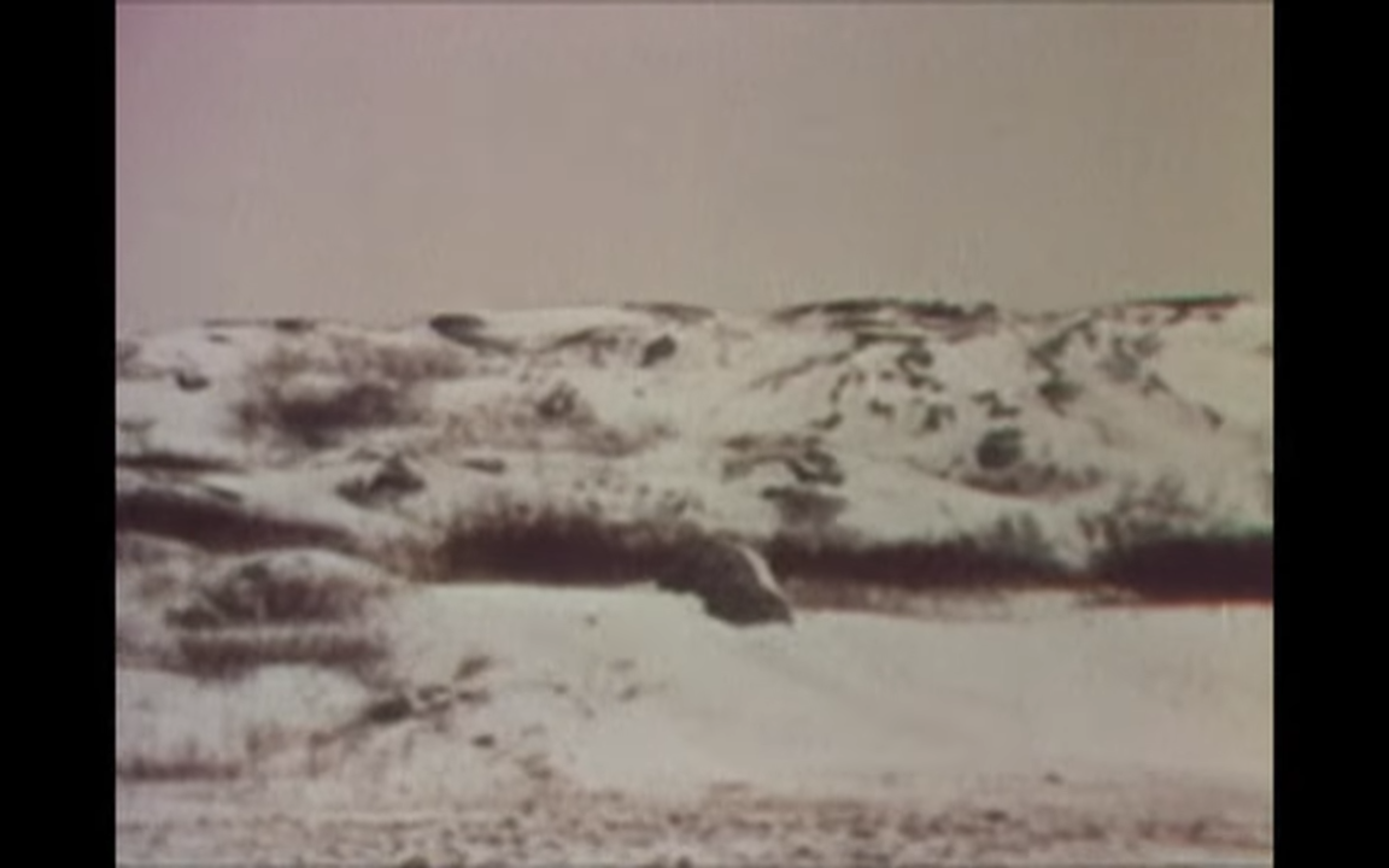
Screen Capture from the CBC television adaptation of The Idea of North
To rethink Canadian identity on the model of hospitality is to name an obvious standard by which to flunk the extant state. Following the work of Toula Nicolacopoulos and George Vassilacopoulos in Indigenous Sovereignty and the Being of the Occupier (2014), one might suggest that hospitality requires a frank response to the question “where do you come from?” Any such self-accounting is specifically repressed in the conscience of the settler, and the romantic conception of North America as a vast wilderness, untrammelled and unpeopled prior to European influence, is an outcome and requirement of this repression. It is possible, and moreover desirable, to think the contrapuntal weft of voices comprising Gould’s radio play as a practice of hospitality; but first one must acknowledge the degree to which, after the means of its realization, this open narrative remains a one-sided overture.
According to Avital Ronell’s The Telephone Book (1989), what operates behind the radio in its appeal to “a tremendous national ear” is an obscure sense of the absolute priority of the other to oneself. (21) As seen above, a latent dialogue haunts every monovocal broadcast. However, one should complicate the too-readily metaphysicalized trope of the other with reference to the specific preoccupancy of a specific space by specific people, rather than fetishize otherness as a philosophico-poetic model for the production of pleasurable moral quandaries. Gould’s radio play would suggest as much, if negatively.
COMPOSING THE NATION-STATE
The fascinating effect of radio, R. Murray Schafer observes in The Soundscape (1994), has to do with the manner in which “broadcasting is separated into independent information channels so that the confusion of simultaneity, so often present in the soundscape at large, is absent.” (234) This facilitates the “deliberate attempt to regulate the flow of information according to human responses and information-processing capabilities.” (ibid) In short, radio functions as a half-conversation, an analysis turned in on itself, facilitating fanaticism and transference. Its domineering guise is the voice on which Berland fixates above, a sonic signature eliding content.

Glenn Gould publicity photo for The Idea of North, courtesy of Canada’s BiblioArchives/ LibraryArchives
Gould bewilders this unitary vision, insisting upon crowded conditions, interruption and subjective chafe. In this regard, his programme is not only contrapuntal, as argued by Kingwell, but enacts a spatial intervention directly analogous to those undertaken in modern music. Schafer explains that the radio technician must account for perspective. The technician, he writes, conceives of the sound-scene in three main parts—the Immediate, the Support, and the Background—the interaction of which permits the listener to hierarchicalize and excerpt information. “The three-stage plan of the radio technician corresponds precisely to the classical layout of the orchestral score with soloist, concertino group and tutti accompaniment.” (234) Gould, after the fashion of his maverick performances, which involved a kind of escalating competition between the orchestra and the soloist, revels in conditions of uncertainty as to which features of the soundscape are ground and which are figure. At crowded moments, the determination of semantic signal and ambient support, is at the listener’s discretion.
“I was fascinated by the country as such,” The Idea of North begins; and this abstraction collapses back into the desire that it originates, for the speaker’s geographical cathexis manifests a country from above, a mottled sublime: “I felt that I was almost part of that country, part of that peaceful surrounding, and I wished that it would never end.” The “almost” of this encounter is Gould’s theme. One speaker contradicts himself in tracing the evasiveness of an imaginary terrain: “I can’t conceive of anyone being in close touch with the North, whether he lived there all the time or simply traveled it month after month, year after year. I can’t conceive of such a person being really untouched by the North for the rest of his life.” By this conflicted account, one can neither touch, nor remain untouched by, this terrain. That the idea of the North will never coincide with any terrain seems logically apparent; for the object under discussion is designated by a cardinal direction, an expression of spatial relation. One must be south of North to perceive it as such: the idea would be necessarily southern.
Gould frequently qualified his vantage over the course of his life: his composition was ineluctably nostalgic, shaped by southern biases, and so on. This modesty is itself a token of mandatory modernity, mediated by professional politesse. But the work largely concerns the composer’s own difficulty before intransigent material. “It’s not da gold, it’s de finding da gold,” one speaker quotes in order to affirm his own designs upon the landscape, and the phatic article before the questing verb suggests a more salient problem of definition: “I think the North is process,” the ruminant continues, without specifying the (innocent or sordid) processes in which one’s fantasy may be enrolled. “North is multiple, shifting, elastic,” Sherrill Grace writes in her book, Canada and the Idea of North (2007), suggesting that Canadians can change their ideas of this destination, in spite, or because, of their unseemly and persistent attachment to myriad partial representations. (17)

Screen Capture from the CBC television adaptation of The Idea of North
In 1967, however, Gould’s panel reproduces a paternalistic depiction of the territories and their denizens. “Considering a place romantic means that one doesn’t know too much about it,” our first speaker opines, professing helplessness before communities she had intended to rescue. At this telling point in the collaged “discussion,” which evades a certain burden of representation by evacuating the narrative center, a pointed racism crests, albeit in a version intended to ambiguate pernicious stereotypes by distributing them across so many unreliable voices. But the denominator of this chorus is all too Canadian. However multiple, the voices that were selected to depict a democratic and multi-perspectival clamor did not have the least moral difficulty ruling upon the communities that they encountered in pursuit of their own obscure desires.
TALKING BACK
Grace titles the penultimate section of her book “The North Writes Back,” attempting a theory of Northern discourse to broadly refute colonial description. The voices presented here run counter to the documentary attempts of Glenn Gould, Pierre Berton, and so many others outlined in the first chapter, “Representing North.” Inuit artist Alootook Ipellie furnishes an epigram: “Let us put, without hesitation, a voice in the mouth of our silent mind.” (227) This rebukes the repeat characterization of (the idea of) North as a state of silence, vacancy, or isolation; and the secondhand zen of the willfully itinerant settler, determined to meditate unto epiphany upon any unassimilable strangeness. The silencing conditions to which Ipellie addresses himself may well be the din of interlopers and their presumptions, rather than the manifold soundscape of their common destination. To place voice in the mouth of mind is to reply to silencing conditions: the operative distinction between voice and mouth evokes a talk-back capacity implicit in receipt, if unrealized.
Artist and DJ Geronimo Inutiq’s 2015 work, ARCTICNOISE, commissioned by curators Britt Gallpen and Yasmin Nurming-Por, responds directly to Gould’s radio play. A multilingual, multimedia portrait of the sovereign voices of an irreducible North, Inutiq’s installation extends the discursive counterpoint of Gould’s composition, spanning platforms as well as perspectives. As Sydney Hart remarks in his essay, Reading Contrapuntally (2016), Inutiq’s formal extrapolation of Gould’s structure resonates with Edward Said’s musical thoughts on postcolonial literature and its plurality of voices. Contrapuntal reading entails a “simultaneous awareness both of the metropolitan history that is narrated and of those other histories against which (and together with which) the dominating discourse acts.” (62)
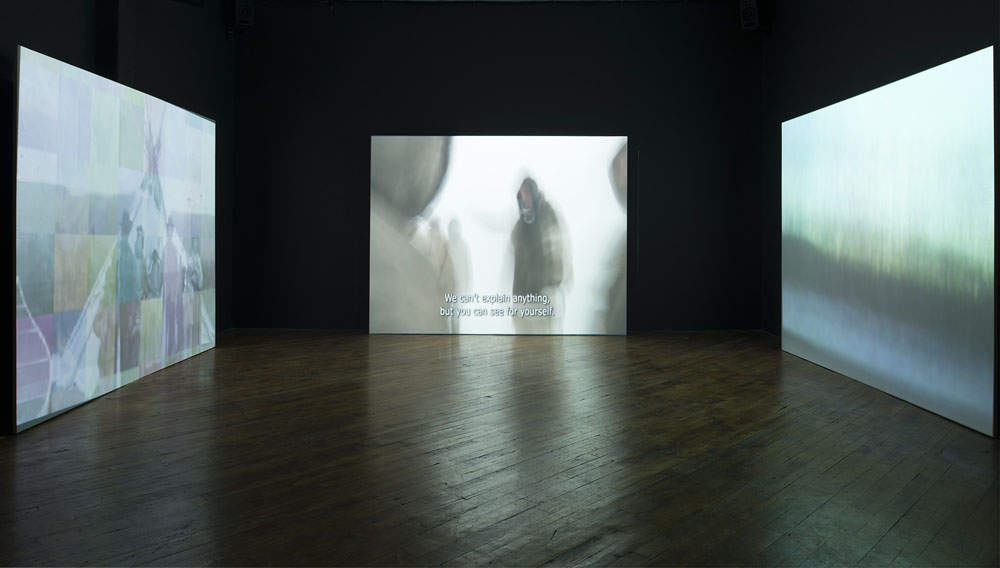
“ARCTICNOISE” Still from 2015 Installation, image by Trinity Square Video and imagineNATIVE Film + Media Arts Festival
In Inutiq’s installation, multiple video projections appear at cross-rhythms to each other, abstract digital art contrasting documentary interviews and archival footage. This juxtaposition aptly demonstrates the uneven contours of international development, mapped over the immersive course of Inutiq’s multipanoramic presentation. The context is combined and contradictory: resource extractive projects impelling settlers North, technological and military expansion into contested space during the Cold War, and a gallery-backed effort to create and claim Inuit artistic production, ready to market, as a national treasure, all play a part. These angles on the North are strategic abstractions, too; but to map them in simultaneity allows for a concerted, and concrete, critique.
Grace’s attempt to consolidate a “Northern” reply to a southern settler’s imaginary stalls upon qualification, as her ungrounded anthropology finds an innocuous “topographical and meteorological diversity” recapitulated at the highly localized level of attendant practice. By comparison, Inutiq’s ARCTICNOISE foregrounds interference in its very name. To call the multidiscursive clamour of the landscape ‘noise,’ an antecedent backing of any strong signal, is a totalizing gesture in the negative; at least where the transmissibility of identity to the state is concerned. In As We Have Always Done (2017), Nishinaabeg scholar Leanne Betasamosake Simpson cites nêhiyaw (Plains Cree) and Dene Suline scholar and artist Jarrett Martineau, describing Indigenous artistic practice as “noise to colonialism’s signal.” (198) This work, Simpson says, operates at an “elegant level of protection and disruption,” declining any susceptibility to a settler’s interception or interpretation, such as I cannot render here.

“ARCTICNOISE” Still from 2015 Installation, image by Trinity Square Video and imagineNATIVE Film + Media Arts Festival
This complicates the philosophical trope of counterpoint, which requires the horizontal elaboration of two or more mutually dependent themes, as well as their vertical separation in space for clarity. Settler colonialism and capitalism alike oversee any number of encroachments, such that this meaningful categorical distinction lapses into convolution. If Gould’s ideal is a melodically assured phraseology, each soloist empowered to give a self-account, Inutiq’s challenge restores a prerequisite space to the arrangement of voices. The additive model of liberal civics—the progressivist notion that we only need for more diversity of talk-for-trade—swaps the necessity of a collaborative space for more and greater time, in which span all will be forgiven. To visually recompose Gould’s ad hoc townhall, with greater geographical and cultural specificity, is a powerful reminder that the purposes of any settler-artist’s pilgrimage may coincide with a place of their choosing, but never essentially.
PROGRAMME MUSIC
What does the radio voice shore in a Canadian context? Gould’s selective chorus is a demonstration of certain normative commitments, formally reiterative of an impasse of representation. The difficulties implicit in broadcast cannot simply be addressed at the level of more and authoritative voices, for it is not the radio voice that is the problem here so much as the body from which it is presumed to emanate.

Screen Capture from the CBC television adaptation of The Idea of North
“I am indeed a Northern listener then,” the Virgilian surveyor McLean proclaims late in the broadcast, “and the pity of it all is that I’m not always able to select what I want to hear. I hear what other people inflict upon me. You know, the noise, the noise of civilization and its discontents.” In this vulgarized Freudian remark, the speaker identifies ‘noise’ as a claustrophobic condition, from which one might escape. While Freud’s text details the aversive attempt by an individual ego to differentiate itself over-against bracing reality, Gould’s soloist attempts identification with a synthetic perspective straddling this opposition: “I do believe able to reflect on that selection makes you more than the mere analyst that most of us claim we are [. . .] in detaching and in reflecting and in listening I suppose I’m able to synthesize, to have these different rails meet in the infinity that is our conscious hope.” However multiply determined, this identification—of transportation infrastructure with a vastly collective desire—remains laudably materialist, emphasizing the production of heretofore unheardof proximities in space.
In heavy handed analogy to symphonic form, The Idea of North ends more or less where it began, generically elsewhere. The metaphorical journey by train concludes with the armchair philosophical pontifications of panelist W. V. MacLean, backed with a defamiliarized recording of Sibelius’ fifth symphony, which threatens at moments to swallow MacLean’s climactic speech. Paraphrasing William James, MacLean posits struggle against provisional alterity as a psychological necessity and subjective virtue. Today, he posits brazenly, “the moral equivalent of war is going North.” Gould concludes the piece with this bon mot, a surprise analogy that relies for its effect on the presumption that Canadian designs in this direction are more often peaceable than not. This is far from certain, and Gould’s finale reminds the listener that the vehicle of this idea is itself susceptible to weaponization, as radio develops in periods of conflict and conquest. Then the least technologically contingent aspect of Gould’s epochal docudrama would appear the most bizarre today—the desire to test one’s conflictual mettle in flight.
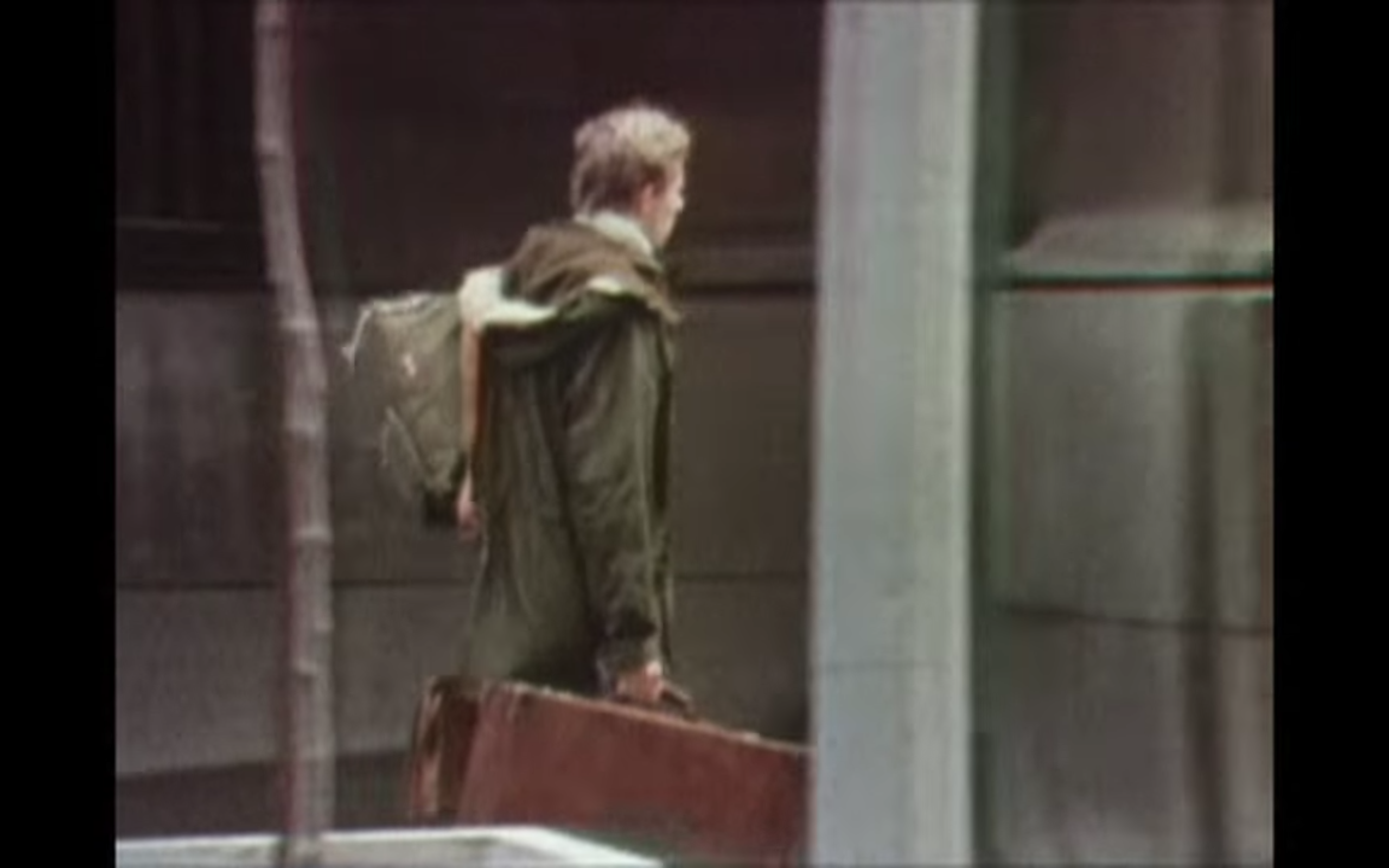
Screen Capture from the CBC television adaptation of The Idea of North
CODA
How these examples speak to today’s post-broadcast episteme would require another survey altogether. Surely today’s ideological counterpoint would sound far more dissonant, a disputatious and often collaborative din. But this idealized polyvocality may itself manifest a one-sided desire, a dialogic fantasy of which agenda national radio is but one diagram. Practical matters, of land and its capture, are obscured by this restaging of the stakes of colonialism as a conversation rather than an occupation.
A key theme of The Idea of North would be the practice and depiction of utopia for loners, but a counter-message sounds as clearly: that wherever one travels to find oneself, one is forever destined to find other people in their place. There are no definitive arrivals, and everything depends upon what happens next—on hospitality contra the arrogance of occupation. One historical staging of this quandary has been named “Canada,” and Gould’s mythopoetic play for voices is a crucial document of its becoming, flaws and all. As with any broadcast, it is up to each listener to imagine a possible reply.
—
Featured Image:Screen Capture from the CBC television adaptation of The Idea of North
—
CAM SCOTT is a poet, critic, and improvising non-musician from Winnipeg, Canada, Treaty One territory. He performs under the name Cold-catcher and writes in and out of Brooklyn. His visual suite, WRESTLERS, was released by Greying Ghost in 2017.
—
 REWIND! . . .If you liked this post, you may also dig:
Unsettled Listening: Integrating Film and Place — Randolph Jordan
Unsettling the World Soundscape Project: Soundscapes of Canada and the Politics of Self-Recognition–Mitchell Akiyama
Becoming Sound: Tubitsinakukuru from Mt. Scott to Standing Rock–Dustin Tahmahkera
EPISODE 60: Standing Rock, Protest, Sound and Power–Marcella Earnest
Share this:


Current Top Posts





April 2021

January 2020

November 2019

October 2019

August 2019

April 2014

November 2017

March 2015

December 2017

October 2015
 Sounding Out!
Recent Comments