
From Spanish to English to Spanish: How Shakira’s VMA Performance Showcases the New Moment in Latin Music “Crossover”

***This post is co-written by Petra Rivera-Rideau and Vanessa Díaz
On the night of September 12, Colombian pop star Shakira made history as the first predominantly Spanish-language artist to be honored as MTV’s Video Vanguard at the Video Music Awards (VMAs). The award recognizes artists who have had a major and innovative impact on music videos and popular music. Shakira played a 10-minute medley of Spanish and English hits from her three-decades long career. Her performance demonstrated her breadth as an artist as she shifted from pop to rock to reggaetón.
Not only did she demonstrate her impressive musical range, but of her 69 singles, Shakira selected those that represent two significant crossover moments for Latin music. She sang hits like “Wherever, Whenever,” “Hips Don’t Lie,” and “She Wolf” from her English-language crossover in the early 2000s as part of the so-called “Latin Boom.” She sang 2001’s “Objection (Tango)” with the same samba/rock music arrangement she used at her very first VMA performance in 2002.
During this “Latin Boom” of the late 1990s and early 2000s, Shakira and other established Latin stars who had previously performed in Spanish, such as Ricky Martin, Marc Anthony, and the late Selena Quintanilla, dominated the charts with English-language albums. Despite their successful global careers in the Latin market—and the long history and influence of Latinx musicians in U.S. pop music–U.S. media consistently portrayed these artists as exotic newcomers to the scene, praised more for being “Latin lovers” than established musicians. The Latin boom stars were valued as spicy foreigners there to expose Americans to new, exotic Latin sounds – conga beats, flamenco-style guitar riffs, and festive horns – even as many of these songs draw from familiar rock/pop references. Draco Rosa, one Ricky Martin’s co-writers, remembers “channeling [Jim] Morrison” and “elements of big band … a little bit of surf guitar” in the 1999 smash “Livin’ La Vida Loca.”

Despite the Latin Boom’s English-language crossovers, the images and sounds associated with the moment underscored the artists’ foreignness, something that continues today. This year’s Grammys’ botched treatment of superstar Bad Bunny’s performance and acceptance speech, in which, in lieu of translations, the subtitles merely declared that his words were “non-English.” Spanish has long been used to signify Latinxs’ alleged foreignness and inability to assimilate into US life and culture despite the fact that Latinx communities have been part of the fabric of the US for centuries. In the context of increased anti-immigrant sentiment, the popularity of Spanish-speaking artists like Bad Bunny and Shakira takes on even greater significance.
Following the Grammy’s disastrous handling of Bad Bunny’s performance and speech, backlash ensued. A plethora of popular memes and even t-shirts proudly claiming non-English popped up almost overnight. New York Times’ critic and Princeton professor Yarimar Bonilla proclaimed that “Bad Bunny is [Winning in Non-English].” Celebrities from comedian Cristela Alonzo to rapper 50 Cent admonished CBS. Even California Congressman Robert Garcia sent a letter directly to the CBS president and CEO George Cheeks, writing that the incident “display[ed] a lack of sensitivity and foresight. For too many Spanish-speaking Americans, it felt disrespectful of our place in our shared society, and of our contributions to our shared culture.” CBS eventually released a tepid statement saying that their vendor was not adequately equipped to manage Benito’s Spanish-language speech and performance, and Cheeks took “full responsibility” for the incident. Overall, the Grammys snafu reflects the ways in which the American mainstream still is incapable of embracing the status of Latin artists as equal players in the US and global music markets, in any language.
Compared to this year’s Grammys, however, MTV’s VMAs offered a much more inclusive approach, with a historic perspective that demonstrated exactly how we were able to arrive at this new moment in Latin music. When Puerto Rican and Cuban American rapper Fat Joe and Mexican pop star Thalia presented the award for Best Latin video, Thalia reminded the audience that “in the 2000s’ first Latin explosion, we had a song together, and now we’re here celebrating again this new Latin explosion.” This new Latin explosion refers to the numerous Spanish-language artists like Shakira, Bad Bunny, Karol G, and Peso Pluma who have recently broken out in the US mainstream.
But, unlike the previous Latin Boom, these artists have maintained their Spanish and their musical style. Bad Bunny’s Grammy performance included plena, reggaeton, and merengue rather than the kitschy styles of his Latin Boom predecessors. In addition to selling out stadiums around the country, Karol G drew 15,000 fans, the largest crowd in the Today Show’s history, for her reggaetón performance as part of the program’s Summer Concert Series in Rockefeller Center. Just this past September, Eslabon Armado became the first Mexican regional music group to ever perform on Good Morning America with their chart-topping hit “Ella Baila Sola” (the first Mexican regional song to ever hit number one on Billboard’s Global 200 chart). Whether it is the percussive dembow beat of reggaetón or the syncopated horns of corridos tumbados, all of these musicians have maintained the sounds of their respective genres, foregoing the stereotypical “Latin” sonic signifiers historically associated with Latin music.
Shakira herself reflected this moment in her Video Vanguard performance. She performed her new Spanish-language songs as 2022’s “Te Felicito,” and 2023’s “TQG” and “Bzrp Music Sessions: Volume 53” (the latter having broken four Guinness world records, including the most streamed Latin track in 24 hours). All of these songs have been part of this new Latin music movement. In fact, her “TQG” collaborator Karol G also performed her Spanish hits at the show. Mexican regional phenom Peso Pluma sang “Lady Gaga” on a small stage, surrounded only by his band, and called out “¡arriba México!” at the end. Brazilian artist Anitta performed a multilingual medley from her Funk Generation: A Favela Love Story. In addition, Shakira and Karol G won the award for best collaboration for “TQG.” Not only did the women give their acceptance speech in Spanish, shouting out their home country of Colombia, but they also won in a category otherwise populated by mainstream English-language artists like Doja Cat with Post Malone, and Metro Boomin with The Weeknd, 21 Savage, and Diddy. The interchangeable, tropical Latinidad of the earlier Latin boom was replaced with shout outs to specific countries and regions, and the crowd proudly waved Mexican, Puerto Rican, and Colombian flags. At the VMAs, Latin musicians were not isolated in Latin awards categories or depicted as exotic novelties. They were central to the show – nominated for major awards, and celebrated for some of the night’s most memorable performances.
Much like this year’s Coachella, which featured Bad Bunny and K-Pop sensation Black Pink as headliners, this year’s VMAs reflects a more global approach to pop music. Tuesday night’s award show also featured two performances by K-Pop groups, and MTV offered its first ever award in Best Afrobeats. In this context, it makes sense that Latin music would have a significant presence in the program. But the dominance of Latin music right now makes it so that no part of the music industry can leave Latin music out anymore. Not the VMAs, not the Grammys, not Coachella. As Thalia proudly declared on stage, “this last year for the first time in the US Latin music made a billion dollars in streaming.” Bad Bunny has been the most streamed artist on Spotify for three years in a row, has the longest-running Spanish-language album at the top of the Billboard chart, and in 2022 became the only artist in history to stage two separate $100 million-grossing tours in less than 12 months. Karol G became the first woman to have a Spanish-language debut at number one, and came to the VMAs after a string of historic performances at her Mañana Será Bonito stadium tour. Latin music’s global appeal is undeniable and the industry has to respond accordingly.
This is among the most important times in history for Latin music, and honoring artists like Shakira center stage at the VMAs helps underscore the musical evolution we are lucky enough to witness. Twenty years ago, Shakira had to crossover into the US market in English; now she performs in her native Spanish and is more relevant than ever. The global success of stars like Peso Pluma, Karol G, and Bad Bunny means we need to completely reevaluate the concept of the crossover. Latin artists today did not crossover, the market crossed over into them. They are not compromising their language, their identity, or their culture. They do not have to kowtow to industry expectations that they perform the exotic, sexy Latin other. So while the VMA Vanguard Award winner Shakira may have had to crossover into English to make it during the ‘90s Latin boom, she can proudly return to her roots and, this time, the market will follow her.
—
Featured Image: Screen shot by SO! from Shakira’s MTV 2023 Video Vanguard acceptance speech
—
Petra Rivera-Rideau is Associate Professor of American Studies at Wellesley College, and the author of Remixing Reggaetón: The Cultural Politics of Race in Puerto Rico and the forthcoming book Fun, Fitness, Fiesta: Selling Latinx Culture in Zumba Fitness. Vanessa Díaz is Associate Professor of Chicana/o and Latina/o Studies at Loyola Marymount University, and the author of Manufacturing Celebrity: Latino Paparazzi and Women Reporters in Hollywood. Díaz and Rivera-Rideau are the co-creators of the Bad Bunny Syllabus.
—

REWIND!…If you liked this post, you may also dig:
Ronca Realness: Voices that Sound the Sucia Body—Cloe Gentile Reyes
Contra La Pared: Reggaetón and Dissonance in Naarm, Melbourne—Lucreccia Quintanilla
Unapologetic Paisa Chingona-ness: Listening to Fans’ Sonic Identities–Yessica Garcia Hernandez
SO! Podcast #74: Bonus Track for Spanish Rap & Sound Studies Forum
Listening (Loudly) to Spanish-Language Radio– D. Inés Casillas
Share this:

Ronca Realness: Voices that Sound the Sucia Body

This series listens to the political, gendered, queer(ed), racial engagements and class entanglements involved in proclaiming out loud: La-TIN-x. ChI-ca-NA. La-TI-ne. ChI-ca-n-@. Xi-can-x. Funded by an Andrew W. Mellon Foundation as part of the Crossing Latinidades Humanities Research Initiative, the Latinx Sound Cultures Studies Working Group critically considers the role of sound and listening in our formation as political subjects. Through both a comparative and cross-regional lens, we invite Latinx Sound Scholars to join us as we dialogue about our place within the larger fields of Chicanx/Latinx Studies and Sound Studies. We are delighted to publish our initial musings with Sounding Out!, a forum that has long prioritized sound from a queered, racial, working-class and “always-from-below” epistemological standpoint. —Ed. Dolores Inés Casillas
—
My Puerto Rican grandmother used to sing Pedro Infante’s “Las mañanitas” to all the women in the family on their birthdays, so naturally I grew up thinking this was a Puerto Rican song. Not quite – it’s Mexican. When my family came to New York City from Puerto Rico in the 1950s, they were starved of warm waters, mountains, and family members, but they were not starved of Spanish-language music and media thanks in large part to Mexico’s Golden Age of Cinema. In the Bronx, Puerto Ricans would go the theaters to watch movies like Nosotros los Pobres (1948),which popularized boleros like “Las Mañanitas.” This movie-going ritual in the wake of relocation and diaspora has provided the birthday soundtrack to my life.
My mother grew up listening to her father sing boleros, and she would later sing with the Florida Grand Opera Chorus when I was a child. My early knowledge of opera came from her. Growing up in Miami Beach, I would also listen to reggaetón and hip-hop in afterschool programs. The Parks & Recreation department would host dances for us, and that was where I first learned to dance perreo. My early musical surroundings represent what it means to be a colonial subject, to hear the Italianate vocal legacies of opera mixed with the Afro-Diasporic and Indigenous rhythms of reggaetón. This post contextualizes my experience within bolero’s colonial history and legacy particularly its operatic disciplining of brown and Black bodies and voices. Reggaetóneras provide models for sonic subversion by being ronca, raspy, or breathy, and thus overriding internalized Eurocentric dichotomies of feminine and masculine vocal timbres.
When I began my own operatic training in college, I was constantly told to “purify” my voice, to resist vocal “fry,” and to handle my acid reflux by avoiding spicy foods. I was steered away from singing the pop songs I had grown up with, and kept many musical activities secret, like when I soloed for the tango ensemble and my a cappella group. In graduate school, thanks to my Latina roommates, I began listening to reggaetón again. I reunited with the voices that raised me and was reassured that their teachings of resistance would always present themselves when I needed them.
After 20 years of listening to Ivy, I have located the descriptor that most closely encapsulates the way her voice sounds to me: ronca. This is Spanish for hoarse, and in my experience, it’s been used colloquially, mostly by women, to describe moments when their throats might feel sore, and their voices sound raspy, or masculine, even. Ronca has been articulated as an epistemology of vocal sounding in the artistry of lower-class Black reggaetón creators like Don Omar and more recently, Ozuna. Sounding ronca is a signifier of realness, of truly knowing the struggle of race and class oppression. It is a vocalization of full-body rage fueled by poverty and colonization.
Ivy’s voice is so special to me because she sounds like my aunt when she’s had a long day, my mom when she’s yelling, and my grandma after years of having long days and yelling at people. She sounds like the raw, unfiltered power that comes from exhaustion. She sounds like inner will and justified fury. She sounds like yelling at landlords and ex-husbands for hot water and child support. She sounds like age. And she always has, even when she was “young.” And this sound is even more beautiful and life-giving to me after 4+ years in a classical voice program that told me it was bad to sound hoarse or raspy, surveilled my eating, and perpetuated the colonization of Native and Black peoples through musical subjugation.

Operatic training utilizes mechanisms that are opposite of what is “natural” for me as a poor Latina from the barrio. It asks me to lift my voice, clarify it, and feminize it. This, to me, is antithetical to the girl who laughs really loudly, gets raspy often from yelling and eating too many Takis, and loves to sing from her chest. Ivy’s voice empowers my place as the antithesis. Even as I sang classically in college, my voice was still often described as “soulful,” “hoarse,” “raspy,” “throaty.” My voice, although in a moment of attempted cleanup in college, was read as having previously engaged in genres that disrupt colonial dichotomies of “art” and “noise.” The sonic Blackness– in particular the exoticized and tropicalized Blackness of Latinidad in the U.S.- of my timbre was legible, and perhaps even hyper-audible, in moments when I was trying to adapt to European art forms. Raquel Z. Rivera asserts in New York Ricans from the Hip Hop Zone (2003) that Latinidad doesn’t take away from Blackness but adds an element of exoticism to the Blackness. Thus, I have come to understand ronca voices as representative of a Latina/e liberatory sonic and embodied praxis that resists the derogatory discourse around racialized voices predicated on European ideals of cleanliness.
The ronca voice is negotiating suciedad, Deborah Vargas’ analytic for how queers of color may reclaim their abject bodies and social spaces. Readings of my voice in predominantly white spaces were contextualized by my queer ambiguously-brown body, which in direct opposition to whitening regimes, was sounding suciedad. This is what ronca voices do, and what I conceptualize as “ronca realness”: the tendency of Latinas/es to not hide behind the voice but rather keep it real with the audience via their vocal timbre. Ronca voices sound another option to Barthes’ hegemonic article “The Grain of the Voice,” which has been applied to Ivy Queen and Don Omar in Jennifer Domino Rudolph’s “‘Roncamos Porque Podemos,’” and Dara Goldman’s “Walk like a Woman, Talk like a Man: Ivy Queen’s Troubling of Gender.” I intend ronca realness to be understood as a queer of color vocal analytic born from community and lived experience.

Ronca voices reflect emotional states, flip colonial gendered vocal scripts, reveal if the singer had coffee that morning and Hot Cheetos the night before, and navigate tough musical contours with strain and stress; most importantly, they refuse to be white(ned). In college, my ronca realness was not always a choice. Keeping it real, in general, is sometimes undecided upon prior to the act of realness; it is an additional and deeply engrained responsibility that queer people of color have in white spaces to sound their dissent, or else face the continued exploitation of their communities. Further, these acts of realness may not even be legible as such but are often coded as bad behavior or an attitude problem.
Within communities of color and (im)migrant communities, it’s important to recognize that Ivy Queen’s ronca timbre was permissible because she was light-skinned, thin, and usually took on the masculine role of the rapper, rather than the feminine role of the dancer, in several of her videos. These privileges have left Afro-Latina ronca reggaetóneras like La Sista in the shadows.
La Sista has veered away from sounding ronca in recent years, but in her debut album, Majestad Negroide (2006), she praised Yoruba goddess Yemaya and Taino cacique Anacaona with a hoarse, raspy, bold sound. She is the Afro-Indigenous Latina many of us needed growing up, and her absence speaks to the ways in which Black ronca voices are policed and erased within Latinx culture and elsewhere. Let us praise her now.
—
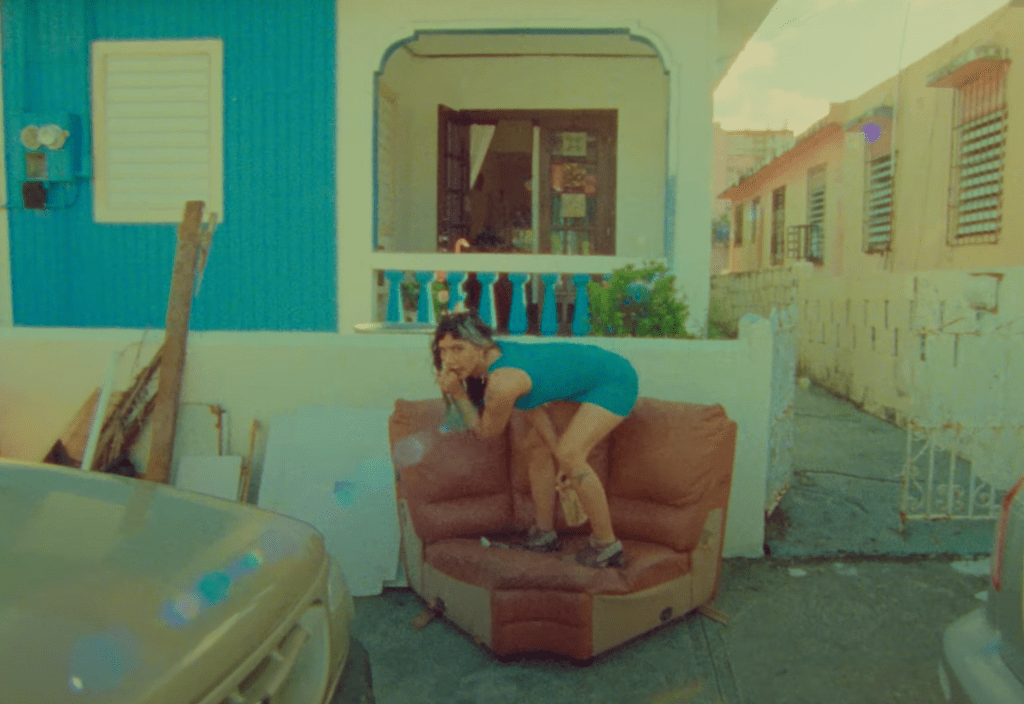
Featured Image: Still image by SO! from RaiNao’s “Tentretiene”
—
Cloe Gentile Reyes (she/her) is a queer Boricua scholar, poet, and performer from Miami Beach. She is a soon-to-be Faculty Fellow in NYU’s Department of Music and earned her PhD in Musicology from UC Santa Barbara. Her writing explores how Caribbean femmes navigate intergenerational trauma and healing through decolonial sound, fashion, and dance. Cloe’s poems have been featured in the womanist magazine, Brown Sugar Lit, and she has presented and performed at PopCon, Society for American Music, International Association for the Study of Popular Music-US Branch, among several others.
—
REWIND!…If you liked this post, you may also dig:
Contra La Pared: Reggaetón and Dissonance in Naarm, Melbourne—Lucreccia Quintanilla
“How Many Latinos are in this Motherfucking House?”: DJ Irene, Sonic Interpellations of Dissent and Queer Latinidad in ’90s Los Angeles—Eddy Francisco Alvarez Jr.
Unapologetic Paisa Chingona-ness: Listening to Fans’ Sonic Identities–Yessica Garcia Hernandez
SO! Podcast #74: Bonus Track for Spanish Rap & Sound Studies Forum
Cardi B: Bringing the Cold and Sexy to Hip Hop—Ashley Luthers
Share this:


Current Top Posts





April 2021

January 2020

November 2019

October 2019

August 2019

April 2014

November 2017

March 2015

December 2017

October 2015
 Sounding Out!
Recent Comments