
Listen to the Sound of My Voice
Betrayal
I first realized there was a problem with my voice on the first day of tenth grade English class. The teacher, Mrs. C, had a formidable reputation of strictness and high standards. She had us sit in alphabetical order row after row, and then insisted on calling roll aloud while she sat at her desk. Each name emerged as both a command and a threat in her firm voice.
“Kelly Barfield?”
“Here,” I mumbled quietly. I was a Honor Roll student with consistent good grades, all A’s and one B on each report card, yet I was shy and softspoken in classes. This was an excellent way to make teachers amiable but largely go unnoticed. The softness of my voice made me less visible and less recognizable.
Mrs. C repeated my name. Caught off guard, I repeated “here” a little more loudly. She rose to her feet to get a better look at me. I knew what she saw: a petite girl with long ash blonde hair, big brown eyes, and overalls embroidered with white daisies on the bib. When her gaze finally met mine, Mrs. C frowned at me and cleared her throat loudly. I curled into my desk, hoping to disappear.

“Lincoln High School 9-16-2007 008” by Flickr user Paul Horst, CC BY-NC 2.0
“Miss Barfield, did you hear me call your name twice? In this class, when I call roll, you respond.” I gave a quick nod, but Mrs. C wasn’t finished: “We use our strong voices in here, not our girly, breathy ones.” My cheeks flushed red while Mrs. C droned on about confidence and classroom expectations.
“Do you understand me?”
I stammered a “yes.” Mrs. C turned her attention back to the roll call. Her harsh words rang in my ears. I sank low in my chair, humiliated and angry. I couldn’t help that I sounded girly: I was, in fact, a girl. This was the way my voice sounded. It was not an attempt to sound like the dumb blonde she appeared to think I was.
That day I decided that I would never speak up in her class. Forget the Honor Roll. If the sound of my voice was such a problem, then my mouth would remain firmly shut in this class and all of my others. I would never speak up again.

“Listen” by Flickr user lambda_x, CC BY-ND 2.0
My vow to stop speaking lived a short life. I enjoyed Mrs. C’s serious fixation on diagramming sentences and her attempts to show sophomores that literature offered ideas and worlds we didn’t quite know. At first, I spoke up with hesitation and fear of the inevitable dismissal, but I continued to speak. Becoming louder became my method to seem confident, even when I felt anything but.
Throughout high school, my voice emerged again and again as a problem. Despite the increased volume, my voice still sounded tremulous, squeaky, hesitant, and shrill to my own ears. Other girls had these steady, warm voices that encouraged others to listen to them. Some had higher voices that were melodic and lovely. I craved a lower, more resonant voice, but I was stuck with what I had. In drama club, our director scolded me with increasing frustration about my tendency to end my lines in the form of a question. My nerves materialized as upspeak. The more he yelled at me, the more pronounced the habit became. He eventually gave up, disgusted by my inability to control my vocal patterns.

By Dvortygirl, Mysid [GFDL (http://www.gnu.org/copyleft/fdl.html) or CC-BY-SA-3.0 (http://creativecommons.org/licenses/by-sa/3.0/)%5D, via Wikimedia Commons
Meanwhile, at a big state university in my native Florida, I learned quickly that a Southern accent marks you as a dumb redneck from some rural town that no one had heard of. Students in my classes asked me to say particular words and then giggled at my pronunciations. “You sound like a Southern belle,” one student noted. This was not really a compliment. According to my peers, Southern belles didn’t have a place in the classroom. Southern belles didn’t easily match up with “college student. As a working-class girl from a trailer park, I learned that I surely didn’t sound like a college student should. I worked desperately to rid myself of any hint of twang. I dropped y’all and reckon.
I listened carefully to how other students talked. I mimicked their speech patterns by being more abrupt and deadpan, slowly killing my drawl. When I finally removed all traces of my hometown from my voice, my friends both from home and from college explained that now I sounded like an extra from Clueless. My voice was all Valley girl. I was smarter, they noted with humor, than I sounded and looked. My voice now alternated between high-pitched and fried. Occasionally, it would squeak or crack. I thought I sounded too feminine and too much like an airhead, even when I avidly tried not to. I began to hate the sound of my voice.
My voice betrayed me because it refused to sound like I thought I needed it to. It refused to sound like anyone but me.
When I started teaching and receiving student evaluations, my voice became the target for students to express their displeasure with the course and me. According to students, my voice was too high and grating. Screechy, even: one student said my voice was at a frequency that only bats could hear. In every set of evaluations, a handful of students declared that I sounded annoying. This experience, however, was not something I alone faced. Women professors and lecturers routinely face gender bias in teaching evaluations. According to the interactive chart, Gender Language in Teaching Evaluations, female professors are more likely to be called “annoying” than their male counterparts in all 25 disciplines evaluated. The sound of my voice was only part of the problem, but I couldn’t help but wonder if how I sounded was an obstacle to what I was teaching them.
Once again, I tried to fix my problematic voice. I lowered it. I listened to NPR hosts in my search for a smooth, accentless, and educated sound, and I attempted to create a sound more like them. I practiced pronouncing words like they did. I modulated my volume. I paid careful attention to the length of my vowels. I avoided my natural drawl. None of my attempts seemed to last. Some days, I dreaded lecturing in my courses. I had to speak, but I didn’t want to. I wondered if my students listened, but I wondered more about what they heard.
Sound
Public Domain, https://commons.wikimedia.org/w/index.php?curid=1393933
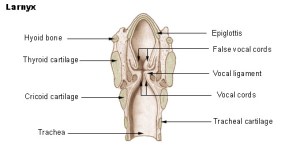
The sound of your voice is a distinct trait of each human being, created by your lungs, the length of your vocal cords, and your larnyx. Your lungs provide the air pressure to vibrate your vocal cords. The muscles of your larnyx adjust both the length and the tension of the cords to provide pitch and tone. Your voice is how you sound beyond the resonances that you hear when you speak. It is dependent on both the length and thickness of the vocal cords. Biology determines your pitch and tone. Your pitch is a result of the rate at which your vocal cords vibrate. The faster the rate, the higher your voice. Women tend to have shorter cords than men, which makes our voices higher.
Emotion also alters pitch. Fright, excitement, and nervousness all make your voice sound higher. Nerves would make a teenage girl have an even higher voice than she normally would. Her anxious adult self would too. Her voice would seem tinny because her larnyx clenched her vocal cords tight. Perhaps this is the only sound she can make. Perhaps she is trying to communicate with bats because they at least would attempt to listen.
Biology, the body, gives us the voices we have. Biology doesn’t care if we like the ways in which we sound. Biology might not care, but culture is the real asshole. Culture marks a voice as weak, grating, shrill, or hard to listen to.

“Speak” by Flickr user Megara Tegal, CC BY-NC-ND 2.0
My attempts to change my voice were always destined to fail. I fought against my body and lost. I couldn’t have won even if I tried harder. My vocal cords are determined that my voice would be high, so it is. The culture around me, however, taught me to hate myself for it. Voice and body seem to cast aspersions on intelligence or credentials. It’s the routineness of it all that wears on me. I expect the reactions now.
I wonder if I’m drawn to the quietness of writing because I don’t have to hear myself speak. I crave the silence while simultaneously bristling at it. Why is my voice a problem that I must resolve to placate others? How can I get others to hear me and not the stereotypes that have chased me for years?
Fury
My silence has become fruitful. The words I don’t say appear on the page of an essay, a post, or an article. I type them up. I read aloud what I first refused to say. I wince as I hear my voice reciting my words. I listen carefully to the cadence and tone. This separation of words and voice is why writing appeals to me. I can say what I want to say without the sound of my voice causing things to go awry.
People can read what I write, yet they can’t dismiss my voice by its sound. Instead, they read what I have to say. They imagine my voice; my actual sound can’t bother them. But, they aren’t really hearing me. They just have my words on the page. They don’t know how I wrap the sound around them. They don’t hear me.
Rebecca Solnit, in “Men Explain Things to Me,” writes “Credibility is a basic survival tool.” Solnit continues that to be credible is to be audible. We must be heard to for our credibility to be realized. This right to speak is crucial to Solnit. Too many women have been silenced. Too many men refuse to listen. To speak is essential “to survival, to dignity, and to liberty.”

“Listen” by Flickr user Emily Flores, CC BY-ND 2.0
I agree with her. I underline her words. I say them aloud. The more I engage with her argument, the more I worry. What about our right to be heard? When women speak, do people listen? Women can speak and speak and speak and never be heard. Our words dismissed because of gender and sound. Being able to speak is not enough, we need to be heard.
We get caught up in the power of speaking, but we forget that there’s power in listening too. Listening is political. It is act of compassion and empathy. When we listen, we make space for other people, their stories, their voices. We grant them room to be. We let them inhabit our world, and for a moment, we inhabit theirs. Yes, we need to be able to speak, but the world also needs to be ready to listen us.
We need to be listened to. Will you hear me? Will you hear us? Will you grant us room to be?
When I think of times I’ve been silenced and of the times I haven’t been heard, I feel the sharp pain of exclusion, of realizing that my personhood didn’t matter because of how I sounded. I remember the burning anger because no one would listen. I think of the way that silence and the policing of how I sound made me feel small, unimportant, or disposable. As a teenager, a college student, and a grown woman, I wanted to be heard, but couldn’t figure out exactly how to make that happen. I blamed my voice for a problem that wasn’t its fault. My voice wasn’t the problem at all; the problem was the failure of others to listen.
“listen” by Flickr user Jay Morrison, CC BY-NC-ND 2.0
Loss
While writing this essay on my voice, I almost lost mine, not once but twice. I caught a cold and then the flu. My throat ached, and I found it difficult to swallow. A stuffy nose gave my voice a muted quality, but then, it sounded lower and huskier. I could hear the congestion disrupting the timber of my words. My voice blipped in and out as I were radio finding and losing signal. It hurt to speak, so I was quiet.
“You sound awful,” my husband said in passing. He was right. My voice sounded unfamiliar and monstrous. I tested out this version of my voice. It was rougher and almost masculine. I can’t decide if this is the stronger, more authoritative voice I wanted all along or some crude mockery of what I can never really have. I couldn’t sing along with my favorite songs because my voice breaks at the higher register. I wheezed out words. I croaked my way through conversations. “Are you sick?” my daughter asked, “You don’t sound like you.”
Her passing comment stuck with me. You don’t sound like you. Suddenly, I missed the sound of my voice. I disliked this alien version of it. I craved that problematic voice that I’ve tried to change over the years. I wanted my voice to return.
After twenty years, I decided to acknowledge the sound of me, even if others don’t. I want to be heard, and I’m done trying to make anyone listen.
—
Featured image: “Speak” by Flickr user Ash Zing, CC BY-NC-ND 2.0
—
Kelly Baker is a freelance writer with a religious studies PhD who covers religion, higher education, gender, labor, motherhood, and popular culture. She’s also an essayist, historian, and reporter. You can find her writing at the Chronicle for Higher Education‘s Vitae project, Women in Higher Education, Killing the Buddha, and Sacred Matters. She’s also written for The Atlantic, Bearings, The Rumpus, The Manifest-Station, Religion Dispatches, Christian Century’s Then & Now, Washington Post, and Brain, Child. She’s on Twitter at @kelly_j_baker and at her website.
—
 REWIND!…If you liked this post, you may also dig:
Vocal Gender and the Gendered Soundscape: At the Intersection of Gender Studies and Sound Studies — Christine Ehrick
On Sound and Pleasure: Meditations on the Human Voice– Yvon Bonefant
As Loud As I Want To Be: Gender, Loudness, and Respectability Politics — Liana Silva
Share this:

SANDRA BLAND: #SayHerName Loud or Not at All
It is customary that whenever I go to my Nana’s house I turn the car speakers as low as possible. She has super hearing. Sometimes I forget, and the following conversation takes place:
“What’s up Nana Boo?”
“I heard you before you got the house, girl. I told you about playing your music too loud.”
“It wasn’t too loud.”
“I heard you before I saw you.”
“Yes ma’am. I’m sorry.”
“Don’t bring attention to yourself.”
Don’t bring attention to yourself.

Picture from The Feminist Wire.
Physically this is impossible. I am a black woman over six feet tall. My laugh sounds like an exploding mouse. I squeak loudly and speak quickly when I get excited. I like knock in my trunk and bass in my music. Don’t bring attention to yourself. I frequently heard this warning as a girl and well into my adult life. I rarely take it as a slight on my grandmother’s account – though she is the master of throwing parasol shade. She spoke to me with a quiet urgency in her warning. In the wake of the murders of Jordan Davis, Sandra Bland, and other black lives that vigilantes and mainstream media deemed irrelevant, I understand her warning better from the perspective of sound.
As a loud, squeaky black woman I am especially attuned to how my sonic footprint plays into how I live and if I should die. As a black woman, the bulk of my threat is associated with my loudness. My blackness sonically and culturally codes me as threatening due to the volume of my voice. This is amplified, as a southern black woman. I exist and dare to thrive in a country that historically and socially tries to deflate my agency and urgency. The clarity of my sentiments, the establishment of my frustration, and the worth of my social and cultural interventions are connected to how others hear my voice. It is not what I say but how I say it.

A woman waits at the Fulton Street subway stop in New York City on February 20, 2010.
Black women navigate multiple codes of sonic respectability on a daily basis. Their sonic presence is seldom recognized as acceptable by society. Classrooms, homesites, corporate spaces, kitchen tables, and social media require a different tone and volume level in order to gain access and establish one’s credibility. Like other facets of their existence, the way(s) black women are expected to sound in public and private spaces is blurry. What connects these spaces together is a patriarchal and racially condescending paradigm of black women’s believed inferiority. A black women’s successful assimilation into American society is grounded in her ability to master varying degrees of quiet and silence. For black women, any type of disruptive pushback against cultural norms is largely sonic in nature. A grunt, shout, sigh, or sucking teeth instigates some type of resistance. Toning these sonic forms of pushback—basically, silencing themselves—is seen as the way to assimilate into mainstream American society.
In what follows I look at the tape of Sandra Bland’s arrest from this past summer to consider what happens when black women speak up and speak out, when they dare to be heard. As the #SayherName movement attests, black women cannot express sonically major and minor touchstones of black womanhood – joy, pleasure, anger, grief – without being deemed threatening. These sonic expressions force awareness of the complexity of black women’s experiences. In the case of Sandra Bland, I posit that the video of her arrest is not a video of her disrespecting authority but rather shows her sonic response to officer Brian Encinia’s inferred authority as a police officer. I read her loud and open interrogation of Encinia’s actions as an example of what I deem sonic disrespectability: the use of sound and volume to contest oppression in the shape of dictating how black women should or should not act.
The sonic altercation in the video (see full-length version here) sets the stage for Encinia’s physical reprimand of Bland, a college graduate from Prairie View A&M who hailed from Chicago. Bland is not physically threatening—i.e. she emphatically states she’s wearing a maxi dress—but her escalating voice startles and even intimidates Encinia. Bland is angry and frustrated at Encinia’s refusal and to answer her questions about why she was pulled over. Encinia’s responses to Bland’s sonic hostility are telling of his inability to recognize and cope with her anger. In fact, he refuses to answer her questions, and she repeats them over and over again while he barks orders. Encinia states later in the dashboard camera that Bland kicks him and thus forces him to physically restrain her. However, Bland’s vocal assertion of her agency is more jarring than her physical response to Encinia’s misuse of power.
The dashboard camera footage is indicative of their vocal sparring match. Encinia’s voice starts calm and even. He explains to Bland he pulled her over for failure to indicate a lane change. Bland’s responses are initially low and nearly inaudible. However, after Encinia asks Bland if she is “okay,” her responses are much louder. She does not just follow orders but expresses her displeasure in sonic ways, while she stays in the car. His tone shifts when Bland refuses to extinguish her cigarette. Encinia then threatens to pull her out of the car for disobedience. He begins to yell at her. Bland then voices her pleasure in taking Encinia and his complaint to court. “Let’s take this to court. . .I can’t wait! Ooooh I can’t wait!” Bland’s pleasure in taking Encinia to court is an expression of her belief in her own agency. The act of voicing that pleasure is particularly striking because it challenges an understanding of courts and the justice system as hyperwhite and incapable of recognizing her need for justice. Her voice is clear, loud, and recognizably angry.

Picture from The New York Times
Her voice crescendos throughout the video, signifying her growing anxiety, tension at the situation, and anger for being under arrest. However, Bland’s voice begins to crack. Her sighs and grunts signify upon her disapproval of Encinia’s treatment of her physical body and rights. Once handcuffed, Bland’s voice is very high-pitched and pained, a sonic signifier of submission and Encinia’s re-affirmation of authority. She then is quiet and a conversation between Encinia and another officer is heard across the footage.
Many critiques of Bland center around her ‘distasteful’ use of language. One critic in particular described the altercation as “an African American woman had too much mouth with the wrong person and at the wrong time.” The assumption in those critiques is that she was not properly angry. Instead of a blind obedience of Enicnia’s inferred authority (read: superiority), she questions him and his inability to justify his actions. Sandra Bland’s sonic dis-respectability (dare I say, ratchet), is a direct pushback against the cultural and social norms of not only rural Southern society but the mainstream American (inferred) belief of southern black folks’ blind respectability of white authority and law enforcement.
Although Bland was a graduate of a southern HBCU, I do not want to assume that Bland possessed the social sensibilities that upheld this unstated social practice of blindly obeying white authority. Her death runs parallel to those of Emmett Till and Mary Turner. The circumstances of Till’s death swirled around his alleged whistling at a white woman – read as a sonic signifier of Till’s black masculine sexuality instead of boyhood – and disregard for white femininity, a protected asset of white men’s authority. Till, from Illinois like Bland, allegedly ignored his cousins’ warnings about the ‘proper protocol’ of interacting with white folks. Mary Turner, a black woman from Valdosta, Georgia, spoke out publicly against the lynching of her husband in 1918. She and her unborn child were also lynched in response to her sonic audacity. Before her death, members of the mob cut open her belly and her unborn baby fell on the ground; it was stomped to death after it gave out a cry. Turner’s voice disrupted white supremacy. Her baby’s lone cry re-emphasized it. Sound grounds much of the racial and gendered violence in the South.

“Sandra Bland mural” by Flickr user Robert Fairchild, CC BY-NC 2.0.
The Southern U.S. emphasizes listening practices as part of social norms and cultural traditions. Listening was an act of survival more so than vocalizing the challenges facing black folks. (Jennifer Stoever’s upcoming book on the sonic color line addresses how advertisements for runaway slaves, for example, mentioned whether they were good listeners, as a way to codify whether they were compliant slaves.). Consider my grandmother’s warning about not bringing attention to myself. In her eyes, by not bringing attention to myself I’m able to remain invisible enough to successfully navigate society’s expectations of my blackness and my womanhood. Silence and listening are tools of survival. Contrarily, Bland’s loud disapproval and emphatic use of curse words registered her blackness and womanhood as threatening. She was coded as less feminine and therefore threatening because of her direct verbal confrontation with Encinia. She was not quiet or polite, especially in the south where quiet is the ultimate and sole form of women’s politeness and respectability. The combination of these multiple representations of black women’s anger invoked Encinia’s hyper-authoritative response to regain control of the situation.
Black folks are increasingly pushing back against “being in their place.” Sandra Bland’s death is rooted in an unnecessarily escalated fear of black women literally speaking their truth to power. In a moment where black women are speaking on multiple wavelengths and levels of volume, it is imperative to single out instances and then implode outdated cultural and social practices of listening.
—
Featured image:”Sandra Bland is Her Name” by Flickr user Light Brigading, CC BY-NC 2.0
—
Regina Bradley is a writer, scholar, and researcher of African American Life and Culture. She is a recipient of the Nasir Jones HipHop Fellowship at Harvard University (Spring 2016) and an Assistant Professor of African American Literature at Armstrong State University. Dr. Bradley’s expertise and research interests include hip hop culture, race and the contemporary U.S. South, and sound studies. Dr. Bradley’s current book project, Chronicling Stankonia: Recognizing America’s Hip Hop South (under contract, UNC Press), explores how hip hop (with emphasis on the southern hip hop duo Outkast) and popular culture update conversations about the American South to include the post-Civil Rights era. Also known as Red Clay Scholar, a nod to her Georgia upbringing, Regina maintains a critically acclaimed blog and personal website – http://www.redclayscholar.com. She is a regular writer for Sounding Out!
—
REWIND! . . .If you liked this post, you may also dig:
I Been On: BaddieBey and Beyoncé’s Sonic Masculinity — Regina Bradley
“President Obama: All Over But the Shouting?” — Jennifer Stoever
Óyeme Voz: U.S. Latin@ & Immigrant Communities Re-Sound Citizenship and Belonging-Nancy Morales
Share this:


Current Top Posts





April 2021

January 2020

November 2019

October 2019

August 2019

April 2014

November 2017

March 2015

December 2017

October 2015
 Sounding Out!
Recent Comments