
The Love Below (the Mason Dixon Line): OutKast’s Rejection at the 1995 Source Awards

During his acceptance speech at 2017’s Golden Globe awards, actor and rapper Donald “Childish Gambino” Glover thanked the black people of the city of Atlanta for “being alive,” and the Atlanta trap rap group Migos for their single “Bad and Boujee.” As the camera panned out into the crowd, it showed dominantly white faces full of confusion and polite yet uncomfortable laughter. These audience members seemed unfamiliar with Migos and with categorizing a “black” Atlanta (and South) separate from the pop culture hub we know as Atlanta today. Glover’s speech re-affirmed the sentiments of Outkast’s Andre “3000” Benjamin over twenty years’ prior at the 1995 Source Awards, that the (black) South got something to say.
As I’ve argued previously, Andre and Big Boi’s acceptance speech at the Source Awards was the springboard for what I call the “hip hop south,” the social-cultural experiences that frame southern blackness after the Civil Rights Movement. The declaration “the South got something to say”—and the booing that ensued—is important to engaging how southerners see and hear themselves in a contemporary landscape. The Source Award’s dominantly New York audience booing both jolts the ear and affirms hip hop’s hyper-regional focus in the early to mid 1990s. The booing crowd identifies hip hop as northeastern, urban, and rigidly masculine, an aesthetic that was a daunting task for non-northeastern performers to try and break through. Even celebrated west coast artists like Snoop Dogg, who menacingly and repeatedly asked the crowd “you don’t love us?” during the show, struggled with the challenge of being recognized – and respected – by northeast hip hop enthusiasts.

The 1995 Source Awards proved to be the climax of the beef instigated by both West Coast Death Row Records and East Coast Bad Boy Records, the bitter lyrical and personal battle between Tupac Shakur and Notorious B.I.G., and OutKast, a Southern act, chosen as “Best New Rap Group.” The crowd’s increasingly despondent sonic rejection of hip hop outside of New York foregrounds my reading of OutKast’s acceptance speech as blatant and unforgiving southern black protest, a rallying cry that carves a space for the hip hop south to come into existence.
A recap of that night, in which Christopher “Kid” Reid and Salt-N-Pepa presented OutKast their award. Upbeat and playful, Kid says “ladies help me out” to announce the winner, but there is a distinctive drop in their enthusiasm when naming OutKast the winner of the category. The inflection in their voices signifies shock and even disappointment, with Kid quickly trying to be diplomatic by shouting out OutKast’s frequent collaborators and label mates Goodie Mob. The negative reaction from the crowd was immediate, with sharp and continuous booing.
Big Boi starts his acceptance speech, dropping a few colloquial words immediately recognizable as proper hip hop – “word” and “what’s up?” Over a growingly irritated crowd, Big Boi acknowledges that he is in New York, “y’alls city,” and tries to show respect to the New York rappers by crediting them as “original emcees.” Big Boi recognizes he is an outsider, his southern drawl long and clear in his pronunciation of “south” as “souf,” yet attempts to be diplomatic and respectful of New York. There is also a recognition that where he is from, Atlanta, is also a city: his statement, “y’alls city,” is not only a recognition of his being an outsider but a proclamation that he, too, comes from a city—except it’s a different city.
Big Boi’s embrace of Atlanta as urban challenges previous cultural narratives of southerners as incapable of maneuvering within an urban setting. Because of a long-standing and comfortable assumption that the American south was incapable of anything urban (i.e. mass transit, tall buildings, bustling neighborhoods and other forms of communities), beliefs about southerners’ perspectives remained aligned with rural – read ‘country’ and ‘backward’ – sensibilities incapable of functioning within an urban cultural setting. These sensibilities often played out in longhand form via literature or in popular black music, with focus on dialect and language standing in as a signifier of regional and cultural distinction.

Big Boi still repping ATL in 2012, Outside Lands Music Festival, San Francisco, CA, Image by Flickr User Thomas Hawk, (CC BY-NC 2.0)
Consider Rudolph Fisher’s southern protagonist King Solomon Gillis from the short story “City of Refuge” (1925). Fisher’s characterization of Gillis, a black man from rural North Carolina, is one of naiveté and awe for not only New York and its sounds, but the premise of city life in general. In the opening of the story Fisher describes Gillis’s ride on the subway as “terrifying,” with “strange and terrible sounds.” References to the bang and clank of the subway doors and the close proximity of each train as “distant thunder” is particularly striking, a subtle sonic nod to Gillis’ rural southernness and his inability to articulate the subway system outside of his limited southern experiences. The references to “heat,” “oppression,” and “suffocation” also lend premise to southern weather, a well as the belief of the American south as an unending repetition of slavery and its effects.
It is important to point out that Gillis certainly isn’t a fearful man in the literal sense: his reason for migrating to Harlem was out of necessity and desperation after shooting a white man back home to avoid being lynched. Yet Fisher’s attention to sound presents Gillis as an outsider. Further, Fisher describes Gillis as “Jonah emerging from the whale,” both a biblical allusion to triumph over a difficult situation as well as a rebirth, the possibility of a new life and new purpose. This can be connected to the biblical reckoning of southern black folks migrating out of the south for social-economic change and advancement.
Still, southern black folks emerging in the city is not an easy transition, with Gillis’ train ride and his discomfort with the sounds it produces symbolizing the move from one difficult landscape to another. Although Gillis ultimately is confronted with the brutality he was trying to avoid in North Carolina, his repetitive proclamation, “they even got cullud policemans!” amplified his southernness and naiveté. Fisher’s intentional use of written dialect enhances the repetitiveness of the impact of seeing black police officers, which blots out the characteristic of region but not white supremacy as a whole. Gillis’s acceptance of black police officers blurred the binaries of the Great Migration as a testament to black folks not only looking for social-economic change outside of the American South, a terroristic space for blacks, but the unfortunate anxiety of those deciding to remain in the south, complacent in the lack of social equality.

Panel 35 of Jacob Lawrence’s Migration Series, documenting Black Americans’ move to Northern Urban Centers : “They Left the South in Great Numbers. They Arrived in the North in Great Numbers.” Photo by Flickr User Ron Cogswell, (CC BY-NC 2.0)
Seventy years later Big Boi, a Georgian, returns to New York with the confidence of both rural and southern sensibilities outside of the immediately recognizable urban trope embodied by New York. Big Boi’s full embrace of being “cullud,” in both the linguistic and cultural elements that Fisher’s long-hand dialect represented as authentic southernness, is jarring because his intentional embrace of southern blackness as othered anchors his approach to rap music. Big Boi does not posture the south as a space or place in need of escape or reposturing. Rather, the hyper-awareness from both Big Boi and Andre in front of the dominantly New York crowd ruptures the accepted narrative of the south as needing saving by non-southern counterparts. Big Boi’s speech forces the audience to de-romanticize their notions of northeastern supremacy and recognize the south as capable of hip hop. Their direct booing is a sonic representation of that discomfort.
From this perspective, André’s now iconic remarks from the acceptance speech further emphasized Big Boi’s departure from reckoning with northeastern hip hop as the standard. He stumbles in his speech, possibly because of nerves or irritation, and, like Big Boi, must talk over the crowd. André speaks about having the “demo tape and don’t nobody wanna hear it,” a double signifier of not only being rejected for his southernness but also the difficulty of breaking into the music industry. André’s frustration with being unheard as a southerner can also be extended into the actual production of the tape by OutKast’s production team Organized Noize, who drew from southern musical influences like funk, blues, and gospel to ground their beats. Andre’s call-to-arms, “the south got something to say,” rallied other southern rappers to self-validate their own music. It is important to note that André’s rally called to the entire south, not just Atlanta. This is significant in thinking about southern experiences as non-monolithic, the aural-cultural possibilities of multiple Souths and their various intersections using hip hop aesthetics.

OutKast at the Pemberton Music Festival, CREDIT MARK C AUSTIN(CC BY 2.0)
OutKast moves past their rejection at the Source Awards via their second album ATLiens (Atlanta aliens), which offered an equal rejection of hip hop culture’s binaries. The album’s use of ‘otherworldly’ sonic signifiers i.e. synthesizers and pockets of silence that sounded like space travel – embodied their deliberate isolation from mainstream hip hop culture. Still, OutKast didn’t forget their rejection, sampling their acceptance speech in the final track from their third album Aquemini titled “Chonkyfire.” The brazen and hazy riffs of an electric guitar guide the song, with the recording from the source appearing at the end of the track. There is a deliberate slowing down of the track, with both the accompaniment and the recording becoming increasingly muddled. After André’s declaration “the south got something to say,” the track begins to crawl to its end, a sonic signifier of not only the end of the album but also the end of OutKast’s concern with bi-coastal hip hop expectations. Sampling their denial at the Source Awards was a full-circle moment for their music and identities. It was a reminder that the South was a legitimate hip hop cultural space.
In this contemporary moment, there is less focus and interest in establishing regional identities in hip hop. The dominance of social media collapses a specific need to carve up hip hop spaces per physical parameters. Sonically, there is an intriguing phenomenon occurring where rappers from across the country are borrowing from southern hip hop aesthetics, whether it be the drawl, bass kicks, or lyrical performance. Although our focus on social media has seemingly collapsed the physical need to differentiate region and identity, geographical aesthethics remain central to our listening practices. With this in mind, OutKast’s initial rejection from then mainstream hip hop in favor of sonic and cultural reckonings of southern blackness keep them central to conversations about how the Hip Hop South continues to ebb and weave within and outside the parameters of hip hop culture. Their rejection of hip hop’s stage solidified their place on it.
—
Featured Image “Big Boi I” by Flickr user Matt Perich (CC BY 2.0)
—
Regina N. Bradley, Ph.D is an instructor of English and Interdisciplinary Studies at Kennesaw State University. She earned her Ph.D in African American Literature at Florida State University in 2013. Regina writes about post-Civil Rights African American literature, the contemporary U.S. South, pop culture, race and sound, and Hip Hop. Her current book project explores how critical hip hop (culture) sensibilities can be used to navigate race and identity politics in this supposedly postracial moment of American history. Also known as Red Clay Scholar, a nod to her Georgia upbringing, Regina maintains a blog and personal website and can also be reached on Twitter at @redclayscholar.
—
 REWIND! . . .If you liked this post, you may also dig:
Caterpillars and Concrete Roses in a Mad City: Kendrick Lamar’s “Mortal Man” Interview with Tupac Shakur—Regina Bradley
I Been On: BaddieBey and Beyoncé’s Sonic Masculinity — Regina Bradley
The (Magic) Upper Room: Sonic Pleasure Politics in Southern Hip Hop—Regina Bradley
Share this:

Moonlight’s Orchestral Manoeuvers: A duet by Shakira Holt and Christopher Chien
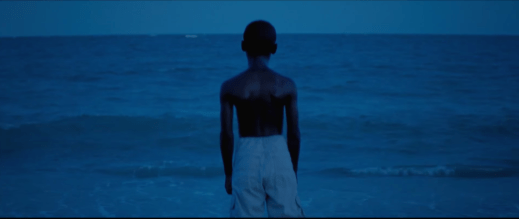
On January 10th, 2017, A24 + AFROPUNK + Wordless Music + Spaceland presented Moonlight at the historic Million Dollar Theater in Downtown Los Angeles with the Wordless Music orchestra as live accompaniment. The oldest and once-largest theater in LA, The Million Dollar has a capacity of around 2000 people. Reviewers Shakira Holt and Chris Chien attended separately, but were brought together on Facebook via SO! editorial magic for a discussion on the sonic valences of the film and the entire event experience.
Shakira Holt is a Southern Cali-based high school lit teacher with a doctorate in English from the University of Southern California. She’s deeply interested in the intersections of race, religion, sexuality, class, and politics. This is her second piece for SO!; Her first, “‘I Love to Praise His Name’: Shouting as Feminine Disruption, Public Ecstasy, and Audio-Visual Pleasure,” was published five years ago. Moonlight was on her winter break to-do list in December 2016, but the SO! call for a reviewer of the LA showing intrigued and excited her. Jenkins’s film was taking critics and general audiences by storm and already meant so much to so many people. She approached the screening with a healthy respect and desire to do it justice, walking into the Million Dollar Theatre the night of January 10th completely “fresh,” with scarcely more than trailers and the film’s sponsored social media posts as background.
Chris Chien is an American Studies and Ethnicity graduate student at the University of Southern California, and is doing research on early Asian gay and lesbian organizing in North America, and these social movements’ place within contemporary transpacific, diasporic narratives of a liberalizing Asia, particularly Hong Kong. He has previously written on Sounding Out! about the sonic materiality of diasporic feeling through the relic of the cassette tape, and has an upcoming article on righteous white violence in the music of trans-hardcore band G.L.O.S.S. He hadn’t seen Moonlight or even a trailer before this screening, but heard from many people he respects that it was magical. When SO! ed-in-chief JS reached out after seeing him post about attending on FB, he immediately embraced the idea of a conversation with Shakira.
***
The special screening of Moonlight in Los Angeles was an enjoyable and important, though mixed, experience. The live music, engineered to perfection, formed a seamless auditory union with the film’s other music; the live orchestra was much more of a visual cue for those attendees who could see the pit than a sonic one. However, the exclusion from live performance of non-orchestral music, especially those genres hailing from African American and Latin American creative spheres, detracted from the event, setting it somewhat amiss. Certainly, the screening paid fitting tribute to classical musicians who make those lush swells and accents happen in film. In truth, however, the screening succeeded most where it would have in a typical screening—in the story itself and in its manifold deep and broad significances.
Chris Chien: Just to start off: this was an event. It was drizzling that day, which, let’s be real, felt a little magical in Los Angeles. Seeing the lineup that snaked around the block full of stylish folks dressed in their finest, freshest outfits made it seem like postmodern opera. I had never watched a film in the presence of so many other people but I can say that a collective viewing experience of that scale contributed to the filmic magic.
Shakira Holt: Agreed. Walking through that soft Los Angeles rain up to and then through the crowds made the screening feel momentous and special.
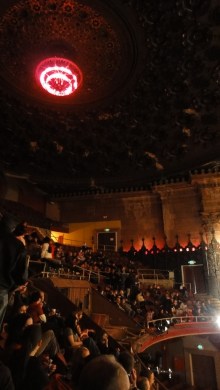
Interior of LA’s Million Dollar Theater, by Flickr user Omar Bárcena (CC BY-NC 2.0)
CC: Inside, it was thrilling to soak in the collective affect: ecstatic applause that filled the cavernous space as well as sniffles, sobs, and laughter during certain scenes but looking back, I would’ve preferred a more intimate viewing experience. The attendees around us came in late, talked, and checked their social media throughout the movie (yes, actually). Director Barry Jenkins did say during the Q&A afterwards that it was the largest viewing audience in North America, so perhaps a little chaos is to be expected! Of course, the major selling point of the event for my group was the live orchestral accompaniment to the film. We were up in the nose-bleeds, though, so we struggled to notice when the orchestra kicked in. We also couldn’t see the pit from our seats, and tended to just assume they were playing when there were strings in the film score. So to us, the orchestra was a bit of a non-event.
SH: I was down on the floor with the orchestra and could see the pit fairly well, but I completely get your point. Taken with a scene, I would often forget about the live music until movement in the pit would attract my eye, which was always slightly jarring in a really meaningful way. We forget about the work of folks whose labor provides the musical idiom of film we simply expect to be there. Frankly, it was always with a bit of guilt that I would be brought to remembrance of the presence of the musicians who were that critical contribution to the experience I was having.
CC: You’re so right! It’s interesting that to get the effect, there had to be a visual accompaniment, which speaks to both our ocular-centrism and how we’ve been conditioned to take (sound) labor in film for granted. I also recall Jenkins giving a shoutout to the sound engineer for rigging a custom sound system in the theater space in order for the film sound and orchestral sound to work together properly. He was really gracious in pointing out the unseen labor that you mentioned.
SH: So I’d like your thoughts on that opening scene which features extended Liberty City street dialect.
CC: KPCC’s John Horn, the host of the post-screening discussion with the cast and crew (Barry Jenkins, Nicholas Britell, Mahershala Ali, Naomie Harris, Ashton Sanders, and Trevante Rhodes), asked a question about the “Liberty City dialect” in the opening scene of the film. His question assumed that “we” couldn’t understand the dialect of that scene, when clearly, his use of “we” assumes a lot about the audience—I’m sure there were folks in the crowd that could understand perfectly what was going on!
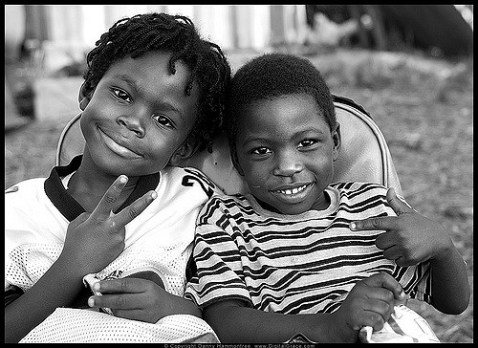
Two young boys from Umojaa Village, Liberty City, Miami, 2003, image by Flicker User danny.hammontree, (CC BY-NC-ND 2.0)
I wasn’t one of them, unfortunately, but I was drawn to the politics of that move. The refusal to translate, and the insistence on the authenticity of that voice, which necessarily separates a particular portion of the audience because of knowledge they don’t have, and often are comfortable having. Jenkins also talked at length about the specificity of time and place too. He insisted on representing Liberty City in all its particularities and refused the notion of Moonlight’s wide or universal intelligibility or relatability.
SH: Right. He was very clear about his determination to tell one specific story. Now, on one level, I see it, I get it, and I applaud it. However, on another level, I know that narratives are successful only to the degree that they mine a set of specifics to unearth truths that are universal. I think I’d be hard put to find anyone who would argue against the statement that even in the specificity which Jenkins rightly champions, Moonlight is deeply informed by a powerful universal quality.

Ashton Sanders as Chiron, screen capture from Moonlight trailer by JS
CC: And both Ali and Sanders said during the discussion that they felt their embodiment of their respective characters was meant to be relatable to a wide audience. At the same time, Jenkins added that he hoped his method of narrative specificity would inspire other marginalized people to go out and do the same for their own stories, so perhaps he’s more concerned with universal methods than narrative details.
I’m only realizing now that the film just does so damn much, based on how the actors and director imagine their art reaching out to various audiences. One of the most immediate ways is through the use of diverse musical signposts. Others have commented on the gorgeous Barbara Lewis track “Hello Stranger” that Kevin plays on the diner jukebox, (and we could certainly spend all day jumping into the rabbit holes that all the disparate songs on the soundtrack take us to), but I wanted to ask if you had any thoughts on the use of the classic Mexican huapango song “Cucurrucucú Paloma.”
SH: Yes, I did. In a rather convoluted way, I connected that song to the character of Juan, so I’ll back my way into my thinking. The character of Juan is a very special character for me. I don’t think I’ve come across another like him; in fact, I see him as a new type: a trans-American father figure of the African diaspora. Juan is a Cuban native and thus functions as a reach-out to–a gesture towards, a signifier of—Cuba, of course, and, by extension, the rest of the Caribbean, which are American locations not typically identified by their Americanness. I see that Mexican track, “Cucurrucucu Paloma,” as an extension, not of Juan precisely, but of his function. This song is a reach-out to Mexico as another American location that is typically not acknowledged as American. In all truth, it is often imagined and imaged as distinctly anti-American. Through these reach-outs, both characterological and musical, this film initiates a conversation between the U.S. and other parts of the Americas which have been figuratively lopped off from their American identities simply because they fall outside of the United States, which is now almost singularly synonymous with America.
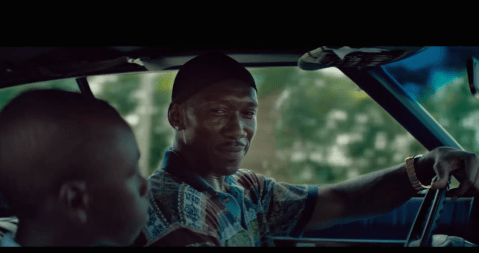
(l-r) Alex Hibbert as Little and Mahershala Ali as Juan, screen capture of Moonlight trailer by JS
Another layer to this, of course, is that the film makes these reach-outs to different parts of the Americas in the specific context of New World blackness, which automatically invokes the slavery which once covered the Americas and produced the enduringly racist economic and social structures from which Juan, Black, and entire communities like Liberty City are largely excluded.
CC: The film is definitely able to telescope some of most intimate and specific concerns into the widest transnational frames. It’s also interesting that we took different things from Jenkins’ use of that song. I didn’t recognize it during the film, but there was a familiarity to the subdued arrangement. My friend mentioned after that it was the same version by the Brazilian composer and singer Caetano Veloso that Wong Kar-Wai uses in Happy Together (1997) (Jenkins has elsewhere talked at length about the influence of Wong), a film about the fraught relationship between two gay Hong Kong Chinese men living in Argentina.
For Wong, the song, mixed with the sound of crashing water from Iguazu Falls in Argentina, signals characters in the midst of a crumbling relationship reaching back to happier times. In Moonlight, it works in a parallel manner, as an affective and sonic cue that envelops Black and Kevin in the very moment of living a future happy memory: the act of reuniting as adults and cruising around their hometown. The sonic touchstone of “Cucurrucucú Paloma” injects a sense of cosmopolitanism in Happy Together, which opens with shots of the lovers’ passports, but does so referentially in Moonlight through its gesture to global cinema.
SH: Precisely. The reach-outs, as we’re calling them, add such depth and such complex meaning to this film in so many different directions. They are in large measure directly responsible for this film’s richness and importance and intellectual and emotional heft. The film redounds with the boundary-shattering cosmopolitanism you mention because it is obsessed with the ways in which entities and forms which don’t typically speak to one another can be placed in conversation with one another and thus enabled to reach conversance with one of another.
Cinematically, as you mention, this U.S. film, overarching in its Americanness, speaks directly to those of Wong Kar-wai musically, visually, thematically, narratively. This thread of conversation and conversance, operative in so many ways and on so many levels, cannot be overstated.
Characterologically, this happens in all of the film’s main relationships but most significantly between Black and Kevin, whose relationship is always characterized by both speech and silence, which serve as conduits for the conversance, or intimacy, they share.
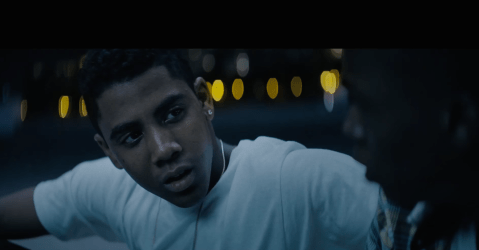
(l-r) Jharrel Jerome as Kevin and Ashton Sanders as Chiron, Screen capture from Moonlight trailer by SO! ed JS
CC: Yes! I love your reading of silence as a form of intimate conversance. It’s such a great way to think about how both people and cultures, putatively “worlds apart,” are in fact always talking to one another. I’ve also seen some writing on the prominent use of classical music, some of which suggested its “incongruousness” to the story, which I’m sure are based in part on problematic assumptions and associations.
SH: Right. There is a decidedly poignant conversation between this black, male, gay, urban narrative and orchestral music, which is a noteworthy choice. And yes, there are other musical genres represented in the film, but Jenkins seems especially to venerate orchestral music above the other genres. I mean, he did single it out for the live music screening, which necessarily raises its profile above the hip-hop, the R&B, the huapango.
In fact, in the wake of the special screening, those other genres, though important, might be interpreted as intervening on or interrupting the ongoing, and seemingly more important, conversation underway between the black, male, gay, urban narrative and orchestral music. In this context, we might see the prominence of the classical music as a rhetorical bid for the inclusion of this black, male, gay story in a distinctly white, Western cultural canon—not as a quest for whiteness per se but rather as a quest for the ontological normativity which whiteness has long enjoyed.
Perfectly supporting, perhaps even enabling, this conversation between this narrative and classical music is the very telling–quite political, really–application of the “chopped-and- screwed” mixing technique to the classical music in the score. That orchestral music, which is generally perceived as the music of the white elite classes–music, which, even when it is composed and produced in the US, still reads as distinctly European in origin and orientation–should be handled in the same way as the chopped-and-screwed masterpieces of people such as DJ Screw, OG Ron C, and Swishahouse, is more than just a little funny. It is deliciously subversive and, given the political moment, downright democratic and egalitarian.
In a piece for SO, Kemi Adeyemi discusses how the technique was created in Houston by the late DJ Screw in the latter years of the 20th century as a sonic representation of the “loosened, detached body-feeling” of the (black male) body under the influence of the substance lean. Adeyemi explains how lean, a mixture of codeine and sweet soda or juice, has become a chief coping mechanism especially of hip-hop-identified black males trapped in their unrelenting contention with aggressive racist assault that is usually directly responsible for their premature deaths via what Adeyemi identifies as the “discursive entanglements of race, labor, and drugs…in the neoliberal state.”
The “chop” part of chopping and screwing involves adding rhythmic breaks of repetition into a song, hearkening back to the turntable mixing of classic hip-hop. Playing off of Adeyemi’s analysis, I read this chopping as auditory representation of the inescapability of the pace of modern life, particularly the beat of life in a lethally racist context that will not be denied. The “screw” aspect involves the slowing of the song’s overall tempo, which transmogrifies the original track into a plea for more time just to be and for more space to be unmoored from all the dangers poised to assail the black body.
Dave Tomkins, in a piece for mtv.com, quotes composer Nicholas Britell who wonders at the seeming magic of chopping and screwing to “open up all these new harmonics and textures…[and also to] stretch and widen out” phrases and words, enabling the listener to “marinate in the words more.” Britell notes that chopping and screwing the orchestral music of Moonlight’s score produced similar effects, explaining, “The same thing happens for the music, when it goes into those lower-frequency ranges. The sound becomes a feeling.” Tomkins points out that the “feeling” is often one of dread or coming doom that is distinctly black, male and urban, which dovetails Adeyimi’s discussion of chopping and screwing’s origins and cultural context. The film, then, forces the Eurocentric elite into conversance with blackness that is also gay, urban, Southern, hip-hop-identified, and beset by a range of lethal pressures.
Moreover, the orchestral music, in its chopped-and-screwed state, becomes a critical conveyance of deep meaning of the narrative. In the January 10th post-screening discussion, Britell emphasized how chopping and screwing produced “those lower-frequency ranges” by dropping the pitches of each instrument so that each was made to sound like another, deeper, more resonant one. This sonic masking speaks directly to the film’s central issues of voice, true identity, and intimacy.
Discussion between director Barry Jenkins and composer Nicholas Britell discussing “chopping and screwing” the score of Moonlight (starts at 4:10).
CC: The selection and transformation of music in Moonlight is definitely doing something to challenge all sorts of normative assumptions. And not just cultural assumptions either but our understanding of the experience of music and film altogether. Jenkins said in a separate discussion that the insertion of silence/music reflects Chiron’s consciousness, what he calls the “cogno-dissonance” of being Chiron. The idea of turning inward in the face of trauma was important to Jenkins. He and the sound crew apparently used surround sound and played with mixing to unbalance the audience’s sonic perception as a way to simulate this experience of trauma, which I think may have been less apparent in this particular theater setup. The thoughtful play on the phenomenology of sound shows us that music, at least in the Moonlight universe, is the substance of life.
SH: Yes. Music in this film is of the utmost importance, making direct and often very strong comment on every aspect of modern life, even to the point of marking trauma by speaking the unspeakable. As we’ve discussed before, various musical genres are put to the task of translating, interpreting, expressing life and its traumas.
However, there is one genre that is quite noticeably absent from this film. The absolute avoidance of the black church and its music is striking and lands a deft blow to a site within African American culture that has been stridently anti-gay despite its own embrace of rich, abundant LGBTQ artistic and cultural contribution. The reproach is so fierce, the black church is not allowed to exist in the film even on the plane of the lamest obligatory church tropes with which we are all too familiar. There is no Sunday service, no booming, looming vestmented preacher, no hymn-humming, Scripture-quoting grandma—not even a religious crisis set to a chopped-and-screwed Mahalia Jackson or Clara Ward track. The closest we get to religion is the swimming lesson as Juan, the trans-American father of the African diaspora, baptizes Little in the waters of the Middle Passage and teaches him how to survive in them. The context here is much more cultural and historical than it is religious. This thoroughgoing circumvention of the black church and gospel music in a film that traffics in reach-outs connotes nothing less than obdurate, unreprievable censure.
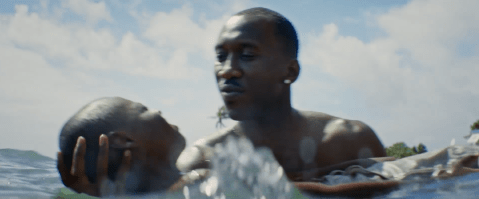
Hibbert as Little and Ali as Juan, Screen capture from Moonlight trailer by SO! ed JS
CC: This avoidance is especially interesting in light of the long history of gospel influence in the artistry of founding Black queer artists like Little Richard and Sister Rosetta Tharpe. And the exclusion of the Black church and its sonic registers interacts provocatively with the foregrounding of hip hop in Black’s arc since that genre has been characterized in some quarters as homophobic (though that critique can be reductive and itself plagued by racialized stereotyping).
SH: And in some instances, it has been homophobic, though that seems to be changing with the times and their increasing embrace of both the black secularism and the openness towards diverse black sexualities which Moonlight celebrates.
CC: So, what do you think you will remember most about this night, and this singular performance?
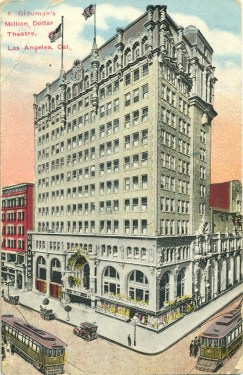
Vintage Postcard of Grauman’s Million Dollar Theatre, Downtown Los Angeles, which opened in 1918.
SH: This night is one that I think I’ll always love and remember for many reasons–the moody weather, the dinner beforehand with my old friend, Dr. Ruth Blandon, the buzzing excitement of the crowds, our spotting the amazing Mahershala Ali seated just across the aisle from us, the tour de force film, the panel discussion afterwards–but perhaps one of the greatest reasons will be that sense of overwhelming connection I felt that night. It was simply electric. I don’t know about you, but I felt deeply connected to the city itself that night, to Los Angeles–especially old, historic, LA, the LA that my grandmother moved to as a five-year old back in 1940. My grandmother will be 82 this coming September, so she’s still very much here in the flesh, but I felt especially close to her, or really, to what I imagine was her five-year old self. Thinking about her precipitated a connection to that old theatre. I wondered how many times she had been there, or knowing her penchant for mischief, how many times she had snuck in.
And then, in a more diffuse but not less important way, I felt a kinship with all the strangers in the theatre, gathered there that evening for a single purpose. So it is fitting to me that an event celebrating a film which devotes itself so thoroughly to “reach-outs,” as we’ve called them here, to these critical, radical conversations in pursuit of conversance, would have also so generously provided me an opportunity to experience my own, very personal reach-outs and connections. What about you?
CC: Absolutely agreed. I don’t have as much of a connection to this city as you, being part of the dreaded transplant-class, but it speaks to the power of events such as this that I feel it more. There’s something to our exchange, too, that speaks not only to the importance of the film, but also, in this time of threatened funding to the arts, the critical nature of collective enjoyment and, indeed, production of daring new art by queer people of color.
The film reaches out and touches folks who don’t often get that experience and there’s no better example of this than the closing sequence. The film ends with Black talking to Kevin about the absence of intimate touch in his life and then a moment of the beautiful silent conversance that you pointed out earlier. The parting shot is of the most tender contact, over which we hear the sound of crashing waves. This visual-sonic collage suggests that the act of gay black men touching is elemental, almost tectonic—at once basal but also a force of nature; at once deeply individual (the actual final image is a dive inward, of young Chiron looking back at us from a darkened beach), but also an image of ceaseless, living tenderness, like the rolling waves on the Liberty City shores. I think the two thousand people in the room that night, both of us included, however differently we may all have perceived it, felt that touch.

Miami Beach, Image by Flickr User Beaster 725, (CC BY-NC-ND 2.0)
—
Featured Image: Screen capture of Alex Hibbert as Little from Moonlight Trailer by JS
—
REWIND!…If you liked this post, you may also dig:
Fade to Black, Old Sport: How Hip Hop Amplifies Baz Luhrmann’s The Great Gatsby– Regina Bradley
Quiet on the Set?: The Artist and the Sound of a Silent Resurgence– April Miller
Sonic Connections: Listening for Indigenous Landscapes in Kent Mackenzie’s The Exiles–Laura Sachiko Fujikawa
Enacting Queer Listening, or When Anzaldúa Laughs–Maria Chaves Daza
Share this:




Current Top Posts





April 2021

January 2020

November 2019

October 2019

August 2019

April 2014

November 2017

March 2015

December 2017

October 2015


Recent Comments