
SO! Reads: Jace Clayton’s Uproot

 “Music has always confounded value,” writes interdisciplinary artist and writer Jace Clayton in Uproot: Travels in 21st-Century Music and Digital Culture (FSG Originals, 2016, 22). Recounting his extensive international travels performing as DJ /rupture, Clayton presents a flow of cosmopolitan musical experiences that illustrate complex collisions between music and value around the world. Whether writing about homemade sound-systems in tropical clubs in Brooklyn, or about shellac preservation at the Arab Music Archiving and Research Foundation in Beirut, Clayton considers the technologies by which we make — and place value on — musical sounds in “a world where worth is created in radically different ways from what the market teaches us” (24).
Uproot is a narrative about the ways working musicians experience globalization. “Our music seems to sound the way global capital is — liquid, international, porous, and sped up,” the author writes (16). This homology between sound and economic processes echoes the theories of sociologists like Anthony Giddens and the late Zygmunt Bauman, both of whom argue that modern life is characterized by fluidity and fragmentation: employment is precarious, experience is mediated, and ethical decisions are full of ambiguity. These ideas clearly inspire Clayton’s narrative; that said, Uproot is not an academic publication. As Atossa Araxia Abrahamian writes at the Nation, the book evades genre, “at once travelogue and cultural ethnography, pop philosophy and memoir, a guide to contemporary music and a fanzine.”
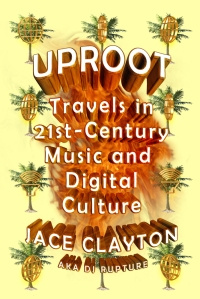 The book begins with a discussion of the history of Auto-Tune. While Clayton’s claim that Auto-Tune was the “first truly new sound effect of the internet era” might be overstated, his distinction between “corrective Auto-Tune” and “cosmetic Auto-Tune” is useful, the first of many moments of clarity in parsing the ways we use and mis-use musical media today. “The robot voice signifies differently everywhere you go,” he writes, an observation that becomes central to the book (49). By refusing to take a deterministic stance toward technology, Clayton empowers the musicians he writes about, acknowledging the ways in which artists mold trends to their own regional and local purposes. Of collaboration with a violinist in Morocco, Clayton writes: “We may have thought similarly, yet our ‘default settings’ were so far apart as to be almost incompatible” (185).
Uproot offers intimate insights into a range of tools and techniques of production, such as compression artifacts, “refixes,” and dozens of music-making interfaces, including Clayton’s own “music software-as-art project,” Sufi Plug Ins.
.
Even language itself is conceived as a form of technological mediation, as when Clayton compares Arabizi — a phonetic spelling of colloquial Arabic — to the hybrid sounds of mahraganat music that the language is used to describe. Of these “wandering genealogies” that emerge from international conversations, Clayton suggests that any hybrid genre we can imagine likely already exists: “Accordions and African techno? It’s called funaná” (102). The book describes at least a dozen other music traditions and microgenres–some very old, some just coalesced–from dabke to zar, each the product of a unique fusion of vocabularies.
Clayton on Mazaher (182): “Umm Sameh, Umm Hassan, and Nour el Sabah: these three women are some of the only people in Egypt keeping zar alive.”
Clayton’s own prose style, replete with metaphor and fluent in informal language, mirrors the ethos of music production he explores in the book: eclectic, energetic, and bursting with detail. What better way to describe Auto-Tune’s effect than as liquification of sound into a “bright neon stream, as if a dial-up modem and a river have fallen in love” (53)? Clayton’s technological travelogue extends beyond aural sensation alone. This is a story of “sidewalk vendors, radios, mosque loudspeakers,” (106) but it is just as much about “jerk chicken, fish tea, goatskin soup” (73). When Clayton describes his surroundings, we can touch the orange blossoms and smell the cigarettes.
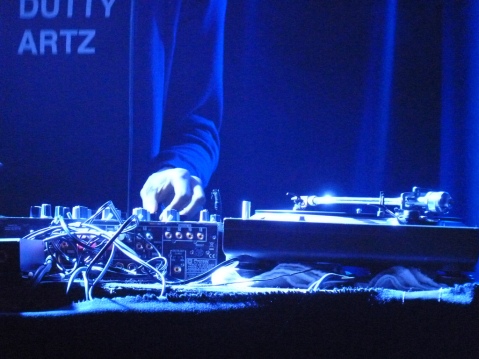
Dj /rupture performs in Minefield UK, 2010, image by Flickr User Paul Narvaez Attribution-NonCommercial 2.0 Generic (CC BY-NC 2.0)
The book’s recurrent question is how DJ practices in different locations are both constrained and inspired by financial flows. In any context, Clayton argues, “[m]oney runs to the people with the least imagination” (24). Early on, he establishes this view that musical experience is priceless, more valuable than any profit derived from rhythms of supply and demand, which reward the wrong people. That said, Clayton isn’t naive about musicians’ inevitable need for income, and throughout the text, readers are asked to inhabit ethical dilemmas that artists encounter throughout the world. At one point, Clayton describes his own moral quandary when asked to perform in front of a giant Red Bull logo, a “glowing lump of techno-fascist DJ furniture.” Later, Clayton critiques the hegemony of “Red Bull patronage” and similar systems of support for artists who are desperate for funding (121). He makes clear his disdain for corporate sponsors, companies that “appear generous as they let us know that our music is literally worthless to them” (123).
A tradeoff emerges between pragmatism and idealism. Clayton pokes holes in the empty rhetoric of “authenticity” that marketers encourage and exploit, even as we sense that he hasn’t yet relinquished his belief in something essentially good about the human spirit. Listening is a powerful social practice that, in Clayton’s view, gives true meaning to music in a global economy that otherwise undervalues it. “The heavier the workaday grind to escape from, the more a party transports us” (73), he writes, suggesting that listeners extract their own surplus value.
At times, Clayton’s observations could benefit from an engagement with ethnographic methods that can help mitigate fieldwork biases. For example, although the book does involve open discussions of gendered inequalities, they are limited in scope. At one point Clayton calls attention to “macho wrangling over propriety and womanhood” among managers and producers in Agadir, Morocco (52); he describes his own futile attempt to acquire a frank interview with female singers amid the patriarchal structure there. But despite Clayton’s awareness of gendered power dynamics, he does not critique the male musicians and producers who propagate such imbalances.
When female figures do appear, they are often treated as side characters. Rihanna, for example, is presented as exemplary of the business model of “singer as mouthpiece” (50), a person for whom others do the work. Clayton isn’t wrong to call attention to the large networks of employees that work behind any celebrity brand, but it is risky to do so at the expense of female workers, especially in the midst of a book that elsewhere describes women as decoration for the musical environments in which men perform what are presumably more important tasks. “Naked girls on pedestals [who] got their bodies painted” (19), “photoshopped young women” (49) and “demure girls” (49) all set scenes for tales of male creativity. This is not to critique how some women may choose to participate in music scenes, but rather to point out that women’s concerns and perspectives are not Clayton’s focus in these passages, nor in much of the book.
On Berber Auto-tune star Saadia Tihihit (49-50): “Like Justin Beiber or any child groomed to be a media star, Saadia Tihihit occupies a place at least initially defined more by the commercial strategies of those around her than by any desire for artistic autonomy.”
Comparably, Clayton’s conception of music and global inequality is sometimes uneven. Drawing stark divisions between the “civilized” and otherwise, he resorts to clichéd language when he writes of “backwater Uzbekistan” (31) and “war-torn Africa” (81). When he describes towns and villages near Casablanca where “ancient rhythms of life still hold sway” (33), he reproduces exoticizing tropes of African music. Elsewhere in the book, Clayton addresses musical accusations of fetishism, stating: “I know that Africans and blacks have been fetishized for centuries now, perhaps millennia. Who cares? You simply exist in all your complexity and let them deal with it. Fetishism is so vague” (84). He also critiques what he calls the “spectacle of a so-called ancient culture” (99) that is often at the heart of “world music” scenes, but then describes Appalachian musical performance as “the old-timey way with banjos and fiddles and washtub percussion” (32), opposing these practices against technological advancement, a false dichotomy that ethnomusicologists work to complicate, if not avoid.
Clayton brings these issues to a head during the book’s extensive discussion of “world music” as a marketing category. His commentary on the conundrums of appropriation surrounding figures such as Paul Simon, M.I.A., and Moby feels familiar, but he surpasses the usual analysis of these common case studies with more personal insights into “world music,” beginning with crate-digging excursions at record shops with deep international selections, such as the now-defunct RRRecords in Lowell, Massachusetts. Clayton contrasts his own on-foot exploration of foreign sounds with what he calls “World Music 2.0,” an internet-driven network of musical discovery based around the commodification of information and attention, in which middlemen reign supreme. His ambivalence is exemplified by this claim: “At its worst, World Music 2.0 offers the clubland equivalent of a package vacation. At its best, it propels some of the most exciting music in the world” (104-105).
The book’s ideas occasionally undermine themselves, but there is no question that the author ultimately intends to advocate for people on the margins. As Max Pearl has noted at the LA Times, Clayton consistently defends lo-fi, lo-tech, and lo-res sonic expression — that which is “distorted, homespun, libidinous” (80) — as valuable in its own right. Further, Sukhdev Sandhu has suggested at the Guardian that the book’s attention to homologies between “the movement of sounds and of migrant bodies” serves to recognize the struggles of global refugees and affirm their humanity.
Among Uproot’s many mentions of transport, readers never receive a clear statement about what, precisely, the relationship between music and motion is, or how exactly value emerges from that pairing. Rather than a weakness of the book, however, maybe such equivocation should be taken as an accurate reflection of the nebulous circumstances in which many of us find ourselves — creators and listeners who are regularly uprooted, usually at the mercy of those whom the money follows. Faced with this precarity, let Clayton’s enthusiasm for all sounds ground you.
Uproot is accompanied by an online Listening Guide that includes audio and visual examples of music from the book: http://www.uprootbook.com.
—
Featured Image: DJ /rupture performing at the Fórum Eletronika de Mídias Expandidas 2005 by Flickr user Brayhan Hawryliszyn (Attribution-NonCommercial 2.0 Generic (CC BY-NC 2.0)
—
Elizabeth Newton is a doctoral candidate in musicology. She has written for The New Inquiry, Tiny Mix Tapes, Real Life Magazine, the Quietus, and Leonardo Music Journal. Her research interests include musico-poetics, fidelity and reproduction, and affective histories of musical media. Her dissertation, in progress, is about “affective fidelity” in audio and print culture of the 1990s.
—
 REWIND!…If you liked this post, you may also dig:
SO! Reads: Dolores Inés Casillas’s ¡Sounds of Belonging!–Monica De La Torre
SO! Reads: Roshanak Khesti’s Modernity’s Ear–Shayna Silverstein
Lokananta: Sounds of Crisis and Recovery from Indonesia’s National Record Company — Ian Coss
Share this:

Spaces of Sounds: The Peoples of the African Diaspora and Protest in the United States

The slaves who were ourselves had known terror intimately, confused sunrise with pain, & accepted indifference as kindness. – Ntozake Shange, Sassafrass, Cypress & Indigo
Sanford. Baltimore. Chicago. Staten Island. Charlotte. Cleveland. Oakland. Austin. Los Angeles. The Bronx.
Despair in the United States is nothing new. It is neither an emotion confined to the neatly-drawn borders of this land nor is it experienced more acutely by any one group of people. The vast discrepancy between the results of the popular vote and the electoral college’s selection of Donald Trump as forty-fifth president of the United States amply reveals despair to be an sentiment viscerally experienced by a wide swath of people in this country, irrespective of race, ethnicity, gender, class, or sexuality.
Such despair has been ignored, however, by those who have caused and who continue causing the suffering of peoples of both indigenous and, later, African descent. We are taught that men from what we now recognize as Europe arrived in this hemisphere in the late fifteenth century, settling initially on a strip of earth in the Caribbean Sea that would become the first site of massacre and genocide, acts which unleashed, if one lends credence to the narrator of Junot Díaz’s The Brief Wondrous Life of Oscar Wao, the fukú, the “Curse and the Doom of the New World.” The narrating voice himself characterizes the curse not in the actions of death, but in the “screams of the enslaved, [..] the death bane of the Tainos, uttered just as one world perished and another began […]” (1). The fukú resonated through the sounds that these human beings made.

Image of the People’s History of Telegraph Avenue mural, designed by Osha Neumann, painted in 1976, restored and enlarged in 1999, at the corner of Haste and Telegraph in Berkeley. Image by Flickr user nursenicole329 (CC BY-NC-ND 2.0).
.
Not a house in the country ain’t packed to its rafters with some dead Negro’s grief. – Toni Morrison, Beloved
The State’s unwillingness to hold George Zimmerman responsible for the murder of Trayvon Martin–and its subsequent refusal to hold any police officer accountable for the hundreds of deaths they have caused–has galvanized the United States in the last four years. Hundreds of thousands of men, women, and children alike have taken to the streets, as #BlackLivesMatter, a true and succinct sentence, has roused ghosts of the past who have never left us, who have always been present, accompanying us on this journey.
This post is not a reflection of the music that has served as a soundtrack to these protests, though there are articles that have done so, such as this one, this one, and this one. These pieces do not include the extensive list of articles that address perhaps the most widely-viewed piece of protest music thus far, Beyoncé’s “Formation” video, a scarce offering of which can be found here, here, and here. Instead, it is an essay inspired by the sounds of the protesters themselves, the noises made by the minds, bodies, and spirits of the men, women and children who have taken to public spaces and sometimes commercial zones in order to confront and object to the protections applied to those who kill men, women, and children, often of African descent.
Listen to Los Angeles in 2013. . .
. . .to Houston in 2014. . .
. . .to New York City in 2014. . .
. . .and to Charleston in 2015. . .
. . .
 In his pivotal Cities of the Dead: Circum-Atlantic Performance (1996), Joseph Roach characterized New Orleans and London as urban centers marked by two simultaneous, consistent acts: appropriation by white people and white power structures of the cultures of the peoples they have violently marginalized, and then, at the same time, a clear distancing from those very cultures and peoples. Although now in its twentieth year of publication, Roach’s theorization of the circum-Atlantic world remains vastly underutilized in scholarly circles—particularly in sound studies, where it should have special resonance– and has become increasingly critical to our understanding of this historical moment, as it “insists on the centrality of the diasporic and genocidal histories of Africa and the Americas, North and South, in the creation of the culture of modernity” (4). With this configuration, Roach accomplishes two feats simultaneously: first, he decentralizes the United States as the focal point of studies about the so-called New World, instead, placing on equal footing all of the histories and cultures of the Americas. For this scholar of the literatures of the Americas, particularly those written by men and women of African descent, Roach’s is a critical gesture that facilitates comparative work across national boundaries.
Second, and most importantly, Roach emphasizes the role of murder, rape and the destruction of whole cultures indigenous to the American and African continents in the foundation of the nations of this hemisphere. Ta-Nehisi Coates is perhaps the most recent writer to remind us that the most potent legacy of such modernity, racism, “is a visceral experience, that is dislodges brains, blocks airways, rips muscle, extracts organs, cracks bones, breaks teeth” (Between the World and Me, 10). That which we know as “modernity,” itself a deeply flawed construct that remains in need of serious revision, was born of broken backs, mutilated limbs, hushed middle-of-the-night tears of indigenous and African peoples. Moans and sighs, whispers and wails, cries and screams, they are the musical score of this hemisphere’s American experiment.
The slaves who were ourselves aided Indigo’s mission, connecting soul & song, experience & unremembered rhythms –Ntozake Shange

Harriet Tubman Memorial Monument, Harlem, Image by Flickr User John Mannion (CC BY-NC-ND 2.0).
In the face of a populace accustomed to ignoring the wailing of mothers who have buried their children, who have disregarded their dignity and the weight and shape and taste of their loss, men, women, and children have mobilized. They have made manifest that which communities of peoples of African descent have spoken of and have documented since the founding of this nation. As Roach has utilized the term performance, the literal rituals of mourning by communities of African heritage not only commemorate those who have recently passed but they also invoke the spirits of those who have long borne witness to such violence. Throughout his study, Roach distinguishes between a European heritage that begins to segregate the living from the dead during the Enlightenment (50), and more traditional cultures, particularly African ones, where spirits mingle with their human counterparts. While written texts may not, and often do not, adequately commemorate the loss of lives deemed marginal to the larger society, performance itself – chants, wails, songs – serve not only to memorialize but also as gestures of restoration.
Protesters and activists are no longer satisfied with the well-established decree that we should wait for a distant moment for a more perfect realization of the United States’s many promises. No, instead, they have identified this as the historical moment in which those oaths are to be fulfilled. They have walked, marched, and stomped through streets, on sidewalks, parks, churches, filling malls and transportation hubs with their bodies as testimony. They have repossessed and redefined spaces once thought of as simply neutral, transparent space as Katherine McKittrick refers to it in Demonic Grounds, revealing the fault-lines of difference based on class, race, gender, and sexuality in this society (xv). They have done so manipulating sound, both recycling chants used through the decades to protest injustice and, at times, simply occupying space, without a word uttered.
The silence waged in the 2014 protest in Grand Central Terminal after the non-indictment of Daniel Pantaleo in the murder of Eric Garner does not represent erasure, but rather a purposeful demonstration of the willful humanity of those unwilling to forget.
They quiet themselves. They replace the sounds of unfettered pain and grief with its absence, until all that you hear is the mechanized announcement of train schedules. The contrast is stark: the moment highlights what Claudia Rankine has identified as the condition of black life in Citizen, that of mourning (145), against a backdrop of technological advancement, that which has been built on the backs of and through the physical, emotional, and intellectual labor of black life. Here, the members of this community enact what has been called a “die-in”: simulating the physical positioning of bodies in caskets, they force onlookers to confront an uncomfortable truth about the history of this country and of the nations of this hemisphere.
All of us walk on land soaked in the blood of those who have made our lives easier and more convenient. The men and women at Grand Central make manifest what Roach terms surrogation: in the chasm left by death, they offer a replacement, one that both evokes those who have died and disturbs the complacency of survivors themselves (2). The performance serves to confront those who dare say that the violence of genocide and enslavement of past generations should remain in the past; no, these men and women and the spirits they invoke respond. Time is not linear, as we have been taught. For past, present, and future are temporal constructs used to service oppression and domination; this will no longer do.

From Kara Walker’s 2014 exhibit, “A Subtlety,” at the Domino Sugar Factory in Brooklyn (CC BY-NC 2.0)
Here, in this here place, we flesh; flesh that weeps, laughs; flesh that dances on bare feet in grass. Love it. Love it hard. – Toni Morrison
We bear witness to the reclamation of grief, of lives cut short at the hand of a government charged with protecting those human beings who inhabit its borders, at least theoretically. While, as Roach surmises, “memory [may be] a process that depends crucially on forgetting” (2), we hold space to those dedicated to not forget, to instead excavate the silences, breathe life into those histories, remembering that the stories we have heard, the pages we have read, were once human beings. We create “counter-memories” as challenge and testimony, as a sacred pledge to those who are no longer present physically in this realm (Roach 26). We recall the cultures and practices of those who lived before the written form was a tool of exclusion, when remembrance was a practice of community.
American culture, in the hemispheric sense, incorporates all such rituals, across generations; as Roach notes, it is performance that “works on behalf of living memory, by bringing the parties together as often as necessary” (138). No longer consigned to the past, the spirits of those killed by the state are revived, their existences in the human plain celebrated. They are not defined by how they died but instead by how they lived. While literacy of the written form can separate, sound and gesture more effectively bypass the fictions of difference based on race, ethnicity, gender, class, and sexuality. Cities of the Dead amplifies how “performance can articulate what otherwise may not be properly communicated” (161).
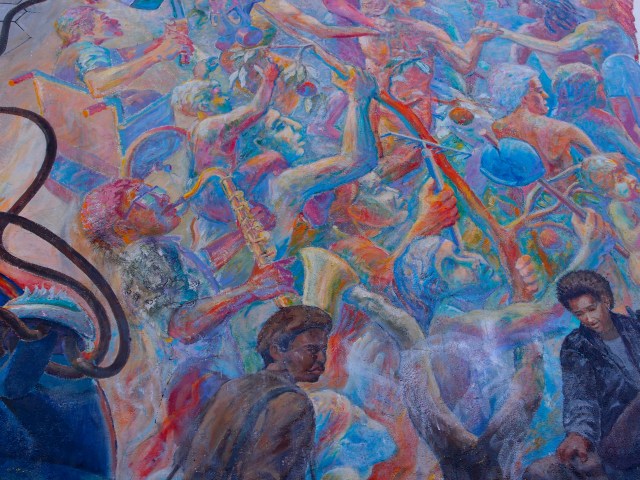
Image of the People’s History of Telegraph Avenue mural, designed by Osha Neumann, painted in 1976, restored and enlarged in 1999, at the corner of Haste and Telegraph in Berkeley. Image by Flickr user nursenicole329 (CC BY-NC-ND 2.0).
It’s so magic folks feel their own ancestors coming up out of the earth to be in the realms of their descendants – Ntozake Shange
We say their names. We say their names: Eleanor Bumpers. Anthony Báez. Sean Bell. Aiyana Stanley-Jones. Tyisha Miller. Oscar Grant. Rekia Boyd. Trayvon Martin. Tanisha Anderson. Renisha McBride. Eric Garner. Yvette Smith. Tamir Rice. Sandra Bland. Freddie Gray. Korryn Gaines. Akia Gurley. Alton Sterling. Philando Castile. Micah Jester. Deborah Danner. Walter Scott. Michelle Lee Shirley.
The list, tragically, grows, and still we say their names. We do so as an act of remembrance. As an offering. As peoples of African descent around the world do in times of ceremony, in the name of ritual. We remember those who have come before us, who have birthed this current historical moment of awakening here in the United States. We say their names.
And, as the sounds of their names said aloud echoes, we pray. Ashé.
—
Vanessa K. Valdés is associate professor of Spanish and Portuguese at The City College of New York; she is the editor of Let Spirit Speak! Cultural Journeys through the African Diaspora (2012) and The Future Is Now: A New Look at African Diaspora Studies (2012) and the book review editor of sx salon. She is the author of Oshun’s Daughters: The Search for Womanhood in the Americas (2014). The title of this essay is inspired by Josh Kun’s Audiotopia: Music, Race, and America, where he writes that his book is “focusing on the spaces of music, the spaces of songs, and the spaces of sounds” (25).
—
Featured Image “Freedom Marchers” by Flickr User Keoni Cabral, Photoshop processed digital image from the Martin Luther King Center in Atlanta, Georgia (CC BY 2.0).
—
 REWIND! . . .If you liked this post, you may also dig:
SO! Reads: Shana Redmond’s Anthem: Social Movements and the Sound of Solidarity in the African Diaspora—Ashon Crawley
Music Meant to Make You Move: Considering the Aural Kinesthetic–Imani Kai Johnson
Black Mourning, Black Movement(s): Savion Glover’s Dance for Amiri Baraka–Kristin Moriah
Something’s Got a Hold on Me: ‘Lingering Whispers’ of the Atlantic Slave Trade in Ghana–Sionne Neely
Share this:




Current Top Posts





April 2021

January 2020

November 2019

October 2019

August 2019

April 2014

November 2017

March 2015

December 2017

October 2015


Recent Comments