
SO! Amplifies: Cities and Memory
 SO! Amplifies. . .a highly-curated, rolling mini-post series by which we editors hip you to cultural makers and organizations doing work we really really dig. You’re welcome!
—
Inspired by how sound and memory interact, Cities and Memory is a sound program with the aim of “remixing the world, one sound at a time,” existing on the (already quite blurred) line between documentary field recording and sound art.
Its primary manifestation is an online global sound map, on which every location boasts two sounds, the “city” and the “memory.” The “city” sound is the faithful, documentary field recording capturing that place at that time, as it existed and was heard. The “memory” sound is a reimagined, remixed, reinterpreted version of that sound: everything from oral reconstructions, full-on techno tracks built around a field recording, ambient reimaginings, and all the points in between, as summarized in this roundup of creative approaches from the site. The reimagined sounds represent how sound is remembered and experienced differently by each individual, and explore what happens in that magical period between sounds being physically experienced and their being mentally processed, interpreted, and above all felt.
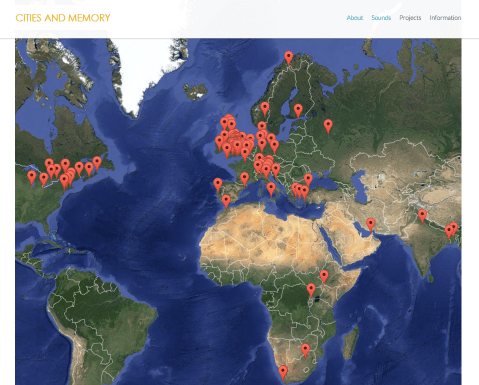
Starting from that basic premise, Cities and Memory has collected more than 600 sounds from around the world in just over a year, with more than 100 artists, musicians, field recordists and sound enthusiasts contributing anything from a field recording snatched on a mobile phone through to a complete musical reconstruction.
Over recent months, Cities and Memory has expanded with a series of projects each exploring a different avenue or window onto sound that has been opened up. For instance, last November saw #HamburgSounds, an ambitious project to sound map the vast city of Hamburg, Germany and to reimagine its sounds. A four-day recording session garnered enough recordings for forty sound artists each to give their take on a different aspect of Hamburg’s sounds and what they meant to them. The results were symbolically released over a 24-hour period, representing a day in the city’s life, and in the memories and imagination of its citizens. For more sounds from Hamburg, click here.

This year also saw a project using Brian Eno and Peter Schmidt’s Oblique Strategies cards as creative direction for reimagining field recordings. The reimagined sounds that came from more than 100 different creative strategies employed in the project were even more diverse than its locations, which covered everything from jungle in Thailand and Shanghai temples to the urban centres of Chicago, New York and London. Spectrum analysis, musical cryptograms, working simultaneously with artists in different countries, even TripAdvisor reviews(!) – every creative sonic technique in the book seems to have been used in one way or another.
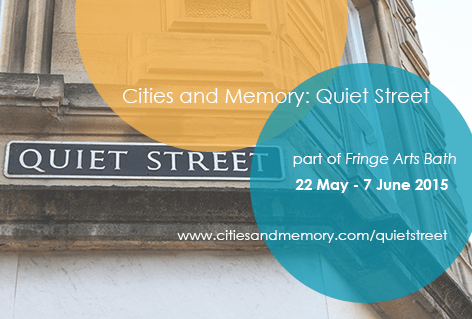
The latest project, called Quiet Street, takes the form of a simultaneous digital and physical exhibition, reimagining the sounds of the city of Bath as part of its Fringe Arts Bath Festival. The physical installation presents two sides of sonic memory – first, the documentary field recording of a location in Bath, and second the reimagined, or ‘memory’ version of the sound. The audience can navigate between two sonic ‘versions’ of Bath simultaneously on different sides of the space. One side broadcasts the “city” sound from a location, the other the matching “memory” sound, a remix or reinterpretation of the field recording, time-synced so that the sets of sounds shift in and out of one another in unison. The listener chooses – by his or her own physical proximity – to experience freely the two sound worlds.
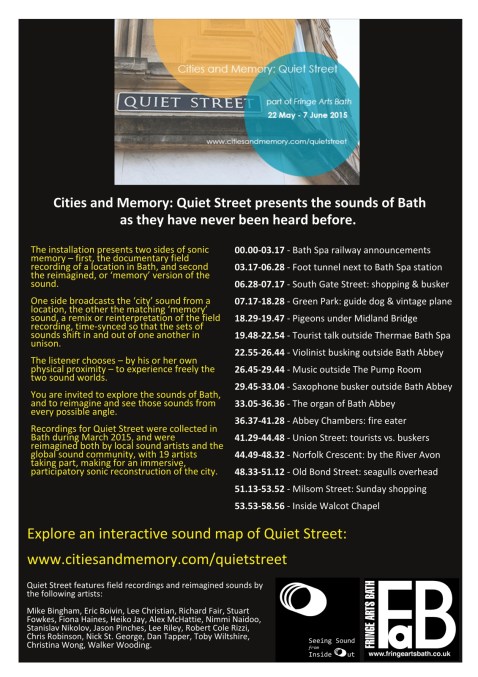
Visit the physical installation of Quiet Street at Fringe Arts Bath Festival, 22 May 2015 – 7 June 2015 at 8/9 New Bond Street Place, Bath
As the “city” and “memory” sounds are precisely time-synced in the installation, an additional creative challenge for the artists was to create reimagined version the same length as the source field recording. More importantly, they also needed consider not just how the reimagined sound stood on its own, but how it would live simultaneously in the same space as the field recording, creating a direct tension between “real” documentary sounds and the memory of those sounds in the same space.
The digital exhibition of Quiet Street allows the sounds to be explored through a map interface. It also allows listeners to simulate the installation experience with a series of installation mixes, presenting the field recording and reimagined sound on opposite sides of the stereo field. You can access playlists here and here as well as download the album documenting the event here.
As a curator, the most exciting thing to me is that the central idea behind Cities and Memory is so open; there are almost infinite possibilities for its application. A new angle on sound, place or memory can bring up a new project at any point, and every contributor brings their own experience and interpretation.
In the course of exploring hundreds of field recordings, examining them in detail and finding a creative angle from which to reinterpret them, I’ve developed a new appreciation not just of field recording as a practice, but of how to listen to whichever environment I find myself in. It’s given me a new perspective on sound and on music, and how utterly blurred the lines are between the two. I listen very differently to the world now. As Cities and Memory continues to grow, I hope many others will too.

—
Stuart Fowkes is the creator and curator of Cities and Memory, producing a large number of the source field recordings and reimagined ‘memory’ versions himself, as well as curating the project as a whole. Quiet Street runs from 22 May to 7 June at 8/9 New Bond Street Place, Bath, as part of Fringe Arts Bath, and digitally at www.citiesandmemory.com/quietstreet. Find out more about Cities and Memory and how to contribute: http://citiesandmemory.com/what-is-cities-and-memory-about/
—
 REWIND!…If you liked this post, you may also dig:
Toward A Civically Engaged Sound Studies, or ReSounding Binghamton–Jennifer Stoever
SO! Amplifies: Ian Rawes and the London Sound Survey–Ian Rawes
SO! Amplifies: Carleton Gholz and the Detroit Sound Conservancy–Carleton Gholz
Share this:

SO! Amplifies: Maile Colbert, Rui Costa, and Jeff Cain’s “Radio Terramoto”

SO! Amplifies. . .a highly-curated, rolling mini-post series by which we editors hip you to cultural makers and organizations doing work we really really dig. You’re welcome!
—
This November 1st will mark the 259th anniversary of the Great Lisbon Earthquake on All Saints Day, 1755, which destroyed a quarter of the city and beget consequential tsunamis and fires. “Radio Terramoto” is a soundwalk research and art project designed to bring this seemingly distant devastation into contemporary consciousness. Based on the idea of listening to sound from a past historical event, “Radio Terramoto” is a traveling audience immersive event. It’s inaugural procession, made up of the creators and audience members, followed a path from the Convento do Carmo down to the River Targus in Lisbon, Portugal. It was also performed this summer in the town of Viseu, Portugal, as part of the Invisible Places, Sounding Cities Symposium in July 2014.
.
“Radio Terramoto” is a radio transmission from All Saints Day, 1755. We are not sure how or why the forty minutes were recorded, but having been discovered aaccidentallyit has proven to be an important record of the experience of the people caught in the earthquake. We follow our mysterious ghost recorder from the Convento, where people were gathered for mass. The first wave hits and the convent crumbles. As people run to the river, we follow their path as the buildings around us burst into flames and collapse. Upon reaching the river in a panic, we are only to be greeted by the water pulling out, revealing flopping fish and shipwrecks, pulling towards the ocean to fuel the giant wave that would finally overcome our poor recorder. From here, the transmission stops. (To read this summary in Portuguese click here).

The end of the inaugural “Radio Terramoto” performance in Lisbon, 11/1/13
The project and research for “Radio Terramoto” asks the question, what can listening to the past reveal about the now, both in artistic practice and scientific research? Its site-based (yet mobile) sound design weaves between the present and the past and is based on research on the earthquake, using documents of first hand experiences and the first seismic and “earthquake”-proof architecture that came after what may be the largest earthquake recorded in history.
 For the original “Radio Terramoto” soundwalk in Lisbon, first performed November 1, 2013, we walked with the audience bearing a transmitter; the audience carried radios and cell phones tuned into the specific frequency of the transmission. The soundwalk also included hand-held sculptural octahedra created using a geometric framing system designed by Jake Dotson, assembled as a singular form approximating a Pombaline cage, the first modern earthquake resistant architecture. The radio transmitter, and other key electrical devices were suspended in these 1 foot 3 inch octahetra made of brightly colored sticks of wood held together with friction and tension. The large cage broke apart into the individual octahedra to aid in the transportation of equipment and in providing a visual wayfinding aide for the participants.

“Radio Terramoto” procession, Maile Costa and Rui Colbert in the foreground, Lisbon, Portugal, November 1, 2013
Like Maile’s “Passageira em Casa,” a traveling intermedia work that explores the concept of “home,” “Radio Terramoto” changes to be site and context specific with each presentation. When we led a performance in Viseu, Portugal, for example, we began at the Sé de Viseu, moved through the old city center, and ended at a small body of water off the Avenida Emídio Navarro.
.
-

- Maile begins “Radio Terramoto” at the Sé de Viseu
-

- Audience procession along Rua Nova do Almada in Viseu
-

- The end site for “Radio Terramoto” in Viseu, Avenida Emídio Navarro
.
Planned future performances of “Radio Terramoto” include a version in Los Angeles that will unite the original team in collaboration with Jesse Gilbert. Gilbert created the program SpectralGL, a cell phone app that enables sound to visually affect the landscape from the video camera as the audience member walks. As Los Angeles has its own fraught relationship with earthquakes, we expect this performance to be particularly resonant and thought provoking.
—
Images courtesy of the artists and Jennifer Stoever (Viseu shots)
—
Rui Costa is a sound artist from Lisbon, Portugal. He is a founding member and artistic director of Binaural/Nodar, an arts organization founded in 2004 and dedicated to the promotion of context-specific and participatory art projects in rural communities of the Gralheira mountain range, northern Portugal. Rui has been performing and exhibiting his work since 1998 in festivals, galleries and museums across Portugal, Spain, Italy and the United States and has been collaborating regularly with the Italian vocal performer Manuela Barile and the American intermedia artist Maile Colbert. Rui Costa is also a regular speaker in conferences and gives workshops dedicated to sound art. For more from Binaural/Nodar, please check out the organization’s soundcloud, vimeo, and flickr.
Maile Colbert is a multi-media artist with a concentration on sound and video who relocated from Los Angeles, US to Lisbon, Portugal. She is a regular writer for Sounding Out!
Jeff Cain is an artist, designer, curator and director of the Shed Research Institute a multidisciplinary art, research, curatorial, and design studio in Lincoln Heights, Los Angeles.
—
REWIND!…If you liked this post, you may also dig:
Wayback Sound Machine: Sound Through Time, Space, and Place-Maile Colbert
Six Years in Nodar: Sound Art in a Rural Context–Rui Costa
SO! Amplifies: Eric Leonardson and World Listening Day 18 July 2014
Share this:


Current Top Posts





April 2021

January 2020

November 2019

October 2019

August 2019

April 2014

November 2017

March 2015

December 2017

October 2015
 Sounding Out!

Recent Comments