
Reproducing Traces of War: Listening to Gas Shell Bombardment, 1918

Welcome to World Listening Month 2014, our annual forum on listening in observation of World Listening Day on July 18th, 2014. World Listening Day is a time to think about the impacts we have on our auditory environments and, in turn, its affects on us [for the full deets, peep our recent SO! Amplifies post by Eric Leonardson, Executive Director of the World Listening Project]. We kick off our month of thinking critically about listening with a post by media historian Brian Hanrahan, who listens deeply to sonic traces of the past to prompt us to question our desires for contemporary media representations of “reality.” It also marks the global 100 year anniversary of World War I this August 2014: a moment of silence. —J. Stoever, Editor-in-Chief
—
For some reason that I don’t fully understand, I am very emotionally moved by the space around a sound. I almost think that sometimes I am recording space with a sound in it, rather than sound in a space. –Walter Murch
If you want to listen to the past, there’s never been a time like the present. Every year, it seems, new old recordings are identified, new techniques developed to recover sounds thought irrecoverable. Here is Bismarck’s voice, preserved on a cylinder in 1889. Here, older still, is Edison’s. There is the astonishing recuperation of phonautograms – reverberation traced onto soot-blackened paper in the mid-nineteenth century, digitally processed and played back in our own. But as that processing underlines, no sound recording straightforwardly reproduces the real. An acoustic artifact is a compound of materiality, form and meaning, but also a place where technology meets desire. Old recordings meet the listener’s longing halfway; they invoke a reality always out of reach. And not simply a longing to hear, but also to touch, and be moved by, the fact of an absent existence.
Take, for instance, HMV 09308. In October 1918, just before the end of the Great War, William Gaisberg, a sound recordist of the pre-electric era, took recording equipment to the Western Front in order to capture the sound of British artillery shelling German lines with poison gas. Gaisberg died not long after, probably from Spanish flu, although some say he was weakened by gas exposure during the recording. Nonetheless the “Gas Shell Bombardment” record – a 12-inch HMV shellac disc, just over 2 minutes at 78 rpm – was released a few weeks later, just as the war came to an end. Initially intended to promote War Bonds, ultimately the record was used to raise money for disabled veterans.
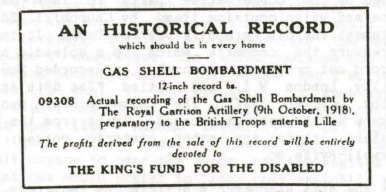
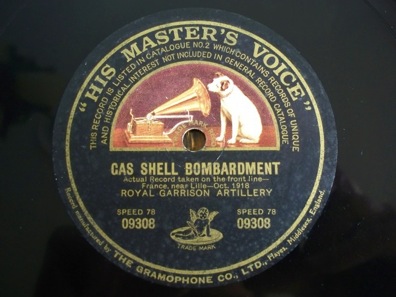
For decades, the HMV recording had a reputation as one of the very earliest “actuality” recordings – one documenting a real location and event beyond the performative space of the studio, imprinted with the audible material trace of an actual moment in space and time. Documents like this – no matter what the technology – usually come with additional symbolic authentication. Here, the record’s label does some of that work. This “historic recording,” says the subtitle, is an “actual record taken on the front line.” Publicity pieces drove home the message. In the popular HMV magazine The Voice, Gaisberg – or probably his posthumous ghost-writer – described the expedition in detail, claiming the track to be a “true representation of the bombardment.”
.
In the same issue, a Major C.J.C. Street compared the recording to his own experience on the Front. “Its realism,” he wrote, ”took my breath away… I played the record many times… finding at each attempt some well-remembered detail.” He didn’t say so in his article, but Street – an artillery officer, a novelist and a propaganda man for the intelligence agency MI7 – was in fact the impresario of the record. This was not the first time he had found astute uses for sound media. The previous year he had put together a record that set artillery drill commands to popular tunes – the recording was both a propaganda release and an army training tool for new recruits. With the Gas Shell record, Street knew he wasn’t just selling recorded sound, but also an auratic sense of closeness to an overwhelming reality, the palpable proximity of war and death. Authenticating detail helped to underpin this sense of an absent real made present. Street cued the listener for those “well-remembered details.” In particular, he singled out one indistinct rattly flap-whizz noise, hearing in it, he claimed, the sound of a round with a “loose driving-band.”
The record stayed in the HMV catalog until 1945, but only in the early 1990s were its production history and authenticity claims seriously examined. In specialist journals, archivists, collectors and amateur historians undertook a collective forensic and critical analysis. A promising auditory witness was located: 95-year-old Lt.-Col. Montagu Cleeve another former artillery officer, in his time a developer of “Boche Buster” railway gun, later a music professor – was invited to critically assess the recording. Cleeve vouched unreservedly for its authenticity. He heard in it, he said, an unmistakable succession of sounds – the clang of the breech, the gigantic report of the firing explosion, the distinctive whiny whistle of a gas shell on its way across no-man’s-land. Others looked to data rather than the memories of old soldiers. One expert on pre-electric recording noted the angles commanded in firing instructions, correlated them with known muzzle velocities for 4.5 and 6-inch howitzers, then used this and other information to “definitively” explain the counter-intuitive anti-Doppler sound of the shells’ whistling. He also identified the audible echo effect – the curious “double report” of the guns heard here – as the sound of a brass recording horn violently resonating at a distance of exactly 26.5 meters from the guns.
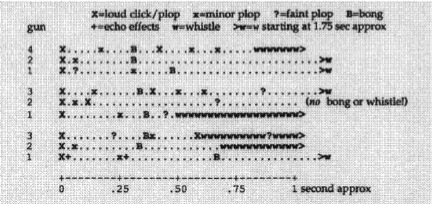
Peter Adamson, “The Gas Shell Bombardment record,” The Historic Record Quarterly, April 1991.
Eventually, skepticism won out. Close listening at slow speeds – just careful attention and notation, nothing more elaborate – revealed inconsistencies and oddities in the firing noises. The bongs, plops and whistles seemed internally inconsistent. Some of the artillery sounds – ostensibly a battery of four, firing in quick succession – varied implausibly with each successive firing. Physical evidence from the record’s groove, as well as extraneous noises – surface crackle and fizz, and, audible within the recording, the swish of a turntable – seemed to indicate at least two rudimentary overdubs, in which the output of one acoustic horn was relayed into a second, possibly using an auxetophone, an early compressed-air amplifier. All this resulted in a double- or triple-layered sonic artifact. Finally – the crucial evidence, although oddly it was hardly noticed at the time – an alternative take was located. In this take, according to its discoverer, the entire theatrics of gunnery command is simply absent, and there is no sound at all of whistling shells in motion. What was left was a skeleton sequence of clicks, thuds and cracks, supplemented with only a single closing insert, the portentous injunction “Feed the Guns with War Bonds!”
In short, it seems highly likely that any original field recording was, at the very least, post-dramatized with performed voices and percussive and whistling sound effects. So, it is tempting to say, that clears that up. The recording’s inauthenticity is proven. File under Fake. But in fact, if we don’t stop there, if we set aside narrow and absolutist ideas of authenticity, and instead explore the recording’s ambiguity and hybridity, then Gas Shell Bombardment becomes all the more interesting as an historical artifact.
Let’s assume, for the sake of argument, that some form of basic recording was done in France, very possibly a staged barrage specifically performed for Gaisberg’s visit, and that this recording then had effects added back at HMV in London. The record might then be seen less as a straightforward documentary, and instead as an unusual version of the “descriptive speciality,” a genre of miniature phonographic vignette dating back to the 1890s, far predating longer-form radio drama. Very little is known about these early media artworks, but it is a fair generalization to say that in America the genre was more slanted towards vaudeville comedy, whereas in Europe, imperial and military scenes predominated. As early as 1890, for example, there had been German phonographic representations of battles from the Franco-Prussian war. The Great War saw a flourishing of the genre. Scholars are just beginning to take an interest these old phonographs; here’s one recent essay on the “Angel of Mons,” for example, a British acoustic vignette of a famous incident on the Western Front.
Listen to a 1915 German descriptive speciality, depicting the attack on the fortress of Liège the previous year:
.
As a descriptive speciality, Gas Shell Bombardment is unusual because it incorporates an actual indexical trace. But such traces – as emphasized by Charles Sanders Pierce and many later media-theoreticians– do not resemble their referent, they are caused by it. The bullet hole does not look much like a bullet; thunder is lightning’s trace, not its likeness. But for Street and Gaisberg, the trace’s lack of resemblance caused problems: the original recording’s lack of detail, cues and clues, but above all its lack of internal dimensionality, created a perceptual shortfall and a lack of credibility. Maybe they hoped that the guns, by sheer force of amplitude, would overcome the spatially impoverished, reverbless reproduction of pre-electric recording. If so, it didn’t work. Without added effects, the guns’ trace was as flat and “body-less” as a sequence of Morse. It was a sound without a scene. The producers’ interventions aimed to thicken the primary artifact with referential-sounding detail, but also to heighten the sense of materiality and spatiality, and to strengthen the sense of diegetic presence, of worlded thereness. The soldiers’ voices – louder and quieter, close-up and farther-out – and the fake-Doppler of the “shell whistling” lent the recording narrative direction (literally, some trajectory) and “authenticating” points of detail. But above all they gave a sense of internal space to the recording, a space into which the listener could direct her attention.
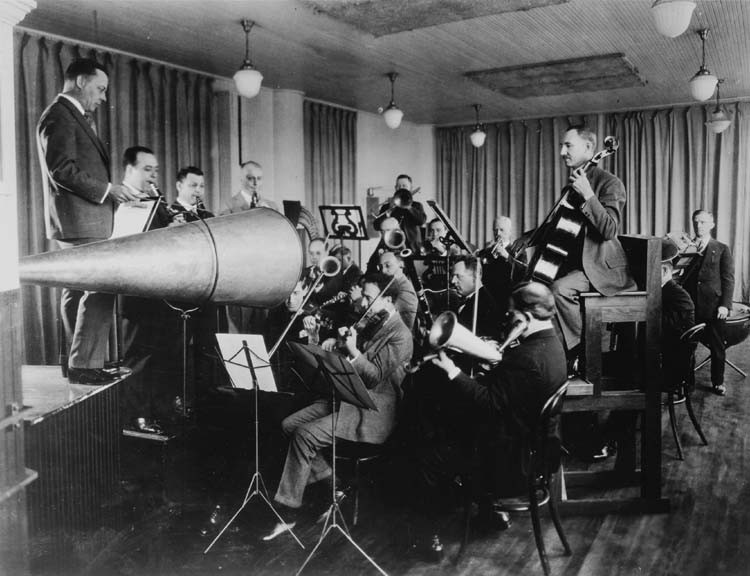
In this context, we can only admire the creativity and performative élan of the unknown production crew. We know little about effects production in early phonography. It is a safe bet that some techniques were adopted from theatre, and that there was overlap with silent film accompaniment. But whatever the method used, it would have called for the awkward orchestration of a limited number of iconic sounds to create an impression of a spatially coherent and materially detailed sonic environment. The recordist and his team would first have had to imagine how relative loudness – of voices, of material objects struck and sounded – might create a sense of spatial depth when transduced through the horn’s crude interface. Then they would have had to perform this as a live overdub, keeping time with the base track of the gun recording played through another horn. And all this done with participants and equipment crowded tightly around the mouth of the huge horn, crammed into the tiny pick-up arc, a scene looking something like this image of Leopold Stokowski’s pre-electric recording sessions or this photograph of the recording of a cello concerto.
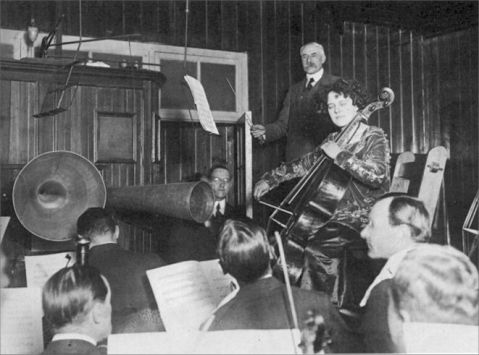
Acoustic recording session with Elgar and Beatrice Harrison, 1920
As well as this hybrid of trace and live performance, there is another performance here – Gaisberg’s journey itself. With twenty years of recording experience, Gaisberg was probably very well aware that the expedition would not yield a “realistic” recording of the guns. But the expedition had to be made, so that it could be said to have taken place. Expectations had to be primed and colored, so that, to use André Bazin’s famous phrase about photographs, the recording could partake in an “irrational power to… bear the belief” of the listener. The journey, and the accounts of Gaisberg and Street are not a supplement to the “true representation” of the gas bombardment. They are part of that representation. Moreover, in subsequent writing it is noticeable that the manner of Gaisberg’s death becomes a rhetorical amplification for the authenticity of the recording’s trace, as if his fatal inhalation (of gas molecules or flu bacilli) were itself a deadly indexation, paralleling the recording’s claim to capture the breath of the War, and even of History itself.
In media-historical terms, the Gas Shell Bombardment recording can be understood as a late, transitional artifact from phonography’s pre-microphonic era. The desire for the sonic trace, for an ever more immersive proximity to events was there, but electro-acoustic technology was not yet in place. Two years later, in 1920, Horace Merriman and Lionel Guest made the first experimental electrical recording, arguably also the first true field recording. The event, appropriately enough, was an official war memorial service in London, where Merriman and Guest – working for Columbia Records – put microphones in Westminster Abbey, running cables to a remote recording van parked in the street outside, where they sat amidst heating ovens and cutting lathes. By the end of the 1920s, remote recording and broadcasting, while never straightforward, were well on the way to ubiquity.
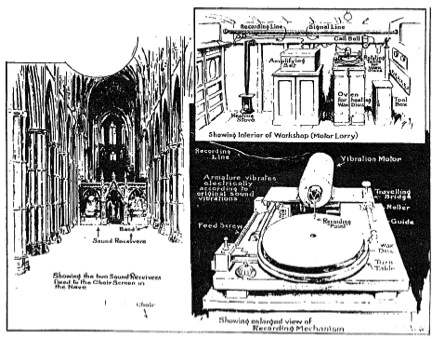
Illustrated London News, 1920.
Claims made on behalf of technologies of reproduction may seem simplistic, but there’s a grain of truth to their simplicity. If there were nothing special – even magical – in the referentiality of the camera that captures the moment, the recording that’s like being there, the liveness of the live broadcast, these things would not play the role they do in everyday life and in the ideological fabric of society. But there is falsehood too, in over-simplifying the nature and affective charge of old photographs, old footage, old recordings. These are made things, composed of different materials, media, signs and conventions; they are inseparable from the desires and expectations they induce and direct. They function in part by mimesis and verisimilitude, but also through the gaps, blank spots and false illusions of their trace. They can – rightly – intensify our feeling towards the past, but should also prompt us to think about our own desires and investments.
—
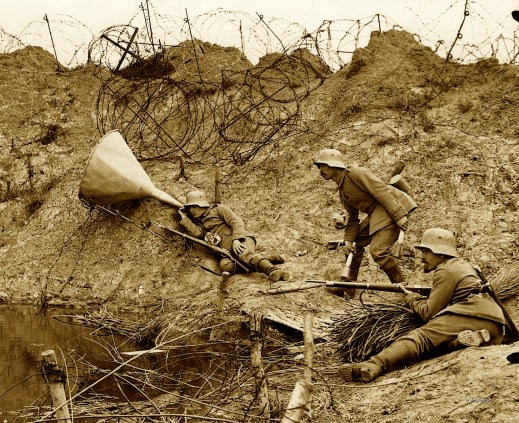
Image by Flickr User DrakeGoodman, “Horchposten im Spengtrichter vor Neuve-Chapelle 6km nördlich von La Bassée Nordfrankreich 1916,” A trio of lightly equipped soldiers from an unidentified formation oblige the photographer by looking serious and pretending they’re just metres from the enemy, listening for activity in his lines. The improvised “listening device” is actually a large funnel, probably liberated from a nearby farm.
—
Brían Hanrahan is a film, media and cultural historian, whose work focuses on the history of acoustic media, German and European cinema and the culture of the Weimar Republic.
—
Edited post-publication at 8:00 pm EST on July 7, 2014
–
 REWIND!…If you liked this post, you may also dig:
SO! Reads: Susan Schmidt Horning’s Chasing Sound: Technology, Culture and the Art of Studio Recording from Edison to the LP–Enongo Lumumba-Kasongo
A Brief History of Auto-Tune–Owen Marshall
DIY Histories: Podcasting the Past–Andrew Salvati
Share this:

Radio Ambulante: A Radio that Listens

 Welcome back to the final article in our three-part series, Radio de Acción. Special thanks to you, our readers, and to editors Jennifer Stoever and Neil Verma at Sounding Out! for hosting this addition to a burgeoning field of Latin American critics and producers who are changing the way we hear radio as history, as theory, and in practice.
Over the past several weeks we have tried to bring you into the multiple worlds made possible by radio in Latin America. If you missed our previous posts, please find Alejandra Bronfman’s stunning history of radio in the Caribbean here, and Karl Swinehart’s fascinating study of Aymaran-Spanish radio here.
Both of these critical approaches set the stage for Carolina Guerrero’s extraordinary work with radio in the Americas. An executive director and co-founder of Radio Ambulante—a program that fellow co-founder and novelist Daniel Alarcón calls “This American Life, but in Spanish, and transnational”—Guerrero’s post takes us behind the scenes of her show to consider how the sounds on radio come to life for us as listeners, and the significance of hearing someone’s words in her or his own voice and language. For more Radio Ambulante after you finish reading and listening to Carolina’s post, please visit their website and download their podcasts.
–Guest editor Tom McEnaney
—
In late 2007, novelist Daniel Alarcón was hired by the BBC to produce a radio documentary about Andean migration in his native Peru. He spent 10 days traveling around the country, from the highlands to Lima, conducting interviews in both English and Spanish, talking to a wide range of people with very personal stories about migration. But when Daniel received the final mix from London, he was disappointed to find that the editor had privileged the English language voices, and left out many of the most compelling Spanish language storytellers. Daniel was left with a question: what if there was a space for those voices on the radio waves? What would it sound like?
Over coffee in San Francisco in January 2011, Alarcón and I decided to create that space, inspired by US public radio shows like This American Life and Radiolab, which had no Spanish counterpart. We knew that poignant, fun, surprising, unique, sometimes sordid, sometimes romantic, absurd and incredible stories we often heard in Latin America were out there, just waiting to be reported. We knew that they would make great radio. And we knew there was an audience—in Latin America and the US—that wanted to hear it. The result became Radio Ambulante.
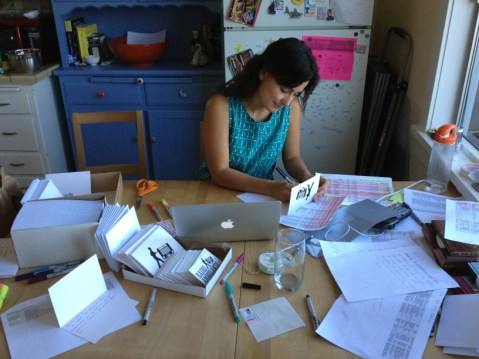 .
.
FIRST STEPS
We began by asking many of our print journalist friends in Latin America to share stories with us. We sent them links to stories from some of our favorite American radio programs, and then contacted a few bilingual independent radio producers here in the US, and asked them for advice on the basics of radio production. Many directed us to Transom.org, which was an absolutely essential resource.
In March of 2012, we launched a Kickstarter campaign. All we had was an idea and a sampler with less than 45 minutes of audio—and still, we managed to raise $46,000 with the support of 600 backers. The success of this campaign was a huge confidence boost, and we knew we were on to something. We used this money to produce our pilot season.
.
Since then, we’ve worked with more than twenty different producers in more than a dozen countries. These are the characters that emerge from Radio Ambulante stories: a transgender Nicaraguan woman living with her Mexican wife in San Francisco’s Mission District; a Peruvian stowaway telling his harrowing tale of coming to New York in 1959, hidden in the hold of a tanker ship; the Chilean soccer player who dared challenge the authority of General Pinochet; a young Argentine immigrant to North Carolina, trying to find his way through the racially charged environment of an American high school. Taken together these voices create a nuanced portrait of Latino and Latin American life:
.
PERSONAL STORIES FOR ALL EARS
Now in our third season, we’ve been working hard to create a group of trusted producers and editors across Latin America; people we can turn to with an idea, people we know we can trust with our limited time and resources; reporters we can send to Cuba, send to Honduras, send to Venezuela, and be certain they’ll come back with usable tape, and a good story. We want these first time producers to become long-term contributors.
That’s the case of Camila Segura, Radio Ambulante’s current Senior Editor. She had no prior experience as a radio producer when she reported her first story for us in 2012. That piece, El otro, el mismo (The Other, The Same) is about two men, one Colombian, one Argentinian, who not only share the same name, but who look almost identical. From this coincidence, the story becomes something much stranger, funnier, more subtle, and ultimately quite moving:
.
We want the listener to be able to relate and identify with the characters, to feel what they feel. A good Radio Ambulante story should be universal and shouldn’t have an expiration date.
One story from our first season captures this universal quality. In 2011, River Plate, one of the most famous soccer clubs in South America, was relegated to the Argentine Second Division. This event shook the entire nation, and anyone who listens to this story could relate to the sadness and pain that the protagonist is feeling. Two years later, the story still has that raw power:
 .
.
HOW WE SOUND
Martina Castro, Senior Producer, has designed most of Radio Ambulante’s sound, finding the balance between music and sound effects in order to support the voice of the main characters. As she explains,
There are many kinds of pieces that make it to Radio Ambulante. Sometimes the story is focused on one person and their experience: something that happened long ago. Like with Mayer Olórtegui in Polizones (The Stowaways), and the story of how he and his friend Mario jumped aboard a ship headed to the United States. There is no substitute for a dynamic storyteller like Mayer. He not only recreates moments, sometimes even imitating the sounds of what he heard, but he remembers the emotion of what happened, and really feels deeply what he is talking about, like when his voice breaks up at the mention of saying goodbye to his friend Mario.
.
Other, more symphonic, multi-voiced pieces provide a different kind of production challenge. The script must showcase the many characters, while giving the listener enough grounding so as not to get lost. A particularly successful example is our award-winning piece “N.N.”, about Puerto Berrio, Colombia, by reporter Nadja Drost. Nadja gathered recordings of this river town, and conducted interviews with many locals, always focused on the issue of the floating, anonymous dead and the town’s strange relationship with these bodies. The music in a piece like this is only meant to support those real-life sounds and characters, and a repeated melody serves as a ghost-like echo of the dead, those voices we never hear.
We use music carefully to shift the mood, to mark the end of a section, and to alert the listener that something new is coming. The music is also meant to break up chapters of a story, give us a moment to reflect on what we just heard, or to indicate when something is about to change. There are examples in Yuri Herrera’s “Postcard from Juárez,” produced by Daniel Alarcón. It tells the story of Diana la Cazadora, or Diana the Hunter, a vigilante who set about killing bus drivers in one of the world’s most violent cities, allegedly as revenge for years of misogyny and sexism.
.
In this particular story, we were able to do something that the English version (produced for This American Life) could not: read in the original Spanish the letter that the supposed killer sent the local Ciudad Juárez newspaper explaining her actions. We had this read by Lizzy Cantú, a Mexican journalist who’d worked with us before, and then distorted her voice, to give it that dark ambience. The listener is supposed to feel the grim violence in those words: the desperation.
 THE STORY IS KEY
In three seasons producing the show, we’ve learned that the craft of radio comes from listening, and that the most challenging aspect of producing radio is not in the technical details of recording those voices or sounds, but in the story itself.
The most basic building block of a good radio story is a good interview. The technical aspects of gathering sound are less important than phrasing the questions to get vivid, almost filmic answers, full of details that set the scene.. As Executive Producer Daniel Alarcón explains,
We ask our reporters to push interviewees to describe scenes in great detail, to unpack moments. Our interviews can last two hours or more, and many are surprised that we go so in depth. We like our reporters to circle back, and then circle back again, so that we’re sure we’re getting the most vivid version possible of a given story’s crucial moments.
We ask our reporters to write colloquially, to imagine they’re telling the story to a friend at a bar. It’s important to have immediacy in the language, an expressive tone that can seem almost improvised, even when it isn’t. The emotional impact of radio is that it feels as though a secret is being shared. The script and the production should always be in service of this intimacy.
Before a script is final, it’s shared with other editors on the team around the globe (California, Colombia, Puerto Rico, Chile), mixed, edited, soundtracked, and refined through hours of collective work online.
 .
.
ONWARD
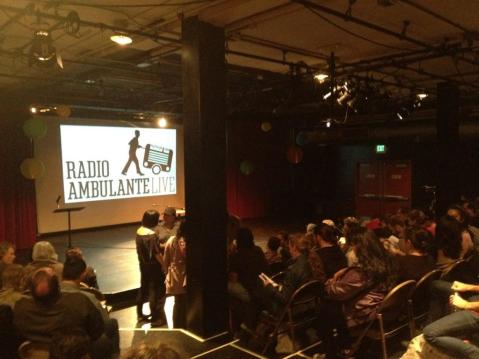
While creating our own sound and storytelling style, Radio Ambulante is constantly experiment with different formats and looking for new ways to interact with our listeners. We’ve done three live radio shows, in Los Angeles, San Francisco, and New York. In addition, we’ve produced two English Language specials, and partnered with writers and animators on hybrid multimedia storytelling. With our partners at PRI, we’re developing a new interview series, and are working with Latin American universities and media outlets to teach more journalists to use radio. Our hope is that Radio Ambulante’s success will mean more innovative radio work in Spanish, and more experiments in the possibilities of bilingual radio.
—
Carolina Guerrero is the Executive Director of Radio Ambulante. Before getting into journalism, she was a promoter for cultural and social projects, creating a bridge between organizations in three different continents. She has worked with public and private institutions in several countries, for which she has designed and overseen festivals, art exhibits, teaching workshops and fundraising events. Carolina is a John S. Knight Journalism Fellow at Stanford University 2014-15. She is the proud mother of León and Eliseo. (@nuncaduermo)
All images courtesy @radioambulante on Twitter
—
REWIND!…If you liked this post, you may also dig:
“We wanted to tell stories about sound: Opening Ears Through the Everything Sounds Podcast”-Craig Shank
“Chicana Radio Activists and the Sounds of Chicana Feminisms”-Monica De La Torre
“Óyeme Voz: U.S. Latin@ & Immigrant Communities Re-Sound Citizenship and Belonging”-Nancy Morales
Share this:


Current Top Posts





April 2021

January 2020

November 2019

October 2019

August 2019

April 2014

November 2017

March 2015

December 2017

October 2015
 Sounding Out!

Recent Comments