
They Do Not All Sound Alike: Sampling Kathleen Cleaver, Assata Shakur, and Angela Davis

Welcome to week four of our February Forum on “Sonic Borders,” a collaboration with the IASPM-US blog in connection with this year’s IASPM-US conference on Liminality and Borderlands, held in Austin, Texas from February 28 to March 3, 2013. The “Sonic Borders” forum is a Virtual Roundtable cross-blog entity that will feature six Sounding Out! writers posting on Mondays through February 25, and four writers from IASPM-US, posting on Wednesdays starting February 6th and ending February 27th. For an encore of weeks one through three of the forum, click here. And now, Tara Betts drops some science, Sounding Out! style. –JS
—
DOI: https://doi.org/10.59350/mb38y-ty376
When underground hip-hop artist P. Blackk released Blackk Friday (2011), several reviewers insisted that he sampled political activist Angela Davis. Oddly enough, one of the reviews from The Meara Blog, featured the video for “Brainz,” the song in question–and the video clearly showed that the sampled track was in fact not Davis but activist and lawyer Kathleen Cleaver. Why the automatic assumption that any black woman sampled from the 1960s is Davis? Why the collapsing and erasure of so many distinct and powerful voices?
Davis, Cleaver, and Assata Shakur are arguably the three most iconic women of the Black Power Movement, but they largely go unrecognized in mainstream history. Erasure by omission represents how many historical sources are resistant to identifying their specific contributions to grassroots organizing, intellectual life, and politics, while the male leadership of the Black Power Movement is often mentioned by name. So, the inclusion of Davis, Cleaver, and Shakur in songs by hip hop artists P. Blackk, John Forté, and Common simultaneously amplifies the distinctiveness of their voices while signaling conscious choices by younger male artists to align themselves with the political thinking espoused by these radical women in politically-rooted, layered tracks–even as these samples inadvertently reveal the mainstream public’s tendency to treat black female activists as interchangeable. Both in their moment and in its sampled echoes, these women resist being grouped into an amorphous group of misconstrued black people, and these tracks highlight that.
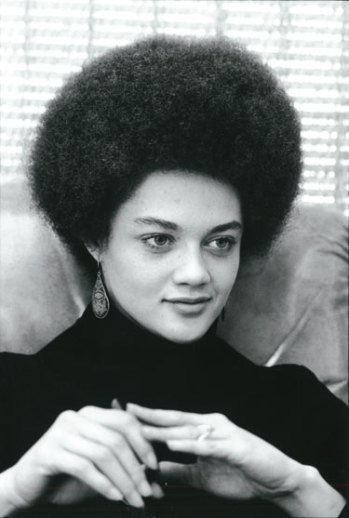
In “Brainz,” P. Blackk samples a 1968 speech by Cleaver. In the track, the basic bassline reverbs beneath the emcee’s repeated hook. He begins the song with the “huh” sound that many emcees use to amplify enthusiasm, start rhyming, and alert whomever is listening that the words are about to arrive. Blackk repeats certain phrases and utilizes internal rhyme as he makes observations about the choices people should make to care for themselves, their children, and their communities. The most original slant rhyme emerges in the second of two verses, replicated here:
It’s funny how we love chains and whips
when we were bound by em.
and we hate rock’n’roll and it was found by us.
You can’t hate what’s beautiful. I’m black and I’m proud,
but that ain’t got nothing to do with my pants sagging down.
Society is pimping you.
I’m just a man who’s a little more sensible.
I used to be invisible, now I’m invincible.
Not the stereotypical,
and I’m doing my thing in a game with no principles.
Knowledge and power, all I need, yeah, that’ll do.
The difference between me and my peers is gratitude.
Younguns is dumb too and too cool,
but it’s uncool living in a city that’s gun-ruled.
Here, P. Blackk most closely echoes how Cleaver expresses a sense of embracing and affirming black beauty while still acknowledging flawed educational systems, materialism, the origin of rock music, intergenerational disconnects, and gun violence. As a member of the Black Panther Party, wife of Eldridge Cleaver, attorney and professor, Cleaver has been a spokesperson for African American struggles. When the chorus simply repeats “real n-gga wit a brain,” P. Blackk is claiming the term that is still an affront to middle class people reaching for the civility of assimilation. He is insisting that some people are afraid of their intelligence and growing awareness as marginalized people and what actions that might entail. This fear of a nascent threat was at the root of resistance towards the slogan “Black is Beautiful” in the 1960s.
The Cleaver sample comes at the end of “Brainz,” and in the music video appears in its entirety on a projection screen and against P. Blackk himself, decked in a white shirt and bow tie, as he “lectures” students in a darkened classroom. As different black historical figures, including the likes of Marcus Garvey, Rosa Parks, Angela Davis, Ralph Abernathy, George Jackson, and James Baldwin, are projected on the screen behind Blackk, the instrumental audibly drops much lower so the only voice heard is Cleaver’s.
[Cue to 3:05 for Kathleen Cleaver]
The footage from which her sample is taken has background sound such as others talking and a chant with cadences that were often heard at black political protests; these can be faintly heard along with the audible buzz of varied speaking voices in the crowd that surrounding Cleaver. She was not onstage nor the main focal point of the larger event, but P. Blackk’s re-framing places her at its center. When one considers the position of Davis and Cleaver as esteemed and radical activists and professors, it’s not surprising that P. Blackk video positions him as an educator, like these women, to further reinforce the point of Cleaver’s words.
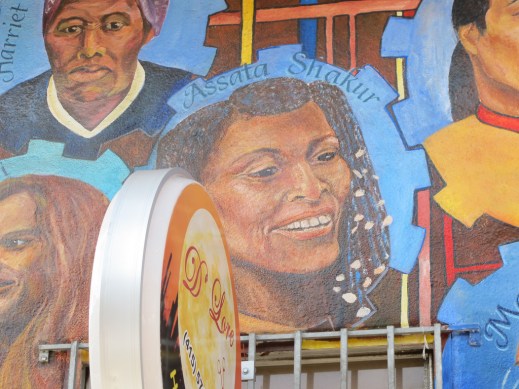
In “A Song for Assata,” from Like Water for Chocolate (2000), Common retells some of the events detailed in Assata: An Autobiography, but his sample reinforces why her activism was so important to Common and others like him. Her looped voice concludes his song, incredulously repeating the question, “You askin’ me about freedom?” In the sample Shakur explains how she knows more about what freedom is not, which is similar to a comment that Shakur made in Gloria Rolando’s documentary Eye of the Rainbow: Assata Shakur and Oya. Shakur then defines how freedom allows one to be one’s self, and the definition is faded down and the last of the soaring music rises slightly. When this fade occurs, we have a few examples of what Shakur imagines what freedom could potentially be, but it also leaves a sonic pause where listeners might contemplate how they define freedom for themselves.
The choice to fade out a sample says so much about not just the message that it (and Common) hopes to convey, but also reveals narratives that have been enforced consistently through institutions and time. I read the fade out as sonically emphasizing “the struggle,” rather than the intellectual present of an activist speaking; it limits her to the role of an representing the past. In dream hampton’s documentary Black August, Malcolm X Grassroots Movement organizer Meron Haile Selassie elucidates how women like Shakur are idolized:
Historically, the black liberation movement and actually all movements, let’s be honest, have fallen short of trying to incorporate the role of women, what women need, and how we incorporate anti-sexist theory and anti-sexist work in our general liberation movement. And when the woman that we put on the poster every single year, Assata Shakur, is someone that these artists revere and talk about yet but they’re somehow unable to see an Assata Shakur in the woman they’re dating that’s a painful realization.
In other words, even in black history and social movements, some women are canonized and celebrated and others are disregarded, which is not a far cry from the well-worn debate of using the word “b-tch” or “ho” and insisting that this namecalling does not address all women. Such overlooking and fading out is a subtler silencing of women.
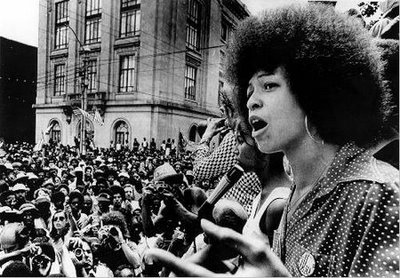
John Forte’s “Drift On” works against the narrative of the fade-out in “A Song for Assata.” In “Drift On,” from his album The Water Suite (2012), Forte lyrically articulates the feeling of being distant from someone; however, it is the brief sample of a few seconds from Angela Davis that reinforces the possibility of redemption during and after confinement. Forté begins singing the hook over a guitar-like loop that functions almost like a chord, and his soft singing of the chorus contrasts with his solemn rhyming lines and the firm solemnity of Davis’ brief sample midway through the song. A little more than a minute before “Drift On” ends, Davis speaks:
many people recognize that they can refashion themselves. They can rehabilitate themselves. They can live a life of the mind.
Davis stresses the words “they,” “refashion” and the third, final “can” spoken in this sample. Her tendency to stretch and soften particular nouns and verbs in speaking is a consistent pattern in Davis’ public speech, achieved by rhetorical devices such as metanoia– the immediate restatement of a phrase–and amplification. When Davis speaks in this manner, she makes listeners pay attention to the “they” whom she refers to as intellectually capable, but it also stresses “possibility” and redemption of the self.
It is important to note that the artists sampling these iconic Black women are men. Although women such as Me’shell Ndegeocello, and Terri Lyne Carrington and Diane Reeves have sampled Angela Davis on successful records, these records were not necessarily considered hip hop, which has consistently relied on men’s voices to create a radical impression in music, like Public Enemy’s “Fight the Power.” Public Enemy long relied on voices like Malcolm X and Martin Luther King, Jr., but happens to (and with) women’s voices? Including these voices in hip hop shows that women do exist as thinkers, activists, and speakers, even if the exposure is being exercised by artists who are men.
However, each song extends the narrative of each woman in a different manner than they constructed for themselves. P. Blackk stops admonishing, advising, and insisting on pragmatic Afrocentrism so he can to listen to Cleaver explain why black beauty was finally being embraced in the 1960s. Cleaver, in her 1968 speech, eschews white standards of beauty to embrace herself, which P. Blackk uses to connect self-hatred in the past and self-destructive behavior in the present. Common ends “A Song for Assata” with Shakur so she can share some of her thoughts on freedom after the song relates major events from her life based on details and paraphrased lines from poems in Assata: An Autobiography. Forté uses the sample of Angela Davis to further a narrative that reveals how the prison industrial complex diminishes perceptions of the humanity and the intellectual capacity of prisoners in “Drift On.”
These three hip hop songs align with a continuum of specific radical women during a time when there are few women getting consistent recognition in the genre of hip hop music, so it marks a curious point of departure where women can be part of conversations in a musical genre where they are not frequently prominent as vocalists. This sampling practice also places men and women in conversation–activists, artists, and listeners–in a manner that reflects strength, certainty, and a sense of coming together with specific political ideas in a manner that, importantly, does not erase intellectual, or sonic, difference.
—
Tara Betts is the author of the poetry collection Arc and Hue, a Ph.D. candidate at Binghamton University, and a Cave Canem fellow. Tara’s poetry also appeared in Essence, Bum Rush the Page, Saul Williams’ CHORUS: A Literary Mixtape, VILLANELLES, both Spoken Word Revolution anthologies, and A Face to Meet the Faces: An Anthology of Contemporary Persona Poetry. Her research interests include African American literature, poetry, creative writing pedagogy, and most recently sound studies. In the 1990s, she co-founded and co-hosted WLUW 88.7FM’s “The Hip Hop Project” at Loyola University while writing for underground hip hop magazines, Black Radio Exclusive, The Source, and XXL. She is co-editor of Bop, Strut, and Dance, an anthology of Bop poems with Afaa M. Weaver.
—
Share this:

SO! L.A.: Sounding the California Story

Editor’s Note: Welcome to the second installment in our month-long exploration of listening in observation of World Listening Day on July 18, 2012. For the full introduction to the series click here. To peep the previous post, click here. Otherwise, whip out your most oversized sunglasses, kick back, and listen to Bridget Hoida’s California. –JS
—-
DOI: https://doi.org/10.59350/7veap-jyw46
STOP.
Do not read along with me “in your book.”
Resist the temptation to follow along with your eyes.
Click play. Listen.

If I had things my way, I would whisper these stories to you as we sat in mesh folding chairs on the poured concrete porch of my Central Valley childhood home. If I had things my way, I would refill your glass with lemons and gin, and we would breathe in the sweet, summer smell of rotting blackberry brambles. If I had things my way, we would wait until the sun set against a Tokay harvest, taking with it the harsh triple digit temperature and leaving us nothing but the quiet of a delta breeze and moonlight. If I had it my way, I would ask you to lean in close as I whisper with canonical voices:
“This is a story about love and death in the golden land, …”
“I remember that moment exactly, those exact words registering in my mind like the notes of a solo…”
“Bobby Gene was a tattletale he told everything he heard…”
“You must not tell anyone what I am about to tell you…”
“My history is murky, and I wanted it [ …] that way so I could be free to tell whatever I wanted. “
“I’ll tell you what I suppose from your silences and few words and you can tell me if I’m mistaken. You’ll have to speak up with the real stories if I’ve got you wrong…”
“And so they talked and told tales of their region, and I listened. Long into the night I listened until I dropped off to sleep and my father would pick me up onto his lap as he continued to talk about the Revolution…. And every camp was different, none existing for more than six or seven weeks, then off we would go to the next harvest, where new people would gather and there would be new tales to be told and heard. I knew when I was six years old that the one thing I most wanted from life was to be a storyteller.
The storied sound of California
-All Voices
Shush…. Listen.
Linger with me on the drawn-out drawl of the stories I was raised on. Of the stories I was raised upon. For this is the sound of the California story: A myriad of voices sounding out narratives onto the page. Conflicting, concurring, spoken-over and rewrote…no one lasts longer than the next harvest, the next filmic “Action!” This is the sound of the storied terrain of interwoven melodies spoken upon the California soil that I call home.
1.
In or around 1995, I fell madly in love with Joan Didion. It’s not so much Didion the woman but rather the sound of Didion’s words that have me so hung up. My obsession began in the stacks of the Bancroft Library at UC Berkeley. I was assistant to the assistant librarian there and during my lunch hour I would take the dumb waiter up to the roof, eat a Kaiser roll with apricot jam, and read dime store copies of classic novels. I chose the roof because I like to read aloud, and in libraries at the time, reading aloud, especially to yourself, was expressly forbidden.

So there I was on the roof of Bancroft, with my roll, my jam, and my dime store copy of Play It As It Lays. I opened the page and read something about snakes and Iago. A mother died, the town of Silver Wells was won, and then lost, in much the same way a marriage slips into divorce. And then it happened. I stumbled across a line that changed the way I thought about words. Page 7, the first full sentence of the top paragraph, on the right: I might as well lay it on the line, I have trouble with as it was.
And after that line a whole lot of white space.
Beautiful, brilliant, blank white space.
As though in the silence of the rooftop, of the view, Didion was screaming to the reader, to me, something louder than words. In that white space there was sound and it was deafening.

2.
Later, when I decided to get a Ph.D. in creative writing, and although I couldn’t say as much on paper, examine, among other things, the commonality of language in California writers and the sonic devices of oral storytelling, I came across a quote from Didion, in interview, that said:
I had the technical intention to write a novel so elliptical and fast […] it would scarcely exist on the page at all…white space. Empty space. […] A white book to which the reader would have to bring his or her own bad dreams…
And although I adore everything about her I almost wished she hadn’t said it. Or that I hadn’t read it, because the thing about Didion is that statement… the part about the blank space… and the nightmare… it was already there. On the roof of the Bancroft library with my Kaiser roll and apricot jam, when the air tasted like September, I brought my own bad dreams because in that brilliant bit of white space I heard the scream.
3.
I like the white page. I prefer stories to plots. Plot for me is how the narrative moves from one space in time (from one line on the page) to the next. Story is how the narrative sounds. Story is voice. Plots are where girls meet boys and girls lose boys and girls get boys back. Stories are the shuffle and stop of scuffed shoes walking railroad levees, old men clearing phlegm, the surprise of an elastic bikini band as it snaps against the freshly burnt back of a burgeoning starlet. And the sounds of words as they smack unbridled against the page.


4.
When I read Didion we are on my porch and I hear her voice. When we think of writing, when we imagine reading, we think of quiet moments that exist alone with fixed type on a printed page. But as a reader, and more importantly as a writer, I have never felt this way.
5.
Voice, to paraphrase Emily Dickinson, is the “slant” you bring to your version of “the truth.” Plots are recyclable. Hell, you can buy one on eBay, to be sure. But a writer’s voice is different. I don’t read a book to figure out what happens next. I read to hear the whisper of the author’s voice. If they whisper well, I turn the page.
6.
From John Steinbeck to Gertrude Stein, John Fante to Susan Straight, Larry Levis and Mary Hunter Austin to William Saroyan and Shawna Yang Ryan, there is commonality of sound and language that I’m willing to claim composes an aural palimpsest of sorts. A voicing over, both literally and figuratively of native daughters and native sons held up on the tongue of the golden state.
The cadence, the rhythm, the obsession with things past. The aching nostalgic longing. The reflection. The fear. The reclamation. The imagination. The witness of an agrarian undoing. Sleepy Hollow moments reborn—again and again on western soil. The feeling of home. The feeling of home slipping away. The feeling of self, self-made in the image of home, slipping away alongside it. There’s a certain Californianess to it.
7.
What if we found a way to consider the sound these “fixed texts” emote? What if we broke with conventional narrative structure and embraced a written technique that more adeptly mirrored the sound and cadence of spoken story telling? Then might it be possible that the very aurality that is “written over” on the read palimpsest is in fact the sound that also remains?
As a writer, a writer who believes in voice, who rejoices in sounds as the strike-like syllables against a now forgotten Olivetti key, my pursuit in writing not only a novel, but in writing a novel about California was how I could possibly enter into this conversation. How I might be able to raise my voice loud enough to embrace the crowd of such a respectable page. How I could construct my text in such a way that it would not only read, but also sound Californian.

8.
In my struggle to voice not only my novel, So L.A., but also my protagonist Magdalena de la Cruz, I relied heavily on the patterns, soundscapes and literary devices of the collective California canon comprised of authors such as the ones I spoke of above. In So L.A. I was looking for a way to tell the story out loud while still operating within the conventional structure of a “type and text” book.

9.
My novel opens with Magdalena falling off a boat and then moves both forward and backward in time. This is how most people tell stories orally. They begin in the middle and then jump around, forgetting, amending, and calling attention to the most important parts, while the listener rarely ever exclusively listens but instead interjects and provides his or her own connections, observations and experiences. Eliminating quotations allowed me to access some of this interplay. It allowed me to question the reliability of spoken language. Spoken utterance does NOT always translate to precise hearing of the said words uttered. There is always interference—be it emotional (memory-sound triggers), psychological (felt meaning as opposed to said meaning), physical (honking cars, loud birds, eye rolls and sneezing) or linguistic (signifiers and unspoken gestures). Just because words are utter does not mean they are the same words that are heard. And not only did I want this, but I needed it on my page. Although I considered the docunovel (in the vein of Raymond Barrio), autho-interview collage (like Anna Deavere Smith) and autofictive exploration (ala Salvador Plascencia) I ultimately decided to abandon quotation marks.


10.
This (“) says open. It says start.
This (”) says closed. It says stop.
But (“) and (”) also sound.
For me they sound like a particularly rough clearing of the throat. They sound like standing on a library rooftop, trying to confess your love with the passion of a librarian “with hiccups.”
“They” interrupt the eye. “They” provide visual cues for accessing character and I didn’t want Magdalena “to be seen.” I wanted her to sound.
Her voice required a fluidity and unreliability not attainable “in quotes.” Without conventional quotes I was free to wander inside the head and voice of my protagonist as I pushed the blur between what she was saying, what the listener perceived she was saying, and what other characters were voicing without visual interruption.
11.
Also important in my authorial access to sound (and the absence of sound) on the fixed and written page was the use of filmic microchapters (some only as long as a single sentence). A sentence that reads as a chapter, surrounded by all that stark and lovely white space, not only looks different from a classical bookish chapter, but it also sounds different. Read out loud, or quietly inside the reader’s head, it sounds out a particular meaning and resonated differently within the mind’s eye and ear.
12.
With so much of the present world turning virtual, author and storyteller Barry Sanders concludes, “We demand less from the historical accuracy of our stories. We even demand less of a truth. We are content with images and feelings. If it feels closer to the truth then it might as well be.” However I’d like to extend Sander’s assessment beyond image and feeling to include sound. In this newly constructed world of virtual storytelling we are again experiencing a shift (not unlike the shift from oral to written storytelling) that is also sound dependent and sonically informed. From the staccato sounds of Twitter as compared to the unconstricted and leisurely expanse of Tumblr, it is important to acknowledge that the twenty-second sound bite can be (and historically has been) used (and utilized) in fiction to make noise and call attention to lasting moments of profound revelation. Although Didion’s Maria may “have trouble with how it was” I find a certain sense of comfort in how it is provided we are all able to lean in close and listen. Listen past the interference of type, text and YouTube to the sound of words both on and upon the page as,
“These are tales told in darkness in the quiet at the end of the day’s heat…”
—
Opening Image Credit: “L.A. Sky at Sunset” by Flickr User David Vienna
Audio note: Voices used, with the exception of Bridget Hoida, are not the actual voices of the authors listed, nor are they meant to be representative of said authors.
—
Bridget Hoida is the author of So L.A. (2012). In a past life she was a librarian, a DJ, a high school teacher, and a barista. In this life she experiments with words and has taught writing at UC Irvine, the University of Southern California and is currently a professor at Saddleback College. Hoida is the recipient of an Anna Bing Arnold Fellowship and the Edward Moses prize for fiction. She was a finalist in the Joseph Henry Jackson/San Francisco Intersection for the Arts Award for a first novel and the William Faulkner Pirate’s Alley first novel contest. Her short stories have appeared in the Berkeley Fiction Review, Mary, and Faultline Journal, among others, and she was a finalist in the Iowa Review Fiction Prize and the Glimmer Train New Writer’s Short Story Contest. Her poetry has been recognized as an Academy of American Poets Prize finalist and she was a Future Professoriate Scholar at USC.
She has a BA from UC Berkeley, a MA in fiction from San Francisco State University, and a Ph.D. in Literature and Creative Writing from the University of Southern California. So L.A. is her first novel.
Share this:




Current Top Posts





April 2021

January 2020

November 2019

October 2019

August 2019

April 2014

November 2017

March 2015

December 2017

October 2015


Recent Comments