
On the Lower Frequencies: Norman Corwin, Colorblindness, and the “Golden Age” of U.S. Radio
Editor’s Note: This is Liana, Managing Editor for Sounding Out!, introducing you to this special fall installment of our series “Tune Into the Past,” penned by our very own Editor-in-Chief and Guest Posts Editor, Jennifer Stoever-Ackerman. We at SO! have been waiting for months for Jennifer to share with us a brand-spanking new blog post! She’s back in action this month with a post that asks readers to listen to the cultural landscape that foregrounded Norman Corwin’s success as a radio writer and producer, inspired by her research on her book manuscript on the sonic color-line. In particular, Jennifer addresses the notion of colorblindness and its very real repercussions on radio artists and producers of color in the 1940s. Want to catch up on our series on Norman Corwin? Check out this summer’s posts by radio scholars Neil Verma, Shawn VanCour, and Alex Russo. If you’re all caught up, open your ears and your eyes then (to paraphrase Kurt Cobain). —LMS
—
DOI: https://doi.org/10.59350/zqa88-d9v21
Almost every day, I hear someone on the radio hailing America as the home of democracy. Yet almost every network is guilty of discrimination against the Negro performer. There are a few isolated cases of Negroes in broadcasting, but the lily-white policy is seldom violated.—Lena Horne, Chicago Defender 1940
The fine pieces in the “Tune in to the Past” series have thoughtfully considered the audible legacies of Norman Corwin: the “kaleidosonic” aesthetics that Neil Verma called the “Corwinesque,” the virtually seamless melding of artistic and commercial concerns that Shawn VanCour analyzed, and the echoes of Corwin remixed into WNYC’s Radiolab that Alexander Russo amplified. But the research I performed for my book manuscript, The Sonic Color-line: Race and the Cultural Politics of Listening, about the fraught relationship between race and 1940s radio, left me pondering the gaps and silences of Corwin’s soundscape. Radio’s “Golden Age” was also its most racially segregated: was the philosophy of “colorblindness” that Norman Corwin publicly espoused key to keeping it that way?
It’s not my goal to undermine Corwin’s work, but rather to enhance our understanding of it by embedding his broadcasts in the wider political, historical and sonic fields in which he was enmeshed. Just as Corwin’s sounded legacy left long-lasting traces in our media, so too have the silences and omissions fostered by the media executives, casting directors, union bosses, radio critics, and sonic auteurs of the “Golden Age.” If Corwin’s work is difficult to access save for far-flung archives and spotty collector’s catalogues, the exclusions of African-American producers, performers, and listeners are even harder to hear, in part because of his very insistence that radio’s microphones were colorblind. As the epigraph from Lena Horne testifies, the discourse of democracy is not mutually exclusive with segregation. In what follows, I discuss the intensely segregated history of the “Golden Age of Radio,” arguing that one of Corwin’s most far-reaching legacies may not have been set in motion by his virtuostic broadcasting, but rather by the World War II-era liberalism that shaped it.
The apex of Corwin’s radio career coincided with a profound shift in America’s dominant racial formation, the beginnings of “colorblindness.” By colorblindness, I mean the belief that if individuals and institutions ignored skin color as a signifier and eliminating race as an official category of identity—particularly within governmental institutions—it would cease to matter in American life and all groups would have equitable access to the privileges, opportunities, and freedoms afforded by citizenship. The shift toward colorblindness—what Michele Hilmes calls America’s “wartime racial realignment” in Radio Voices—was predicated on creating a sense of unity that would inspire men across the color-line to sign up to fight what was dubbed a war to end racism and fascism, even as it raged on in their segregated hometowns. The Pittsburgh Courier’s Double V Campaign—Victory against fascism abroad and Victory against racism at home—addressed these ironies. Barbara Dianne Savage’s Broadcasting Freedom: Radio, War, and the Politics of Race details the suppression of many black newspapers on military bases due to the Double V Campaign, as well as the pressure it put on government radio programs to address race. However, she notes:
if black people had been forced to rely on radio as their primary means of communication about the failings of the federal government, they would have been on an impossible mission, since they were admitted to radio only as entertainers or as briefly invited guests expected to be on their best behavior (94).
Despite high-profile protests in the black press, mainstream broadcasters constructed radio as an unmediated purveyor of equality and truth with increasing frequency during World War II—its “lofty aerials, symbols of freedom” according to New York Times radio critic Orrin Dunlap. In the case of Norman Corwin, he wrote a symptomatic (and nervy) editorial for Negro Digest in 1945 that depicted U.S. radio as a direct material and technological representation of colorblindness itself.
In “A Microphone. . . is. . . Color Blind”–what revealing ellipses!–Corwin assures black readers that “my feeling about Negroes in radio is that they belong as surely as the microphone.” This strange opening gambit compares black participation in radio to the mute technological presence of the microphone that, while absolutely central to broadcasting, is an object with no inherent agency. Unlike the proprietary, agenda-setting presence of whites in radio, a microphone amplifies the voices of others, while speaking not a word of its own. From his privileged vantage point, Corwin doesn’t quite realize how colorblindness enables him to use black people as tools.
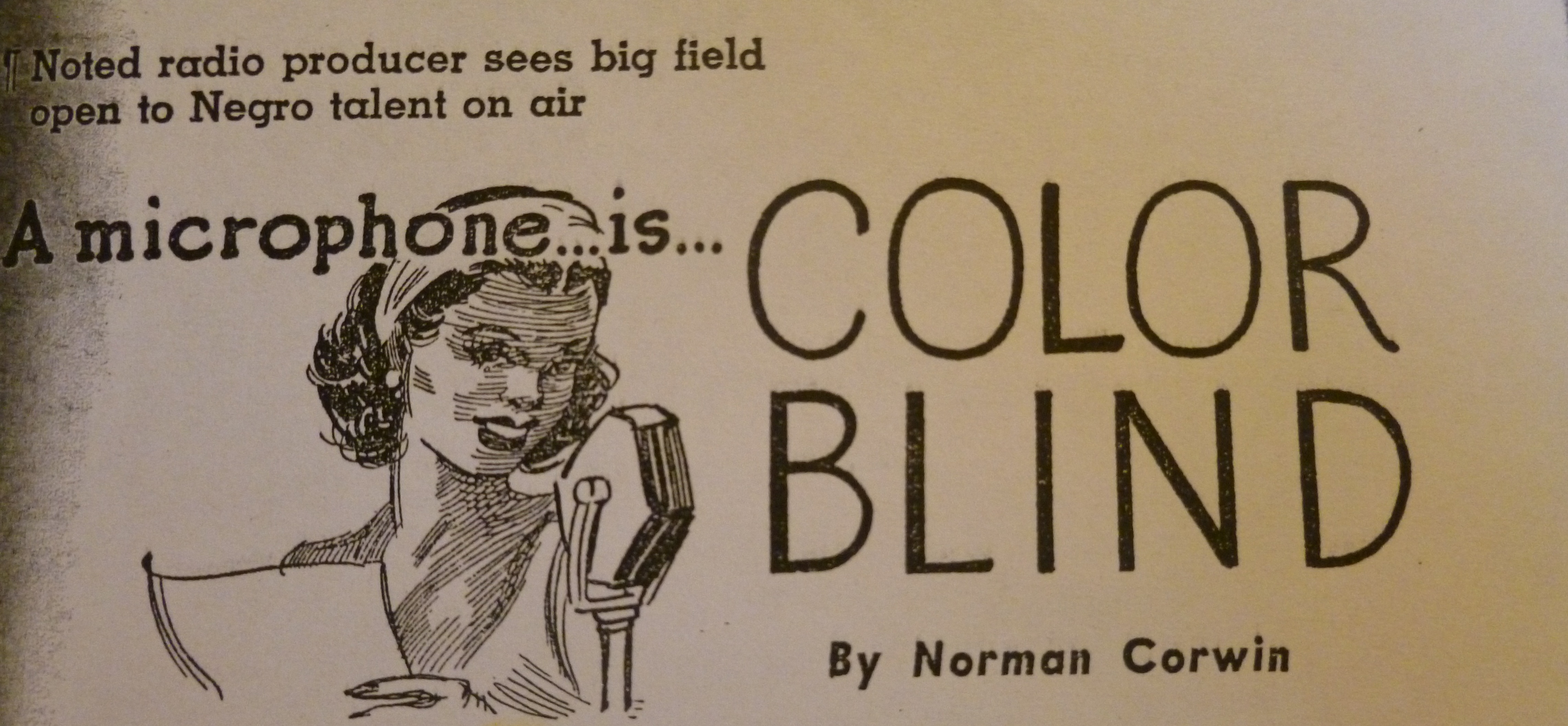
And, while Corwin’s title insists on the microphone’s colorblindness, his article suggests otherwise. Much of his description of what America is missing without black people’s radio presence has to do with aural racial difference: “I have found the same thing that makes Negroes supremely great artists in song makes them great in speech. The color and warmth conveyed in the performance of a Negro artist is directly communicable by air. The microphone is a faithful reporter and says exactly what it hears.” In addition to perpetuating the old stereotype of black people as natural performers, Corwin’s realist depiction of the microphone as a “faithful reporter” that “says exactly what it hears” covers up exactly how much black voices were sculpted for white consumption during this period in radio; as actor Johnny Lee (“Algonquin C. Calhoun” on Amos ‘n’ Andy) told UCLA graduate student researcher Estelle Edmerson in 1954: “I had to learn how to talk as white people believed Negroes talked. Most of the directors take it for granted that if you’re a Negro actor, you’ll do the part of a Negro automatically.”
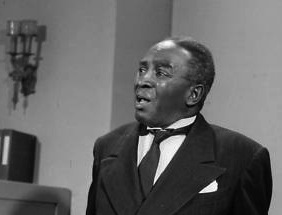
Whereas radio listeners were able to hear a wide range of white voices in a spectrum of roles—major and minor, comedic, dramatic, musical, informational—the sound and the content of black speech was circumscribed by the sonic color-line that marked it as “automatic,” essential, comedic, and potentially dangerous. Corwin’s use of the word “communicable” rather than “communicated,” for example, is a revealing flourish giving black sound a tinge of contagion and infectiousness. While ostensibly celebrating black voices, this passage simultaneously assures white listeners that they will still be able to unequivocally identify the race of any speaker over the “colorblind” airwaves and that this experience will be a pleasurable one for them. While the microphone may be color blind, it clearly is not color deaf.
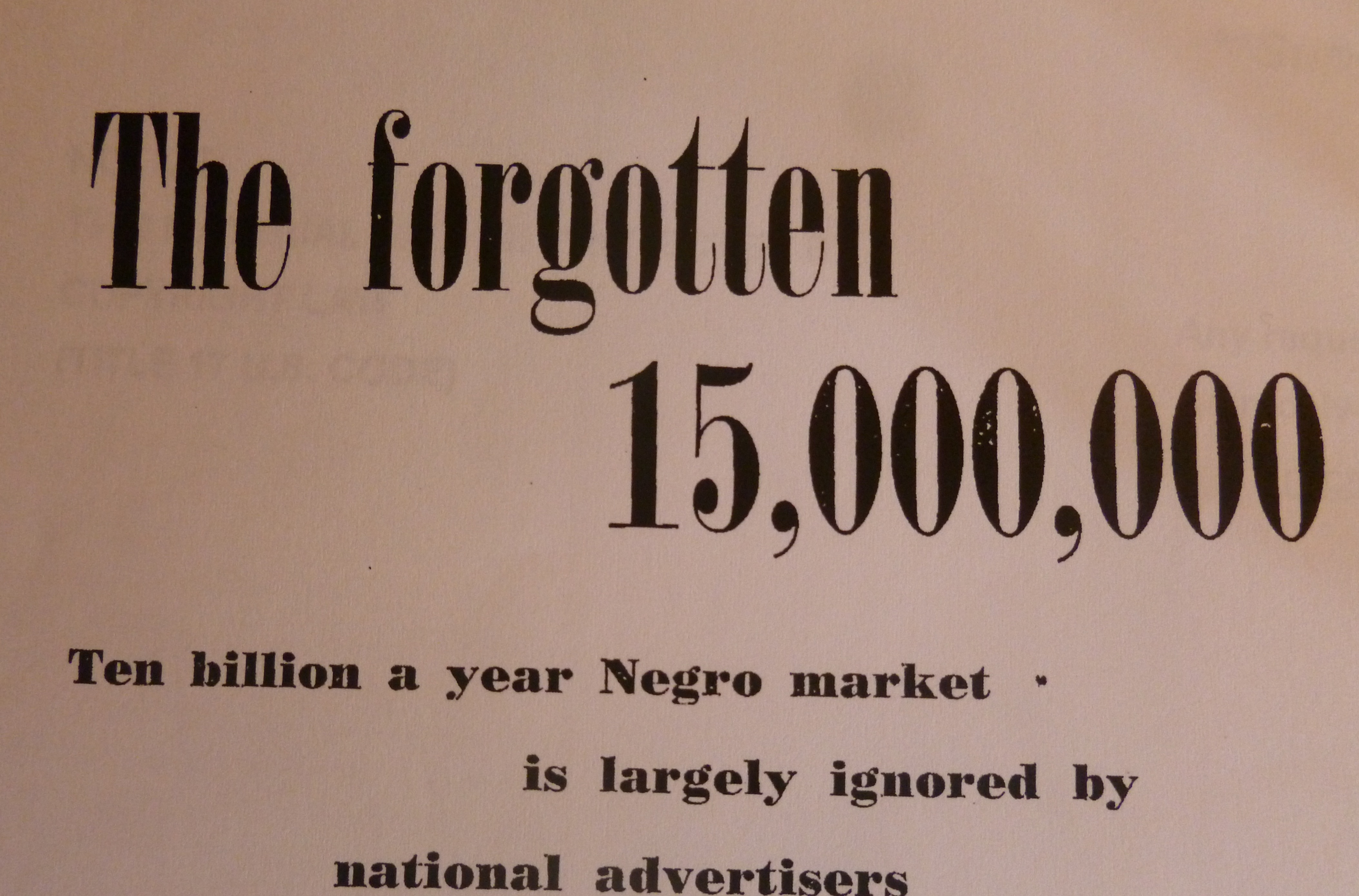
That Corwin assumes a white audience becomes more obvious with his assertion a few lines later that “I have found too few Negroes who have taken an interest in radio. I suspect it’s because they don’t know about it.” This statement is fairly incredible, considering that the Research Company of America published a study in the radio industry magazine Sponsor that placed African American radio ownership at 87%, just shy of the national figure of 90% (October 1949, 25). Sponsor dubbed black audiences “The Forgotten 15,000,000.”
In addition to being inaccurate, Corwin’s suggestion that African Americans had limited knowledge of radio performs one of the signature moves of colorblindness; it makes institutional barriers to access—lack of training, networks, and mentorship, as well as straight up discriminatory hiring practices—invisible by asserting that black people only need to work harder to succeed in the American media industry. Under colorblindness, the failure to achieve success equitable to white citizens falls squarely on the shoulders of those oppressed. It also willfully mutes the protest of many black actors—such as Butterfly McQueen—who refused to participate in the segregated industry and the agency of all the black listeners who turned the dial on shows distasteful to them, allowing the fantasy of a unified (white) America to remain a powerful referent.
By and large, Corwin’s article paints colorblindness as already achieved. In his estimation, it is up to black people themselves to take advantages of the opportunities he suggests already await them via the colorblind microphone: “My attitude is not unique among radio directors—at least not in the main centers of radio[. . . ],“Corwin insists, “there is less prejudice in this field than in any other. It exists unfortunately, but you can get a hearing.” For someone whose bread and butter was rhetorical flourish, Corwin’s use of passive sentence construction to discuss racial prejudice is significant—he naturalizes it as something that merely “exists,” tooling along without any specific historical agent performing the discriminatory and oppressive actions. Such omission lets the white gatekeepers of the 1940s radio industry off the hook for both the institutional and individual forms of discrimination that kept the industry largely, as Lena Horne phrased it, “lily-white.”
Radio’s profound whiteness was aural as well as visual. In Corwin’s colorblind America, a radio “hearing” comes at a heavy price for African Americans. Without commenting on educational segregation, Corwin proclaimed: “Negro schools should have in their curriculum courses in public speaking, radio, theater. There is no reason why there should not be Negro announcers. It is important to study diction so that distinction in speech cannot be noted.” While Corwin begins “A Microphone. . . is. . .Color blind” by arguing that black voices should continue to retain the racial markings that are legible (and pleasurable) to white listeners, he then suggests they must also simultaneously sound enough like the white voices surrounding them in order to be heard and accepted as fellow American citizens. Radio didn’t just passively reflect the sounds of American citizenship during this period–it actively constructed them on a foundation of exclusion and silencing.
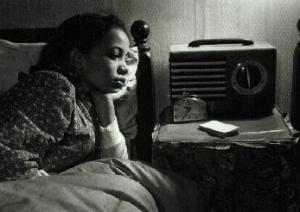
There remains, then, a profound disconnect between the full exercise of American citizenship, the idealized discourse of colorblind equality forwarded by government officials, media critics, and prominent broadcasters exemplified here by Corwin, and the actual representation of African Americans as radio producers, performers, and listeners during and after this period. At the same time as state-sponsored colorblind ideology rose to prominence during the war years, the U.S.’s airwaves became almost exclusively white. There were no black writers regularly employed by any national radio station during the 1940s and there was not a single black member of the Los Angeles Writer’s Guild. While black authors Langston Hughes and Carlton Moss wrote occasional scripts on one-shot contracts, they were about topics deemed of black interest by the networks. Black radio critic Joe Bostic—who would later become one of the nation’s first black radio sportscasters—described the limited openings for black radio performers:
publication last week of the most authoritative and comprehensive of the radio polls showed not a single Negro entertainer placing in the first ten of any branch of radio entertainment. Such a compilation outlines, in bold relief the disturbing fact that the Negro, long a leader in every phase of entertainment, is being excluded in this newest and most lucrative branch (People’s Voice, 1942).
Regular on-site broadcasts from nightspots that featured black performers all but vanished after 1940, meaning that the vast majority of black musical performances broadcast over the American radio networks were conditioned and mediated by white announcers and sponsors as well as the sounds of white-oriented programming that introduced and followed them.
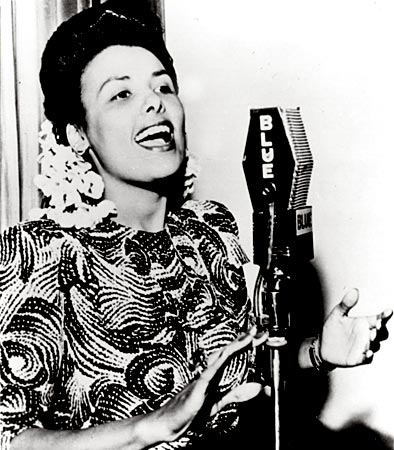
To be clear, I don’t blame Corwin individually for the ideology of colorblindness and the world it has wrought, but I do think it is important to consider his role as a cultural producer in the “Golden Age” of segregated radio, and as a power broker who helped shape the media landscape with which we now contend. While we commemorate his labors as a sonic artist with high journalistic standards who undoubtedly worked to “glorify the ‘common man,'” we also have to consider the institutionalized privilege that enabled him to claim this role as his own, as well as the many people silenced by him doing so, inadvertently or not. Tuning in to the past demands a vigilant ear attentive to the profound silences of exclusion: the traces of words muted, mangled, disciplined and unsaid, as well as the subterranean reverberations ghosting the triumphant tones of the “Golden Age,” a shadow broadcast, on the lower frequencies, of all the sounds that might have been.
—
Jennifer Stoeveris co-founder, Editor-in-Chief and Guest Posts Editor for Sounding Out! She is also Assistant Professor of English at Binghamton University and a former Fellow at the Society for the Humanities at Cornell University (2011-2012).
—
Share this:

The Noise of SB 1070: or Do I Sound Illegal to You?
DOI: https://doi.org/10.59350/9w731-ye773
There have been many heated debates over Arizona’s newly-implemented legislation SB 1070, a law which targets one of the U.S.’s most vulnerable communities, undocumented workers, and makes them subject to deportation, police harassment, and criminalization. However, in the midst of all the shouting, there has been surprisingly little said about what the role of sound will be in the enforcement of this law. Conversations about racial profiling have been predominately limited to visual aspects: skin color, haircuts, and most infamously, footwear selection. However, in order to fully understand the devastating impact of SB 1070, we need to render sonic examples of discrimination as visible as their visual counterparts. In other words, what does “illegality” sound like? And, conversely, how is U.S. citizenship produced through sound? Even though we rarely talk about either of these auditory social constructions, sonic representations of both abound in American culture, and—regardless of constitutionality—Arizona residents will use both to ferret out whom they feel belongs and whom they believe does not.
In other venues, I have termed dominant listening practices in America the listening ear [For those with access to an online Social Text subscription, click here to download the full text of my article, “Splicing the Sonic Color-Line: Tony Schwartz Remixes Postwar Nueva York”]. The listening ear is a phrase that describes mainstream perception. It represents the ways in which Americans have been disciplined to consider some sounds as natural, normal, and desirable, whole deeming alternate ways of listening and sounding as aberrant, dangerous, and yes, even illegal. Basically, the listening ear is what Judith Butler calls “a constitutive constraint” in Bodies that Matter: a socially-constructed filter that produces but also regulates specific cultural ideas about sound. In regards to SB 1070, the listening ear lines up a little too comfortably with the hazy language of “reasonable suspicion” that has been the focus of so much outcry against the law.
Basically, before Judge Susan Bolton declared a temporary injunction against the law on July 28th, 2010, it allowed police to check the immigration status of any one they made a “lawful contact” with, provided that “reasonable suspicion exists that the person is an alien.” Because unspoken, racialized norms about sound exist and circulate through American culture via the listening ear, members of dominant groups may use sound with impunity to forge “reasonable suspicion” about the citizenship status of anyone who sounds different from them (and who creates, consumes, and appreciates sounds differently from them). Certainly the sound of Spanish is at the top of this list; even though the United States does not have an official language, Arizona has enacted multiple strident “English Only” laws, the most recent of which resulted in the removal of a U.S. Census 2010 banner in Prescott, AZ because it included a sentence in Spanish. Beyond the sound of Spanish itself, there is the sound of accented English, and, as Stanford sociologist John Baugh’s work on linguistic profiling bears out, accents can have extreme impact on one’s economic chances in the U.S. as well as one’s sense of belonging. Now, accents may decide whether or not one gets hassled for their papers and detained and—if not a citizen or a legal resident—deported. Undoubtedly, the accent of the Fresno, CA-born American citizen who was asked to show his birth certificate to police at a truck weigh-in station in Arizona in April 2010 had much to do with his subsequent detainment.
In one of few examples to address the sonics of citizenship via language and accent, the ACLU’s recently released video “Would You Ask This Man for His Papers?” utilizes the sound of Spanish to illustrate the potential for auditory markers to determine citizenship status, especially in concert with visual cues like skin color and classed and raced job duties, like landscaping in the Southwest.
The video’s message—that sonic markers of citizenship are just as unreliable as visual ones—hinges on the fact that the man in the video, Roberto Reveles, is not only bilingual, but a prominent, natural born citizen; he has been president of the Arizona Board of Directors of the ACLU since 2006. However, the stark contrast in representation here risks reifying the division between the sound of Spanish as “foreign” and the sound of English as “normal” or “American,” just as it suggests that speakers of Spanish are much more agreeable to the American listening ear when their citizenship status is no longer in question.
The sounds of Spanish, however, are only the most obvious of a whole host of sonic markers of citizenship. The sounds of music are another. The American listening ear lumps musical genres like mariachi, Tejano, salsa, norteña and reggaetón together—regardless of the diverse national origins of the music or its consumers—and the sounds of instruments like the accordion, timbales, and brass horns become metonyms for the presence of Latino/a “Others.” For many monolingual English-speaking U.S. citizens, the increasing numbers of radio stations that broadcast pan-Latin musical genres—there are over 23 in the state of Arizona—sonically symbolize the perceived invasion and encroachment of the undocumented Latino/a “Others” on (white, English) American territory. The film “The Job” (2008), a short by Screaming Frog that satirizes the imagery of immigration in light of America’s most recent economic crash, represents one facet of the ready associations that the dominant American listening ear draws between music, sound, race, and social status.
The parodic twist in “The Job” turns on the association of particular types of music with undocumented workers. Note the sonic contrast between the “serious” sounds of the white corporate atmosphere and the festive stylings of the Latin music—not unimportantly, a “stock” song called “mariachi” that the producers obtained from Royalty Free Music—as well as the expedient way in which the horns function to herald the brown body of the Latino day laborer before viewers see him.
Given these preexisting aural connections, noise laws are a ready site at which SB 1070’s all-important “reasonable suspicion” can be obtained in a manner that circumvents traditional “colorblind” ideas about racial profiling. After all, it isn’t merely the content of a sound that determines whether or not listeners will hear it as “noise,” but also its context—its appearance in time and space. Whereas numerous forms of representation have disciplined the dominant American listening ear to hear mariachi music at El Torito’s Sunday brunch as a pleasant aural form of “local color,” the reaction to hearing a version of said music emanating from the backyard of one’s neighbor late on a Saturday night might be qualitatively and quantitatively different, particularly if the listener is already primed to perceive immigrants and/or people of color as threatening trespassers, no matter what their legal status may be. Historian Peter Bailey describes noise as “sound out of place,” and I cannot think of a more apt description for the aural stakes of illegality in America’s borderlands. In other words, it isn’t just the sound of an accent or the blare of a trumpet that marks someone as a noncitizen—or worse yet, a non-person, as the progenitors of the dehumanizing term “illegal alien” would have it—but where and when the sound appears and what boundaries it is perceived to cross by citizens empowered to lodge noise complaints.
Tellingly, the language of many noise ordinances is just as vague as SB1070, echoing the normative language of “reasonable suspicion” and the hidden classed, raced, gendered, and nationalized standards of the dominant American listening ear. For example, although the noise laws of Phoenix, Arizona can be quite specific—referencing barking dogs, whistling on the streets, and loudspeakers for advertising—they include a general “morals and conduct” clause that allows that “anything which is obnoxious to health, or is indecent, or is offensive to the senses, or is an obstruction to the free use of property so as to interfere with the comfortable enjoyment of life or property by any considerable number of persons, or unlawfully obstructs any public street, alley, sidewalk or highway is hereby declared a nuisance and may be abated by order of the City Court” (emphasis mine). Clearly, terms like “comfortable” and “offensive” are a socially determined grey area dependent upon which “considerable number of persons” comprise the power base for any given area. It is not a stretch of the imagination to consider how already “Othered” sounds like Spanish accents and Latin music or the sounds of daily life in Latino households that fall outside of the purview of the dominant American listening ear—alternate religious practices, holidays, and customs about children’s play and front/back yard use, for example—can lead to some SB 1070 dime-dropping by one of said “considerable number of persons.” Just ask the predominately Latino gardeners of Los Angeles, CA, who found themselves sonically profiled by wealthy whites who rallied against the sound of the gas-powered leaf blower in 1998, in part to decrease their presence in exclusive neighborhoods. Despite a prominent hunger strike on the steps of city hall by a coalition of Latino gardeners, leaf blowers were deemed illegal in L.A. that same year.
Not surprisingly, there has been an uptick in the battle against noise in the state of Arizona at the same time as the struggle over SB 1070 has heated up. Citizens of cities like Scottsdale and Prescott have been clamoring for tighter noise legislation and increased noise code enforcement in 2010; in language quite similar to SB 1070, one citizen of Scottsdale told the Arizona Republic that police officers should be empowered to “distinguish and make judgment calls as to who is loud and who’s not.” Note the telling slippage between noise and the people who (allegedly) make it.

Interestingly, in spite of the utility of noise laws for implementing SB 1070, the overt demographic target of much Arizona noise legislation has been motorcycle owners, who are among the whitest, wealthiest, malest, and most middleaged populations in the U.S. according to statistics complied by the 2008 Motorcycle Industry Council Owner Survey, and therefore traditionally a group resistant to visual racial profiling—at least in the arena of law enforcement. Perhaps, given Gary L. Kieffner’s claim in “Police and Harley Riders: Discrimination and Empowerment” in the Spring 2009 issue of the International Journal of Motorcycle Studies that the struggle of Harley-Davidson riders had “similarities with the civil rights movement of the 1960s, women’s liberation in the 1970s, and advances by other oppressed minorities,” aggrieved motorcyclists will join hands with the undocumented workers finding themselves on the wrong side of America’s sonic color- line.
Instead of holding my breath, I am going to put at least some of my faith in Sound Strike, a group of artists including Ozomatli, M.I.A., Rage Against the Machine, Nine Inch Nails, DJ Spooky, Los Tigres del Norte, Kanye West, and Yeasayer among many others devoted to fighting the noise of SB 1070 with the silence of Arizona’s empty concert halls.
The Sound Strike on Facebook
Sound Strike Petition to Stop SB 1070
And it’s not like Public Enemy hasn’t been warning us for years. I’d like to close with their “noisy” rejoinder to Arizona’s refusal to acknowledge Martin Luther King Jr. as a national holiday back in 1986, “By the Time I Get to Arizona”. DJ Spooky has created a free downloadable remix of the song in the wake of SB 1070 for your listening displeasure. Let the sound strike begin.
P.S. I also want to mention that many artists are choosing to fight SB 1070 through their performances in AZ rather than boycotting the state, most notably Lady Gaga.
—
Jennifer Lynn Stoever
__
Share this:




Current Top Posts





April 2021

January 2020

November 2019

October 2019

August 2019

April 2014

November 2017

March 2015

December 2017

October 2015
 Sounding Out!
Recent Comments