
Improvisation and Play in New Media, Games and Experimental Sound Practices
DOI: https://doi.org/10.59350/657xk-rqj17
Editors’ Note: Welcome to Sounding Out!‘s December forum entitled “Sound, Improvisation and New Media Art.” This series explores the nature of improvisation and its relationship to appropriative play cultures within new media art and contemporary sound practice. This series will engage directly with practitioners, who either deploy or facilitate play and improvisation through their work in sonic new media cultures.
The first essay in this series draws from a constellation of disciplinary perspectives that investigate these critical valences, and posits both play and improvisation as critical interventions which can expose, critique and interrupt the proprietary techniques and strategies of contemporary consumer media technologies.
— Guest Editors Skot Deeming and Martin Zeilinger
—
As media art scholars and curators of the annual Vector Game Art & New Media Festival, we are particularly interested in the conceptual convergence between critical approaches to play, on the one hand, and to improvisation, on the other. In this short essay, we therefore ask how improvisational sound-based media practices that use technologies, aesthetics, artifacts, and expressive modes of play may challenge the assimilative advances of corporate capital, carving out sites at which its logic may be opposed and confounded. We contend that there is a critical edge to the cultural milieu of playful computation through which practitioners (whether as artists or simply as players) can recuperate play from the mainstreamed sound cultures of digital capital through improvisation-based approaches. It is in this regard that play, as a participative act, rather than an interactive mode, can become a critical site by which to understand artistic interventions through contemporary technologies. This essay provokes a dialogue between theoretical avenues in popular music studies and game studies in order to show how the often-conflated practices of improvisation and play have the potential to challenge the homogenous and repetitive logic of the technological sector and the music industry.
We must turn first to popular music studies where the critical valence of improvisation is a relatively well-established concept. Jazz improvisation in particular has been widely recognized as a powerful mode of political expression. Charles Hersch has argued that techniques of polyphony allow for jazz to reconcile the seemingly contradictory dynamics of individual expression and collectivity, thus allowing for the articulation of black solidarity through musical interventions (97-8). Because jazz is importantly built on appropriation-based creative models, it yields fluid, fleeting, spontaneous results that are difficult to assimilate into the entertainment industry’s property-based circuits. Digital play exhibits a similar potential of challenging the logic of capital; it harbors a powerful creative potential even in heavily commodified contexts. Play allows us (indeed, requires us) to become active in shaping the improvisational, the field of simultaneously critical, creative and performative contexts of expression.
Like jazz musicians, game players embody and enact a powerful sense of potentially uncommodifiable agency. Both improvisation and play function similarly, and highlight how contexts of music-making and game-playing activate individuals as critical, expressive agents. Players guide themselves through games based on subjective, rather than imposed, motivations. We can see this emerging in gaming cultures through the rise of player-based phenomena such ‘speedrunning,’ a practice that exploits glitches and faults in a game’s architecture in order to reach the end of a game in the shortest possible time. These niche and ephemeral gaming practices highlight the degree to which practices of improvisation in play may constitute a powerful way of pushing ‘through’ capital–both literally, by accessing games through glitches in their proprietary fabric, and figuratively, if we understand such forms of play as ways to resist the capitalist ideologies embedded within the structures of games (such as the accumulation of wealth, power, or points). Having established here how game-play can act as a form of critical improvisation, this essay now intends to show how these practices of playful improvisation are manifest in the technologies, aesthetics, and the cultural contexts of sound-based art.
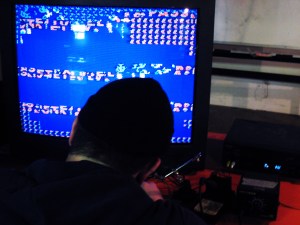
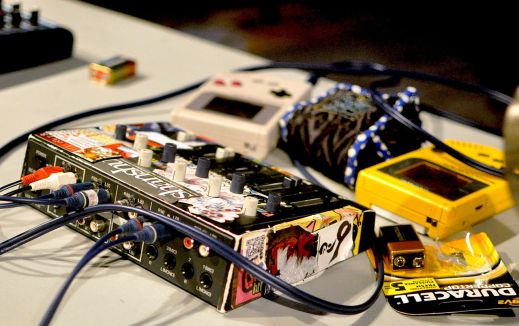
Where can we locate practices of improvisation in the context of sound art? For us, sound art is improvisational both in form and practice. First, the emerging aesthetic dimensions of the medium are fundamentally related to the participatory practices of making that have been used to develop the instruments of sound art, such as circuit bending, hacking, tinkering. Here, the playful and open-ended practices of making are a form of improvisation, a modulation within the typical technological frames in which musical composition is typically embedded. Second, when gaming devices are turned into musical instruments (or vice versa), users are called upon to rethink improvisational practice as game-play, and experiment with deploying play as composition. In this sense, game players become sound artists, with sound technologies extrapolating and improvising new sounds from the habit of their play. Improvisation and play thus allow emerging communities of practice to counteract the corporate ‘black boxing’ of entertainment technologies and the creation of closed systems of interaction and participation (such as many mainstream video games) which assimilate user activities and foreclose improvisational play.
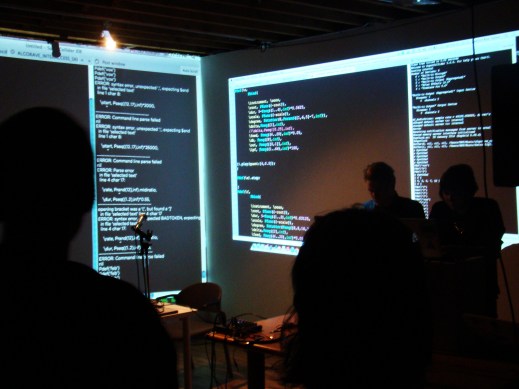
Such approaches to sound art are represented by many creative practitioners and take a wide variety of forms, including the appropriation and creative redeployment of participative game environments and game engines. Examples include the creation of interactive sound environments and playable instruments within mainstream participative game ecologies such as the Little Big Planet franchise, the hacking and ‘bending’ of proprietary technologies that invoke the vast universe of game culture nostalgically or in a parodic mode (including handheld gaming systems such as the Nintendo Gameboy, which spawned an entire electronic music genre known as chipmusic), or the making of non-proprietary infrastructures for creative expression that encourage open, participative play, such as open source live coding environments including Sonic Pi, originally developed for the Raspberry Pi platform. Following such approaches, game controllers, digital objects, avatars, virtual architectures, and digital artifacts can thus become tools of composition and/or improvisation. Similarly, we might also think of the improvisational frameworks constructed by sound practitioners as ‘playgrounds,’ which allow players to become performers who explore the technological, political, and aesthetic limits of play. But emergent communities of creative practitioners frequently adopt such close systems and technologies subversively, for example by reverse-engineering them and developing alternative uses. In doing so, they alter the contexts in which these technologies are employed, and open them up for use as musical instruments and infrastructure for creative and critical expression. Technological artifacts with unique user communities can thus be conceptualized as frameworks for musical expression. Vintage gaming consoles, games engines, and computational algorithms have all been reconstructed as new forms of musical creation and interaction through participatory creative communities.
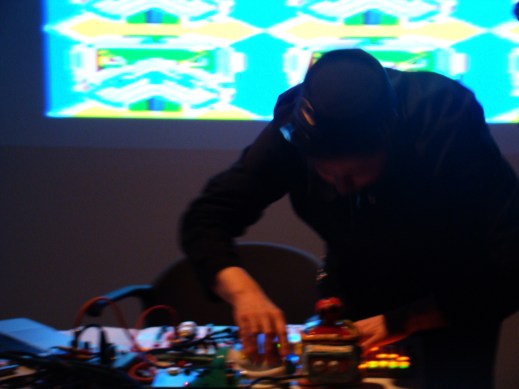
In this short essay, we have approached ‘play’ and ‘improvisation’ as related concepts that can serve to recuperate and empower critical perspectives within the game and sound cultures of capital. As we have suggested, playful approaches to improvisational sound-work and perspectives on play that are rooted in musical traditions can be productively discussed both in sound studies contexts and within game studies paradigms. How, then, do sound practitioners appropriate game technology? How do the socio-political dimensions of digital game culture inform musical practice? With the help of our contributors to this series, we explore how critical perspectives on musical improvisation aid our understanding of the cultural and socio-political significance of play and, likewise, how critical theories of play may broaden our understanding of improvisational sound practices. Through building, tinkering, problem solving, and improvising on the technological back end, creative practitioners playfully create and reshape tools, devices, and techniques of improvisational practice that often embody important ethics of openness, dynamism, fluidity, and sharing, posited against the closed culture of proprietary consumer technology by which we are commonly surrounded. Between live coding, modular synthesis, creative computing, hardware hacking, and appropriation-based interactive performances, the contributors to this series operate in many creative modes that oscillate between improvisation and play. What all of them share is a sense that both play and improvisation enable creative expression outside of prescribed, commodified circuits of media consumption. Improvisation and play can yield wonderful aesthetic experiments and experiences, they can provide critical, social commentary, and they can sharpen our sense of the impact that proprietary technology has on our digital cultural landscape. What we are most interested in are moments when these ambitions converge, when improvisation – drawing on techniques or technologies of play and operating in modes that are associated with play – becomes critical.
—
All images used with permission from Vector Game Art & New Media Festival.
Featured image: ”Blip Fest 2011 @ Eyebeam, Day 2” by Wikimedia Commons user Lucius Kwok CC BY-SA.
—
Skot Deeming is an interdisciplinary artist, curator and scholar, whose work spans the spectrum of new media art practice from broadcast media to computational art, experimental videogames, and game art. Drawing on a wealth of practical experience and theoretical knowledge, skot’s practice focuses on new media history and historiography, and DIY technology cultures. This work articulates itself through critical research and writing, exhibitions, installations, and performances. With Martin, Skot is the co-curator of Vector Game Art & New Media Festival., in Toronto, Canada, and the artistic director of the Drone Island Sound Art Festival in Yellowknife, NT. He currently resides in Montreal where he is a doctoral student in the Individualized Program at Concordia University, and a member of the TAG Research Centre, where he investigates critical histories of computational and new media art practices. http://www.mrghosty.com/
Martin Zeilinger (PhD) is a new media researcher, practitioner, and curator whose work focuses on the intersection of digital media art, activism, and intellectual property issues. He is a Lecturer in Media at Anglia Ruskin University, Cambridge/UK, as well as an Associate Researcher at the OCADU Data Materialization Studio. He is co-editor of ‘Dynamic Fair Dealing’ (Univ. of Toronto Press 2014), which develops interdisciplinary perspectives on cultural ownership issues in new media contexts; recent peer-reviewed essays have appeared in the Computer Music Journal, the International Assoc. for the Study of Popular Music Journal, and in Sampling Media (Oxford UP 2014). With Skot, Martin is co-curator of the Toronto-based Vector Game Art & New Media Festival. http://marjz.net/
—

REWIND! . . .If you liked this post, you may also dig:
Playing with Bits, Pieces, and Lightning Bolts: An Interview with Sound Artist Andrea Perkins — Maile Colbert
Digital Analogies: Techniques of Sonic Play — Roger Moseley
Experiments in Aural Resistance: Nordic Role-Playing, Community, and Sound — Aaron Trammell
—
Share this:

SO! Amplifies: Cities and Memory

SO! Amplifies. . .a highly-curated, rolling mini-post series by which we editors hip you to cultural makers and organizations doing work we really really dig. You’re welcome!
—
DOI: https://doi.org/10.59350/rbn13-gg696
Inspired by how sound and memory interact, Cities and Memory is a sound program with the aim of “remixing the world, one sound at a time,” existing on the (already quite blurred) line between documentary field recording and sound art.
Its primary manifestation is an online global sound map, on which every location boasts two sounds, the “city” and the “memory.” The “city” sound is the faithful, documentary field recording capturing that place at that time, as it existed and was heard. The “memory” sound is a reimagined, remixed, reinterpreted version of that sound: everything from oral reconstructions, full-on techno tracks built around a field recording, ambient reimaginings, and all the points in between, as summarized in this roundup of creative approaches from the site. The reimagined sounds represent how sound is remembered and experienced differently by each individual, and explore what happens in that magical period between sounds being physically experienced and their being mentally processed, interpreted, and above all felt.
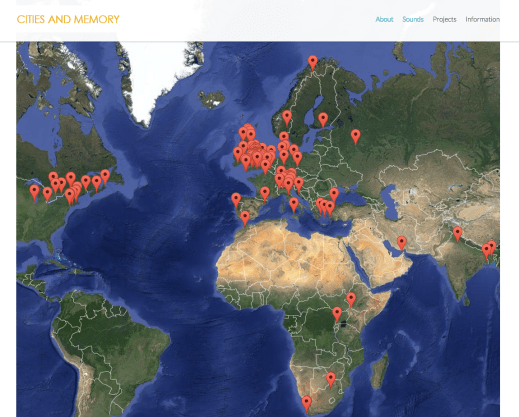
Starting from that basic premise, Cities and Memory has collected more than 600 sounds from around the world in just over a year, with more than 100 artists, musicians, field recordists and sound enthusiasts contributing anything from a field recording snatched on a mobile phone through to a complete musical reconstruction.
Over recent months, Cities and Memory has expanded with a series of projects each exploring a different avenue or window onto sound that has been opened up. For instance, last November saw #HamburgSounds, an ambitious project to sound map the vast city of Hamburg, Germany and to reimagine its sounds. A four-day recording session garnered enough recordings for forty sound artists each to give their take on a different aspect of Hamburg’s sounds and what they meant to them. The results were symbolically released over a 24-hour period, representing a day in the city’s life, and in the memories and imagination of its citizens. For more sounds from Hamburg, click here.
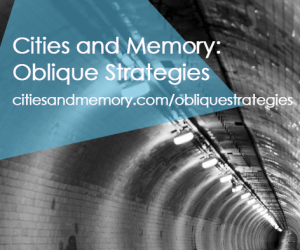
This year also saw a project using Brian Eno and Peter Schmidt’s Oblique Strategies cards as creative direction for reimagining field recordings. The reimagined sounds that came from more than 100 different creative strategies employed in the project were even more diverse than its locations, which covered everything from jungle in Thailand and Shanghai temples to the urban centres of Chicago, New York and London. Spectrum analysis, musical cryptograms, working simultaneously with artists in different countries, even TripAdvisor reviews(!) – every creative sonic technique in the book seems to have been used in one way or another.
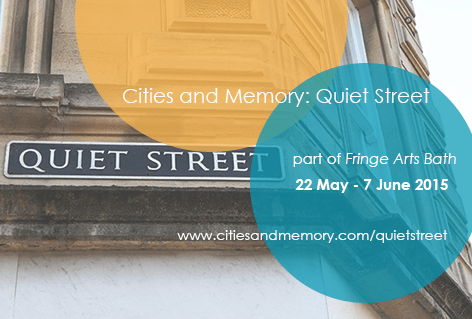
The latest project, called Quiet Street, takes the form of a simultaneous digital and physical exhibition, reimagining the sounds of the city of Bath as part of its Fringe Arts Bath Festival. The physical installation presents two sides of sonic memory – first, the documentary field recording of a location in Bath, and second the reimagined, or ‘memory’ version of the sound. The audience can navigate between two sonic ‘versions’ of Bath simultaneously on different sides of the space. One side broadcasts the “city” sound from a location, the other the matching “memory” sound, a remix or reinterpretation of the field recording, time-synced so that the sets of sounds shift in and out of one another in unison. The listener chooses – by his or her own physical proximity – to experience freely the two sound worlds.

As the “city” and “memory” sounds are precisely time-synced in the installation, an additional creative challenge for the artists was to create reimagined version the same length as the source field recording. More importantly, they also needed consider not just how the reimagined sound stood on its own, but how it would live simultaneously in the same space as the field recording, creating a direct tension between “real” documentary sounds and the memory of those sounds in the same space.
The digital exhibition of Quiet Street allows the sounds to be explored through a map interface. It also allows listeners to simulate the installation experience with a series of installation mixes, presenting the field recording and reimagined sound on opposite sides of the stereo field. You can access playlists here and here as well as download the album documenting the event here.
As a curator, the most exciting thing to me is that the central idea behind Cities and Memory is so open; there are almost infinite possibilities for its application. A new angle on sound, place or memory can bring up a new project at any point, and every contributor brings their own experience and interpretation.
In the course of exploring hundreds of field recordings, examining them in detail and finding a creative angle from which to reinterpret them, I’ve developed a new appreciation not just of field recording as a practice, but of how to listen to whichever environment I find myself in. It’s given me a new perspective on sound and on music, and how utterly blurred the lines are between the two. I listen very differently to the world now. As Cities and Memory continues to grow, I hope many others will too.

—
Stuart Fowkes is the creator and curator of Cities and Memory, producing a large number of the source field recordings and reimagined ‘memory’ versions himself, as well as curating the project as a whole. Quiet Street runs from 22 May to 7 June at 8/9 New Bond Street Place, Bath, as part of Fringe Arts Bath, and digitally at www.citiesandmemory.com/quietstreet. Find out more about Cities and Memory and how to contribute: http://citiesandmemory.com/what-is-cities-and-memory-about/
—

REWIND!…If you liked this post, you may also dig:
Toward A Civically Engaged Sound Studies, or ReSounding Binghamton–Jennifer Stoever
SO! Amplifies: Ian Rawes and the London Sound Survey–Ian Rawes
SO! Amplifies: Carleton Gholz and the Detroit Sound Conservancy–Carleton Gholz
Share this:




Current Top Posts





April 2021

January 2020

November 2019

October 2019

August 2019

April 2014

November 2017

March 2015

December 2017

October 2015


Recent Comments