
Listening to Disaster: Our Relationship to Sound in Danger

Editor’s Note: Welcome to Sounding Out!‘s World Listening Day Extravaganza! Enjoy this special bonus “soundtracked” post by multimedia artist (and new Sounding Out! regular) Maile Colbert –full of field interviews with artists and acoustic ecologists such as Marc Behrens, Andrea Polli, Bernie Krause, and Peter Cusack–as well as a podcast produced by Eric Leonardson, Director of the World Listening Project. (Click HERE to go to the podcast). For the full introduction to the World Listening Month! series click here. To peep the previous posts, click here. And remember, here at Sounding Out! every day is for listening. . .so meet us here for the 364 days between WLDs for more aural treasures and sonic thought.–JS
—-
Even the surrounding hills were hushed, as if brought low by language. –from Grendel by John Gardner
DOI: https://doi.org/10.59350/92zh7-08e33
Under good weather conditions in 2007, six artists, two curators, and two guides set out towards the Brenndalsbreen glacier in Vestlandet, Norway. An arm of the largest glacier in continental Europe, the Brenndalsbreen is maintained by high snowfall rates rather than cold temperatures, so the glacier has high melting rates. Since 2000, Brenndalsbreen has retreated 276 meters (820 feet). The group was the first to venture there that spring, the winter being too dangerous. Marc Behrens, one of the artists present, received permission to follow a guide down a crevice in a tongue of the glacier. There, surrounded by walls of ice, he began to record the melting drops that feed the glacial river flowing underneath. It was in this moment that Marc heard a change in the sound that signaled to him he may be in life-threatening danger, but due to the focus of the equipment he was using, he had no way to perceive how dangerous that threat may be.
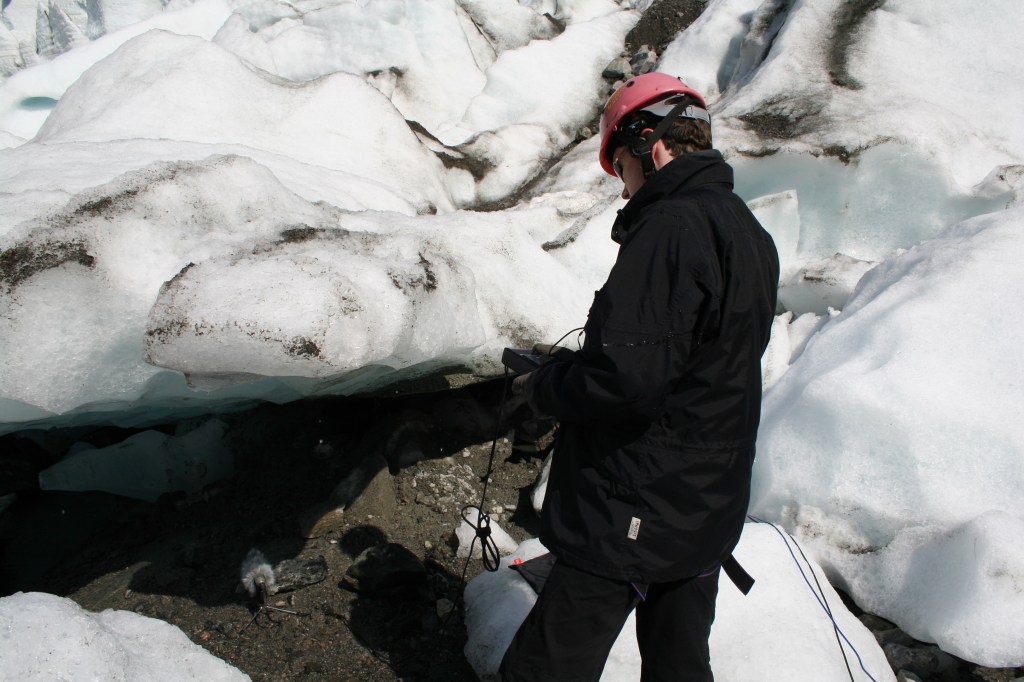
A question to Marc Behrens: “Can you describe your process of perception between thought and hearing within your personal story of disaster?”
When the crashing ice announced itself by the little crunch, I assumed it was merely a modulation in the noises the glacier made anyway – I was very calm listening to the beautifully trickling melt water drops – basically a stream of the same minuscule sounds over a long period of time. I appreciated this and it did not occur to me that it could have been the start of a more dramatic and quick development.
Then, as a surprise I heard that loud crash, which, as I had (bad) headphones on and listened to the microphone input which was directional, I could not relate the spatialization in the headphones to the physical surrounding. In the recording it seems smaller than it was – but it seemed as if the whole glacier just came down on me – sonically. I could not localize the sound, so I could not escape in any direction as I did not know where to. So I decided to stay where I was and just raise my hands/arms to protect my head as much as possible. I perceived a rush of adrenalin but remained lucid, especially as there was nothing else to do, and hence no possibility to fail. I mean: I could just wait and hope I would not be injured. And so, I waited for a moment more after the crash, then stopped the recorder and went out from the protruding ice to signal the others that I was okay.
In 2011, the disastrous 2011 Tohoku earthquake and tsunami devastated Japan. Within its horrific footprint, a number of nuclear accidents affected hundreds of thousands of residents with radiation levels up to eight times what are considered normal. Many other radioactive hot spots were also found outside the evacuated radius, including within Tokyo. All over social networks, people posted photos, videos, and sound clips of their Geiger counters reading the radioactivity in their homes and neighborhoods. The process a Geiger counter uses is called sonification, a form of auditory display that uses non-speech audio to convey information. As I played a sound file from a friend of the above-normal readings in his kitchen in Tokyo, I was unnerved by the ominous, staticky click, like the chirping of some robotic insect.
In fact, the entire event was sonically terrifying. Some of the most chilling recordings I heard from the underwater earthquake and the birth of the tsunami were picked up by the hydrophones of the National Oceanic Atmospheric Administration’s VENTS Program. The Tohoku earthquake was the largest sound they had ever picked up.
Using the seismic data from this same quake, audio programmer and artist Micah Frank used his creation Tectonic, a real-time seismic analysis and sound synthesis system, to sonify the sounds of the earth shifting and opening that fateful day. With Tectonic, sound is created in real-time by seismic activities as they occur across the globe. Using magnitude, elevation, time of day, and geographical coordinates, the data is mapped to synthetic spectrums and processed by granular, aggregate and subtractive synthesis.
Tectonic: Earthquakes Generate Music in Realtime from Micah Frank on Vimeo.
But is this more artistic and emotive approach effective in conveying the disaster, if that is even the point? Most comments on his Soundcloud track range from “cool sounds” to “I’ll send you the remix when it’s done.” When compared to the hydrophonic recordings from the VENTS program, perhaps the use of data to sonify is too abstracted from the event itself.
Digital media artist Andrea Polli takes a different approach to sonification. During the 2007/2008 season Polli was on site in Antarctica conducting work through the National Science Foundation residency, working with scientists gathering weather and climate data. Here she created the project 90 Degrees South, which “aims to communicate both the aesthetic beauty and the scientific importance of Antarctica to global climate.” This project gave birth to the audio album, Sonic Antarctica, which uses field recordings, sonifications, and audifications of the collected data.
.
To Andrea Polli: “How can sonification help us understand climate change?”
One thing that comes to mind is that sound and music can provoke an emotional (or at least affective) response that is not always possible through graphs and images. For example I have used low, almost sub-aural sounds in data sonifications to promote a visceral response in the listener to various atmospheric events. . .
I have worked with weather and air quality data in real time, both using on-site data or remote data. To become attuned to the remote data takes some time and quiet listening, to me it is like being in two places at once, for example in a gallery or on-line and at a remote site near the North Pole.
Often we associate catastrophes with massive and sudden sounds. We give animalistic descriptions to the sounds made by what we call natural disasters, such as growling tornado, roaring avalanche, shrieking cyclone, groaning earth. This practice speaks to our complex relationship with nature, connecting us to it and taking us out of it at the same time. But what of the slow silencing that happens to our soundscapes when certain species die out? Such quiet disasters affect everything, sadly in ways we don’t (and won’t) notice until too late.
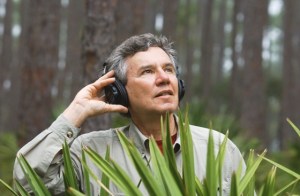
In The Great Animal Orchestra, author, musician, soundscape recordist, bio-acoustician and naturalist Bernie Krause coins the term, biophony, to help ecologists, biologists, acoustic scientists, and others to understand the long-term impact of disasters, particularly silent ones. Biophony refers to the collective sound vocal non-human animals create in each given environment. We face many compounding problems with the silencing of certain species and the quieting of a whole biophony, not the least of which is our connection with the world.
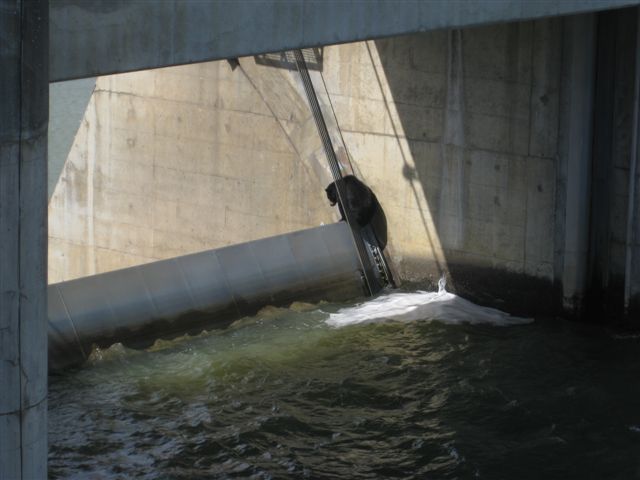
Krause provides some powerful examples of silenced biophonies in his book, such as the story of the Wy-am tribe in the Northwestern United States, whose history has been intertwined with the Celilo Falls, a waterfall just west of the Columbia River’s midway point, for thousands of years. Wy-am means “the echo of falling water.” Krause writes: “so central were the falls to the tribe that the Celilo was considered a sacred voice through which divine messages were conveyed.” It was also their yearly source for fish. In 1957, when the Dalles Dam gates were ordered shut by the U.S. Army Corps of Engineers, the waterfall and fishing site were completely submerged, sending the Wy-am into a state of mourning that continued to subsequent generations.
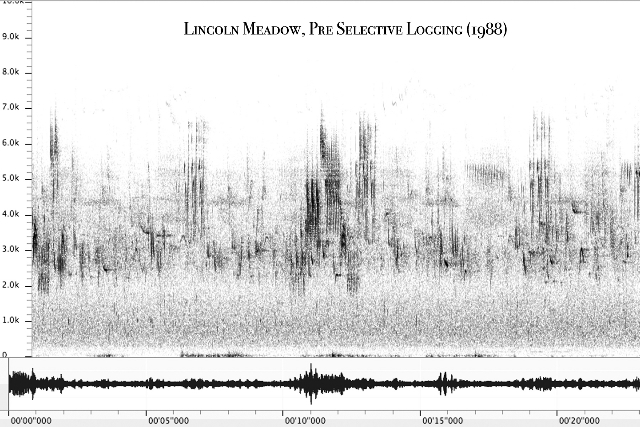
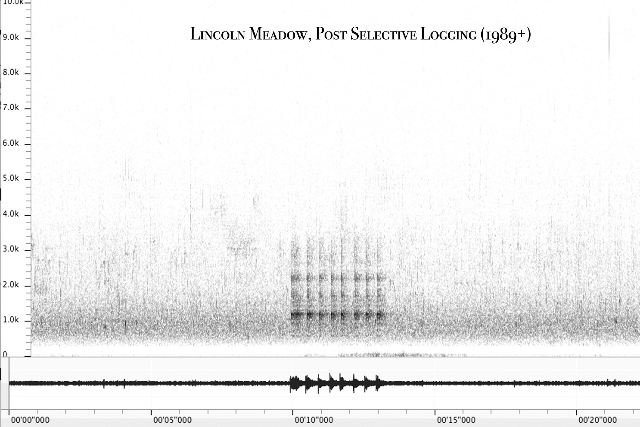
Krause cites several similar “silencings” in his book using spectrographs. Similar to sonification, Krause’s spectrograms give form and shape to “silent” disasters. A particularly sad example for me, coming as I do from a family from the Hawaiian Islands, is the recorded comparisons of the coral reef in Vanua Levu, Fiji, that has been devastated by warming waters, shifts in pH, and pollution.
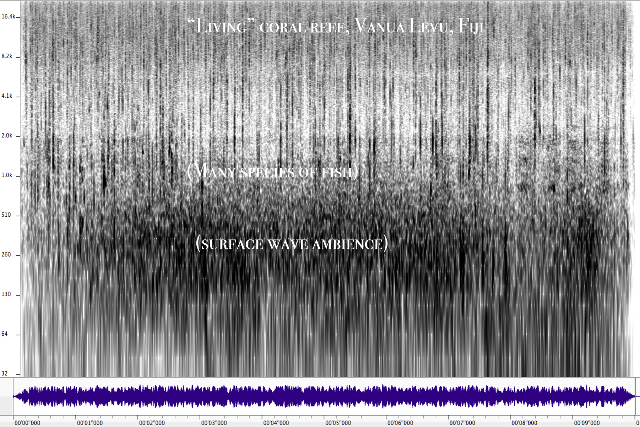
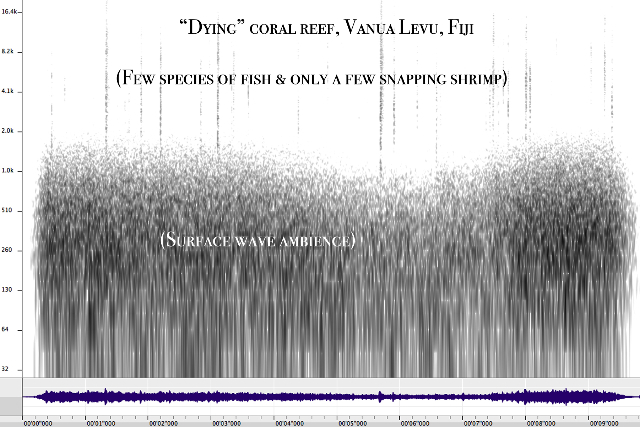
Krause also recorded twice at the Lincoln Meadow “forest management area” in the Sierra Nevadas, once before mass logging went into effect, and once after, a year later on the same date, time, and same weather conditions. While visually it seemed that little had changed, Aurally it was a different story:
To Bernie Krause: “We have a tendency to attribute ‘loud’ to the perspective of a disastrous event. Can you discuss the relationship of silence to disaster?”
In the natural world there are so many events that, to the “rational” human mind, appear to be contradictions. For instance, after the 11 September 01 disaster, which resulted in cancellation of all domestic and private aircraft flights and a reduction of automobile traffic around our house in the far western United States, the natural soundscape (biophony) returned in a way that we had never heard it before…even in September…late summer when almost all of the birds have fledged and gone elsewhere. And then there’s the reference in the book to the return of the biophony around Chernobyl, recorded by Peter Cusack from the UK. On the other hand, after some types of disasters, the immediate silence appears to happen because all of the vocal creatures have to reassess their acoustic territory, and, depending on the biome, takes anywhere from minutes to years, to recover a stable biophonic expression.
UK artist Peter Cusack’s Sounds from Dangerous Places, sought recordings from disaster sites like the Chernobyl exclusion zone in the Ukraine, the Caspian oil fields in Azerbaijan, the Chernobyl-fallout affected farmlands of Northern Wales, and the rivers of Eastern Turkey with their extensive, local climate altering dams. What is surprising and moving about these works is the strong human element, especially the lack of human presence and the evolving relationship of humans to these post-disaster soundscapes.
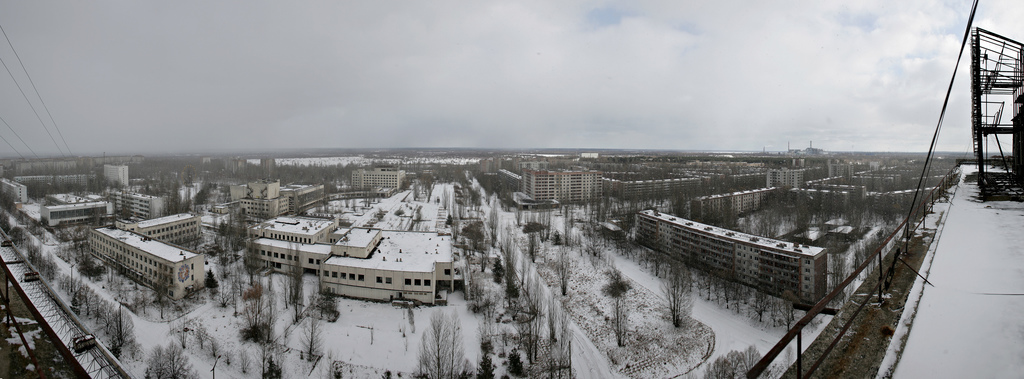
Listening to some of Cusack’s recordings from Chernobyl, one might feel surprised to hear that iconic name attached to such rich and pastoral soundscapes. When we consider the massive industrial accident that killed thousands and created an exclusion zone of 30 kilometers (19 miles), some of us are compelled to imagine a wasteland…not a living creature in sight. But those like Cusack who have visited the area are met with quite a different experience, one we can share when listening to the recordings. Cusack says Chernobyl held the richest dawn bird choruses he has ever recorded; haunting full choruses of frogs and nightingales sound throughout the night. And again we hear that iconic sound of the Geiger counter increasing its metallic chirp as Cusack walks toward an infamous radioactive hotspot, at one point it makes an eerie duet with a calling cuckoo.
To Peter Cusack: “How has the sound of dangerous places surprised you?”
Dangerous places can be both sonically and visually compelling, even beautiful and atmospheric. There is, often, an extreme dichotomy between an aesthetic response and knowledge of the ‘danger,’ whether it is pollution, social injustice, military or geopolitical.
In the context of the Sounds from Dangerous Places project ‘dangerous places’ are mostly areas of major environmental damage, but also include nuclear sites or the edges of military zones. The danger is not usually to short-term visitors, but to local people who have no option but to stay or more widely through the location’s role in global power politics.
Many aspects of dangerous places are a surprise, mostly because ones expectations are often wide of the mark, especially in the smaller details. However different places surprise one very differently. For example the name ‘Chernobyl exclusion zone’ implies no one is there. Not so. Thousands still work at the site, some live there and some commute in every day (by rail, so trains are part of the soundscape). That many people also require restaurants, bars, administration and all the infrastructure of a small town. So people and work sounds of all kinds are still to be heard around Chernobyl town and the nuclear sites. Some of the villagers, originally evacuated out, have returned bringing their sounds too – horses, chickens, carts, hand farming, traditional songs, modern day TV. The zone is also now a wildlife haven and the sounds of the dawn and evening chorus of spring are intense. The vibrant recordings of wildlife show that many species, at least, are doing fine in the exclusion zone. . .
In other places, though, sounds gives no indication of the danger. In the borough of Uttlesford, also just outside London, one hears church bell, over flying aircraft, cats mewing, cars passing, lawn mowing and common birds singing. It’s exactly as expected for one of the wealthiest areas in South East England. It also produces the greatest amount of domestic greenhouse gas of anywhere in the country.
I want to leave you with the example of the elephant seal, not as a “success story” but as an example of the great responsibility that humans have to know and be aware of our impact on a whole biophony, a whole ecosystem, a whole planet. When we think to such scales, there can be the tendency to look at the dying out of a single species as not so catastrophic. But we forget the interconnectivity of things, and how one species affects another, as well as its surroundings and its future. Sound can herald disaster, but it can also signal the potential for renewal, too.
The northern elephant seals once boasted colonies of hundreds of thousands in the Pacific Ocean. By 1892 only 50 to 100 individual seals were left, until in 1922 the Mexican government gave protective status, pressuring the U.S. government into following suit, and today their numbers are up to approximately 160,000. Known for their distinct vocalization, especially in the males, the large proboscis of the elephant seal is used to emit a loud roaring sound. From chortles to growls to screams to melodic sighs, their frequency range and detailed expression is amazing to listen to.
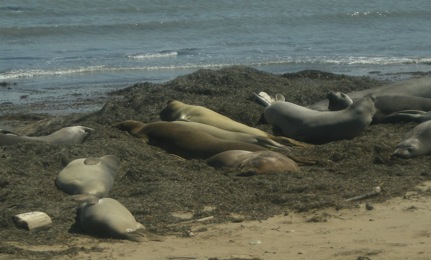
With growing numbers, the seals started populating Año Nuevo in California in 1955, now dominating the biophony against the waves with various sea birds, sea lions from an offshore island, frogs, and the occasional bark towards the evening and night hours from coyotes and foxes. It is one of the most vibrant and unique soundscapes I have ever experienced, weighted with the thought of how close it came to me never hearing their calls in the wild.
There is a moment upon hiking into the park where you can hear the seals’ voices being carried on the ocean wind, but only sand dunes lay in front of your eyes. Skin pricks up at such a strange sound; my companion admitted excitement and a little fear upon hearing it. The look on her child’s face, however, was priceless wonder. Thousands of tourists come every year to see these magnificent beast, but mostly to listen to these calls, that were, once upon a time not too long ago, almost silenced forever.
—
This post is dedicated to Dr. Donald Allen Colbert, who sparked wonder in the world beyond what I could see…
__
Featured Image Credit: Air Raid Siren by Flickr User Wader
__
Maile Colbert is an intermedia artist with a concentration in sound and video, living and working between New York and Portugal. She is an associated artist at Binaural/Nodar and director of Cross the Pond, an organization based on arts exchange between the U.S. and Portugal. She holds a BFA in Studio for Integrated Media at Massart, and a MFA in Integrated Media/Film and Video from Calarts. She has had multiple screenings, exhibits, and shows, including The New York Film Festival, Ear to Earth Festival, LACE, MOMA, LACMA, the REDCAT Theater in Los Angeles, The PDX Film Festival, Future Places Festival Oporto, HOERENSEHEN 2.0 Berlin, Störung Festival Barcelona, Teatra Municipal in Guarda, Observitori Festival Valencia, and has performed and screened widely in Japan, Europe, Mexico, and North America, and co-composed for a featured installation at the 2009 UN Climate Conference. She was a visiting lecturer teaching at UCSD and Escola Superior de Teatro e Cinema, and guest artist and lecturer at NYU, MassArt, Calarts, SUNY Buffalo, SUNY Binghamton, Muhlenburg College, and Universidade Nova de Lisboa. She is currently in production on an interdisciplinary experimental opera based on Portuguese Maritime history, and will release two albums this year. You can find her at www.mailecolbert.com.
—
Share this:

On Donuts, Sandwiches and Beattapes: Listening for J Dilla Six Years On

DOI: https://doi.org/10.59350/yns4n-b5v12
It has been six years this week since the passing of James “J Dilla” Yancey, considered by many in hip-hop as the quintessential producer’s producer. Over the course of his career the Detroit-born beatmaker garnered production credits with artists ranging from The Pharcyde to Janet Jackson. Since his passing there has been a substantial amount of posthumous output, including a Yancey Boys album with his brother Illa J, Ruff Draft, The Shining and Jay Stay Paid. There have also been the tons of unofficial releases by artists using material from his beattapes without prior permission. An unofficial discography of projects ‘featuring’ Dilla’s work could eclipse his official one.
Dilla’s beattapes, which he shared amongst friends and associates via CDs, eventually traveled the globe via message boards years prior to his passing. His legacy became what it is, at least in part, due to the reach of these CDs, but unfortunately it has also made monetizing the work after his passing a difficult task. There were early issues between Dilla’s family and the legal estate, but for the last couple of years there has been a process established which allows for the use of tracks from his vaults. They are currently set to release The Rebirth of Detroit, which boasts unheard Dilla beats featuring the Detroit artists he came up with:
In addition to posthumous releases under Dilla’s name the estate also licenses tracks for projects by other artists. With over 4000 tracks in their possession, it stands to reason there will be plenty more Dilla in the future. Yet still there is a sense that ‘new Dilla’ will never be new again, as in the future we will only be able to look at Dilla’s past. How would his process as an artist have grown? Surely whatever he was doing before he passed sounds nothing like what he would be doing in 2012.
Fortunately, the creativity of Dilla lives on through his influence on others. In the years since his passing, that influence has gone beyond hip-hop into jazz, indie rock, classical, and electronic music; some might argue Dilla’s influence has spawned new styles or even genres of music . The LA beat scene was seemingly born in homage to him; with its off kilter drums and wild sample chops, it extends beyond the initial influence, projecting into the future a lineage which will forever trace back to Dilla. Another of those lineages takes Dilla to perhaps the least likely place for a hip-hop producer: late-night television, through the figure of Ahmir “?uestlove” Thompson of The Roots.
At the end of the 90s until around 2001, Dilla was a member of The Soulquarians creative team that produced albums for Erykah Badu, D’Angelo, Common, and Bilal:
During this time Dilla worked closely with drummer, producer, and founding member of The Roots ?uestlove. There was a musical bond established over countless studio hours which allowed for a fusion of styles between them that carried Yancey from his Jay Dee period into his J Dilla period, and which ?uestlove continues to carry to this day.
Since Dilla’s passing, ?uest has been an instrumental voice in keeping Dilla’s legacy alive. He regularly DJ’s events celebrating Dilla’s work. On all of The Roots albums except for the most recent one, there have been musical dedications to Dilla. It is when ?uest goes into the studio with The Roots, however, that the living continuation of their musical fusion can be found.
The studio is where ?uest spends a lot of his time, rehearsing The Roots for their role as the house band on the Late Night with Jimmy Fallon show; ?uest records the sessions to listen back before and after the show. On Late Night The Roots play new songs in front of a live audience five nights a week. These songs only air for ten to twenty seconds going in and out of commercials. If you run to grab something from the refrigerator you might miss them. Or, coming back you might find your head nodding to them. Not only are they original works (other than walk on music for show guests, and musical performances), they are an insight into the creative process which shaped both ?uest and Dilla.
?uest names the tracks Sandwiches, a nod to his former collaborator’s Donuts. Donuts was the last official project that Dilla worked on, quite literally on his death bed, and is considered his instrumental opus. It opened up the notion of the short-form instrumental hip-hop work, which traces its own lineage to the history of beattapes. Today, a beattape is a collection of hip-hop instrumentals released as a product through distribution channels (free or paid). In the beginning however, beattapes were physical cassette tapes (and later CD-Rs) passed around from hand to hand. Tracks from beattapes were snippets of beats often recorded right after they were made so the producer could listen to them again outside of the studio setting. They were passed amongst friends and eventually within the industry as a means of selling the producer’s beats.
Early beattapes were not meant for public consumption or as cohesive projects. It’s important to remember that at the time you didn’t finish productions in a home or project studio. Artists, labels, producers etc. would listen to a beattape and select tracks to be purchased for a project. If a beat was bought, the producer would meet the artist in a large studio with an engineer, which is where the beat went into production. The beattape at the time was not considered a final anything, but a sketch of what could become a production.
In addition, beattapes had a secondary purpose as a measure of skill and technique. They became a format for rehearsal and practice. Where a traditional instrumentalist may practice chord changes on their instrument, a beat maker makes beats and records them for easy playback later. For example, a producer could decide to sample the same record as another producer to show how they would use the sample differently. There would be no intent to turn such a track into a full fledged song (though it could happen), instead it would be recorded so they could play it back to a friend or even the producer who originally used the sample for bragging rights.
Dilla was an active participant in this trade. His beat CDs became his calling card particularly for the techniques displayed on them. Donuts was his expansion of that beattape format. Rather than a display of short rough sketches that serve as indications of productions to come, Dilla produced intricate and layered flaunts of technique compacted into short sketches.
The most recognized technique from Donuts is the chop. The chop comes out of the stab line of techniques. A stab is a single instrumental hit played on a sampler. On the MPC line of samplers (which Dilla was famous for using), stabs could be spread across trigger pads pitch shifted chromatically allowing melodic sequences to be played using a single stab. The chop takes that a step further by using multiple samples from the same source (chops) to replace the chromatic stabs, and play melodically. What Dilla displayed on Donuts however, is not merely the chop but the variety of techniques available by which a producer can chop. Working outside the limitations of loops and stabs, new techniques like drum and instrument isolation, de-quantization, vocal stabs and more come at you, one layered technique after the other.
Many of these techniques have been canonized today, but some quality has been lost with that normalization. With de-quantization by example, overuse has practically rendered the technique cliché because its depth was reduced by its definition. De-quantization translates to simply turning off the preference in software programs or hardware beat machines that align all sound triggers to the grid of the tempo and time signature. That definition speaks nothing to what Dilla actually did with that preference off, which was impose his own humanized sense of timing onto the de-quantized patterns of the machine.
Of those that followed Dilla, most got the de-quantization part but missed his sense of time. While de-quantization has shown influence, outside of the ‘stock Dilla’ pattern, his sense of timing has been continued by only a few. At the top of that list is ?uestlove, as he is as responsible for the development of that sense of timing as Dilla is his own. The root of that development can be found in the The Soulquarians period, which can be marked as the time both artists came into their own by working together. That they would come together at all was quite serendipitous, as no player has a better sense of timing than a drummer. It was the mutual sense of timing between Dilla and ?uest that worked to produce the amazing material that resulted.
In The Soulquarians studio sessions ?uest and Dilla created a feedback loop between the drum machine and the drums. This pushed their sense of time as they fused a sonic texture for their drums, which can be heard between their productions. There is a shuffling urgency with a tick of hats between pulses that lead one into the other; the snare or clap crisp, never aggressively cracking, the kick big but not over dominant. It is sequence-based music turned into grooves that maintain the variable constraints of the sequence. They each took these elements with them in their post Soulquarians work, and after Dilla’s passing, you can frequently hear ?uest calling back to those days through his music.
Take a Sandwich like “Gross Understatement.” At the onset a drum loop with a prominent clap is layered into the snare on alternate hits, while a keyboard moves through presets until an organ sound is found. The bass noodles patiently until, with a chord, they meet. When ?uest comes in it takes a couple of bars of him pushing the drums to get everyone else to fall in on his time, but once it hits he can’t control himself, letting out a holler, “something flew out the gate.” What follows is three minutes of magic as the band jams to a grove that is the perfect cross between Dilla and ?uest.
Gross Understatement (G minor) #Sandwich 1397
Up until November 2011, by ?uest’s count, The Roots had created almost 1800 Sandwiches. He has released a stream of Sandwiches through his Swift FM account (the page is currently down until the site relaunches). By his own admission though, all of the Sandwiches aren’t as good as “Gross Understatement.” Out of the 2 to 23 they record each day, he says only about 1 in 19 are bangers. At 94 out of 1800 it isn’t a bad count, enough for nine albums. The only format in these tracks exist however, is as they appear on Late Night, on ?uest’s harddrive and whatever Sandwiches he decides to share. What would a studio project of this material sound like? As big of an audience as they receive on Late Nite, Sandwiches are buried in the mix of television things where it’s not easy to give them the musical attention they deserve. Perhaps in the future an official release of a project from this line will emerge. In the meantime catch them on NBC when you can and stay tuned to ?uest’s social stream.
—
Primus Luta is a husband and father of two (maybe three by the time this goes up). He is a writer and an artist exploring the intersection of technology and art, and their philosophical implications. He is a regular guest contributor to the Create Digital Music website, and maintains his own AvantUrb site. Luta is a regular presenter for the Rhythm Incursions Podcast series with his monthly show RIPL. As an artist he is a founding member of the live electronic music collective Concrète Sound System, which spins off into a record label for the exploratory realms of sound in 2012. Luta is currently working on completing his first book, BeatGenealogy: A History of the Electronic Beat From WWII to Now.
—
Share this:




Current Top Posts





April 2021

January 2020

November 2019

October 2019

August 2019

April 2014

November 2017

March 2015

December 2017

October 2015


Recent Comments