
They Do Not All Sound Alike: Sampling Kathleen Cleaver, Assata Shakur, and Angela Davis

Assata Shakur, Image with quote courtesy of Flickr user Jacob Anikulapo
 Welcome to week four of our February Forum on “Sonic Borders,” a collaboration with the IASPM-US blog in connection with this year’s IASPM-US conference on Liminality and Borderlands, held in Austin, Texas from February 28 to March 3, 2013. The “Sonic Borders” forum is a Virtual Roundtable cross-blog entity that will feature six Sounding Out! writers posting on Mondays through February 25, and four writers from IASPM-US, posting on Wednesdays starting February 6th and ending February 27th. For an encore of weeks one through three of the forum, click here. And now, Tara Betts drops some science, Sounding Out! style. –JSA
—
When underground hip-hop artist P. Blackk released Blackk Friday (2011), several reviewers insisted that he sampled political activist Angela Davis. Oddly enough, one of the reviews from The Meara Blog, featured the video for “Brainz,” the song in question–and the video clearly showed that the sampled track was in fact not Davis but activist and lawyer Kathleen Cleaver. Why the automatic assumption that any black woman sampled from the 1960s is Davis? Why the collapsing and erasure of so many distinct and powerful voices?
Davis, Cleaver, and Assata Shakur are arguably the three most iconic women of the Black Power Movement, but they largely go unrecognized in mainstream history. Erasure by omission represents how many historical sources are resistant to identifying their specific contributions to grassroots organizing, intellectual life, and politics, while the male leadership of the Black Power Movement is often mentioned by name. So, the inclusion of Davis, Cleaver, and Shakur in songs by hip hop artists P. Blackk, John Forté, and Common simultaneously amplifies the distinctiveness of their voices while signaling conscious choices by younger male artists to align themselves with the political thinking espoused by these radical women in politically-rooted, layered tracks–even as these samples inadvertently reveal the mainstream public’s tendency to treat black female activists as interchangeable. Both in their moment and in its sampled echoes, these women resist being grouped into an amorphous group of misconstrued black people, and these tracks highlight that.
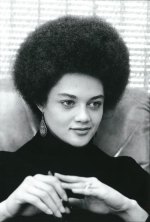
Kathleen Cleaver, 1960s
In “Brainz,” P. Blackk samples a 1968 speech by Cleaver. In the track, the basic bassline reverbs beneath the emcee’s repeated hook. He begins the song with the “huh” sound that many emcees use to amplify enthusiasm, start rhyming, and alert whomever is listening that the words are about to arrive. Blackk repeats certain phrases and utilizes internal rhyme as he makes observations about the choices people should make to care for themselves, their children, and their communities. The most original slant rhyme emerges in the second of two verses, replicated here:
It’s funny how we love chains and whips
when we were bound by em.
and we hate rock’n’roll and it was found by us.
You can’t hate what’s beautiful. I’m black and I’m proud,
but that ain’t got nothing to do with my pants sagging down.
Society is pimping you.
I’m just a man who’s a little more sensible.
I used to be invisible, now I’m invincible.
Not the stereotypical,
and I’m doing my thing in a game with no principles.
Knowledge and power, all I need, yeah, that’ll do.
The difference between me and my peers is gratitude.
Younguns is dumb too and too cool,
but it’s uncool living in a city that’s gun-ruled.
Here, P. Blackk most closely echoes how Cleaver expresses a sense of embracing and affirming black beauty while still acknowledging flawed educational systems, materialism, the origin of rock music, intergenerational disconnects, and gun violence. As a member of the Black Panther Party, wife of Eldridge Cleaver, attorney and professor, Cleaver has been a spokesperson for African American struggles. When the chorus simply repeats “real n-gga wit a brain,” P. Blackk is claiming the term that is still an affront to middle class people reaching for the civility of assimilation. He is insisting that some people are afraid of their intelligence and growing awareness as marginalized people and what actions that might entail. This fear of a nascent threat was at the root of resistance towards the slogan “Black is Beautiful” in the 1960s.
The Cleaver sample comes at the end of “Brainz,” and in the music video appears in its entirety on a projection screen and against P. Blackk himself, decked in a white shirt and bow tie, as he “lectures” students in a darkened classroom. As different black historical figures, including the likes of Marcus Garvey, Rosa Parks, Angela Davis, Ralph Abernathy, George Jackson, and James Baldwin, are projected on the screen behind Blackk, the instrumental audibly drops much lower so the only voice heard is Cleaver’s.
[Cue to 3:05 for Kathleen Cleaver]
The footage from which her sample is taken has background sound such as others talking and a chant with cadences that were often heard at black political protests; these can be faintly heard along with the audible buzz of varied speaking voices in the crowd that surrounding Cleaver. She was not onstage nor the main focal point of the larger event, but P. Blackk’s re-framing places her at its center. When one considers the position of Davis and Cleaver as esteemed and radical activists and professors, it’s not surprising that P. Blackk video positions him as an educator, like these women, to further reinforce the point of Cleaver’s words.
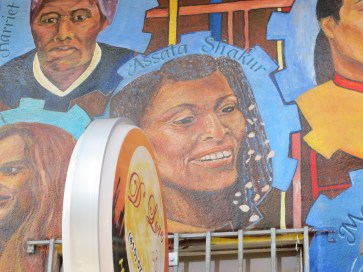
Image of Assata Shakur on Community Mural of Revolutionary Heroes, Image by Flickr User Gary Stevens
In “A Song for Assata,” from Like Water for Chocolate (2000), Common retells some of the events detailed in Assata: An Autobiography, but his sample reinforces why her activism was so important to Common and others like him. Her looped voice concludes his song, incredulously repeating the question, “You askin’ me about freedom?” In the sample Shakur explains how she knows more about what freedom is not, which is similar to a comment that Shakur made in Gloria Rolando’s documentary Eye of the Rainbow: Assata Shakur and Oya. Shakur then defines how freedom allows one to be one’s self, and the definition is faded down and the last of the soaring music rises slightly. When this fade occurs, we have a few examples of what Shakur imagines what freedom could potentially be, but it also leaves a sonic pause where listeners might contemplate how they define freedom for themselves.
The choice to fade out a sample says so much about not just the message that it (and Common) hopes to convey, but also reveals narratives that have been enforced consistently through institutions and time. I read the fade out as sonically emphasizing “the struggle,” rather than the intellectual present of an activist speaking; it limits her to the role of an representing the past. In dream hampton’s documentary Black August, Malcolm X Grassroots Movement organizer Meron Haile Selassie elucidates how women like Shakur are idolized:
Historically, the black liberation movement and actually all movements, let’s be honest, have fallen short of trying to incorporate the role of women, what women need, and how we incorporate anti-sexist theory and anti-sexist work in our general liberation movement. And when the woman that we put on the poster every single year, Assata Shakur, is someone that these artists revere and talk about yet but they’re somehow unable to see an Assata Shakur in the woman they’re dating that’s a painful realization.
In other words, even in black history and social movements, some women are canonized and celebrated and others are disregarded, which is not a far cry from the well-worn debate of using the word “b-tch” or “ho” and insisting that this namecalling does not address all women. Such overlooking and fading out is a subtler silencing of women.

Angela Davis speaking in Oakland, 1969
John Forte’s “Drift On” works against the narrative of the fade-out in “A Song for Assata.” In “Drift On,” from his album The Water Suite (2012), Forte lyrically articulates the feeling of being distant from someone; however, it is the brief sample of a few seconds from Angela Davis that reinforces the possibility of redemption during and after confinement. Forté begins singing the hook over a guitar-like loop that functions almost like a chord, and his soft singing of the chorus contrasts with his solemn rhyming lines and the firm solemnity of Davis’ brief sample midway through the song. A little more than a minute before “Drift On” ends, Davis speaks:
many people recognize that they can refashion themselves. They can rehabilitate themselves. They can live a life of the mind.
Davis stresses the words “they,” “refashion” and the third, final “can” spoken in this sample. Her tendency to stretch and soften particular nouns and verbs in speaking is a consistent pattern in Davis’ public speech, achieved by rhetorical devices such as metanoia– the immediate restatement of a phrase–and amplification. When Davis speaks in this manner, she makes listeners pay attention to the “they” whom she refers to as intellectually capable, but it also stresses “possibility” and redemption of the self.
It is important to note that the artists sampling these iconic Black women are men. Although women such as Me’shell Ndegeocello, and Terri Lyne Carrington and Diane Reeves have sampled Angela Davis on successful records, these records were not necessarily considered hip hop, which has consistently relied on men’s voices to create a radical impression in music, like Public Enemy’s “Fight the Power.” Public Enemy long relied on voices like Malcolm X and Martin Luther King, Jr., but happens to (and with) women’s voices? Including these voices in hip hop shows that women do exist as thinkers, activists, and speakers, even if the exposure is being exercised by artists who are men.
However, each song extends the narrative of each woman in a different manner than they constructed for themselves. P. Blackk stops admonishing, advising, and insisting on pragmatic Afrocentrism so he can to listen to Cleaver explain why black beauty was finally being embraced in the 1960s. Cleaver, in her 1968 speech, eschews white standards of beauty to embrace herself, which P. Blackk uses to connect self-hatred in the past and self-destructive behavior in the present. Common ends “A Song for Assata” with Shakur so she can share some of her thoughts on freedom after the song relates major events from her life based on details and paraphrased lines from poems in Assata: An Autobiography. Forté uses the sample of Angela Davis to further a narrative that reveals how the prison industrial complex diminishes perceptions of the humanity and the intellectual capacity of prisoners in “Drift On.”
These three hip hop songs align with a continuum of specific radical women during a time when there are few women getting consistent recognition in the genre of hip hop music, so it marks a curious point of departure where women can be part of conversations in a musical genre where they are not frequently prominent as vocalists. This sampling practice also places men and women in conversation–activists, artists, and listeners–in a manner that reflects strength, certainty, and a sense of coming together with specific political ideas in a manner that, importantly, does not erase intellectual, or sonic, difference.
—
Tara Betts is the author of the poetry collection Arc and Hue, a Ph.D. candidate at Binghamton University, and a Cave Canem fellow. Tara’s poetry also appeared in Essence, Bum Rush the Page, Saul Williams’ CHORUS: A Literary Mixtape, VILLANELLES, both Spoken Word Revolution anthologies, and A Face to Meet the Faces: An Anthology of Contemporary Persona Poetry. Her research interests include African American literature, poetry, creative writing pedagogy, and most recently sound studies. In the 1990s, she co-founded and co-hosted WLUW 88.7FM’s “The Hip Hop Project” at Loyola University while writing for underground hip hop magazines, Black Radio Exclusive, The Source, and XXL. She is co-editor of Bop, Strut, and Dance, an anthology of Bop poems with Afaa M. Weaver.
Share this:

One Nation Under a Groove?: Music, Sonic Borders, and the Politics of Vibration
Welcome to week three of our February Forum on “Sonic Borders,” a collaboration with the IASPM-US blog in connection with this year’s IASPM-US conference on Liminality and Borderlands, held in Austin, Texas from February 28 to March 3, 2013. The “Sonic Borders” forum is a Virtual Roundtable cross-blog entity that will feature six Sounding Out! writers posting on Mondays through February 25, and four writers from IASPM-US, posting on Wednesdays starting February 6th and ending February 27th. For an encore of weeks one and two of the forum, click here. And now, get up and get ready for Marcus Boon, because there’s no parking on the dance floor at Sounding Out!–JSA
—
What borders remain when it comes to thinking about sound today? The field of sound studies has exploded in so many far-flung directions in the last few years. However, I argue that what is still somewhat off limits in the field is a consideration of the ontological status of sound: in other words, what it means to understand our own being in the world as a sonic phenomenon. Out of attempts to approach this sonic ontology, comes the realization that there are prohibitions, perhaps universal ones, on thinking about sound in this way, and from that emerges what I call the politics of vibration.
For those, such as myself, who have grown up as a part of sonic subcultures, it is not difficult to ponder sonic ontologies, for the simple reason that many of the most intense and powerful experiences we have had have occurred on dance floors or at clubs, as DJs, musicians, clubbers and/or listeners. I still remember the moment of first hearing Funkadelic’s “One Nation Under a Groove” blasting through the speakers at a Pop Group gig at the Electric Ballroom in London in the late 1970s: tumbling polyrhythms, polyphony, polysexuality, polyeverything. The feeling was: “wow, the universe contains this! And it contains other people who know what it is!” And contrary to the warnings of Slavoj Zizek concerning the “autistic jouissance” to be found at the limits of language, here we all were: high; the histories of Afrodiasporic displacement and solidarity echoing off the walls; our own implication in those histories illuminated; flickering between utopia and shame.
To quote Eric Satie: “When I was young they told me: You’ll see when you’re fifty. I’m fifty. I’ve seen nothing.” Me too. But I’ve heard a lot and I still experience that same power of sound in more or less the same way. If anything, sound’s power is more intense and surprising, each time it appears. Partly because I have learned how to be a social being through sound—how to love and be loved—enabling me to be more open to its impact than I was as an awkward youth. It makes me sad the way in Canada and elsewhere in el Norte people seem to lessen their involvement in the more intense aspects of sound cultures as they hit 30 or 40. It makes me sad that my four-year-old son rarely gets to hear a real sound system. I look for music at carnivals, weddings, community centers, on the beach. . .anywhere that those age barriers are ignored. Even as a DJ, I increasingly look for new or different kinds of publicness than that of club or dancehall.
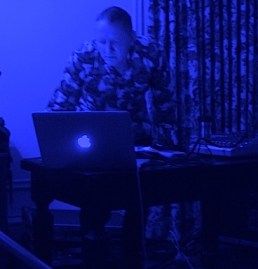
Marcus Boon DJ-ing, image by JSA
Still, I do wonder. Was the movement into sonic subcultures that my generation (and those that followed) made–especially in the UK where music (and intoxicants, and immigration) were one of the few escape routes from the brutalities of Thatcherism–a mistake, precisely because we accepted as ontological, a structure that in fact was smoothly integrated into the operations of late capitalism? From the Factory and Paradise Garage to Berghain or Ministry of Sound. . . how will history look on the era of the mega-club?
Although one could argue that the Internet put an end to the idea of subculture, since it breaks down the locality and secrecy around which particular subcultural communities grow, in fact what seems to be happening is an acceleration in the generation and dissolution of subcultural formations. Hip-hop has adapted very quickly to the internet. The cassettes or CD-Rs sold out of DJ Screw’s record store in Houston, Texas, for example, morph into the world of online mixtapes, Youtube clips and Twitter battles; the gray market availability of samples sounds a lacuna of time, appearing for a day on a hosting site rather than flying below the radar in some particular geographical location. At the same time, sonic subcultures are expanding around the world. If Jacques Attali was right that sound is prophetic, then #idlenomore was announced by Ottawa Native dubstep crew A Tribe Called Red; Tahrir Square by Chaabi and North African hip-hop.
In his book 1989, Joshua Clover describes popular music in the period of neo-liberal globalization as the sound of ideological containment. It’s true that popular music is full of ontological claims about sound, of music that celebrates setting us free. . .but which fails to actually do so. A quote from Ray Brassier just came up on my Twitter feed:

If true, this would suggest that the intensity of moments of sonic jouissance does not necessarily mean anything in terms of ontology or the truth about what’s Real. It could be entirely delusional.
All of which might be true. We might come to realize that, to put it in Heideggerian terms, we’ve been thrown into this, and that maybe there’s not much difference between being thrown and being played. But somehow I think people on dancefloors already know this. The dramas of seduction, commitment and loss are at the core of disco, and many other kinds of popular music too. To quote the disco classic “Lost in Music” by Sister Sledge (later covered by post-punks The Fall):
We’re lost in music; caught in a trap.
No turning back. We’re lost in music.
We’re lost in music. Feel so alive.
I quit my nine-to-five. We’re lost in music.
Other examples are not lacking.
Perhaps sound and music border on a vibrational ontology, rather than being truly the core of one. This is why, as Michael Taussig, Jayna Brown, and others have suggested, they can be concerned with healing. Perhaps any practice that is meaningful — and sonic subcultures are certainly a matter of practice, as Julian Henriques indicates in his book Sonic Bodies — must necessarily work at the boundary of a space that it can never entirely inhabit as a practice, but which it can push one towards, and also receive one from. The anticipation, fear, desire before one goes out, for example, but also the blinding daylight, the sensation of cool air on exposed skin when one leaves a dancehall or a party.

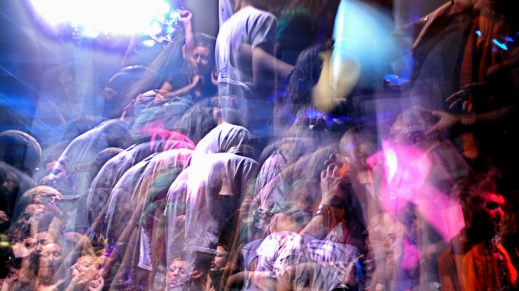
Lasers in a dance club, image by flickr user gabriel.jorby
Sound studies has not truly begin to explore these moments of exposure to and abjection from the vibrational core of sound. No doubt, Steve Goodman performed heroic work in Sonic Warfare—which sets out a proposal for a vibrational ontology in the midst of the commodification and militarization of the sonic —as have various explorations of the phenomenology of sound, such as those in Salome Voegelin‘s Listening to Noise and Silence. Yet in both cases, a full consideration of sonic ontology is in the end foreclosed. In Goodman’s case by Sonic Warfare’s emphasis on the militaristic applications of sound and vibration that are appropriated by sonic art and subcultures, which gives the violence of sound and vibration something like ontological status, while the aesthetic and cultural “uses” of the same have only a secondary, somewhat parasitic status. Conversely, in Voegelin’s work, an emphasis on the phenomenological rendering of the moment or event of sonic relationship forecloses a broader investigation of sonic ontology, because it “brackets” (to use Husserl‘s term) considerations beyond that of the subject-object relationship. In both cases, the sonic thing in itself, or indeed an ontology of vibration, risks being lost.
The recent turn to the speculative and to realism in philosophy has yet to make an impact in sound studies, despite the fact that the object of sound presents a provocative and very intimate entry point to that problematic. One of the more intriguing and improbable hypotheses emerging from the speculative realist movement is that of Quentin Meillassoux, who, in After Finitude, makes an argument that speculative knowledge of the real, unmediated by correlation with the Kantian subject, is possible through mathematics. It is roughly Alain Badiou‘s thesis in Being and Event too. As much as music is clearly about the contingency of sonic experience, there are strong arguments, going back to Pythagoras and beyond, about the relation of music to mathematics. Natural harmonics, rhythm: the elements of music express mathematical relationships. I am not interested in reducing music to a kind of vulgar scientism. But what if when we listen to music, we are exposed to a mathematical ontology and at the same time, the contingency of an unprecedented event? What if music is speculatively real? The word “speculative” here would refer not to philosophical propositions, but to the uncanny movement across subject/object individual/collective borders that the sonic matrix offers when “we” listen to “it.” Music not as the source of a speculative discourse on the real, but a speculative practice in which order and contingency meet.

A cymatic image, made by sound vibrations on a visible medium by flickr user evan grant
Genres, styles form around places of cohesion, of transport, of passage. Not an instrumental mathematics (though it can be that too), but a speculative one that seeks out locations of collective affect, of resonance between micro and macro spheres. It matters little whether a specific knowledge of mathematics is invoked here, since many traditional musics find their way to structures that, according to scholars such Alain Danielou, already express mathematical relationships. And in this way, music and musicians can be said to participate in a sonic ontology.
Reluctantly perhaps. Ready or not. The question remains: how many institutional, historical, disciplinary, intellectual, social and political barriers remain in order that a cultural artifact like “One Nation Under a Groove” can be considered to have ontological significance? That is what I mean by the politics of vibration, and in terms of borders, it’s an important set of borders for researchers in sound studies to consider.

Tyler, the Creator crowdsurfing, image by flicker user choe.brandon
Much of my current work focuses on tropes of abjection in recent hip-hop and RnB music, notably that of Odd Future members Tyler, the Creator and Frank Ocean, artists like Azealia Banks, and a new generation of queer rap MCs emerging out of New York City such as Zebra Katz, Le1f and Cakes Da Killa. All of their work is bracingly obscene, funny, violent. . .a tumbling deck of cards of performances of gender, race, sexuality, class and more. Of course, cursing to a beat is nothing particularly new, but the way in which these artists multiply and collapse identities to an ever more minimal, humming beat perhaps is.
Katz’s remarkable “Ima Read” and its equally remarkable video is a case in point. Although Katz occasionally claims dryly that the song is “pro education,” the “reading” in question mostly refers to the drag queen balls of the Harlem ballroom/voguing scene of the late 1980s/early 1990s, where to read meant to verbally trash, i.e. abject, someone at a ball. The song is rapped by male and female voices, crisply denouncing a “bitch” who they are going to “take to college.” The violence of the song is ironic, as much a marker of queer community and Eros as of sexual difference, of racial and trans-racial solidarity as much as racialized violence. It is performed over a minimal beat with a humming, in-your-face bass drum that is the only recognizable tonal element.
Why make the leap to talking about ontology in discussing this admittedly awesome Youtube clip? Both Judith Butler’s famous elaboration of the performativity of gender, one of the bases of queer theory, and Katz and friends play with taboos concerning gender, sexuality and race in contemporary hip-hop emerge from that moment of the ballroom scene.
But what if Butler’s emphasis on performance actually covered up or abjected the ontological nature of experiments at the balls? Perhaps we need to rethink why the ultimate ball anthem is Cheryl Lynn’s “Got To Be Real.” What is sonic ‘realness’? In restoring the sonic dimension to the ballroom scene, and learning, from Zebra Katz, to face that constitutive abjection that Kristeva amongst others has pointed us towards, we can begin to feel for ourselves what a vibrational ontology is.
—
My thanks to Catherine Christer Hennix, Steven Shaviro, Kevin Rogers and Ken McLeod for conversations that helped me in thinking this through, and to Jennifer Stoever-Ackerman for luminous remix skills.
—
Featured Image by Flickr User depinniped
—
Marcus Boon is associate professor of English at York University in Toronto, and was a Fellow at Cornell’s Society for the Humanities in 2011-12. He is the author of The Road of Excess: A History of Writers on Drugs (Harvard UP, 2002) and In Praise of Copying (Harvard UP, 2010). He writes about contemporary music for The Wire. He is currently co-editing a book on Buddhism and critical theory, and a new edition of William S. Burroughs and Brion Gysin’s The Third Mind. He is also working on a book entitled The Politics of Vibration.
Share this:


Current Top Posts





April 2021

January 2020

November 2019

October 2019

August 2019

April 2014

November 2017

March 2015

December 2017

October 2015
 Sounding Out!
Recent Comments