
Sounding Out! Podcast #24: The Raitt Street Chronicles: A Survivor’s History
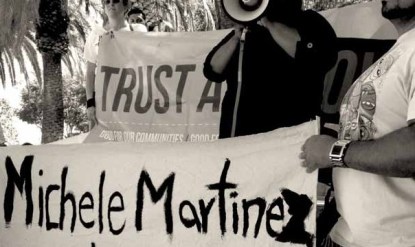
CLICK HERE TO DOWNLOAD: The Raitt Street Chronicles: A Survivor’s History
SUBSCRIBE TO THE SERIES VIA ITUNES
ADD OUR PODCASTS TO YOUR STITCHER FAVORITES PLAYLIST
Listen in as Kevin Cabrera, Nancy Charco, Monica Gonzalez, Jesus Lopez, Javier Morales, Marcus Medina Mendoza, Cynthia Zul, Jasmine Soto, Pablo Montoya, Alex Mendoza, Marilynn Montaño, Robert Salas, and Isabel Marin guide us through the soundscapes of Raitt Street, their neighborhood in Santa Ana. If you are interested in learning more about the Raitt Street Chronicles please listen to this interview with Manny Escamilla, the archivist for the Santa Ana History Room at the Santa Ana Public Library. Also, check out the Raitt Street Chronicles website where you can find narrated photojournals by the authors of this podcast.
This podcast was made possible through different individuals and institutions dedicated to the histories of Santa Ana. The Santa Ana Public Library partnered with Cal State Fullerton’s Grand Central Art Center and the Studio for Southern California History to train teens to collect oral histories from the Townsend/Raitt neighborhood. Project mentors trained youth participants to collect, archive, and share the underreported stories of survival from one the nation’s most at-risk communities. Over the course of 12 months the participants recorded video interviews with survivors of violence. Community impactful projects like this are made possible through the generous support of foundations, corporate sponsorships, and the generosity of individuals who believe in the mission and purpose of such collaborative efforts. This collaboration with Santa Ana Public Library has been fortunate to receive support from a Cal Humanities 2013 Community Stories grant, but additional funding and in-kind support is needed to realize this project, as well as other projects in the works, to their fullest and most positive impactful outcomes.
–
Manuel “Manny” Escamilla – Is the archivist for the Santa Ana History Room at the Santa Ana Public Library. He received an AA from Santa Ana College in 2006, a BA in History from UC Berkeley in 2008, and is in the first year of his MLIS at UCLA as an Inland Empire LEADS fellow. He has interned the Emma Goldman Papers at UC Berkeley, the Special Collections Department at UCI, and the Chicano Research Center at UCLA. With the aid of a 2008 McNair Scholarship, Manny organized an independent research project at the U.K. National Archives in London. As the archivist for the Santa Ana History Room he has concentrated on increasing the archives collection of historically underrepresented minorities and creating innovative youth outreach programming for the ‘Teen Community Historians.’ As a 2010 Eureka fellow he completed the “Our Lives Our History” project that helped youth volunteers collect 35 oral history interviews of recent immigrants from various states of Mexico. He is currently the Project Director for ‘The Raitt Street Chronicles: A Survivors’ Oral History’ and the upcoming ‘Santa Ana Civic Archive: Connecting Future Leaders to their Community’s Civic Past.’ Additionally he serves as the Programming Chair for UCLA’s Student Chapter of the Society of American Archivists and is an active member of OC REFORMA.
Since earning her PhD in History from the University of Southern California (USC) in 2002, Sharon Sekhon has explored the integration of critical local history into public discourse. Over 2003 – 2005, Sekhon was a Postdoctoral Fellow at the Institute for Multimedia Literacy at the Annenberg Center for Communication at USC. There, she worked with faculty in developing discipline-driven, multimedia scholarship and curricula. She was the Principal Investigator for the Holiday Bowl History Project, a place-based, cross institutional online oral history project on the Holiday Bowl bowling alley in the Crenshaw neighborhood of Los Angeles. Sekhon founded the history organization the Studio for Southern California History (Studio) in 2006. The Studio uses participatory methods to create conversations about our shared spaces across Southern California. The Studio’s work is showcased on the LA History Archive at www.lahistoryarchive.org. In addition, Sekhon has taught in the Department of American Studies at California State University Fullerton since 1999.
—
 REWIND! . . .If you liked this post, you may also dig:
Sounding Out! Podcast #20: The Sound of Rio’s Favelas: Echoes of Social Inequality in an Olympic City— Andrea Medrado
Sounding Out! Podcast #9: Listening to São Paulo, Brazil— Leonardo Cardoso
Sounding Out! Podcast #6: Spaces of Listening/The Record Shop— Aaron Trammell
Share this:

The Acoustics of Passing: Harriet Beecher Stowe’s Uncle Tom’s Cabin as Supremacist Remix
 Editor’s Note: Sound Studies is often accused of being a presentist enterprise, too fascinated with digital technologies and altogether too wed to the history of sound recording. Sounding Out!‘s last forum of 2013, “Sound in the Nineteenth Century,” addresses this critique by showcasing the cutting edge work of three scholars whose diverse, interdisciplinary research is located soundly in the era just before the advent of sound recording: Mary Caton Lingold (Duke), Caitlin Marshall (Berkeley), and Daniel Cavicchi (Rhode Island School of Design). In examining nineteenth century America’s musical practices, listening habits, and auditory desires through SO!‘s digital platform, Lingold, Marshall, and Cavicchi perform the rare task of showcasing how history’s sonics had a striking resonance long past their contemporary vibrations while performing the power of the digital medium as a tool through which to, as Early Modern scholar Bruce R. Smith dubs it, “unair” past auditory phenomena –all the while sharing unique methodologies that neither rely on recording nor bemoan their lack. Last week, the series began with Mary Caton Lingold‘s exploration of the materialities of Solomon Northup’s fiddling as self-represented in 12 Years a Slave. This week, Caitlin Marshall treats us to a fascinating new take on Harriet Beecher Stowe’s listening practice and dubious rhetorical remixing of black sonic resistance with white conceptions of revolutionary independence. —Jennifer Stoever-Ackerman, Editor-in-Chief
—
Harriet Beecher Stowe. Courtesy of Flickr Creative Commons
Harriet Beecher Stowe: novelist, anti-slavery agitator, antebellum DJ? In 1852, Stowe penned one of the most famous works of fiction in American history: Uncle Tom’s Cabin. A sentimental work, the novel dramatized the lives of fictional slaves searching for freedom. Eager to achieve a national hearing of her anti-slavery agenda, Stowe’s novel required a voice that could “speak” in morally efficacious tones against slavery. To stage this voice, one that hinged on a sonic appeal to inter-racial sympathy, Stowe sampled and mixed two powerfully persuasive, if diametrically opposed, cultures of speaking and listening in the United States.
The first of these cultures revolved around revolutionary American understandings of political rhetoric. According to Jay Fliegelman, this tradition of republican oratory drew upon 18th century philosophical principles to recast Declaring Independence as a speech act. In his Declaration, Jefferson announced the ‘self-evidence’ of an American people by performing a nationally specific common sense in two important ways. First, he displayed a breed of American moral feeling in direct contrast to that of the colonial British; second, he did so through an oratorical style that inaugurated a common, American modality for articulating and hearing truth. The felt and sounded show of a common ‘self’ evidenced Americans’ natural rights to independence, and installed a markedly white revolutionary acoustics of freedom.
Stowe’s second sample was a misappropriation of a new mode of hearing in the 1845 Narrative of the Life of Frederick Douglass, An American Slave. As Sounding Out! Editor in Chief Jennifer Stoever-Ackerman has argued in “The Word and the Sound: Listening to the Sonic Colour-line in Frederick Douglass’s 1845 Narrative,” Douglass’s narrative was a direct attempt to bend and subvert what she terms “the sonic colour-line” (21). An acoustic schema that racialized sound and recruited the ear in black subjection, the sonic color line was epitomized by the republican oratorical tradition wherein meaning was linked to white articulation, and meaninglessness to black utterance, heard simply as ‘noise.’
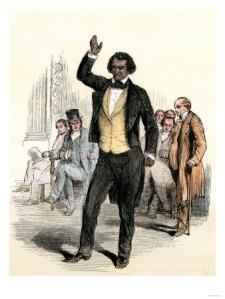
Image of Fredrick Douglass speaking in England regarding his experiences as an American slave
Contrastingly, the reformed sonic model presented in the Narrative sought to position black sound as a site of meaning and resistance, and challenged Northern readers to question and remap both their hearing of such sounds and their ethical relationship to black meaning. Jonathan Cruz, in Culture on the Margins, terms this new mode of hearing “ethnosympathy” and defines it as an “interpretive ethos of pathos” (3). Importantly, Stoever-Ackerman highlights that Douglass did not seek to cast black sound as “a sentimental appeal to truth,” but “rather [as] a challenge to dominant notions of truth produced and disseminated through the ear” (31). Stowe however, did not hear Douglass’s message so subtlety, and like many Abolitionists, was quick to commandeer black sound for a white social justice platform wherein it served as the innately moral (and romantically racialized) sound of sentimental suffering. Thus, it was this mishearing of the strains of black resistance that Stowe remixed with the white tones of revolutionary independence to spin a brand new soundtrack for the antebellum era. I term this soundtrack the acoustics of passing.
A vocal melodrama (a literal speech act) in black and white, the acoustics of passing was an amalgamated grid of sonic intelligibility invested in the political power of voice that encapsulated the seemingly antithetical (to white America) tones of republican virtue and black experience, and was deployed by Stowe to narrate the fantastical passage of African Americans from bondage to freedom. Composed first through Uncle Tom’s Cabin, and propagated later in her paternalistic relationships with black female artists, Stowe’s acoustics was ostensibly a powerful tool in the fight against slavery, but was ultimately used by the author to recapitulate her whitewashed vision of America.
Stowe’s acoustics appear in Uncle Tom’s Cabin in novel’s first passing scene: George Harris’s Spanish masquerade. Stowe frames this scene prominently with the fugitive slave advertisement that George’s master, Mr. Harris, has posted. Many scholars have pointed to the way in which the visual organizes the practice of passing, but it is important to note that in this scene, the oral/aural is equally emphasized as key to a passing performance; Mr. Harris, for one, notes in his advertisement that George’s keen eloquence and literacy are the fugitive’s distinguishing features. Moreover, the advertisement seems to warn, in combination with George’s European complexion, he is rendered seemingly indistinguishable from a white man. Mr. Harris expects George to attempt such a passing ruse, and therefore clearly identifies the marks that will testify to George’s slave status. George
is deeply scarred on his back and shoulders; has been branded in his right hand with the letter H (95).
Contrary to Mr. Harris’ predictions, however, George enters the roadhouse disguised as a Spanish gentleman. To pull off this guise George darkens his skin and hair. In the essay, “Spanish Masquerade and the Drama of Racial Identity in Uncle Tom’s Cabin,” Julia Stern argues that George’s third term identity, “nonblack, nonwhite,” is radical because it upsets the logic of the antebellum racial dichotomy. However, we should note that this dark masquerade allows Stowe to symbolically align George, a mixed race man, with both his black and white parentage. In darkening his skin George pays tribute to his slave mother, while by adopting a well-known Anglican slaveholding surname, Henry Butler, George references his absentee father. Thus, the Spanish disguise is Stowe’s reminder that George is passing for who he claims to be.

Tailpiece illustration by Hammat Billings for Uncle Tom’s Cabin; or, Life Among the Lowly, by Harriet Beecher Stowe. Illustrated Edition. Original Designs by Billings; Engraved by Baker and Smith. (Boston: John P. Jewett and Company, 1853). George Harris, Mr. Wilson. Clifton Waller Barrett Collection, University of Virginia.
Yet before George can break from the tavern on his way towards Canada, he must reveal himself to his former employer, Mr. Wilson, who, George believes, has recognized him. In the long speech that follows, George must convince Mr. Wilson to discard a juridical sense of right in favor of an ethical one. Carefully arranged through Stowe’s acoustics of passing, George’s oratory presents equal parts white republican sentiment and black pathos, sentimentally persuading Wilson (and a listening America) of the moral justice in permitting him to pass to freedom.
Well aware that her readers at home would have been reciting the text of Uncle Tom’s Cabin aloud, Stowe is careful score George’s speech for both sonic whiteness and blackness–leaving intertextual clues that act like dynamic musical notation to indicate how George’s performance should sound. To begin, Stowe spells out her source material for George’s speech by directly citing Jefferson’s “Declaration” in a footnote to George’s opening salvo. Stowe wants readers to hear George’s speech as the realization of the American Republican promise. Americans, Stowe argues, are in a state no better than the British of the 1770’s: like the tyrannical father/monarch King George, Americans are “deaf to the voice of justice & of consanguinity.” A lengthy address, George’s monologue is an account of the domestic crimes of slavery, and, like the Declaration, is a complaint of personal injury at the hands of a nation that has been as negligent in looking after its blood kin as has George Harris’s father. Concluding with the passionate exclamation, “I’ll fight for my liberty to the last breath I breathe! You say your fathers did it; if it was right for them, it is right for me!” (102), George’s Declaration claims the rhetorical, and therefore natural, rights that are his white, paternal inheritance.
The sonic difference in George’s speech however, is the pathos of it, the “tears, and flashing eyes, and despairing gesture,” here meant to index the orator’s audible black suffering. Though setup as racially inscrutable in this scene, Stowe takes great pains to ‘out’ George’s hidden blackness. Not only does Stowe symbolically darken George to cite his mother’s race, but she draws attention to the black body through repeated citation of his scars. This figuration of speaking wounds was prevalent in the popular imagination of Stowe’s day, and represented the white fantasy that black speech was the ‘playback’ of slave experience as recorded in the grooves of the traumatized and marked black body. Frederick Douglass, for example, recounts in My Bondage and My Freedom that he was first introduced as a speaker to the Abolitionist lecture circuit as a “graduate from the peculiar institution…with my diploma written on my back!” (359).
Miraculously, at the climax of George’s sonically mixed oration, Mr. Wilson is overcome with a revised sense of justice, one consonant with George’s bid for freedom. In this overdetermined acoustic schema, Stowe aligns progressive white ethos and republican sentiment with the distinct sounds of black pathos, and positions any mode of hearing contrary to this inter-racial sonic sympathy as un-Christian, un-patriotic, and detrimental to the future of the Union.
Yet Stowe’s acoustics of passing is decidedly supremacist. To begin, George’s mixed sound is haunted by the specter of forced conception and familial alienation ubiquitous to slavery. Additionally, while Stowe deploys the acoustics of passing towards an anti-slavery platform, her sonic schema ultimately preserves the social and political function of whiteness. Thus, while George’s sonic blackness is essential for playing out the moral justice of Stowe’s cause, it is this same audible blackness that permits Stowe to ultimately write the political problem of inter-racial integration off to Liberia with the entire Harris family.

Freedom to Africa. Headpiece illustration by Hammat Billings for Uncle Tom’s Cabin; or, Life Among the Lowly, by Harriet Beecher Stowe. Illustrated Edition. Original Designs by Billings; Engraved by Baker and Smith. (Boston: John P. Jewett and Company, 1853). Courtsey of Clifton Waller Barrett Collection, University of Virginia
Herein is the problem of Stowe’s acoustics: its sonic inter-racial sympathy at once promised speakers of color the agency of a sounded path to freedom (that which George performs and narrates) while ultimately deploying white practices of containment. And Stowe indeed dramaturged the lives of several mixed race artists through these acoustics, most notably the Dramatic Reader, Mary Elizabeth Webb and the concert vocalist Elizabeth Taylor Greenfield.

Elizabeth Taylor Greenfield, Courtesy of the New York Historical Society
As I continue to investigate the careers of women of color like Greenfield and Webb, I think about how Stowe’s acoustics could have empowered and constrained their bids for resistance, rights and recognition.
—
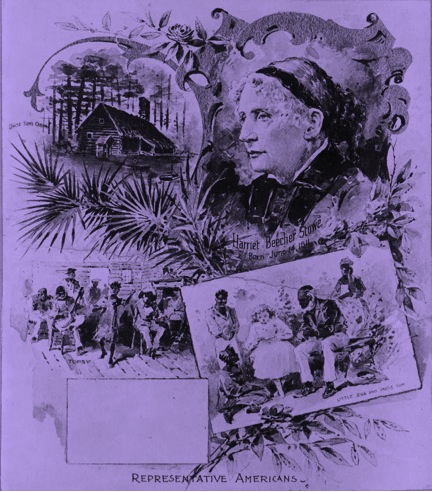
Featured Image: “Representative Americans” Image of Harriet Beecher Stowe surrounded by characters from Uncle Tom’s Cabin, 1893, Remixed by Jennifer Stoever-Ackerman
—
Caitlin Marshall is a PhD Candidate in Performance Studies at UC Berkeley. A vocalist herself, Caitlin applies her practice-based knowledge of voice towards the study of what it meant to ‘sound American’ during the nation’s first independent century. Focusing on ‘Othered’ American vernaculars at the intersections of race, disability, gender, and ethnicity, her dissertation, ‘Power in the Tongue’: Crippled Speech & Vocal Culture in Antebellum America, takes seriously the metaphor of voice in American democracy, and works at the confluence of Performance, Sound, and Disability Studies to mobilize speech impairment as a broad material and theoretical category for investigating how American citizenship was established as an exclusionary vocal limit in the antebellum era.
—
 REWIND! . . .If you liked this post, you may also dig:
“Como Now?: Marketing ‘Authentic’ Black Music,” –J. Stoever-Ackerman
Hearing the Tenor of the Vendler/Dove Conversation: Race, Listening, and the “Noise” of Texts –Christina Sharpe
How Svengali Lost His Jewish Accent––Gayle Wald
Share this:


Current Top Posts





April 2021

January 2020

November 2019

October 2019

August 2019

April 2014

November 2017

March 2015

December 2017

October 2015
 Sounding Out!
Recent Comments