
As Loud As I Want To Be: Gender, Loudness, and Respectability Politics

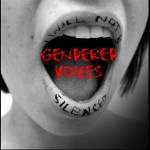 Editor’s Note: Here’s installment #2 of Sounding Out!‘s blog forum on gender and voice! Last week we hosted Christine Ehrick‘s selections from her forthcoming book; she introduced us to the idea of the gendered soundscape, which she uses in her analysis on women’s radio speech from the 1930s to the 1950s. In the next few weeks we’ll have SO regular writer Regina Bradley, with a look at how music is gendered in Shonda Rhimes’ hit show Scandal, A.O. Roberts with synthesized voices and gender, Art Blake with his reflections on how his experience shifting his voice from feminine to masculine as a transgender man intersects with his work on John Cage, and lastly Robin James with an analysis of how ideas of what women should sound like have roots in Greek philosophy.
As I planned for SO!’s February forum, I wondered about my own connection to the topic: how is the loudness of a voice gendered? Does it matter who we call “loud”? As a Latina, I’m familiar with the stereotypes of the loud Latina, and as a Puerto Rican I faced them at every gathering. So for this week I decided to reflect upon my experiences in a personal essay. Lean in, close your eyes, and don’t let the voices startle you.–Liana M. Silva, Managing Editor
—
I was 22 years old when someone called me deaf. I was finishing my bachelor’s degree at the University of Puerto Rico, Rio Piedras campus. After four years of living in San Juan, I still hadn’t gotten used to the class and race microaggressions I encountered regularly because I was a brown girl who grew up in the country and was going to school in the urban capital, el área metropolitana. These microaggressions were usually assumptions about who I was based on how I talked: I called pots a certain way, I referred to nickels in another way, and I couldn’t keep my voice down–all indications, according to my “urban” friends, that I grew up in the country. But being called “deaf” was a new one.
My boyfriend at the time had no cellphone, and his mother would call me regularly to see if he was on his way home from a gig or to ask him to run an errand. She and I were not close, but we were cordial. I always felt we didn’t click on some level. This particular weekend day, she had called to ask if he had left San Juan already to come visit her, and I told her I had just seen him that morning before he left. Somehow she and I went from small talk into a conversation.
In my head, I thought I was making headway with her and that this was a huge step forward in our relationship. We talked about his gig the night before, about how my family was doing, things like that. Then she asked me if my family had a medical history of people losing their hearing. “No? I don’t think so. Why do you ask?” I said in Spanish.
“Because you talk so loud, and so do your father and your sister. Your mom isn’t loud.”
That was over 10 years ago, but the comment still stings. I am certain that wasn’t the only time someone called me “loud” or pointed out the tone of my voice, but it’s the one time that still rings in my ears when I think about the intersection of gender and sound. It wasn’t just that I spoke at a high volume, it was that I was a woman who spoke at a high volume. I was the girlfriend who was loud.
Of course we’re not born loud- or soft-speakers – we learn to use the volume level that prevails in our culture, and then turn it up or lower it depending on our subculture and peer group.
-Anne Karpf, The Human Voice
What does “loud” mean, anyway? Denotations fade into connotations. As I write this, I struggle to think of how to describe loud in a way that doesn’t feel negative. Because every time I think of “loud” its negative connotations float up to the surface. Just take this Merriam-Webster online dictionary entry for “loud.” Aside from the reference to volume, “loud” also means sounds that are offensive, obtrusive—annoying.
To be fair, I’ve always been self-conscious of my voice, and not in the way most people hate the sound of their voice. I always felt my voice was not girly enough. I always felt as a teenager and a young adult not “pretty” enough, not thin enough, not “feminine” enough, so my insecurities also extended to my voice.
Growing up, I heard people tell me time and time again to keep my voice down, that I was talking too loud, that people next door could hear me, et cetera. Grandparents, cousins, parents, friends: I got it from every corner. Shush. But I don’t recall anybody saying that about the boys/men I hung out with. Add to that the comments I got about my appearance: “you’re too fat,” “your hair is too frizzy,” ‘you’re ugly.” I associated being loud with being unattractive. Just another flaw.
It’s no coincidence then that describing a woman as loud is almost never said as a compliment. Although a man can be loud—he might even be expected to have a deep, booming, commanding voice, as the above video describes—when a woman is described as loud, it’s almost never in a good light. Karpf mentions in The Human Voice: The Story of a Remarkable Talent that “Loudness certainly seems to be judged differently depending on the sex of the speaker. Talking loudly is considered an act of aggression in women, but in men as no more than they’re entitled to.” In other words, society deems men to be allowed to be loud, and by extension loudness comes off as a masculine feature. So loudness, something that at its base means high volume, ends up being constructed as more than just decibels. Women who are “loud” become noisy, rude, unapologetic, unbridled.
Mija pero que duro tu hablas.
In Puerto Rico, the word for “loud” was alto (high) but also duro (hard). I knew early on that when someone told me that I spoke duro they didn’t mean it in a kind way. The voice was described as hard, harsh, shards of glass. It hurt to be called loud. It hurt to be called hard. Especially when you understand that society accepts only certain ways of being a woman: soft, delicate, fragile, dainty. It was never meant as a compliment to have someone call your voice “hard.”
If I was listening to my mother and my aunts or cousins speaking, and then chimed in, I would get the “shhhh” or if they wanted to be discreet they would make a gesture with their hands to indicate to me that I should bring my voice down. I learned early on that a lower voice was more appealing than the loud voice hiding in my vocal box.

I am Puerto Rican, and even though I was born in New York City, I was raised in a small town on the western side of Puerto Rico. I was already well-aware of stereotypes and digs about my being born in New York, even at a young age. My cousins would tell me I was stuck up, I thought I was better than other people because I had cable, I only listened to music in English (I guess that was a bad thing to them). When I moved to San Juan, I was no longer a displaced Nuyorican but a country bumpkin. Peers, friends, and new acquaintances would not classify me as a Nuyorican but, because I was living in San Juan at the time, would categorize me as an islander, de la isla, which basically meant I was not from el “area metro.” I was, in short, a country bumpkin to them.
The loudness of my voice was not just a marker of where I came from (the country, with all of the classicism that the phrase entails) but for me became conflated with gender. I knew that even when I wasn’t living in the city, I had been called loud. It’s just that when my peers asked me to lower my voice or to not speak so “duro” it was also because they thought of me as jíbara, country.
Sometimes I would get carried away when I was telling a joke among my female roommates, or I’d be excited to share some news, and eventually someone would tell me to tone it down. Baja la voz. As I reflect upon my college years living with roommates in a crowded apartment in a crowded city, I remember that we often got together and laughed, talked over each other, shouted across the apartment. But I would get carried away and then someone would say something about it. Mira que nos van a mandar a callar. Someone’s gonna tell us to shut up.
It was in college, however, that I learned to modulate my voice. I am physically capable of whispering, but when I spoke in English in a classroom setting (I was an English major in a school whose language of instruction was Spanish) I felt even louder in English. So I made the effort to tone down my voice, literally. I equated English with career, and by extension with my professional persona.
Ultimately, English would be the language I spoke (and still speak) in academic circles; with the language came also the tone and the volume. Men in my classes seemed more often to initiate conversations in my classes, and sometimes even in the ones where they were a minority. Meanwhile, the driven graduate student that I was, I wanted to step in but not stand out because of my voice. I didn’t want to give them (or the professor for that matter) a chance to discount me because I was a loud Puerto Rican woman at an American school. Eventually I learned how to switch back and forth. So did my fellow female classmates.
I remember as a teacher modulating my voice so I would be less loud and less abrasive in a college classroom. I wanted to assert my authority. If some women resort to vocal fry in order to be taken seriously, as this 2014 article in The Atlantic (online) suggests, I resorted to modulating my voice. That was my way of passing: passing for creative elite, passing for feminine, passing for authoritative. I tried to assert my credibility as a burgeoning scholar and professor by tweaking my voice. I laughed a little softer, I spoke a little slower, I sounded a little lower. I teetered between trying to sound feminine and trying to downplay my femininity through my voice.
Was I trying to sound more like the stereotype of a woman so I could be more credible in the classroom? Was this my own version of respectability politics? “Don’t be so loud and they’ll listen to you”?
“White supremacy grants white people the ability to be understood as expressing a dynamic range; whites can legitimately shout because we hear them/ourselves as mainly normalized. At the same time, white supremacy paints black people as always-already too loud.”
-Robin James, “Some philosophical implications of the “loudness war” and its criticisms”
The negative rhetoric about women and loudness is also connected to respectability politics. Take for example the stereotype of the angry black woman (which is in the vicinity of the loud Latina). If women must be delicate and feminine, being loud would be unattractive, unseemly. Loud also means “not being silent,” in other words, speaking when not spoken to. Robin James touches upon “loudness” in contemporary music, and how the turn toward less loud tracks also has to do with racialized ideas about who can speak and who can be loud–in other words, what counts as noise and what counts as harmonious sound. She cites Goldie Taylor’s piece in The Daily Beast about how, regardless of how angry she felt about the racial injustices in the United States, she would never be able to scream and shout without consequences. Loudness is something racialized people cannot afford.
The stereotype of the angry woman points to how the notion of who is loud and what tone of voice is considered loud are constructed. Although there are studies that point out that the sound of one’s voice indicates to others that one is in a position of authority or that one’s voice can make or break one’s career, there is yet to be a study that shows how the biology of the body that produces the voice affects what one can or cannot do. In other words, the connection between voice and our abilities, or our social class, is constructed—in our heads.
Assertive, aggressive, leader: these descriptions benefit men, for the most part. Aggressiveness is seen as a masculine trait, and along with that a loud tone of voice is also seen as masculine. (This idea is also problematic, for it sets anything that isn’t aggressive and assertive as female, and therefore negative.) The opposite applies to women; the same way our society associates fragile delicate things with femininity, a fragile, soft, low tone of voice is the acceptable range for a woman. And James and Taylor’s comments point to how race also changes the equation. Damned if we speak, damned if we don’t.
***
Over the years, I’ve become more comfortable with the way I sound. I’ve also become more comfortable switching between my aural codes, like I do with English, Spanish, and Spanglish. I know that there’s a volume that I use in certain spaces. I also know that in other spaces I don’t have to watch over how loud I am. If I am in a familiar space, with people I am close to, I feel less inclined to watch myself. I feel safe, not judged. I can be as loud as I want to be. But loudness is also an accepted way of speaking around my family. If I spoke in a low tone, I’d probably be picked on for that. My father, for one, has a booming, deep, loud voice, and so do many of my family members.
For me, embracing my voice is also a kind of body acceptance. My body, plus-sized and all, takes up space. My voice takes up space too. As a teenager and an adult I was constantly shamed for the way I look (skin too brown, voice too loud, face too painted, hair too short), and for a time tweaking my voice became a way to try to fit in. But I later learned how to respond to the remarks. I learned to be sarcastic. I learned to make jokes. I learned to talk back. I didn’t find my voice; I embraced my voice.
Dear readers, let us know in the comments: have you been chastised for being loud? Or for not speaking loudly enough?
—
Featured image: property of the author.
—
Liana M. Silva is co-founder and Managing Editor of Sounding Out!.
—
 REWIND! . . .If you liked this post, you may also dig:
I Been On: BaddieBey and Beyoncé’s Sonic Masculinity–Regina Bradley
Learning to Listen Beyond Our Ears: Reflecting Upon World Listening Day—Owen Marshall
An Ear-splitting Cry: Gender, Performance, and Representations of Zaghareet in the U.S.–Meghan Drury
Share this:

Of Sound Machines and Recording, Sharing that Transcends Time and Space

This is the conclusion to a two-part post by SO! regular writer Maile Colbert. Read Part One from Monday, January 12th here.
—
As we are primarily a visual culture, no longer connected to what environments can tell us through sound, we’ve lost aural acuity once central to the dynamic of our lives.
From what we have just begun to see, it appears that ancient human beings had learned well the lessons imparted by natural sounds. Their lives depended as much (if not more) on their ability to hear and understand the audio information imparted by their surroundings as those given by visual cues. –Bernard Krause, Ph.D The Soundscape Newsletter 06, June, 1993
Birth
All newborns emerge with the same cry, it is near impossible to distinguish one from another, even as a mother. This could be for many reasons and serve many purposes. Should something happen to a birth mother, the indistinguishable cry may help draw attention from another. It could be that, considering niche effect (in which animals adapt their calls to a frequency less populated by other environmental sounds), aside from biological reasons, a newborn’s cry is shaped by the wombscape from whence it came, and I speculate that generally speaking one wombscape is similar to another. Primarily what a fetus is hearing is low frequency. So it would serve that they would have an instinct to initially call out in a high frequency range. The baby then develops its cry according to its surrounding, such as a household in the city versus a country, a household with other children or not, a household with constant media sound.
My daughter has the most incredible earsplitting high frequency bark when she wants attention. If this doesn’t work (such as when “Baby, Mama has to wash the garden manure from her hands before she picks you up”), she’ll roll into a gritty horrific low growl that sounds like she’s being strangled. One of these always works, and I often wonder about these sounds’ relationship to the white noise (her specific mix in a more mid-range involving pink noise and a “rain on roof” recording) that has been a constant since her birth, and is still used for naps, some feedings, and bedtime.
Sound Machines and Noise
From my late pregnancy insomnia, to creating a calming environment in the labor room at the hospital, to keeping a consistent calming environment in the recovery room, to using that sound as a signal that it is time to calm, time to sleep…a sound machine has been a constant already in my daughter’s new world. It started with an app in Paris, at a festival during my third trimester, my waddling condition wouldn’t allow me to walk around much nor meet friends for drinks, etc. So I choose to stay in the hotel room and read. The fetal babe wasn’t in the mood to read, kicking and dancing, perhaps excited from the music at the festival. For a little while I played with her, her kicking in response to my pokes and prods. But soon I knew we both needed to both settle down. I was always fascinated by my parents’ sound machine as a child, it seemed something magical. I found and downloaded an app that allowed you to create your own mix, and so it began.
But recent research poses the question of whether a sound machine can actually affect hearing development. Some researchers have questioned if prolonged exposure to consistent sound could affect auditory pathways to the brain. I wonder what then of infants who grow up near, say, the ocean…or like my mother near a stream and small waterfall, a constant sound in her childhood and soundtrack to her memories from then. Or near a busy road or even walkway. Of course I want the babe to grow up to enjoy and focus on a varied soundscape. But at certain points, the noise has been a lifesaver! It’s been especially useful now combatting construction sounds, as babies tend to focus on background sounds, most likely for survival:
.
Of course it is very important to be aware of the strength of the sound a baby is exposed to, all too easy for our very visual culture to ignore. Even a sound machine with the volume too high, or the proximity too close, could reach decibels over 80, a threshold that could cause the tiny hair cells in the ear needed for hearing to die. As we lose these, we start to lose our hearing. The amount of energy in a sound doubles with even just a three decibel climb. If any sound makes it difficult to hold a regular conversation, chances are it’s past this threshold and could be doing damage. Our world is in many ways getting increasingly louder. As our cities grow, its sounds grow, and we are exposed to more constant and louder soundscapes. Will an accidental evolution be for us to adapt to losing our hearing? For me of course, this is a very bleak thought.
Death
Your words are preserved in the tin foil and will come back upon the application of the instrument years after you are dead in exactly the same tone of voice you spoke in then. . . . This tongueless, toothless instrument, without larynx or pharynx, dumb, voiceless matter, nevertheless mimics your tones, speaks with your voice, speaks with your words, and centuries after you have crumbled into dust will repeat again and again, to a generation that could never know you, every idle thought, every fond fancy, every vain word that you chose to whisper against this thin iron diaphragm.
-Edison’s Ars Memoria, concept for the phonograph

Kaua’i `O’o, extinct since 1987
A recorded sound transcends time. It allows a listener to share a space and perspective with the recordist. It allows a future people to hear the songs of people passed, and of their shared past. It allows for an extinct bird to call into the future, for a child to hear that bird and wonder, and question, and to have that question affect her future and therefore perhaps the future of others. I often think about what soundscapes or sound I have experienced that my daughter might not have the opportunity to experience when she’s older. Already since my childhood growing up in part in Hawaii, three birds I knew, I had heard, that my mother grew up with, that her father grew up with, that his parents grew up with (and so on)…are no longer calling in the wild. But what the world and I can share with her and her generation, can give her, can leave her, are recordings.
Kaua’i `O’o: http://macaulaylibrary.org/audio/6031
Po’ouli: http://macaulaylibrary.org/audio/5125
Hawaiian Crow: http://macaulaylibrary.org/audio/13434
The library I am constantly creating, shaped by my choice and perspective…where to hit start, when to stop, where to point the mic, what equipment to use, how to frame this aural moment that captured me and invoked the desire to save and to share.
I think of this very often these days, as a friend and great soundscape ecologist and composer has passed. Steve Miller (www.stevemiller.net ) left a wealth of music, sound, and writing that his daughter and family can share. His daughter will be able to put on headphones and share a space her father formed with his perspective, his choices, his interests. A sharing active with him.
A sharing that transcends time and space.

The artist and her daughter in the studio, Image by JS
.
Future Memory, for Odette
Sound has a hold over my daughter in a way I wasn’t quite expecting. It’s almost a punch line that the daughter of two parents that work with and study sound would have such sensitivity. The smallest sounds can pull her from sleep, can pull her from eating. They can be a character for her, making her laugh, cry, yawn, widen her eyes in amazement.
It was only natural my partner and I decided to make an album as a gift to our daughter. We had wanted to do the same marking our history together years back, and had various sound recordings and unfinished ditties in a library marked “Future Memory.” The idea behind it was an aural coming together of our history and feelings expressed and translated through sound and song. We realized, of course, in many ways this was Odette’s history as well, and she our future.
The album became Future Memory, for Odette, a lullaby album in dedication and celebration to her, and including sounds from her growing in the womb, soundscapes we hope will be a part of her life, and in recording them in some way ensuring that, a score written for her while I was in labor from a friend, songs her father and I began and finished together during the stages of pregnancy, birth, and her first year, and collaborations and contributions in sound and music from family and friends would be her legacy.
This is her first song:
—
Dedicated to Odette Helen, and to the family, daughter, and memory of Steve Miller
“Future Memory, for Odette” to be released in 2015 through Wild Silence (www.wild-silence.com ). A dedication album to a new born daughter…a mix of her parents’ recorded and shared sounds, memories, hopes, and dreams towards a future with her. Sounds of her womb-scape, birth, and first year…music in collaboration with friends and family across oceans and land…an album of lullabies for Odette.
—
Maile Colbert is a multi-media artist with a concentration on sound and video who relocated from Los Angeles, US to Lisbon, Portugal. She is a regular writer for Sounding Out!
—
REWIND! . . .If you liked this post, you may also dig:
On Sound and Pleasure: Meditations on the Human Voice– Yvon Bonenfant
This Is Your Body on the Velvet Underground– Jacob Smith
Sound Designing Motherhood: Irene Lusztig & Maile Colbert Open The Motherhood Archives– Maile Colbert
Share this:


Current Top Posts





April 2021

January 2020

November 2019

October 2019

August 2019

April 2014

November 2017

March 2015

December 2017

October 2015
 Sounding Out!
Recent Comments