
Death Wish Mixtape: Sounding Trayvon Martin’s Death
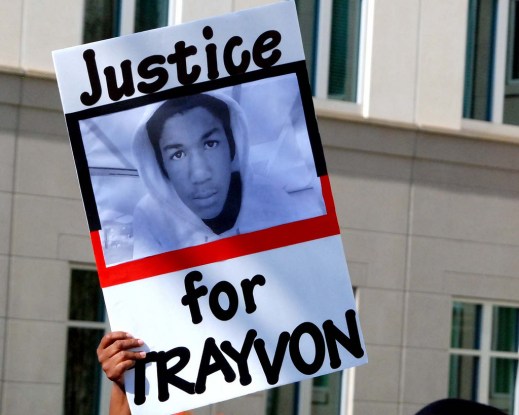
“Many men wish death up on me/ blood in my eye dog and I can’t see/ I’m trying to be what I’m destined to be/ and niggas tryna take my life away” –50 Cent, “Many Men (Death Wish)”
After hearing about the murder of Trayvon Martin, the unarmed teenager who was shot to death by George Zimmerman in a gated community in Sanford, Florida on February 26, 2012, I grappled with the urge to grab my godsons, nephews, cousins, brothers, and husband and never let go. I grappled with the Du Boisian question of the color-line, redressing it to consider “what does it feel like to be not only a problem but a target?” With these thoughts in my mind, I especially grappled with listening to the audio records of the 911 calls documenting the death of Trayvon Martin, just released late Friday March 16thby the Sanford police department.
I have mixed reasoning as to why I listened to the tapes. Part of me was just being nosy, but there was a deeper, far reaching curiosity stemming from my southern roots. As a Georgia girl, I was raised by Georgia men. My grandfather vividly recounted horrific stories of lynchings and beatings that happened “at the hands of persons unknown.” My mindset, like that of many, shifted to thinking about Trayvon’s death as a lynching. These tapes gave sonic urgency to a historically silent crime. In a word, Trayvon’s desperate screams gave voice to the countless men and women before him who died at the hands of white vigilantism.
As I listened to the distraught callers—and Trayvon’s final screams and pleas for his life—my mind became a mosh pit of emotions. Pissed, my mental playlist shuffled to 50 Cent’s “Many Men (Death Wish).”
.
I imagine Trayvon walking as the haunting piano and strings at the start of “Many Men” accompany his steps. He anxiously questions Zimmerman– “Why are you following me?” – in a similarly anxious way as 50 Cent can be heard asking “what’s taking homie so long, son?” and the shot rings out. As Trayvon screams and falls, the hard hitting boom fills the silent void. His lifeless body lays face down in the dirt, a lone piano softly signifying vulnerability as 50 Cent’s chorus starts: “many men wish death upon me/blood in my eye dog and I can’t see/I’m trying to be what I’m destined to be/and niggas tryna take my life away.” Situating Trayvon Martin’s final moments in a song by 50 Cent is discomforting, yet speaks to the reality and imaginative scripts of black masculinity as violent. The physical gunshot to Martin’s chest echoes the allegorical shots heard in the “Many Men” track and those in songs like Notorious B.I.G.’s “Who Shot Ya,” as another example, simultaneously blur and re-enforce black death as fantasy and normative. The 911 calls documenting Trayvon Martin’s death heard in concert with 50 Cent’s song sonically reify (gun) violence as a dominant discourse of black male identity. Indeed, Trayvon, I know who shot ya and gave you a death wish. I cannot, however, understand why.
.
The sonic surveillance of Trayvon Martin and George Zimmerman’s run-in—documented by the numerous accounts of neighbors who heard something but did not go outside—presents a juxtaposition of expected black male identity with the vulnerability of a horrified child forced into a criminalized space of black masculinity. In Zimmerman’s 911 call–listen via the Huffington Post here–he nonchalantly and at time heavily sighs about Martin’s blackness and its associated threat – “he’s black,” “he looks suspicious,” “he’s up to no good.” The passivity of Zimmerman’s voice reflects his bridging of (young) black masculinity as threatening. The panicked callers’ voices, however, represent reprieve and reinstate Trayvon’s humanity. The Trayvon Martin 911 recordings, then, are a mixtape of his final moments, sampling the voices of the various callers to construct Trayvon’s fatal narrative. Ultimately, the callers give voice to the vulnerabilities that Trayvon was deemed unable to evoke or possess by default as a black male.
 I use the word “mixtape” here to argue that the frequencies of trauma in which the (white) listener situates Trayvon Martin’s death must be heard within a larger understanding of sound as a commodified and racialized space. Ultimately, the recordings of Trayvon’s death are a sonic reflection of a long history of white America’s treatment of black bodies as capital. In negotiating the black (male) body as a commodity – which is historically and culturally significant – sounding the black male body as a commodity contextualizes this moment of expected black masculine performance for nonblack listeners. It needs to be noted how pathological black masculinity is profitable and mutually invested in by black men and white consumers alike. Briefly referring back to 50 Cent, he performs and is validated by the violence his narrative possesses. He knowingly invests in the exaggeration of his experience – he really was shot – and builds his image upon that paranoia. In In the Break, Fred Moten discusses the sonic commodification of blackness as “not what the commodity says but that the commodity says or, more properly, that commodity in its ability to say, must be made to say” (9). Situating black rappers’ narratives and, extensively, black men’s narratives as a commodity speaks to how the ambiguity of such narratives relegate blackness to a position of profitable, essentialized discourse. Moten suggests sounding blackness as a commodity is an effort to address these ambiguities, linking the privilege of speaking and constructing black (masculine) narrative, not content, as culturally and capitalistically recognizable and significant.
Trayvon’s political agency is invested in the violence placed upon his body by public scrutiny as a black man before there is any vulnerability as a child. Thrust instead into the position of ‘suspicious’ black man in a predominately white middle-class gated community, Trayvon the child bears the public scripts of expected black masculine performance, which are both visual and sonic. These expectations of popular culture and public opinion distort Trayvon’s sonic imprint, rendering him unable to vocalize and physically relay his desperate need for help.
As Mark Anthony Neal points out in a his March 19th New Black Man post “Hearing Trayvon Die” linking hearing Trayvon Martin’s death to a scene of a grieving Muddy Waters (Jeffrey Wright) from the 2008 film Cadillac Records, in which Waters’s pain is heard but not seen: “part of the reason that Jeffrey Wright’s howling had to be experienced off screen is that we have little understanding of Black males, as vulnerable, in pain, under duress, in terror and confronting death.” The impact of the lack Neal describes emphasizes the necessity for a sonic imposition of such vulnerabilities. In this case, the agency of this need is heightened by the audience being forced to listen to Trayvon’s frantic screams for help on tapes, thus humanizing him before racializing his body.
Yet it is Trayvon’s alleged screams – which I undoubtedly believe ARE his screams– that also sonically invoke his humanity. On the recording, heart-wrenching screams for help are silenced by the forceful pop of a gunshot, the silence signifying multi-layered historical and cultural indicator of Trayvon’s worth as a black boy in American society. Trayvon’s screams vocalize the agonizing silent demise of the murdered black boys before him. . .Oscar Grant. . .Amadou Diallo. . .Emmett Till. His screams are an echo of Frederick Douglass’s Aunt Hester’s screams, recorded in his 1845 Narrative, acknowledgement of the cruelty and continued viability of longstanding—even foundational—racial prejudice and violence that exists within the contemporary ‘postracial’ American agenda.

The Million Hoodies Union Square protest in New York against the shooting of Trayvon Martin in Sanford, Florida, by Flick'R User David Shankbone
Moreover, Trayvon’s scream also concisely signifiy the ongoing “upheaval” and chaotic existence of black men that Moten suggests “pressures the assumption of the equivalence of personhood and subjectivity” (1). Trayvon’s screams amplify a tragic dimension of what I theorize as “sonic cool pose,” where black masculinity is only cool if accompanied – instrumentally, lyrically, and otherwise – with violence. In this regard, the sonic signifiers that mark death—like the gunshots and screams that introduce 50 Cent’s “Many Men,” for example—are Trayvon’s. Both built upon the traumatic condition frequently faced by men and boys of color, Trayvon and 50 Cent’s lived experiences can be heard as sonically interchangeable despite obvious differences in class position. Through sound and the American popular imagination, black manhood is virulently fluid. There is a universal, stereotypical understanding that black masculinity resorts to identical markers of lived experience. This awareness is especially heightened and dominant in sound, where 50 Cent’s shooting on the corner parallels Trayvon’s shooting in a gated townhome community.
The release of the 911 audio of Trayvon Martin’s death is a powerful intervention in maneuvering black masculinity and violence in American (popular) culture. There is a delicate and simultaneous reading of the recordings as a sonic realization of black masculine violence and a fetishizing of a violated black male body. The sounds they contain amplify a continued American investment and interest in the black pathological narrative while doubly intervening as an alternative reading of such negotiations of black manhood. Whether sounded across a courtyard in a gated suburban neighborhood in Sanford, Florida, or on the streets of South Jamaica, Queens—or in the isolation booth in a recording studio—these frantic and desperate screams are sonic imprints of his social-cultural relevance. They may bleed into one another, but they won’t fade away.
 —
—
R.N. Bradley is a PhD candidate in African American Literature at Florida State University. She writes about African American literature, race and pop culture, Hip Hop, and her own awesomeness. She earned her BA in English from the Unsinkable Albany State University (GA) and a MA in African American and African Diaspora Studies from Indiana University Bloomington. Her dissertation project looks at negotiations of white hegemonic masculinity and race consciousness in 21st century African American literature and popular culture. You can read her work atAllHipHop, Newsone, TheLoop21, or her monthly column “The Race to Post” over atPopMatters. Scholar by day, unapologetic Down South Georgia Girl 24/7/365. Catch up with her awesomeness via twitter:@redclayscholar and her blog Red Clay Scholar (http://redclayscholar.blogspot.com).
Share this:

Orality and Cybernetics in Battleship
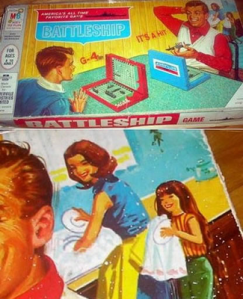
The gendered space of play. Borrowed from superpunch.blogspot.com.
His moment has come. After having scoured each vector of a ten by ten grid, the young tactician makes his move. “G-4,” he announces, possessing some intelligence of a large ship in the south-west quadrant of enemy territory. There is a moment of tension, as his dad sizes up the situation. “It’s a hit,” Dad admits, smiling, as he resignedly lifts a token from his board. The women in the family beam proudly from the kitchen. For a brief moment the social hierarchy is undermined as the house patriarch on the front of the Battleship box concedes victory to his progeny.
Sound has been integrated in different ways into the production of simulated warfare after World-War II. Simulated warfare involves, namely, the cybernetics of paper machines (as board games have been coined by Matthew Kirschenbaum), and the gradual effacement of oral mediation therein. As technologies of interactivity improve, the need for oral communication amongst the games participant’s decreases. The following is a case study of four Battleship commercials that aims to chronicle a set of shifting cultural tendencies parallel to the integration of sound-effects within the material game-form.
As Ong (1982) has noted, writing is powerful because it mediates the vastness of imagination. Once spoken words become grounded in text and inscribed on paper, they become, “locked in our visual fields forever” (p. 11). This is not as totalizing as it sounds, for as words are recirculated in oral cultures, the trace of writing yields slowly to the performative nature of ritual, oral culture. The rules of tabletop games, such as Battleship, although first established in the manual included with the game, are passed through oral ritual more often than not (Fine, 2002; Bowman, 2010). The oral maintenance of game rules is a practice which lends itself, critically, to the cultural attitudes of the group which maintains them. As is evident in the box art above, the game of Battleship is a gendered space where the rules have likely been explained (and maintained) by the household patriarch, then shared with his enthusiastic son.

Borrowed from badhaven.com.
There is an ideological element at play here as well. The box art for Battleship is unmistakably American. From Milton Bradley’s strong red-and-blue branding to the white trim of the son’s shirt, dad’s sweater and the soap suds in the kitchen. After all, the company owed its success to America and the war effort. A 1940s bailout saw Milton Bradley producing landing gear for fighter planes and gunstock for soldiers alongside portable game kits for soldiers seeking diversions in their down-time. The production of board games in post-World War II America owes as much to the military-industrial complex, as the production of video games does today (Dyer-Witherford and dePeuter, 2009). The relationship between the military production and simulation has been well documented by Crogan (2011), who has argued that the production of game interfaces, from the start, has been the by-product of a military desire to map real space onto the virtual in the design of ballistics. To this point, the bombastic introduction to a late-1960s commercial for Battleship (see video below) should come as no surprise. The sonic blast of a real-world battleship is calculated to lure consumers into believing that the game is an authentic simulation of maritime warfare.
The players in this commercial are actively engaged in a discussion amongst themselves. They laugh, and joke as they engage one-another in a tactical crossfire. In some cuts, the players seem particularly engrossed in the games strategy. Even though the commercial showcases two players actively engaged in oral communication, it is important to note that the players are both white males, and that the winner callously gloats as his opponent tumbles into the water. Milton Bradley’s connection to the American military is distinct here, and it plays out as a set of social relationships between the players. Reminiscent of Cold-War politics, the games action plays out as a series of tactical exchanges. Consumers are urged to practice at winning in their living-rooms, or on the go. The portable elements of Battleship are played down in an advertisement about 15 years later. Here, Battleship is situated as a centerpiece of family life.
Also integrating stock footage of real-world military battleships the narrative in this mid 1980s commercial begins with a squabble over domestic space. The actors are (at first) two boys (10 and younger), playing Battleship in the bedroom. After winning, the older boy banishes his younger brother, presumably forever, from his bedroom. Although this act could easily be imagined as selfish, in the context of the 1985 nuclear family, competition is fostered and encouraged. In a second skit, the older boy emerges again victorious at Battleship, his opponent (and father) slouches, consoled by the mother while the grandfather eagerly congratulates the young victor. Electronic Battleship is introduced here as a product as well, and the players are depicted commanding the electronic elements of the game. Feedback is given to the players sonically, as programmed game moves result in dynamic military explosions. There is still a residue of oral communication here, notably the father lamenting, “You sunk my battleship,” as the older boy lets out a strong cheer. Even though the embarrassed father is a commercial trope designed to stimulate the consumer imagination of aspiring child tacticians, it also functions as an in-joke for caring parents looking to instantiate intellectual (mathematical) competition as a centerpiece of domestic life in the age of Reagan’s Star Wars economics and family values.
Ten years later, the commercial narrative has more to do with overt warfare than family life. The competing children are spliced alongside clips of competing Navy officers performing various technical tasks on a real Battleship. As the background music takes on a tense, and somewhat militaristic tone, a command to “Man your battle stations,” is echoed as the two boys careen into their chairs. No longer is the narrative established as a civil exchange between two military masterminds, Electronic Talking Battleship uses sound to enhance the player experience of the simulation. When a hit is scored, a quick shot of the player pumping their fist and shouting is quickly replaced by stock footage of a battleship-explosion. Even wavy radio-lines are used to enhance the over-the-top comic feel of the product’s sound. A number of shots showcase the players programming their battle-stations. The commercial explicitly connects the discourse of soldier-controlled military technology, to player controlled information technology. Good players are able to program on their toes, the only conversation between players is a series of taunts and cheers. At one point, a player refers to the rules. Electronic Talking Battleship is evidence of the increasing capital of information technologies, and deterioration of orality in electronic games in the mid-1990s.
A final, 1997, commercial for Electronic Talking Battleship disposes entirely of the oral element of gameplay. The commercial begins with a child in what seems like an office conference room. After he presses a green button, a virtual matrix appears before him, and two navy officers materialize across the table from him. The viewer is to assume that one is an officer, and the other his superior. The narrative has the Navy officers desperately trying strategies against a hooting and smiling child. The Navy officers are a metaphor for the game’s computer, which can, at this point, serve as a virtual Battleship opponent. The affective work of companionship, which was once performed by one’s friends and family is now, in at least this commercial, replaced by a machine interface. The oral communication, which once governed the rule-set in a social space, has been outsourced to a machine which governs the rules, precisely, in cybernetic space
As computers begin to take a more active role in our culture, a by-product is the exchange of oral ritual for cybernetic participation. This odd shift can be read as having both positive and negative potential. One positive aspect is the estrangement of the social hierarchies which have been a necessary for the ritual infrastructure of oral communication dating back to Homeric times. While the children in the commercials (and on the original box) seem increasingly autonomous, they also begin to dialogue less with themselves, and more with the game. This, unfortunately, is the negative potential of this cybernetic shift. Where the early advertisements of the game depicted a product which provided a potential escape from a war-ravaged world, later advertisements seek to situate the consumer in the center of the action. A common thread amongst these social, and technical shifts is the instantiation of an electronic voice and interface as keeper of the rules. And, with this shift, the military discursivity of the game-form and its accompanying electronics is inscribed, and made to seem innocent in our imagination and understanding of childhood games and play.
—
Aaron Trammell is co-founder and multimedia editor of Sounding Out! He is also a Media Studies PhD student at Rutgers University.
Share this:


Current Top Posts





April 2021

January 2020

November 2019

October 2019

August 2019

April 2014

November 2017

March 2015

December 2017

October 2015
 Sounding Out!
Recent Comments