
to follow an invisible creek: in search of a decolonial soundwalk praxis

i begin with an acknowledgement of the myriad of organizers, scholars, artists, and teachers that have shaped and continue to shape the way that i think and write. Édouard Glissant, Christina Sharpe, Lucille Clifton, Saidiya Hartman, Fred Moten, Sylvia Wynter, Katherine McKittrick, Dionne Brand, June Jordan, and Audre Lorde. it is through their profound reflections on questions of Blackness, place, belonging, earth, and love, that i have found meaning in and context for what follows.
—
in the context of the rapid rise of big tech in san francisco, california, the perspective of land as perpetually exploitable is ever-present. tech-sponsored development projects are always framed by the city as being motivated by care and consideration for residents, and sometimes as being motivated by environmentalism. in reality, the displacement and destruction that results from projects like these falls primarily on poor people of color, and their homes, gardens, businesses, community spaces, and schools. similarly, large-scale development projects more often than not have devastating impacts on the land – whether it’s the land that’s being built over or the sacrifice zone elsewhere. perhaps the electric cars of san francisco are thought to represent clean energy and a healthy modern city, but the manufacturing of these cars is predicated upon extensive mining and exploitative and extractive labor outside far outside the city’s borders. and these cars drive over flattened creeks and sand dunes turned to asphalt—through gentrified neighborhoods on stolen land of the Ramaytush Ohlone, people who are still alive and fighting for sovereignty on their traditional territory, and who remain stewards of the land.
these disparities are present in the sounds of the bay area. sound, quite literally, does not exist in a vacuum. the presence of sound thus implies the presence of something outside of that sound; in every sound we hear, there is also information about the context that surrounds it. and the sounds that we do hear say something about the value of the sounds that we don’t. however, i want to argue for a soundwalking praxis that does not settle for the sounds that most easily reach the ear, as in the freeway noise or the planes passing above or the white people on the street, but that reaches beyond to listen for the negative sonic space that is always present and creating itself in the spaces between what we perceive as audible. in my understanding, this is a practice of giving life to that which capitalism/white supremacy/colonialism renders dead, a practice of centering the life that is otherwise stepped on, forgotten, discarded, silenced. listening for the ecologies of the dispossessed. for proof of life, insisting. this is a decolonial soundwalk praxis.
Allie Martin describes “decolonial soundwalk praxis” as a way of listening that disrupts and disturbs dominant western understandings of sound and space, in “Hearing Change in the Chocolate City: Soundwalking as Black Feminist Method” (2019). to me, it also involves cultivating an embodied practice of centering that life which dominant pedagogies deem less than, exploitable, and extractable. in the specific geographies of the bay area, it has meant that my primary orientation while soundwalking has been to listen for the creek that runs through the land—even when the water runs dry, even when all we can see is an intersection.

the creeks i followed were mostly routed underground, culverted to run under parking lots, freeways, shopping malls, grocery stores, and other urban sites of development. the prioritizing of urban development/renewal/gentrification in the bay area over tending to the ecologies of its creeks points to the place that the land is seen to hold in so-called modern society: as a resource available to exploit as desired, as is convenient for the logistics of capitalist expansion and development. to listen in such a way, for the creek and for other forms of life forced underground and to the margins, requires methods perhaps alternative to the traditional soundwalk. we must renegotiate the categories of sound that are implied in western colonial pedagogies. we must reevaluate what constitutes a “creek sound” or a “nature sound” in the first place.
to listen for the creek when it is covered by concrete necessitates that we reach beyond thinking of a creek as something which exists in and of itself, in isolation.

∼∼∼might the sound of a creek be more than just trickling water falling through rocks? can it not be heard still in the place where it meets the ocean?∼∼∼

∼∼∼or in the rustling of the trees who drink from the same groundwater?∼∼∼
.

∼∼∼couldn’t a creek be heard in a voice that speaks of it, as in a prayer, or a promise, or a song?∼∼∼
.
if we understand space as relational, as Nigel Thrift offers in “Space: The Fundamental Stuff of Human Geography” (96), then perhaps we can reach an imagining of a creek as finding its life everywhere where water is sacred, running freely through the bodies of those that know it is there.
acknowledging the body as the point of contact between the self and the environment is an important part of a decolonial soundwalk praxis. “place is involved with embodiment” Thrift says (103), and in fact, when we truly acknowledge the body, the very boundary between the body and the environment begins to dissipate, because the body itself is constantly a part of place-making processes. if sound is a dimension through which we can understand place, then, similarly, listening for the life insisting in a place is not separate from listening for the people who are in relationship with it.
in my soundwalks, i leaned into the fact that i was experiencing every place principally through my body, and as i became more comfortable recording, i gave myself more permission to allow my experience to be subjective. what i realized is that my subjectivity, my specific presence to my body’s relationship with the places i was in, was an important orientation to be able to embody a decolonial soundwalk praxis – to be able to hear the sounds that otherwise may have been neglected.
∼∼∼while walking along lobos creek trail, for example, i noticed, growing out of the sand, plants that were familiar to me, that i had relationships with. the house finches were chirping, and my footsteps were clear∼∼∼
.
∼∼∼but the plants i recognized were not – could not be – audible to me until i spoke their names and touched their seed pods.∼∼∼
.
∼∼∼i pulled a few pods off a branch and holding them near the microphone i cracked them open, letting the seeds fall into my hands. i listened to the pods split down the middle and drop the seeds, and in their snapping i heard how much tension they were holding.∼∼∼
.
i felt how much strain it must be to make and carry all those seeds, how much release it must be to crack open and spill out of yourself, and i was grateful to bear witness. i held the seeds in my hand and some time later, i gave them to the creek. in allowing myself the trust to follow my body’s intuitive relationship with the given place, i found sounds that i otherwise would not have heard. ultimately, i found a depth of connection to and intimacy with a place that before listening to in this way, i was a stranger to.
the work of giving attention to the sounds that go unheard is necessarily an embodied exercise. it demands relationship and it demands entanglement. it demands crawling inside a mossy culvert to hear the creek talk.
curious to hear how the creek sounded differently in the tunnel, i went off the trail at piedmont park to climb inside the section where the culvert begins. with the dripping, there was a nuance to its rhythm distinct from its sounds outside of the tunnel. i was able to hear, but only by coming inside and joining the creek. we sat there together, in the dark, for a while.
it also meant sawing down a 20-foot-tall agave in order to save the seeds after the 30-something-year-old plant finally bloomed—with bright yellow flowers on branches shaped like coral—and then began to dry out and lean precariously. to keep the other plants safe, and to release some pressure from the agave, we cut its stalk and from it saved its branches, seed pods, and seeds. the pods are now hanging around the garden at the Land of Disturbance and Defiance as art.

i am principally interested in sound because i am interested in love, and when i imagine a decolonial soundwalk praxis, intimacy is surely at the center. this perspective offers a way of learning place from the position of a being who is co-creating it – not as a scientist but as a steward. a decolonial soundwalk praxis complicates traditional soundwalking’s aversion to the body. we cannot exist separate from the sonic space around us anymore than we can exist separately from the ecologies woven into our lives. to touch is to alter, and so the work here is to lean into the inevitability of connection, the impossibility of objectivity. a decolonial soundwalk praxis rejects the extraction of sound as data, pushing us instead to open our bodies/hearts/minds to receive the sounds of a place as the place is receiving us. how might we use sound to remove ourselves from the perspective of the observer? and what kind of responsibility to place does this open up? if we are a part of the places we are in and listening to, then surely we owe them reciprocity, love, conversation, patience; we must listen as we would a relative, a lover, or a friend.

i chose to record my final soundwalk at the garden on walnut and virginia street in berkeley, california, because it is a place that i know well and love dearly and i hoped to center that. the north side of the garden runs alongside strawberry creek.
rather than imposing a plan/route through the garden upon arriving, i allowed my relationship with the land to guide my movement through it. in my final mix, i layered pieces from this soundwalk together with selected excerpts from a meeting i attended with two fellow members of A.G.A.V.E., or Aspiring Gardeners Affirming Vibrant Ecologies (also Aspiring Gardeners Against Violent Extraction).in which we were trying to synthesize a manifesto using notes from previous conversations, itself a process of collective and layered creation. i chose to include portions of our conversation centered around ideas of relationship and care grounded in land, and i chose sounds from the walk that i feel hold in them intimacy and history:
∼∼∼the crows, who we feed every day and who plant seeds for us∼∼∼
∼∼∼the lock, which only those who know the land can open∼∼∼
∼∼∼and the marigolds, which we grow every year and which we harvest for offerings∼∼∼
.
these sounds are proof of relationship. small sounds that are easy enough to forget to hear, but that are important to remember – and so i try, as i would for an invisible creek.
if a decolonial soundwalk praxis is anything, it is that love is listening, and so, my promise to invisible creeks (and all quiet[ed] sounds) everywhere is to lean a little closer,
and feel your whisper on my neck,
and to listen well,
and to take notes,
and to remember,
and to conspire.
—
Featured Image: “California Pepper Tree” by Flickr user baird, CC BY-SA 2.0
—
ameia camielle smith (they/she) is an aspiring gardener, dancer, and writer based in the san francisco bay area (Ohlone land). they are of mixed Afro-Indian ancestry and are greatly shaped by the seeds/shells/lives that exist at the intersection of these diasporas. ameia’s work is anchored in cultural ecologies and Black feminist geographies, and they are most inspired by stories of survival and collaboration between people and plants.
ameia received their B.A in geography from the university of california berkeley in may 2024. they are currently traveling through the southern united states where they are exploring maroon swamp geographies, tracing the steps of Zora Neale Hurston, and listening to the swampy cicada sounds of their childhood in north-central florida.
—

REWIND! . . .If you liked this post, you may also dig:
Flâneuse>La caminanta–Amanda Gutierrez
Unsettling the World Soundscape Project: Soundscapes of Canada and the Politics of Self-Recognition–Mitchell Akiyama
Soundwalking on the Edges: Sound, Safety and Privilege in São Paulo, Brazil—Paola Cossermelli Messina
El Caracol: A Stroll through Space and Time in Mexico City–Anthony Rasmussen
Sonic Connections: Listening for Indigenous Landscapes in Kent Mackenzie’s The Exiles–Laura Sachiko Fugikawa
EPISODE 53: H. Cecilia Suhr’s “From Ancient Soul to Ether”
EPISODE 47: Finding the Lost Sounds of Kaibah–Marcella Ernest
.
Share this:

Music Video as Process: “Revitalize” by T-Rhyme

What is a music video, anyway? Historically dismissed by film theorists as cinematically flawed or by the public as mere promotional snippets, music videos didn’t used to get the credit they deserve as a serious artistic medium. In the 1990s, Carol Vernallis challenged both notions, suggesting that they are actually a unique genre where music and visuals aren’t just paired—they communicate deeply with each other. Since then, scholars have taken diverse approaches to try to make sense of how film theory is applicable to these delicious nuggets of musical storytelling. For example, Phoebe Macrossan argues that Beyoncé’s Lemonade is a signal example of “film worlding,” indicating how the artist uses video to create her own intimate and all-encompassing environment. Additionally, Olu Jenzen and colleagues have found that political remix videos use recombinations of existing sounds and images to make rhetorical points that can challenge mainstream media reporting in real time. According to Stan Hawkins and Tore Størvold, from the perspectives of musicology or music theory, perhaps it is the video that amplifies the song’s harmonic structure or musical form, as suggested by their analysis of Justin Timberlake’s “Man of the Woods.”
Through skillful harmonic analysis or rhetorical analysis or cataloging of film techniques, scholars and critics now take music videos seriously. Yet, across interdisciplinary research approaches to music videos, what is largely taken for granted is that the music video is an object, a work to which various theories can be applied. What if we extend these approaches further and consider the music video not just as an object of analysis to be dissected, but as a representation of a creative process that entwines sound and vision in innovative ways to connect people and forge relationships? Such an analysis is especially possible when listening to independent creators who take an active role in conceptualizing, shooting, and editing their videos. By shifting our perspective to view the music video as documenting an ongoing creative and relational journey rather than solely as an object for analysis, we open up new possibilities for understanding the deeper significance of these works. Music videos can serve not just as vehicles for artistic expression, but as catalysts for strengthening bonds, preserving cultural knowledge, and fostering a sense of pride and resilience within communities.
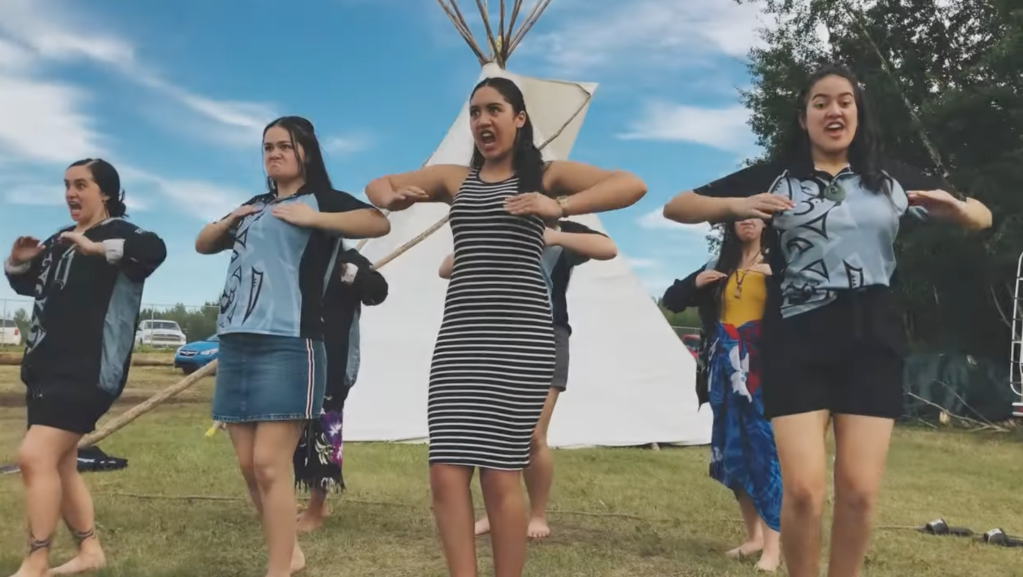
Music Video as Process
In 2023, I co-organized a series of performances for Native Jam Night at UC Riverside, an annual music showcase featuring Indigenous artists from California and across Turtle Island. One way my colleagues and I honed in on guest artists was by asking students to listen to several playlists and recommend the music that spoke to them. The song “Revitalize” by T-Rhyme came up as a favorite. T-Rhyme has released music that tells personal stories and responds to contemporary social realities. At times, this music responds to her lived experience as a woman with Nehiyaw and Denesuline roots.
The music video for “Revitalize” is not only a popular extension of the song’s appeal, but an audiovisual series of connections and interactions. Paying attention to it in this way shows what can emerge from one kind of nontraditional listening posture, this one inspired by my conversations with T-Rhyme and also grounded in the way I have been opening my ears to her music. I first got to know T-Rhyme in-person when I invited her and MC Eekwol to perform as part of the Show & Prove hip hop event in 2018. We stayed in touch over the next several years.

As part of T-Rhyme’s return visit to California in 2023, we got to drive around and talk music business, have dinner with Native directors and actors as part of an Indigenous Storytelling event, go shopping, and get tacos at one of my favorite hole-in-the-wall spots. When it came time to make plans around the release for my book Sonic Sovereignty: Hip Hop, Indigeneity, and Shifting Popular Music Mainstreams, I knew it made sense to keep building on dialogues with musicians. Instead of just talking about myself, or even ideas that were already published, I wanted to keep the conversation going, continue listening, and find ways to share what I was hearing with more audiences. When I talked with T-Rhyme in the winter and spring of this year, then, it was to hear more about her creative process beyond any single project, to talk about what I was hearing and how I was listening, and to make space for that meaning making that almost approaches a musical flow that can bubble up out of a good dialogue.
Revitalization
A years-long process led up to “Revitalize,” T-Rhyme told me, and there are goals for the song that stretch beyond the moment of recording. To make the video, T-Rhyme went out to ceremonial grounds with her family and her photographer cousin Tennille Campbell’s family, spending time out with buffalo so Campbell could record. Looking back, she went through over a year and a half of her recordings of family and friends to select moments of daily life to interweave with special moments of celebration.
To convey the importance of land with viewers, the rapper worked with her brother, who shared his drone landscape footage that he recorded where he lives in northern Saskatchewan. She filmed other pieces at a powwow in Treaty Six territory in Alberta, finding inspiration from old friends she reconnected with for the occasion, as well as other Indigenous musicians and dancers she met while looking to connect there. T-Rhyme delivers the chorus and rapped verses over a beat by Doc Blaze, while collaborators in the music video mouth key words, notably “revitalize,” to her audio. Each aspect of the video was made with family or friends, and together they encompass years of work and hopes for the future.

From her past work, T-Rhyme recalled that shooting a music video can be stressful and involve intense time pressure. Instead, she told me, “I wanted none of those vibes to be involved with this project. I wanted the whole entire thing to be good vibes. And positive because part of our healing is through laughter and joking and being together as family.”
So, what is “revitalization” in the context of making music with family and friends? For T-Rhyme, “These are people I trust, I grew with, I evolved with, I changed with. All these people make me feel good and that I’m proud of, that I want to show off.” Paying attention to how musicians choose to tell their stories and further relationships with others is part of recognizing their sovereignty through sound. Sonic sovereignty is an active process.
The notion of “sonic sovereignty” builds from Jolene Rickard’s determination in “Diversifying Sovereignty and the Reception of Indigenous Art,” that “the idea of our art serving Indigenous communities reinforced my understanding that sovereignty is more than a legal concept”(82), and Tewa and Dine scholar-filmmaker Beverly Singer’s working through what she refers to as “cultural sovereignty,” in Wiping the War Paint off the Lens: Native American Film and Video, “which involves trusting in the older ways and adapting them to our lives in the present”(2). It’s meaningful to move into celebration together, as T-Rhyme explains: “Part of revitalization, especially when it comes to our healing as Native people, is we need to remember love. We don’t need to be in survival mode all the time.”
Intergenerational Teaching
Generations of T-Rhyme’s family stretch throughout the video for “Revitalize”. In the first verse, the musician’s mother stands in a bright red ribbon skirt at the edge of the river, near a photo frame.Then this photo of the rapper’s grandparents smiles out from the rocky shores of a river. A kid in sneakers runs nimbly over these same rocks, generations converging at the water. When T-Rhyme raps in the chorus, “raise your fists high in the air right now,” viewers see her mother raising her fist, the river greenery behind her, then proudly holding the picture of her own parents.

Music videos are often associated with youth culture, especially in a North American context. Yet in process and in content, this music video showcases intergenerational teaching and learning, with the involvement of elders, parents, children, and friends, connecting embodied knowledge across generations. Men and boys teaching intergenerationally feature onscreen, notably a father and son in regalia and an entrepreneur who runs Cree Coffee Company. Community leaders and scholars across Turtle Island share stories of diverse Indigenous masculinities, highlighting the kinds of teaching, leadership, and care that men, boys, and masculine people share from the present into the future. T-Rhyme reflected, “we have men out here who are trying to be warriors still, in their own way, whether they’re dancing powwow, whether they’re running their own business, and just being present fathers.”

T-Rhyme described that over the years, her relationship with her mother has changed. And yet, they have an ongoing push and pull between being serious and being playful together. With her mom, she says, “laughter and joking is our medicine.” She laughed as she recalled that for filming, “we’d be trying to have a serious moment and I’d say ‘okay mom, stand in the water’ and she’d say, ‘okay, like this.’ ‘Yeah, that looks good. Rest your face. You look real Kookum right now.’ Just cracking jokes at her.” T-Rhyme uses a word for grandmother to kid with her mom.
The process of writing the lyrics, too, involved reflecting on the relationship she has had with her mom across the past, present, and future. T-Rhyme raps, “My mother is sacred, she’s a survivor for real, though it’s taken her and I so many decades to heal.” This comes from what the rapper describes as a way to highlight how her mom is a “survivor and somebody that I respect and ultimately, enabled and motivated me to do my own healing too.”
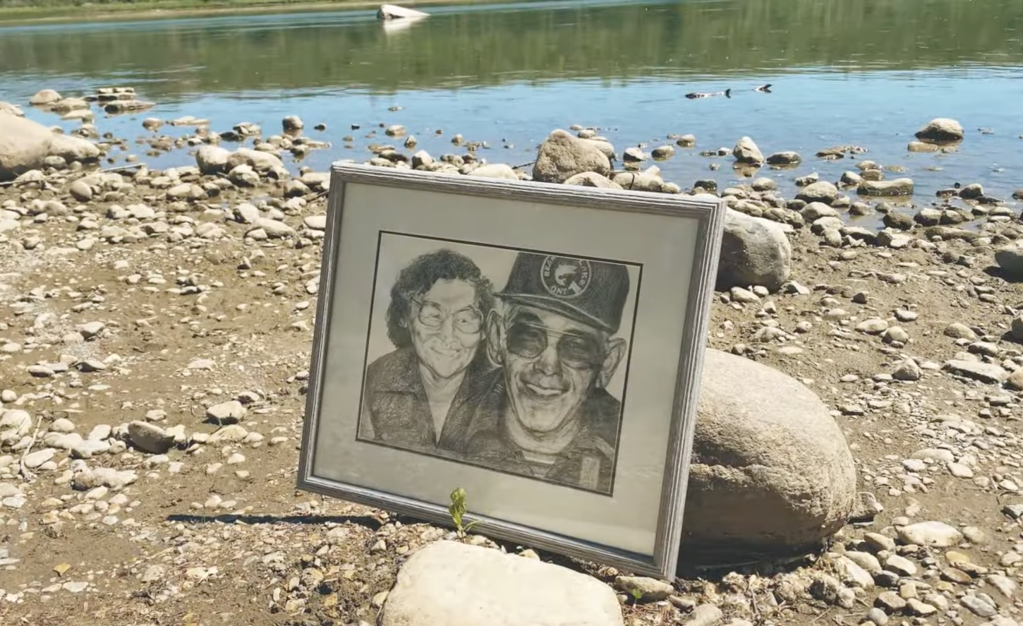
In the context of intergenerational healing, T-Rhyme’s music video, which involves multiple generations of her family, embodies Indigenous survivance –the active transition from mere survival to resilience—in the face of historical and ongoing colonial violence. T-Rhyme brought her grandparents into the filming through their photograph, and their living memory. She explained, “Without them, I wouldn’t be here, my kids wouldn’t be here and my mom wouldn’t be here. Speaking of revitalization, they were the ones that were the front lines of maintaining our culture through a literal, cultural genocide in our communities.” Since “they really had to do their part in maintaining our culture enough to survive through residential school,” she recalls, “It was important to me to acknowledge them as survivors.”
T-Rhyme included her daughter in ‘Revitalize,” as well as in other music videos, notably the title track on “For Women By Women.” She explains, “I always want to feature her because she’s such a powerhouse.” T-Rhyme’s visual narrative brings in a photo of her daughter dancing at one of her shows, and the rapper has made music videos with her son as well.
When they were all getting stir-crazy from COVID shutdowns, T-Rhyme and her kids made the video “Trap’d,” for which the rapper helped then-12-year-old Joaquem act as videographer. Teaching her son and daughter and giving them space to make their own art, she calls her kids her “heroes,” explaining, “I just love including them where I can.”
The Story Beyond the Video
Watching and listening to the work of independent artists, such as T-Rhyme, complements existing writing on music video that comments on mainstream names like Madonna and Beyoncé. Furthermore, approaching music videos as processes through which relationships are built and furthered rather than solely as objects for analysis invites other forms of listening, especially modes that acknowledge the network of people whose interactions create the sounds that vibrate audience members’ eardrums.

The people who click play on the finished music video make up what is traditionally understood as its audience. By witnessing relationships behind musical choices, we can recognize that there is another group, too, that the video is for: media professionals, family members, and community participants who work together to create it. Making a piece as complicated as a music video can become an occasion for all of these actors to further and strengthen relationships: filming may offer the excuse everyone needed to visit an important location together, or storyboarding brings people in the room together who hadn’t been able to find the time, or the song provides a vehicle for talking about a topic that would otherwise be repeatedly put on the shelf for another day. Listening for process in this way can encourage audience members who view the video, too, to use this communally crafted artistic labor as an invitation for connection.
“Revitalize” particularly serves as an example of how making a music video can involve collaboration with family and friends over an extended period, encompassing years of documentation and strengthening relationships. In addition to sharing a past and inspiring interaction for the making of the video, the song carries hopes for a future. As T-Rhyme says, “I want “Revitalize” to be a catalyst for healing and pride.” Paying attention to how musicians tell their stories and build relationships through music videos is part of recognizing their sovereignty and cultural continuity through sound and visuals.
—
Featured Image: Still from music video for “Revitalize” by T-Rhyme (2021)
—
Dr. Liz Przybylski (pronunciation) is an ethnomusicologist and pop music scholar working in hip hop and electronic music in the US and Canada. Dr. Przybylski is an Associate Professor of Ethnomusicology at the University of California, Riverside. A graduate of Bard College (BA) and Northwestern University (MA, PhD), Liz’s research appears in Ethnomusicology, Journal of Borderlands Studies, and IASPM Journal, among others. Dr. Przybylski has presented research nationally and internationally, including at the Society for Ethnomusicology, Native American and Indigenous Studies Association, Feminist Theory and Music, International Association for the Study of Popular Music, and International Council for Traditional Music World Conferences. Recent and forthcoming publications analyze how the sampling of heritage music in Indigenous hip hop contributes to dialogues about cultural change in urban areas. Dr. Przybylski has also published on popular music pedagogy. Liz was awarded a National Endowment for the Humanities Faculty Fellowship and a Fulbright Fellowship. Liz’s most recent book Sonic Sovereignty: Hip Hop, Indigeneity, and Shifting Popular Music Mainstreams was published in July 2023 (NYU Press). This follows Liz’s first book, Hybrid Ethnography: Online, Offline, and In Between (SAGE Publications, 2020) which develops an innovative model of hybrid on- and off-line ethnography for the analysis of expressive culture. In addition to university teaching, Liz has taught adult and pre-college learners at the American Indian Center in Chicago and the Concordia Language Villages program of Concordia College in Bemidji. On the radio, Liz hosted the world music show “Continental Drift” on WNUR in Chicago and has conducted interviews with musicians for programs including “At The Edge of Canada: Indigenous Research” on CJUM in Winnipeg. Dr. Przybylski served as the Media Reviews Editor for the journal American Music, the President of the Society for Ethnomusicology, Southern California and Hawaii Chapter, and on the Society for Ethnomusicology Council.
—
—
REWIND! . . .If you liked this post, you may also dig:
Sounding Out! Podcast #40: Linguicide, Indigenous Community and the Search for Lost Sounds–Marcella Ernest
The “Tribal Drum” of Radio: Gathering Together the Archive of American Indian Radio–Josh Garrett Davis
Sonic Connections: Listening for Indigenous Landscapes in Kent Mackenzie’s The Exiles–Laura Sachiko Fugikawa
Unsettling the World Soundscape Project: Soundscapes of Canada and the Politics of Self-Recognition–Mitchell Akiyama
Becoming Sound: Tubitsinakukuru from Mt. Scott to Standing Rock–Dustin Tahmahkera
EPISODE 60: Standing Rock, Protest, Sound and Power–Marcella Ernest
A Tribe Called Red Remixes Sonic Stereotypes–Christina Giancona
I’m on my New York s**t”: Jean Grae’s Sonic Claims on the City––Liana Silva
How not to listen to Lemonade: music criticism and epistemic violence–Robin James
Share this:


Current Top Posts





April 2021

January 2020

November 2019

October 2019

August 2019

April 2014

November 2017

March 2015

December 2017

October 2015
 Sounding Out!
Recent Comments