
Xicanacimiento, Life-giving Sonics of Critical Consciousness


This series listens to the political, gendered, queer(ed), racial engagements and class entanglements involved in proclaiming out loud: La-TIN-x. ChI-ca-NA. La-TI-ne. ChI-ca-n-@. Xi-can-x. Funded by an Andrew W. Mellon Foundation as part of the Crossing Latinidades Humanities Research Initiative, the Latinx Sound Cultures Studies Working Group critically considers the role of sound and listening in our formation as political subjects. Through both a comparative and cross-regional lens, we invite Latinx Sound Scholars to join us as we dialogue about our place within the larger fields of Chicanx/Latinx Studies and Sound Studies. We are delighted to publish our initial musings with Sounding Out!, a forum that has long prioritized sound from a queered, racial, working-class and “always-from-below” epistemological standpoint. —Ed. Dolores Inés Casillas
—
In the past year, we, Esther, a first-generation profesora in Latinx culture and feminist studies in Chicago and Kristian, an L.A-raised Xicano de letras pursuing a doctoral degree in Santa Barbara, engaged in a multi-synchronous dialogue on the life-giving sonics of our critical consciousness. This Xicanacimiento, as theorized in Kristian’s current writing and in conversation with Irene Vasquez and an emerging generation of Chicana/o scholar-educators, refers to the incomplete process and life-giving knowledge forged in the socio-political and pedagogical activities of Chicanx worldmaking.
SO! writers note music listening as a powerful site for critical thinking. Erika Giselda Abad, for instance, teaches the Hamilton Mixtape so her Latinx students may “hear [their stories] from people who look and sound like them.” We reflected on the pedagogical implications of our music listening that informed our coming-into-critical consciousness. In this diálogo, we developed a playlist through experimenting with our sonic memories through the poetics of our rasquache sensibilities. Gloria Anzaldúa suggests something similar with notes from Los Tigres, Silvio Rodriguez, and others in La Frontera. Our auditory imaginary echoes our evolving conocimiento toward spiritual activism.
Here, we offer our musical resonances as shaped by our gendered, place-based, and generational Xicanx experiences as a pathway to hear the auditory dimensions of Xicanacimiento. Our listening is thus counter-hegemonic or a “brown form of listening” as suggested by D. Inés Casillas, “a form of radical self-love, a sonic eff-you, and a means of taking up uninvited (white) space,” when this listening evolves critical anti-imperialist and feminist consciousness that hears 500 years of opresión y resistencia.
Diverging from the mixtape genre, our Xicanacimiento playlist seeks to convey something beyond connection and emotion towards a sustained affective state. Instead of a sonic moment, we hear a sonic stream; a subaltern auditory repertoire that is multi-directional and open to expansion by any and all interpellated Xicanx ears.
Kristian: Tuning-in to Xicanacimiento is a symbiosis of feeling and listening to La Chicanada from Califas to all corners of Aztlán unearthed. I was raised to the sounds of my father’s rancheras played in his truck and the hip-thumping rhythms of bachata and reggaetón played in my mother’s kitchen after a workday.
Yet, my love for UK anarcho-punk and US hardcore punk developed in defiance of public schooling and of a disaffected civil society. As a youth during the Great Recession, a future without higher education meant prison, the military, death by overdose, or the eternal damnation of working the Los Angeles service industry. I thrashed in sound; numbing my ears with noise, bruising in the mosh pit; bearing witness to minors as mota and alcohol addicts; pierced by the cries of police sirens breaking up our communion.
I found refuge in Xicanacimiento as a community college student and as a transfer at UC Los Angeles. I came into Xicanx consciousness by studying Mexican anarchists and Chicanx organizing. As a MEChistA, I came to listen to the ways local elders, youth, organizers, and agents of social transformation in Los Angeles identified their struggle with land, life, and spirit. My primer to social movements gave me language, and it was MEChistAs who offered me a new soundtrack against the escapism of the Los Angeles punk scene. The resonances of marchas, fiestas, and the songs of danza azteca oriented me into a new modality of listening. Xicanacimiento was the sonic web of these social and cultural practices, rooted in my auditory encounters with the verses of Quetzal, the biting guitars of Subsistencia, the rhythms of Quinto Sol, and the lyrical narratives of Aztlán Underground. The life-giving sonics of Xicanacimiento grazed against my wounded sonics of broken glass, nos tanks, drunk noise, and the cacophonous affair of a raided gig as intoxicated Latinx youth disperse into the discordant symphonies of the urban soundscape.
Esther: I listen as a campesina migrante translocada from Jalisco to California, Texas, and Illinois. Some twenty years ago, while attending Cal State en el Valle Central, I heard Xicanacimiento as concientización; an evolving awareness about la lucha obrera, the open veins of Latinoamerica and my place within the interlocked hierarchies of race, class, and gender in US society. With Chicanx and brigadista musics I felt connected to la lucha and acquired the language to name capitalist imperialism rooted in white supremacy as the enemy of humanity and Pachamama.
My early sonic memories include the sequence of my Alien number, the urging tones of radio hablada discussing Prop 187 (insisting we were aliens), Prop 227 (banning our language), and reports of Minuteman harassing la raza. I was immersed in listening; my mother’s sobremesa, my sister’s Temerarios at 5 am, Selena on the school bus, and 90s hits-from Chalino to Morrissey-on Columbia House CDs I traded with my older brother. Among other norteñas, La Jaula de Oro, the theme song of the diaspora of papás mexicanos, played at random-at the marketa, en los files, in passing cars, and so on…- to remind us of my father’s sacrificio en el norte caring for 500 dairy cows, six days a week, in two 5-hour shifts, to provide us el sueño americano.
I studied music in college, playing jazz and orchestral bass until the racist and sexual harassment targeting my young Latina body turned me away. I left the scene but continued my communion with music through library loans, traveling vendors, and trips to Amoeba. In reggae and canción nueva I found otros mundos posibles in the upbeat, cariño in 2 over 3, and the poetics of black and brown history; manos abiertas, muchas manos.
In 2002, “El Rasquache Rudo” a poet from the Rudo Revolutionary Front brought me sounds from Azltán; the UFW unity clap rallying in Modesto, a recitation by José Montoya in Sacramento, and brigadista music synergizing the 1492 quincentennial resistance with the uprising of the Ejército Zapatista de Liberación Nacional (EZLN). As Omar Marquez argues, the Zapatista uprising shifted Chicano ideology to speak from the position of a living indigenous present; still loud in the work of Xicanx activists like Flor Martinez. Into the 21st century, Aztlán Underground, Manu Chao, and Todos Tus Muertos, among others, soundtracked our protests against the invasions of Afghanistan and Iraq.
Julieta Venegas’s distinctly vulnerable voice over the controlled chaos of ska and Martha Gonzalez’s tension over the wall of sound that is Quetzal, was transformative as I heard In Lak’ech; hearing in their voices possibilities for my Chicana existence.
Some of these selections anchor my first-year lectures at the University of Illinois in Chicago, where most of my students are working-class Latinx and Black. I do this with the intention of “opening affective pathways toward Xicanacimiento” as Kristian offered, and to insist on the point that Latina/o/x Studies is to be a critical, anti-hegemonic, subaltern field of study that hears a history from el mundo zurdo.
Outro:
In a gesture to deconstruct the term Xicanacimiento, one might think of the words “renacimiento”and “conocimiento.” What might emerge is a “regenerative force” and “collective knowledges” in consideration to how we listen, what resonances are made, and what sounds we inhabit when Xicanacimiento is invoked or felt as sound. Tuning into this auditory imagination guides the listener to a myriad and select decisions of what constitutes the Xicanx resonance for the local sonic geographies and the soundscapes which emerge from music. This curated sonic experience is one where voice, instrument, memory, and affect intersect.
—
Featured Image by Jennifer Lynn Stoever
—
Esther Díaz Martín is a researcher and educator in the Latin American and Latino Studies and the Gender and Women’s Studies program at the University of Illinois in Chicago. At present, she is working towards finishing her manuscript Latina Radiophonic Feminism(s) which seeks to amplify the acoustic work of popular feminism in contemporary Spanish-language radio and Latina podcasting.
Kristian E. Vasquez is a Xicano writer, poet, and zinester born and raised in Los Angeles, California currently pursuing a doctoral degree in Chicana and Chicano Studies at UC Santa Barbara. His research on the affects, sounds, and semiotics of La Xicanada expands the concept of Xicanacimiento, centering the affective force of expressive culture.
—

REWIND!…If you liked this post, you may also dig:
Ronca Realness: Voices that Sound the Sucia Body—Cloe Gentile Reyes
SO! Podcast #74: Bonus Track for Spanish Rap & Sound Studies Forum—Lucreccia Quintanilla
“Heavy Airplay, All Day with No Chorus”: Classroom Sonic Consciousness in the Playlist Project—Todd Craig
Deep Listening as Philogynoir: Playlists, Black Girl Idiom, and Love–Shakira Holt
Mixtapes v. Playlists: Medium, Message, Materiality–Mike Glennon
SO! Amplifies: Memoir Mixtapes
Could I Be Chicana Without Carlos Santana?–Wanda Alarcón
Tape Hiss, Compression, and the Stubborn Materiality of Sonic Diaspora–Christopher Chien
Sounding Out! Podcast #28: Off the 60: A Mix-Tape Dedication to Los Angeles–J.L. Stoever
“Oh how so East L.A.”: The Sound of 80s Flashbacks in Chicana Literature–Wanda Alarcón
Share this:

Kawa: Rediscovering Indigeneity in China via Reggae
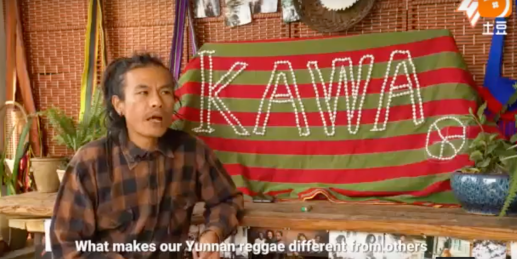
Kawa is a reggae group from Yunnan’s Ximeng, an autonomous county for the Wa people in the southwest of China, bordering Myanmar. When I learned about Kawa’s story in 2016, I was first intrigued by the geographical similarities between Yunnan and Jamaica: both regions are characterized by tropical climates, lush vegetations, and perhaps most prominently, proximities to marijuana plantations. Outsiders often associate the musical style of reggae with a stereotypical “laidback” lifestyle projected onto these locales. Known as “Yunnan Reggae,” Kawa’s music indeed exhibits some of the most characteristic elements of reggae music—slower tempos, remixed vocals, and repetitive chords falling on the offbeat.
“Yunnan Reggae”–Kawa
Recently I realized this climate connection was simplistic and reductive, and what I failed to grasp in Kawa’s music was far more important—a notion of indigeneity manifested through reggae’s generic elements. In Steven Feld’s “From Schizophonia to Schismogenesis: The Discourses and Practices of World Music and World Beat” in 1995, he noted the affinity of many indigenous cultures for reggae music. “Its [reggae] perception by indigenous peoples outside the Caribbean as an oppositional roots ethnopop form has led to its local adoption by migrants and indigenes in places as diverse as Europe, Hawaii, Native North America, Aboriginal Australia, Papua New Guinea, South Africa, and Southeast Asia” (110). In the 1970s, “roots” reggae translated the everyday lives of Jamaicans as well as their Rastafarian spirituality into a stark resistance to racial oppression, economic inequality, and colonial capitalism that they had experienced in history. The music was deeply embedded in the Jamaican culture. Around the same time, however, engineers and producers in Jamaica–many of them Chinese and Chinese-Jamaican–began to experiment with remixing reggae songs, contributing to an adaptive style of pop music as well as its international popularity. Therefore, against the global market force for “a world music,” reggae was quickly adopted to preserve indigenous cultures, remixing a wide range of ethnomusical elements.
But note that Feld’s list did not include East Asia. In fact, indigeneity as a discourse has been largely absent in this region. Taiwan is perhaps the only exception, where the Austronesian peoples have claimed their indigenous status and political rights. Japan and the Koreas are often considered as the most ethnically homogeneous countries in the world. And China, while officially acknowledging its ethnic diversity, never thought its internal migration of the Han majority as a potential threat to its ethnic minorities and indigenous cultures. I grew up in the southwest of China in the 1990s, when the internal migration of ethnic groups was already a norm. I could not remember if “indigeneity” meant anything even remotely political. I could not remember if the cultural traditions of ethnic minorities were meant to be tied up to the land on which they are/were practiced. What I do remember is that there are regions where the ethnic minorities concentrate and in which they integrate.
This post examines how the Chinese reggae group Kawa introduces an indigenous discourse through the sonic elements of reggae. In their performances, Lao Han often opens with a statement about being an indigenous ethnic minority. Most members of the group have non-Han Chinese backgrounds—Wa, Hani, Aini, and Hui. And even the name Kawa refers to the Wa people in their own language.
Kawa always find the most innovative ways to incorporate ethnic elements into their interpretations of the genre. In “Yunnan Reggae,” for example, sampled vocals from Wa people, lyrics written in Wa language, and traditional Wa instrumentation all work together to portray living cultural traditions closely associated with the Wa ethnic identity. However, it is the intimacy with the land Kawa expresses in their music that foregrounds their indigenous sentiments.
Although the entirety of the lyrics consists of two lines, the song “Red Hair Tree” reveals an indigenous life dwelling on the land—in its neighborhood, locality, and proximity.
Such a huge red hair tree
Hitting the wooden drum sounding dong dong
“Red Hair Tree” resembles a labor song narrating the mundane activities of logging and drum crafting. The first line describes the tree’s size, invoking a reverence for its sublimity. The glistening red color contributes to the plant’s vibrant animacies. As Ai Yong explains, “If you have chatted with the elders on the A Wa Mountains about this land, you will see an extraordinary beam of light glistening in their eyes, carrying endless assurance and reverence” (translated by Meng Ren). The second line translates that reverence into a more intimate whispering. Due to the Wa people’s animist beliefs, the red hair tree’s spirit is reincarnated in the wooden drum. The “dong dong” sound then embodies an invocation of the natural spirits. “The Wa ancestors believe, where there is the red hair tree, there is god’s blessing. In the past, the tall and robust red hair trees surrounded all Wa villages.” As Ai Yong continues to explain, the natural spirits are called for protection in exchange for the people’s worship.
“Red Hair Tree” is not the first time when reggae prompted the Han Chinese to confront questions about migration and indigeneity, however. It is often forgotten that the Chinese diaspora in Jamaica contributed to the development of reggae. Stephen Cheng’s “Always Together (A Chinese Love Song)” in 1967 is a rare yet symptomatic example of how the Chinese imagined indigeneity through remixing reggae.
Despite its obvious rocksteady overtone, the song combines a wide range of Chinese elements. It opens with a pronounced bass line coupled by the guitar and then the accented drum beat. Although this rhythmic beat is reminiscent of typical reggae songs, the music flow is somehow disrupted by the sudden appearance of the male vocal. Stephen Cheng sings in Mandarin. His chest voice meanders across a wide range, registering a sonority that is more often heard in Chinese opera than in reggae songs (or pop music in general). His delivery accentuates on the extended vowels, exaggerating the dramatic ups and downs of the tonal language—Mandarin Chinese. In fact, the music is adapted from a well-known Taiwanese folk song “Green is the Mountain (Gao Shan Qing).” On the surface, it is a romantic love story. It depicts the scenic landscape of the mountains and waters of Alishan, which the Taiwanese indigenous Tsou people traditionally inhabit. Through a metaphorical parallel, the romantic love between a young Tsou couple is embodied in the companionship between the mountain and the water, which resonates with its English title “Always Together.”
Indeed, “Green is the Mountain” was written by the Han Chinese who fled to Taiwan during the Chinese Civil War, and it is often criticized for romanticizing the experience of the indigenous peoples who were forced to move into the mountain. When the song is rendered into reggae by Cheng, however, it re-contextualizes this imagined indigeneity as a diasporic yearning to restore the lost connections between land and culture. “Always Together” was produced by Byron Lee, a Chinese-Jamaican who founded the renowned ska band Byron Lee and the Dragonaires. As record producers, sound system owners, or band managers, numerous Chinese-Jamaicans like Lee contributed “Chinese elements” to reggae during its formative years. In return, reggae carries on the tradition of cultural remix, always opening itself up to local adaptions.
Reggae has always been an eclectic music form. As we have seen, both examples combine a wide range of musical elements from different cultures—from ethnic minorities in China to Chinese and African diaspora in Jamaica. Despite almost a half century apart, the two reggae songs foreground a discourse on indigeneity that is shaped by the migration of people and the mixing of culture. Despite the most generic “pop” elements, the local adoption of reggae reveals an attempt to comprehend the relationship between ethnic identity, cultural practice, and the land. Understood in this way, Kawa’s reggae music becomes an important voice in understanding ethnic differences and indigeneity in today’s China.
—
Featured Image: Screen Shot from “Kawa: Chinese Yunnan Reggae Band”
—
Junting Huang is a Ph.D. Candidate in the Department of Comparative Literature at Cornell University. His research areas include literary studies, film/media studies, and sound studies. His dissertation project “The Noise Decade: Intermedial Impulse in Chinese Sound Recording” examines the figure of noise in contemporary Chinese literature and new media art. It analyzes how noise is conceptualized through the recorded sound as a materializing force that indexes the shifting social relations in the 1990s.
—
 REWIND! . . .If you liked this post, you may also dig:
Decolonizing the Radio: Africa Abroad in the Age of Independence– Samantha Pinto
“Everyone I listen to, fake patois…”– Osvaldo Oyola
Radio de Acción: Violent Circuits, Contentious Voices: Caribbean Radio Histories–Alejandra Bronfman
Share this:


Current Top Posts





April 2021

January 2020

November 2019

October 2019

August 2019

April 2014

November 2017

March 2015

December 2017

October 2015
 Sounding Out!
Recent Comments