
“Oh how so East L.A.”: The Sound of 80s Flashbacks in Chicana Literature

 For the full intro to the forum by Michelle Habell-Pallan, click here. For the first installment by Yessica Garcia Hernandez click here. For the second post by Susana Sepulveda click here.
The forum’s inspiring research by scholars/practioners Wanda Alarcón, Yessica Garcia Hernandez, Marlen Rios-Hernandez, Susana Sepulveda, and Iris C. Viveros Avendaño, understands music in its local, translocal and transnational context; and insists upon open new scholarly imaginaries. . .
Current times require us to bridge intersectional, decolonial, and gender analysis. Music, and our relationship to it, has much to reveal about how power operates within a context of inequality. And it will teach us how to get through this moment. –MHP
—
A new generation of Chicana authors are writing about the 1980s. An ‘80s kid myself, I recognize the decade’s telling details—the styles and fashions, the cityscapes and geo-politics, and especially the sounds and the music. Reading Chicana literature through the soundscape of the 80s is exciting to me as a listener and it reveals how listening becomes a critical tool for remembering. Through the literary soundscapes created by a new generation of Chicana authors such as Estella Gonzalez, Verónica Reyes, and Raquel Gutiérrez, the 1980s becomes an important site for hearing new Chicana voices, stories, histories, representations, in particular of Chicana lesbians.
Reading across Gonzalez’s short story, “Chola Salvation,” Reyes’s Chopper! Chopper! Poetry from Bordered Lives; and Gutiérrez’s play, “The Barber of East L.A,” this post activates the concept of the “flashback” to frame the 1980s as a musical decade important for exploring Chicana cultural imaginaries beyond its ten years. In Gonzalez’s “Chola Salvation,” for example, Frida Kahlo and La Virgen de Guadalupe appear dressed as East Los cholas speaking Pachuca caló and dispensing valuable advice to a teen girl in danger. The language of taboo and criminality is transformed in their speech and a new decolonial feminist poetics can be heard. In Reyes’s Chopper! Chopper!, Chicana lesbians – malfloras, marimachas, jotas, y butch dykes – strut down Whittier Boulevard, fight for their barrio, take over open mic night and incite a joyous “Panocha Power” riot, and make out at the movies with their femme girlfriends. Gutiérrez’’s “Barber of East L.A” recovers forgotten butch Chicana histories in the epic tale of a character called Chonch Fonseca, inspired by Nancy Valverde, the original barber of East Los Angeles. A carefully curated soundtrack amplifies her particular form of butch masculinity. These decolonial feminist ‘80s narratives signal a break from 1960s and ‘70s representations of Chicanas/os and introduce new aesthetics and Chicana/x poetics for reading and hearing Chicanas in literature, putting East L.A. on the literary map.

East LA Valley, 2010, by Flickr User James (CC BY 2.0)
Gonzalez, Reyes, and Gutiérrez’s work also use innovative sonic methods to demonstrate themes of feminist of color coalition and solidarity and represent major characters whose desires and actions transgress normative gender and sexuality. All three contain so many mentions of music that operate beyond established notions of intertextuality, referencing oldies, boleros, and alternative 80s music as a soundtrack that actually transform these works into unexpected sonic archives. Through the 80s soundscapes that music activates, these authors’ work shifts established historical contexts for reading and listening: there was a time before punk, and after punk, and this temporality sounds in Chicana literature.

Alice Bag in The Decline of Western Civilization (1981). Still by Jennifer Stoever
If the classic documentary film The Decline of Western Civilization by Penelope Spheeris was meant to give coverage to the Los Angeles neglected by mainstream music journalists, it also performs an important omission that leaves Chicano viewers searching for a mere glimpse of “a few brown Mexican faces,” as Reyes writes in her poem “Torcidaness.” Among the bands featured–most male fronted–the film captures an electric performance by Chicana punk singer Alice Bag, née Alicia Armendariz. In contrast to the other musicians in jeans, bare torsos, and, combat boots, Bag is visually stunning and glamorous. She dressed in a fitted pink dress reminiscent of the 1940s pachuca style; she wears white pointed toe pumps, her hair is short and dark, her eye and lip makeup is strong and impeccable. In the four brief minutes the band is on camera Bag sings in a commandingly deep voice, slowly growling out the words to the song “Gluttony” and before the tempo picks up speed, she lets out a long visceral yell on the “y” that is high pitched, powerful, and thoroughly punk. It’s a superb performance, yet Bag is not interviewed in this film.
Reyes’s poem draws attention to that omission as the narrator searches for a mere glimpse of “a few brown Mexican faces.” This speaks to the longing and the difficulty for Chicanas to see themselves reflected in the very same spaces that offer the possibility of belonging. Over thirty years since the film, Bag is now experiencing a surge in her career and has sparked renewed interest in histories of Chicanas in punk. She has written two books including the memoir: Violence Girl: From East L.A. Rage to L.A. Stage – A Chicana Punk Story (2011) and is sought out for speaking engagements on university campuses. Bag is able to tell her story now through writing, something a film dedicated to documenting punk music was not able to do. In retrospect, thirty-five years later, Bag’s current visibility emphasizes the further marginalization of Chicanas in punk the film produces by silencing her speaking voice against the audible power of her singing voice. Recovering Chicana histories in music may not happen through film, I propose that it is happening in the soundscapes of new Chicana literature. Importantly, new characters emerge and representations that are minor, marginalized, or non-existent in the dominant literary landscape of Aztlán are rendered legibly and audibly.

Barber of East LA-era Butchlális de Panochtítlan, (l-r) Claudia Rodriguez, Mari Garcia, Raquel Gutiérrez, Image by Hector Silva
***
Theorizing the flashback in Chicana literature raises new questions about temporality that invite and innovate ways to trace the social through aesthetics, politics, music, sound, place and memory. Is flashback 80s night at the local dance club or 80s hour on the radio always retrospective? Also, who do we envision in the sonic and cultural imaginary of “the 80s”? As a dominant population in Los Angeles and California, it is outrageous to presume that Chicanas/os or Mexican-Americans were not a significant part of alternative music scenes in Los Angeles. This post turns up the volume on the ’80s soundscapes of Chicana literature via Verónica Reyes’s poem “Torcidaness: Tortillas and Me,” to argue that one cannot nostalgically remember the 80s in a flashback radio hour or 80s night at the club and forget East L.A.
“Torcidaness” (Twistedness) speaks in an intimate voice homegirl-to-homegirl: “Tú sabes, homes how it is in—el barrio.” Through this address the narrator describes the sense of knowing herself as different and “a little off to the side on the edge” much like a hand formed tortilla. In the opening stanza, Reyes introduces the metaphor for queerness that runs through the poem in the image of the homemade corn tortilla, “crooked, lopsided and torcida.” Part of Reyes’s queer aesthetics prefers a slightly imperfect shape to her metaphorical tortillas rather than one perfectly “round and curved like a pelota.” As a tongue-in-cheek stand-in for Mexicanness, the narrator privileges the homemade quality of “torcidaness” versus a perfect uniformity to her queerness.

homemade corn tortillas, image by flikr user hnau, (CC BY-NC 2.0)
Importantly, the narrator locates her queer story that begins in childhood as “a little chamaca” in the Mexican barrios of East Los Angeles. “Torcidaness” names the cross streets to an old corner store hangout and brings East L.A. more into relief:
Back then on Sydney Drive and Floral in Belvedere District
Oscar’s store at the esquina near the alley was the place to be
We’d hang out and play: Centipede Asteroids Pac Man
or Ms. Pac Man (Oh yeah, like she really needed a man)
and even Galaga… Can you hear it? Tu, tu, tu… (very Mexican ?que no?)
Tú, tú, tú (Can you hear Eydie Gorme? Oh how so East L.A.) Tú, tú, tú…”
Coming at you … faster faster—Oh, shit. Blast! You’re dead (22).
This aurally rich stanza rings with the names of classic video games of the early 1980s. Reyes reminds us that video games are not strictly visual, they’re characterized by distinct noises, quirky blips and beeps, and catchy “chiptunes,” electronic synthesizer songs recorded on 8-bit sound chips. The speaker riffs off the playful noises in the space game Galaga, asking the reader to remember it through sound: “Can you hear it?” Capturing the shooting sounds of the game in the percussive phrase, “tú, tú, tú” prompts a bilingual homophonic listening that translates “tú” into “you.” The phrase is only a brief quote, a sample you could say, and the poem seems to argue that you’d have to be a homegirl to know where it comes from. The full verse of its source goes like this: “Me importas tú, y tú, y tú / y solamente tú / Me importas tú, y tú, y tú / y nadie mas que tú” as sung by the American singer Eydie Gorme with the Trio Los Panchos in their 1964 recording of “Piel Canela.”
To some extent the poem is not overly concerned with offering full translations, linguistic or cultural, but the reader is invited to corporeally join in the game of “Name That Tune.” The assumption is that Gorme’s Spanish language recordings of boleros with Los Panchos are important to many U.S. Mexicans and they remain meaningful across generations. And importantly, this “flashback” moment is not an anachronistic reference, rather it says something about the enduring status of boleros and the musical knowledge expected of a homegirl. Reyes’s temporal juxtaposition of the electronic sounds of the video game with the Spanish language sounds of a classic Mexican love song—and their easy, everyday coexistence in a Chicana’s soundscape–is part of what the narrator means by, “Oh how so East L.A.”
As a map, this poem locates the ’80s in part through plentiful references to the new electronic toys that became immensely popular in the US, yet Reyes does not fetishize the technology nor does she abstract Mexican experiences from these innovations as the American popular imaginary does all too often. Rather, she situates the experience of playing these new toys in a corner neighborhood store among other Mexican kids. The deft English-Spanish code switching audible in lines such as, “Oscar’s store at the esquina near the alley was the place to be,” is also part of the poem’s grammatically resistant bilingual soundscape. In these ways the poem makes claims about belonging and puts pressure on how we remember. There is danger in remembering only the game as a nostalgic collective memory and not the gamers themselves.
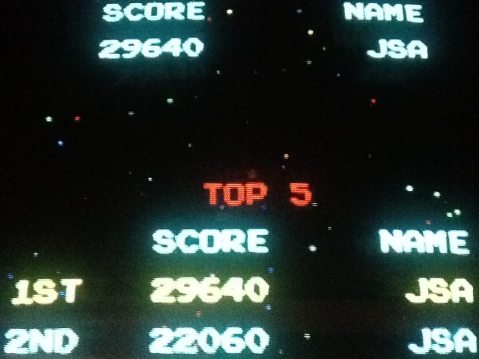
Galaga High Scores, image by Jenny Stoever
As a soundtrack, Reyes’s poem remembers the 80s through extensive references to the alternative rock music and androgynous and flamboyant artists of the MTV generation. This musical lineage becomes the soundtrack to the queer story in the poem. Through the music, the narrator produces a temporally complex “flashback” where queer connections, generational turf marking, and Mexicanness all come together.
No more pinball shit for us. That was 1970-something mierda
We were the generation of Atari—the beginning of digital games (22)
[. . .]
This was Siouxsie and the Banshees’ era with deep black mascara
The gothic singer who hung out with Robert Smith and Morrissey
The Smiths who dominated airwaves of Mexican Impala cars (23)
In these lines the narrator shows no nostalgia for the 1970s and boasts intense pride for all things new ushered in with the new decade. She brags about a new generation defined by new cultural icons like video games and synthesizer driven music. And while this music’s sound discernibly breaks from the 70s, its alternative sensibility isn’t just about sound, it’s about a look where “deep black mascara” and dark “goth” aesthetics – for girls and boys – are all the rage and help fans find each other. Simply dropping a band’s or artist’s name like “Siouxsie” or “Morrissey” or quoting part of a song conjures entire musical genres, bringing into relief a new kind of gender ambiguity and queer visibility that flourished in the 1980s. The poem is dotted with names like Boy George, Cyndi Lauper, Wham!, Elvis Costello, X, Pretenders, all musicians one might hear now during a “flashback 80s” radio hour radio or club theme night.

Sandy and Siouxsie, 2007, Shizu Saldamando, Los Angeles. Courtesy of the artist. See Shizu’s work through January 8, 2018 at the Pacific Standard Time show “My Barrio: Emigdio Vasquez and Chicana/o Identity in Orange County” at Chapman University.
The complex sense of time-space of the “flashback” as a theoretical concept is part of what links seemingly discrete flashback events: club nights, radio hours, musical intertexts. What is new about the “flashback” in this context is the unexpected site (literature) and literature’s unexpected Chicana subjects who frame readers’ listenings. Reyes’s poem represents and reminds me that the reason I go to dance clubs has always been for the love of music, all music, a feeling shared passionately among my stylish and musically eclectic friends (read more in my SO! post “New Wave Saved My Life.”). The last 80s night I went to was earlier this summer at Club Elysium in Austin, Texas, with my partner Cindy and our friend Max, who says he loves it because everyone there is his age – and for the love of new wave and fashion! The DJ played requests all night which made some of the transitions unexpected. But there we were, three Chicanos, less than ten years apart in age, enjoying a soundscape any 80s kid – from SoCal or Texas — would be proud of. When I got home I added four new songs we heard and danced to that night to my oldest Spotify list titled, “Before I Forget the 80s.” Although the purpose of this list is to stretch my memory of the music as a living pulsing archive, it also recovers the memory of this great night out with friends that extends beyond the physical dance floor.
.
Spotify Playlist for “Torcidaness” by Wanda Alarcon
Yet, in “Torcidaness,” remembering this music is mediated by the Chicana lesbian storyteller’s perspective who keenly tunes into these sounds and signs of alternative music and gender from East Los Angeles. The line, “The Smiths who dominated airwaves of Mexican Impala cars,” has implications that she was not alone in these queer listenings, as Reyes casually juxtaposes the image of lowrider car culture associated with Chicano hypermasculinity with the ambiguous sexuality of the Manchester based band’s enigmatic singer, Morrissey. Morrissey and lead guitarist Johnny Marr captivated generations of music listeners with their bold guitar driven sound, infectious melodies, and neo-Wildean homoerotic lyrics in the albums The Smiths (1983), Meat is Murder (1985), and The Queen is Dead (1986).
Recalling the song, “This Charming Man” against the poem’s reference to an Impala lowrider complicates how I hear the lyric: “Why pamper life’s complexities when the leather runs smooth on the passenger seat?” In a flash(back), the gap between the UK and East L.A. is somehow bridged in this queer musical mediation echoing what Karen Tongson calls “remote intimacies across time.” Although the poem reads like a celebration, there is a critique here in lines such as these. Chicanos and people of color are never at the forefront of who is imagined to be “alternative” in histories of alternative rock music. A vexing exception can be found in the Morrissey fandom. Mozlandia, Melissa Mora Hidalgo’s study in “transcultural fandom” is partly a response to troubling misrepresentations of Chicano fans of Morrissey. In the important work of Chicana representation where audibility is as needed as visibility, this poem not only remembers but it documents queer Chicana/o presence in these alternative 80s music scenes.

“Embrace Series: Morrissey Night” by Shizu Saldamando, LA 2009, Ballpoint pen on fabric, 72 x 120 inches. Image courtesy of the artist. See Shizu’s work at the LA Japanese American National Museum’s Transpacific Borderlands show through 25 February 2018.
By poem’s end, “torcidaness,” a Spanglish term, comes to mean lesbian, working class, and Chicana of the eighties generation all at once. Tuning into the poem’s soundscape enables the possibility of hearing all of these queer meanings simultaneously as well as the possibility of hearing Aztlán, vis-a-vis Eydie Gorme, in a video game. In these ways, Verónica Reyes’s sonically rich poem renders East Los Angeles and the 1980s as an important nexus for recovering Chicana histories and Chicana lesbian representation.
Ultimately “Torcidaness and Me” captures the joy and the struggle of queer Chicana belonging in this new narrative of what Cherrie Moraga calls, “Queer Aztlán.” Reyes writes, “Yep, this was the eighties and I was learning my crookedness.” At the same time, the compatibility of the term “queer” to tell Chicana stories is challenged by the presence of alternative ways to indicate ambiguity of gender and sexuality. In this poem, “crookedness,” “torcidaness,” “my torcida days to come,” and “marimacha” all convey “queerness” in forms more audible and meaningful to a homegirl from East L.A. If there is a sound to gender—to marimachas, malfloras, jotas, butches/femmes, what does using the word “queer” do to how we hear them? Some meanings are lost in translation, yet I don’t believe that translation should always be the goal.
Theorizing the concept of the flashback in the soundscapes of this generation of Chicana authors rejects the abstract and diffuse notion of 80s themed events deployed in mainstream American culture and resists the erasure of Chicanos and Latinos in the ways we remember this important musical decade. The stakes involved in representing and remembering such histories are high. Yet Chicana histories, experiences, sexualities, subjectivities, intimacies, language, style, desires cannot be understood without a deep recognition of Chicana lesbians and butch/femme as subjects of literature and the communities we live in. As part of a decolonial feminist listening praxis, the flashback becomes an important tool linking listening with remembering as more diverse Chicana worlds emerge.
—
Featured Image: Shizu Saldamando’s Pee Chee LA 2004, courtesy of the artist. See Shizu’s work at the LA Pacific Standard Time Show Día de los Muertos: A Cultural Legacy, Past, Present & Future at Self Help Graphics opening September 17th, 2018.
—
Wanda Alarcón is a lecturer in the Department of Feminist Studies at UC Santa Cruz. She is a recipient of the Carlos E. Castañeda Postdoctoral Fellowship in the Center for Mexican American Studies at the University of Texas at Austin (2016 –2017). She received her Ph.D. in Ethnic Studies with a Designated Emphasis in Women, Gender, and Sexuality from UC Berkeley in 2016, and earned an M.A. in English & American Literature from Binghamton University. Her research interests lie at the intersections of decolonial feminism, sound studies, popular music, eighties studies, and Chicana/o and Latinx cultural studies. Her interdisciplinary research theorizes “listening” as a decolonial feminist praxis with which to remember alternate histories of Chicana/o belonging within and out of national limits. In particular, her research argues that queer Chicana/x and Latina/x sonics become more audible in the soundscapes of Greater Mexico. At home Wanda plays piano almost every day, tinkers with bass guitar, and enjoys singing in her car. She listens to The Style Council and The Libertines in equal measure and is active on Spotify where she makes playlists for work, play, and sharing with friends.
—
 REWIND! . . .If you liked this post, you may also dig:
Listening to Punk’s Spirit in its Pre-, Proto- and Post- Formations – Yetta Howard
Could I Be Chicana Without Carlos Santana?–Wanda Alarcon
If La Llorona Was a Punk Rocker: Detonguing The Off-Key Caos and Screams of Alice Bag--Marlén Rios
Share this:

St Erkenwald: The Spectacle of Noise


series co-editors Dorothy Kim and Christopher Roman
Here is a distilled introduction to the latest installment of Medieval Sound, Aural Ecology, by series co-editors Dorothy Kim and Christopher Roman. To read their previous introduction, click here. To read the first run of the series in 2016, click here. To read the full introduction to “Aural Ecology” and to read last week’s post by Thomas Blake, click here.
Aural Ecology
What is considered music, noise, or harmony is historically and culturally contingent. [. . .] The essays in “Aural Ecologies” address the issue of unharmonious sounds, sounds that often mark dissonant critical identities—related to race, religion, material—that reverberate across different soundscapes/landscapes. In this way, this group of essays begins to open up the stakes of Medieval Sound in relation to what contemporary sound studies has begun to address in relation to cultural studies, architectural and environmental soundscapes, and the marking of race through the vibrations of the body. —Dorothy Kim and Christopher Roman
We don’t always listen to medieval poetry in the same way that we listen to contemporary verse, despite its many sonic features. This article addresses the central role of sound in a Middle English alliterative poem, St Erkenwald, which recounts a meruayle (158) that takes place in St Paul’s cathedral. Through listening to the aural texture of the poem, to the voices in the text listeners/ readers can interact with events as they unfurl.
Indeed John Scattergood has been argued that this work is a “conversation poem, a poem of transformations” (181), wherein things, legends are re-invented. Its central concerns are with the nature of salvation and history, how the past confronts the present and is obscured through the mists of time, with lay folk requiring the mediation of the clergy in order to comprehend its significance. The pagan judge’s discourse can be seen as representing living history, revealing what artifacts, writing, documents cannot. The poem’s highlighting of the limitations of memory, written records and commemoration, creates an enigma as P. Vance Smith phrases it, with the dead body left to recount its own place in the scheme of events (59-60, 74). It is through dialogue and sound, the poem’s sonorous fabric that the events are finally resolved, and their potential meaning extracted.
St Erkenwald opens with an account of the physical, historical and religious setting of the tale, which evolves into a description of the re-building of the cathedral. The mery (39) stone masons, whilst engaged in their work, uncover a splendid tomb, lavishly decorated. The description of the digging and carving of stone conveys jarring, bustling activity. News of the tomb with its indecipherable text spreads rapidly (58-62).
Voice File: lines 58-100
Click here to view transcript of Lines 58-100

Etching of Old St. Paul’s Cathedral, London, from Francis Bond’s Early Christian Architecture, 1913.
Apart from the explicit references to noise, the verbs are evocative of clamour and urgency. Far from proceeding calmly and in an orderly fashion to the tomb, the people highid, boghit, lepen and ronnen. A powerful sense of speed and movement is evoked, heightened by the numbers of people involved. Something extremely unusual has happened and everyone desires to see it. The event develops into a spectacle of noise, a lively social occasion, as layers of details and elements are accumulated.
Noise does not signify in itself, it has meaning only in relation to other modes of signification. Michelle R. Warren, in her analysis of “The Noise of Roland”, argues that from the “combined perspectives of acoustics, information theory, and philology” it is possible to view noise and signals or messages as interdependent and that what distinguishes something as meaningful, a signal or message, or disruptive, is “intent” (283). This is particularly evident in literature, which can be viewed as the “noise of culture,” a disturbance in the dissemination of information and thus literary texts can be viewed as “various forms of mixed signals” (304). Sound, like time and space helps to delineate boundaries between the self and other and in order for identity to be established the noisy other must be silenced.
However, there is no hint of violence, unease or alterity in all of this haste in the cathedral to see the wonder with which the pilgrims have been presented. The opening of the tomb is carefully and courteously organized by the mayor and the sacristan and skillfully enacted by the workmen. The body unearthed is as fresh as he is “sounde sodanly were slippid opon slepe”(92). There is a child-like innocence, an enthusiasm for the marvelous, the new. Even the mayor, civic and religious leaders are anxious to investigate the find. Each person questions what lies before him and endeavours to make sense of it.
To this end, they search for records and memories of this seemingly important individual (96-100). The discussion works from the materiality of the body outwards in an attempt to unravel the underlying meaning. This referral to documentation to find a rationale for what is happening proves ineffectual. The questioning of texts and modes of recording draws in the receivers of St. Erkenwald, who possess a similar level of knowledge of the events, witnessing them unfurl, just as the folk in the poem, uniting both the internal and external audiences.

Erkenwald teaching monks in a historiated initial from the Chertsey Breviary (c.1300)
News reaches Bishop Erkenwald of these happenings whilst he is visiting an abbey in Essex, and losing no time, he buskyd þiderwarde bytyme (112). Erkenwald spends the night reciting his canonical hours, beseeching God’s help to solve the mystery in order to confirm the people’s faith. His prayers prefigure the closure of the poem, functioning as an expression of desire, which through supplication is fulfilled leading to celebration as his wish and the wishes of the people are fulfilled in that the mystery of the body and divine workings are revealed.
Once he assumes control of proceedings all clamour and commotion cease, at his behest (131-2).
Voice File 2 lines 131-145
Click here to read a transcript of likes 131-145
The exquisite notes of the choir are an instance of that important element of medieval cultures, music, with every aspect of medieval life and experience and embodiment being musically significant. Lords gather, not rush to herken (134) the beautiful, intricate singing. After this carefully designed performance of sound in honour of God, the bishop processes to the tomb location. We learn of all the great, good and ordinary souls who follow the bishop as the area is unlocked with a great bundle of keys. The keys probably jangle in the echoing confines of the cloister, a naturalistic detail that draws the listener/ reader into the scene. Having negotiated the cloister the focus then narrows to a moving conversation between the bishop and the corpse. All is silence now (218-20).
Voice File 3 lines 193-220
Click here to read a transcript of lines 193-220
The crowd is as large as before, with a crush forming behind the bishop as he passes through it, yet it is becalmed through sheer amazement. The contrast between the calmness and silence of the crowd now and its previous frenetic noisy activity is quite arresting. Boisterous garrulous behavior evident amongst those attending religious worship is widely attested and, as Diana Wood notes, the church court records contain references to louts disrupting worship and bear testament to widespread chattering with warnings issued upon occasion (207).

University of Leicester Special Collections. The Shrine of Saint Erkenwald, which was in the shape of a pyramid, with an offering-table before it, and was adorned with gold, silver and precious stones. From SCT 00908, William Dugdale, The History of St. Pauls Cathedral in London : From its Foundation Untill these Times …, (London, 1818)
The dean recounts to Erkenwald all their attempts to unearth the identity of the body (159-62). Erkenwald responds by counselling the need to draw inspiration from God and to trust in their faith and to emphasize that only with divine aid can miracles be comprehended. Thereafter follows a dialogue between the bishop and the body in which we learn of the circumstances of the latter’s life and death. We are presented with performance history, the dead speaking to the living, to us, rather than information having to be gleaned from dusty monuments, texts and documents. These living words reveal God’s plan and their underlying significances are mediated by Erkenwald for the deceased judge and spectators. The poem in turn translates these events for later readers/listeners. The focus remains firmly fixed on the bishop and the corpse, with the crowd quietly observing and listening, in the same manner as those who hear/read the text.
Indeed, throughout this section the references to noise are limited to verbs and phrases which suggest sorrow. The corpse hummyd (281) and gefe a gronyng (283). One can almost hear the silence as Erkenwald pauses and looks at the tomb with flowing tears. As he warpyd the words of baptism wete (321) drips from his eyes and trillyd adoun (322). A drop falls on the judge’s face, facilitating his having a vision of paradise. His sadde soun (324) sounds out in that place for the last time for a final time as he describes what he sees and “wyt this cessyd his sowne, sayd he no more” (341). The judge is miraculously received into heaven and his body instantaneously decomposes, in the midst of great tranquility.
The climax of the poem is a crescendo of sound, as the crowd rejoices at the happy fate of the judge, but it is a happiness inevitably tinged with sadness in the face of death (350-2).
Voice File 4 lines 309-352
Click here to read a transcript of lines 309-352

A sermon at Paul’s Cross
(from the Society of Antiquaries of London)
All are involved in the procession with bells ringing out throughout the town. The bells call not only the folk of Erkenwald’s London to participate in this joyful spectacle; they invite later audiences to join the celebration. Thus childlike innocence and enthusiasm combined with the direction of the church in tangible situations are deemed beneficial. This is paralleled in the positivity of silence and the three correct usages of human speech as explicated in a fifteenth-century sermon by an Oxford student monk on the gospel reading for the third Sunday in Lent, Luke II:14-28. An individual, especially a cleric, must be silent and meditate before he can graciously address the Lord. Quiet study is necessary prior to exhorting people to leave their sinful ways, with the final purpose of rightful speech being confession, which should only be exercised after the silent acquiring of wisdom (41-51).
The poem’s narrative voice adds that physicality is merely vainglorious, and what is fundamental is the soul’s achieving of bliss through the expression of love for Our Lord who makes this feasible. Such explicit comments are comparatively rare in St. Erkenwald with the role of the church and lay folk, and their obligations performed, expressed, rather than stated. The poem provides a model of the religious culture of a cathedral with the roles of clergy and laity carefully delineated. Through a spectacle of sound, ordered and disordered, of human and divine orchestration, pastoral care and guidance is enacted for the audience in and of the poem.
—
Featured Image: Image from the Crusader Bible, Morgan Library M.638, fol. 3r.
—
Bonnie Millar, Ph.D., Researcher at the University of Nottingham holds degrees from Trinity College Dublin, and the University of Nottingham. She has authored a critical study of the Siege of Jerusalem, and also publishes regularly on alliterative poetry, medieval romances, gender theory and myths. Publications include a paper entitled “Hero or Jester: Gawain in Middle English Romances and Ballads” in Le Personnage de Gauvain dans la literature européenne du Moyen Âge ed. Marie-Françoise Alamichel, a chapter on “Key Critics, Concepts & Topics” in the Continuum Handbook of Medieval British Literature, “A Measure of Courtliness: Sir Gawain and the Carl of Carlisle” in Cultures Courtoises en Mouvement: Proceedings of the Thirteenth Congress of the International Society of Courtly Literature and contributions to the Facts on File Companion to Pre-1600 British Poetry. Current projects include a full length study of the figure of Gawain entitled Gawain: From Hero to Anti-Hero in late Middle English and Early Modern Romances and Ballads.
—
REWIND!…If you liked this post, you may also dig:
The Amplification of Muted Voices: Notes on a Recitation of the Adhan–David Font-Navarette
Wayback Sound Machine: Sound Through Time, Space, and Place–Maile Colbert
“Playing the Medieval Lyric”: Remixing, Sampling and Remediating “Head Like a Hole” and “Call Me Maybe”–Dorothy Kim
Share this:


Current Top Posts





April 2021

January 2020

November 2019

October 2019

August 2019

April 2014

November 2017

March 2015

December 2017

October 2015
 Sounding Out!
Recent Comments