
Finding Resonance, Finding María Lugones
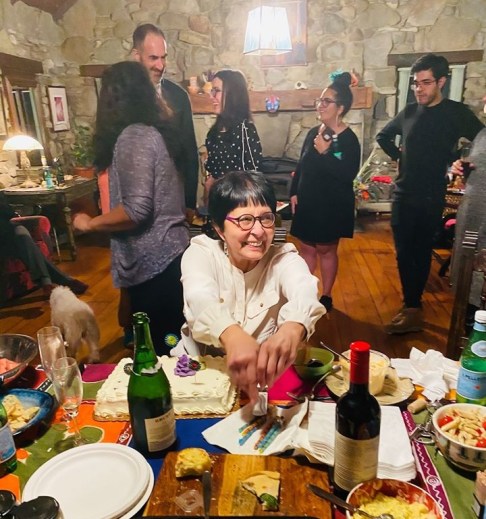
I am always listening for María: I find her most in the traces of words.
Trained as a literary scholar, I relish in the contours of stories; I savor the nuances found between crevices of language and the shades of implication when those languages are strung together. It is no surprise, then, that since the death of my friend and mentor María Lugones, I have turned to many books, particularly her book, Pilgrimages/Peregrinajes: Theorizing Coalition Against Multiple Oppression, to feel connected to her. I have struggled, though, to write about her, talk about her, even think about her for many years. It wasn’t until I found a passage about spirits and hauntings in Cuban-American writer and artist Ana Menéndez’s novel The Apartment that I found language to describe a way through the grief of the last five years.

Menéndez’s novel follows many characters that all, at some point in time, come to live in apartment 2B in Miami Beach. While each person is seemingly disconnected from the next, they all leaves sonic traces of themselves for the next person’s arrival. Each new tenant leaves behind the creak of a dented floorboard, or the rumbling of the air conditioner, the faint melody of a piano, or the swish of spirits looking for a place to sit down. The climax of the novel revolves around Lenin García, a young Cuban migrant who commits suicide in the Miami apartment shortly after arriving. Anna, a journalist who migrated to the US from the Czech Republic during their communist regime, prepares the apartment for rental after the suicide. When looking through Lenin’s belongings she explains that the “Spirits pressed down on her, and again and again she rejects them. Sends them packing, back to the pre-rational past. Not a haunting, but an echo. The boy’s life a gesture pointing back to her own. A dream of a thousand iterations” (131). These spirits that surround her, that remind her of her own life’s ghosts, provide a particularly sonic connection; the tethers that connect one migration tragedy to another is an echo of commonality that creates a kin experience.
The three years I learned with and from María are overshadowed by the physical distance the pandemic required of me in her final moments. When I try to write about her, my hair stands on end, my eyes water, my nose drips, and I stretch out my hand toward a presence I feel, just out of reach. I know it’s her, I just can’t seem to touch her. I have described María’s death as a haunting—as something that haunts me. I defined this haunting as a physical presence that I could not see, but I could feel, sense. But what if, like Anna, I am feeling, not a haunting, but an echo; or more accurately, the resonances of María that echo around me constantly? What Menéndez’s passage provides is the necessity of reinterpreting my awareness of María from one of general sensing to one of specific aural attunement. If I am listening for her, how, then do I keep her with me?

Lenin, from The Apartment, provides a potential answer: when meeting with a curandera in Cuba, she tells him “The ancestors speak to you from the home of your inner life. When your inner life is spare, there is nowhere for the ghosts to sit. When you furnish your spirit, the ancestors will once again find rest in you” (143). Echoes become an analytic that provide furnishings ‘in the soul’ for sustained company of those who have passed. The reverberation of echoes—reverberations as a prolonged sense of resonance that stretches the meeting of two energies—can, quite literally, allow a reader to connect back to people across space and time. My tether to María is a resonance that simultaneously locates and disperses spatially and temporally. I hear this connection as my harmony to her melody. To further the metaphor, that resonance is the strumming of a guitar, where I am the guitar and she is the musician, and that moment where we both hear for each other, even when we do not know the other exists, is the note.
What happens when I use literary methods of analysis to find people in the interstices of sound? To search for María in what she calls the “enclosures and openings of our praxis” as a reader of her text? Now that I had to search the histories of her echo, I turned to her book, Pilgrimages/Peregrinajes.
When María recommends “to women of color in the United States that we learn to love each other by learning to travel to each other’s ‘worlds’,” (78) I imagine our first few encounters; encounters that were strange, difficult, and lessons in learning to listen to her on her terms. I had been invited to her home in Binghamton, New York for a meeting of a political-intellectual group she hosted, and was nervous to meet the woman I had written my Master’s thesis on, and who was the reason I applied to Binghamton for a PhD program. Her voice rang through the room, slow and clear; her mouth pursed a bit as she thought through her next sentence, her finger pointed as she spoke her next idea. In trying to stay out of her way, I became a barrier when she moved backward; she bumped into me and said simply ‘you must be careful not to trip me’ and moved along. I was mortified.
Our next few encounters were similarly odd, and lead me to think that, maybe, María was not the right choice for my mentoring needs. A few months into this first year in graduate school—where tenured male professors were violent toward me, and I was not sure I should stay in academia—I confessed to a friend in the same political-intellectual group that I was not sure María liked me or that I should work with her. Her response changed everything: this friend, who had worked with María many, many years said: “don’t do that. Don’t make her mother you. It’s not who she is. Travel to her, learn her.” I finally understood that traveling to María’s world meant listening to her from her perspective, not my own. That shift in me “from being one person to being a different person” (89) is how I first found María in the haptic world. I learned to listening to her: I learned the catch in her throat meant she wanted tea; I learned the increase in sighs meant she was in more pain that usual; I learned the shuffling of papers probably meant she was looking for her handkerchief to wipe her forehead as she had a hot flash. Each of these sonic gestures, I could respond to—could show up for her.

But with María’s death, this kind of listening is no longer available to me; I could not listen for hem or hmm or tchps. I had to learn to listen differently. In re-reading Pilgrimages/Peregrinajes I learn that it does not just contain her philosophical interventions for liberatory futures. It is a series of stories; her stories of the echoes that resonate inside of her; stories that she weaves together that happen to name philosophical practices of relationality. It is through the coerced placement of her by her father in an asylum that she finds other woman who teach her to resist; this resistance is sonic: a woman repeating over and over “I am busy, I am busy” as they electroshock her (i). It is through wanting desperately to love her mother that she finds ways her mother taught her to listen differently in order to name the capacity of ‘world’-traveling. What I had felt when I first read her work over a decade ago was a resonance; a sonic reverberation across space and time that connected my to her before our physical meeting, during our time as friends and mentor/mentee, and now after her physical death.
Connecting to María through echoes feels effortless now that I have the language. I hear now María’s warning against the dangers in the primacy of the visual. In “Hablando Cara a Cara/Speaking Face to Face: An Exploration of Ethnocentric Racism,” she explains:
I exercise this playful practice. The appreciation of my playfulness and its meaning may be realized when the possibility of becoming playful in this way has been collectively realized, when it has become realized by us. It is here to be appreciated or missed and both the appreciation and the missing are significant. The more fully this playfulness is appreciated, the less broken I am to you, the more dimensional I am to you. But I want to exercise my multidimensionality even if you do not appreciate it. To do otherwise would be to engage in self-mutilation, to come to be just the person that you see. To play in this way is then an act of resistance as well as an act of self- affirmation (41).
What she taught me here is that being herself meant a practice that was more than being seen. To be what others could only see was an act of mutilation to her multidimensionality. That reminder was crucial to becoming her friend during my time at Binghamton, but even more crucial now that she is gone from this world.

I’ll leave you with the most important story she left behind: she provided a method of learning that was based on the senses and focused primarily on the sonic—what she called “tantear.” This tantear has become instrumental in my own research. It is a fumbling around in the dark, a feeling around tactically that focuses on searching “for meaning, for the limits of possibility; putting our hands to our ears to hear better, to hear the meaning in the enclosures and openings of our praxis” (1). The embodied experience of stumbling, of careful and intense feeling for and with others, requires a capacity of listening deeply. It is listening that undergirds the learning. The language of the sonic provides the understanding of the feelings within the body. Listening becomes a profound practice of relationality; echoes become a mechanism of connection; and resonance becomes the confirmation that I can still be with María.
—
Images courtesy of the author, except where noted.
—
Daimys Ester García is a Latinex writer, artist and educator from Miami. She earned her PhD in Comparative Literature at SUNY Binghamton. She is currently an Assistant Professor in English at the College of Wooster, where her research and teaching is at the intersections of Latinx literatures & studies, Native literatures & studies, women of color feminisms, and decolonial praxis with a focus on coalitional politic. She is working on a book manuscript, tentatively titled Comfort is Colonialism: Coalitional Commitments for Cuban-American Women Writers, which offers a repertoire of practices to re-connect Cuban-Americans with other histories of resistance in the US.
—
Thank you to Wanda Alarcón for care in the form of editorial labor.
—

REWIND!…If you liked this post, you may also dig:
Faithful Listening: Notes Toward a Latinx Listening Methodology–Wanda Alarcón, Inés Casillas, Esther Díaz Martín, Sara Veronica Hinojos, and Cloe Gentile Reyes
Enacting Queer Listening, or When Anzaldúa Laughs–Maria Chaves Daza
“Oh how so East L.A.”: The Sound of 80s Flashbacks in Chicana Literature–Wanda Alarcón
Xicanacimiento, Life-giving Sonics of Critical Consciousness–Esther Díaz Martín and Kristian E. Vasquez
Share this:

SO! Podcast #82: Living Sounds: Rhythms of Belonging

CLICK HERE TO DOWNLOAD: SO! Podcast #82: Living Sounds: Rhythms of Belonging
SUBSCRIBE TO THE SERIES VIA APPLE PODCASTS
FOR TRANSCRIPT: ACCESS EPISODE THROUGH APPLE PODCASTS , locate the episode and click on the three dots to the far right. Click on “view transcript.”
It’s been a minute for the SO! podcast but we are glad to be back–however intermittently–with a podcast episode that shares a discussion between women sound studies artists and scholars. The panel “Living Sounds: Rhythms of Belonging,” was held on September 19 at 6-7pm EDT at The Soil Factory arts space in Ithaca, New York. Moderator Jennifer Lynn Stoever, sound studies scholar and our Ed. in Chief, talks with four women sound artists about their praxis: Marlo de Lara, Bonnie Han Jones, Sarah Nance and Paulina Velazquez Solis.


Bios
Marlo De Lara (they/siya) obtained a PhD in Cultural Studies (University of Leeds) and an MA in Psychosocial Studies from the Centre of Psychoanalytic Studies at Essex. Their creative practice works within the realms of sound performance, visual distraction, and film. Using found objects, installation, and various forms of amplification, environments/structures use sound to impart meaning and affect for the participant. As the child of Philippine migrants, De Lara’s unabashed feminist sociopolitical practice/research editorializes on contemporary global conditions. As an arts facilitator, using their critiques of the nonprofit industrial complex and institutional learning, De Lara aims to transgress and subvert traditional hierarchical ways of managing contemporary art spaces. In the role of community care, Marlo uses mutual aid and emergent strategies in combination with decolonial ways of nourishing equity, diversity, and inclusion practices to ensure safety and access for all. Marlo is a Certified Deep Listening Facilitator and shaping a career as Counsellor/Coach/Guide in therapeutic healing methods informed by Western psychotherapeutic/psychological, healing arts, expressive therapies, and various indigenous practices, most specifically sikolohiyang pilipino.
Bonnie Han Jones is a Korean-American improvising musician, poet, and performer working with electronic sound and text. She performs solo and in numerous collaborative music, film, and visual art projects. Bonnie was a founding member of the Transmodern Festival and CHELA Gallery and is currently a member of the High Zero Festival collective. In 2010, along with Suzanne Thorpe she co-founded TECHNE, an organization that develops anti-racist, feminist workshops that center on technology-focused art making, improvisation, and community collaboration. She has received commissions from the London ICA and Walters Art Museum and has presented her work extensively at institutions in the US, Mexico, Europe and Asia. Bonnie was a 2018 recipient of the Foundation for Contemporary Arts Grants to Artists Award. Born in South Korea, she was raised on a dairy farm in New Jersey, spent her formative years in Baltimore, Maryland and Providence RI and currently resides in Chicago, IL.
Sarah Nance is an interdisciplinary artist exploring the intersections of geologic processes and human experience in archived, constructed, and speculative landscapes. Her work has been performed and exhibited widely, at venues in China, France, Canada, Iceland, South Korea, Germany, and Italy, as well as across the U.S.
Paulina Velázquez Solís is a multimedia artist and curator from Mexico and Costa Rica. She works with installation, sound, sculpture, drawing, animation/video, and media performance. She is interested in the body and the biological and natural world in interaction with the cultural and social notions of normalcy and experiences as a multinational individual. Her work has been shown in places like Museo de Arte y Diseño Contemporáneo and TEOR/éTica in Costa Rica; Taipei Fine Arts Museum; Ex Teresa Arte Actual in México City; Casa de las Americas in La Havana, Cuba; Museo de Arte Contemporáneo in Panamá City; Museum of the Americas, Washington, DC; and Root Division and The Lab in San Francisco.
Jennifer Lynn Stoever is Associate Professor of English at Binghamton University, founding Editor-in-Chief of Sounding Out!, and author of The Sonic Color Line: Race and the Cultural Politics of Listening (NYU Press, 2016). Her research has been supported by the Whiting Foundation, the George A. and Eliza Gardner Howard Foundation, and the National Endowment for the Humanities.
Thank you to Travis Johns for the recording and mixing.
—

REWIND! . . .If you liked this post, you may also dig:
SO! Podcast #48: Languages of Exile
SO! Podcast #53: H. Cecilia Suhr’s “From Ancient Soul to Ether”
SO! Podcast #55: The New Brunswick Music Scene Symposium
Share this:


Current Top Posts





April 2021

January 2020

November 2019

October 2019

August 2019

April 2014

November 2017

March 2015

December 2017

October 2015
 Sounding Out!
Recent Comments