
The Sounds of Anti-Anti-Essentialism: Listening to Black Consciousness in the Classroom

Image by Flickr User Pere Ubu
 In teaching the many interrelated and complicated aspects of the Civil Rights movement, Black Power, and the Black Arts Movement, the challenge for me is to help students understand the “facts” of this period, and to simultaneously destabilize the teleological historical narrative these “facts” seem to suggest. In a pedagogical context, sound helps fill in the gaps that fall outside of the knowledge produced–and contained within–certain archival accounts of black cultural and political history. While crucial, having students listen to the gaps, can be daunting, especially in our current historical moment, as the decades-long push against identity politics has been solidified by the recent (re)election of the nation’s first black president, Barack Obama. This point demands more elaboration than I can provide here, but the critical pedagogical issue it raises within the province of black studies, is that it is becoming increasingly difficult to consider black political culture outside of the sedimented lines of American pluralism and black radical thought.
I use sound as a pedagogical tool to help outline a middle ground–what Frantz Fanon refers to in The Wretched of the Earth as “zone of hidden fluctuation” (166)–based upon articulations of resistance and identity that refuse to be frozen in time. Building on Paul Gilroy’s conceptualization of anti-anti-essentialism in The Black Atlantic, an idea of black consciousness that is flexible and moves between the insufficient terms of “essentialist” and “anti-essentialist,” I use specific pedagogical examples to suggest that teaching about race and sound is a rich, evolving, and productively interactive continuum. The auditory sense opens up new terrains of knowledge and dynamically expands the possibilities for students to think through the intricate and multifaceted formations of black consciousness during the volatile years of the 1960s and the resonance of those years in our present.
The recorded presence of Martin Luther King, Jr., for example, represents an important aural site for engaging in reflexive pedagogy, because King’s tonality–the resonance of his voice–creates a certain familiarity and is pivotal to the construction of the American myth of the radical transformation of the civil rights movement and the idea of post-civil rights racial equality. For many students, King’s sound signals the dream of, and the pathway towards, a unified America. Conscious of how this idea of King reflects a linear understanding of civil rights as simply a desire for inclusion, I direct students’ attention to the sound of King’s last recorded speech in Memphis on April 3, 1968. Given the evening before his assassination, this speech resounds with King’s deepening critical perspective on black struggle through its haunting concluding notes. I point out to my classes that King’s final years (1965-1968) were marked by his increasing focus on ideas of black resistance outside of the Civil Rights mainstream, including his critique of U.S. involvement in the Vietnam War, and his radical rethinking of the possibilities for black economic and political self-determination.

Martin Luther King in 1968, Image courtesy of UIC Digital Collections
Centered on the economic injustice and dehumanization of Memphis’s striking black sanitation workers, King’s speech details the need for the Memphis black community do more than simply boycott municipal entities, but rather articulate their resistance by boycotting prominent national brands such as Wonder Bread and Coca-Cola. Against this background, I play segments (particularly the final minutes) of King’s speech, entitled, “I’ve Been to the Mountaintop.”
The acoustic dimensions of King’s final speech resonate with a social and political complexity that troubles the sonic memories many students have of King’s “I Have a Dream” speech, delivered on the steps of the Lincoln Memorial in 1963. The much more intimate and less overtly majestic soundscape of Memphis’ Mason Temple underlines King’s shift from national icon back to local, community activist. The frequent audience shifts–applause, extemporaneous interjections, and silence–create a reverberating sonic energy that accumulates throughout the speech. Rather than relying strictly on a call-and-response interpretation of the interactive exchanges between King’s voice and the audience’s response, I have students consider the non-linear ebbs and flows in King’s sound in this latest of moments (as Fred Moten would say, the totality of King’s tonality). For example, as King’s audience considers the weight of his analyses and what it means to articulate black resistance as “a dangerous unselfishness” that “puts pressure where it really hurts,” I identify moments of uncertainty, hesitation, and contemplative reflection that mark a non-linear interactive sonority between King and his audience.
Listening to King’s final thoughts offers a disturbing and disruptive emphasis on the stakes of breaking with entrenched modes of activist thinking. He concludes the speech with a series of prophetic thoughts on mortality as a cost of making a stand against “our sick white brothers.” Set within the historical and ideological context I have sketched above, the delivery distinguishes the sound of King’s words. As we listen I draw attention to King’s expression of a lack of fear in anything, any man, as King seems to convey an eerie foreknowledge of his murder and his irreverence in its face.
“I’ve Been to the Mountaintop” –Listen to the concluding two minutes
The apocalyptic sound of King’s concluding notes to this political sermon leaves much to contemplate. From the mention of the potential threat posed to his life by “our sick white brothers,” through the speech’s last line, there is a tonal, timbral shift in his voice and demeanor. Through sound and posture, and the reaction of the audience to those factors, King’s affect seems to convey something more momentous occurring beneath the event’s surface dynamics. King projects a confrontational edge through the sound of fearlessness in the face of mortality. Did he know he was going to be killed shortly after giving this speech? It’s a question that the peculiar tonality of his concluding lines raises for students. If so, what does it mean to use the sermon as a site of prophetic, aural documentation of the fact that a force of transformation exists beyond the flesh and blood of leadership, a force that assassination can’t kill? In the speech’s final synesthetic moment, I have the students listen and watch the shift that occurs in King’s demeanor as he closes, and the way that this shift culminates in an almost ecstatic moment as he delivers the final line: “Mine eyes have seen the glory of the coming of the Lord.” His defiant turning away from the microphone is crucial as it amplifies the meaning of the voice, letting those watching know that, much like an emcee, King has just “served” white power with a delivery that will outlast the sniper’s bullet the following evening.

Nina Simone, Image courtesy of Flickr User GlingG
I want to briefly point to two other examples that show additional ways in which sound complicates ideas of racial identity and expression during the 1960s. When I teach Nina Simone’s composition, “Mississippi Goddamn,” (recorded live at Carnegie Hall in 1964), I ask students to consider the relationship between the distinctive sound of her voice and the ironic and critical elements of her lyrical meaning as this interaction creates a complex idea of radical black consciousness. Composed in the aftermath of the murder of Medgar Evers and the bombing of the 16th Street Baptist Church in Birmingham, Alabama, Simone offers a musical, and more broadly sonic meditation on white supremacy.
Most students find the timbre of Simone’s voice, its grain (as Roland Barthes would say) and depth, immediately striking. Her unique sonority and its context, greatly influence attempts by students to understand her reference to the song as simply a tune: “The name of this tune is Mississippi Goddamn” she says, and “This is a show tune, but the show for it hasn’t been written yet.” Clearly it isn’t simply a tune, and the caustic quality of lines such as, “Oh but this country is full of lies/ You’re all gonna die and die like flies,” creates a critical depth through the sound of Simone’s commitment to a black radical perspective. What does it mean, for instance, that Simone projects such sarcasm and biting critique to a predominately white audience at Carnegie Hall? How might we hear the specific grain of her voice in this setting? How does Simone’s projection of critical black sonic resistance, emerge at the conjuncture of anti-black racism and the beginning of legislative efforts under the Johnson administration to rectify racial inequality through civil rights bills? What can be taken from the simultaneity and contrast that Simone projects her sound within? I pose such questions to my students as a way of considering what it means to be committed to critical thought and social transformation that falls outside of the dominant lines of American national consciousness, and how the sound of such commitment, heard in the pitch and tenor of Simone’s voice, matters as a different kind of historical documentation.
In considering how the sound of music can offer an intervention within the formation of black political consciousness in the Black Arts Movement, I often use the 1966 recording of Amiri Baraka’s signal poem, “Black Art,” as it set to the experimental musical sounds of Sonny Murray’s ensemble (Murray-drums, Albert Ayler-tenor saxophone, Don Cherry-trumpet, Henry Grimes, Lewis Worrell-bass). Having first read the poem, students then are able to hear it set to– and against–the unconventional instrumentation of Murray’s ensemble.
The musicians create an unconventional sonic context for Baraka’s reading that de-emphasizes and re-situates the apparent dimensions of black rage that seem to arise from verse that can “shoot guns,” through an almost carnivalesque, comedic, and off-kilter sound that troubles the linear expectations one might have of instrumentation amplifying the words on the page. The dissonance between page and sound allows for useful pedagogical opening, in that it underlines the non-conformist, avant-garde aspects of the movement, and the fine line that artists such as Baraka were imagining between the intensity of black radical consciousness and the ability to articulate that standpoint outside of the expected forms of black cultural nationalism.

Image Courtesy of UIC Digital Collections
As these examples have shown, I incorporate sound into my pedagogical framings of black cultural and political identity as an opening through which students may expand their understandings of black consciousness and black political culture well beyond stagnant ideas of racial authenticity, while still preserving an understanding of the transformative and often radical possibilities that have been projected through black expression during the period. It is the open space of sound that invests the project of black radical thought with the uncanny spontaneity of experimentation. Having students understand ideas of expansiveness, asymmetry, and non-linearity as central to black cultural expression and critique–even as artists refuse to sacrifice an expressed political commitment to black resistance–begins to suggest ways for students to contemplate the intersection of identity politics with the unexpected, fantastic elements of expression that lie outside of more recent flattened diagnoses of black nationalism. Teaching at the intersections of race and sound opens up new terrains of knowledge, dynamically expanding students’ abilities to think through the intricate and multifaceted formations of black consciousness during the volatile years of the 1960s and the resonance of those years in our present.
—
Carter Mathes is an assistant professor of English at Rutgers University. He has completed a book manuscript entitled, Imagine the Sound: Experimental Form in Post-Civil Rights African American Literature, that focuses on the relationship between sound and literary innovation during the 1960s and 1970s. He is co-editing a volume of essays on Black Arts Movement writer and critic Larry Neal; and also has essays in print or forthcoming on Toni Cade Bambara, Peter Tosh, and James Baldwin. At Rutgers, he regularly teaches classes focusing on African American literature, Twentieth-century literature, music and literature, and experimental writing.
—
 REWIND! . . .If you liked this post, you may also dig:
Audio Culture Studies: Scaffolding a Sequence of Assignments–Jentery Sayers
They Do Not All Sound Alike: Sampling Kathleen Cleaver, Assata Shakur, and Angela Davis–Tara Betts
Freedom Back: Sounding Black Feminist History, Courtesy the Artists–Tavia Nyong’o
Share this:

Radical Listening and the People’s Microphony: A Conversation with Elana Mann
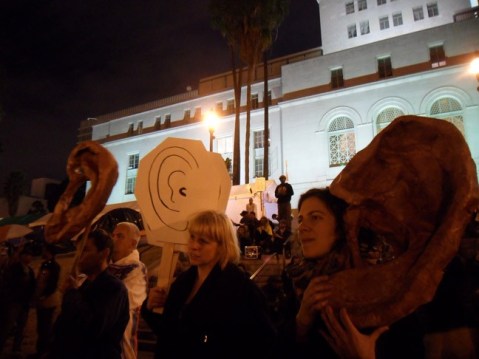
Members and collaborators of ARLA (Paula Cronan, Juliana Snapper, and Elana Mann) participating in a General Assembly at Occupy LA City Hall, November 11, 2011
Listen to everything all the time and remind yourself when you are not listening–Pauline Oliveros
“CAN YOU HEAR ME?!” “I CAN HEAR YOU!!” “IT’S A VAN GOGH PARADE!!” . . .were some of the enthusiastic replies when artist Elana Mann, musician Juliana Snapper, and other members of ARLA (Audile Receptives Los Angeles) arrived on the scene at Occupy LA with giant hand-made ears. Mann co-founded ARLA in the Spring of 2011 with Snapper, filmmaker Vera Brunner-Sung, and choreographer Kristen Smiarowski. After studying scores and techniques on listening developed by composer Pauline Oliveros, ARLA developed a workshop geared toward Occupy LA that included a listening parade in which they held up the giant ears and protest signs with ears on them. Snapper recalls, “The simple physical presence of people carrying large paper-mache ears was met with a kind of hungry recognition…recognition of what it meant that we were holding the symbols (giant ears).” They led workshops, listening sessions, and discussion groups. They performed Oliveros’ sonic meditation “Teach Yourself to Fly” and a composition written by Mann and Snapper entitled “People’s Microphony.” And a project was born. Through personal interviews and audio-visual examples, I document, contextualize, and analyze its work. 
Mp3=The People’s Microphony Camerata performing “Teach Yourself to Fly” Pauline Oliveros
I am happy that Elana Mann chose to use my Sonic Meditations for the People’s Microphony project. These pieces are meant for anyone that wants to perform them regardless of musical training.” –Pauline Oliveros
For Mann, active listening is “a process of tuning in simultaneously inward and outward. Active listening allows for an awareness of and an opening up to sounds around me and also a digestion of what is happening inside of me in relation to these sounds.” Much of the recent focus on this practice comes from the music and sound art worlds, as well as acoustic ecology, a field formed from the overlapping area between science and art that concentrates on the importance of experiencing and investigating our sonic surroundings with detailed care and respect to understand its importance on our world and our place within it. Mann’s work addresses a unique angle at the intersection of these fields: listening’s empathetic effect on those whom you are listening to, a consideration arising from a project she worked on between 2007-2010 with Iraq war veteran Captain Dylan Alexander Mack, called “Can’t Afford the Freeway.”
. “Can’t Afford the Freeway” highlights how her collaborations emerge as conversations between involved artists as well as the audience. Speaking to Mann about the project, she stated,Alex created some recordings for me and I kept listening to them over and over again trying to figure them out. I eventually produced more interviews with him and realized that he needed his story to be heard and I needed to try and understand his story. So I created a project in which I attempted to listen as best I could. Listening to his recordings made me feel close to him, but I also recognized that no matter how many times I heard his words they were still foreign to me. Still the very act of me struggling to listen was important for both of us, and I think this is true of many interpersonal/political and social situations. You can never experience what it is like to be someone else, but active listening opens up a space of empathy and connection. I also think we can see how a lack of active listening is affecting the political landscape in the United States so negatively, by producing a highly polarized and vitriolic environment.
And what about at Occupy LA?
At Occupy LA I was hopeful that there would be a place for listening to voices that had not been heard before and sometimes that happened. Other times people used the space for projecting, not receiving. I think that there needs to be strong voices making themselves heard, but I don’t want to lose the other part of that equation, which is those voices being quiet and listening to others, and themselves.

ARLA Ear Strengthening Workshop, Occupy LA site, November 11, 2011, Photo by Carol Cheh
Mann, thinking and researching about social, aesthetic, and political points of listening and voicing, felt there was something to be considered about the “radical receptivity and the core message of the OWS movement” and its global amplification of voices struggling to be heard. In the Spring of 2012, she formed The People’s Microphony Camerata with Snapper, a radical experimental choir based in Los Angeles exploring the process of the People’s Microphone. The exact history of the “People’s Microphone,” or “People’s Mic” is unclear, but its use in the Occupy Movement has already become iconic. Ted Sammons discusses the implications of the People’s Mic for communication in his October 2011 post, “‘I didn’t say look; I said listen’: The People’s Microphone, #OWS, and Beyond.” The human microphone is a way to deliver one person’s message to a large group of people in situations where amplification tools, such as bullhorns, are either not allowed or unavailable, or if the acoustics of a space distort amplification. The speaker calls, “mic check!” to alert their intentions. Those around them call back, “mic check!”, until the gathering understands something will be said. The speaker breaks their statement into short sentences, pausing to allow those around them, or the “first wave,” to repeat them in unison. They then pause for those further away, or the “second wave,” to repeat again…and so on until those in the back of the gathering have heard the statement.
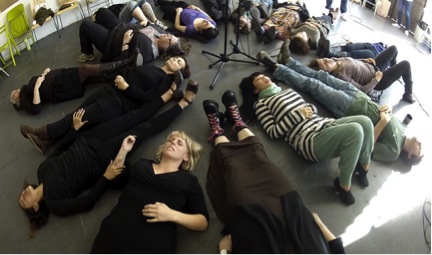
Members of People’s Microphony Camerata rehearsing in Los Angeles, April 15, 2012, Photo by Jean-Paul Leonard
The group’s trademark intensity sometimes carried over to the audience. Mann discovered such transference often had to do with prior associations with a location or context. Mann recalled a particular performance at the Occupy movement called “Chalkupy” that was formed in response to a protest running simultaneously with the LA Art Walk, in which activists had handed out chalk and told stories of police repression while chalk drawings were created on the walkways. The police shut down the art walk and a violent struggle ensued. The Occupy LA movement called for people globally to take to the street with chalk in protest, and the day was called “Chalkupy”. The audience of protestors was mixed and tense, and when the PMC began their performance of a highly emotive score called “Sob-Laugh” by Daniel Goode, people were either drawn to or repelled by the performance.
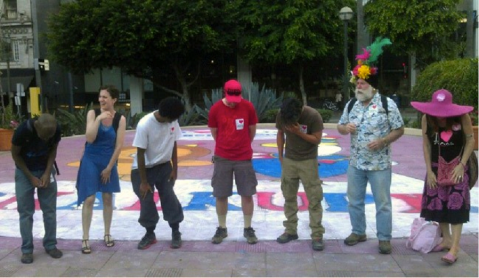
The PMC performing “Sob Laugh” at the “Chalkupy” protest in downtown Los Angeles, Image by Daniel Goode
I think there was some fear about the vulnerable revelation of emotions in the space of the protest. Many of the Occupy LA protests were so risky that everyone had to be extremely tough to exist in that activist space. I respect that. Still I think there are other things that can happen in a space of protest that bring out different feelings. Some activists wanted us to be more musically conventional, “why can’t you just sing some folk songs like normal protest choirs,” we were asked. But we really were not into that kind of thing. . .
In most protest situations, the audiences welcomed their activities. Many shared that it opened up a new space where people could meet each other as humans rather than adversaries or collaborators. Mann edited and published a monochromatic grassroots songbook with the various scores the PMC received for performance, opening up the circle for anyone and everyone to perform and feel that closeness.
Sometimes it was hard to translate a piece that worked during a group rehearsal to something for an audienceperformer situation. . .The PMC never fully developed how to deal with audience participation, but this is something I have been developing on my own in working with students on PMC materials. The scores from the People’s Microphony Songbook and the techniques Juliana and I developed when we first formed the PMC create an immediate closeness within a group, which is remarkable.

From the “People’s Microphony Songbook”: Many voices that were once silenced are now resonating through large crowds, not only of activists, but ordinary people all over the world, assisted by internet networks, and a simple technology called the People’s Microphone. The People’s Mic expressed the interrelated desires of collective and individual voices to speak and be heard, to hear one’s words spoken back through different mouths, and to digest someone else’s words through one’s own body. Beyond projecting an individual’s voice further then it can resonate on its own, the People’s Mic has implications for all of the bodies in its vicinity. It energizes listeners in ways the microphone or megaphone cannot by making listening active, vocal, and embodied. The project, like the Occupy movement, holds all the complexity, beauty, and drive of being human, whether you consider it “working” or not. When I asked Mann about how changes within and towards the Occupy Movement affected the choir, and whether they were winding down or taking a new form, she answered:
I think more than anything else, our group faced a lot of the same challenges that the Occupy Movement faced challenges in horizontality, in the push and pull between interior and exterior exploration, in the sometimes painful vulnerability of investigating the intimate personal and political space with others. I think the project is still developing. The choir still communicates, and some members are currently collaborating with composer Daniel Corral, but the PMC does not meet and rehearse like we used to I think it will continue to wax and wane. In the meantime, I am still working on ideas of active listening. I am currently creating a project called “Listening as (a) movement” within an under-served neighborhood in Pasadena, CA, exploring ideas of radical listening within a specific neighborhood.
In an age of constant bombardment of stimuli, our heads scream with thoughts, opinions, arguments, and expressions. With our current technology, our input and output can be a constant rush of snap reactions and impulses, which has a profound effect, of course, on our day-to-day lives, on our culture(s), on our politics. But these circles cannot be affectively complete without the other side. We need someone to hear us, and, more then that, we need someone to listen to us. And we, in turn, need to listen to them.
—
Maile Colbert is a multi-media artist with a concentration on sound and video who relocated from Los Angeles, US to Lisbon, Portugal. She is a regular writer for Sounding Out!
—
REWIND! . . .If you liked this post, you may also dig:
“Sensing Voice”–Nina Sun Eidsheim
“Within a Grain of Sand: Our Sonic Environment and Some of Its Shapers”–Maile Colbert
“Listening to #Occupy in the Classroom”–Travers Scott
Share this:


Current Top Posts





April 2021

January 2020

November 2019

October 2019

August 2019

April 2014

November 2017

March 2015

December 2017

October 2015
 Sounding Out!
Recent Comments