
Thrills, Chills, and Safe Sexuality: The Sounds of Michael Jackson’s “Thriller”

Next month may mark the 30th Anniversary of the release of Michael Jackson’s Thriller, but chances are that if you are going to a Halloween dance party this year –or have since 1982–the musical highpoint of the night will still be when they play the title track. While thematically and sonically appropriate for Halloween getting down, there is more to the song’s sonic exploration of fear, both its “scary sounds” and the lyrical references to sound–the stolen scream, the creeping from behind–in the role of scaring an audience. There is startling disconnect between the scariness the song describes (and the stock sounds of classic Hollywood horror films it samples) and its ability to make something potentially scary palatable to a pop mainstream. It is not so much the elements of horror themselves that Michael Jackson’s song makes acceptable, but the potential scariness of sexuality for which it is a metaphor.
There is a long tradition of horror movies as metaphors for sexuality, in particular adolescent sexuality. Iconic examples include Michael Landon’s untrustworthy violent tendencies in 1957’s I Was a Teenage Werewolf (a film clearly being referenced in the opening to the John Landis-directed video for “Thriller”) or more recent incarnations like Joss Whedon’s Buffy the Vampire Slayer, where sleeping with your boyfriend can literally lead to the loss of his soul.
While written by Rod Temperton, a white Briton, “Thriller,” as performed by Michael Jackson and produced by Quincy Jones, takes on the horrors of emergent sexuality via a racial lens. The pop song becomes self-referential, metaphorically about the very taboo thrills that have made young white people seek out black music, and their parents fear for the consequences. And while 1983 was a far cry from the 1950s-era outrage over white kids listening to and making their own “black” rock n’ roll, we also can’t forget that it was an era of a newly-launched MTV almost completely devoid of black artists (before hip hop’s explosion among young white males). It was largely Jackson’s popularity, in fact, that prompted MTV to finally include more black artists in its programming.

Photo by Shaun Wong via Flickr
While references to race in “Thriller” may be oblique, the lyrical references to sex are fairly obvious. The menace of the sexual encounter is present throughout the song as it is in the genre—sex itself is thrilling, desirous despite its potential physical, emotional or even social dangers.The scariness of the late night creature feature on television becomes an excuse to “cuddle close together.” This comforting occurs “all through the night” and the singer “can thrill you more than any ghost would ever dare try” (and the use of “ghost” to make a distinction between it and the singer reverberates with racial meaning). There is a dichotomy present in the song, in that the speaker is both the comfort from the fear of violence, and potentially “the beast about to strike.” Of course “nothing can save you” from that beast, when it is also the figure you are counting on to save you to begin with.
Similarly, at the height of his popularity, Michael Jackson embodied a safe version of black male sexuality. (In contrast, consider Prince, who in the early 80s was putting it all out there with albums like Dirty Mind (1980) and Controversy (1981), and would not get anything remotely like Thriller success until 1984’s Purple Rain). Despite Jackson’s pelvic thrusts or his videos featuring dark alleyway dancing, he represented a form of sexless sexiness, as emasculated in the eyes of the public as his doll (as famously demonstrated by Eddie Murphy on SNL). Perhaps most indicative of that position was Jackson’s bringing Brooke Shields as his date to the 1984 Grammy awards, while having Emmanuel Lewis accompany them. At the time MJ’s Peter Pan latency meant that Brooke was safe from predation and Emmanuel Lewis was an innocent child-friend to the child-like entertainer. Michael Jackson’s persona would not be undone by the accusations of monstrous pedophiliac tendencies for another nine years. Like the Thriller-themed doll pictured, Jackson was safe for both children and mainstream America, despite his ability to be transformed into something ostensibly terrifying.

Eddie Murphy shows what MJ has between his legs on SNL
The song is arranged and produced by Jones to echo this dichotomy of safe danger. The bass groove is a creeping disco loop never arriving, but suggestive of the warning music of the slasher genre. The hook is introduced with a sudden and shocking chords on a synthesizer, like the title screen music of an old monster movie. The high-pitched synthesizer whine that warbles during Vincent Price’s rap emulates the sci-fi spookiness of a theremin. The availability of Vincent Price was a coup for Jones and Jackson—a well-known figure of the genre, but even by 1980s, he was already a throwback to an older and out-of-date notion of horror—known for his low-budget work in Roger Corman films like Masque of the Red Death (1964) and appearances on Scooby-Doo. Furthermore, the song is marked by stock creaks, footsteps, thunderclap, slamming doors, wind and howls, sounds that enter the realm of kitsch. The sound effects are so exaggerated and artificial as to undercut the sense of the scariness the song describes and potentially represents. It disguises the supposed threat of black sexuality so successfully that it is now performed at many a white American wedding.
The campiness of the song’s excess, both sonically and lyrically, takes the edge off the sexual desire—the very thrill the song is meant to evoke. Even John Landis’s vision of the song in his 14-minute long video that remixes the album track for cinematic effect, mixes its film-quality monster effects with a playfulness evident in Jackson’s multiple incarnations in the video. In the movie inside the dream inside the video narrative, he seems more concerned with teasing his date about how easily she is scared (and scaring her some more) than sleeping with her—but his mischievous grin signals an unspoken desire that comes alive in his date’s alternating desire and fear of him. The dangers of werewolves and zombies are always arrested to reveal a level of artifice, a gotcha moment for his date–and for the audience–that undermines any real risk.

Michael Jackson transformed into a literal “black beast.”
The title track on what remains one of the best selling albums in history, “Thriller” evinces the ways in which Jackson and Jones figured out how to perfectly package and promote this tamed sexuality through their manipulation of sound. Sonically, the song (and other songs on Thriller such as “Beat It,” Billie Jean,” and “Wanna Be Startin’ Something”) evokes the tantalizingly forbidden and yet makes it accessible. The infectiousness of “Thriller”‘s groove, along with the appeal of pop hook sung by Jackson’s unmistakable voice, threatens possession of the listener but always allows for her to “change that number on your dial.” Part of what made this music broadly appealing (aside from Jackson’s obvious talent) is its success at dissembling, avoiding the backlash against the figure of “the black beast” rapist while subconsciously evoking the fear of it.
But there is a price to be paid for this sonic disconnection. There was certainly something horrific in Jackson’s physical transformation in the years that followed his Thriller apogee. Could it be that MJ’s desire to further improve on this formula led to what Richard Middleton describes in his book, Voicing the Popular (2006): a change from black child star to a “simulacrum of white middle-class woman” (128)? The extremity of such camp collapsed on itself, allowing that sexual anxiety to flow back through the disconnect his “safe” persona was supposed to shore up. Whatever fear that the sexless sexiness of Michael Jackson was actually a cover for queerness was brought to the fore because he stood accused of molesting little boys, allowing for a depiction of monstrousness that works across both gender and racial lines (and also highlighting a difference in attitude from when girls are the victims).

“Thriller” re-enactment held in October 2010 in Springfield, MO.
Photo by Darin House via Flickr
Jackson’s fall from grace may have come in the form of molestation accusations, but it still provides insight into the long history of fear of black America and black music that still lingers, proving that the mainstream’s love can turn to suspicion, even hate, in a heartbeat. Jackson’s broad appeal narrowed significantly when there was even a chance he wasn’t the sexless figure he appeared to be. As James Baldwin, whose writing and social criticism was always focused on the intersection of race and sexuality in America, wrote in 1985’s “Here Be Dragons” in regards to the hysteria of Michael Jackson’s popularity:
The Michael Jackson cacophony is fascinating in that it is not about Jackson at all. I hope he has the good sense to know it and the good fortune to snatch his life out of the jaws of a carnivorous success. He will not swiftly be forgiven for having turned so many tables, for he damn sure grabbed the brass ring, and the man who broke the bank at Monte Carlo has nothing on Michael. . . Freaks are called freaks and are treated as they are treated–in the main, abominably–because they are human beings who cause to echo, deep within us, our most profound terrors and desires.
—
Osvaldo Oyola is a regular contributor to Sounding Out! and ABD in English at Binghamton University.
Share this:

Evoking the Object: Physicality in the Digital Age of Music

In our current relationship with technology, we bring our bodies, but our minds rule–Linda Stone, “Conscious Computing”
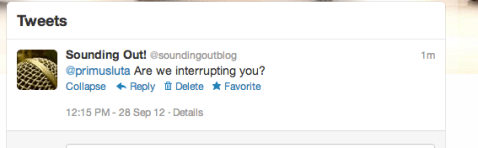
I begin with an epigraph from Linda Stone, who coined the phrase ‘continuous partial attention’ to describe our mental state in the digital age. The passive cousin of multi-tasking, continuous partial attention is a reaction to our constantly connected lifestyles in which everything is happening right now and where value is increasingly equated with our ability to digest it all. Almost everything we do has the potential to be interrupted, be it by an email, a text or a tweet; often we will give only partial attention to any one thing in anticipation of the next thing that will require our attention. In this internal fight for mental attention, listening to music has been seriously impacted.
The digital era has seen more music releases than ever before. Unfortunately, the massive influx of quantity is by no means a measure of how we are engaging with said music. iPhones and similar devices, for which music players have become mere features, enable listening to become a thing of partial attention. From allowing the shuffle or random modes to choose music selections for you, or even streaming music algorithms to calculate things you might like, to listening while playing Angry Birds or reading your Twitter stream, less commitment is made to the act of listening, and as such only a portion of our working memory is committed to the experience. Without working memory actively processing musical information, it is less likely to be stored for the long term, particularly if other information is continuously vying for space and attention.
These days video games sell better than music. Despite being a digital product, games are able to instill memories (even of the music) into one’s consciousness, because the game interface allows our sensory memories to work together in an active manner with the medium. Iconic memory stores visual cues from the game, echoic memory takes the audible cues from the game and the haptic memory is engaged in controlling game play. There is only so much more which can be done while playing a video game. If something were to interrupt game play, the game would be paused to address the new information rather than giving it partial attention. This is quite different from music which plays a background role in so much of our lives even when we are actively putting music on we tend to only engage it with partial attention.
When I began thinking about turning Concrète Sound System into a record label, one of my main goals was to create works that could engage the audience in active musical experiences that could create long term memories. I felt that as important as the music would be, it would take something material to create these memories, a physical product more evocative of earlier moments in recording history than the CD, its most recent gasp. I wondered if, by creatively evoking the physical object, the listener could be engaged in an active manner that would enable the memory of music and its power to persist through the everyday waves of digital noise.
The first mass duplicated audio medium was the Gold Moulded Edison Cylinder at the turn of the twentieth century. Imagine two cylinder copies of one of these recording today, as musical objects. Each of them would have over a hundred years of physical history. From the wear of the cases to the condition of the wax based on the temperature in which they were stored, each of these cylinders would be unique musical objects, with completely different histories, despite having the same origin. It is reasonable to assume that if the cylinders were played today on the same playback device, despite the fact that the compositions and performances are exactly the same, the differences between the recordings would be audible.

Wax Cylinders in the Library of Congress preservation Lab, Image by Flickr User Photo Phiend
Even without a century of history, there would likely be audible differences between the cylinders. If one cylinder was the first copy made, and another the 150th –master cylinders of Gold Moulded Edison Cylinders could only produce 150 copies reliably–the physical wear in the process of reproduction would leave its own imprint, making each of those copies distinct musical objects. In the analog world, as the technology improved the differences between copies decreased substantially. Cassettes were manufactured in batches of ten to hundreds of thousands without audible differences. But even in circulations so high, over time each of those analog copies took on their own identity and collected their own memories.
The listener as an active agent contributed to the development of these unique musical objects. After a purchase, any number of variables played into the ritual of the first experience of the music. Was there a way to listen upon walking out of the store? Were there liner notes or lyric sheets inside? Would you read those prior to listening or as you listen? Where would you listen? Through headphones? The listening chair in front of the hi-fi stereo? Or on the boombox with some friends? All of these possibilities shaped memories as musical objects that defined the music consumption culture of the past.
 For example, I bought the debut 2Pac album 2Pacalypse Now on cassette the day it was released. I loved the album so much I kept it in regular rotation in my Walkman for months until finally the tape popped. Rather than go out and buy a new copy I decided to perform a surgery. It was in a screwless reel case which meant I couldn’t just open it up to retrieve the ends of the tape trapped inside, but rather had to crack the reel case open and transplant the reels into a new body. So, my copy of the 2Pacalypse Now cassette is now inside of a clear reel holder with no visual markings. It also has a piece of tape that was used to splice it back together, which makes an audible warp when played back. I can pretty much be sure that there is no other copy of 2Pacalypse which sounds exactly like mine. While this probably detracts from the resale value of the cassette (not that I’d sell it), it is imbued with a personal history that is priceless.
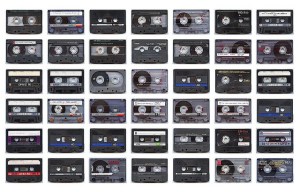
Cassettes, in particular, played a significant role in the attachment of physical memories to music beyond the recordings they held. They gave birth to the mixtape. The taper community was born from personal tape recorders that allowed concert-goers to record performances they attended, and, prior to the rise of peer to peer sharing online, these communities were trading tapes internationally via regular postal mail. European jazz and rock concerts were finding their way back to the states and South Bronx hip-hop performances were traveling with the military in Asia. All of these instances required a physical commitment with which came memories that inherently became their own musical objects.
Needless to say the nature of musical exchange has changed with the rise of the digital age of music. This is not to say that memories as musical objects have gone away, but they are being taken for granted as the objects lose their physicality. I remember going to The Wiz on 96th Street with $10 to spend on music. I spent at least ten minutes trying to decide between Sid and B-Tonn and Arabian Prince. I ended up with Arabian Prince and have regretted it since I got home and listened that day, as I never found Sid and B-Tonn for sale again. Today I could download both in the time it took me to walk to the train station. After skimming through the first few songs of Arabian Prince I could decide it was not for me and drag drop it in the trash where the memory of it would disappear with the files. No matter how I felt about the music then, the memory of it is a permanent fixture in my mind because of the physical actions it took to listen.
The first release for Concrète Sound System, Schrödinger’s Cassette, tackled this issue head on by presenting the audience with its own paradox, an update of physicist Erwin Schrödinger’s famous Thought Experiment, where the ultimate fate of the cassette inside is left up to the individual. Schrödinger’s Cassette sought to take listeners out of digital modes of consumption by using an analog medium to evoke the physical. The cassette release trend has been growing over the last few years, almost in parallel to the rise of the digital music and speaking to the need to separate music from our digital lives and to a desire to work harder for it. At the minimum, listening to a cassette requires having a cassette player, and acquiring one these days takes commitment. Unlike digital media, listeners cannot instantly skip a song on a cassette or put a favorite on repeat. It takes physical manipulation of the medium to move through its songs and doing so is a time investment. All these limitations make the cassette a medium that is best for linear listening, from beginning to end (unless you physically cut, rearrange, and splice it yourself).

Schrödinger’s Cassette, Image Courtesy of The Wire
Schrödinger’s Cassette took the required commitment a step further by encasing the cassette itself in industrial grade concrete. This required the user to actively crack the concrete (or the french concrète meaning ‘real’, from which the label derives its name) in order to listen to the music. The paradox is that, depending on the listener’s method for cracking, harm could be done to the cassette that might render it ‘unlistenable’. Upon receiving one of these pieces, the listener holds in their hands a musical object which they must physically act upon in order to create an unrepeatable musical event. Schrödinger’s Cassette has a look, a sound (if shaken you can hear the cassette reels), a feel, a smell, and a taste as well (though I wouldn’t advise it). All of the senses can be actively focused on the object and, as such, the whole of one’s working memory is engaged in the discernment of the object’s musical contents.

The Wire breaks open Schrödinger’s Cassette courtesy of their Twitterstream
For many, Schrödinger’s Cassette was taken as a work of art and left uncracked. The Wire magazine successfully cracked one edition open, revealing a portion of the musical contents on their regular radio program. For those that decided not to crack it, digital versions were made available so that they could listen, though this option was only made available after the listener spent some time with their physical object. In this way, the music from the project, a compilation called Between the Cracks, was directly connected to physical memories spurred by a material presence.
Triggering active memory during the consumption of music through physical objects need not be this complex. Old medium such as vinyl and cassette releases inherently have the physical properties required without the concrete or much else. Perhaps for this reason they show new signs of life despite the rise of digital. No matter how much our reality is augmented by our digital lives, we still inhabit those bodies that we bring with us, and, as far as the memories those bodies carry with them go, physicality rules.
—
Featured Image: Wax Cylinders in the Library of Congress, Image by Flickr User Photo Phiend
—
Primus Luta is a husband and father of three. He is a writer and an artist exploring the intersection of technology and art, and their philosophical implications. He is a regular guest contributor to theCreate Digital Music website, and maintains his own AvantUrb site. Luta is a regular presenter for the Rhythm Incursions Podcast series with his monthly showRIPL. As an artist, he is a founding member of the live electronic music collectiveConcrète Sound System, which spun off into a record label for the exploratory realms of sound in 2012.
Share this:


Current Top Posts





April 2021

January 2020

November 2019

October 2019

August 2019

April 2014

November 2017

March 2015

December 2017

October 2015
 Sounding Out!
Recent Comments