
Death Wish Mixtape: Sounding Trayvon Martin’s Death
“Many men wish death up on me/ blood in my eye dog and I can’t see/ I’m trying to be what I’m destined to be/ and niggas tryna take my life away” –50 Cent, “Many Men (Death Wish)”
After hearing about the murder of Trayvon Martin, the unarmed teenager who was shot to death by George Zimmerman in a gated community in Sanford, Florida on February 26, 2012, I grappled with the urge to grab my godsons, nephews, cousins, brothers, and husband and never let go. I grappled with the Du Boisian question of the color-line, redressing it to consider “what does it feel like to be not only a problem but a target?” With these thoughts in my mind, I especially grappled with listening to the audio records of the 911 calls documenting the death of Trayvon Martin, just released late Friday March 16thby the Sanford police department.
I have mixed reasoning as to why I listened to the tapes. Part of me was just being nosy, but there was a deeper, far reaching curiosity stemming from my southern roots. As a Georgia girl, I was raised by Georgia men. My grandfather vividly recounted horrific stories of lynchings and beatings that happened “at the hands of persons unknown.” My mindset, like that of many, shifted to thinking about Trayvon’s death as a lynching. These tapes gave sonic urgency to a historically silent crime. In a word, Trayvon’s desperate screams gave voice to the countless men and women before him who died at the hands of white vigilantism.
As I listened to the distraught callers—and Trayvon’s final screams and pleas for his life—my mind became a mosh pit of emotions. Pissed, my mental playlist shuffled to 50 Cent’s “Many Men (Death Wish).”
.
I imagine Trayvon walking as the haunting piano and strings at the start of “Many Men” accompany his steps. He anxiously questions Zimmerman– “Why are you following me?” – in a similarly anxious way as 50 Cent can be heard asking “what’s taking homie so long, son?” and the shot rings out. As Trayvon screams and falls, the hard hitting boom fills the silent void. His lifeless body lays face down in the dirt, a lone piano softly signifying vulnerability as 50 Cent’s chorus starts: “many men wish death upon me/blood in my eye dog and I can’t see/I’m trying to be what I’m destined to be/and niggas tryna take my life away.” Situating Trayvon Martin’s final moments in a song by 50 Cent is discomforting, yet speaks to the reality and imaginative scripts of black masculinity as violent. The physical gunshot to Martin’s chest echoes the allegorical shots heard in the “Many Men” track and those in songs like Notorious B.I.G.’s “Who Shot Ya,” as another example, simultaneously blur and re-enforce black death as fantasy and normative. The 911 calls documenting Trayvon Martin’s death heard in concert with 50 Cent’s song sonically reify (gun) violence as a dominant discourse of black male identity. Indeed, Trayvon, I know who shot ya and gave you a death wish. I cannot, however, understand why.
.
The sonic surveillance of Trayvon Martin and George Zimmerman’s run-in—documented by the numerous accounts of neighbors who heard something but did not go outside—presents a juxtaposition of expected black male identity with the vulnerability of a horrified child forced into a criminalized space of black masculinity. In Zimmerman’s 911 call–listen via the Huffington Post here–he nonchalantly and at time heavily sighs about Martin’s blackness and its associated threat – “he’s black,” “he looks suspicious,” “he’s up to no good.” The passivity of Zimmerman’s voice reflects his bridging of (young) black masculinity as threatening. The panicked callers’ voices, however, represent reprieve and reinstate Trayvon’s humanity. The Trayvon Martin 911 recordings, then, are a mixtape of his final moments, sampling the voices of the various callers to construct Trayvon’s fatal narrative. Ultimately, the callers give voice to the vulnerabilities that Trayvon was deemed unable to evoke or possess by default as a black male.
 I use the word “mixtape” here to argue that the frequencies of trauma in which the (white) listener situates Trayvon Martin’s death must be heard within a larger understanding of sound as a commodified and racialized space. Ultimately, the recordings of Trayvon’s death are a sonic reflection of a long history of white America’s treatment of black bodies as capital. In negotiating the black (male) body as a commodity – which is historically and culturally significant – sounding the black male body as a commodity contextualizes this moment of expected black masculine performance for nonblack listeners. It needs to be noted how pathological black masculinity is profitable and mutually invested in by black men and white consumers alike. Briefly referring back to 50 Cent, he performs and is validated by the violence his narrative possesses. He knowingly invests in the exaggeration of his experience – he really was shot – and builds his image upon that paranoia. In In the Break, Fred Moten discusses the sonic commodification of blackness as “not what the commodity says but that the commodity says or, more properly, that commodity in its ability to say, must be made to say” (9). Situating black rappers’ narratives and, extensively, black men’s narratives as a commodity speaks to how the ambiguity of such narratives relegate blackness to a position of profitable, essentialized discourse. Moten suggests sounding blackness as a commodity is an effort to address these ambiguities, linking the privilege of speaking and constructing black (masculine) narrative, not content, as culturally and capitalistically recognizable and significant.
Trayvon’s political agency is invested in the violence placed upon his body by public scrutiny as a black man before there is any vulnerability as a child. Thrust instead into the position of ‘suspicious’ black man in a predominately white middle-class gated community, Trayvon the child bears the public scripts of expected black masculine performance, which are both visual and sonic. These expectations of popular culture and public opinion distort Trayvon’s sonic imprint, rendering him unable to vocalize and physically relay his desperate need for help.
As Mark Anthony Neal points out in a his March 19th New Black Man post “Hearing Trayvon Die” linking hearing Trayvon Martin’s death to a scene of a grieving Muddy Waters (Jeffrey Wright) from the 2008 film Cadillac Records, in which Waters’s pain is heard but not seen: “part of the reason that Jeffrey Wright’s howling had to be experienced off screen is that we have little understanding of Black males, as vulnerable, in pain, under duress, in terror and confronting death.” The impact of the lack Neal describes emphasizes the necessity for a sonic imposition of such vulnerabilities. In this case, the agency of this need is heightened by the audience being forced to listen to Trayvon’s frantic screams for help on tapes, thus humanizing him before racializing his body.
Yet it is Trayvon’s alleged screams – which I undoubtedly believe ARE his screams– that also sonically invoke his humanity. On the recording, heart-wrenching screams for help are silenced by the forceful pop of a gunshot, the silence signifying multi-layered historical and cultural indicator of Trayvon’s worth as a black boy in American society. Trayvon’s screams vocalize the agonizing silent demise of the murdered black boys before him. . .Oscar Grant. . .Amadou Diallo. . .Emmett Till. His screams are an echo of Frederick Douglass’s Aunt Hester’s screams, recorded in his 1845 Narrative, acknowledgement of the cruelty and continued viability of longstanding—even foundational—racial prejudice and violence that exists within the contemporary ‘postracial’ American agenda.

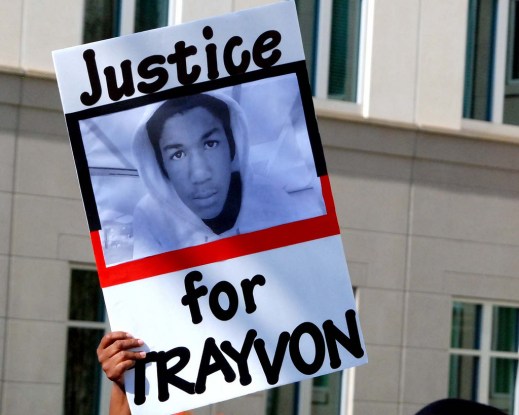
The Million Hoodies Union Square protest in New York against the shooting of Trayvon Martin in Sanford, Florida, by Flick'R User David Shankbone
Moreover, Trayvon’s scream also concisely signifiy the ongoing “upheaval” and chaotic existence of black men that Moten suggests “pressures the assumption of the equivalence of personhood and subjectivity” (1). Trayvon’s screams amplify a tragic dimension of what I theorize as “sonic cool pose,” where black masculinity is only cool if accompanied – instrumentally, lyrically, and otherwise – with violence. In this regard, the sonic signifiers that mark death—like the gunshots and screams that introduce 50 Cent’s “Many Men,” for example—are Trayvon’s. Both built upon the traumatic condition frequently faced by men and boys of color, Trayvon and 50 Cent’s lived experiences can be heard as sonically interchangeable despite obvious differences in class position. Through sound and the American popular imagination, black manhood is virulently fluid. There is a universal, stereotypical understanding that black masculinity resorts to identical markers of lived experience. This awareness is especially heightened and dominant in sound, where 50 Cent’s shooting on the corner parallels Trayvon’s shooting in a gated townhome community.
The release of the 911 audio of Trayvon Martin’s death is a powerful intervention in maneuvering black masculinity and violence in American (popular) culture. There is a delicate and simultaneous reading of the recordings as a sonic realization of black masculine violence and a fetishizing of a violated black male body. The sounds they contain amplify a continued American investment and interest in the black pathological narrative while doubly intervening as an alternative reading of such negotiations of black manhood. Whether sounded across a courtyard in a gated suburban neighborhood in Sanford, Florida, or on the streets of South Jamaica, Queens—or in the isolation booth in a recording studio—these frantic and desperate screams are sonic imprints of his social-cultural relevance. They may bleed into one another, but they won’t fade away.
 —
—
R.N. Bradley is a PhD candidate in African American Literature at Florida State University. She writes about African American literature, race and pop culture, Hip Hop, and her own awesomeness. She earned her BA in English from the Unsinkable Albany State University (GA) and a MA in African American and African Diaspora Studies from Indiana University Bloomington. Her dissertation project looks at negotiations of white hegemonic masculinity and race consciousness in 21st century African American literature and popular culture. You can read her work atAllHipHop, Newsone, TheLoop21, or her monthly column “The Race to Post” over atPopMatters. Scholar by day, unapologetic Down South Georgia Girl 24/7/365. Catch up with her awesomeness via twitter:@redclayscholar and her blog Red Clay Scholar (http://redclayscholar.blogspot.com).
Share this:

On Donuts, Sandwiches and Beattapes: Listening for J Dilla Six Years On

"J Dilla aka Jay Dee R.I.P." by Flickr user Ohm 17 under Creative Commons License
It has been six years this week since the passing of James “J Dilla” Yancey, considered by many in hip-hop as the quintessential producer’s producer. Over the course of his career the Detroit-born beatmaker garnered production credits with artists ranging from The Pharcyde to Janet Jackson. Since his passing there has been a substantial amount of posthumous output, including a Yancey Boys album with his brother Illa J, Ruff Draft, The Shining and Jay Stay Paid. There have also been the tons of unofficial releases by artists using material from his beattapes without prior permission. An unofficial discography of projects ‘featuring’ Dilla’s work could eclipse his official one.
Dilla’s beattapes, which he shared amongst friends and associates via CDs, eventually traveled the globe via message boards years prior to his passing. His legacy became what it is, at least in part, due to the reach of these CDs, but unfortunately it has also made monetizing the work after his passing a difficult task. There were early issues between Dilla’s family and the legal estate, but for the last couple of years there has been a process established which allows for the use of tracks from his vaults. They are currently set to release The Rebirth of Detroit, which boasts unheard Dilla beats featuring the Detroit artists he came up with:
In addition to posthumous releases under Dilla’s name the estate also licenses tracks for projects by other artists. With over 4000 tracks in their possession, it stands to reason there will be plenty more Dilla in the future. Yet still there is a sense that ‘new Dilla’ will never be new again, as in the future we will only be able to look at Dilla’s past. How would his process as an artist have grown? Surely whatever he was doing before he passed sounds nothing like what he would be doing in 2012.
Fortunately, the creativity of Dilla lives on through his influence on others. In the years since his passing, that influence has gone beyond hip-hop into jazz, indie rock, classical, and electronic music; some might argue Dilla’s influence has spawned new styles or even genres of music . The LA beat scene was seemingly born in homage to him; with its off kilter drums and wild sample chops, it extends beyond the initial influence, projecting into the future a lineage which will forever trace back to Dilla. Another of those lineages takes Dilla to perhaps the least likely place for a hip-hop producer: late-night television, through the figure of Ahmir “?uestlove” Thompson of The Roots.
At the end of the 90s until around 2001, Dilla was a member of The Soulquarians creative team that produced albums for Erykah Badu, D’Angelo, Common, and Bilal:
During this time Dilla worked closely with drummer, producer, and founding member of The Roots ?uestlove. There was a musical bond established over countless studio hours which allowed for a fusion of styles between them that carried Yancey from his Jay Dee period into his J Dilla period, and which ?uestlove continues to carry to this day.
Since Dilla’s passing, ?uest has been an instrumental voice in keeping Dilla’s legacy alive. He regularly DJ’s events celebrating Dilla’s work. On all of The Roots albums except for the most recent one, there have been musical dedications to Dilla. It is when ?uest goes into the studio with The Roots, however, that the living continuation of their musical fusion can be found.
The studio is where ?uest spends a lot of his time, rehearsing The Roots for their role as the house band on the Late Night with Jimmy Fallon show; ?uest records the sessions to listen back before and after the show. On Late Night The Roots play new songs in front of a live audience five nights a week. These songs only air for ten to twenty seconds going in and out of commercials. If you run to grab something from the refrigerator you might miss them. Or, coming back you might find your head nodding to them. Not only are they original works (other than walk on music for show guests, and musical performances), they are an insight into the creative process which shaped both ?uest and Dilla.
?uest names the tracks Sandwiches, a nod to his former collaborator’s Donuts. Donuts was the last official project that Dilla worked on, quite literally on his death bed, and is considered his instrumental opus. It opened up the notion of the short-form instrumental hip-hop work, which traces its own lineage to the history of beattapes. Today, a beattape is a collection of hip-hop instrumentals released as a product through distribution channels (free or paid). In the beginning however, beattapes were physical cassette tapes (and later CD-Rs) passed around from hand to hand. Tracks from beattapes were snippets of beats often recorded right after they were made so the producer could listen to them again outside of the studio setting. They were passed amongst friends and eventually within the industry as a means of selling the producer’s beats.
Early beattapes were not meant for public consumption or as cohesive projects. It’s important to remember that at the time you didn’t finish productions in a home or project studio. Artists, labels, producers etc. would listen to a beattape and select tracks to be purchased for a project. If a beat was bought, the producer would meet the artist in a large studio with an engineer, which is where the beat went into production. The beattape at the time was not considered a final anything, but a sketch of what could become a production.
In addition, beattapes had a secondary purpose as a measure of skill and technique. They became a format for rehearsal and practice. Where a traditional instrumentalist may practice chord changes on their instrument, a beat maker makes beats and records them for easy playback later. For example, a producer could decide to sample the same record as another producer to show how they would use the sample differently. There would be no intent to turn such a track into a full fledged song (though it could happen), instead it would be recorded so they could play it back to a friend or even the producer who originally used the sample for bragging rights.
Dilla was an active participant in this trade. His beat CDs became his calling card particularly for the techniques displayed on them. Donuts was his expansion of that beattape format. Rather than a display of short rough sketches that serve as indications of productions to come, Dilla produced intricate and layered flaunts of technique compacted into short sketches.
The most recognized technique from Donuts is the chop. The chop comes out of the stab line of techniques. A stab is a single instrumental hit played on a sampler. On the MPC line of samplers (which Dilla was famous for using), stabs could be spread across trigger pads pitch shifted chromatically allowing melodic sequences to be played using a single stab. The chop takes that a step further by using multiple samples from the same source (chops) to replace the chromatic stabs, and play melodically. What Dilla displayed on Donuts however, is not merely the chop but the variety of techniques available by which a producer can chop. Working outside the limitations of loops and stabs, new techniques like drum and instrument isolation, de-quantization, vocal stabs and more come at you, one layered technique after the other.
Many of these techniques have been canonized today, but some quality has been lost with that normalization. With de-quantization by example, overuse has practically rendered the technique cliché because its depth was reduced by its definition. De-quantization translates to simply turning off the preference in software programs or hardware beat machines that align all sound triggers to the grid of the tempo and time signature. That definition speaks nothing to what Dilla actually did with that preference off, which was impose his own humanized sense of timing onto the de-quantized patterns of the machine.
Of those that followed Dilla, most got the de-quantization part but missed his sense of time. While de-quantization has shown influence, outside of the ‘stock Dilla’ pattern, his sense of timing has been continued by only a few. At the top of that list is ?uestlove, as he is as responsible for the development of that sense of timing as Dilla is his own. The root of that development can be found in the The Soulquarians period, which can be marked as the time both artists came into their own by working together. That they would come together at all was quite serendipitous, as no player has a better sense of timing than a drummer. It was the mutual sense of timing between Dilla and ?uest that worked to produce the amazing material that resulted.
In The Soulquarians studio sessions ?uest and Dilla created a feedback loop between the drum machine and the drums. This pushed their sense of time as they fused a sonic texture for their drums, which can be heard between their productions. There is a shuffling urgency with a tick of hats between pulses that lead one into the other; the snare or clap crisp, never aggressively cracking, the kick big but not over dominant. It is sequence-based music turned into grooves that maintain the variable constraints of the sequence. They each took these elements with them in their post Soulquarians work, and after Dilla’s passing, you can frequently hear ?uest calling back to those days through his music.
Take a Sandwich like “Gross Understatement.” At the onset a drum loop with a prominent clap is layered into the snare on alternate hits, while a keyboard moves through presets until an organ sound is found. The bass noodles patiently until, with a chord, they meet. When ?uest comes in it takes a couple of bars of him pushing the drums to get everyone else to fall in on his time, but once it hits he can’t control himself, letting out a holler, “something flew out the gate.” What follows is three minutes of magic as the band jams to a grove that is the perfect cross between Dilla and ?uest.
Gross Understatement (G minor) #Sandwich 1397
Up until November 2011, by ?uest’s count, The Roots had created almost 1800 Sandwiches. He has released a stream of Sandwiches through his Swift FM account (the page is currently down until the site relaunches). By his own admission though, all of the Sandwiches aren’t as good as “Gross Understatement.” Out of the 2 to 23 they record each day, he says only about 1 in 19 are bangers. At 94 out of 1800 it isn’t a bad count, enough for nine albums. The only format in these tracks exist however, is as they appear on Late Night, on ?uest’s harddrive and whatever Sandwiches he decides to share. What would a studio project of this material sound like? As big of an audience as they receive on Late Nite, Sandwiches are buried in the mix of television things where it’s not easy to give them the musical attention they deserve. Perhaps in the future an official release of a project from this line will emerge. In the meantime catch them on NBC when you can and stay tuned to ?uest’s social stream.
—
Primus Luta is a husband and father of two (maybe three by the time this goes up). He is a writer and an artist exploring the intersection of technology and art, and their philosophical implications. He is a regular guest contributor to the Create Digital Music website, and maintains his own AvantUrb site. Luta is a regular presenter for the Rhythm Incursions Podcast series with his monthly show RIPL. As an artist he is a founding member of the live electronic music collective Concrète Sound System, which spins off into a record label for the exploratory realms of sound in 2012. Luta is currently working on completing his first book, BeatGenealogy: A History of the Electronic Beat From WWII to Now.
Share this:


Current Top Posts





April 2021

January 2020

November 2019

October 2019

August 2019

April 2014

November 2017

March 2015

December 2017

October 2015
 Sounding Out!
Recent Comments