
SO! Reads: Justin Eckstein’s Sound Tactics: Auditory Power in Political Protests

Justin Eckstein’s Sound Tactics: Auditory Power in Political Protests (Penn State University Press) is a book “about the sounds made by those seeking change” (5). It situates these sounds within a broader inquiry into rhetoric as sonic event and sonic action—forms of practice that are collective, embodied, and necessarily relational. It also addresses a long-standing question shared by many of us in rhetorical studies: Where did the sound go? And specifically, in a field that had centered at least half of its disciplinary identity around the oral/aural phenomena of speech, why did the study of sound and rhetoric require the rise of sound studies as a distinct field before it could regain traction?
Eckstein confronts this silence with urgency and clarity, offering a compelling case for how sound operates not just as a sensory experience but as a rhetorical force in public life. By analyzing protest environments where sound is both a tactic and a terrain of struggle, Sound Tactics reinvigorates our understanding of rhetoric’s embodied, affective, and spatial dimensions. What’s more, it serves as an important reminder that sound has always played an important role in studies of speech communication.
Rhetoric emerged in the Western tradition as the study and practice of persuasive speech. From Aristotle through his Greek predecessors and Roman successors, theorists recognized that democratic life required not just the ability to speak, but the ability to persuade. They developed taxonomies of effective strategies—structures, tropes, stylistic devices, and techniques—that citizens were expected to master if they hoped to argue convincingly in court, deliberate in the assembly, or perform in ceremonial life.
We’ve inherited this rhetorical tradition, though, as Eckstein notes early in Sound Tactics, in the academy it eventually splintered into two fields: one that continued to study rhetoric as speech, and another that focused on rhetoric as a writing practice. But somewhere along the way, even rhetoricians with a primary interest in speech moved toward textual representation of speech, rather than the embodied, oral/aural, sonic event that make up speech acts (see pgs 49-50).
Sound Tactics corrects this oversight first by broadening what counts as a “speech act”—not only individual enunciations, but also collective, coordinated noise. Eckstein then offers updated terminology and analytical tools for studying a wide range of sonic rhetorics. The book presents three chapter-length case studies that demonstrate these tools in action.
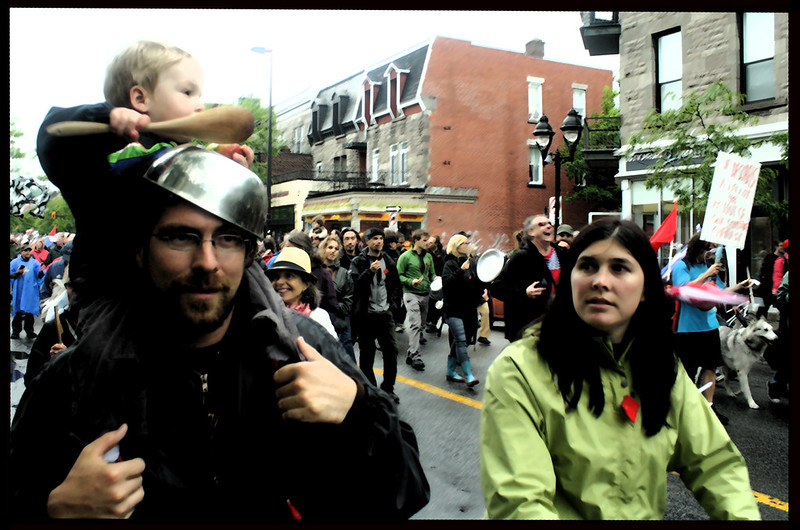
The first examines the digital soundbite or “cut-out” from X González’s protest speech following the school shooting at Marjory Stoneman Douglas High School in Parkland, Florida. The second focuses on the rhythmic, call-and-response “heckling” by HU Resist during their occupation of a Howard University building in protest of a financial aid scandal. The third analyzes the noisy “Casseroles” retaliatory protests in Québec, where demonstrators banged pots and pans in response to Bill 78’s attempts to curtail public protest.
A full recounting of the book’s case studies isn’t possible here, but they are worth highlighting—not only for the issues Eckstein brings to light, but for how clearly they showcase his analytical tools and methods in action. These methods, in my estimation, are the book’s most significant contribution to rhetorical studies and to scholars more broadly interested in sound analysis.
Eckstein’s analytical focus is on what he calls the “sound tactic,” which is “the sound (adjective) use of sound (noun) in the act of demanding” (2). Soundness in this double sense is both effective and affective at the sensory level. It is rhetoric that both does and is sound work—and soundness can only be so within a particular social context. For Eckstein, soundness is “a holistic assessment of whether an argument is good or good for something” (14). Sound tactics, then, utilize a carefully curated set of rhetorical tools to accomplish specific argumentative ends within a particular social collective or audience capable of phronesis or sound practical judgement (16). Unsound tactics occur when sound ceases to resonate due to social disconnection and breakage within a sonic pathway (see Eckstein’s conclusion, where he analyzes Canadian COVID-19 protests that began with long-haul truck drivers, but lost soundness once it was detached from its original context and co-opted by the far right).

Just as rhetorical studies has benefitted from the influence of sound studies, Eckstein brings rhetorical methods to sound studies. He argues that rhetoric offers a grounding corrective to what he calls “the universalization of technical reason” or “the tendency to focus on the what for so long that we forget to attend to the why” (29). Following Robin James’s The Sonic Episteme: Acoustic Resonance, Neoliberalism, and Biopolitics, he argues that sound studies work can objectify and thus reify sound qua sound, whereas rhetoric’s speaker/audience orientation instead foregrounds sound as crafted composition—shaped by circumstance, structured by power, and animated by human agency. Eckstein finds in sound studies the terminology for such work, drawing together terms such as acousmatics, waveform, immediacy, immersion, and intensity to aid his rhetorical approach. Each name an aspect of the sonic ecology.
Rhetoricians often speak of the “rhetorical situation” or the circumstances that create the opportunity or exigence for rhetorical action and help to define the relationship between rhetor and audience. While the rhetorical action itself is typically concrete and recognizable, the situation itself—which is always in motion—is more difficult to pin down. “Acousmatics” names a similar phenomenon within a sonic landscape. Noise becomes signal as auditors recognize and respond to particular kinds of sound—a process that requires cultural knowledge, attention, and the proverbial ear to hear. A sound’s origins within that situation may be difficult to parse. Acousmastics accounts for sound’s situatedness (or situation-ness) within a diffuse media landscape where listeners discern signal-through-noise, and bring it together causally as a sound body, giving it shape, direction, and purchase. As such a “sound body” has a presence and power that a single auditor may not possess.

Eckstein defines “sound body” as “our imaginative response to auditory cues, painting vivid, often meaningful narratives when the source remains unseen or unknown” (10). And while the sound body is “unbounded,” it “conveys the immediacy, proximity, and urgency typically associated with a physical presence (12). Thus, a sound body (unlike the human bodies it contains) is unseen, but nonetheless contained within rhetorical situations, constitutive of the ways that power, agency, and constraint are distributed within a given rhetorical context. Eckstein’s sound body is thus distinct from recent work exploring the “vocal body” by Dolores Inés Casillas, Sebastian Ferrada, and Sara Hinojos in “The ‘Accent’ on Modern Family: Listening to Vocal Representations of the Latina Body” (2018, 63), though it might be nuanced and extended through engagement with the latter. A focus on the vocal body brings renewed attention to the materialities of the voice—“a person’s speech, such as perceived accent(s), intonation, speaking volume, and word choice” and thus to sonic elements of race, gender, and sexuality. These elements might have been more explicitly addressed and explored in Eckstein’s case studies.
Eckstein uses these terms to help us understand the rhetorical complexities of social movements in our contemporary, digital world—movements that extend beyond the traditional public square into the diverse forms of activism made possible by the digital’s multiplicities. In that framework he offers the “waveform” as a guiding theoretical concept, useful for discerning the sound tactics of social movements. A waveform—the digital, visual representation of a sonic artifact—provides a model for understanding how sound takes shape, circulates, and exerts force. Waveforms also obscure a sound’s originating source and thus act acousmastically.
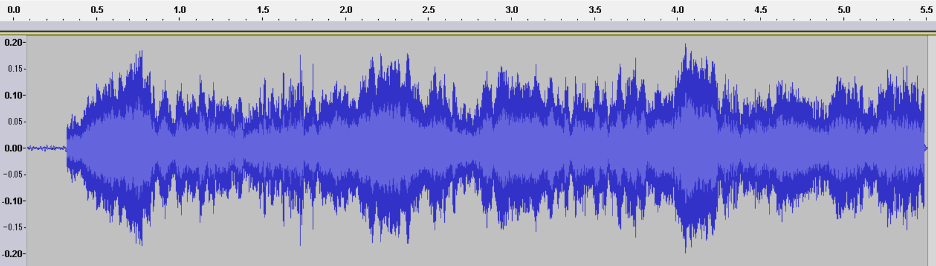
“[A] waveform is a visual representation of sound that measures vibration along three coordinates: amplitude, frequency, and time” (50). Eckstein draws on the waveform’s “crystallization” of a sonic moment as a metaphor to show sound’s transportability, reproducibility, and flexibility as a media object, and then develops a set of analytical tools for rhetorical analysis that match these coordinates: immediacy, immersion, and intensity. As he describes:
Immediacy involves the relationship between the time of a vibration’s start and end. In any perception of sound, there can be many different sounds starting and stopping, giving the potential for many other points of identification. Immersion encompasses vibration’s capacity to reverberate in space and impart a temporal signature that helps locate someone in an area; think of the difference between an echo in a canyon and the roar of a crowd when you’re in a stadium. Finally, intensity describes the pressure put on a listener to act. Intensity provides the feelings that underwrite the force to compel another to act. Each of these features and the corresponding impact of this experience offer rhetorical intervention potential for social movements. (51)
This toolset is, in my estimation, the book’s most cogent contribution for those working with or interested in sonic rhetorics. Eckstein’s case studies—which elucidate moments of resistance to both broad and incidental social problems—offer clear examples of how these interrelated aspects of the waveform might be brought to bear in the analysis of sound when utilized in both individual and collective acts of social resistance.
To highlight just one example from Eckstein’s three detailed case studies, consider the rhetorical use of immediacy in the chapter titled “The Cut-Out and the Parkland Kid.” The analysis centers on a speech delivered by X González, a survivor of the February 14, 2018, Marjory Stoneman Douglas High School shooting in Parkland, Florida. Speaking at a gun control rally in Ft. Lauderdale six weeks after the tragedy, González employed the “cut-out,” a sound tactic that punctuated their testimony with silence.
Embed from Getty Images.
As the final speaker, González reflected on the students lost that day—students who would no longer know the day-to-day pleasures of friendship, education, and the promise of adulthood. The “cut-out” came directly after these remembrances: an extended silence that unsettled the expectations of a live audience disrupting the immediacy of such an event. As the crowd sat waiting, González remained resolute until finally breaking the silence: “Since the time that I came out here, it has been six minutes and twenty seconds […] The shooter has ceased shooting and will soon abandon his rifle, blend in with the students as they escape, and walk free for an hour before arrest” (69–70).
As Eckstein explains, González “needed a way to express how terrifying it was to hide while not knowing what was happening to their friends during a school shooting” (61). By timing the silence to match the duration of the shooting, the focus shifted from the speech itself to an embodied sense of time—an imaginary waveform of sorts that placed the audience inside the terror through what Eckstein calls “durational immediacy.” In this way, silence operated as a medium of memory, binding audience and victims together through shared exposure to the horrors wrought over a short period of time.
…
Sound Tactics is a must-read for those interested in a better understanding of sound’s rhetorical power—and especially how sonic means aid social movements. In conclusion, I would mention one minor limitation of Eckstein’s approach. As much as I appreciated his acknowledgement of sound’s absence from the Communication side of rhetoric, such a proclamation might have benefited from a more careful accounting of sound-related works in rhetorical studies writ large over the last few decades. Without that fuller context, readers may conclude that rhetorical studies has—with a few exceptions—not been engaged with sound. To be fair, the space and focus of Sound Tactics likely did not permit an extended literature review. There is thus an opportunity here to connect Eckstein’s important intervention with the work of other rhetoricians who have also been advancing sound studies.
I am including here a link to a robust (if incomplete) bibliography of sound-related scholarship that I and several colleagues have been compiling, one that reaches across Communication and Writing disciplines and beyond.
—
Featured Image: Family at the CLASSE (Coalition large de l’ASSÉ ) Demonstration in Montreal, Day 111 in 2012 by Flicker User scottmontreal CC BY-NC 2.0
—
Jonathan W. Stone is Associate Professor of Writing and Rhetoric at the University of Utah, where he also serves as Director of First-Year Writing. Stone studies writing and rhetoric as emergent from—and constitutive of—the mythologies that accompany notions of technological advance, with particular attention to sensory experience. His current research examines how the persisting mythos of the American Southwest shapes contemporary and historical efforts related to environmental protection, Indigenous sovereignty, and racial justice, with a focus on how these dynamics are felt, heard, and lived. This work informs a book project in progress, tentatively titled A Sense of Home.
Stone has long been engaged in research that theorizes the rhetorical affordances of sound. He has published on recorded sound’s influence in historical, cultural, and vernacular contexts, including folksongs, popular music, religious podcasts, and radio programs. His open-source, NEH-supported book, Listening to the Lomax Archive, was published in 2021 by the University of Michigan Press and investigates the sonic archive John and Alan Lomax created for the Library of Congress during the Great Depression. Stone is also co-editor, with Steph Ceraso, of the forthcoming collection Sensory Rhetorics: Sensation, Persuasion, and the Politics of Feeling (Penn State U Press), to be published in January 2026.
—

REWIND!…If you liked this post, check out:
SO! Reads: Marisol Negrón’s Made in NuYoRico: Fania Records, Latin Music, and Salsa’s Nuyorican Meanings –Vanessa Valdés
Quebec’s #casseroles: on participation, percussion and protest–-Jonathan Sterne
SO! Reads: Steph Ceraso’s Sounding Composition: Multimodal Pedagogies for Embodied Listening-–Airek Beauchamp
Faithful Listening: Notes Toward a Latinx Listening Methodology––Wanda Alarcón, Dolores Inés Casillas, Esther Díaz Martín, Sara Veronica Hinojos, and Cloe Gentile Reyes
The Sounds of Equality: Reciting Resilience, Singing Revolutions–Mukesh Kulriya
SO! Reads: Todd Craig’s “K for the Way”: DJ Rhetoric and Literacy for 21st Century Writing Studies—DeVaughn Harris
Share this:

SO! Reads: Marisol Negrón’s Made in NuYoRico: Fania Records, Latin Music, and Salsa’s Nuyorican Meanings

I began reading Marisol Negrón’s Made in NuYoRico: Fania Records, Latin Music, and Salsa’s Nuyorican Meanings (Duke University Press, 2024) in earnest this summer, as Bad Bunny’s “NUEVAYol” flooded New York City streets. Whole generations of people had never heard El Gran Combo’s “Un Verano en Nueva York” (1975), perhaps not-coincidentally celebrating its fiftieth anniversary this year. The song is a staple in this city, particularly in the weeks leading up to the National Puerto Rican Day Parade. Instagram and TikTok were inundated with videos of Bad Bunny fans, many of whom were millennials and Gen Z, dancing with their grandparents to “NUEVAYoL” and “BAILE INoLVIDABLE.” Bad Bunny had successfully ushered in a resurgence of interest in salsa, a genre that has remained vibrant since its founding. The archipelago’s superstar celebrated the city that was, beginning in the early 1890s, a major site of Puerto Rican migration for decades; in several of the videos for songs from DeBÍ TiRAR MáS FOToS (2025), he honored the Nuyorican community and all they had contributed to the culture.
In that vein, Negrón has written a book that is, shockingly to me, one of the very few books that center salsa in general and the role of New York in its creation specifically. In this, she joins Juan Flores, Frances Aparicio, and Christopher Washburne to produce book-length studies that examine this genre. She also depends on the magazine articles of long-gone local publications such as Latin N.Y., which ran from 1973-1985, and journalists such as Aurora Flores, Adela López, and Nayda Román, women who recorded what at times feels like an incredibly-male environment. Here, she is focusing on the record label that is synonymous with salsa, Fania Records, which, at one point had signed such singers and musicians as Tito Puente, Celia Cruz, La Lupe, Hector Lavoe, Ruben Blades, Ray Baretto, and Eddie Palmieri, whose passing this summer marked the end of an era, in many ways. Founded by Johnny Pacheco and Jerry Masucci in 1964, Fania reached its heights in the 1970s, securing a distribution center in Panama in 1974, establishing its own recording studio in 1976 – the first “Latin” label to do so – and purchasing a manufacturing plant in 1977. Yet by the end of the decade, many of the original artists had moved on, as had Masucci, who sold the catalog and created several other businesses that continued to do business using the name “Fania” (20). Nevertheless, the music that emerged from that critical historical moment in New York City continues to impact subsequent generations.

Citing Caridad de la Luz, La Bruja, a Nuyorican legend of the spoken word scene who currently serves as the executive director of Nuyorican Poets Café, Negrón defines NuYoRico as “that place somewhere between the Empire State and El Morro” (9), the latter being the fortress originally built in the sixteenth century that is recognized as a UNESCO World Heritage site. Made in NuYoRico is divided into two parts featuring three chapters each; the first part, “Anatomy of a Salsa Boom, 1964-1979” marks the cultural history of salsa for those fifteen years, while the second part, “After the Boom Is Gone, 1980s-2000s,” charts a fascinating examination of the salsa boom in various contexts, including a futile attempt by insular government officials to attract foreign investment by citing salsa as an impactful cultural artifact. In doing so, they offended a faction of the archipelago’s elites who distanced themselves due to the genre being created in the diaspora.
Negrón reviews the 1972 documentary classic Our Latin Thing (Nuestra Cosa Latina) in her first chapter. This movie served for many as the introduction to the Fania All-Stars. Featuring footage from a 1971 concert at New York’s Cheetah Lounge, it features Barretto, Larry Harlow, Willie Colón, Ismael Miranda, “Cheo” Feliciano, Pete “El Conde” Rodríguez, and LaVoe (whose name appears in this way throughout the book recalling his nickname as “La Voz”). In chapter two, “‘Los Malotes de la Salsa’: Salsa Dons and the Performance of Subjecthood,” Negrón looks at the imagery Colón and LaVoe create in their lyrics and the cover art of their albums, while the following chapter, “Salsa’s Dirty Secret: Liberated Women, Hairy Hippies, and the End of the World,” focuses on their performance, together and individually, of a virile masculinity dependent as much on the portraits of insubordinate women, unruly yearnings, and queerness. It is this chapter that speaks fleetingly of Celia Cruz and La Lupe, the two Afro-Cuban women who were the only women signed to Fania. In a study that examines how very much a masculinist world this was, I was looking for the counterpoint that both Cruz and La Lupe offered, only to be met with two pages of reference to them. A deeper discussion centering these women remains opportune.

The fourth chapter “Puerto Rico’s (Un)Freedom: The Soundscape of Nation Branding,” charts the moment in 1992 when, ahead of the celebrations within the Spanish-speaking world of Columbus’s voyage, Puerto Rican governor Rafael Hernández Colón sought to brand Puerto Rico using salsa as the premier Puerto Rican cultural export, only to be met with opposition from elites on the island. With the last two chapters, “Entre la Letra y la Nota: Becoming ‘El Cantante de los Cantantes,’” and “(Copy)Rights and Wrongs: ‘El Cantante’ and the Legislation of Creative Labor,” Negrón examines the last years of LaVoe, his improvisational contributions to what many consider to be his signature song, “El Cantante,” and the legal struggle between Rubén Blades, the writer of the song, and Masucci, for recognition of Blades as sole author of the song.
Made in NuYoRico is a fascinating book, one that encourages the reader to have their streaming service within reach. With the conversation of every album, one can pause and listen to the songs accompanying the album and the art under discussion. In this she joins countless scholars of music, but I was especially reminded of Mark Anthony Neal’s most recent book, Black Ephemera: The Crisis and Challenge of the Musical Archive (NYU, 2022), which was fundamentally dependent on the reader listen to the songs he was referencing in real time. It is a theoretical book published by an academic press, and so discussions about abjection and subjecthood may not reach the general reader; nevertheless it is a worthwhile addition to the library of any salsa aficionado, who will undoubtedly learn something new while revisiting the past.
On August 23, 1973, only two years after their sets at the Cheetah Lounge, the Fania All-Stars played Yankee Stadium. Having attained a certain level of success with the release of Our Latin Thing, the concert at the celebrated ballpark secured legendary status for these singers as they played before more than 40,000 spectators. Four months later they reprised the concert in San Juan’s newly-built Coliseo Roberto Clemente. In September 1974 they played in the Zaire 74 music festival in Kinshasa, Zaire (now Democratic Republic of the Congo) in the country’s premier stadium, the Stade du 20 Mai: the Fania All-Stars were global.
Fifty-one years later, in September 2025, the National Football League announced its selection of Bad Bunny as the performer of the Super Bowl LX halftime show, taking place in February 2026. The championship game is set to air exactly a week after the Grammy Awards, where Bad Bunny is nominated in six categories, including Best Record, Best Song, and Best Album of the Year for Debí Tirar Más Fotos. With an expected viewership of more than one hundred million people, he and his repertoire of reggaetón, dembow, Latin trap, boleros, and yes, decidedly Puerto Rican bomba, plena, and salsa, will be at the center of yet another international cultural moment. Debemos tirar más fotos.
—
Featured Image” “Jibaros Con Salsa” by Flickr User Lorenzo, Taken on July 27, 2011, CC BY-NC 2.0
—
Vanessa K. Valdés is a writer and an independent scholar whose work focuses on the literatures, visual arts, and histories of Black peoples throughout the Western hemisphere. She is the author of three books, Oshun’s Daughters: The Search for Womanhood in the Americas (SUNY Press, 2014); Diasporic Blackness: The Life and Times of Arturo Schomburg (SUNY Press, 2017); and with David Pullins, Juan de Pareja, Afro-Hispanic Painter in the Age of Velázquez (Yale UP, 2024). You can learn more about her at https://drvkv23.com/.
—
REWIND!…If you liked this post, check out:
SO! Reads: Licia Fiol-Matta’s The Great Woman Singer: Gender and Voice in Puerto Rican Music–Iván Ramos
SO! Reads: Danielle Shlomit Sofer’s Sex Sounds: Vectors of Difference in Electronic Music–Verónica Mota
As Loud As I Want To Be: Gender, Loudness, and Respectability Politics–Liana Silva
Spaces of Sounds: The Peoples of the African Diaspora and Protest in the United States–Vanessa Valdes
Share this:


Current Top Posts





April 2021

January 2020

November 2019

October 2019

August 2019

April 2014

November 2017

March 2015

December 2017

October 2015
 Sounding Out!
Recent Comments