
SO! Reads: Hiromu Nagahara’s Tokyo Boogie-Woogie: Japan’s Pop Era and Its Discontents

 When times are tough and people are feeling sad, they might need space to be calm, to reflect, and to heal. For example, in the United States following September 11, 2001, Clear Channel (now iHeartMedia) suggested keeping a number of “aggressive” artists, such as Rage Against the Machine and AC/DC, off the airwaves for a while to provide the nation with one group’s version of a calming sonic space. However, this suppression couldn’t hold; at a certain point, the pilot light re-ignited, and Americans wanted to turn the gas up high, to feel the heat, to extravagantly combust themselves out of the Clear Channel rut. Explosive tracks followed those tragic times in 2002–from Missy Elliott’s “Lose Control” to DJ Snake and Lil Jon’s “Turn Down for What” to Miley Cyrus’ “We Can’t Stop” to Daft Punk’s “Lose Yourself to Dance”–resonating over the airwaves and web browsers and dance floors. So whose idea of a healing sonic space prevails? For how long? Who decided what healing looks and sound like? And who decides the time for healing is finished?
 Hiromu Nagahara is a historian who has examined how music was used during a transformative era in Japanese history. Nagahara’s book, Tokyo Boogie-Woogie: Japan’s Pop Era and Its Discontents (Harvard UP, 2017), focuses on the ryūkōka popular music produced “primarily between the 1920s and the 1950s” (3), which is different from the hayariuta music of the Meiji (1868-1912) and Taishō (1912-1926) periods or the kayōkyoku ballad songs post-1970. One of Nagahara’s central concerns with popular music is how it furthered the nation-building endeavor of the 1920s and 1930s. Another concern is how censorship was implemented and policed through the wartime era and beyond. Nagahara’s stance on censorship in Japan is that state powers such as the Japan Broadcasting Corporation (Nihon Hōsō Kyōkai, NHK), public powers such as music critics, and self-censorship are responsible for the limitations put on artistic productions. This stance is in concert with scholars such as Jonathan Abel and Noriko Manabe, although unfortunately Nagahara’s book doesn’t discuss Manabe’s work on the censorship of music addressing the Daiichi Fukushima disaster.
Nagahara greatly contributes to the English-language scholarship on Japanese music critics; those interested in how Theodor Adorno similarly addressed German sociopolitical issues through music criticism will find both the parallels and the divergences mapped in Nagahara’s work fascinating. The biggest takeaway for this reader, however, was the book’s tracing of Japan’s shifting class formations through these decades. Nagahara shows that Japan evolved from an infamously strict class-caste system into a middle-class society into a society that “increasingly saw itself to be classless” (212) all in the span of a century, and that music and the nation’s burgeoning media industry played pivotal roles in this transformation.
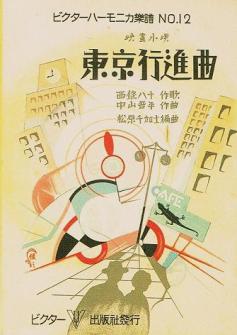
Movie Poster for Tokyo March, 1929, wikimedia commons
Specifically, Nagahara argues that the commercialization and industrialization of music in Japan were natural outcomes of the nation’s shift toward capitalism in the Meiji period. While the “gradual transformation of music, and art in general, into ‘consumer goods’” (64) in Germany signaled the “long-term decline of German middle-class culture” for Theodor Adorno, it actually signaled the opposite for Japan. Nagahara notes that, prior to the Meiji period, the Tokugawa shogunate (1603-1868) “idealized and mandated the separation of different status groups – in particular the division between members of the ruling samurai class and those who were deemed to be ‘commoners’” (21). Therefore, when the Japanese public bought an unprecedented 150,000 copies of “Tokyo March” (“Tokyo kōshinkyoku”) in 1929 and when records produced in 1937 were selling half a million, it became clear that “luxury goods” (18) such as phonographs and records were no longer simply for the ruling elites of Tokugawa-era wealth. Instead, Japan’s former commoners were marching toward capitalism with a middle-class cultural dream on the horizon.
As a period study, Nagahara doesn’t try to tie things up nicely – that’s not often how history works. As such, Nagahara concerns himself with the politicization of media in Japan, and he extends his discussion of pre-war popular music up through the 2000s with quick references to Pokémon and AKB48. However, there is a missed opportunity here in that Nagahara never references the Daiichi Fukushima disaster and the subsequent outpouring of popular music that responded to the public and private-sector management of the catastrophe.
This would have fit perfectly in the “The Television Regime” subsection of the book’s conclusion, and it would have added greatly to what Nagahara recognizes is a “significant dearth of scholarly analysis of the inner workings of popular song censorship in the last decades of the twentieth century” (218) and beyond. This reader would be excited to read more by Nagahara if he were to take up this task. I learned so much about the context and reception of pop music in Japan from Tokyo Boogie-Woogie, and this book would help any reader better understand one of the largest and most influential music and media scenes in the world today.
—
Featured Image: “Vintage Hi-Lite Transistor Radio, Model YTR-601, AM Band, 6 Transistors, Made In Japan, Circa 1960s” by Flickr User Seah Haupt, CC BY-NC-ND 2.0)
—
Shawn Higgins is the Academic Coordinator of the Undergraduate Bridge Program at Temple University’s Japan campus. His latest publication is “Orientalist Soundscapes, Barred Zones, and Irving Berlin’s China,” coming out in the 2018 volume of Chinese America: History and Perspectives.
—
 REWIND! . . .If you liked this post, you may also dig:
SO! Reads: Janet Borgerson and Jonathan Schroeder’s Designed For Hi Fi Living–Gina Arnold
SO! Reads: Susan Schmidt Horning’s Chasing Sound: Technology, Culture and the Art of Studio Recording from Edison to the LP— Enongo Lumumba-Kasongo
SO! Reads: Jonathan Sterne’s MP3: The Meaning of a Format–Aaron Trammell
Share this:

SO! Reads: Nicole Brittingham Furlonge’s Race Sounds: The Art of Listening in African American Literature

 Is literature truly a primarily visual entity? Do we only read books or are we actually actively “listening in print”(1)? These are the main questions that Nicole Brittingham Furlonge explores in Race Sounds: The Art of Listening in African American Literature (2018). As Black literature is often considered in terms of its attention to music, listening has therefore been limited to the musicality of stories, and many voices are left unheard. What Furlonge does in Race Sounds is go back to these unheard voices and focus our attention on them to see what we have been missing.
Furlonge wants to demonstrate how to “uncover the different ways of knowing that emerge from aural engagement” (3) such as exposed in Invisible Man, Their Eyes Were Watching God, and Sterling Brown’s “Ma Rainey.” She urges us to learn to “decode print differently” (4) by attuning the reader to the practice of listening, as well as to (black) sound(s) studies in more general terms, by referring to the essential scholars of the field: Tsitsi Jaji, Fred Moten, Kevin Quashie, Jennifer Stoever, and Alexander Weheliye – to name a few. Furlonge further “joins a collective effort to shift from a heavy emphasis on sounding to an attention to listening practices” (9). By redirecting the reader to listening practices, Furlonge leads us to reconsider our own “coexistence among humans.” (9)
 Furlonge, previously chair of the English Department at the Princeston Day School, and new Director of Teacher’s College’s Klingenstein for Independent School Leadership is not only an experienced scholar, but a teacher experiencing first hand what it means to listen: in a classroom and in society. Race Sounds is a five chapter book, moving from a consideration of “Literary Audiences” (chapter one), to the “Silence of Sound” (chapter two), to various forms of Listening (chapters three-five). Her fifth chapter, as well as her epilogue, have an especially interesting approach to Sound Studies through her lens as an educator. Not only does Furlonge have extensive classroom experience and administrative expertise in curriculum development, diversity issues, faculty development and issues regarding equity and access, but she is in a good position, as an independent scholar, to reflect on listening practices in and out of academia. It is quite exceptional to consider pedagogy in a critical text, as it observes education in the classroom and citizenship, in addition to her critical analysis.
By guiding her reader to listening in new modes throughout the book, Furlonge demonstrates how to “read in a multimodal way” (109) in order to learn to listen. This multimodal method includes an attention drawn beyond the book to “sonic literacy,” “aural pedagogies,” as well as the full sensory process of listening (from hearing, to vibrations, to sensory immersion of many kinds, and so on). She insists that, “while hearing is a physiological form of reception, listening is interpretive, situated, and reflective” (83), and this is ultimately what she presents in Race Sounds.
Furlonge aims at an audience of readers and listeners ready to deepen their understanding of the importance of sounds through the multisensory experiences that she proposes, especially as she describes her experience of “Aural Listening in the English Classroom.” She “aim[s] to amplify listening as a creative, aesthetic, and interpretative practice in ways that provoke robust motivations to develop our capacities to listen” (15) and manages to do just that by guiding her readers to consider sounds, voices, vibrations, silences, and historical listening, such as (re)reading Zora Neale Hurston’s Their Eyes Were Watching God in a new light, pointing to protagonist Phoebe’s listening throughout the novel.
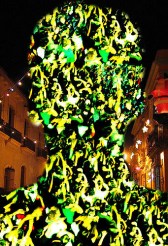
Image by Flickr User Adrian Sampson, from a series of three art pieces engaged with Ralph Ellison’s Invisible Man (CC BY 2.0)
By close reading, or listening, to many canonic texts such as Their Eyes Were Watching God, The Chaneysville Incident, and Invisible Man, Furlonge performs an in-depth understanding of sound and what it means to “unmute words in print” (109). She renews the ways to interpret the texts by teaching her readers how to hear sonic literature. After situating the texts in the literature, she depicts what sounds and silences in the narratives tell the reader. For instance, in the first chapter, “Our Literary Audience,” Furlonge distances herself from the often-times asked question of “whether or not Janie realizes her voice over the course of [Their Eyes Were Watching God]” and thinks about “Phoebe’s hungry listening” (25) and what it adds to the conversation. Rather than analysing the story’s narrator yet again, Furlonge turns the reader’s attention towards her friend, the listener. The reader is presented with the importance of listening with an analysis of the “storyhearer” (60) and the work that they accomplish by listening in proper ways, which allows the speaker to develop a voice they know is heard. In this sense, “storyhearers” are used to critique and bring the listening back into stories. As Furlonge considers the body a “living archive” (63), the intake of sounds and its use and reiterations transport the stories and transform the listener into an archive that will allow the story to live on and be transported.
Race Sounds, therefore, brings to the discussion ideas of what it means to listen and one’s responsibility of listening properly and carrying the story within one’s self. “Historical listening” (82) further defines the importance of the audiences in engaging with sounds. As one’s listening, in becoming knowledge, develops this importance, as well as a civic responsibility, to bring the story where it needs to be. Furlonge wonders about the same question Peter Szendy asks, “Can one make a listening listened to? Can I transmit my listening, as unique as it is?” (102). Through reading of The Chaneysville Incident, she demonstrates the carrying of such stories through sound, “a sound that contains memories” (117), and its historical as well as civic importance.
Furlonge also brings new insight to Ralph Ellison’s Invisible Man, a novel often studied in African American Sound Studies, such as in Weheliye’s Phonographies, because of its use of the phonographand its attention to the use of music. However, Furlonge diverges from the usual exploration of Ellison’s narrator with his phonograph and insists on vibrations and the experience of “tactile listening” (55), or the materiality that comes with the listening experience. In shifting the conversation, Furlonge presents the physicality of sound and voices, and does so throughout Race Sounds. Redirecting the reader’s attention to how listening practices affects the novel’s narration, Furlonge aims for the reader to rethink their own listening practices in turn.

Teagle F. Bourge in Oren Jacoby’s adaptation of Ralph Ellison’s INVISIBLE MAN. At the Huntington Theatre Company Jan. 4 – Feb. 3, 2013. Photo: Michael Brosilow (Court Theatre production), (CC BY 2.0)
By directly addressing our way of being in the world, Furlonge creates a text that speaks to the reader, and cannot leave one indifferent. In her last chapter, a walkthrough of her class on listening, Furlonge plunges with the reader into a sense of meaning; everything that one has just read comes together into her classroom. The result of Furlonge’s observations guide the reader into finding a new listener within themselves. Before concluding her book, she describes:
While I hoped students would grow as listeners, I did not anticipate that their perceptions of themselves as readers and writers would also shift. […] Helping students learn to listen, to be attentive to others, and to be discerning of all the talk that comes their way can lead to enduring understandings about themselves and the ways in which they want to engage with and change their world. (118)
As optimistic and ambitious as this statement is, I believe Furlonge manages to teach exactly this to the reader of Race Sounds. By concretely applying in her classroom what she presents in this book, not only does she prove how her work furthers the conversation of Sound Studies, she demonstrates how it belongs in larger conversations about our society’s listening practices and the role of every person in it.
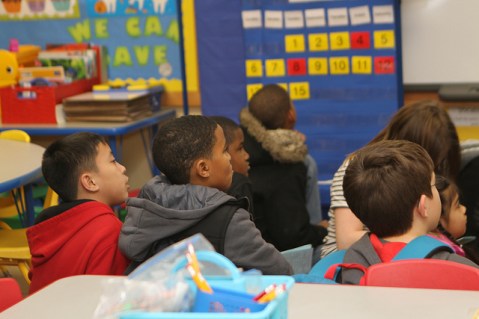
“Students travel around the world with books” image by Flickr User Garrison Casey, (CC BY 2.0)
Furlonge’s book intends to speak to anyone interested in their own listening practices. By being conscious of one’s own body as a “living archive,” it may allow a story to live on by listening properly to it. Finally, “we are unaware of the conversations we miss when we speak” (120) concludes the book on a reflection unto the self to be a better listener, in order to allow our surroundings to teach us to listen differently, and maybe hear things we have not heard before.
—
Featured Image: Quinn Dombrowski,(CC BY-SA 2.0)
—
Alexandrine Lacelle is mainly interested in Modernist literature, women’s writing, and Sound Studies (especially silences). She is pursuing her Master’s degree in English Literature at Queen’s University, where she will be starting her PhD in the fall of 2019, with a focus on the use of wordlessness and sounds in early 20th century literature by women. Originally from Montreal, she completed her BA in English Literature at Concordia University, where she was able to practice her background in French, English, and German.
—
 REWIND!…If you liked this post, you may also dig:
SO! Reads: Dolores Inés Casillas’s ¡Sounds of Belonging!–Monica De La Torre
SO! Reads: Roshanak Khesti’s Modernity’s Ear–Shayna Silverstein
SO! Reads: Kirstie Dorr’s On Site, In Sound: Performance Geographies in América Latina–Benjamin Bean
Share this:


Current Top Posts





April 2021

January 2020

November 2019

October 2019

August 2019

April 2014

November 2017

March 2015

December 2017

October 2015
 Sounding Out!

Recent Comments