
Death Wish Mixtape: Sounding Trayvon Martin’s Death
“Many men wish death up on me/ blood in my eye dog and I can’t see/ I’m trying to be what I’m destined to be/ and niggas tryna take my life away” –50 Cent, “Many Men (Death Wish)”
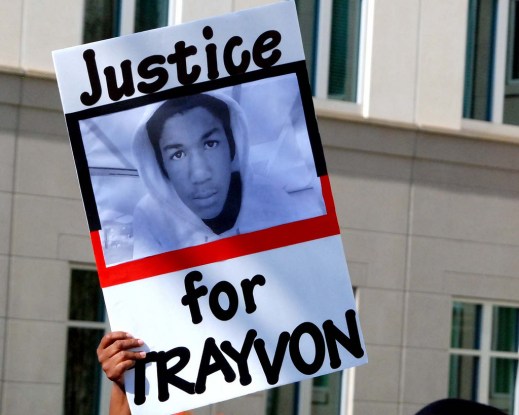
After hearing about the murder of Trayvon Martin, the unarmed teenager who was shot to death by George Zimmerman in a gated community in Sanford, Florida on February 26, 2012, I grappled with the urge to grab my godsons, nephews, cousins, brothers, and husband and never let go. I grappled with the Du Boisian question of the color-line, redressing it to consider “what does it feel like to be not only a problem but a target?” With these thoughts in my mind, I especially grappled with listening to the audio records of the 911 calls documenting the death of Trayvon Martin, just released late Friday March 16thby the Sanford police department.
I have mixed reasoning as to why I listened to the tapes. Part of me was just being nosy, but there was a deeper, far reaching curiosity stemming from my southern roots. As a Georgia girl, I was raised by Georgia men. My grandfather vividly recounted horrific stories of lynchings and beatings that happened “at the hands of persons unknown.” My mindset, like that of many, shifted to thinking about Trayvon’s death as a lynching. These tapes gave sonic urgency to a historically silent crime. In a word, Trayvon’s desperate screams gave voice to the countless men and women before him who died at the hands of white vigilantism.
As I listened to the distraught callers—and Trayvon’s final screams and pleas for his life—my mind became a mosh pit of emotions. Pissed, my mental playlist shuffled to 50 Cent’s “Many Men (Death Wish).”
.
I imagine Trayvon walking as the haunting piano and strings at the start of “Many Men” accompany his steps. He anxiously questions Zimmerman– “Why are you following me?” – in a similarly anxious way as 50 Cent can be heard asking “what’s taking homie so long, son?” and the shot rings out. As Trayvon screams and falls, the hard hitting boom fills the silent void. His lifeless body lays face down in the dirt, a lone piano softly signifying vulnerability as 50 Cent’s chorus starts: “many men wish death upon me/blood in my eye dog and I can’t see/I’m trying to be what I’m destined to be/and niggas tryna take my life away.” Situating Trayvon Martin’s final moments in a song by 50 Cent is discomforting, yet speaks to the reality and imaginative scripts of black masculinity as violent. The physical gunshot to Martin’s chest echoes the allegorical shots heard in the “Many Men” track and those in songs like Notorious B.I.G.’s “Who Shot Ya,” as another example, simultaneously blur and re-enforce black death as fantasy and normative. The 911 calls documenting Trayvon Martin’s death heard in concert with 50 Cent’s song sonically reify (gun) violence as a dominant discourse of black male identity. Indeed, Trayvon, I know who shot ya and gave you a death wish. I cannot, however, understand why.
.
The sonic surveillance of Trayvon Martin and George Zimmerman’s run-in—documented by the numerous accounts of neighbors who heard something but did not go outside—presents a juxtaposition of expected black male identity with the vulnerability of a horrified child forced into a criminalized space of black masculinity. In Zimmerman’s 911 call–listen via the Huffington Post here–he nonchalantly and at time heavily sighs about Martin’s blackness and its associated threat – “he’s black,” “he looks suspicious,” “he’s up to no good.” The passivity of Zimmerman’s voice reflects his bridging of (young) black masculinity as threatening. The panicked callers’ voices, however, represent reprieve and reinstate Trayvon’s humanity. The Trayvon Martin 911 recordings, then, are a mixtape of his final moments, sampling the voices of the various callers to construct Trayvon’s fatal narrative. Ultimately, the callers give voice to the vulnerabilities that Trayvon was deemed unable to evoke or possess by default as a black male.
 I use the word “mixtape” here to argue that the frequencies of trauma in which the (white) listener situates Trayvon Martin’s death must be heard within a larger understanding of sound as a commodified and racialized space. Ultimately, the recordings of Trayvon’s death are a sonic reflection of a long history of white America’s treatment of black bodies as capital. In negotiating the black (male) body as a commodity – which is historically and culturally significant – sounding the black male body as a commodity contextualizes this moment of expected black masculine performance for nonblack listeners. It needs to be noted how pathological black masculinity is profitable and mutually invested in by black men and white consumers alike. Briefly referring back to 50 Cent, he performs and is validated by the violence his narrative possesses. He knowingly invests in the exaggeration of his experience – he really was shot – and builds his image upon that paranoia. In In the Break, Fred Moten discusses the sonic commodification of blackness as “not what the commodity says but that the commodity says or, more properly, that commodity in its ability to say, must be made to say” (9). Situating black rappers’ narratives and, extensively, black men’s narratives as a commodity speaks to how the ambiguity of such narratives relegate blackness to a position of profitable, essentialized discourse. Moten suggests sounding blackness as a commodity is an effort to address these ambiguities, linking the privilege of speaking and constructing black (masculine) narrative, not content, as culturally and capitalistically recognizable and significant.
Trayvon’s political agency is invested in the violence placed upon his body by public scrutiny as a black man before there is any vulnerability as a child. Thrust instead into the position of ‘suspicious’ black man in a predominately white middle-class gated community, Trayvon the child bears the public scripts of expected black masculine performance, which are both visual and sonic. These expectations of popular culture and public opinion distort Trayvon’s sonic imprint, rendering him unable to vocalize and physically relay his desperate need for help.
As Mark Anthony Neal points out in a his March 19th New Black Man post “Hearing Trayvon Die” linking hearing Trayvon Martin’s death to a scene of a grieving Muddy Waters (Jeffrey Wright) from the 2008 film Cadillac Records, in which Waters’s pain is heard but not seen: “part of the reason that Jeffrey Wright’s howling had to be experienced off screen is that we have little understanding of Black males, as vulnerable, in pain, under duress, in terror and confronting death.” The impact of the lack Neal describes emphasizes the necessity for a sonic imposition of such vulnerabilities. In this case, the agency of this need is heightened by the audience being forced to listen to Trayvon’s frantic screams for help on tapes, thus humanizing him before racializing his body.
Yet it is Trayvon’s alleged screams – which I undoubtedly believe ARE his screams– that also sonically invoke his humanity. On the recording, heart-wrenching screams for help are silenced by the forceful pop of a gunshot, the silence signifying multi-layered historical and cultural indicator of Trayvon’s worth as a black boy in American society. Trayvon’s screams vocalize the agonizing silent demise of the murdered black boys before him. . .Oscar Grant. . .Amadou Diallo. . .Emmett Till. His screams are an echo of Frederick Douglass’s Aunt Hester’s screams, recorded in his 1845 Narrative, acknowledgement of the cruelty and continued viability of longstanding—even foundational—racial prejudice and violence that exists within the contemporary ‘postracial’ American agenda.

The Million Hoodies Union Square protest in New York against the shooting of Trayvon Martin in Sanford, Florida, by Flick'R User David Shankbone
Moreover, Trayvon’s scream also concisely signifiy the ongoing “upheaval” and chaotic existence of black men that Moten suggests “pressures the assumption of the equivalence of personhood and subjectivity” (1). Trayvon’s screams amplify a tragic dimension of what I theorize as “sonic cool pose,” where black masculinity is only cool if accompanied – instrumentally, lyrically, and otherwise – with violence. In this regard, the sonic signifiers that mark death—like the gunshots and screams that introduce 50 Cent’s “Many Men,” for example—are Trayvon’s. Both built upon the traumatic condition frequently faced by men and boys of color, Trayvon and 50 Cent’s lived experiences can be heard as sonically interchangeable despite obvious differences in class position. Through sound and the American popular imagination, black manhood is virulently fluid. There is a universal, stereotypical understanding that black masculinity resorts to identical markers of lived experience. This awareness is especially heightened and dominant in sound, where 50 Cent’s shooting on the corner parallels Trayvon’s shooting in a gated townhome community.
The release of the 911 audio of Trayvon Martin’s death is a powerful intervention in maneuvering black masculinity and violence in American (popular) culture. There is a delicate and simultaneous reading of the recordings as a sonic realization of black masculine violence and a fetishizing of a violated black male body. The sounds they contain amplify a continued American investment and interest in the black pathological narrative while doubly intervening as an alternative reading of such negotiations of black manhood. Whether sounded across a courtyard in a gated suburban neighborhood in Sanford, Florida, or on the streets of South Jamaica, Queens—or in the isolation booth in a recording studio—these frantic and desperate screams are sonic imprints of his social-cultural relevance. They may bleed into one another, but they won’t fade away.
 —
—
R.N. Bradley is a PhD candidate in African American Literature at Florida State University. She writes about African American literature, race and pop culture, Hip Hop, and her own awesomeness. She earned her BA in English from the Unsinkable Albany State University (GA) and a MA in African American and African Diaspora Studies from Indiana University Bloomington. Her dissertation project looks at negotiations of white hegemonic masculinity and race consciousness in 21st century African American literature and popular culture. You can read her work atAllHipHop, Newsone, TheLoop21, or her monthly column “The Race to Post” over atPopMatters. Scholar by day, unapologetic Down South Georgia Girl 24/7/365. Catch up with her awesomeness via twitter:@redclayscholar and her blog Red Clay Scholar (http://redclayscholar.blogspot.com).
Share this:

‘Corn-ing’ the Suburbs on Halloween, a Sonic Trick and Treat

It was a crisp Saturday night in late-October. I was probably seven or eight. My brother and I were sitting on the couch watching “It’s the Great Pumpkin, Charlie Brown” for the zillionth time.
And then we heard it.
To our stunned ears, it seemed as though my parents’ bay window, situated directly behind us, had shattered to pieces. But, mysteriously, it was still there, in tact.
Our tiny nervous systems were not prepared for this sonic assault, especially because it didn’t make sense. We stared in disbelief at the window for a minute, waiting for it to spill its shards. When we got enough courage to get up and peer out the front door, we saw the lanky silhouettes of teenagers running away into the dark of the trees. Piles of dried out corn kernels were scattered all over the porch like empty shells. We had been corned.
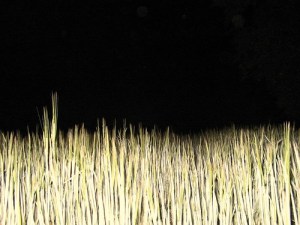
“Corn-ing,” a longstanding Halloween tradition in the suburbs of western Pennsylvania, is a popular prank in which kids sneak up to houses after dark and throw pre-hardened corn kernels at their windows, producing a truly startling sound effect. Corn-ing’s treat lies in the sonic trick—corn is able to convincingly sound like something else entirely. Thinking back on my experiences as both a victim of and participant in corn-ing, it occurs to me that this prank is sonic through and through—from listening for farmers in the corn fields before snatching husks from their crops, to locating one’s corn-ing partners in pitch black environments by the sound of the kernels bouncing rhythmically in their backpacks.
When early October rolled around each year, it was like an alarm went off in the heads of the kids that lived in my neighborhood. October meant it was time to procure ears of corn from the farms located on the outskirts of our Wonder-Years-ish suburb. In the days before we had our drivers’ licenses, this was an arduous task. We’d have to ride our bikes on the hilly back roads in mid-day (night time was too scary after we’d seen Children of the Corn), ditch them in the woods near the fields, and listen carefully for any signs of life in the corn—farmers, animals, blood-thirsty fundamentalist Christian children named Malachi, etc.
We couldn’t rely on our sight in these instances because the corn was so tall. We had to stop filling our backpacks every so often and listen for sounds of danger—for the rustles and crunches of stalks.
After our backpacks were filled to the brim, the preparation process began. The corn would sit for weeks in our garage, getting harder and harder. Once it became pebble-like in consistency, we’d shuck it back into our backpacks, listening to the pinging sound as it accumulated. On Friday afternoons, anxiously waiting for the sun to go down, we’d talk strategy. We decided that corning old people was out of the question. Even in our pseudo-delinquent state, we realized that sound had consequences—that spooking someone could give them a heart attack. So we mostly stuck to mean neighbors like old man Haybee, who was notorious for the unsightly cursive green “H” that was bolted to his chimney like a garish fast food sign. He never gave out candy to trick or treaters, so he was basically asking for it. Once a plan of attack was developed, it was time to suit up in all-black clothing and put on our packs. As soon as the streetlights came on, we were off.
My memories of these adolescent adventures are predominately sonic—the crunch of the fallen leaves, pounding hearts and nervous breathing, barely muffled laughter, and of course the sound of corn making contact with glass. Indeed, the success of the prank was measured in sound. The louder the sound the corn produced, the louder the aftermath tended to be. It was a true victory if dogs barked, or if people came out of their houses to yell. “You damn kids better run!” they would scream, sometimes only half seriously. And we did. We ran for our lives, despite the oppressive weight of the corn on our backs.
Click for the sound of sorn-ing: corn-ing
I wanted to capture the sounds of a real corn-ing experience to include here, but I quickly realized what an incredibly stupid idea that would be (what you heard, by the way, was the sound of me and my neighbor corning our own apartment building). As an almost 30-year-old Pittsburgher living in a fairly rough neighborhood, sneaking up to people’s houses at night in order to produce startling noises would most likely result in an encounter with police or violence of some kind. In the suburban environment of my adolescence, the sound of corn-ing was associated with a silly prank. Neighbors came to expect (and even get a kick out of) this Halloween tradition. In an urban environment in which the corn-ers are no longer in their teens, however, the sound of corn-ing would most almost certainly be interpreted as an aggressive or threatening act.
This just goes to show that different configurations of sound, spaces, and bodies (particularly raced and classed bodies) can result in vastly different understandings about what it means to share sound in a community. In Pittsburgh, I find myself constantly bombarded with the sounds of emergency and panic—police and ambulance sirens, firetrucks, helicopters. In my community’s soundscape, loud, startling noises are definitely not associated with fun and folly. Rather, they are a constant reminder of the looming danger that apparently surrounds me, as well as the incessant surveillance and policing of the city. This does not leave much room for sonic play.
This is not to say that there was no danger in corn-ing the burbs. For instance, this recent tragedy, in which a corn-er accidentally was hit by a car, happened in a suburb not far from the one where I grew up. Back when I was pitching corn, my best friend Courtney was once tackled by a man who thought she was slashing the tires of his truck (she was really just hiding behind a tire with a fistful of corn). And my brother Matt and I often found ourselves taking cover in the neighbors’ shrubbery waiting for the town patrolman to finish his watch. But I’d imagine that these war stories would not even come close to the dangers of corn-ing in the city. It is clear that the effectiveness of corn-ing as a prank is contingent upon the specific time, season, location, and culture in which its sounds occur.
Perhaps the real trick of sound, then, is that the context of its sounding can completely transform its effects and affects. But if you can get the sounds in sync with the right context, well, then you’ve got yourself a real treat.
—–
Steph Ceraso is a 4th year Ph.D. student in English (Cultural/ Critical Studies) at the University of Pittsburgh specializing in rhetoric and composition. Her primary research areas include sound and listening, digital media, and affect. Ceraso is currently writing a dissertation that attempts to revise and expand conventional notions of listening, which tend to emphasize the ears while ignoring the rest of the body. She is most interested in understanding how more fully embodied modes of listening might deepen our knowledge of multimodal engagement and production. Ceraso is also a 2011-12 HASTAC [Humanities, Arts, Science, and Technology Advanced Collaboratory] Scholar and a DM@P [Digital Media at Pitt] Fellow. She regularly blogs for HASTAC.
Share this:


Current Top Posts





April 2021

January 2020

November 2019

October 2019

August 2019

April 2014

November 2017

March 2015

December 2017

October 2015
 Sounding Out!
Recent Comments