
The Noises of Finance
DOI: https://doi.org/10.59350/5v3ds-zzw51
What does finance sound like? Is it the clanging of the opening and closing bells at the New York Stock Exchange? The shouting of offers to buy or sell? The beeps made by cash registers as a credit card is swiped? The whirring of fans working overtime to cool computers? What is this noise?
Noise, however, is not purely a sonic phenomenon. Since the late 1940s, noise has been intimately linked with theories of communication and information, as Aaron Trammell discusses in Sounding Out! posts such as “What Mixtapes Can Teach Us About Noise.” My research attempts to bring these two aspects of noise—the sonic and informatic—into conversation. I trace the interferences noise makes within a set of disparate disciplines: I listen to the history of the impact of information theory on experimental and electronic music; investigate the interferences of “fearless speech,” artistic robotics, and the public; and examine how noises digital and sonic have impacted the development of finance. Rather than creating my own definition of noise, I follow how other disciplines deal with their encounters with noise as both a material phenomenon—something that interferes with a signal, or a sound that is deemed unwanted—and as something to be theorized, asking questions such as what are the meanings of these noises? or should we be controlling noise at all?
In this post, I discuss three vignettes that outline the different ways in which noise (sonic and informatic) interferes with different aspects of finance: the shouts of open-outcry pits and the information they may or may not convey; new forms of electronic trading and the noises of server farms and trading behavior; and the Flash Crash of May 6th, 2010 that provoked noises from both traders and artists. Each reflects a particular conjunction of the sonic and informatic aspects of noise. When we attend to both components simultaneously, we discover that financial noises are complex entities that are not inherently revolutionary nor regressive, but are rather an elusive combination of both.
Noisy Trading: The Pits
My interest in the noises of finance comes in part from listening to open-outcry trading, following the work of Caitlin Zaloom’s Out of the Pits: Traders And Technology from Chicago to London and the documentary Floored (2008). An open-outcry pit, such as that found on the floor of the Chicago Board of Trade (CBOT), pairs buyers and sellers through a bodily practice of trading involving the extremities of behavior. Shouting, pushing, and shoving occur on the steps of the pit as buyers and sellers work to match their orders through nearly whatever means necessary.
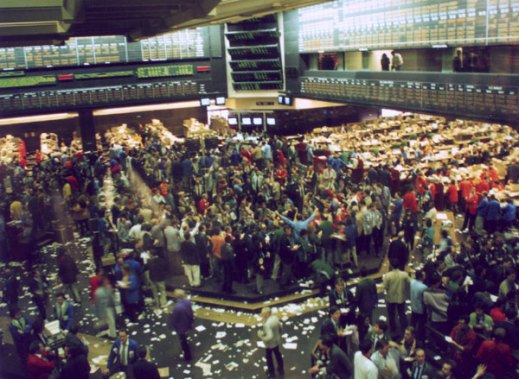
In the wonderfully titled article “Is Sound Just Noise?”, the business school professors Joshua Coval and Tyler Shumway ask, in one of the few academic articles related to the sounds of the pits, whether or not the shouting might convey information that is not necessarily available on the computer screens that were then coming to dominate trading:
we ask whether there exists information that is regularly communicated across an open outcry pit but cannot be easily transmitted over a computer network. Any signals that convey information regarding the emotion of market participants—fear, excitement, uncertainty, eagerness, and so forth—are likely to be difficult to transmit across an electronic network (1890).
Coval and Shumway found that the ambient sound level of the pits did have predictive impact regarding various aspects of the market: in short, the louder the pits got, the higher the volatility in the prices of securities and the decrease in the likelihood of conducting a trade.
Noisy Trading, Redux: Datacenters
Yet changes in the structure of the market have not only shifted the location of activity to people behind computer screens and away from these types of sounds, it has also shifted the actual location of the exchanges themselves. No longer do most trades take place in the physical location of, for example, the NYSE; rather, they take place in buildings like this one, at 1700 MacArthur Boulevard in Mahwah, NJ.
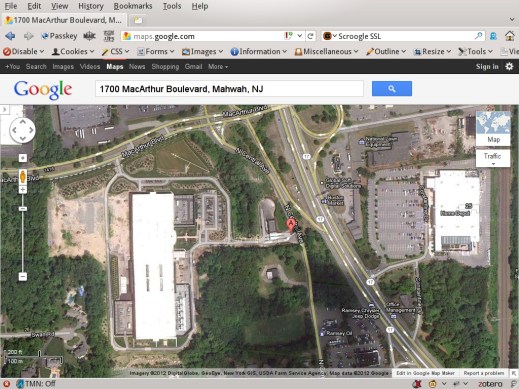
This is the location of the NYSE’s new datacenter, a 400,000 square foot facility. (In the linked video, note the whirring of the fans, a new noise of finance beyond that of the pits.) The servers in these datacenters—run by highly-capitalized financial firms large and small alike—are able to respond much quicker to market information the closer they are to the computers that run the exchange. And what can be closer than being co-located in the same datacenter as the exchange? This need for speed has lead to all sorts of interesting situations, such as new fibre-optic lines being laid to shave off a millisecond or two in travel between New Jersey and Chicago, or the taking into account of special relativity effects in the location of future datacenters. The new High-Frequency Trading (HFT) algorithms run on these servers in these datacenters.
Noisy Trades, Sonified: May 6th 2010
The voice on this recording, made on May 6th, 2010, belongs to Ben Lichenstein, an employee of a firm called Trader’s Audio. Now, Trader’s Audio provides live coverage of market movements from a person on the floor of an exchange in order for day traders and others to get an idea of the “sentiment” of a market. It’s kind of like a play-by-play of market activity, a running commentary of major market movements that can’t be discerned soley by the watching of numbers on a screen. What, then, could have been going on for Ben Lichenstein to be in such a frenzy, for his voice to be inflected in such a way? What are we to make of this noise?
Well, May 6th, 2010 was the day of what has infamously become known as the Flash Crash. The full details of this day are beyond the scope of this post, so I will outline it schematically, following the findings of the official US report produced by the Commodity Futures Trading Commission (CFTC) and the Securities and Exchange Commission (SEC). (For a different take on this, see the sociologist of finance Donald MacKenzie’s “How to Make Money in Microseconds”.) In short, between the hours of 2 and 3PM Eastern Time the New York Stock Exchange (NYSE) had both its largest single day loss as well as its largest single day gain, a swing of over 600 points. A series of trades made by algorithms that failed to take into account their impact on the market caused the prices of securities to swing to extremes, excerbated by the activity of High-Frequency Trading (HFT) algorithms. While the market eventually recovered—in part due to the activity of the same algorithms that caused the problem in the first place—the event indicated the precariousness of the stock market, the potential for things to spiral quickly out of control, and the difficulty in forecasting the behavior of an ecosystem of opaque algorithms.
How do the HFT algorithms relate to the Flash Crash that took place on May 6th, 2010? While the report of the CFTC and the SEC regarding the Flash Crash does not lay blame on HFT in particular, it did indicate how these algorithms contributed to the large price swings, the immense number of shares traded, and the drying up of liquidity (that is, the ability to find buyers and sellers in the market). One of the reasons why the market swings were so severe on May 6th, 2010 was due to the fact that HFT algorithms react immediately to small fluctuations of price, a quality of markets that financial economists call microstructure noise, a fascinating topic that is unfortunately beyond the scope of this particular post. In general, HFT and these datacenters go hand-in-hand, as it is a truism that it will take longer for data to travel between a machine in New Jersey and one in Chicago, than it will to travel between two machines in the same data center in New Jersey. HFT works to take advantage of this shorter latency in order to exploit market movements on the timescale of milliseconds, accelerating trading far beyond the open-outcry pit.
Noisy Finance: The Sonic and the Informatic
.
Let’s conclude with a sonic artifact of the Flash Crash from the French collective rybn. Their work has explored the concept of “antidatamining,” that is, the use of the “data mining” techniques of computational capitalism in order to shed light on the intersection of data and society. Consider their piece FLASHCRASH SONIFICATION (one of the few artistic responses to the Flash Crash), where rybn took trading data from nine different exchanges on the afternoon of the Flash Crash and created an austere, digitally-sharp yet undulating soundscape that recalls the work of artists Ryoji Ikeda or Carsten Nicolai without the rhythmic precision. If you can, listen to their online-available, two-channel mix on headphones in order to appreciate the details of the piece.
The building towards the end of “FLASHCRASH SONIFICATION” was meant to “emphasize the moment of the crash, [by] adding an effect of resonance, which propagates slowly, making it more tense, as the krach goes on” (all quotes in this paragraph from author’s personal interview with rybn). Thus instead of merely transparently translating the data into sound, rybn constructed the sonification in order to bring out this resonance: “resonance is pointed [to] as one of the major risk[s] of HFT by many economists and the feedback phenomenon was in the center of our discussions when we were preparing the piece.” Isolating the Flash Crash was important for rybn as it was perhaps the “moment when people started to understand financ[ial] orientations more clearly” thereby highlighting the symptomatic nature of the “speculative short-term loop finance seems to be stuck in.”
In FLASHCRASH SONIFICATION, sonic noise becomes a translation of the data from the market—abstract yet eminently material—into a different abstract form that does not immediately signify. FLASHCRASH SONIFICATION suggests rather than indicates; listening to it cannot provide us with rational information regarding the dynamics of the Flash Crash. Instead it produces a dark foreboding of the mechanisms at work, the high-frequency pulses first recalling heartbeats that soon speed up beyond any ability for distinction. In FLASHCRASH SONIFICATION, rybn comments on the inability for computation—and by extension, the market—to be the perfectly rational, ordered space it is ideally understood to be.
In Noise We Cannot Trust
If there is one thing clear about the examples of noises heard and encountered in this post—the shouting in the pits, the fluctuations of prices, the whirring of air conditioning, the sonification of the Flash Crash—it is that noise cannot be counted upon for positive or negative disruption. Noise cannot be counted upon as a political exploit in the market, as it can signify the potential of a trade, or be recuperated into profit through the activity of HFT algorithms. Yet noise can also provide an alternative experience of the Flash Crash beyond that of bureaucratic reports and figures. It is thus through the interferences noise causes within the dynamics of finance that we come into contact with the equivocality of noise as a phenomenon, and thus become attuned to a particular need to not confine noise to preconceived notions of positivity or negativity.
—
Adriana Knouf (she/her/hers, sie/hir/hirs) is an Assistant Professor of Art + Design in the College of Arts, Media, and Design at Northeastern University. She is a media artist and scholar researching noise, interferences, boundaries, and limits in media technologies and communication.
Her current research project, tentatively entitled The Xenology Notebooks, is a transmedia, transdisciplinary corpus expansively considering the “xeno”. Her first book, How Noise Matters to Finance (University of Minnesota Press, 2016), traced how the concept of “noise” in the sonic and informatic domains of finance mutated throughout the late 20th century into the 21st.
Her current artistic research explores queer and trans futurities on earth and in the cosmos. Projects include Enredos Sónicos/Sonic Plots, a collaborative sonic exchange between the US and Cuba; they transmitted continuously / but our times rarely aligned / and their signals dissipated in the æther (2018-present), a 20 channel sound art installation with speakers made from handmade abaca paper and piezo electric elements, with sounds collected by custom antennas from satellite transmissions; and PIECES FOR PERFORMER(S) AND EXTRATERRESTRIAL ENTITIES (2017-present), event scores laser etched into handmade translucent abaca paper.
—

REWIND! . . .If you liked this post, you may also dig:
Experiments in Agent-based Sonic Composition–Andreas Pape
Listening to Disaster: Our Relationship to Sound in Danger–Maile Colbert
SO! Reads: Jonathan Sterne’s MP3: The Meaning of a Format–Aaron Trammell
—
Share this:

The Sounds of Anti-Anti-Essentialism: Listening to Black Consciousness in the Classroom

DOI: https://doi.org/10.59350/2f4nj-5zp04
In teaching the many interrelated and complicated aspects of the Civil Rights movement, Black Power, and the Black Arts Movement, the challenge for me is to help students understand the “facts” of this period, and to simultaneously destabilize the teleological historical narrative these “facts” seem to suggest. In a pedagogical context, sound helps fill in the gaps that fall outside of the knowledge produced–and contained within–certain archival accounts of black cultural and political history. While crucial, having students listen to the gaps, can be daunting, especially in our current historical moment, as the decades-long push against identity politics has been solidified by the recent (re)election of the nation’s first black president, Barack Obama. This point demands more elaboration than I can provide here, but the critical pedagogical issue it raises within the province of black studies, is that it is becoming increasingly difficult to consider black political culture outside of the sedimented lines of American pluralism and black radical thought.
I use sound as a pedagogical tool to help outline a middle ground–what Frantz Fanon refers to in The Wretched of the Earth as “zone of hidden fluctuation” (166)–based upon articulations of resistance and identity that refuse to be frozen in time. Building on Paul Gilroy’s conceptualization of anti-anti-essentialism in The Black Atlantic, an idea of black consciousness that is flexible and moves between the insufficient terms of “essentialist” and “anti-essentialist,” I use specific pedagogical examples to suggest that teaching about race and sound is a rich, evolving, and productively interactive continuum. The auditory sense opens up new terrains of knowledge and dynamically expands the possibilities for students to think through the intricate and multifaceted formations of black consciousness during the volatile years of the 1960s and the resonance of those years in our present.
The recorded presence of Martin Luther King, Jr., for example, represents an important aural site for engaging in reflexive pedagogy, because King’s tonality–the resonance of his voice–creates a certain familiarity and is pivotal to the construction of the American myth of the radical transformation of the civil rights movement and the idea of post-civil rights racial equality. For many students, King’s sound signals the dream of, and the pathway towards, a unified America. Conscious of how this idea of King reflects a linear understanding of civil rights as simply a desire for inclusion, I direct students’ attention to the sound of King’s last recorded speech in Memphis on April 3, 1968. Given the evening before his assassination, this speech resounds with King’s deepening critical perspective on black struggle through its haunting concluding notes. I point out to my classes that King’s final years (1965-1968) were marked by his increasing focus on ideas of black resistance outside of the Civil Rights mainstream, including his critique of U.S. involvement in the Vietnam War, and his radical rethinking of the possibilities for black economic and political self-determination.
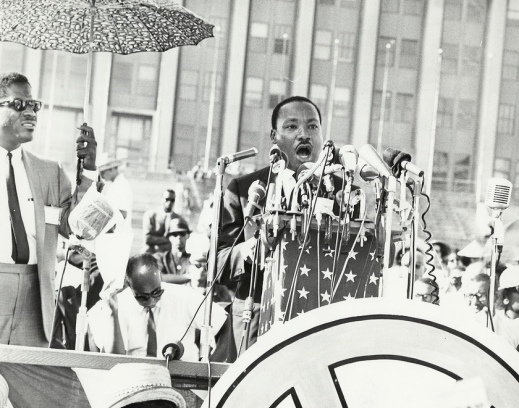
Centered on the economic injustice and dehumanization of Memphis’s striking black sanitation workers, King’s speech details the need for the Memphis black community do more than simply boycott municipal entities, but rather articulate their resistance by boycotting prominent national brands such as Wonder Bread and Coca-Cola. Against this background, I play segments (particularly the final minutes) of King’s speech, entitled, “I’ve Been to the Mountaintop.”
The acoustic dimensions of King’s final speech resonate with a social and political complexity that troubles the sonic memories many students have of King’s “I Have a Dream” speech, delivered on the steps of the Lincoln Memorial in 1963. The much more intimate and less overtly majestic soundscape of Memphis’ Mason Temple underlines King’s shift from national icon back to local, community activist. The frequent audience shifts–applause, extemporaneous interjections, and silence–create a reverberating sonic energy that accumulates throughout the speech. Rather than relying strictly on a call-and-response interpretation of the interactive exchanges between King’s voice and the audience’s response, I have students consider the non-linear ebbs and flows in King’s sound in this latest of moments (as Fred Moten would say, the totality of King’s tonality). For example, as King’s audience considers the weight of his analyses and what it means to articulate black resistance as “a dangerous unselfishness” that “puts pressure where it really hurts,” I identify moments of uncertainty, hesitation, and contemplative reflection that mark a non-linear interactive sonority between King and his audience.
Listening to King’s final thoughts offers a disturbing and disruptive emphasis on the stakes of breaking with entrenched modes of activist thinking. He concludes the speech with a series of prophetic thoughts on mortality as a cost of making a stand against “our sick white brothers.” Set within the historical and ideological context I have sketched above, the delivery distinguishes the sound of King’s words. As we listen I draw attention to King’s expression of a lack of fear in anything, any man, as King seems to convey an eerie foreknowledge of his murder and his irreverence in its face.
“I’ve Been to the Mountaintop” –Listen to the concluding two minutes
The apocalyptic sound of King’s concluding notes to this political sermon leaves much to contemplate. From the mention of the potential threat posed to his life by “our sick white brothers,” through the speech’s last line, there is a tonal, timbral shift in his voice and demeanor. Through sound and posture, and the reaction of the audience to those factors, King’s affect seems to convey something more momentous occurring beneath the event’s surface dynamics. King projects a confrontational edge through the sound of fearlessness in the face of mortality. Did he know he was going to be killed shortly after giving this speech? It’s a question that the peculiar tonality of his concluding lines raises for students. If so, what does it mean to use the sermon as a site of prophetic, aural documentation of the fact that a force of transformation exists beyond the flesh and blood of leadership, a force that assassination can’t kill? In the speech’s final synesthetic moment, I have the students listen and watch the shift that occurs in King’s demeanor as he closes, and the way that this shift culminates in an almost ecstatic moment as he delivers the final line: “Mine eyes have seen the glory of the coming of the Lord.” His defiant turning away from the microphone is crucial as it amplifies the meaning of the voice, letting those watching know that, much like an emcee, King has just “served” white power with a delivery that will outlast the sniper’s bullet the following evening.
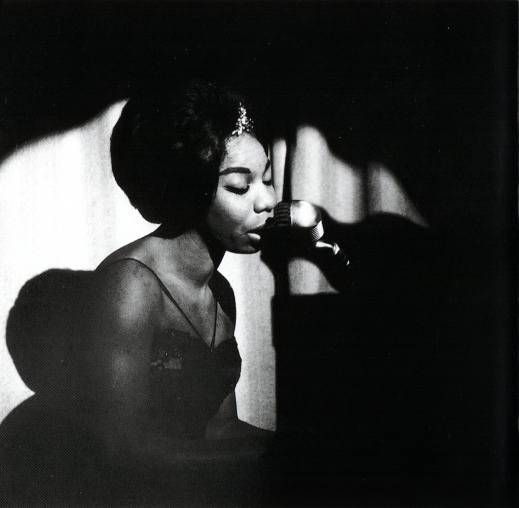
I want to briefly point to two other examples that show additional ways in which sound complicates ideas of racial identity and expression during the 1960s. When I teach Nina Simone’s composition, “Mississippi Goddamn,” (recorded live at Carnegie Hall in 1964), I ask students to consider the relationship between the distinctive sound of her voice and the ironic and critical elements of her lyrical meaning as this interaction creates a complex idea of radical black consciousness. Composed in the aftermath of the murder of Medgar Evers and the bombing of the 16th Street Baptist Church in Birmingham, Alabama, Simone offers a musical, and more broadly sonic meditation on white supremacy.
Most students find the timbre of Simone’s voice, its grain (as Roland Barthes would say) and depth, immediately striking. Her unique sonority and its context, greatly influence attempts by students to understand her reference to the song as simply a tune: “The name of this tune is Mississippi Goddamn” she says, and “This is a show tune, but the show for it hasn’t been written yet.” Clearly it isn’t simply a tune, and the caustic quality of lines such as, “Oh but this country is full of lies/ You’re all gonna die and die like flies,” creates a critical depth through the sound of Simone’s commitment to a black radical perspective. What does it mean, for instance, that Simone projects such sarcasm and biting critique to a predominately white audience at Carnegie Hall? How might we hear the specific grain of her voice in this setting? How does Simone’s projection of critical black sonic resistance, emerge at the conjuncture of anti-black racism and the beginning of legislative efforts under the Johnson administration to rectify racial inequality through civil rights bills? What can be taken from the simultaneity and contrast that Simone projects her sound within? I pose such questions to my students as a way of considering what it means to be committed to critical thought and social transformation that falls outside of the dominant lines of American national consciousness, and how the sound of such commitment, heard in the pitch and tenor of Simone’s voice, matters as a different kind of historical documentation.
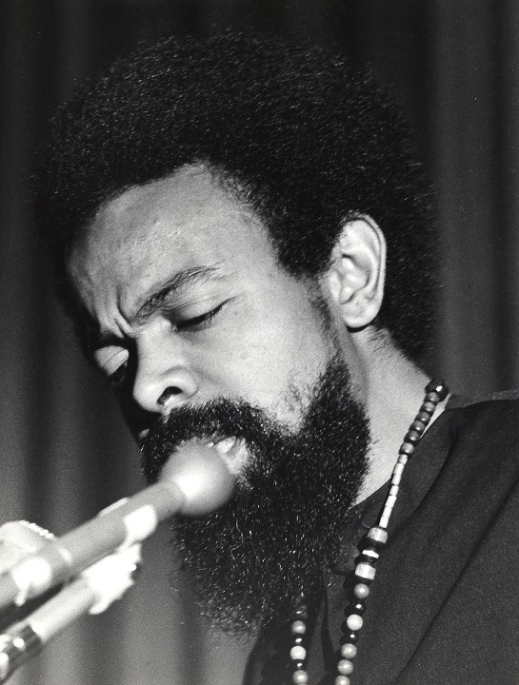
In considering how the sound of music can offer an intervention within the formation of black political consciousness in the Black Arts Movement, I often use the 1966 recording of Amiri Baraka’s signal poem, “Black Art,” as it set to the experimental musical sounds of Sonny Murray’s ensemble (Murray-drums, Albert Ayler-tenor saxophone, Don Cherry-trumpet, Henry Grimes, Lewis Worrell-bass). Having first read the poem, students then are able to hear it set to– and against–the unconventional instrumentation of Murray’s ensemble.
The musicians create an unconventional sonic context for Baraka’s reading that de-emphasizes and re-situates the apparent dimensions of black rage that seem to arise from verse that can “shoot guns,” through an almost carnivalesque, comedic, and off-kilter sound that troubles the linear expectations one might have of instrumentation amplifying the words on the page. The dissonance between page and sound allows for useful pedagogical opening, in that it underlines the non-conformist, avant-garde aspects of the movement, and the fine line that artists such as Baraka were imagining between the intensity of black radical consciousness and the ability to articulate that standpoint outside of the expected forms of black cultural nationalism.
As these examples have shown, I incorporate sound into my pedagogical framings of black cultural and political identity as an opening through which students may expand their understandings of black consciousness and black political culture well beyond stagnant ideas of racial authenticity, while still preserving an understanding of the transformative and often radical possibilities that have been projected through black expression during the period. It is the open space of sound that invests the project of black radical thought with the uncanny spontaneity of experimentation. Having students understand ideas of expansiveness, asymmetry, and non-linearity as central to black cultural expression and critique–even as artists refuse to sacrifice an expressed political commitment to black resistance–begins to suggest ways for students to contemplate the intersection of identity politics with the unexpected, fantastic elements of expression that lie outside of more recent flattened diagnoses of black nationalism. Teaching at the intersections of race and sound opens up new terrains of knowledge, dynamically expanding students’ abilities to think through the intricate and multifaceted formations of black consciousness during the volatile years of the 1960s and the resonance of those years in our present.
—
Carter Mathes is an assistant professor of English at Rutgers University. He has completed a book manuscript entitled, Imagine the Sound: Experimental Form in Post-Civil Rights African American Literature, that focuses on the relationship between sound and literary innovation during the 1960s and 1970s. He is co-editing a volume of essays on Black Arts Movement writer and critic Larry Neal; and also has essays in print or forthcoming on Toni Cade Bambara, Peter Tosh, and James Baldwin. At Rutgers, he regularly teaches classes focusing on African American literature, Twentieth-century literature, music and literature, and experimental writing.
—
REWIND! . . .If you liked this post, you may also dig:
Audio Culture Studies: Scaffolding a Sequence of Assignments–Jentery Sayers
They Do Not All Sound Alike: Sampling Kathleen Cleaver, Assata Shakur, and Angela Davis–Tara Betts
Freedom Back: Sounding Black Feminist History, Courtesy the Artists–Tavia Nyong’o
—
Share this:




Current Top Posts





April 2021

January 2020

November 2019

October 2019

August 2019

April 2014

November 2017

March 2015

December 2017

October 2015
 Sounding Out!
Recent Comments