
SO! Reads: Marisol Negrón’s Made in NuYoRico: Fania Records, Latin Music, and Salsa’s Nuyorican Meanings


I began reading Marisol Negrón’s Made in NuYoRico: Fania Records, Latin Music, and Salsa’s Nuyorican Meanings (Duke University Press, 2024) in earnest this summer, as Bad Bunny’s “NUEVAYol” flooded New York City streets. Whole generations of people had never heard El Gran Combo’s “Un Verano en Nueva York” (1975), perhaps not-coincidentally celebrating its fiftieth anniversary this year. The song is a staple in this city, particularly in the weeks leading up to the National Puerto Rican Day Parade. Instagram and TikTok were inundated with videos of Bad Bunny fans, many of whom were millennials and Gen Z, dancing with their grandparents to “NUEVAYoL” and “BAILE INoLVIDABLE.” Bad Bunny had successfully ushered in a resurgence of interest in salsa, a genre that has remained vibrant since its founding. The archipelago’s superstar celebrated the city that was, beginning in the early 1890s, a major site of Puerto Rican migration for decades; in several of the videos for songs from DeBÍ TiRAR MáS FOToS (2025), he honored the Nuyorican community and all they had contributed to the culture.
In that vein, Negrón has written a book that is, shockingly to me, one of the very few books that center salsa in general and the role of New York in its creation specifically. In this, she joins Juan Flores, Frances Aparicio, and Christopher Washburne to produce book-length studies that examine this genre. She also depends on the magazine articles of long-gone local publications such as Latin N.Y., which ran from 1973-1985, and journalists such as Aurora Flores, Adela López, and Nayda Román, women who recorded what at times feels like an incredibly-male environment. Here, she is focusing on the record label that is synonymous with salsa, Fania Records, which, at one point had signed such singers and musicians as Tito Puente, Celia Cruz, La Lupe, Hector Lavoe, Ruben Blades, Ray Baretto, and Eddie Palmieri, whose passing this summer marked the end of an era, in many ways. Founded by Johnny Pacheco and Jerry Masucci in 1964, Fania reached its heights in the 1970s, securing a distribution center in Panama in 1974, establishing its own recording studio in 1976 – the first “Latin” label to do so – and purchasing a manufacturing plant in 1977. Yet by the end of the decade, many of the original artists had moved on, as had Masucci, who sold the catalog and created several other businesses that continued to do business using the name “Fania” (20). Nevertheless, the music that emerged from that critical historical moment in New York City continues to impact subsequent generations.

Citing Caridad de la Luz, La Bruja, a Nuyorican legend of the spoken word scene who currently serves as the executive director of Nuyorican Poets Café, Negrón defines NuYoRico as “that place somewhere between the Empire State and El Morro” (9), the latter being the fortress originally built in the sixteenth century that is recognized as a UNESCO World Heritage site. Made in NuYoRico is divided into two parts featuring three chapters each; the first part, “Anatomy of a Salsa Boom, 1964-1979” marks the cultural history of salsa for those fifteen years, while the second part, “After the Boom Is Gone, 1980s-2000s,” charts a fascinating examination of the salsa boom in various contexts, including a futile attempt by insular government officials to attract foreign investment by citing salsa as an impactful cultural artifact. In doing so, they offended a faction of the archipelago’s elites who distanced themselves due to the genre being created in the diaspora.
Negrón reviews the 1972 documentary classic Our Latin Thing (Nuestra Cosa Latina) in her first chapter. This movie served for many as the introduction to the Fania All-Stars. Featuring footage from a 1971 concert at New York’s Cheetah Lounge, it features Barretto, Larry Harlow, Willie Colón, Ismael Miranda, “Cheo” Feliciano, Pete “El Conde” Rodríguez, and LaVoe (whose name appears in this way throughout the book recalling his nickname as “La Voz”). In chapter two, “‘Los Malotes de la Salsa’: Salsa Dons and the Performance of Subjecthood,” Negrón looks at the imagery Colón and LaVoe create in their lyrics and the cover art of their albums, while the following chapter, “Salsa’s Dirty Secret: Liberated Women, Hairy Hippies, and the End of the World,” focuses on their performance, together and individually, of a virile masculinity dependent as much on the portraits of insubordinate women, unruly yearnings, and queerness. It is this chapter that speaks fleetingly of Celia Cruz and La Lupe, the two Afro-Cuban women who were the only women signed to Fania. In a study that examines how very much a masculinist world this was, I was looking for the counterpoint that both Cruz and La Lupe offered, only to be met with two pages of reference to them. A deeper discussion centering these women remains opportune.

The fourth chapter “Puerto Rico’s (Un)Freedom: The Soundscape of Nation Branding,” charts the moment in 1992 when, ahead of the celebrations within the Spanish-speaking world of Columbus’s voyage, Puerto Rican governor Rafael Hernández Colón sought to brand Puerto Rico using salsa as the premier Puerto Rican cultural export, only to be met with opposition from elites on the island. With the last two chapters, “Entre la Letra y la Nota: Becoming ‘El Cantante de los Cantantes,’” and “(Copy)Rights and Wrongs: ‘El Cantante’ and the Legislation of Creative Labor,” Negrón examines the last years of LaVoe, his improvisational contributions to what many consider to be his signature song, “El Cantante,” and the legal struggle between Rubén Blades, the writer of the song, and Masucci, for recognition of Blades as sole author of the song.
Made in NuYoRico is a fascinating book, one that encourages the reader to have their streaming service within reach. With the conversation of every album, one can pause and listen to the songs accompanying the album and the art under discussion. In this she joins countless scholars of music, but I was especially reminded of Mark Anthony Neal’s most recent book, Black Ephemera: The Crisis and Challenge of the Musical Archive (NYU, 2022), which was fundamentally dependent on the reader listen to the songs he was referencing in real time. It is a theoretical book published by an academic press, and so discussions about abjection and subjecthood may not reach the general reader; nevertheless it is a worthwhile addition to the library of any salsa aficionado, who will undoubtedly learn something new while revisiting the past.
On August 23, 1973, only two years after their sets at the Cheetah Lounge, the Fania All-Stars played Yankee Stadium. Having attained a certain level of success with the release of Our Latin Thing, the concert at the celebrated ballpark secured legendary status for these singers as they played before more than 40,000 spectators. Four months later they reprised the concert in San Juan’s newly-built Coliseo Roberto Clemente. In September 1974 they played in the Zaire 74 music festival in Kinshasa, Zaire (now Democratic Republic of the Congo) in the country’s premier stadium, the Stade du 20 Mai: the Fania All-Stars were global.
Fifty-one years later, in September 2025, the National Football League announced its selection of Bad Bunny as the performer of the Super Bowl LX halftime show, taking place in February 2026. The championship game is set to air exactly a week after the Grammy Awards, where Bad Bunny is nominated in six categories, including Best Record, Best Song, and Best Album of the Year for Debí Tirar Más Fotos. With an expected viewership of more than one hundred million people, he and his repertoire of reggaetón, dembow, Latin trap, boleros, and yes, decidedly Puerto Rican bomba, plena, and salsa, will be at the center of yet another international cultural moment. Debemos tirar más fotos.
—
Featured Image” “Jibaros Con Salsa” by Flickr User Lorenzo, Taken on July 27, 2011, CC BY-NC 2.0
—
Vanessa K. Valdés is a writer and an independent scholar whose work focuses on the literatures, visual arts, and histories of Black peoples throughout the Western hemisphere. She is the author of three books, Oshun’s Daughters: The Search for Womanhood in the Americas (SUNY Press, 2014); Diasporic Blackness: The Life and Times of Arturo Schomburg (SUNY Press, 2017); and with David Pullins, Juan de Pareja, Afro-Hispanic Painter in the Age of Velázquez (Yale UP, 2024). You can learn more about her at https://drvkv23.com/.
—

REWIND!…If you liked this post, check out:
SO! Reads: Licia Fiol-Matta’s The Great Woman Singer: Gender and Voice in Puerto Rican Music–Iván Ramos
SO! Reads: Danielle Shlomit Sofer’s Sex Sounds: Vectors of Difference in Electronic Music–Verónica Mota
As Loud As I Want To Be: Gender, Loudness, and Respectability Politics–Liana Silva
Spaces of Sounds: The Peoples of the African Diaspora and Protest in the United States–Vanessa Valdes
Share this:

Finding Resonance, Finding María Lugones
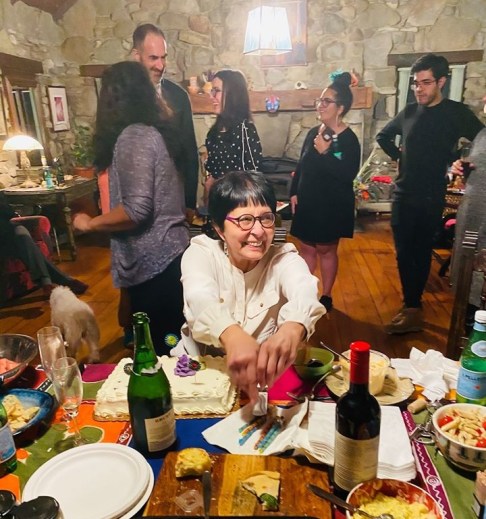
I am always listening for María: I find her most in the traces of words.
Trained as a literary scholar, I relish in the contours of stories; I savor the nuances found between crevices of language and the shades of implication when those languages are strung together. It is no surprise, then, that since the death of my friend and mentor María Lugones, I have turned to many books, particularly her book, Pilgrimages/Peregrinajes: Theorizing Coalition Against Multiple Oppression, to feel connected to her. I have struggled, though, to write about her, talk about her, even think about her for many years. It wasn’t until I found a passage about spirits and hauntings in Cuban-American writer and artist Ana Menéndez’s novel The Apartment that I found language to describe a way through the grief of the last five years.

Menéndez’s novel follows many characters that all, at some point in time, come to live in apartment 2B in Miami Beach. While each person is seemingly disconnected from the next, they all leaves sonic traces of themselves for the next person’s arrival. Each new tenant leaves behind the creak of a dented floorboard, or the rumbling of the air conditioner, the faint melody of a piano, or the swish of spirits looking for a place to sit down. The climax of the novel revolves around Lenin García, a young Cuban migrant who commits suicide in the Miami apartment shortly after arriving. Anna, a journalist who migrated to the US from the Czech Republic during their communist regime, prepares the apartment for rental after the suicide. When looking through Lenin’s belongings she explains that the “Spirits pressed down on her, and again and again she rejects them. Sends them packing, back to the pre-rational past. Not a haunting, but an echo. The boy’s life a gesture pointing back to her own. A dream of a thousand iterations” (131). These spirits that surround her, that remind her of her own life’s ghosts, provide a particularly sonic connection; the tethers that connect one migration tragedy to another is an echo of commonality that creates a kin experience.
The three years I learned with and from María are overshadowed by the physical distance the pandemic required of me in her final moments. When I try to write about her, my hair stands on end, my eyes water, my nose drips, and I stretch out my hand toward a presence I feel, just out of reach. I know it’s her, I just can’t seem to touch her. I have described María’s death as a haunting—as something that haunts me. I defined this haunting as a physical presence that I could not see, but I could feel, sense. But what if, like Anna, I am feeling, not a haunting, but an echo; or more accurately, the resonances of María that echo around me constantly? What Menéndez’s passage provides is the necessity of reinterpreting my awareness of María from one of general sensing to one of specific aural attunement. If I am listening for her, how, then do I keep her with me?

Lenin, from The Apartment, provides a potential answer: when meeting with a curandera in Cuba, she tells him “The ancestors speak to you from the home of your inner life. When your inner life is spare, there is nowhere for the ghosts to sit. When you furnish your spirit, the ancestors will once again find rest in you” (143). Echoes become an analytic that provide furnishings ‘in the soul’ for sustained company of those who have passed. The reverberation of echoes—reverberations as a prolonged sense of resonance that stretches the meeting of two energies—can, quite literally, allow a reader to connect back to people across space and time. My tether to María is a resonance that simultaneously locates and disperses spatially and temporally. I hear this connection as my harmony to her melody. To further the metaphor, that resonance is the strumming of a guitar, where I am the guitar and she is the musician, and that moment where we both hear for each other, even when we do not know the other exists, is the note.
What happens when I use literary methods of analysis to find people in the interstices of sound? To search for María in what she calls the “enclosures and openings of our praxis” as a reader of her text? Now that I had to search the histories of her echo, I turned to her book, Pilgrimages/Peregrinajes.
When María recommends “to women of color in the United States that we learn to love each other by learning to travel to each other’s ‘worlds’,” (78) I imagine our first few encounters; encounters that were strange, difficult, and lessons in learning to listen to her on her terms. I had been invited to her home in Binghamton, New York for a meeting of a political-intellectual group she hosted, and was nervous to meet the woman I had written my Master’s thesis on, and who was the reason I applied to Binghamton for a PhD program. Her voice rang through the room, slow and clear; her mouth pursed a bit as she thought through her next sentence, her finger pointed as she spoke her next idea. In trying to stay out of her way, I became a barrier when she moved backward; she bumped into me and said simply ‘you must be careful not to trip me’ and moved along. I was mortified.
Our next few encounters were similarly odd, and lead me to think that, maybe, María was not the right choice for my mentoring needs. A few months into this first year in graduate school—where tenured male professors were violent toward me, and I was not sure I should stay in academia—I confessed to a friend in the same political-intellectual group that I was not sure María liked me or that I should work with her. Her response changed everything: this friend, who had worked with María many, many years said: “don’t do that. Don’t make her mother you. It’s not who she is. Travel to her, learn her.” I finally understood that traveling to María’s world meant listening to her from her perspective, not my own. That shift in me “from being one person to being a different person” (89) is how I first found María in the haptic world. I learned to listening to her: I learned the catch in her throat meant she wanted tea; I learned the increase in sighs meant she was in more pain that usual; I learned the shuffling of papers probably meant she was looking for her handkerchief to wipe her forehead as she had a hot flash. Each of these sonic gestures, I could respond to—could show up for her.

But with María’s death, this kind of listening is no longer available to me; I could not listen for hem or hmm or tchps. I had to learn to listen differently. In re-reading Pilgrimages/Peregrinajes I learn that it does not just contain her philosophical interventions for liberatory futures. It is a series of stories; her stories of the echoes that resonate inside of her; stories that she weaves together that happen to name philosophical practices of relationality. It is through the coerced placement of her by her father in an asylum that she finds other woman who teach her to resist; this resistance is sonic: a woman repeating over and over “I am busy, I am busy” as they electroshock her (i). It is through wanting desperately to love her mother that she finds ways her mother taught her to listen differently in order to name the capacity of ‘world’-traveling. What I had felt when I first read her work over a decade ago was a resonance; a sonic reverberation across space and time that connected my to her before our physical meeting, during our time as friends and mentor/mentee, and now after her physical death.
Connecting to María through echoes feels effortless now that I have the language. I hear now María’s warning against the dangers in the primacy of the visual. In “Hablando Cara a Cara/Speaking Face to Face: An Exploration of Ethnocentric Racism,” she explains:
I exercise this playful practice. The appreciation of my playfulness and its meaning may be realized when the possibility of becoming playful in this way has been collectively realized, when it has become realized by us. It is here to be appreciated or missed and both the appreciation and the missing are significant. The more fully this playfulness is appreciated, the less broken I am to you, the more dimensional I am to you. But I want to exercise my multidimensionality even if you do not appreciate it. To do otherwise would be to engage in self-mutilation, to come to be just the person that you see. To play in this way is then an act of resistance as well as an act of self- affirmation (41).
What she taught me here is that being herself meant a practice that was more than being seen. To be what others could only see was an act of mutilation to her multidimensionality. That reminder was crucial to becoming her friend during my time at Binghamton, but even more crucial now that she is gone from this world.

I’ll leave you with the most important story she left behind: she provided a method of learning that was based on the senses and focused primarily on the sonic—what she called “tantear.” This tantear has become instrumental in my own research. It is a fumbling around in the dark, a feeling around tactically that focuses on searching “for meaning, for the limits of possibility; putting our hands to our ears to hear better, to hear the meaning in the enclosures and openings of our praxis” (1). The embodied experience of stumbling, of careful and intense feeling for and with others, requires a capacity of listening deeply. It is listening that undergirds the learning. The language of the sonic provides the understanding of the feelings within the body. Listening becomes a profound practice of relationality; echoes become a mechanism of connection; and resonance becomes the confirmation that I can still be with María.
—
Images courtesy of the author, except where noted.
—
Daimys Ester García is a Latinex writer, artist and educator from Miami. She earned her PhD in Comparative Literature at SUNY Binghamton. She is currently an Assistant Professor in English at the College of Wooster, where her research and teaching is at the intersections of Latinx literatures & studies, Native literatures & studies, women of color feminisms, and decolonial praxis with a focus on coalitional politic. She is working on a book manuscript, tentatively titled Comfort is Colonialism: Coalitional Commitments for Cuban-American Women Writers, which offers a repertoire of practices to re-connect Cuban-Americans with other histories of resistance in the US.
—
Thank you to Wanda Alarcón for care in the form of editorial labor.
—

REWIND!…If you liked this post, you may also dig:
Faithful Listening: Notes Toward a Latinx Listening Methodology–Wanda Alarcón, Inés Casillas, Esther Díaz Martín, Sara Veronica Hinojos, and Cloe Gentile Reyes
Enacting Queer Listening, or When Anzaldúa Laughs–Maria Chaves Daza
“Oh how so East L.A.”: The Sound of 80s Flashbacks in Chicana Literature–Wanda Alarcón
Xicanacimiento, Life-giving Sonics of Critical Consciousness–Esther Díaz Martín and Kristian E. Vasquez
Share this:


Current Top Posts





April 2021

January 2020

November 2019

October 2019

August 2019

April 2014

November 2017

March 2015

December 2017

October 2015
 Sounding Out!
Recent Comments