
Ronca Realness: Voices that Sound the Sucia Body


This series listens to the political, gendered, queer(ed), racial engagements and class entanglements involved in proclaiming out loud: La-TIN-x. ChI-ca-NA. La-TI-ne. ChI-ca-n-@. Xi-can-x. Funded by an Andrew W. Mellon Foundation as part of the Crossing Latinidades Humanities Research Initiative, the Latinx Sound Cultures Studies Working Group critically considers the role of sound and listening in our formation as political subjects. Through both a comparative and cross-regional lens, we invite Latinx Sound Scholars to join us as we dialogue about our place within the larger fields of Chicanx/Latinx Studies and Sound Studies. We are delighted to publish our initial musings with Sounding Out!, a forum that has long prioritized sound from a queered, racial, working-class and “always-from-below” epistemological standpoint. —Ed. Dolores Inés Casillas
—
DOI: https://doi.org/10.59350/mwypm-jhc86
My Puerto Rican grandmother used to sing Pedro Infante’s “Las mañanitas” to all the women in the family on their birthdays, so naturally I grew up thinking this was a Puerto Rican song. Not quite – it’s Mexican. When my family came to New York City from Puerto Rico in the 1950s, they were starved of warm waters, mountains, and family members, but they were not starved of Spanish-language music and media thanks in large part to Mexico’s Golden Age of Cinema. In the Bronx, Puerto Ricans would go the theaters to watch movies like Nosotros los Pobres (1948),which popularized boleros like “Las Mañanitas.” This movie-going ritual in the wake of relocation and diaspora has provided the birthday soundtrack to my life.
My mother grew up listening to her father sing boleros, and she would later sing with the Florida Grand Opera Chorus when I was a child. My early knowledge of opera came from her. Growing up in Miami Beach, I would also listen to reggaetón and hip-hop in afterschool programs. The Parks & Recreation department would host dances for us, and that was where I first learned to dance perreo. My early musical surroundings represent what it means to be a colonial subject, to hear the Italianate vocal legacies of opera mixed with the Afro-Diasporic and Indigenous rhythms of reggaetón. This post contextualizes my experience within bolero’s colonial history and legacy particularly its operatic disciplining of brown and Black bodies and voices. Reggaetóneras provide models for sonic subversion by being ronca, raspy, or breathy, and thus overriding internalized Eurocentric dichotomies of feminine and masculine vocal timbres.
When I began my own operatic training in college, I was constantly told to “purify” my voice, to resist vocal “fry,” and to handle my acid reflux by avoiding spicy foods. I was steered away from singing the pop songs I had grown up with, and kept many musical activities secret, like when I soloed for the tango ensemble and my a cappella group. In graduate school, thanks to my Latina roommates, I began listening to reggaetón again. I reunited with the voices that raised me and was reassured that their teachings of resistance would always present themselves when I needed them.
After 20 years of listening to Ivy, I have located the descriptor that most closely encapsulates the way her voice sounds to me: ronca. This is Spanish for hoarse, and in my experience, it’s been used colloquially, mostly by women, to describe moments when their throats might feel sore, and their voices sound raspy, or masculine, even. Ronca has been articulated as an epistemology of vocal sounding in the artistry of lower-class Black reggaetón creators like Don Omar and more recently, Ozuna. Sounding ronca is a signifier of realness, of truly knowing the struggle of race and class oppression. It is a vocalization of full-body rage fueled by poverty and colonization.
Ivy’s voice is so special to me because she sounds like my aunt when she’s had a long day, my mom when she’s yelling, and my grandma after years of having long days and yelling at people. She sounds like the raw, unfiltered power that comes from exhaustion. She sounds like inner will and justified fury. She sounds like yelling at landlords and ex-husbands for hot water and child support. She sounds like age. And she always has, even when she was “young.” And this sound is even more beautiful and life-giving to me after 4+ years in a classical voice program that told me it was bad to sound hoarse or raspy, surveilled my eating, and perpetuated the colonization of Native and Black peoples through musical subjugation.

Operatic training utilizes mechanisms that are opposite of what is “natural” for me as a poor Latina from the barrio. It asks me to lift my voice, clarify it, and feminize it. This, to me, is antithetical to the girl who laughs really loudly, gets raspy often from yelling and eating too many Takis, and loves to sing from her chest. Ivy’s voice empowers my place as the antithesis. Even as I sang classically in college, my voice was still often described as “soulful,” “hoarse,” “raspy,” “throaty.” My voice, although in a moment of attempted cleanup in college, was read as having previously engaged in genres that disrupt colonial dichotomies of “art” and “noise.” The sonic Blackness– in particular the exoticized and tropicalized Blackness of Latinidad in the U.S.- of my timbre was legible, and perhaps even hyper-audible, in moments when I was trying to adapt to European art forms. Raquel Z. Rivera asserts in New York Ricans from the Hip Hop Zone (2003) that Latinidad doesn’t take away from Blackness but adds an element of exoticism to the Blackness. Thus, I have come to understand ronca voices as representative of a Latina/e liberatory sonic and embodied praxis that resists the derogatory discourse around racialized voices predicated on European ideals of cleanliness.
The ronca voice is negotiating suciedad, Deborah Vargas’ analytic for how queers of color may reclaim their abject bodies and social spaces. Readings of my voice in predominantly white spaces were contextualized by my queer ambiguously-brown body, which in direct opposition to whitening regimes, was sounding suciedad. This is what ronca voices do, and what I conceptualize as “ronca realness”: the tendency of Latinas/es to not hide behind the voice but rather keep it real with the audience via their vocal timbre. Ronca voices sound another option to Barthes’ hegemonic article “The Grain of the Voice,” which has been applied to Ivy Queen and Don Omar in Jennifer Domino Rudolph’s “‘Roncamos Porque Podemos,’” and Dara Goldman’s “Walk like a Woman, Talk like a Man: Ivy Queen’s Troubling of Gender.” I intend ronca realness to be understood as a queer of color vocal analytic born from community and lived experience.

Ronca voices reflect emotional states, flip colonial gendered vocal scripts, reveal if the singer had coffee that morning and Hot Cheetos the night before, and navigate tough musical contours with strain and stress; most importantly, they refuse to be white(ned). In college, my ronca realness was not always a choice. Keeping it real, in general, is sometimes undecided upon prior to the act of realness; it is an additional and deeply engrained responsibility that queer people of color have in white spaces to sound their dissent, or else face the continued exploitation of their communities. Further, these acts of realness may not even be legible as such but are often coded as bad behavior or an attitude problem.
Within communities of color and (im)migrant communities, it’s important to recognize that Ivy Queen’s ronca timbre was permissible because she was light-skinned, thin, and usually took on the masculine role of the rapper, rather than the feminine role of the dancer, in several of her videos. These privileges have left Afro-Latina ronca reggaetóneras like La Sista in the shadows.
La Sista has veered away from sounding ronca in recent years, but in her debut album, Majestad Negroide (2006), she praised Yoruba goddess Yemaya and Taino cacique Anacaona with a hoarse, raspy, bold sound. She is the Afro-Indigenous Latina many of us needed growing up, and her absence speaks to the ways in which Black ronca voices are policed and erased within Latinx culture and elsewhere. Let us praise her now.
—
Featured Image: Still image by SO! from RaiNao’s “Tentretiene”
—
Cloe Gentile Reyes (she/her) is a queer Boricua scholar, poet, and performer from Miami Beach. She is a soon-to-be Faculty Fellow in NYU’s Department of Music and earned her PhD in Musicology from UC Santa Barbara. Her writing explores how Caribbean femmes navigate intergenerational trauma and healing through decolonial sound, fashion, and dance. Cloe’s poems have been featured in the womanist magazine, Brown Sugar Lit, and she has presented and performed at PopCon, Society for American Music, International Association for the Study of Popular Music-US Branch, among several others.
—

REWIND!…If you liked this post, you may also dig:
Contra La Pared: Reggaetón and Dissonance in Naarm, Melbourne—Lucreccia Quintanilla
“How Many Latinos are in this Motherfucking House?”: DJ Irene, Sonic Interpellations of Dissent and Queer Latinidad in ’90s Los Angeles—Eddy Francisco Alvarez Jr.
Unapologetic Paisa Chingona-ness: Listening to Fans’ Sonic Identities–Yessica Garcia Hernandez
SO! Podcast #74: Bonus Track for Spanish Rap & Sound Studies Forum
Cardi B: Bringing the Cold and Sexy to Hip Hop—Ashley Luthers
Share this:

The Queerness of Wham’s “Last Christmas”

Christmas pop songs tend to revolve around just a few basic topics: 1) Jesus, 2) Santa, 3) Did you notice it’s winter?, and 4) Love. These aren’t mutually exclusive categories, of course. For instance, the overlap between the second and fourth category produce a sub-genre I’d call Santa Kink, exemplified by “Santa Baby” and “I Saw Mommy Kissing Santa Claus.” And the overlap between the first and fourth categories—between Jesus songs and Love songs—is, I would argue, complete overlap. The dominance of Christian ideology in the United States means that even when Christmas pop songs don’t explicitly say anything about Christianity, they are reenforcing dominant Christian ideology all the same. That’s how hegemonies work: hegemonic ideas are always already implicit in a variety of discourses whether those discourses are closely or remotely related to that ideology. So while pop stars may shy away from Christmas songs about Jesus because they don’t want to seem too religious, any song with Christmas as its theme will inherently fold back onto Christian ideology regardless of an artist’s intentions.

“Last Christmas” by Flickr user Helgi Halldórsson, CC BY-SA 2.0
So, what does it mean when Love and Jesus overlap in Christmas songs? It’s quintessentially heteronormative: a man, a woman, and a baby who will rescue humanity’s future. But hegemonies aren’t totalizing, so while they dominate discourse, it is possible to craft ontologies that map out other ways of being. Here, I’m going to engage the queerness of “Last Christmas”—the original Wham! version (1984)—and a 2008 Benny Bennasi remix of the original song. What each have in common is a failure to achieve heteronormativity that, in turn, undermines the Love/Jesus trope of Christmas pop songs; this failure orients us toward queer relationalities that plot alternatives to Christian heteronorms.
Looking back at those four categories of Christmas pop songs, three of them make lots of sense for a Christmas song topic: Jesus, Santa, and winter. But why love? In part, it’s because most pop music boils down to love in some way. Beyond that, though, a love song in the context of Christian heteronormative ideology yields what Lee Edelman calls “reproductive futurity”:
terms that impose an ideological limit on political discourse as such, preserving in the process the absolute privilege of heteronormativity by rendering unthinkable, by casting outside the political domain, the possibility of a queer resistance to this organizing principle of communal relations.
In other words, the heteronormative imperative of reproducing and then protecting (white) Children is embedded so deeply in politics that it isn’t even up for debate. It is, instead, the societal framework within which debate happens, and anything outside that framework resonates as queer.

“Traditional Nativity Scene” by Flickr user Leonard J Matthews, CC BY-ND 2.0
Pivoting back to Christmas, it’s instructive to contemplate the nativity scene. It can be built with a variety of details, but at its center every time is Jesus, Mary, and Joseph—baby, mom, and dad. In a reproductive futurist society, recurring images like the nativity scene underscore the normalcy of the nuclear family, regardless of how utterly abnormal the details of the story surrounding the nativity scene might be. The heteronormativity of the nativity scene “impose[s] an ideological limit” on the discourse of Christmas love songs: every cuddle next to the fireplace, each spark under the mistletoe, all coercive “Baby, it’s cold outside”s are a reproduction of the christian Holy Family (baby, mom, and dad). What on the surface is simply Mariah Carey’s confession that all she wants for Christmas is you becomes miraculously pregnant with a dominant religio-political ideology that delimits queerness and manufactures White Children. That’s why pop stars sing Christmas love songs when they don’t want to sing about Jesus or Santa or winter; it’s because the love songs buttress a Christian ideology that squares comfortably with dominant political discourse even when they don’t explicitly mention religion.
The texture of my “Last Christmas” analysis is woven from a few theoretical strands. Jack Halberstam’s queer failure and Sara Ahmed’s queer phenomonology each orient us to queer relationalities that emerge from getting heteronormativity wrong. Hortense Spillers’ vestibular flesh and Jayna Brown’s utopian impulses tune us to the vibrations of alterity buzzing just beyond hegemony’s earshot. Taken together, these theories open space for hearing how a Christmas pop song about love might resonate queerly even in the midst of heteronormative dominance. Instead of rehearsing the nativity scene, a queer Christmas pop song might undo, sidestep, detonate, or otherwise fail to recreate the nativity. A queer analysis of Christmas pop songs looks and listens for moments of potential disruption in the norm.

Screenshot from official video from “Last Christmas”
In a reproductive futurist world, Wham!’s “Last Christmas” is a nightmare: heartbreak, disillusionment, and loneliness. Lyrically, the hook tells us that this year our singer has found someone special, but the verses betray the truth: he’s still hung up on last year’s heartbreak and has already started hoping that, actually, maybe next year will be the one that works out for him. I think we can push deeper than this lyrical message of hope (strained though it is) and find something a little Scroogier in the structure of the song, a denial of fulfilled desire that projects a queer, non-reproductive future:
Intro (8 measures) (0:00)
Chorus (16 measures) (0:15)
Post-Chorus (8 measures) (0:53)
Verse 1 (16 measures) (1:11)
Chorus (1:47)
Post-Chorus (2:23)
Verse 2 (2:41)
Chorus (3:17)
Post-Chorus (with partial lyrics from Verse 2) (3:53)
Post-Chorus (4:11)
There’s a reason we all know the chorus so well: it’s a double chorus that happens three times. That is, from “Last Christmas” to “someone special” is only 8 measures long, but that quatrain is repeated twice for a 16 measure chorus. So that’s six different times we hear George Michael summarize what happened last Christmas, and it becomes easy to recognize that this is less a celebration of having someone special than it is an attempt to convince oneself of something that isn’t true. When we compound the double chorus with the percussion part, which hits a syncopated turnaround every four measures (the turnaround signifies moving on to a new part; by repeating the same one every four measures in the middle of lyrical monotony, the song suggests a failure to really move on), the effect is one of extreme repetition. We rehearse, over and again, the failure of last Christmas, the failure to hetero-love, the failure to reproduce anything but, well, failure.
What I’ve labeled the Post-Chorus is a bit of an oddity here, a musical interlude played on festive bells that separates Chorus from Verse. The work it performs is best understood in conjunction with the music video. In the video, a group of friends meet to enjoy a getaway at a ski lodge; the character played by George Michael is here with this year’s girlfriend, and last Christmas’s girlfriend brings this year’s boyfriend. Intrigue! The visual narrative matches the song. In the same way the jolly instrumental seems largely unaware of Michael’s downer lyrics, the group of friends seem oblivious to the furtive, hurt glances between last Christmas’s lovers. This structural oddity, the Post-Chorus, proves key to the visual narrative. There’s a Scrooge in this story, and the Post-Chorus will visit him in the night.
The first Post-Chorus is the ghost of Christmas present. As the friends crowd into a ski lift that will take them to their lodging, the first bell hits right as last year’s girlfriend is center screen (0:53 in the video above), and we watch as the friends arrive at their getaway, the final two measures playing over a wide-angle shot of a ridiculously large cabin. The second Post-Chorus is the ghost of Christmas past. Here, as everyone gathers around a feast, all holly and jolly, the bells (2:23) strike at the moment Michael catches sight of the brooch he gave last Christmas’s girlfriend. He broods. The payoff comes in the second half of Verse 2 (2:59), when we see a flashback to the happy couple the year before, when they frolicked in the snow, lounged by the fire, and exchanged fabulous 80s jewelry. Finally, the third Post-Chorus is the ghost of Christmas future. This time the bells strike as the group is hiking back to the ski lift, returning to the point where they began. We hear the Post-Chorus twice this time, and the first instance (3:53) is accompanied by lyrics pulled from the flashback section of Verse 2, where Michael describes himself and the heartless way he’s been treated. This time, though, instead of finishing the line with “now I’ve found a real love, you’ll never fool me again,” Michael can only offer a breathy “maybe…next year.” In this third Post-Chorus, we have future (maybe next year) overlapping with past (the flashback lyrics) accompanied by visuals that close the narrative circle – a return on the same ski lift we see during the first Post-Chorus. In other words, Michael’s character can sing about someone special all he wants, but the song knows last year’s failure to reproduce will repeat again and again. The fourth Post-Chorus hammers this repetition home: as the friends debark from the lift and the screen fades, we hear this Christmas ghost haunting, lingering at the edges, reproducing heteronormative failure ad infinitum (the fade in the music suggests there’s no definitive ending point).
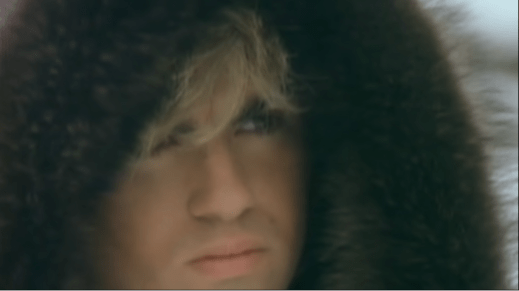
Screenshot from Wham’s “Last Christmas”
George Michael, of course, was publicly closeted for a long time. It’s unsurprising that we see some horror motifs in this heterofest. The wide-angle shot of the isolated cabin, the close up of a brooding, tortured hero…There may well be a queerness in the absence of gendered pronouns and in the visual aesthetic of the music video. But the real disruption, I think, comes in the structural repetition, the rehearsal of the singer’s failure to reproduce each year at the moment that reproduction is most central. If Christmas love songs circulate in a framework of reproductive futurity, “Last Christmas” Scrooges its way onto the airwaves every year and projects an utter failure of a future.
Most Christmas pop songs come and go. The drive to fill the airwaves with a genre of music that is only functional for 6-8 weeks of the year yields heaps of treacly sonic detritus. Christmas pop songs are, by nature, ephemeral. A few of these songs, though, become classics that artists return to and cover or remix over and again. “Last Christmas” is one of these classics, settling onto November and December playlists in its original form and the myriad cover versions that have piled up over the years. Benny Benassi’s “Last Christmas” remixes the Wham! song in a way that maintains the original’s queerness even as it flips the idea of looping failures.
Benassi’s “Last Christmas” revolves around two main sections: a driving techno beat (A) and a reworking of Wham!’s chorus (B).
A (48 measures)
B (48 measures) (1:25)
A’ (24 measures) (2:22)
B’ (56 measures) (3:04)
A” (32 measures) (4:15)
The A sections include a voiceover from a computerized voice affected so that it sounds like some dystopic transmission. “We would like to know if something does not sound quite right,” the voice starts, and then preps the entry of section B with “to guarantee safety to your perfect celebration, be sure – when playing this tune at maximum volume level – to chant around like everybody else is.” It’s hard to be more on-the-nose than this: an android voice instructing us how to fit in at our reproductive futurist holiday gatherings. “You know, just…I don’t know, just do what the others are doing?”
The B sections are each a sequence of three “Last Christmas” choruses (B’ includes an extra eight measures of the third in the sequence). The first is a sped-up but otherwise unaltered Michael singing about last Christmas. It’s a jarring entry, as the cool machinery of Benassi’s beat suddenly gives way to shimmery 80s pop. The second time through that familiar double chorus, we can hear Benassi’s groove faintly in the background and growing louder and fuller toward the end. It’s a straightforward remix technique: here’s the thing, here’s the thing mixed with my beat, and now here’s what I’m really getting at.
It’s the third sequence (1:53), then, where Benassi really crafts his own “Last Christmas.” Here, the beat we heard when the android told us how to fit in combines with Michael’s chorus as Benassi stutters and clips not only the lyrics but the instrumental, too: nothing is stable. Michael can’t finish a sentence (“La-a-as-a-ast, I gave you my gave you my hear-. Thiii-i-i-i-is year to save me from save me from, I’ll give it to someone, I’ll give it to someo-o-one.”), and the beat can’t get a firm start. While Wham!’s “Last Christmas” uses the Post-Chorus to form a closed loop where past and future circle back around to each other, Benassi’s “Last Christmas” denies reproductive futurity by chopping off the beginnings and ends of phrases. Built on a simple two-measure loop that otherwise motors smoothly through the song, Benassi’s “Last Christmas” can’t loop in the third sequence of the B section because there’s nothing to latch onto.

“last christmas” by Flickr user Dako Huang, CC BY 2.0
While Wham! loops queer failures in their overarching forms, Benassi’s version of the song queerly fails to loop. Both versions of “Last Christmas” bah and humbug at reproductive futurism. They’re Scroogey reminders each year to listen for disruptions of nativity, refusals of politically delimited desires that are queerly vibrating through our earbuds.
_
Featured image: “GOOD BYE and THANK YOU” by Flickr user fernando butcher, CC BY 2.0
_
Justin aDams Burton is Assistant Professor of Music at Rider University. His research revolves around critical race and gender theory in hip hop and pop, and his book, Posthuman Rap, is available now. He is also co-editing the forthcoming (2018) Oxford Handbook of Hip Hop Music Studies. You can catch him at justindburton.com and on Twitter @j_adams_burton. His favorite rapper is one or two of the Fat Boys.
_
 REWIND! . . .If you liked this post, you may also dig:
Benefit Concerts and the Sound of Self-Care in Pop Music–Justin Adams Burton
Audio Culture Studies: Scaffolding a Sequence of Assignments– Jentery Sayers
“Hearing Queerly: NBC’s ‘The Voice’”– Karen Tongson
Share this:


Current Top Posts





April 2021

January 2020

November 2019

October 2019

August 2019

April 2014

November 2017

March 2015

December 2017

October 2015
 Sounding Out!
Recent Comments