
Death Wish Mixtape: Sounding Trayvon Martin’s Death
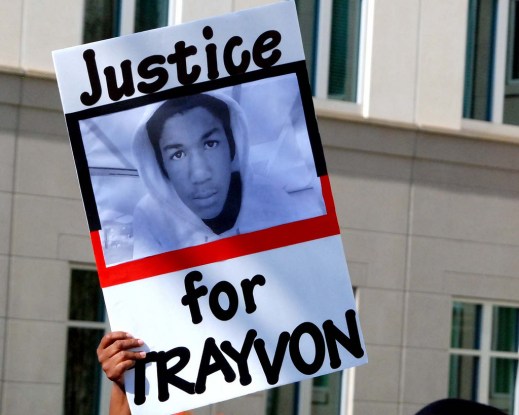
“Many men wish death up on me/ blood in my eye dog and I can’t see/ I’m trying to be what I’m destined to be/ and niggas tryna take my life away” –50 Cent, “Many Men (Death Wish)”
After hearing about the murder of Trayvon Martin, the unarmed teenager who was shot to death by George Zimmerman in a gated community in Sanford, Florida on February 26, 2012, I grappled with the urge to grab my godsons, nephews, cousins, brothers, and husband and never let go. I grappled with the Du Boisian question of the color-line, redressing it to consider “what does it feel like to be not only a problem but a target?” With these thoughts in my mind, I especially grappled with listening to the audio records of the 911 calls documenting the death of Trayvon Martin, just released late Friday March 16thby the Sanford police department.
I have mixed reasoning as to why I listened to the tapes. Part of me was just being nosy, but there was a deeper, far reaching curiosity stemming from my southern roots. As a Georgia girl, I was raised by Georgia men. My grandfather vividly recounted horrific stories of lynchings and beatings that happened “at the hands of persons unknown.” My mindset, like that of many, shifted to thinking about Trayvon’s death as a lynching. These tapes gave sonic urgency to a historically silent crime. In a word, Trayvon’s desperate screams gave voice to the countless men and women before him who died at the hands of white vigilantism.
As I listened to the distraught callers—and Trayvon’s final screams and pleas for his life—my mind became a mosh pit of emotions. Pissed, my mental playlist shuffled to 50 Cent’s “Many Men (Death Wish).”
.
I imagine Trayvon walking as the haunting piano and strings at the start of “Many Men” accompany his steps. He anxiously questions Zimmerman– “Why are you following me?” – in a similarly anxious way as 50 Cent can be heard asking “what’s taking homie so long, son?” and the shot rings out. As Trayvon screams and falls, the hard hitting boom fills the silent void. His lifeless body lays face down in the dirt, a lone piano softly signifying vulnerability as 50 Cent’s chorus starts: “many men wish death upon me/blood in my eye dog and I can’t see/I’m trying to be what I’m destined to be/and niggas tryna take my life away.” Situating Trayvon Martin’s final moments in a song by 50 Cent is discomforting, yet speaks to the reality and imaginative scripts of black masculinity as violent. The physical gunshot to Martin’s chest echoes the allegorical shots heard in the “Many Men” track and those in songs like Notorious B.I.G.’s “Who Shot Ya,” as another example, simultaneously blur and re-enforce black death as fantasy and normative. The 911 calls documenting Trayvon Martin’s death heard in concert with 50 Cent’s song sonically reify (gun) violence as a dominant discourse of black male identity. Indeed, Trayvon, I know who shot ya and gave you a death wish. I cannot, however, understand why.
.
The sonic surveillance of Trayvon Martin and George Zimmerman’s run-in—documented by the numerous accounts of neighbors who heard something but did not go outside—presents a juxtaposition of expected black male identity with the vulnerability of a horrified child forced into a criminalized space of black masculinity. In Zimmerman’s 911 call–listen via the Huffington Post here–he nonchalantly and at time heavily sighs about Martin’s blackness and its associated threat – “he’s black,” “he looks suspicious,” “he’s up to no good.” The passivity of Zimmerman’s voice reflects his bridging of (young) black masculinity as threatening. The panicked callers’ voices, however, represent reprieve and reinstate Trayvon’s humanity. The Trayvon Martin 911 recordings, then, are a mixtape of his final moments, sampling the voices of the various callers to construct Trayvon’s fatal narrative. Ultimately, the callers give voice to the vulnerabilities that Trayvon was deemed unable to evoke or possess by default as a black male.
 I use the word “mixtape” here to argue that the frequencies of trauma in which the (white) listener situates Trayvon Martin’s death must be heard within a larger understanding of sound as a commodified and racialized space. Ultimately, the recordings of Trayvon’s death are a sonic reflection of a long history of white America’s treatment of black bodies as capital. In negotiating the black (male) body as a commodity – which is historically and culturally significant – sounding the black male body as a commodity contextualizes this moment of expected black masculine performance for nonblack listeners. It needs to be noted how pathological black masculinity is profitable and mutually invested in by black men and white consumers alike. Briefly referring back to 50 Cent, he performs and is validated by the violence his narrative possesses. He knowingly invests in the exaggeration of his experience – he really was shot – and builds his image upon that paranoia. In In the Break, Fred Moten discusses the sonic commodification of blackness as “not what the commodity says but that the commodity says or, more properly, that commodity in its ability to say, must be made to say” (9). Situating black rappers’ narratives and, extensively, black men’s narratives as a commodity speaks to how the ambiguity of such narratives relegate blackness to a position of profitable, essentialized discourse. Moten suggests sounding blackness as a commodity is an effort to address these ambiguities, linking the privilege of speaking and constructing black (masculine) narrative, not content, as culturally and capitalistically recognizable and significant.
Trayvon’s political agency is invested in the violence placed upon his body by public scrutiny as a black man before there is any vulnerability as a child. Thrust instead into the position of ‘suspicious’ black man in a predominately white middle-class gated community, Trayvon the child bears the public scripts of expected black masculine performance, which are both visual and sonic. These expectations of popular culture and public opinion distort Trayvon’s sonic imprint, rendering him unable to vocalize and physically relay his desperate need for help.
As Mark Anthony Neal points out in a his March 19th New Black Man post “Hearing Trayvon Die” linking hearing Trayvon Martin’s death to a scene of a grieving Muddy Waters (Jeffrey Wright) from the 2008 film Cadillac Records, in which Waters’s pain is heard but not seen: “part of the reason that Jeffrey Wright’s howling had to be experienced off screen is that we have little understanding of Black males, as vulnerable, in pain, under duress, in terror and confronting death.” The impact of the lack Neal describes emphasizes the necessity for a sonic imposition of such vulnerabilities. In this case, the agency of this need is heightened by the audience being forced to listen to Trayvon’s frantic screams for help on tapes, thus humanizing him before racializing his body.
Yet it is Trayvon’s alleged screams – which I undoubtedly believe ARE his screams– that also sonically invoke his humanity. On the recording, heart-wrenching screams for help are silenced by the forceful pop of a gunshot, the silence signifying multi-layered historical and cultural indicator of Trayvon’s worth as a black boy in American society. Trayvon’s screams vocalize the agonizing silent demise of the murdered black boys before him. . .Oscar Grant. . .Amadou Diallo. . .Emmett Till. His screams are an echo of Frederick Douglass’s Aunt Hester’s screams, recorded in his 1845 Narrative, acknowledgement of the cruelty and continued viability of longstanding—even foundational—racial prejudice and violence that exists within the contemporary ‘postracial’ American agenda.

The Million Hoodies Union Square protest in New York against the shooting of Trayvon Martin in Sanford, Florida, by Flick'R User David Shankbone
Moreover, Trayvon’s scream also concisely signifiy the ongoing “upheaval” and chaotic existence of black men that Moten suggests “pressures the assumption of the equivalence of personhood and subjectivity” (1). Trayvon’s screams amplify a tragic dimension of what I theorize as “sonic cool pose,” where black masculinity is only cool if accompanied – instrumentally, lyrically, and otherwise – with violence. In this regard, the sonic signifiers that mark death—like the gunshots and screams that introduce 50 Cent’s “Many Men,” for example—are Trayvon’s. Both built upon the traumatic condition frequently faced by men and boys of color, Trayvon and 50 Cent’s lived experiences can be heard as sonically interchangeable despite obvious differences in class position. Through sound and the American popular imagination, black manhood is virulently fluid. There is a universal, stereotypical understanding that black masculinity resorts to identical markers of lived experience. This awareness is especially heightened and dominant in sound, where 50 Cent’s shooting on the corner parallels Trayvon’s shooting in a gated townhome community.
The release of the 911 audio of Trayvon Martin’s death is a powerful intervention in maneuvering black masculinity and violence in American (popular) culture. There is a delicate and simultaneous reading of the recordings as a sonic realization of black masculine violence and a fetishizing of a violated black male body. The sounds they contain amplify a continued American investment and interest in the black pathological narrative while doubly intervening as an alternative reading of such negotiations of black manhood. Whether sounded across a courtyard in a gated suburban neighborhood in Sanford, Florida, or on the streets of South Jamaica, Queens—or in the isolation booth in a recording studio—these frantic and desperate screams are sonic imprints of his social-cultural relevance. They may bleed into one another, but they won’t fade away.
 —
—
R.N. Bradley is a PhD candidate in African American Literature at Florida State University. She writes about African American literature, race and pop culture, Hip Hop, and her own awesomeness. She earned her BA in English from the Unsinkable Albany State University (GA) and a MA in African American and African Diaspora Studies from Indiana University Bloomington. Her dissertation project looks at negotiations of white hegemonic masculinity and race consciousness in 21st century African American literature and popular culture. You can read her work atAllHipHop, Newsone, TheLoop21, or her monthly column “The Race to Post” over atPopMatters. Scholar by day, unapologetic Down South Georgia Girl 24/7/365. Catch up with her awesomeness via twitter:@redclayscholar and her blog Red Clay Scholar (http://redclayscholar.blogspot.com).
Share this:

Sound at EMP Pop Con 2012

As our Editor-in-Chief Jennifer Stoever-Ackerman mentioned in her Society for Cinema and Media Studies (SCMS) Conference Round-Up post from this past Monday, this weekend will be action packed for those interested in media studies and popular music studies. This year is the first year the Experience Music Project Museum (EMP) POP Conference will take place on the East Coast—sponsored by New York University’s Clive Davis Institute of Recorded Music. In addition, the EMP POP Conference will be jointly held with the International Association for the Study of Popular Music (US) Conference (IASPM-US for short). With that in mind we have brought two conference round-up posts this week. (Speaking of blogging about conferences, don’t miss IASPM’s blog coverage of EMP POP Conference 2012, where they are previewing several papers that will be read at the conference.) Even though our editorial collective is still working on the technology to enable us to be in several places at once so we don’t miss out on these awesome opportunities, I will be Sounding Out’s eyes and ears at EMP POP Conference. I will also attempt to live-tweet the panels I am attending. You can find me at @literarychica, or you can follow the conference tweet stream at #PopCon
The EMP POP Conference has been bringing together academics and non-academics alike, musicians and non-musicians alike, music writers and non-music-writers to discuss the direction of popular culture–especially popular music. The theme of this year’s POP Conference is Sounds of the City, and what better location for these cross-disciplinary conversations than New York City? From the conference website:
Presenters will pay particular attention to what urban environments have meant for race, gender, and sexuality. Jazz, rock, indie, country, metal, electronic dance music, roots, disco, and Broadway music are but some of the sounds that will be the subject of entire panels.
The city becomes the place to explore how sound is constructed but also how the city helps construct sound—and its counterpart, noise. Detroit, Berlin, and New York City, among others, take certer stage in this year’s program. Many of the panel topics show an interest in thinking about how sound influences our notion of urban space, which brings to my mind the “cities of feeling” that Carlo Rotella talks about in his book October Cities: The Redevelopment of Urban Literature. If, according to Rotella, “literary writers are in the business of imagining cities,” here at the EMP POP Conference there is an impulse to consider how do sound and noise participate in that imagining, and how gender and race play a role (3). The conference offerings illustrate an attempt to think about the sounds of the city in a broader sense, not just limiting it to music. Although the EMP POP Conference stands out for its critical focus on everything related to popular music, this year’s panels are more sound-studies oriented.
Another indication of the sound studies influence at this year’s EMP POP Conference is a focus on listening. There seems to be a an inclination not just to think about the sounds within the city but how we listen to those sounds. Listening is an important factor in how sound is constructed; in other words, an analysis of sound is not limited to the sounds themselves, but how those who listen interpret those sounds, or how listeners themselves are perceived. From the Feminist Working Group‘s Friday panel titled Turn It Up! One: Listening to Difference to Gustavus Stadler’s “Aural Drag: Warhol as Pop Listener” to the Sunday panel Urban Ears, listening is part of the conversation taking place at NYU this weekend about sound and urban space.
Our regular readers will see several familiar names in the program. Gayle Wald is presenting on the Marvelettes Friday morning on the Afro Imaginaries panel. Gustavus Stadler is moderating the Lonely Subcultures panel on Friday and presenting on Andy Warhol in his paper “Aural Drag: Warhol as Pop Listener.” (Insider tip: keep an ear out for Eric Lott, who will be presenting on the same panel as Stadler; you can expect a blog post from Lott in the upcoming months.) Karen Tongson, who blogged for us on The Voice, will be presenting a paper titled “Drive and Sounds of the ‘80s Metropolis.” Scott Poulson-Bryant will be participating in the Saturday afternoon roundtable on Whitney Houston titled “Newark’s Finest: Reflections on Whitney Houston.” Last but not least, Regina Bradley, one of our regular writers, and myself will be presenting together on a roundtable on Sunday titled “I Pledge Allegiance to the Block: Cityscapes, Hegemonic Sound, and Blackness.”
The conference will take place at New York University’s Kimmel Center, and is free of charge. To find out more about the presenters or to read about all the other outstanding panels at the conference, please visit the conference website. So if you’re in the New York City area Thursday through Sunday (or if you’re considering hopping on a train from Boston to check out some panels–wink wink), the conference will be well worth your while!
Please comment to let SO! know what you think–both before and after EMP PopCon 2012. If I missed your panel in my round up, please drop me a line: lms@soundingoutblog.com
—
Liana M. Silva is co-founder and Managing Editor of Sounding Out! She is also a PhD candidate at Binghamton University.
Jump to THURSDAY, March 22
Jump to FRIDAY, March 23
Jump to SATURDAY, March 24
Jump to SUNDAY, March 25

"Music in Central Park, New York City" by Flickr user Creative (Elias) 809 under Creative Commons License
Back to menu
THURSDAY, March 22
Thursday, March 22, 2012
Thursday, March 22, 2012 7:00pm-8:30pm
Conference Opening Keynote: The Artist in the City: with Angélique Kidjo, Esperanza Spalding, Santigold, and Himanshu Suri (aka Heems)
Room: Eisner & Lubin Auditorium KC 401
Writing about how jazz in the mid-20th century reflected lived experience in New York city’s tenements, the scholar Shane Vogel quoted Duke Ellington’s description of his swing symphony, “Harlem Air Shaft”: “So much goes on in a Harlem air shaft…You hear fights, you smell dinner, you hear people maing love. You hear intimate gossip floating down. You hear the radio. An air shaft is one great big loudspeaker.” In the crowded city, the musician-composer becomes a living receiver, distilling a static field of sounds and sensations into an evocative whole.
This keynote event gathers together four prominent artists whose work reflects a cosmopolitan worldview, with each artist rooted in his or her particular urban home. Grammy winning Beninoise singer-songwriter Angélique Kidjo has truly had a global career, having recorded albums in a staggering array of languages, styles, genres and cities; her recently-released live album Spirit Rising is a career retrospective featuring diverse guests like Ezra Koenig, Josh Groban and the Kuumba Singers. Grammy winner Esperanza Spalding is about to release her third album, Radio Music Society, a border-crossing blend of jazz, soul, funk and pop that reflects the cities she loves: New York, Barcelona, and her birthplace of Portland, Oregon. Philadelphia-bred, Brooklyn-based Santigold (Santi White) is one of the brightest lights of the East Coast bohemian underground; her upcoming second album, Master of My Make Believe, takes her incendiary blend of hip hop, indie rock and dance music to a new level. On his recent mixtape Nehru Jackets, Himanshu Suri (Heems) of the Queens-identified hip hop group Das Racist drops wit and wisdom about the ups and downs of life in Gotham’s five boroughs. Discussing their new work and how they’ve formed their own sound and vision in relationship to the urban spaces where they thrive, these artists consider what’s changed and what remains consistent in the half-century plus since the Duke found heaven in the clanging multiplicity of the air shaft.
Moderator: Ann Powers
Featuring:
Angélique Kidjo
Esperanza Spalding
Santigold
Himanshu Suri

"Sound The Trumpet" by Flickr user Blacren under Creative Commons License
Back to menu
FRIDAY, March 23
Friday, March 23, 2012
Friday, March 23, 2012 9:00 am-11:00 am
Afro-Imaginaries
Room: KC 804/5
Moderator: Banning Eyre
Featuring:
Gayle Wald, “‘Deliver De Letter’: ‘Please Mr. Postman,’ the Marvelettes, and the Afro-Caribbean Imaginary”
Emily J. Lordi, “Moving Out: White Flight and Sly and the Family Stone’s ‘Stand!'”
Koushik Banerjea, “Cities of the Dead: Soundscaping Race, Memory and Desire in a Forgotten London”
Wills Glasspiegel & Martin Scherzinger, “Beyoncé’s Afro-Future: Power and Play in “Run the World (Girls)””
Repositioning Urban Pop
Room: KC 808
Moderator: Barbara Browning
Featuring:
Rustem Ertug Altinay, “‘In Konya she would marry a regular dude, but Serife from Konya is now a Lady’: Power, Sexuality and Cities in Gungor Bayrak’s Autobiographic Songs”
Erin MacLeod, “‘Layers and layers of not-so-dope synths’: Listening to the Music of Addis Ababa”
Mark Lomanno, “Surfaces and (archi)Textures in Canarian Jazz”
Sonic Contestation
Room: KC 406
Moderator: John Melillo
Featuring:
Patrick Deer, “‘The Cassette Played Poptones’: Punk’s Pop Embrace of the City in Ruins”
Jessica Schwartz, “Conform or Die: Composing the City as National Security Threat, 1945-1962”
John Melillo, “Revenant Frequencies: Destructive Sound from “The Waste Land” to NYC Ghosts and Flowers”
J. Martin Daughtry, “Evocative Objects and Provocative Actions on the Acoustic Territory of War”
Friday, March 23, 2012 11:15 am-12:45pm
Turn It Up! One: Listening to Difference
Room: KC 808
This panel is sponsored by the Feminist Working Group. Since 2008, we have organized panels, get-togethers and networking opportunities for all feminists who participate in EMP. For more information about our activities, and to get involved, please visit http://feministworkinggroup.blogspot.com
Moderator: Lucy O’Brien
Featuring:
Summer Kim Lee, “‘Singin’ Up On You’: Queer Intimacies of the Sonorous Body In ‘The New Sound Karaoke'”
Daniel Sander, “Girl. Reverb. Notes on Queer Tactics of Sonorous Difference”
Kyessa L. Moore, “(Sub)Spacialized Urban Sound, Expressive Communion and Identificatory Dislocations”
Cairo and Athens Spring Up
Room: KC 405
Moderator: Katherine Meizel
Featuring:
Banning Eyre, “Cairo Soundscape: Revolution and Cultural Renaissance”
Maysan Haydar, “Wild in the (Arab) Streets: Songs for the Revolutions”
Hypatia Vourloumis, “Bad Athena: Crises, Syntheses and Sounds of a European Other”
Lonely Subcultures
Room: KC 406
Moderator: Gustavus Stadler
Featuring:
William Hutson, “Abrasive Nostalgia: A Noisescape of Deindustrialization”
Vivian L. Huang, “Not That Innocent: Britney Spears, Laurel Nakadate and Strangers”
Julia DeLeon, “Dance Through the Dark Night: Distance, Dissonance and Queer
Friday, March 23, 2012 2:15pm-3:45pm
Memory, Music, and the Metropolis
Room: KC 804/5
Moderator: Charles Kronengold
Featuring:
Tracy McMullen, “In the Beginning, You Are There: Cloning Genesis and the Return of the Urbane”
Tavia Nyong’o, “Shame and Scandal and Zombies”
Karen Tongson, “Drive and Sounds of the ’80s Metropolis
Broadway Bound
Room: KC 808
Moderator: Caroline Polk O’Meara
Featuring:
Raymond Knapp, “The Sound of Broadway’s Mean Streets”
Jacqueline Warwick, “‘Bigger than Big and Smaller than Small’: Child Stars, Street Urchins, and Little Orphan Annie”
Elizabeth L. Wollman & Susan Tenneriello, “Spider-Man: Turn off the Dark and the Ambivalence of Spectacle
Turn It Up! Two: Making Community
Room: KC 405
Moderator: Elizabeth Keenan
Featuring:
Rachel Devitt, “I Love a (Pride) Parade: Queer Community-Building, Temporary Spaces and Politicized Kitsch among LGBT Marching Bands”
Evelyn McDonnell, “The Roads to Ruin”
Matthew Carrillo-Vincent, “Ears to the Streets, Peripheral Beats: The New Social Map of Backpack Rap”
Friday, March 23, 2012 4:00pm-6:00 pm
Roundtable: “Do You Want More?” The Time and Space of Alternative Sonic Blackness
Room: GC 95
The migration of sounds and ideas across time and place encourages synthesis; giving rise to avant garde, radical, and futurist voices. What (other) worlds open up and what (outer) spaces are formed? How do regional sites remix global flows? What factors/forces enable or prohibit certain voices from finding an audience in the national, global or cyber scene? How do we reconcile organicism of sound, as musicians produce out of particular worlds, with the reckless and restless ways music circulates?
Moderator: Jayna Brown, Daphne Brooks, Tavia Nyong’o
Featuring:
Kyle Dargan
Mendi Obadike
Jace Clayton
The work of Barry Jenkins
Location Location Location
Room: KC 802
Moderator: Fabian Holt
Featuring:
Keith Negus, “Making it in the Big City: Small Town Boys, Country Girls and Suburban Dreamers”
Jennifer C. Lena, “The Ground on which the Race was Run: Careers in Pop”
Carl Wilson, “We Hate It When Our Friends Become Successful: The Death and Life of Great North American Scenius”
Kembrew McLeod & Loren Glass, “Killer Apps Play the Sounds of the Cities”
Detroit: Foundation, Eclecticism, and Memory
Room: KC 808
Moderator: Marlon Bailey
Featuring:
Rebekah Farrugia & Kellie Hay, “‘The Foundation’ in Detroit: Challenging Conventional Ideologies about Sex and Gender in Hip Hop”
Denise Dalphond, “Eclecticism in Detroit: Diverse Dance Party Scenes in Electronic Music”
Carleton S. Gholz, “Remembering Rita: Sound, Sexuality, and Memory”

"New York City." by Flickr user Kyle McCluer under Creative Commons License
Back to menu SATURDAY, March 24
Saturday, March 24, 2012
Saturday, March 24, 2012 9:00 am to 11:00 am
Metal Studies Rising
Room: KC 808
Moderator: Jeremy Wallach
Featuring:
Esther Clinton, “The Gothic Menace, Then and Now: Gothic Literature, Heavy Metal Music, and Moral Panics”
Eric Smialek, “How Does Metal Mean? Ways that Musicology Can Contribute to Metal Studies”
Amber R. Clifford-Napoleone, “Hell Bent for Metal: A Study of Queer Fans of Heavy Metal”
Nelson Varas-Diaz & Eliut R. Rivera-Segarra, “Heavy Metal music in the Caribbean Setting: Social Practices and Meanings of Music at the Periphery”
Saturday, March 24, 2012 11:15am-12:45pm
Street Dreams: Blackness on the Move
Room: KC 802
Moderator: Alexandra T. Vazquez
Featuring:
Adrienne Brown, “Rehearing Hip-Hop Automotivity”
Sonya Posmentier, “City Streets, Country Roads: Zora Neale Hurston’s Moving Sound”
Francisco Robles, “‘This bitter earth may not be so bitter after all’: Political Promise and Sonic Geography in Killer of Sheep and We Insist! Max Roach’s Freedom Now Suite”
Sexuality and the City
Room: KC 405
Moderator: Franklin Bruno
Featuring:
Philip Gentry, “The Erotics of Chance”
Emily Tartanella, “‘A Country Mile Behind the World’: A Smithsian Sense of Place ”
Elias Krell, “Singing the Contours of the City: Transvocality and Affect in Lucas Silveira’s Toronto”
Preserving Soundscapes
Room: KC 406
Moderator: Laura Lavernia
Featuring:
Matthew Hayes, “Preserving America’s Endangered Soundscapes: An Emerging Field in Historic Preservation”
Barrett Martin, “Preserving Musical Memory: Physical Space and Socio-Economic-Cultural Identity”
Devon Powers, “Writing Music (Into) History”
Saturday, March 24, 2012 2:15pm-3:45pm
Warhol’s New York
Room: KC 914
Moderator: Jonathan Flatley
Featuring:
Gustavus Stadler, “Aural Drag: Warhol as Pop Listener”
Eric Lott, “Andy’s Mick: Warhol Builds a Better Jagger”
Bryan Waterman, “‘It’s Too ‘Too Too’ to Put a Finger On’: Tom Verlaine’s Lost Lisp and the Secret History of the New York Underground”
Losing It in the City
Room: KC 804/5
Moderator: Ken Wissoker
Featuring:
Carolina González, “DomiNegro turf: Whose Uptown?”
Keith M. Harris, “‘I don’t care anymore’: Deep Soul, Doris Duke, and the Allegory of Migration”
Michael B. Gillespie, “We Almost Lost Detroit: Sonic Historiography, 9/11, and Theo Parrish”
Saturday, March 24, 2012 4:00pm-6:00pm
Roundtable: Feminist and Queer Studies of Race in Sound
Room KC 804/5
This roundtable convenes two fields of scholarly inquiry—critical race studies and feminist theory/queer studies—to explore the following interrelated questions: How does sound construct racialized and gendered meaning and/or prompt processes of racial subjection? How might various hermeneutics of sound enrich and/or expand current ethnic and gender studies approaches to the study of racial formation? And how might we collectively forge a feminist, queer analytic for the study of racialized sound and sonic processes of racialization?
Moderator: Kevin Fellezs
Featuring:
Kirstie Dorr
Roshanak Kheshti
Deborah Vargas
Saturday, March 24, 2012 6:15pm-7:30pm
IASPM-US General Membership Meeting
Room: Rosenthal Pavilion, 10th Floor
The general membership meeting of IASPM-US is the organization’s opportunity to gather together and discuss the accomplishments of the past year, any concerns or issues that have arisen, and plans for the coming year. All IASPM members are welcome. We would also like to invite any interested regular EMP participants who might be interested in joining IASPM. Beyond our normal business, the general meeting this year will feature the announcement of the first winner of the Charles Hamm Memorial Award in recognition of lifetime contribution to Popular Music Studies. In addition, the David Sanjek Award for best paper by a graduate student at the meeting will be announced.

"NYU" by Flickr user LEH.nicor under Creative Commons license
Back to menu
SUNDAY, March 25
SUNDAY, March 25, 2012
Sunday, March 25, 2012 9:00 am to 11:00 am
‘Silver City Bound’: Black Women Musicians & the Urban Avant Garde
Room: KC 905/7
Moderator: Imani Perry
Featuring:
Daphne A. Brooks, “‘One of these mornings, you’re gonna rise up singing’: The Secret Black Feminist History of the Gershwins’Porgy and Bess ”
Farah Jasmine Griffin, “Playing through the Changes: Mary Lou Williams’ Manhattan”
Salamishah Tillet, “Bethlehem, Boardwalks, and the City of Brotherly Love: Nina Simone’s Pre-Civil Rights Aesthetic”
Jayna Brown, “After the End of the World: Afro Diasporan Feminism and Alternative Dimensions of Sound”
Distanced Listening
Room: KC 802
Moderator: Tom Miller
Featuring:
Jeremy Morris, “Hear, Here: Location-Based Music”
Van Truong, “Distant Sounds”
Mark Katz, “Analog and Digital: A Love Story”
Karl Hagstrom Miller, “I am Sitting in a Room: The Private Pop Experience”
Sunday, March 25, 2012 11:15am-12:45am
Utopian Spaces in an Accelerated Age
Room: KC 802
Moderator: Eric Lott
Featuring:
Wayne Marshall, “Music as Social Life in an Age of Platform Politricks”
Julianne Escobedo Shepherd, “Cunt Music: When Vogue House Dips Meet Dipset”
Max Pearl & Alexis Stephens, “New Jack City: Frenzied Cultures, Transitory Spaces (or, how I learned to stop worrying and embrace the hype cycle)”
Sunday, March 25, 2012 2:15pm-3:45pm
Urban Ears
Room: KC 905/7
Moderator: Greil Marcus
Featuring:
Sonnet Retman, “Muddy the Waters: Other Stories of Love and Theft in the Making of the Delta Blues”
David Suisman, “The Urban Ear of Tony Schwartz”
Franklin Bruno, “Who Put the Arrow in ‘Cupid?’: Hugo and Luigi’s Schlock ‘n’ Soul”
A Girl’s Guide to the Urban Imaginary
Room: KC 914
Moderated by: Jacqueline Warwick
Featuring:
Elizabeth Keenan, “Out in the Streets: 1960s Girl Groups and the Imagined Urban Space of New York City”
Sarah Dougher, “Making Noise in the Safe Space: How Girls’ Rock Camps Make Place in the City”
Diane Pecknold, “The Spectral Cityscapes of Tween Pop”
“Beat Street”: New York City Hip-Hop
Room: KC 804/5
Moderator: Oliver Wang
Featuring:
Patrick Rivers, “Rumble in the Concrete Jungle: Beat Battles in NYC and Their Impact on Hip-Hop Production”
Shanté Paradigm Smalls, “‘Voices Carry’: Queer Dissonance and the Travel of NYC 1980s Hip-Hop Sound”
Chris Tabron, “‘Boom It in Ya Jeep’: Low-end Theories of Black Aurality in 90’s NYC Hip-Hop”
Roundtable – I Pledge Allegiance to the Block: Cityscapes, Hegemonic Sound, and Blackness
Room: KC 808
Whether a homesite for protest and resistance or, as Alain Locke suggests, an escape from the ‘medieval’ south, the city serves as both a muse and haven for black American cultural expression. Although city-scapes are heavily represented in African American music and popular culture, more discussion is needed about how the city is often a hegemonic space of black cultural expression. In other words, how does an urban setting dictate power and blackness in the (African) American community?
Moderator: Guthrie Ramsey
Featuring:
Regina Bradley
Fredara Hadley
Matthew D. Morrison
Liana Silva
Sunday, March 25, 2012 4:00pm-6:00pm
Modern English
Room: KC 808
Moderator: Devin McKinney
Julia Sneeringer, “‘I’d Never Even Been to Manchester’: Liverpool Musicians in Hamburg’s Entertainment Economy, 1960-1965”
Leonard Nevarez, “How Joy Division came to sound like Manchester”
Lucy O’Brien, “Can I Have a Taste of Your Ice Cream? (Post punk feminism and the Yorkshire Ripper)”
Gillian Gower, “Riot Culture: Beats, Banksy, and the Bristol Sound”
Share this:


Current Top Posts





April 2021

January 2020

November 2019

October 2019

August 2019

April 2014

November 2017

March 2015

December 2017

October 2015
 Sounding Out!
Recent Comments