
Surf, Sun, and Smog: Audio-Visual Imagery + Performance in Mexico City’s Neo-Surf Music Scene

Riding the Surf Wave in a City Without a Seashore
On April 24, 2005, at Zócalo square in downtown Mexico City, the Surf y Arena music festival gathered around 100,000 people and nine bands, ranging from local, barely known groups to big names in the new-wave surf music scene: Fenómeno Fuzz, Los Magníficos, Perversos Cetáceos, Espectroplasma, Los Elásticos, Yucatán A Go-Go, Sr. Bikini, Lost Acapulco, and Los Straitjackets, the latter being the only U.S. band in the festival. One year before, hardly more than a thousand people attended the event, organized in a smaller venue at Alameda del Sur, a few hundred yards south of Zócalo square. Perhaps not even the bands were prepared for the huge response in 2005. Interviewed by local newspaper La Jornada, Fenómeno Fuzz lead guitarist stated, “It’s the first time we see something like this, with so many people. Surf is an instrumental rock genre that was played in the 50s and 60s. There is no sand or sun here as in Acapulco, but we’ve brought downtown a bit of the beach vibe. In Mexico City there must be some 40 bands playing to this rhythm.” In the same interview piece, Lost Acapulco lead guitarist El Reverendo considered, “this festival is a success, for you realize this music is going up. People are on the same pitch. This is not a movement, but a style with many followers. […] It doesn’t matter if there is no beach here—you have to imagine it.”
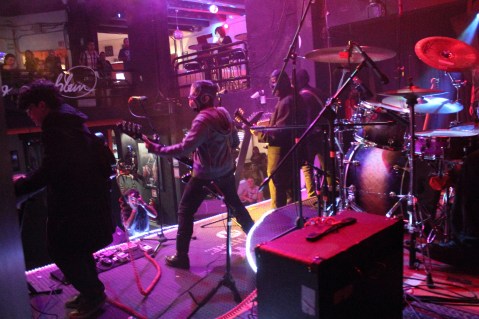
Sr. Bikini at Rock and Road on 30 de Marzo 2013, Image by Flickr User José Miguel Rosas (CC BY-SA 2.0)
The bands who played at the 2005 Surf y Arena Festival wondered whether the success was transitory or would endure. More than a decade later, some are still active, most notably Lost Acapulco, whose singles and compilations have been released in countries like Spain, Italy, and Japan; they have toured around the world, and have released a new EP, Coral Riffs (2015). Los Straitjackets lead guitarist Danny Amis has collaborated with local surf bands like Lost Acapulco and Twin Tones; after surviving a hard battle against cancer, he moved to Mexico City’s Chinatown. Los Elásticos also released a new album, Death Calavera 2.2, the Espectroplasma members formed Twin Tones and have played, toured and participated in the short film inspired by their first record, Nación Apache. In 2016, the Wild’O Fest brought together old and new surf stars, starring The Fleshtones (U.S.) and Wau y los Arrrghs! (Spain), as well as local legends Los Esquizitos and Lost Acapulco. In February 2017, the Russian band Messer Chups toured across Mexico, playing with local bands in several cities. So it seems the scene is alive and kicking.
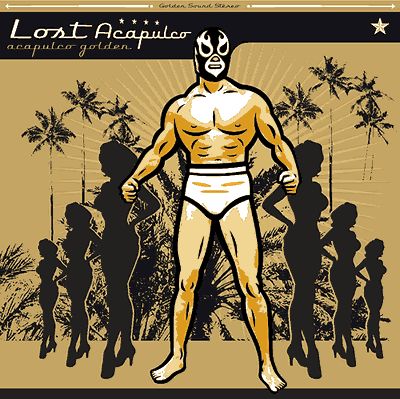
Lost Acapulco’s LP Acapulco Golden cover art by Dr. Alderete (2004). Masks became a famous trait of Mexican surf music. Danny Amys from Los Straitjackets and some Lost Acapulco members wear them on stage, as well as many other surf bands. This cover echoes films from the 50s and 60s featuring wrestlers like Santo and Blue Demon.
Today we can listen to how surf music shaped part of Mexico City’s underground music scene in the last decade of the 20th century and the early 21st. Being 235 miles away from Acapulco, one might wonder how wearing sandals, short pants, floral print shirts, plastic flower necklaces, and dark sunglasses became trendy in the country’s capital city. To this beach imagery, surf bands and fans added references to classic Mexican media icons, like wrestler Santo, comedian Mauricio Garcés, and black and white sci-fi movies. The work by visual artists like Dr. Alderete—who has designed covers and posters for many surf bands, such as Lost Acapulco, Fenómeno Fuzz, Telekrimen, The Cavernarios, Los Corona, among others—has been crucial for this imagery cross-reference process.

Lima-based visual art magazine Carboncito cover art by Dr. Alderete (2012). The cover features Kalimán, main character of an old Mexican comic strip, as well as other characters associated both with surf imagery (the Rapa Nui statue, oddly resembling a bamboo Tiki figure) and spy films like James Bond.
In this article I portray the neo-surf music scene in Mexico as a cultural-musical set of audiovisual and performative traits shared, modified, and transmitted by the scene’s partakers. It cannot be said there is a surf music “urban tribe” (a trendy concept for several years in Mexican youth studies), but rather shared “aesthetic” expressions of cultural syncretism, responding to the increase of atomization and alienation in Mexico City.
Just as in ska, punk, or hardcore rock, a number of surf concert attendees participate in typical genre-related rituals like moshing. Surf fans, however, are more “performatic” in the way Diana Taylor understands this term in The Archive and the Repertoire as “the adjectival form of the nondiscursive realm of performance” (6). Several surf concert goers wear masks, originally worn by notorious Mexican wrestlers like Santo, Blue Demon, and Rey Misterio (whose son would later become a WWE star). At the concert, when a song’s tempo suddenly stops or changes, masked dancers pose as if weightlifting, jump and crowd surf, stage fights, and mimic swimming movements. Surf music is the lyric-less soundtrack for the intertwined performance of different cultural traits, portraying a prolific tension between a hedonistic attitude associated with an invented nostalgia for West Coast surf culture, and the halo of exoticness surrounding Mexican culture in the U.S. imaginary, as portrayed by surf bands and artists (just to name a few, Herb Albert’s “Tijuana Taxi,” Link Wray’s “Tijuana,” and Los Straitjackets’ “Tijuana Boots”).
Mosh pit with masked participants. On stage, Lost Acapulco plays “Frenesick.” Multiforo Alicia, Mexico City, March 20 2009.
Tracing the Origins of Mexican Neo-Surf Music Scene
1960s Mexican rock and garage bands do not usually have instrumental songs in their repertoire, as is the case with Los Sleepers, or Los Rockin’ Devils. However, there are some examples of incursions in surf-related instrumentals, such as Los Teen Tops’ “Rock del diablo rojo,” or Los Locos del Ritmo’s  “Morelia.” It was not until Toño Quirazco (1935-2008) formed Quirazco y sus Hawaian Boys, though, that we find a Mexican instrumental song, “Surf hawaiiano,” explicitly using the noun “surf” as an identity marker, just like “Traveling Riverside Blues,” or “Jailhouse Rock”. The use of a pedal steel guitar (portrayed in their 1965 eponymous album cover photo), and its association to Hawaiian music through the slide guitar method, makes exotism an early sonic feature of Mexican surf. Born in Xalapa, Veracruz, Quirazco was not as famous as Los Teen Tops or Los Locos del Ritmo, but he is a key forerunner not only of surf music, as he is also known for having introduced ska to Mexican audiences, with songs like “Jamaica Ska” and “Ska hawaiano,” both off his album Jamaica Ska, also from 1965.
Although surf music bands suffered heavily with the arrival of the British Wave, not all of them disappeared. Bands such as The Ventures became famous for covering surf standards. Others, like The Beach Boys, eventually migrated to different music styles. Later in the 1970s and 80s, bands like The Cramps, The Stray Cats, and The Go-Go’s kept alive surf-related styles, so that by the time Pulp Fiction appeared, in 1994, there were some interesting bands we already can consider “neo-surf,” such as Man Or Astroman? and The Tantra Monsters; Los Straitjackets re-formed and Dick Dale began touring again. Quentin Tarantino’s soundtrack to Pulp Fiction (including songs by Southern California surf rockers Dale, The Tornadoes, The Revels, The Centurians, and The Lively Ones) contributed to bringing surf music back to mainstream attention, now as a vintage sound commodity (Norandi, 2002).
We might call this “the Pulp Fiction effect,” a phenomenon recognized by stakeholders in the scene, like Los Esquizitos guitar and theremin player Güili:
One day Nacho came up with the idea that we should play surf, because it was the moment in which […] in Satélite [a northern Mexico City neighborhood ] all bands wanted to play funk like Red Hot Chili Peppers or Primus. It became a virtuoso slap competition, and precisely no one was playing surf […]. Shortly afterwards, Tarantino’s Pulp Fiction was released and surf exploded impressively with the movie’s theme. But we were already riding the surf wave.
Multiforo Alicia has been an important venue for the consolidation not only of a surf scene, but also of other emerging movements at the time. Founder and owner Ignacio Pineda remembers,
When we started Multiforo Alicia [in 1995], there was a generational shift. There were a lot of new bands that didn’t fit into what had been going on in the last 10 or 11 years, and they were the punk rock, ska, hip-hop, transmetal, emo, and nu metal movements, which nowadays are quite normal. […] Luckily for us, [Alicia] was like home for all of them.
Interview with Multiforo Alicia owner Ignacio Pineda, 2011
It is a common venue for surf bands (Norandi, 2002, Caballero, 2012), and through their recording label, Grabaxiones Alicia, they have produced albums for some of the most interesting instrumental rock projects in Mexico, among them Twin Tones/Espectroplasma/Sonido Gallo Negro (three groundbreaking bands with the same members), Los Esquizitos, Los Magníficos, Telekrimen, The Cavernarios, and Austin TV. Massive festivals and concerts, like Vive Latino or Surf y Arena, have also contributed to positioning neo-surf as an ongoing trend in alternative rock.
Masking Identity, Performing Difference
While the emergence of Mexican neo-surf was contingent upon local and international music trends in the mid-90s, its permanence has been due to processes of cultural syncretism and appropriation. Wrestler masks are a good example. Worn first by Danny Amis, and later on by Los Esquizitos and Lost Acapulco, masks quickly spread out as a neo-surf visual icon. Los Esquizitos drum player, Brisa, doesn’t remember there being an aesthetic justification behind the masked man using a chainsaw portrayed in their first album cover. Nacho complains, “Argh! We created a monster unawares! Ah, I sometimes regret that. I really regret having worn masks at a concert.”
Los Esquizitos greatly contributed to blend a Mexican surf flavor through their imagery on stage, as well as with their most emblematic song, “Santo y Lunave.” One of the few songs with lyrics in the scene (and with spoken word rather than singing), it tells story of how Santo got lost in space, turning him into an important figure of Mexican neo-surf imagery. As Güili recognizes, “I think it was after the ‘Santo’ song when all the Tetris pieces fit perfectly into place—wrestling, masks, floral print shirts, surf— everything in the same box.”
Live version of “Santo y Lunave” by Los Esquizitos, Vive Latino Music Festival, Mexico City, May 17, 2009. The song was originally released in their first LP (1998)
“Performatic” moshing is another example of cultural appropriation. The apparently random movements of moshers in heavy metal concerts have been compared to the kinetics of gaseous particles (as in Silverberg, Bierbaum, Sethna & Cohen’s “Collective Motion of Moshers”) but in surf concerts their movements cannot be reduced to the categories of “self-propulsion,” “flocking” and “collision.” Here moshers interact in more complex ways, mimicking wrestling movements to the rhythm of the song in turn, enacting fights between masked and unmasked opponents, and helping other moshers to jump over the audience and crowd surf. They consciously perform the icons they associate with surf culture. They are aware of the differential traits existing between this and other rock sub-genres, and they externalize them through ritualized behaviors. In other words, Mexican surf concert goers adopt moshing to participate in simulacra about stereotyped representations of Mexican culture and subjects.
Dancing Desires
In his book Popular Music: The Key Concepts (2nd ed), Roy Shuker describes surf as “Californian good time music, with references to sun, sand and (obliquely) sex” (2005, 262). This sexual suggestiveness is still present in Mexican neo-surf, as can be noticed in songs like Fenómeno Fuzz’s “El bikini de la chica popof” [“The Snob Girl’s Bikini”]:
Ella viene caminando en su bikini de color,
ella viene caminando y a todos nos da calor,
y sus piernas bien bronceadas me hacen suspirar.
Ella viene caminando y no ve a nadie más.
[She’s walking by, wearing her colorful bikini,
she’s walking by and everyone gets hot,
and her well-tanned legs make me sigh.
She’s walking by and doesn’t look at anyone else]
Other bands seem to reinforce this fetishization. Sr. Bikini have sometimes hired women dancers wearing masks and bikinis for their shows, and Los Elásticos have a permanent member, La Chica Elástica, who dances in every live show.
[Final part of a Los Elásticos concert in 2012, featuring La Chica Elástica. All-men and all-women mosh pits can be seen at 0:40 and 3:36.]
However, even though sometimes subject to hedonistic and stereotyped representations, women participate in every level of the scene, expressing agency as band members, scenemakers, and/or fans. Women play in the most representative bands, such as Fenómeno Fuzz’s former singer and bass player, Biani, or Los Esquizitos drummer, Brisa. There are also all-woman bands, such as Las Agresivas Hawaianas (whose brief existence is scarely documented on the internet), rockabilly trio Los Leopardos, and garage-oriented Ultrasónicas, whose members have continued playing solo, most notably Jessy Bulbo.
Offstage, both genders wear masks and enter the pit. Sometimes, when there are many moshers, men and women gather in separate pits. Dancing is much more prominent in the surf scene than in punk; participants appropriate a go-go, swing, rock ‘n’ roll, and ska dancing moves, mixing them with wrestling and weightlifting positions. The attendees accomplish their middle-class expectations of leisure and entertainment by showing off their outfits, feeling desire, desired and/or admired (even if ironically) through dancing and moshing—literally by performing such expectations in situ.
The scene overall, has been critiqued for being too retro and insulated from political critique. As La Jornada‘s Mariela Norandi points out, “an element that the Mexican movement has inherited from the origins of surf is the lack of ideology. Curiously, surf is reborn in Mexico in a moment of political and social unrest [in the mid-90s], with the Zapatista uprising, the peso devaluation, Colosio’s murder, and Salinas’ escape” (2002, 6a). The fact that this scene has survived for over two decades, despite the many economic and political crises Mexico has faced ever since, suggests it works as an ideological outlet for scene partakers to elude their social reality. Just as it happened in the 60s with the Vietnam War, once again surfers stay away from social and political problems, and reclaim their right to have fun and dance. They wear their floral print shirts and dance a go-go style, remembering those wonderful 60s (6a). For Norandi, the lack of lyrics in surf music may be partly responsible for most surf bands seemingly uncritical position.
Into the Surf Sound
Although half of Mexico’s states have a seashore, surf music in the capital is related to everything but actual surfing. The imagery built around it, considered “surrealistic” by Norandi (6a), is the most visible novelty in the new scene, since melodically and rhythmically speaking surf remains fairly simple, like garage or punk. However constrained, like other genres, to the 12-bar blues progression, it is in timbre where we appreciate how surf sound has been defined by several generations of music bands and players. A triple-level approach to surf music (timbral, melodic, and stylistic) can account for the creation and development of several genres or scenes associated to the rise of Mexican neo-surf, like chili western (Twin Tones, Los Twangers, The Sonoras), space surf (Espectroplasma, Telekrimen, Megatones), garage (Ultrasónicas, Las Pipas de la Paz) and rockabilly (Los Gatos, Eddie y Los Grasosos, Los Leopardos, among many others).
Appropriation, practiced through covering standards and imitating riffs and melodies, has been always crucial for shaping the surf sound, just as it was in preceding genres that influenced rock ‘n’ roll, like blues, twist, and jazz. Although not exactly referred to as “surf standards,” there are some foundational songs that shaped the surf sound. Three pieces nowadays still debated as the first surf song—Duane Eddy’s “Rebel Rouser,”Link Wray’s “Slinky,” and Dick Dale’s “Miserlou”—influenced not only contemporary bands and their immediate successors, but also musicians in the ’90s wave.
These and other composers contributed collectively to establishing surf music’s standard traits: the 4/4 drum beat (whose earliest template may be Dale’s “Surf Beat”), the “wavy guitar” riff (perfectly illustrated in the beginning of The Chantay’s “Pipeline”), an extensive use of reverb, and the appropriation of “exotic” tunes (such as the Lebanese melody that inspired Dale’s tremolo style in “Miserlou”). Many surf songs contain, in particular, traits from “Slinky’s” guitar and “Surf Beat’s” drums. Both are simple and repetitive, but can be combined with other arrangements at will. This formula has been used in countless surf songs ever since.
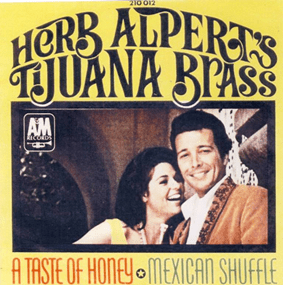 Covering is a way of making connections with specific songs, and paying homage to (or deflating) admired bands and musicians. Links between a band and certain collaboration networks are thus established. Sr. Bikini covered Alpert’s instrumental version of The Beatles’ “A Taste of Honey,” setting up a dialogue with a musician that played a lot with Mexican stereotyped imagery and sounds (like the trumpets, substituted by electric guitars in Sr. Bikini’s version).
Lost Acapulco renamed The Trashmen’s “Surfin’ Bird” as “Surfin’ Band,” participating in a long chain of covers (including The Cramps and The Ramones) of a song that in turn was the result of mixing two pieces by The Rivingtons, “Bird’s The Word” and “Papa Oom Mow Mow.” Los Esquizitos have their own covers of The Cramps’ “Human Fly” (“El moscardón”) and Rory Erickson’s “I Walked With A Zombie.”
Los Magníficos’ “Píntalo de negro,” after The Rolling Stone’s “Paint It Black,” shows that, just as in punk, any piece can be turned into a surf song.
Sometimes it is just a trait (a riff, or a beat) that is referenced. Fenómeno Fuzz’s initial riff in “Tiki Twist” resembles Chuck Berry’s “Johnny B. Goode,” whereas two chili western songs (“Transgenic Surfers” by Los Twangers and “Skawboy” by The Bich Boys) echo The Ramrods’ harmonic and timbral arrangements for “Riders In The Sky,” another song with a long cover history, including Dale, Johnny Cash, and Elvis Presley. A surf version of this song was familiar to Mexican TV viewers in the 90s, since it was a regular soundtrack of furniture store Hermanos Vázquez spots.
Surf was born at a time when stand-alone effects units were just about to change the way music was made, taking audio manipulation off the studio and bringing it to the stage. For example, The Shadows are known for having used the tape-based Watkins Copicat, “the first repeat-echo machine manufactured as one compact unit” according to Steve Russell, responsible for the guitar delay effect in their 1960 rendition of Jerry Lordan’s “Apache,” since then a surf standard. In his book Echo and Reverb, for example, Peter Doyle examines how effects like echo/delay and reverb shaped sonic spatiality in 20th century popular music recording in the U.S., from hillbilly, country, blues, and jazz to rock ‘n’ roll.
Although Doyle only dedicates a few paragraphs to Dale, Wray, and surf instrumentals, acoustic effects greatly contributed to characterize their styles as well. Some traits are intricately related to genre specific manifestations, like the double bass in rockabilly, or the twang effect in chili western. Timbre, then, is the aural counterpart to the scene’s visual aspect, “invoking the rich semiotic traditions that wove through southern and West Coast popular music recording” (Doyle, 2005, 226). It has become a way both to continually define the genre and, in the Mexical neo-surf scene in particular, to overcome melodic and harmonic limitations. Thanks to timbral play, what used to be a blind alley in rock history became in the 1990s a mirror for young generations of Mexicanos to create and feel aligned with fashionable trends, and a sonic filter enabling them to examine their social situations and, sometimes, to willfully sidestep them.
—
Featured Image: Lost Acapulco in Estadio Azteca 2009, Image by Flickr User Stephany Garcia (CC BY-ND 2.0).
—
Aurelio Meza (Mexico City, 1985) is a PhD student in Humanities at Concordia University, Montreal. Co-organizer of the PoéticaSonora research group at UNAM, Mexico City, where he is in charge of designing and developing a digital audio repository for sound art and poetry in Mexico since 1960. Author of the books of essays Shuffle: poesía sonora (2011) and Sobre Vivir Tijuana (2015). Blog: http://aureliomexa.wordpress.com/
—
 REWIND! . . .If you liked this post, you may also dig:
Share this:

Slow, Loud, and Bangin’: Paul Wall talks “slab god” sonics

slab god, Paul Wall’s latest project, surpasses many recent rap releases via its stripped down sound, minimalistic in a non-trendy, monastic sort of way. Sonically, slab god is solemn, thoughtful and surprisingly provocative, especially in the context of Wall’s entire discography (his early material with the Color Changin’ Click, for example, was much more lighthearted and playful). Wall professed, “it’s just something that I wanted to do differently. All the music in Hip Hop right now sounds the same and I wanted to do something that didn’t sound like what was coming out right now, so that’s why I came with this.” Unlike many of Wall’s projects based mostly on freestyles, Slab god took several years to produce.
 As soon as Wall recorded “Swangin’ in the Rain,” the first song arranged for slab god back in 2010, he wanted to make the whole album sonically in line with the single: “music to put in the car and bump and ride to.”
SLAB= Slow, Loud, AND BANGIN’, see: Houston Car Culture
In 2012, Wall embarked on his second beginning by releasing No Sleep ‘Til Houston, his first mixtape as an independent artist again, after departing from his eight year relationship with Atlantic Records. For Wall, that was his opportunity to get back to his roots. Committed to this conviction, he disregarded his mainstream momentum in order to “make music not tainted with outside influence from the music industry.” So, pursuant to the title No Sleep ‘Til Houston, Wall followed this self-prescribed antidote until he reintroduced himself to the city where he started, Houston, Texas.
After Wall felt reconnected, he dropped #Checkseason in 2013. Like many of Wall’s projects, it was about getting money; Wall said, “it was meant to be like a motivation mixtape. When you are on your hustle you pop it in.” And in 2014, Wall dropped Po Up Poet, which was according to Wall, titled after “a nickname one of my boys gave me because I’m always talkin’ ‘bout drankin’, po-in’ up, and leanin’.” To Wall, “the lean culture has taken over globally. There’s Brazilian rappers talking about lean. There’s German rappers talking about lean.” [ed.’s note to Paul Wall: Sounding Out! has talked about lean. See Kemi Adeyemi’s “Straight Leanin’: Sounding Black Life at the Intersection of Hip-hop and Big Pharma” (Sept. 2015)]. As a response, Wall released Po Up Poet, “to claim something for Houston.”
I met up with the enterprising Paul Wall while he was in New York City promoting slab god and had the opportunity to “grill” Wall about his new slab sonics for Sounding Out!. In what follows, Wall explains the oral transmission of slab culture, the sonic tension between regionalism and globalism, and Houston Hip Hop. Wall explored some fascinating concepts, namely, how the stimuli for slab god consisted of a jambalaya of subtropical weather and hyper-local Houston folklore along with the pursuit of fun, money, and aesthetics. He also explains how his new sound makes clear that he is a full-on “slabagogue.”
Douglas Doneson: This album took you several years to make. You recorded “Swangin’ in the Rain” in 2010.
Paul Wall: When we did the song “Swangin’ in the Rain,” immediately, it was special to me. It is my favorite song that I have ever personally made.
Another thing is that there has never been a song about rain and slabs or anything screwed up related with rain. Sometimes when it rains the radio plays the rain mix, where all the songs have a rain theme. In L.A., I recorded “Swangin’ in the Rain,” [and] it rained, and of course it never rains in L.A. I just remember thinking, man it’s a blessing these artists don’t even realize because they get free radio play every time it rains. You know what I am saying? So I was like it would be dope if there was a rap song, especially like a Houston type of themed rap song having to do with rain because it rains all the time in Houston. So shit, you get lucky with a jamming song about rain in Houston, there is going to be a lot of radio play.
After I made the song, I was like man I am going to make a whole album like this. So I went to the studio and [it] went to a folder. I have a few different types of folders. I have one where it is songs about money, another folder where it is mostly songs about drank and syrup, and another where it is mostly songs about cars, because that is what I rap about the most, getting money, driving cars, jewelry, and lean. So those are my different folders.
When “Swangin’ in the Rain” came out, I wanted to make a whole album like that: music for the car, music to put in the car and bump and ride to. If you have a journey or you have to ride across town or ride home from work or wherever, this is something I’ll want to put in. It is riding music.

Paul Wall and the Houston Skyline, Photo by Mike Frost
DD: Who are some of the featured artists?
PW: On slab god some of the features I got are definitely a lot of H-Town collaboration on there, starting off with my boy Dead End Red, Sosa Man, Le$, Devin the Dude, Curren$y, Burner, and Snoop Dogg.
DD: I was surprised to see DJ Chose on there. Tell me more about that collaboration.
PW: I met him a while back and I did a song with him before for one of his projects. You see the passion in him; he really looks at what he is doing as art. I ain’t going to lie; we all looked at it like it was a hustle. We didn’t look at it from an artistic aspect of music; we all looked at it like this is something we do for fun and we are going to go hustle it and make some money off of what we do for fun. But with DJ Chose, you could see the way he records; his style is artistic and a little different. I had wanted to work with him for a while. This is one of those things where you’ve got to get him on the right song. You get him on the right song and he’s going to kill it. That’s what he did.
DD: As far back as I can remember, even back in the Color Changin’ Click days, your rhymes have generally been lighthearted and playful, but slab god, especially your verse on “Crumble the Satellite” is confrontational. A line that stuck out to me the most is, “and just because your shirt say it, that don’t make you trill.” What’s going on here?
PW: Well, number one, I wanted to drop some bars, some quotables, where you’ve got to rewind it, [and ask] “what he say,” “he said what?” You know, some of them type of quotables. It took a little time because that’s not stuff you freestyle, that’s something you think about because it’s got to be said right and wording has to be right. It’s more work and I’m not scared of hard work. It’s more time in the studio perfecting things and getting it right.
I ain’t going to lie, I did my verse first, and I didn’t know where to take the song. I just knew the beat was jamming. When I heard the beat it kind of reminded me of “Still Tippin’” with the bass, the drums, and I always remember my boy T Farris telling me when we did “Still Tippin,’” “go in there and freestyle.” So I heard that in the back of my head and it sounded like “Still Tippin,’” so I went in there and did a little freestyle and I was talking about a bunch of random shit. My verse wasn’t a 12 or a 16 bar verse. It was like a 24 bar verse. Originally, it was going to be just me and I wasn’t even going to put a hook on it. I was going to leave it like a freestyle. But at the end when I said, “crumble the satellite,” I said you know what I’m going to call it that and then I sent it to Curren$y and Devin to jump on and both of them boys came right on with it.
DD: The title of your newest album is slab god. What is a slab god?
PW: I was going to call it Slab Life. I wanted to call it something slab related and I didn’t want to call it Slab King, because Lil’ Keke and Corey Blount are Slab Kings, so I didn’t want to say that like I was trying to take their throne. Someone gave me the nickname, they said, “you are the slab god.” I was like, you ain’t lying, I am. I done had over 20 slabs, so shit. I kept [god] with a lower case “g” because I didn’t want to be blasphemous. People are still like, “you are going to hell for that.” I’m like man, shit. I didn’t make nothing difficult. I’m not saying I’m the almighty God. I am also not saying I am the slab god. I am one of several slab gods. There are lots of other people in Houston who are slab gods. We are carrying on the culture, carrying on the torch for the slab. We are just trying to hold it down.
DD: You mentioned Lil’ Keke is a Slab King. On the song “Checklist” with Lil’ Keke off of slab god, you break down the elements of a slab. What are some of the features of a slab?
PW: It is a fluid list. It is always changing. New technologies come, [now] there are new Halo Oracle headlights you can get installed, but three years ago you couldn’t get that. Same with the Ghost Lights on the door; when you open the door up and the lights shine on the ground. They weren’t available two years ago. The checklist keeps getting bigger.
You’ve got to make it your own. That’s the other thing about a slab, is it’s your personal upgrade. There are definitely a few must haves like, you’ve got to have the Texan Wire Wheels Swangas, the ‘84s; there are several different sizes and variations. But you’ve got to have Swangas and you’ve got to have Vogue tires. If you don’t have Vogue tires and you just have regular black tires or something than nah, it’s no deal. You’ve got to have candy paint on it, music in the trunk, some people put tint on it, some people leave it without tint, and a front grill in the front—that’s a must.
On the older cars you put a hood ornament on it like a woman in the front or something. But on the newer cars you don’t really do that too much. We also put a fifth wheel on the back, which is just a spare tire or rim on the back, but you can’t use it, it’s not for practical purposes, it’s for decoration. We put hydraulic pumps on the fifth wheel and on the trunk, so when you hit the switch, the trunk opens up and you got neon lights showing in there with a word or phrase. You’ve [also] got [to have] speakers in there, and that’s pretty much it. Some slabs have convertible, some have a sun roof, and maybe the other thing about slabs is you’ve got to bang Screw. You’ve got to jam Screw in the slab.
DD: It seems like a lot of slab culture is passed down by oral tradition through the O.G.s and Slab Kings such as Corey Blount. In your song “Top Diine” off of slab god, you say, “Texas Ed taught me how to drive extra patient.” Who is Texas Ed?
PW: Man! He going to LOVE that you said that! [Laughs]. That’s my boy [who] I went to elementary, junior high, and high school with. “Top Diine,” I did with Happy Perez. He produced that track and we did that song four years ago or maybe five years ago, so that’s a nice one that we’ve been sitting on for a while [that] we’ve been waiting to put out. But, Texas Ed is my homeboy. We grew up together. He lived in a neighborhood next to mine. When I was in high school, he was one of the ones riding slab, so he was one of the forefathers before me who showed me how to do it.
DD: On your song “Forever Hustle” off of slab god, each line in your verse is like a new phrase ripe for Houston Hip Hop adoption. Drop a few of your favorite lines and talk to me about them.
PW: With that song I wanted to do a flip on word play. First of all, I thought that beat was just jamming so hard and I was like whatever I do to this, I better not fuck up this jamming beat. That’s really what I was thinking. But other than that it, the hook kept coming to me. I don’t know what I was going through at the time, but I heard Slim Thug say one time in a rap, “man I’m going to do this for 10 more years, I ain’t never falling off.” So, shit, that made me realize that as long as there are things I want, [and] as long as I want these things, then I’m going to have to hustle for them. There is no lottery ticket, where you never have to work again. As long as Cadillac makes cars, I’m going to want one. That’s my dream car. My dream car is whatever the newest Cadillac is. As long as they got Swangas and Vogues to put on them I’m going to be putting them on. You know what I’m saying? [Laughs].
I really wanted to do a word play- “I’ma sip mud, ‘til I’m in the mud,” “I’ma sip syrup, until I’m in the dirt.” The rhyme scheme wasn’t a normal bar for bar rhyme; I broke it up in halves and did different shit. “I’ma let the trunk wave, ‘til I’m in the grave,” and “I’ma bang Screw, ‘til I join him,” all that man, shit. It was just something different I wanted to do.
DD: Tell me about your special connection to Slab culture.
PW: For one, it is something that is ours in Houston. There are other places like Austin [and] we generally say Texas, but there’s a lot of places in Texas where they don’t ride slab. There’s not too many people in Dallas that ride slabs, maybe outside Austin, maybe San Antonio, and maybe a few other places; a couple of people in Madisonville, and some of the smaller towns, but as a whole, we try to say Texas, but it is really more of a Houston thing.
The greatest things to me in the world are the most local things. You know when you go to certain areas of the world and they got that cuisine? There is nothing like eating a cheese steak in Philly, there is nothing like going to Louisiana and eating some creole food or Cajun food, and there is nothing like going to Texas and eating some Tex-Mex. With these types of things the localized aspects of it are always the best. It’s something that we got that’s our own and the fact that the rest of the world don’t ride makes it even more special to me because if everyone else did I wouldn’t want to because it was just be something everybody else is doing. That sense of Texas pride is instilled in you when you come from Texas. Texas history from when you were in school, to “everything is bigger in Texas,” to all the companies that come from Texas that are so Texas proud like Blue Bell, and stuff like that. Everybody is so Texas proud. They just teach you that sense of pride in Texas, so our car culture is no different.
The Screw music is another thing that’s ours that came from Texas so, it’s part of that culture and goes right along with the slab culture, so it’s like something I take a lot of pride in because its comes from where we are from, so I want to represent it that much more, you know what I am saying?
Sometimes I might be riding somewhere and there might be somebody, like an old person who don’t like my car and they might give me a dirty look or something and that makes me smile because it reminds me that this is not for everybody and this is something that is just ours. Like my album, I know this album is jamming, so if somebody says they don’t like it then hey it might not be their type of music, or maybe they hate it, or maybe they listened to the wrong album, but I know it’s not because I ain’t do my thing right. Same thing with my car, I know my car looks good. I’m not saying that it’s the best. There are definitely things I should improve, but I know my shit is clean. So if someone else don’t like it then that just means it’s not for them, or they are just a hater, or whatever, but that’s cool because it’s for me, you know what I’m saying?

“Paul Wall Texas Longhorns,” photo by Mike Frost
DD: In an interview you recently did with Devi Dev on KHOU Houston, Texas, you state, “the best artists ever in the world have always been true to their local culture, local style, and local sound.” However, a lot of music critics claim that one reason Houston artists have a hard time popping off is because they won’t let go of their close connection to their culture, isolating themselves from audiences outside of Texas. How has this so-called language barrier affected you?
PW: What the critics have said has been one of the main obstacles of Texas artists achieving super main stream success. We’ve achieved mainstream success but not to a level of a Jay-Z or where Lil’ Wayne is now. We got to where Lil’ Wayne was 10 years ago, you know what I’m saying? We all made it to that level. But none of us made it to the level where Lil’ Wayne is at now! Partially, they are right because [of] Texas culture, a lot of people don’t have any clue what we are talking about. Therefore, when they hear us talking about it, its gibberish or it’s another language, so people are ignorant to what we are saying, when really we might be dropping some hella-fied metaphors, and similes, and bars that are real lyrical. People don’t take it like that because they hear the accent; they hear the slang references, or the culture references that are different than their culture so they just look at it as being bullshit. For instances, if Tupac came out right now and was rapping Russian, I don’t think he’d be looked at as the greatest rapper ever because most people wouldn’t understand what he was saying. But since he spoke in English, we understood what he was saying. So our culture is like speaking Russian.
DD: I love how you brought that up. You transport the Houston sound to other regions. I’m fascinated with your trip to Poland to work with Kazcor. How’d that come about?
That’s dope you asked me about that. Kazcor will be excited about that. This is my dream job. Growing up in Houston, a lot of us never left the neighborhood. I have friends who still, have never left the North Side of town or the South Side of town. You don’t drive past the Galleria, the Galleria is as far as you go. [DD note: Gu raised his hand and indicated he rarely leaves his neighborhood. Everyone laughs] The first time he left the South Side is probably when we went out of town somewhere. There’s a lot of people like that so, that’s how we are brought up in Houston. We just stick to our own area and that’s it and the only reason we’d travel to the other side of town is to go to AstroWorld or something.
The Polish flag and the Texas flag are a lot similar. The only difference I think is the star. So I always wondered if my fan base in Poland was big because the flag is kind of similar. We find excuses or reasons to associate with people for whatever reason. So anyway, a guy I know grew up in Russia, but he moved to Chicago, then he moved to Milwaukee, and then when the recession hit, he and his family moved back to Poland. They went to their family business, which was the slaughter house business and he was just homesick one year for Christmas and was like man, “I am homesick and you were my favorite rapper, so I am going to bring you to Poland and do a concert.” He wasn’t a concert promoter or nothing like that. He wanted to have a dope concert and he was homesick. So I went out there and for me being able to travel around the world to different places like that is a once in a lifetime opportunity, especially when I’m going to these places and literally, I know people who haven’t crossed I-10 in their life; the only time they crossed I-10 was to go downtown to court.
Poland is dope. Some parts of Europe, they speak English, but in Poland, nobody spoke English. It was not an English speaking country; English wasn’t their first language, English wasn’t their second language, [and] English wasn’t their third language. But man, I was inspired by their Hip Hop scene over there. The first time I went, Kazcor, had beef at the time with another rapper, and he performed right before me, and his whole performance was like 50 Cent at Summer Jam, bringing out a blow up doll, doing skits, all related to his beef with another Polish rapper. I was like damn; the beef history of Hip Hop is traveling. I was inspired by that.
They had their own producers out there; rappers, rap scene, rap culture, and DJs and none of them were at all familiar with what was going on in America. It’s not like you know, when Texas is popping now its popping out there, if Atlanta music is popping, its popping out there. It’s not even like if it’s popping, a few months later it’ll be popping there. No man, whatever was going on in America, they didn’t even know who they were. When I would talk to people, I’d be like [have you] heard of this person or that person? They’d say, “nope.” I was inspired that they were completely out of touch with what was going on in Hip Hop in America but, yet and still Hip Hop in Poland was thriving, healthy, and they had their own award shows.
DD: Another example of you bringing the Houston sound to another region is you Screwed and Chopped the album Haunted Cities, by California based rock-rap group The Transplants. Whose idea was that?
PW: I met Skinhead Rob and Travis Barker in the Atlantic offices right when I signed to Atlantic. Of course I knew who Blink 182 was, but I met both of them and they were both cool as a fan. After that, I started researching more of their music and got familiar with it and it was dope.
Skinhead Rob was the one who was like, “man, why don’t you do a Screwed and Chopped version of this? There never been anything like this done before.” First of all, if something has never been done, I’m already like “yep, I’ll do it.” And it was also jamming, so we were on the same level. It was easy to do. So when Skinhead Rob put that play in motion, I was like, hell yes. I am proud of that one, man.
DD: On slab god you mention Jacka. I was wondering who that is and if you feel comfortable talking about him.
PW: For sure. He’s a rap artist from the Bay. He was in a group called the Mob Figaz. My boy Husalah is on the album too, he’s in the group Mob Figaz. Jacka got killed a few months ago, this year. He was a real close friend of mine. Before I had even met him, I was a big fan of him. Matter of fact, my boy Skinhead Rob turned me onto him. Skinhead Rob turned me on to a lot of underground music. He turned me on to Mac Dre, Andre Nikatina, the Mob Figaz, Jacka, Husalah, Mitchy Slick, and to a lot of West Coast artists.
But, Jacka, I still remember meeting him, when the All Star Game was in Houston, 2006 Super Bowl. I remember meeting Jacka; somebody in the club saying in the microphone, “shout out to the Jacka, Mob Figaz in the house.” I was like, “what? Where is he at? I got to meet him.” I just asked somebody who I knew from the Bay, I was like, “bro, is Jacka in here? Where he at?” He said that’s him over there. So I went up to him and was like, “bruh, I fuck with your shit.” Because I really did jam his music like that. I think he was taken back like, “man are you for real or are you just like saying this?” And I said, “nah, bruh.” I was quoting lyrics and quoting lines, dropping bars, like I really fuck with you. He was literally one of my favorite rappers, especially at the time and still now.
I get stuck in my personal zone where I only listen to a few artists, and he was one of them for sure. He just was a good person and that’s how we met [and] over the years we did other things, shows, songs, we got an album together, it hasn’t come out yet, but we’ve been working on that. We really have two albums together.
Something I always admired about him was how he preached gems in his music. In his music, he’ll drop a spiritual gem that will make you reevaluate your relationship with God and in his raps he would inspire people to be better. And one thing that I always loved about him, anytime I ever would be with Jacka he would always have me feeling like I could conquer the world. He was a hell of a pep talker and a lot of people I know who knew him say the same thing. That was my boy. He got killed [and] I just wanted to do a song for him, dedicate it for him, let the whole world know, and more specifically, put people in Texas on to him because he reminds me of a Z- Ro type of artist. Z- Ro will say God related things or spiritual things to help better yourself sometimes [and] you’ll be like damn this boy Z- Ro is deep. And that’s just kind of how the Jacka is.
DD: Is there anything else you want to share with us?
PW: slab god is in stores now. Houston Oiler is on the way.
—
Featured Image: Paul Wall, his slab, and the white cup, Photo by Mike Frost
—
Douglas Doneson writes about Houston rap music. He has written for The T.R.O.Y. Blog, Complex, Noisey, and God is in the TV.
—
 REWIND!…If you liked this post, check out:
“This is Your Body on the Velvet Underground“–Jacob Smith
“The (Magic) Upper Room: Sonic Pleasure Politics in Southern Hip Hop“–Regina Bradley
Culture Jamming and Game Sound: An Interview with foci + loci–Skot Deeming and Martin Zeilinger
Share this:


Current Top Posts





April 2021

January 2020

November 2019

October 2019

August 2019

April 2014

November 2017

March 2015

December 2017

October 2015
 Sounding Out!
Recent Comments