
Sound and Curation; or, Cruisin’ through the galleries, posing as an audiophiliac
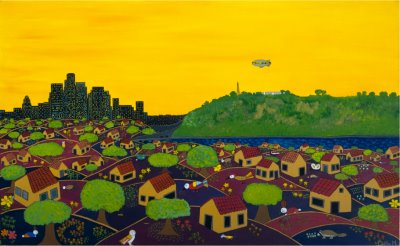
“L.A. Reimagined” by Dalila Paola Mendez (c), Mendez’ work will be featured in re:present LA, opening 5/3/12
But to love this turf is love hard and unrequited.
…
To love L.A. is to love more than a city
It’s to love a language.
–“L.A. Love Cry” (1996) by Wanda Coleman
Los Angeles, an enigmatic metropolis to many who arrive here with a dream in hand and hope for a better tomorrow, still challenges historians, artists, and troubadours on how to best represent it. Poet Wanda Coleman, born in Watts, captures the pain and wonder of loving this city in “L.A. Love Cry.” Because the city is “hard and unrequited” one must also be willing to love its nuances and see it as“more than a city.” To love this city, “it’s to love a language,” a cultural immersion that goes beyond the seeming ease of words into the complexities of sound and rhythm.
Through a Museum Studies course I teach at Claremont Graduate University entitled Welcome to L.A., I introduce students to varied texts in which scholars and artists challenge the imaginaries created by outsiders, boosters, and apocalyptic cinema. Instead, the course readings present how we in L.A. actively engage with one another by fostering communities of creative praxis. For the students’ final project, they curate and develop educational programming for an exhibition at a local museum or art center. On May 3, 2012, this semester’s project, re : present L.A., opens at the newly-renovated Vincent Price Art Museum (VPAM) located on the East Los Angeles College Campus. Showing works from over thirty artists from May 3-July 27, re : present L.A serves as an extension of the conversations we had in class, not only celebrating the interconnectedness of our communities but encouraging new associations and encounters within the visual and resonant space of VPAM’s Community Focus Gallery. For a look at the Virtual Exhibit Catalogue, click here.
In each exhibition for Welcome to L.A., I try to include something that challenges myself to think outside the white-box, per se, of the gallery. Given that we had read several texts that highlighted in the importance of music to build and uplift communities of color in Los Angeles, it was both important and necessary for me to include sonic elements in re: present LA that exhibits L.A.s vibrant musical legacy as intermingled with and fundamental to its visual culture. Among the challenges to document the cross-cultural connections between ethnic communities in Los Angeles is how to unpack what Anthony Macias calls “the cultural networks” that facilitated these exchanges through the music scenes at music halls, clubs, youth centers and record stores in Mexican American Mojo (10-11). Studies done by George Lipsitz, Macias, and Victor Viesca, provide readers a means to understand how the music in Los Angeles is much more than entertainment; it is political; it is a lifestyle; it defines spaces of multicultural interactions. In How Racism Takes Place, Lipsitz points out how integral the reclamation of space defined the political outlook and music in Horace Tapscott’s Arkestra based in South L.A. Viesca’s research documents the rise of an East L.A. rock sound, post-Los Lobos, that was defined by the activism of the Zapatista Movement and California’s Prop 187 through the work done at the Peace & Justice Center, Self-Help Graphics, and Regeneración.
Therefore, in order to engage both the history and the sound of Los Angeles’s musics with the city’s visual representations, I invited Rubén Funkhuatl Guevara from Ruben & The Jets, is a multi-threat musician, performer, writer, and producer, and Jennifer Stoever-Ackerman (of Binghamton University, Sounding Out!, and of course, Riverside, CA) to curate playlists for a “sound booth,” which will consist of a stationary iPod™ Nano that gallery visitors can use at their leisure. The classic circular wheel allows the viewer to advance tracks or play the playlists on shuffle. Headphones will be set up so that the viewer can either focus on their listening experience or, listen while viewing the artwork around them. Since the gallery is relatively small, the pieces on the opposite wall are recognizable though are distant. In addition, Maya Santos of Form Follows Function will screen their short documentary on Radiotron, a youth center that presented Hip-Hop shows during the 1980s.
Guevara’s playlist Los Angeles Chicano Rock & Roll is included in the exhibition thanks to the Museum of Latin American Art. Stoever-Ackerman’s playlist Off the 60, unites the two spaces of East L.A. and Riverside through a mix of intra- and trans-cultural musical experiences. Guevara’s rock & roll selections highlight many of the bands that emerged in East L.A. Both the musical listings and the liner notes for the sound presentations will be accessible on the re:present L.A website when the exhibit goes live on May 3rd, 2012.

Juan Capistran’s The Breaks (2000), Courtesy of the Artist
.
My sonic intervention in the white, often silent, spaces of the gallery was especially inspired by two recent precedents: the inclusion of the iPod™ in MEX/LA (2011) at the Museum of Latin American Art and Phantom Sightings (2008) at the Los Angeles County Art Museum. Both experiences invited me as a viewer to see the artwork through another sensory experience. The first time I saw music included in an exhibition not specifically about music (such as the Experience Music Project’s 2007 American Sabor: Latinos in U.S. Popular Music, or Marvette Peréz’s curation of ¡Azúzar! The Life and Music of Celia Cruz at the Smithsonian National Museum of American History) was LACMA’s Phantom Sightings, which garnered much critical acclaim and criticism due to the premise of presenting contemporary Chicano Art inspired ‘after’ the Chicano Movement. However, I want to focus on one aspect of the exhibition, a corner display with books that informed the curators’ conceptual approach and on the bookshelf was an iPod™. The iPod™ included playlists from some of the artists reflecting their inspiration for their artwork. I enjoyed listening and reminiscing while sitting in the gallery. However, I wanted the music to take more of a central role in the exhibition, especially because much of the artwork so obviously revealed traces of Los Angeles’ musical influences, partly due to the recent generation of artists who actively engaged in subcultural expressions and referenced it in their art. For example, as Ondine Chavoya describes in the Phantom Sightings catalogue, Juan Capistran’s The Breaks (2000) is a giclée print documenting the artist break-dancing on Carl Andre’s minimalist floor pieces. The guerilla performance then is presented through a series of twenty-five still images showing the various movements seen in how to break-dance books (125). Shizu Saldamando’s ink on fabric portraits of Siouxsie (2005) and Morrissey (2005) showcase how post-punk and new wave music from England is part of her life as an Angeleno (and that of her friends), yet the medium is reminiscent of pinto drawings. Saldamando also does portraits of her friends at clubs, backyard bbqs “documenting a world where identity is fluid” as Michele Urton describes in the catalog (197).

Shizu Saldamando’s Siouxsie (2005), Courtesy of the Artist
It would be another three years before MEX/LA would further marry music with art, now casting it in relation to the politics of Chicano and Mexican presence in Los Angeles. MEX/LA, among the many Pacific Standard Time exhibitions presented throughout Los Angeles, was among the best curated due to the range of artifacts representative of the city and the cultural production emerging in post-war L.A. Another striking element was the influence of Méxicano popular culture among Chicanos and vice-versa. As curator Rubén Ortiz-Torres, and associate curator Jesse Lerner write on the MoLAA website: “The purpose of the construction of a ‘Mexican’ identity in the South of California is not to consolidate the national unity of a post-revolutionary Mexico, but to recognize and be able to participate in an international reality, with all its contradictions and conflicts that this entails.” One of the ways this cultural exchange was embodied was in the playlists curated by Rubén Funkhuatl Guevara and Josh Kun that were prominently displayed alongside the artwork and heard in the interactive iPod™ “sound booths,” that invited viewers to sit on beanbags and listen. The music served to contextualize the art in relation to popular culture of the time. For example, Guevara presents a Chicano rock & roll genealogy that followed the chronology of the visual exhibit, 1930-1980, that begins with boogaloo and swing of the 1940s era culminating with the punk rock sounds of The Bags.
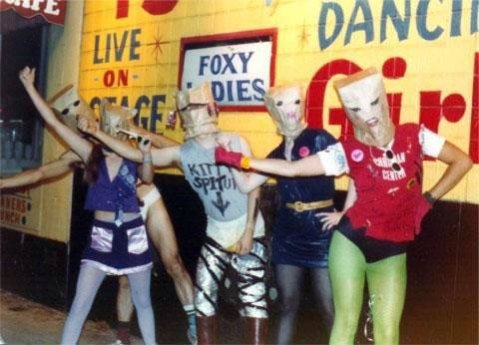
“Bag Parade,” 1977, Courtesy of Alice Bag
In both these exhibitions, the music served to complement the artistic elucidations of identity, race, and American popular culture seen in much of the artwork. The simplicity of the presentation was due to the inclusion of a familiar object like the iPod™. What is surprising is that more exhibitions have not incorporated more sonic elements to engage viewers’ other sensory experiences beyond the podcasts, or cell-phone audio listening tours set up at most major museums. While musical playlists can serve as another didactic component of an exhibition like the more established audio tours, I am arguing for a different use of sound in museum space, one that provides a wider sense of agency, connection, and encounter with the visual elements on display rather than a one-way transmission of information. In the cases of MEX/LA and Phantom Sightings, the inclusion of iPods™ provided a tool to understand the cultural production of a “post-Chicano movement” generation of artists while at the same time enabling an experience that recognized—and resonated with—my bicultural experience.

“Ancient Mexico in Ancient Mexico” by Yvonne Estrada (c), is featured in re:present LA, opening 5/3/12
Being that L.A. is a car culture moving to the rhythms of the radio waves, I’m always seeking to find synchronicity between music that feels me with joy and my work as a cultural worker. Part of my impetus to locate Los Angeles sonically in re : present L.A. was driven by the question: is it possible to capture my sonic landscape growing up in the city of Los Angeles that ranges from Hip-Hop – British Rock – Mexican Pop? The playlists curated by Guevara and Stoever-Ackerman are familiar to me personally. Stoever-Ackerman’s Off the 60, reminds me of the sounds of my youth, when KDAY and KROQ rocked the radio waves and my students banded together in my high school quad according to their favorite music – metal-heads, b-boys, alternative rock, and the cha-chas, who traveled across town every Friday night to Franklin High, where DJs spun L.A. disco. At home, the music was different. My mom and tías used to reminisce about their homeland every Sunday night through the variety show Siempre en Domingo, binding us to the t.v., religiously following the rising stars. Through the bi-lingual selections in Guevara’s Los Angeles Rock & Roll, there’s a familiarity of home and the music heard at backyard parties and quinceañeras.
By including my iPod™ nano, I bring together my lived experience as a cultural worker through the sounds of L.A. and activate the white walls of the museum. The playlists created by Guevara and Stoever-Ackerman serve to reflect the history of the community surrounding VPAM, as well capture the diversity of the city sonically re:presenting L.A. to our audiences. While the playlists can stand alone as audio curations in their own rights, I hope that they will engage audiences to rethink the relationship between music and art, and feel their lived experience inclusive within the museum.
—-
reina alejandra prado saldivar is an art historian, curator, and an adjunct lecturer in the Social Science Division of Glendale Community College in Glendale, California and in the Cultural Studies Program at Claremont Graduate School. As a cultural activist, she focused her earlier research on Chicano cultural production and the visual arts. Prado is also a poet and performance artist known for her interactive durational work Take a Piece of my Heart as the character Santa Perversa (www.santaperversa.com) and is currently working on her first solo performance entitled Whipped!
Share this:

The Plasticity of Listening: Deafness and Sound Studies

“Listening Post” by Flickr User Theory
Editor’s Note: Steph Ceraso‘s post wraps up Sounding Out!’s three-part February forum on the intersection of deafness, Deaf Studies, and sound studies. However, SO! would like this series to open an ongoing conversation. If you would like to respond to these posts and/or pursue your own avenue of inquiry, please direct your pitches to jsa@soundingoutblog.com. We’d love to hear from you. By the way, if you missed (or want to re-read) Liana Silva‘s “Listen to the Word: Deafness and Participation in Spiritual Community” click here and C.L. Cardinale‘s “my mother’s voice, my father’s eye, and my other body: the sound of deaf photographs” click here.
There is no difference in being deaf or hearing—one will always appreciate the subtleties of sound because of the ability to feel things in greater depth to what the ear alone will allow us to hear. -Evelyn Glennie from Shirley Salmon’s Hearing—Feeling—Playing: Music and Movement with Hard-of-Hearing and Deaf Children
I am not deaf, nor am I someone who is affiliated with the scholarly field of disability studies. However, I am someone who is very interested in expanding notions about what it means to listen. For my dissertation research, I have been working on developing a theory of what I call “multimodal listening.” Rather than understanding listening as something that is dependent upon the ears, “multimodal” listening refers to the various ways in which sound is felt throughout the body (via vibration), and to the multiple senses in addition to the auditory sense that are employed during a listening event.

Photo by Flickr User jimmiehomeschoolmom
Because of my interest in moving beyond ear-centric models of listening, I really appreciated Liana M. Silva’s recent post on the Deaf International Community Church (DICC). I was especially struck by how her experience as a hearing individual attending a Deaf church service suddenly defamiliarized her own relationship to sound and voice. The visual nature of this service, which was conducted through the use of American Sign Language (ASL), prompted her to consider listening practices that do not rely on a fully functioning auditory system.
I wonder, though, if swapping the ears for the eyes is still too limiting—too dependent on a single mode. For instance, if a non-signing deaf person was attending a service similar to the one Silva described, visual listening (in a discursive sense) would not be a possibility. My use of “deaf” (with a small “d”) is a strategic choice here. The descriptor “Deaf” (with a capital “D”), as Silva uses it in her discussion of the church, is almost always employed to refer to the Deaf Community as a cultural and linguistic entity, whereas “deaf” refers to an audiological deficiency. Since the use of ASL is most often associated with individuals in the Deaf community, those who do not sign would most likely avoid churches like the DICC. However, depending on the acoustics and the material features of the church, a non-signing deaf person might be able to experience the sound of music through vibration in a more full-bodied kind of listening practice.
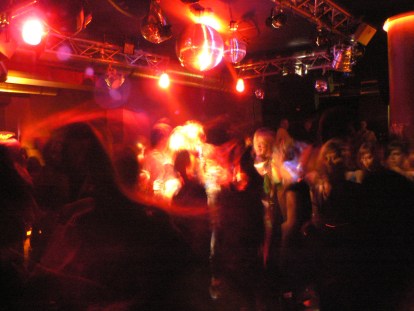
Photo by Flickr User curran.kelleher
Listening via vibration is something that Cara Cardinale Fidler writes about in her poetic account of growing up with deaf parents. She remembers,
In high school, I went to a dance at the Fremont School for the Deaf where my parents were chaperones. It was easy to find the dance; you could hear the throbbing bass from across campus. It was so loud, it hurt. When I walked in, I wasn’t surprised to see a wall full of uncomfortably dressed teenagers holding balloons to feel the sound and bobbing their heads in tempo.
In this passage, Cardinale Fidler amplifies the tactile experience of sound—the ability of all bodies to listen-feel through the force of vibration. Sometimes we feel sound in our guts or throats or teeth, but this is not usually an aspect of listening that most people with a working auditory system meditate on, or try to refine in any way.
I think it is important to acknowledge, as Silva and Cardinale Fidler do by example, that the labels “deaf” and “hearing” are not as clear-cut as they may seem. There is a whole range of auditory function among people who are given these labels, or who fit somewhere between them. Sound scholars might think of deafness, then, not as a uniform lack, but as a range of listening practices in which sensory modes other than the ears are employed. Some people rely more on one mode than others, and some might develop synesthetic listening practices.

Evelyn Glennie, playing the marimba faster than the camera can cope with, Photo by Flickr User Bankside
For instance, in the documentary Touch the Sound, percussionist Evelyn Glennie uses the convergence of sound, sight, and touch in her own listening training. We need to start thinking about listening less in terms of binaries (e.g. you either have the capacity to listen or you do not), and more in terms of possibilities. The fact that bodies can be retrained to experience listening via multiple modes highlights the extremely flexible, plastic nature of listening habits and practices. In considering this diverse range of listening possibilities, I wonder how we might design more listening experiences that are truly multimodal—that require or at least present the possibility of listening with more than one sensory mode. How might we expand the listening capacities of all bodies?
Deaf space and architecture is one area that is beginning to take up such questions. Based on the concept of universal design, which emphasizes the production of products and environments that are accessible to both so-called “disabled” and “able-bodied” individuals, deaf architecture considers the ways in which deaf listening bodies move through and communicate within space. These spaces seem particularly well-designed for visual and tactile listening situations. For example, according to blogger Scott Rains, some key principles of deaf architecture include: the use of partial walls or open concept spaces, no sharp angles and curved corners to increase visual range, no sources of glaring light that might impede vision, and wooden floors for more pronounced vibration. Bodies, spatial and material configurations, and the senses were all taken into account in this kind of design. The visual and tactile elements in these spaces accommodate particular bodies and communication practices, but there would be no need for such spaces without the existence of those particular bodies and communication practices. The design of deaf architecture is based on the reciprocal relationship between cultural and physiological needs, which in turn broadens the listening possibilities of the inhabitants of deaf spaces.

The Myer Music bowl, where the Melbourne Symphony Orchestra accompanies Evelyn Glennie, photo by Flickr User learza.
Deaf studies and deaf scholars have much to contribute to sound studies. Expanding ideas about what it means to listen, coming up with new ways to extend the capacities of all listening bodies, and developing more dynamic and complex theories of listening will require sound studies scholars to think about listening not only in terms of the ears, but in terms of bodies, affects, behaviors, design, space, and aesthetics. In this sense, deafness may be one of the most significant and generative areas of research in the continuing development of sound and listening studies.
Conversely, sound studies can offer deaf studies fresh ways to think about how sound shapes/enhances/disrupts deaf cultural practices. As we have seen from the examples above, sound plays a powerful and sometimes complicated role in deaf contexts. Using sound studies approaches and methodologies, then, could help to augment the ways in which sound figures into deaf culture–a subject that has received very little attention thus far. Collaborations between these seemingly contradictory areas of study have the potential to enliven and enrich each other in mutually beneficial ways. Sound studies and deaf studies have a lot to say to each other. They just need to start listening.
__
Steph Ceraso is a 4th year Ph.D. student in English (Cultural/ Critical Studies) at the University of Pittsburgh specializing in rhetoric and composition. Her primary research areas include sound and listening, digital media, and affect. Ceraso is currently writing a dissertation that attempts to revise and expand conventional notions of listening, which tend to emphasize the ears while ignoring the rest of the body. She is most interested in understanding how more fully embodied modes of listening might deepen our knowledge of multimodal engagement and production. Ceraso is also a 2011-12 HASTAC [Humanities, Arts, Science, and Technology Advanced Collaboratory] Scholar and a DM@P[Digital Media at Pitt] Fellow. She regularly blogs for HASTAC.
Share this:


Current Top Posts





April 2021

January 2020

November 2019

October 2019

August 2019

April 2014

November 2017

March 2015

December 2017

October 2015
 Sounding Out!
Recent Comments