
Resounding Silence and Soundless Surveillance, From TMZ Elevator to Beyoncé and Back Again
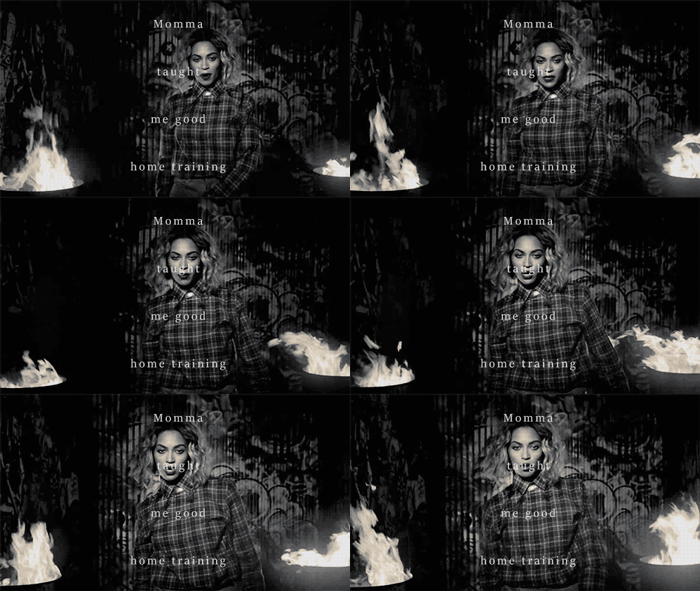
 This September, Sounding Out! challenged a #flawless group of scholars and critics to give Beyoncé Knowles-Carter a close listen, re-examining the complex relationship between her audio and visuals and amplifying what goes unheard, even as her every move–whether on MTV or in that damn elevator–faces intense scrutiny. Last Monday, you heard from Kevin Allred (Women and Gender Studies, Rutgers) who read Beyoncé’s track “No Angel” against the New York Times’ reference to Michael Brown as #noangel. You will also hear from Liana Silva (Editor, Women in Higher Education, Managing Editor, Sounding Out!), Regina Bradley (writer, scholar, and freelance researcher of African American Life and Culture), and Madison Moore (Research Associate in the Department of English at King’s College, University of London and author of How to Be Beyoncé). Today, Priscilla Peña Ovalle (English, University of Oregon) gives us full Beyoncé realness, from TMZ Elevator to Beyoncé and Back Again,–Editor-in-Chief Jennifer Stoever
—
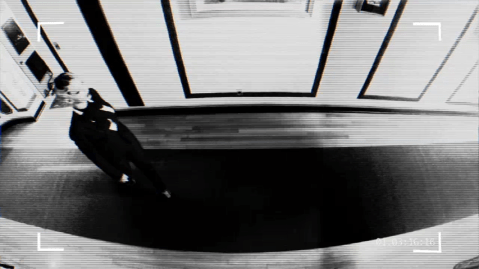
Less than six months after Beyoncé released Beyoncé, she was momentarily silenced on the small screen when the gossip site TMZ released silent elevator security footage of a fight between her famous husband and sister. Doubly framed by the black and white of a surveillance video screen surreptitiously captured on a security guard’s camera-phone, the video’s silence left plenty of room for speculation. But the footage also revealed a woman conscious that her life is on record: Beyoncé’s body seemed to elude the camera’s full view and she emerged from the elevator with a camera-ready smile.
Like Kevin Allred in his powerful reading of “No Angel,” I could not help but rethink Beyoncé in the wake of Michael Brown’s murder. I already read Beyoncé as a sophisticated response to the visual and aural policing of black female bodies, but the closed-circuit images of Beyoncé on TMZ (and in Beyoncé) made me reconsider silence as a damning convention of video surveillance; like Aaron Trammell in “Video Gaming and the Sonic Feedback of Surveillance,” I questioned (the lack of) sound as a technique of control. When the camera-phone recording of Kajieme Powell’s murder, photographed and narrated by a community member in real-time, was released with silent surveillance footage of the alleged theft, my appreciation of Beyoncé—as a response to those silent damnations—took a new turn.

“Resounding Silence and Surveillance” argues that Beyoncé returns the media’s visual-aural gaze. Because of its pop package, the album’s artistic composition and socio-cultural merit are often underestimated. Like the silence of surveillance footage, omitting any one sensory element from Beyoncé distorts the holistic meaning. To untangle this critically complex interplay of audio and video, I analyze the visualized song “Haunted” and briefly address the single “***Flawless” to show how the artist’s triple consciousness anchors Beyoncé. She is on to us: Beyoncé is the culmination of an artist who has spent her career watching us watch her. Temporarily silenced by footage that she could not control, Beyoncé resounds that “elevator incident”—and our sonic/optic perceptions of her feminism—with a flawless remix.
“I see music. It’s more than just what I hear,” declares Beyoncé. Her voiceover runs over the black screen that opens the promotional video “Self-Titled.” Released the same day Beyoncé premiered on iTunes, “Self-Titled” directs audiences to “see the whole vision of the album.” By design, Beyoncé is an immersive experience—like watching Michael Jackson’s “Thriller” as a television event on MTV.
Because Beyoncé was born the same year the cable music channel MTV premiered, she has never known a world without the ability to “see music.” In many ways, her visual album reinvigorates the early spirit of MTV: after Beyoncé, we will “never look at music the same way again.” Though music videos exacerbate the pop single obsession that Beyoncé explicitly resists with Beyoncé, they also produce a unique kinetic connection with the listener-viewer, whose experience of sound is visually registered by the body as it processes shots and edits. This is especially true when strong imagery, rhythmic editing, and dance movements are expertly employed, as in Beyoncé.
Beyoncé deftly critiques the beauty and music/media industries that have been central to her pop success. If taken piecemeal, these critiques can be easily dismissed: the sustained gloss of her image works all too well. There is much to say on a video-by-video basis, but I focus here on the specific aural elements of “Haunted” that articulate Beyoncé’s refusal of the music industry’s status quo. This visualized rejection reveals the layers of racism and sexism that nonwhite female artists (even Beyoncé, even today) must negotiate.
Because of my personal and professional interest in music videos, I consumed Beyoncé as she intended: a sequence of MPEG-4 videos rather than AAC audio files. But it was not until I solely listened to the album that I could discern Beyoncé’s maturation as a black female multimedia pop/culture artist. One refrain from “Haunted” was especially effective:
I know if I’m onto you, I’m onto you/ Onto you, you must be on to me
The song’s ethereal quality is amplified by Boots (Jordy Asher), one of Beyoncé’s (then-unknown) collaborators with whom she shares “Haunted”’s writing and producing credit. The track builds slowly, supporting Beyoncé’s “stream of consciousness” delivery with layers of reverberation and waves of synth sounds like “Soundtrack” or the Roland TR-808 kick drum. Punches of bass accelerate the beat until Beyoncé riffs her explicit desire to create something more than a product:
The music winds to a halt, but the song is not over. Breathy, reverberating vocals transition the track and a piano is delicately introduced:
It’s what you do, it’s what you see
I know if I’m haunting you, you must be haunting me
It’s where we go, it’s where we’ll be
I know if I’m onto you, I’m onto you
Onto you, you must be on to me
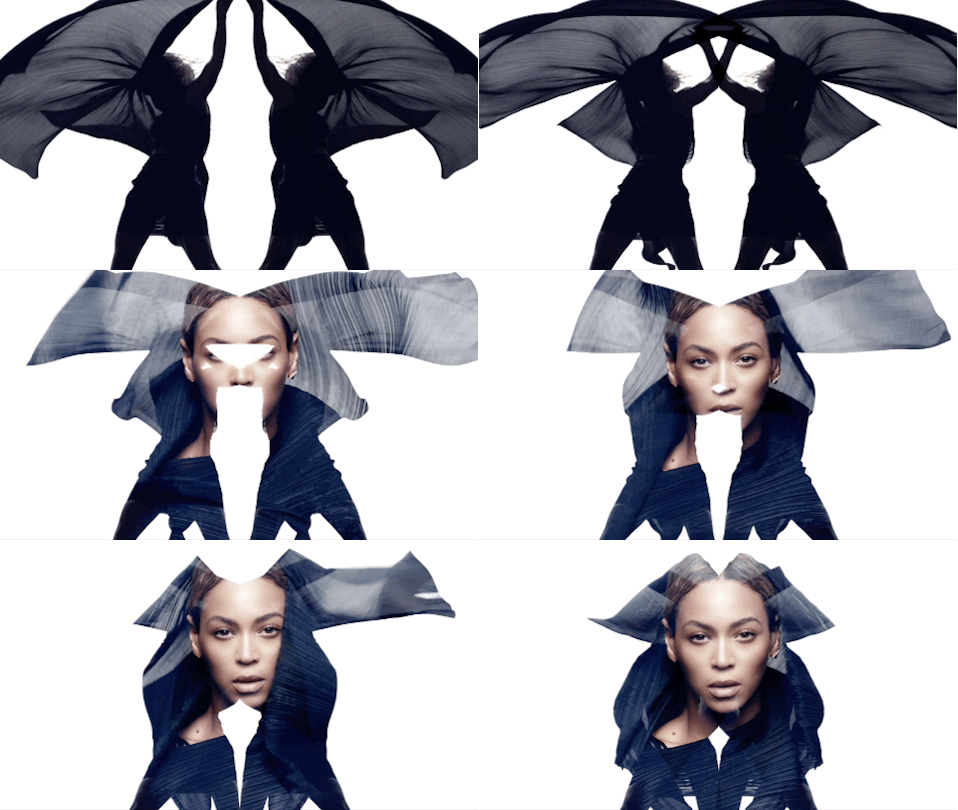
 At this point, the song “Haunted” is split into two videos: “Ghost” (directed by Pierre Debusschere) and “Haunted” (directed by Jonas Åkerlund). The videos’ visual differences exemplify the various points of view—from active subject to object of desire and back again—employed across Beyoncé. “Ghost”’s hypnotic visuals underscore the song’s sentiments: close-ups of Beyoncé’s immaculately lit visage soberly mouthing lyrics are intercut with medium shots of her still body swathed in floating fabric and wide shots of her athletic movements against sparse backgrounds. The ar/rhythmic cuts of “Ghost” enunciate an artistic dissatisfaction with the industry: visuals build against/with the synthetic beat, mixing Beyoncé’s kinetically intense movements with her deadpan delivery.
 The fiery agency of “Ghost” sets up the chill of “Haunted,” a voyeuristic tour in which Beyoncé watches and is watched. The “knowing-ness” of her breathy refrain (“I know if I’m haunting you”) is heightened when the tempo accelerates in the song’s second half. There is much to say about “Haunted”—from the interracial family of atomic bomb mannequins to Beyoncé’s writhing boudoir choreography. Most significantly, she is the video’s voyeur and object of surveillance: her face appears on multiple television screens and her voyeur-character is regularly captured on closed-circuit footage. The “Haunted” video soundtrack features the foley and stinger sounds of a horror film, but these surveillance shots feature the low whirr of a film projector rather than silence. The silence of a moving image is so jarring that it compels us to watch differently, so much so that “silent” film scenes utilize a recorded sound of “nothing” (“room tone”) to focus the audience.
When Beyoncé finally resounded the silence of the “elevator incident,” she chose to do it through “***Flawless,” her explicit response to anti-feminist accusations. While the multifaceted anthem gained attention because of Chimamanda Ngozi Adichie’s audio, the song is uniquely infused with a kind of docu-visuality thanks to Ed McMahon’s well-known voice and the Star Search jingle. These bookends cite a young Beyoncé losing to an all-male rock band, the kind heavily programmed during MTV’s early days. The clips reinforce the album’s critique of racial and gender hierarchies while questioning the double-edged “work ethic” required to surpass them. Of course, Beyoncé pre-emptively frames this discussion for us in “Self-Titled,” a necessary step that helps audiences appreciate the many moving parts of her tour de force, including her creative business mind.So when Beyoncé swapped the audio of Adichie and McMahon for Nicki Minaj, it was no less of a feminist move. Instead, Beyoncé silences TMZ gawkers:
Of course sometimes shit go down/
When it’s a billion dollars on an elevator
She then offers herself as a medium of empowerment. Beyoncé may be part of a billion-dollar empire, but she willingly shares that pleasure with us:
I wake up looking this good
And I wouldn’t change it if I could
(If I could, if I, if I, could)
And you can say what you want, I’m the shit
(What you want I’m the shit, I’m the shit)
(I’m the shit, I’m the shit, I’m the shit)
I want everyone to feel like this tonight
God damn, God damn, God damn!
Beyoncé’s last word is an image. She and her creative team remixed the visuals of the “elevator incident”: the remix single website features black and white photos of Beyoncé and Minaj, simultaneously evoking surveillance footage and the photo booth images of a girls’ night out. Beyoncé is the work of an artist who has spent her career watching us watch her: this minor moment exemplifies Beyoncé’s multimedia resonance as an artist whose power is visible and audible across iTunes and TMZ screens alike.

Beyoncé and Nicki Minaj mugging for the camera
Thanks to Elizabeth Peterson, Charise Cheney, Loren Kajikawa, André Sirois and Jennifer Stoever for providing research and intellectual support for this essay
Priscilla Peña Ovalle is the Associate Director of the Cinema Studies Program at the University of Oregon. After studying film and interactive media production at Emerson College, she received her PhD from the University of Southern California School of Cinema-Television while collaborating with the Labyrinth Project at the Annenberg Center for Communication. She has written on MTV, Jennifer Lopez, and Beyoncé. Her book, Dance and the Hollywood Latina: Race, Sex, and Stardom (Rutgers University Press, 2011), addresses the symbolic connection between dance and the racialized sexuality of Latinas in popular culture. Her next research project explores the historical, industrial, and cultural function of hair in mainstream film and television. You can find her work in American Quarterly, Theatre Journal, and Women & Performance.
—
 REWIND!…If you liked this post, check out:
Aurally Other: Rita Moreno and the Articulation of “Latina-ness”-Priscilla Peña Ovalle
Music Meant to Make You Move: Considering the Aural Kinesthetic–Imani Kai Johnson
Karaoke and Ventriloquism: Echoes and Divergences–Sarah Kessler and Karen Tongson
Share this:

Sculptural Dissonance: Hans Zimmer and the Composer as Engineer
Welcome to our new series Sculpting the Film Soundtrack, which brings you new perspectives on sound and filmmaking. As Guest Editor, we’re honored and delighted to have Katherine Spring, Associate Professor of Film Studies at Wilfrid Laurier University. Spring is the author of an exciting and important new book Saying it With Songs: Popular Music and the Coming of Sound to Hollywood Cinema. Read it! You’ll find an impeccably researched work that’s the definition of how the history of film sound and media convergence ought to be written.
But before rushing back to the early days, stick around here on SO! for the first of our three installments in Sculpting the Film Soundtrack.
– NV
—
It’s been 35 years since film editor and sound designer Walter Murch used the sounds of whirring helicopter blades in place of an orchestral string section in Apocalypse Now, in essence blurring the boundary between two core components of the movie soundtrack: music and sound effects. This blog series explores other ways in which filmmakers have treated the soundtrack as a holistic entity, one in which the traditional divisions between music, effects, and speech have been disrupted in the name of sculpting innovative sonic textures.
In three entries, Benjamin Wright, Danijela Kulezic-Wilson, and Randolph Jordan will examine the integrated soundtrack from a variety of perspectives, including technology, labor, aesthetic practice, theoretical frameworks, and suggest that the dissolution of the boundaries between soundtrack categories can prompt us to apprehend film sound in new ways. If, as Murch himself once said, “Listening to interestingly arranged sounds makes you hear differently,” then the time is ripe for considering how and what we might hear across the softening edges of the film soundtrack.
– Guest Editor Katherine Spring
—
Composing a sound world for Man of Steel (2013), Zack Snyder’s recent Superman reboot, had Hans Zimmer thinking about telephone wires stretching across the plains of Clark Kent’s boyhood home in Smallville. “What would that sound like,” he said in an interview last year. “That wind making those telephone wires buzz – how could I write a piece of music out of that?” The answer, as it turned out, was not blowing in the wind, but sliding up and down the scale of a pedal steel guitar, the twangy lap instruments of country music. In recording sessions, Zimmer instructed a group of pedal steel players to experiment with sustains, reverb, and pitches that, when mixed into the final track, accompany Superman leaping over tall buildings at a single bound.
His work on Man of Steel, just one of his most recent films in a long and celebrated career, exemplifies his unique take on composing for cinema. “I would have been just as happy being a recording engineer as a composer,” remarked Zimmer last year in an interview to commemorate the release of a percussion library he created in collaboration with Spitfire Audio, a British sample library developer. “Sometimes it’s very difficult to stop me from mangling sounds, engineering, and doing any of those things, and actually getting me to sit down and write the notes.” Dubbed the “HZ01 London Ensembles,” the library consists of a collection of percussion recordings featuring many of the same musicians who have performed for Zimmer’s film scores, playing everything from tamtams to taikos, buckets to bombos, timpani to anvils. According to Spitfire’s founders, the library recreates Zimmer’s approach to percussion recording by offering a “distillation of a decade’s worth of musical experimentation and innovation.”
In many ways, the collection is a reminder not just of the influence of Zimmer’s work on contemporary film, television, and video game composers but also of his distinctive approach to film scoring, one that emphasizes sonic experimentation and innovation. Having spent the early part of his career as a synth programmer and keyboardist for new wave bands such as The Buggles and Ultravox, then as a protégé of English film composer Stanley Myers, Zimmer has cultivated a hybrid electronic-orchestral aesthetic that uses a range of analog and digital oscillators, filters, and amplifiers to twist and augment solo instrument samples into a synthesized whole.
Zimmer played backup keyboards on “Video Killed the Radio Star.”
In a very short time, Zimmer has become a dominant voice in contemporary film music with a sound that blends melody with dissonance and electronic minimalism with rock and roll percussion. His early Hollywood successes, Driving Miss Daisy (1989) and Days of Thunder (1990), combined catchy themes and electronic passages with propulsive rhythms, while his score for Black Rain (1989), which featured taiko drums, electronic percussion, and driving ostinatos, laid the groundwork for an altogether new kind of action film score, one that Zimmer refined over the next two decades on projects such as The Rock (1996), Gladiator (2000), and The Pirates of the Caribbean series.
What is especially intriguing about Zimmer’s sound is the way in which he combines the traditional role of the composer, who fashions scores around distinct melodies (or “leitmotifs”), with that of the recording engineer, who focuses on sculpting sounds. Zimmer may not be the first person in the film business to experiment with synthesized tones and electronic arrangements – you’d have to credit Bebe and Louis Barron (Forbidden Planet, 1956), Vangelis (Chariots of Fire, 1981), Jerry Goldsmith (Logan’s Run, 1976), and Giorgio Moroder (Midnight Express, 1981) for pushing that envelope – but he has turned modern film composing into an engineering art, something that few other film composers can claim.
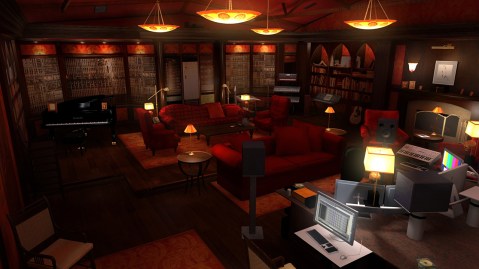
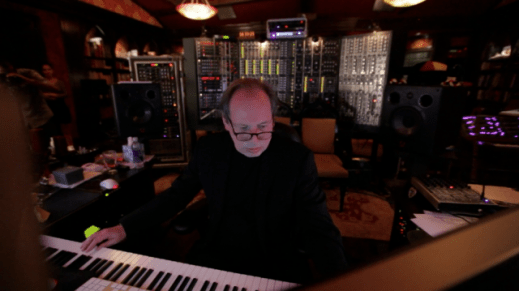
Zimmer’s studio
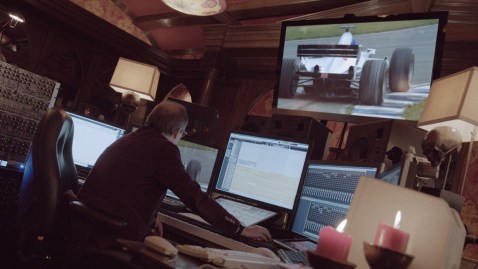
One thing that separates Zimmer’s working method from that of other composers is that he does not confine himself to pen and paper, or even keyboard and computer monitor. Instead, he invites musicians to his studio or a sound stage for an impromptu jam session to find and hone the musical syntax of a project. Afterwards, he returns to his studio and uses the raw samples from the sessions to compose the rest of the score, in much the same way that a recording engineer creates the architecture of a sound mix.
“There is something about that collaborative process that happens in music all the time,” Zimmer told an interviewer in 2010. “That thing that can only happen with eye contact and when people are in the same room and they start making music and they are fiercely dependent on each other. They cannot sound good without the other person’s part.”
Zimmer facilitates the social and aesthetic contours of these off-the-cuff performances and later sculpts the samples into the larger fabric of a score. In most cases, these partnerships have provided the equivalent of a pop hook to much of Zimmer’s output: Lebo M’s opening vocal in The Lion King (1994), Johnny Marr’s reverb-heavy guitar licks in Inception, Lisa Gerrard’s ethereal vocals in Gladiator and Black Hawk Down (2002), and the recent contributions of the so-called “Magnificent Six” musicians to The Amazing Spider Man 2 (2014).
The melodic hooks are simple but infectious – even Zimmer admits he writes “stupidly simple music” that can often be played with one finger on the piano. But what matters most are the colors that frame those notes and the performances that imbue those simple melodies with a personality. Zimmer’s work on Christopher Nolan’s Dark Knight trilogy revolves around a deceptively simple rising two-note motif that often signifies the presence of the caped crusader, but the pounding taiko hits and bleeding brass figures that surround it do as much to conjure up images of Gotham City as cinematographer Wally Pfister’s neo-noir photography. The heroic aspects of the Batman character are muted in Zimmer’s score except for the presence of the expansive brass figures and taiko hits, which reach an operatic crescendo in the finale, where the image of Batman escaping into the blinding light of the city is accompanied by a grand statement of the two-note figure backed by a driving string ostinato. Throughout the series, a string ostinato and taikos set the pace for action sequences and hint at the presence of Batman who lies somewhere in the shadows of Gotham.
Zimmer’s expressive treatment of musical colors also characterizes his engineering practices, which are more commonly used in the recording industry. Music scholar Paul Théberge has noted that the recording engineer’s interest in an aesthetic of recorded musical “sound” led to an increased demand for control over the recording process, especially in the early days of multitrack rock recording where overdubbing created a separate, hierarchical space for solo instruments. Likewise for Zimmer, it’s not just about capturing individual sounds from an orchestra but also layering them into a synthesized product. Zimmer is also interested in experimenting with acoustic performances, pushing musicians to play their instruments in unconventional ways or playing his notes “the wrong way,” as he demonstrates here in the making of the Joker’s theme from The Dark Knight:
The significance of the cooperative aspects of these musical performances and their treatment as musical “colors” to be modulated, tweaked, and polished rests on a paradoxical treatment of sound. While he often finds his sound world among the wrong notes, mistakes, and impromptu performances of world musicians, Zimmer is also often criticized for removing traces of an original performance by obscuring it with synth drones and distortion. In some cases, like in The Peacemaker (1997), the orchestration is mushy and sounds overly processed. But in other cases, the trace of a solo performance can constitute a thematic motif in the same way that a melody serves to identify place, space, or character in classical film music. Compare, for instance, Danny Elfman’s opening title theme for Tim Burton’s Batman (1989) and Zimmer’s opening title music for The Dark Knight. While Elfman creates a suite of themes around a central Batman motif, Zimmer builds a sparse sound world that introduces a sustained note on the electric cello that will eventually be identified with the Joker. It’s the timbre of the cello, not its melody, that carries its identifying features.
To texture the sounds in Man of Steel, Zimmer also commissioned Chas Smith, a Los Angeles-based composer, performer, and exotic instrument designer to construct instruments from “junk” objects Smith found around the city that could be played with a bow or by hand while also functioning as metal art works. The highly abstract designs carry names that give some hint to their origins – “Bertoia 718” named after modern sculptor and furniture designer Harry Bertoia; “Copper Box” named for the copper rods that comprise its design; and “Tin Sheet” that, when prodded, sounds like futuristic thunderclaps.
Smith’s performances of his exotic instruments are woven into the fabric of the score, providing it with a sort of musical sound design. Consider General Zod’s suite of themes and motifs, titled “Arcade” on the 2-disc version of the soundtrack. The motif is built around a call-and-answer ostinato for strings and brass that is interrupted by Smith’s sculptural dissonance. It’s the sound of an otherworldly menace, organic but processed, sculpted into a conventional motif-driven sound world.
Zimmer remains a fixture in contemporary film music partly because, as music critic Jon Burlingame has pointed out, he has a relentless desire to search for fresh approaches to a film’s musical landscape. This pursuit begins with his extracting of sounds and colors from live performances and electronically engineering them during the scoring process. Such heightened attention to sound texture and color motivated the creation of the Spitfire percussion library, but can only hint at the experimentation and improvisational nature that goes into Zimmer’s work. In each of his film scores, the music tells a story that is tailored to the demands of the narrative, but the sounds reveal Zimmer’s urge to manipulate sound samples until they are, in his own words, “polished like a diamond.”
—
Ben Wright holds a Provost Postdoctoral Fellowship from the University of Southern California in the School of Cinematic Arts. In 2011, he received his Ph.D. in Cultural Studies from the Institute for Comparative Studies in Literature, Art and Culture at Carleton University. His research focuses on the study of production cultures, especially exploring the industrial, social, and technological effects of labor structures within the American film industry. His work on production culture, film sound and music, and screen comedy has appeared in numerous journals and anthologies. He is currently completing a manuscript on the history of contemporary sound production, titled Hearing Hollywood: Art, Industry, and Labor in Hollywood Film Sound.
—
All images creative commons.
—
 REWIND! . . .If you liked this post, you may also dig:
Fade to Black, Old Sport: How Hip Hop Amplifies Baz Luhrmann’s The Great Gatsby— Regina Bradley
Quiet on the Set?: The Artist and the Sound of a Silent Resurgence— April Miller
Play It Again (and Again), Sam: The Tape Recorder in Film (Part Two on Walter Murch)— Jennifer Stoever
Share this:


Current Top Posts





April 2021

January 2020

November 2019

October 2019

August 2019

April 2014

November 2017

March 2015

December 2017

October 2015
 Sounding Out!
Recent Comments