
Vocal Anguish, Disinformation, and the Politics of Eurovision 2016

Eurovision—that televisual song pageant where pop, camp, and geopolitics annually collide—started last week. This year’s competition is hosted in Tel Aviv, and continues a recent trend in the competition in which geopolitical controversy threatens to overshadow pop spectacle. Activists accuse the Israeli government of exploiting Eurovision as part of a longstanding government PR strategy of “pinkwashing”: championing Israel as a bastion of LGBT+ tolerance in order to muddle perceptions of its violent and dehumanizing policies towards Palestinians. The BDS movement mobilized a campaign to boycott Eurovision. Reigning Eurovision champion Netta Barzilai, echoing many pro-Israel voices (as well as celebrities concerned about “subverting the spirit of the contest”), referred to the boycott efforts as “spreading darkness.”
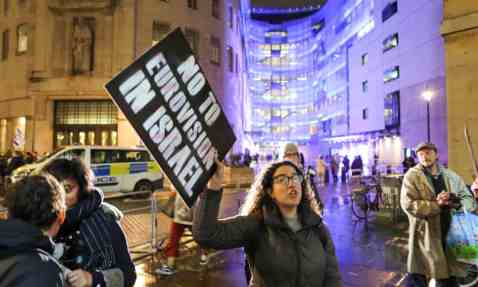
Protesters outside BBC Broadcasting House demonstrate against the 2019 Eurovision song contest being held in Israel. Photograph: Penelope Barritt/Rex/Shutterstock
While this year’s competition opened already mired in contention, I’m going to listen back to the controversial winning song of the 2016 contest, whose media frenzy peaked in its aftermath. That year’s champion, a pop singer of Crimean Tatar heritage who goes by the mononym Jamala, represented Ukraine with a song called “1944.” Just two years before, Crimea had been annexed from Ukraine by Russia following a dubious referendum. Some Crimean Tatars—the predominantly Sunni-Muslim Turkic-language minority group of Crimea—fled to mainland Ukraine following the Russian annexation, viewing the Ukrainian state as the lesser threat; many of those that stayed continue to endure a deteriorating human rights climate (though there are some Crimean Tatars who have bought into—and who reap benefits from—the new Russian administration of the peninsula.)

Screen capture from Stopfake.org
Jamala’s very presence in the contest inevitably evoked the hot geopolitics of the moment. Her victory angered many Russians, and the subject of Eurovision became fodder for conspiracy theories as well as a target of disinformation campaigns waged online and in Russian-influenced media in Ukraine. In much of the Western European and North American media, the song was breathlessly interpreted as an assertion of indigenous rights and a rebuke to the perceived cultural genocide enacted against Crimean Tatars by Russian state power.
In the wake of her victory, many commentators described Jamala as giving voice not only to the repressed group of Crimean Tatar indigenes living in the Russian-annexed territory of Crimea, but to threatened indigenous populations around the world (for better or worse). But indeed, it was not only her metaphorical voice but the sound of vocal anguish that intensified the song’s effectiveness in the contest and made it relevant well beyond the specific geopolitical bog shared by Crimean Tatars, Ukrainians, and Russians. Specifically, the timbre, breath, and dynamic force of Jamala’s voice communicated this anguish—particularly during the virtuosic non-lexical—wordless—bridge of the song. Despite her expertly controlled vocal performance during the dramatic bridge, Jamala’s voice muddies the boundaries of singing and crying, of wailing from despair and yelling in defiant anger. To pilfer from J.L. Austin’s famous formulation, what made Jamala’s performative utterance felicitous to some and infelicitous to others was as much the sound of her voice as the words that she uttered. Put simply, on the bridge of “1944,” Jamala offers a lesson in how to do things with sound.
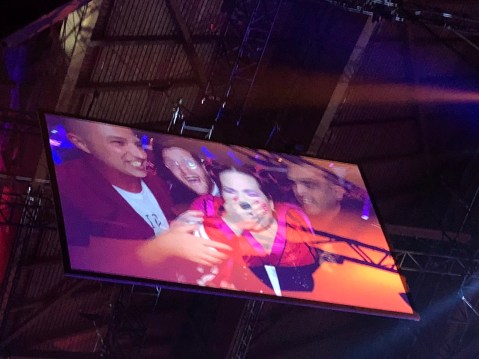
“Netta from Israel Wins the Eurovision Song Contest” by Flickr User David Jones, CC BY 2.0
Some background: the world’s longest-running televised spectacle of song competition, the Eurovision Song Contest began in 1956 with the peaceful mandate of bringing greater harmony (sorry not sorry) to post-war Europe. Competitors—singers elected to represent a country with a single, three-minute song each—and voters come from the member countries of the European Broadcasting Union. The EBU is not geographically restricted to Europe. Currently, some fifty countries send contestants, including states such as Israel (last year’s winner), Azerbaijan, and Australia. Many of the rules that govern Eurovision have changed in its 62-year history, including restrictions governing which language singers may use. Today, it is common to hear a majority of songs with at least some text sung in English, including verses of “1944.” Some rules, though, have been immutable, including the following: songs must have words (although the words need not be sensical). All vocal sounds must be performed live, including background vocals. Voters, be they professional juries or the public—who can vote today by telephone, SMS, or app—cannot vote for their own nation’s competitor (though unproven conspiracy theories about fans crossing national borders in order to vote in defiance of this rule have, at times, flourished.) Finally, reaching back to its founding mandate defining Eurovision as a “non-political event,” songs are not permitted to contain political (or commercial) messages.
Both the title and lyrics of Jamala’s “1944” refer to the year that Crimean Tatars were brutally deported from Crimea under Stalinist edict. Indicted wholesale as “enemies of the Soviet people,” the NKVD rounded up the entire population of Crimean Tatars—estimated to be some 200,000 people—packed them into cattle cars, and transported them thousands of miles away, mostly to Uzbekistan and other regions of Central Asia. The Soviet regime cast this as a “humanitarian resettlement” intended to bring Crimean Tatars closer to other Muslim, Turkic-language populations. However, Crimean Tatars, who estimate that up to two-thirds of their population perished before arriving in Central Asia, consider this a genocidal act. They were not given the right to return to Crimea until the late 1980s. So, through clear reference to a twentieth-century political trauma with consequences that stretch into the present, “1944” was not the feel-good fluff of classic Eurovision.

“Coin in memory of the genocide of Crimean Tatar people” by Flickr User National Bank of Ukraine (CC BY-NC-ND 2.0)
Jamala’s performance of “1944” at Eurovision was also atypical in that it largely eschewed pizzazz and bombast. Little skin was shown, there were no open flames, no smoke machines befogged the scene. Instead, Jamala stood, mostly still and center stage, encircled by spotlight. Large projections of flowers framed the stage for the first two minutes of the song, as she sang verses (in English) and a chorus in (Crimean Tartar) that utilized lyrics from a well-known twentieth-century Crimean Tatar protest song called Ey, Güzel Qirim (Oh, My Beautiful Crimea). The groove of the song is spare and rather slow, and the singer’s voice meanders within a fairly narrow range on both verse and chorus.
But then comes the vocalise on the bridge: two minutes and fifteen seconds into the Eurovision performance, the song’s chilled-out but propulsive motion stops, leaving only a faint synthesizer drone. In the sudden quiet, Jamala mimes the act of rocking an infant. Beginning in the middle of her range, she elaborates a melismatic wail that recalls the snaking modal melody of the traditional Crimean Tatar song Arafat Daği. The bridge consists of two phrases interrupted by a forceful and nervous inhalation of breath. Her breath is loud and intentional, calling attention to the complex ornaments that she has already executed, and preparing us for more ornaments to come.
Over the course of eight seconds, Jamala’s voice soars upwards, increasing steadily in volume and intensifying timbrally from a more relaxed vocal sound to an anguished belt. At the apex of the bridge, the Eurovision camera soars above the stage just as the singer looks into the camera’s eye. Meanwhile, the screens framing the stage explode into visuals that suggest a phoenix rising from the ash. The crowd erupts into applause.
Other renditions of “1944” deliver a similar emotional payoff at the climax of the bridge. In the dystopian narrative of Jamala’s official music video, a tornado whips free, setting a field of immobilized human figures into chaotic motion (minute 2:35). In a reality TV song contest called Holos Kraïny (the Ukrainian Voice), a young singer’s powerful elaboration of the bridge propels a coach out of her seat as she wipes tears from her eyes (minute 3:42). In other covers, the bridge is too difficult to attempt: one British busker leaves the “amazing vocal bit in the middle” to “the good people of Ukraine to sing along.”
Timbrally and gesturally, I also hear the resonance between the plangent sound of the duduk—a double-reed wind instrument associated most closely with Armenia, and often called upon to perform in commemorations of the 1915 Armenian genocide—and Jamala’s voice on the vocalise. According to Jamala (who generously responded to my questions via email through her PR person), this was not intentional. But the prominence of the instrument in the arrangement, the lightly nasal quality that her voice adopts in the bridge, and the glottalized movements she uses between pitches suggest that this connection might have been audible to listeners. After all, the opening melodic gesture of “1944” is sounded by a duduk, and it re-enters spectacularly just after the peak of the bridge, where it doubles Jamala’s vocal line as it cascades downwards from the high note. Through sonic entanglement with the duduk, Jamala here communicates anguish on another register, without translation into words.
The performance of sonic anguish through the voice might be understood, in Greg Urban’s terms, as a “meta-affect.” Jamala delivers the emotion of anguish but also fosters sociality by interpellating listeners into the shared emotional state of communal grieving. I paraphrase from Urban’s well-known analysis of “ritual wailing” to argue that Jamala, through this performance of vocal anguish, makes both intelligible and acceptable the public sentiment of grief. This utterance of grief is a statement of “separation and loss that is canonically associated with death” (392) that included the Eurovision audience as co-participants in the experience of grieving, of experiencing anguish over loss. A popular fan reaction video by “Jake’s Face Reacts,” posted to YouTube, and the hundreds of comments responding to it, attest to this experience of co-participation in the experience of grief. Furthermore, the power of this meta-affect is almost certainly heightened through normative gendered associations with performative anguish. Lauren Ninoshvili (2012) identifies this in the “expressive labor” of mourning mothers’ wailing in the Republic of Georgia, while Farzaneh Hemmasi (2017) has recently elucidated how the voice of the exiled Iranian diva Googoosh became iconic of the suffering, feminized, victimized nation of Iran.

“Googoosh, collection du pasteur de l’église St Paul” by Flickr User Stéphane Gschwind (CC BY-NC-SA 2.0)
The sociologist of music Simon Frith once wrote that “in songs, words are the sign of the voice” (97). To put it in slightly banal terms, songs, as we generally define them, include words uttered by human voices. (Or if they don’t have words uttered by voices, this becomes the notable feature of the song, c.f. Mendelssohn Songs Without Words, Pete Drake’s talking guitar, Georgian vocable polyphony). But non-lexical vocalities also function as a sign of the voice, and, as scholars such as Ana Maria Ochoa (2014) and Jennifer Stoever (2016) have argued, expand our capacity to recover more complex personhoods from the subjugated vocalities of the past. In fact, often the most communicative, feelingful parts of songs occur during un-texted vocalizations. As generations of scholars have argued, timbre means a lot—Nina Eidsheim’s The Race of Sound: Listening, Timbre, and Vocality in African American Music (Duke University Press: 2019) presents a very recent example—and it is often overlooked when we take the key attributes of Western Art Music as our sole formal parameters for analysis: melody, rhythm, harmony, form. So as we watch the parade of aspiring Eurovision champions duke it out in the pop pageant of geopolitics, let’s attune ourselves to the vocal colors, the timbral gestures, the ululations and the growls, to the panoply of visual and auditory stimuli demanding our attention and, more important (depending on where we live), our vote.
_
Featured Image: “Jamala” by Flickr User Andrei Maximov, CC BY-NC-ND 2.0
_
Maria Sonevytsky is Assistant Professor of Ethnomusicology at the University of California, Berkeley. Her first book, Wild Music: Sound and Sovereignty in Ukraine, will be out in October 2019 with Wesleyan University Press.
_
 REWIND! . . .If you liked this post, you may also dig:
Won’t Back Down: Tom Petty, Jason Aldean, and Masculine Vulnerability – Justin Burton
Contra La Pared: Reggaetón and Dissonance in Naarm, Melbourne – Lucreccia Quintanilla
“To Unprotect and Subserve:” King Britt Samples the Sonic Archive of Police Violence – Alex Werth
Share this:

SO! Reads: Nicole Brittingham Furlonge’s Race Sounds: The Art of Listening in African American Literature

 Is literature truly a primarily visual entity? Do we only read books or are we actually actively “listening in print”(1)? These are the main questions that Nicole Brittingham Furlonge explores in Race Sounds: The Art of Listening in African American Literature (2018). As Black literature is often considered in terms of its attention to music, listening has therefore been limited to the musicality of stories, and many voices are left unheard. What Furlonge does in Race Sounds is go back to these unheard voices and focus our attention on them to see what we have been missing.
Furlonge wants to demonstrate how to “uncover the different ways of knowing that emerge from aural engagement” (3) such as exposed in Invisible Man, Their Eyes Were Watching God, and Sterling Brown’s “Ma Rainey.” She urges us to learn to “decode print differently” (4) by attuning the reader to the practice of listening, as well as to (black) sound(s) studies in more general terms, by referring to the essential scholars of the field: Tsitsi Jaji, Fred Moten, Kevin Quashie, Jennifer Stoever, and Alexander Weheliye – to name a few. Furlonge further “joins a collective effort to shift from a heavy emphasis on sounding to an attention to listening practices” (9). By redirecting the reader to listening practices, Furlonge leads us to reconsider our own “coexistence among humans.” (9)
 Furlonge, previously chair of the English Department at the Princeston Day School, and new Director of Teacher’s College’s Klingenstein for Independent School Leadership is not only an experienced scholar, but a teacher experiencing first hand what it means to listen: in a classroom and in society. Race Sounds is a five chapter book, moving from a consideration of “Literary Audiences” (chapter one), to the “Silence of Sound” (chapter two), to various forms of Listening (chapters three-five). Her fifth chapter, as well as her epilogue, have an especially interesting approach to Sound Studies through her lens as an educator. Not only does Furlonge have extensive classroom experience and administrative expertise in curriculum development, diversity issues, faculty development and issues regarding equity and access, but she is in a good position, as an independent scholar, to reflect on listening practices in and out of academia. It is quite exceptional to consider pedagogy in a critical text, as it observes education in the classroom and citizenship, in addition to her critical analysis.
By guiding her reader to listening in new modes throughout the book, Furlonge demonstrates how to “read in a multimodal way” (109) in order to learn to listen. This multimodal method includes an attention drawn beyond the book to “sonic literacy,” “aural pedagogies,” as well as the full sensory process of listening (from hearing, to vibrations, to sensory immersion of many kinds, and so on). She insists that, “while hearing is a physiological form of reception, listening is interpretive, situated, and reflective” (83), and this is ultimately what she presents in Race Sounds.
Furlonge aims at an audience of readers and listeners ready to deepen their understanding of the importance of sounds through the multisensory experiences that she proposes, especially as she describes her experience of “Aural Listening in the English Classroom.” She “aim[s] to amplify listening as a creative, aesthetic, and interpretative practice in ways that provoke robust motivations to develop our capacities to listen” (15) and manages to do just that by guiding her readers to consider sounds, voices, vibrations, silences, and historical listening, such as (re)reading Zora Neale Hurston’s Their Eyes Were Watching God in a new light, pointing to protagonist Phoebe’s listening throughout the novel.
Image by Flickr User Adrian Sampson, from a series of three art pieces engaged with Ralph Ellison’s Invisible Man (CC BY 2.0)
By close reading, or listening, to many canonic texts such as Their Eyes Were Watching God, The Chaneysville Incident, and Invisible Man, Furlonge performs an in-depth understanding of sound and what it means to “unmute words in print” (109). She renews the ways to interpret the texts by teaching her readers how to hear sonic literature. After situating the texts in the literature, she depicts what sounds and silences in the narratives tell the reader. For instance, in the first chapter, “Our Literary Audience,” Furlonge distances herself from the often-times asked question of “whether or not Janie realizes her voice over the course of [Their Eyes Were Watching God]” and thinks about “Phoebe’s hungry listening” (25) and what it adds to the conversation. Rather than analysing the story’s narrator yet again, Furlonge turns the reader’s attention towards her friend, the listener. The reader is presented with the importance of listening with an analysis of the “storyhearer” (60) and the work that they accomplish by listening in proper ways, which allows the speaker to develop a voice they know is heard. In this sense, “storyhearers” are used to critique and bring the listening back into stories. As Furlonge considers the body a “living archive” (63), the intake of sounds and its use and reiterations transport the stories and transform the listener into an archive that will allow the story to live on and be transported.
Race Sounds, therefore, brings to the discussion ideas of what it means to listen and one’s responsibility of listening properly and carrying the story within one’s self. “Historical listening” (82) further defines the importance of the audiences in engaging with sounds. As one’s listening, in becoming knowledge, develops this importance, as well as a civic responsibility, to bring the story where it needs to be. Furlonge wonders about the same question Peter Szendy asks, “Can one make a listening listened to? Can I transmit my listening, as unique as it is?” (102). Through reading of The Chaneysville Incident, she demonstrates the carrying of such stories through sound, “a sound that contains memories” (117), and its historical as well as civic importance.
Furlonge also brings new insight to Ralph Ellison’s Invisible Man, a novel often studied in African American Sound Studies, such as in Weheliye’s Phonographies, because of its use of the phonographand its attention to the use of music. However, Furlonge diverges from the usual exploration of Ellison’s narrator with his phonograph and insists on vibrations and the experience of “tactile listening” (55), or the materiality that comes with the listening experience. In shifting the conversation, Furlonge presents the physicality of sound and voices, and does so throughout Race Sounds. Redirecting the reader’s attention to how listening practices affects the novel’s narration, Furlonge aims for the reader to rethink their own listening practices in turn.

Teagle F. Bourge in Oren Jacoby’s adaptation of Ralph Ellison’s INVISIBLE MAN. At the Huntington Theatre Company Jan. 4 – Feb. 3, 2013. Photo: Michael Brosilow (Court Theatre production), (CC BY 2.0)
By directly addressing our way of being in the world, Furlonge creates a text that speaks to the reader, and cannot leave one indifferent. In her last chapter, a walkthrough of her class on listening, Furlonge plunges with the reader into a sense of meaning; everything that one has just read comes together into her classroom. The result of Furlonge’s observations guide the reader into finding a new listener within themselves. Before concluding her book, she describes:
While I hoped students would grow as listeners, I did not anticipate that their perceptions of themselves as readers and writers would also shift. […] Helping students learn to listen, to be attentive to others, and to be discerning of all the talk that comes their way can lead to enduring understandings about themselves and the ways in which they want to engage with and change their world. (118)
As optimistic and ambitious as this statement is, I believe Furlonge manages to teach exactly this to the reader of Race Sounds. By concretely applying in her classroom what she presents in this book, not only does she prove how her work furthers the conversation of Sound Studies, she demonstrates how it belongs in larger conversations about our society’s listening practices and the role of every person in it.
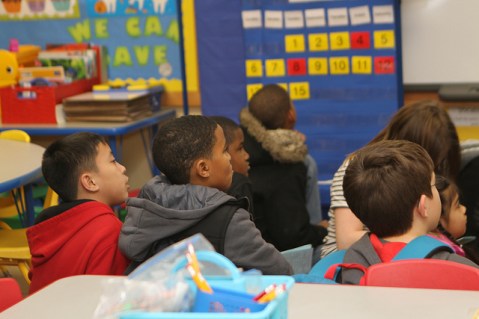
“Students travel around the world with books” image by Flickr User Garrison Casey, (CC BY 2.0)
Furlonge’s book intends to speak to anyone interested in their own listening practices. By being conscious of one’s own body as a “living archive,” it may allow a story to live on by listening properly to it. Finally, “we are unaware of the conversations we miss when we speak” (120) concludes the book on a reflection unto the self to be a better listener, in order to allow our surroundings to teach us to listen differently, and maybe hear things we have not heard before.
—
Featured Image: Quinn Dombrowski,(CC BY-SA 2.0)
—
Alexandrine Lacelle is mainly interested in Modernist literature, women’s writing, and Sound Studies (especially silences). She is pursuing her Master’s degree in English Literature at Queen’s University, where she will be starting her PhD in the fall of 2019, with a focus on the use of wordlessness and sounds in early 20th century literature by women. Originally from Montreal, she completed her BA in English Literature at Concordia University, where she was able to practice her background in French, English, and German.
—
 REWIND!…If you liked this post, you may also dig:
SO! Reads: Dolores Inés Casillas’s ¡Sounds of Belonging!–Monica De La Torre
SO! Reads: Roshanak Khesti’s Modernity’s Ear–Shayna Silverstein
SO! Reads: Kirstie Dorr’s On Site, In Sound: Performance Geographies in América Latina–Benjamin Bean
Share this:


Current Top Posts





April 2021

January 2020

November 2019

October 2019

August 2019

April 2014

November 2017

March 2015

December 2017

October 2015
 Sounding Out!
Recent Comments