
“You’re. . .#noangel. . . either”: Uneasy Politics and Dissonant Sonics in Beyoncé’s “No Angel”
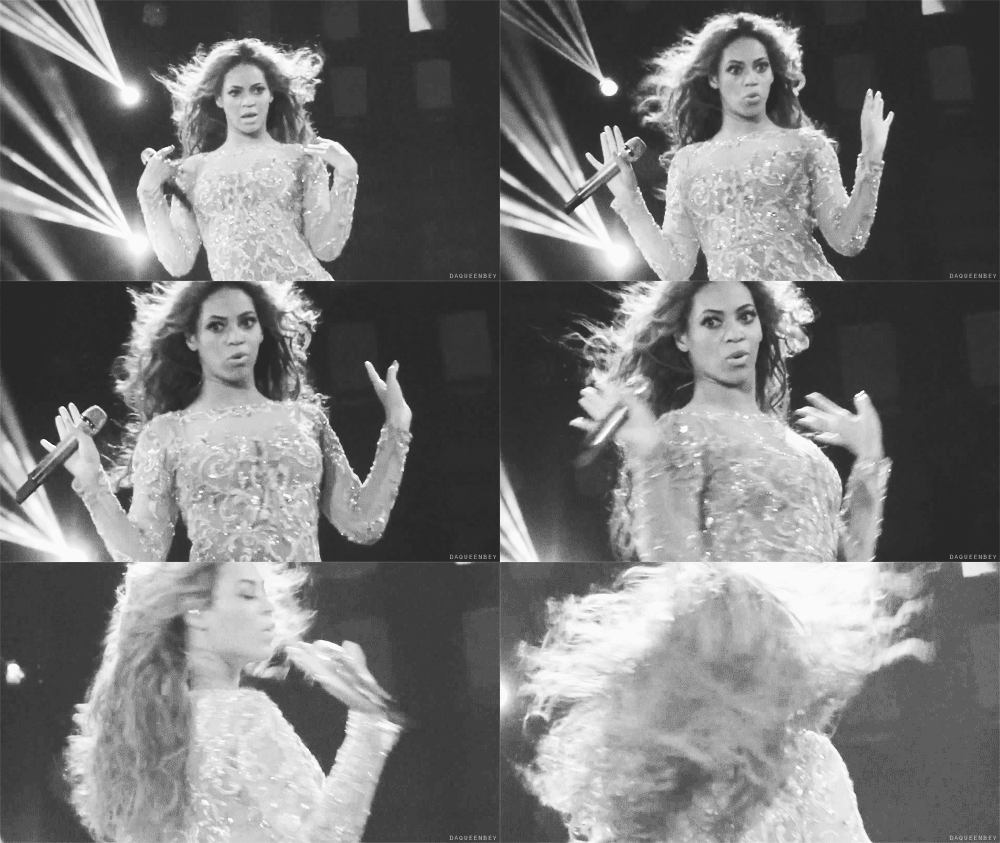

This September, Sounding Out! challenged a #flawless group of scholars and critics to give Beyoncé Knowles-Carter a close listen, re-examining the complex relationship between her audio and visuals and amplifying what goes unheard, even as her every move–whether on MTV or in that damn elevator–faces intense scrutiny. In the coming Mondays, you will hear from Priscilla Peña Ovalle (English, University of Oregon), Liana Silva (Editor, Women in Higher Education, Managing Editor, Sounding Out!), Regina Bradley (writer, scholar, and freelance researcher of African American Life and Culture), and Madison Moore (Research Associate in the Department of English at King’s College, University of London and author of How to Be Beyoncé). Today, we #wakeuplikethis with Kevin Allred (Women and Gender Studies, Rutgers), who refuses to let us fast forward past the understated and discomfiting video track “No Angel.”–Editor-in-Chief Jennifer Stoever
—
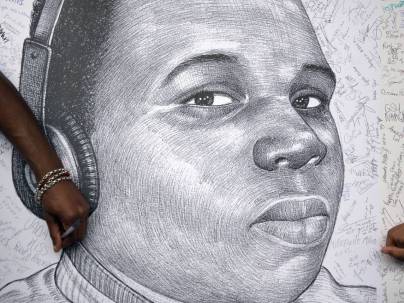
Michael Brown, an unarmed black teenager, was shot to death by white police officer Darren Wilson in Ferguson, Missouri on August 9, 2014, for no apparent reason [see author’s note below]. While the fact that the death of unarmed black men (and women and trans people) at the hands of those in power is, sadly, no unique occurrence, as Melissa Harris-Perry – among countless others – have pointed out, Brown’s death has sparked nation-wide outrage and protests about police brutality, racial injustice, and severely decreased resources for impoverished communities.
In the New York Times’ reportage on Brown’s death, reporter John Eligon found it appropriate to characterize the teenager as “no angel,” as if any amount of alleged wrongdoing or possible character flaws on Brown’s part somehow justified his murder. Both Eligon and the Times were called out on social media and in traditional publications such as the Atlantic, and, while the press quickly apologized, the phrase’s familiar interpellation of victims – especially when they are people of color – as “no angels” lingered: a journalistic gaze born of sympathy with white authority that invalidates an individual’s life, tarnishes their memory, and even rewrites histories.

A powerful counter discourse challenges these racist narratives, however; one we can hear in the dissonant sonics of Beyoncé Knowles-Carter’s “No Angel,” a song that anticipates–and adamantly refutes–the racist notion that people who live, and quite possibly die as Michael Brown did, are anything but valuable.
Released almost 9 months before Brown was killed, Beyoncé’s “No Angel” cannot explicitly be called a response, but the ghosts of black men–living and dead, unfairly judged and mistreated–haunt the entire song. “No Angel” begins with a slow-burning 4-count beat; a low, synthesized, slightly off-kilter kick drum sets the tone for the song while an eerily-lilting high-pitched synthetic warbling noise simultaneously pours out of the speakers. The sound, reminiscent of feedback, drifts between pitches for four painstakingly slow measures before Beyoncé’s vocals kick in. When they do, what we hear is unusual. Her voice reverberates in a breathy, almost too-high falsetto that sounds nothing like the soaring powerhouse vocals of “Halo” or “I Was Here;” nothing like the precise, punctuated staccato of “Single Ladies” or “Run The World (Girls);” and certainly nothing like any of the other songs on BEYONCÉ. Sonic and musical contradictions abound. Neither the kind of impressive falsetto showing a wide range, nor necessarily immediately pleasing to the ear, Beyoncé’s voice is forced. . .and it haunts. Further, the vocals seem to cut the time signature of the song in half, effectively doubling its pace. Its tempo, cadence and vocal dynamics signal “No Angel” as a very different kind of Beyoncé song, one forwarding a sonic and political statement over radio-readiness.
Admittedly, “No Angel” was not initially one of my favorite songs on Beyoncé’s new album. In fact, when teaching this song, most of my students – even the hardcore Beyoncé fans – admit sheepishly to skipping through it because of a feeling of discomfort mainly related to Beyoncé’s vocal delivery. But after a few listens, something clicks: “No Angel” is not supposed to be pleasant, easy listening, but rather it jars and unsettles, just like the impact of news of another unarmed black person killed by white police. We are neither supposed to immediately identify with the audio of “No Angel,” nor possibly even like it.
All about dissonance, the song’s innovation fuels itself with inconsistency and contradiction. Vocally speaking, there are incongruities between the highs and the lows (the bass and the treble or the bass and the soprano), and the abrupt shifts in pacing—the slow pace both in opposition to and contained within the faster pace of the song. Even the stretched and breathy falsetto Beyoncé puts on for most of the song strikes a dissonant chord. Simply put, dissonance is tension, and neither the sonic nor the political tension ends here.
.
Here’s the thing: we know Beyoncé’s voice doesn’t usually sound like it does on “No Angel.” It is a conscious manipulation. And when coupled with the refrain:
You’re no angel either baby
her voice even becomes a kind of accusation. If Michael Brown is “no angel;” if Beyoncé herself, as the singer and also as a black woman in a racist U.S. society, is also initially “no angel” then, Eligon in the NYT as Brown’s accuser and, by extension, we as the listeners, become “no angel either.” What’s more, Beyoncé ‘s delivery is so deliberately overdone that she can be heard taking deep breaths in between each word of the chorus – something most singers would attempt to hide. Beyoncé chooses instead to push it to the forefront of the recording, audibly projecting each word toward the listener; in effect, slapping us in the face with each syllable, driving that message/accusation straight home.
However, while this forum may be dedicated to the sonic qualities of Beyoncé’s work, I don’t believe we can completely divorce the sonic from the visual for “No Angel,” or anything on BEYONCÉ, as it was specifically marketed and publicized as audio and visual album. BEYONCÉ visual music experience is nothing knew to Beyoncé herself. As far back as Dangerously In Love, Beyoncé forwarded her belief “that harmonies are colors” on an interlude toward the end of the album. For her latest album, she went so far as to strike an exclusive deal with iTunes in which the album was only available as a complete package for the first week of its release – singles could not be purchased separately nor without videos (and vice versa). It would be a disservice to ignore the visual depiction of “No Angel,” directed by @LilInternet and its synaesthetic fusion of sound and sight.

Image by Flickr User Princess Mousy Cards
Just as the sonic qualities of the song provoke discomfort, unexpected imagery confronts the eye. First, the video is quite simply not about Beyoncé. She is rarely shown. Instead, Houston street culture and its struggles and poverty, represented largely through the faces of people of color, takes center stage. The video features mainly black men, although there are some images of black women throughout; a stark moment showing black women– raced and sexualized as “no angels”–working as strippers reveals an industry driven not by the agency/desire of the strippers themselves, but rather by the failures of capitalism that often offer few profitable choices to poor women other than sex work (as evidenced in the highlighting money shots/literal shots of money). But the video celebrates the lives of all theses alleged non-angels by showing small moments of happiness – a father smiling with his son; young boys flashing the peace sign with their fingers; sweet glances between lovers, community members proud to show off their jewelry and cars for the camera–redirecting the viewer’s attention to the structural inequality framing many of the images, provoking more voyeuristic viewers to reflect on their own responsibility and complicity in the systems that create poverty and segregation in the first place. Simultaneously, members of the Houston community–as well as diasporic Houstonians–can see themselves represented, even celebrated in the video, as opposed to the usual cinematic vilification and denigration of these very same bodies as “no angels.” Many Houston hop-hop legends appear in the video as well: Bun B, Scarface, Willie D, Z-Ro, and of course Beyoncé herself.

Still from “No Angel” video
When the camera does linger on Beyoncé, it juxtaposes her iconic image–associated with the wealth and power of her celebrity status–with everyday people of her Houston hometown, including its most impoverished. Beyoncé, the residents, and the city itself stare the viewer down – actively challenging us to see both life and death, both living people and memorials to those, such as Michael Brown, who have died too young. The dissonant tension between life and death, encapsulated in Beyoncé’s voice and the video’s mirroring visuals: the high and the low; the rich and the poor; and the fraught gap in between.
Beyoncé tries to bridge this gap, both visually, through her self-representation in Houston, and sonically, particularly the moment when the refrain “you’re no angel, either. . .baby” finishes and she swings her voice down out of falsetto, into her more powerful full-out throat voice. It is assuredly no coincidence that during those moments she repeats the word “no,” over and over again. With that “no,” she objects to mainstream news vilification, anticipating and objecting to Michael Brown’s characterization as “no angel.” Her voice shifts from the high-falsetto – a sound serving the dual purpose of exposing the above dissonance AND acting as a caress to black communities in Houston, and Ferguson, and on and on – and moves into the heavy throat-voiced complaint and objection. “No, you will not treat my people this way. No, you will not treat ANY people this way,” her sound testifies. And, for viewers not represented in the video, that “you” is them–and she means that realization to feel uncomfortable. Beyoncé’s vocal dissonance and visual images force a confrontation with this accusation: it is not Michael Brown and those represented and celebrated in the video who are “no angels,” but the rest of us who fall short.
So, if we are “no angels, either” what do we do about it? Do we skip the track? Do we sit in front of our computer with the visual evidence of the failure of the American Dream staring us down as we groove to Beyoncé’s vocals? Do we turn off the news coverage in Ferguson, MO and pretend it’s not happening? Beyoncé’s voice provokes these uncomfortable questions and more: What does inequality sound like? What does hope and/or resolution/reparation sound like? Are they the same sound? This is a Beyoncé more in line with artists such as Nina Simone, who famously used her voice to express political critique, and not always in the most “pleasant” ways. “No Angel” is Beyoncé’s audio-visual “Strange Fruit,” positioning her alongside some of the most political and innovative protest singers of our time.
—
Author’s Note: At the time of Brown’s death, I had already been submitted this article. Due to the eerie coincidence between Beyoncé’s song “No Angel” and Eligon’s characterization of Michael Brown in the New York Times noted during the review process, I reworked the article to bring the two into conversation – which, in fact, they always were, even though I didn’t know it at the time.
—
Kevin Allred is a musician, activist, and teacher, currently at Rutgers University, where he teaches a signature course he created: “Politicizing Beyoncé.” He lives in Brooklyn, NY with his boyfriend and two elderly dachshunds. Join the Politicizing Beyoncé community at www.facebook.com/politicizingbeyonce. You can also find Kevin at www.kevinallredmusic.com and www.politicizingbeyonce.com.
—
 REWIND!…If you liked this post, check out:
The (Magic) Upper Room: Sonic Pleasure Politics in Southern Hip Hop–Regina Bradley
Freedom Back: Sounding Black Feminist History, Courtesy the Artists–Tavia Nyong’o
“HOW YOU SOUND??”: The Poet’s Voice, Aura, and the Challenge of Listening to Poetry— John Hyland
Share this:

One Nation Under a Groove?: Music, Sonic Borders, and the Politics of Vibration
 Welcome to week three of our February Forum on “Sonic Borders,” a collaboration with the IASPM-US blog in connection with this year’s IASPM-US conference on Liminality and Borderlands, held in Austin, Texas from February 28 to March 3, 2013. The “Sonic Borders” forum is a Virtual Roundtable cross-blog entity that will feature six Sounding Out! writers posting on Mondays through February 25, and four writers from IASPM-US, posting on Wednesdays starting February 6th and ending February 27th. For an encore of weeks one and two of the forum, click here. And now, get up and get ready for Marcus Boon, because there’s no parking on the dance floor at Sounding Out!–JSA
—
What borders remain when it comes to thinking about sound today? The field of sound studies has exploded in so many far-flung directions in the last few years. However, I argue that what is still somewhat off limits in the field is a consideration of the ontological status of sound: in other words, what it means to understand our own being in the world as a sonic phenomenon. Out of attempts to approach this sonic ontology, comes the realization that there are prohibitions, perhaps universal ones, on thinking about sound in this way, and from that emerges what I call the politics of vibration.
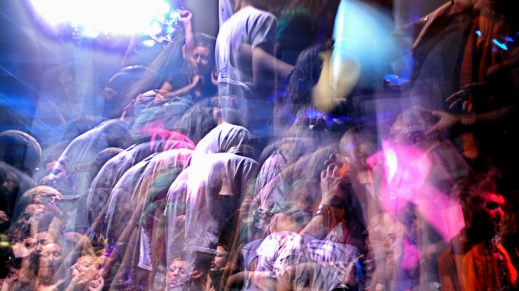
For those, such as myself, who have grown up as a part of sonic subcultures, it is not difficult to ponder sonic ontologies, for the simple reason that many of the most intense and powerful experiences we have had have occurred on dance floors or at clubs, as DJs, musicians, clubbers and/or listeners. I still remember the moment of first hearing Funkadelic’s “One Nation Under a Groove” blasting through the speakers at a Pop Group gig at the Electric Ballroom in London in the late 1970s: tumbling polyrhythms, polyphony, polysexuality, polyeverything. The feeling was: “wow, the universe contains this! And it contains other people who know what it is!” And contrary to the warnings of Slavoj Zizek concerning the “autistic jouissance” to be found at the limits of language, here we all were: high; the histories of Afrodiasporic displacement and solidarity echoing off the walls; our own implication in those histories illuminated; flickering between utopia and shame.
To quote Eric Satie: “When I was young they told me: You’ll see when you’re fifty. I’m fifty. I’ve seen nothing.” Me too. But I’ve heard a lot and I still experience that same power of sound in more or less the same way. If anything, sound’s power is more intense and surprising, each time it appears. Partly because I have learned how to be a social being through sound—how to love and be loved—enabling me to be more open to its impact than I was as an awkward youth. It makes me sad the way in Canada and elsewhere in el Norte people seem to lessen their involvement in the more intense aspects of sound cultures as they hit 30 or 40. It makes me sad that my four-year-old son rarely gets to hear a real sound system. I look for music at carnivals, weddings, community centers, on the beach. . .anywhere that those age barriers are ignored. Even as a DJ, I increasingly look for new or different kinds of publicness than that of club or dancehall.
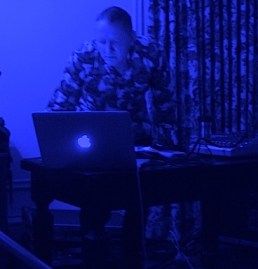
Marcus Boon DJ-ing, image by JSA
Still, I do wonder. Was the movement into sonic subcultures that my generation (and those that followed) made–especially in the UK where music (and intoxicants, and immigration) were one of the few escape routes from the brutalities of Thatcherism–a mistake, precisely because we accepted as ontological, a structure that in fact was smoothly integrated into the operations of late capitalism? From the Factory and Paradise Garage to Berghain or Ministry of Sound. . . how will history look on the era of the mega-club?
Although one could argue that the Internet put an end to the idea of subculture, since it breaks down the locality and secrecy around which particular subcultural communities grow, in fact what seems to be happening is an acceleration in the generation and dissolution of subcultural formations. Hip-hop has adapted very quickly to the internet. The cassettes or CD-Rs sold out of DJ Screw’s record store in Houston, Texas, for example, morph into the world of online mixtapes, Youtube clips and Twitter battles; the gray market availability of samples sounds a lacuna of time, appearing for a day on a hosting site rather than flying below the radar in some particular geographical location. At the same time, sonic subcultures are expanding around the world. If Jacques Attali was right that sound is prophetic, then #idlenomore was announced by Ottawa Native dubstep crew A Tribe Called Red; Tahrir Square by Chaabi and North African hip-hop.
In his book 1989, Joshua Clover describes popular music in the period of neo-liberal globalization as the sound of ideological containment. It’s true that popular music is full of ontological claims about sound, of music that celebrates setting us free. . .but which fails to actually do so. A quote from Ray Brassier just came up on my Twitter feed:

If true, this would suggest that the intensity of moments of sonic jouissance does not necessarily mean anything in terms of ontology or the truth about what’s Real. It could be entirely delusional.
All of which might be true. We might come to realize that, to put it in Heideggerian terms, we’ve been thrown into this, and that maybe there’s not much difference between being thrown and being played. But somehow I think people on dancefloors already know this. The dramas of seduction, commitment and loss are at the core of disco, and many other kinds of popular music too. To quote the disco classic “Lost in Music” by Sister Sledge (later covered by post-punks The Fall):
We’re lost in music; caught in a trap.
No turning back. We’re lost in music.
We’re lost in music. Feel so alive.
I quit my nine-to-five. We’re lost in music.
Other examples are not lacking.
Perhaps sound and music border on a vibrational ontology, rather than being truly the core of one. This is why, as Michael Taussig, Jayna Brown, and others have suggested, they can be concerned with healing. Perhaps any practice that is meaningful — and sonic subcultures are certainly a matter of practice, as Julian Henriques indicates in his book Sonic Bodies — must necessarily work at the boundary of a space that it can never entirely inhabit as a practice, but which it can push one towards, and also receive one from. The anticipation, fear, desire before one goes out, for example, but also the blinding daylight, the sensation of cool air on exposed skin when one leaves a dancehall or a party.

Lasers in a dance club, image by flickr user gabriel.jorby
Sound studies has not truly begin to explore these moments of exposure to and abjection from the vibrational core of sound. No doubt, Steve Goodman performed heroic work in Sonic Warfare—which sets out a proposal for a vibrational ontology in the midst of the commodification and militarization of the sonic —as have various explorations of the phenomenology of sound, such as those in Salome Voegelin‘s Listening to Noise and Silence. Yet in both cases, a full consideration of sonic ontology is in the end foreclosed. In Goodman’s case by Sonic Warfare’s emphasis on the militaristic applications of sound and vibration that are appropriated by sonic art and subcultures, which gives the violence of sound and vibration something like ontological status, while the aesthetic and cultural “uses” of the same have only a secondary, somewhat parasitic status. Conversely, in Voegelin’s work, an emphasis on the phenomenological rendering of the moment or event of sonic relationship forecloses a broader investigation of sonic ontology, because it “brackets” (to use Husserl‘s term) considerations beyond that of the subject-object relationship. In both cases, the sonic thing in itself, or indeed an ontology of vibration, risks being lost.
The recent turn to the speculative and to realism in philosophy has yet to make an impact in sound studies, despite the fact that the object of sound presents a provocative and very intimate entry point to that problematic. One of the more intriguing and improbable hypotheses emerging from the speculative realist movement is that of Quentin Meillassoux, who, in After Finitude, makes an argument that speculative knowledge of the real, unmediated by correlation with the Kantian subject, is possible through mathematics. It is roughly Alain Badiou‘s thesis in Being and Event too. As much as music is clearly about the contingency of sonic experience, there are strong arguments, going back to Pythagoras and beyond, about the relation of music to mathematics. Natural harmonics, rhythm: the elements of music express mathematical relationships. I am not interested in reducing music to a kind of vulgar scientism. But what if when we listen to music, we are exposed to a mathematical ontology and at the same time, the contingency of an unprecedented event? What if music is speculatively real? The word “speculative” here would refer not to philosophical propositions, but to the uncanny movement across subject/object individual/collective borders that the sonic matrix offers when “we” listen to “it.” Music not as the source of a speculative discourse on the real, but a speculative practice in which order and contingency meet.

A cymatic image, made by sound vibrations on a visible medium by flickr user evan grant
Genres, styles form around places of cohesion, of transport, of passage. Not an instrumental mathematics (though it can be that too), but a speculative one that seeks out locations of collective affect, of resonance between micro and macro spheres. It matters little whether a specific knowledge of mathematics is invoked here, since many traditional musics find their way to structures that, according to scholars such Alain Danielou, already express mathematical relationships. And in this way, music and musicians can be said to participate in a sonic ontology.
Reluctantly perhaps. Ready or not. The question remains: how many institutional, historical, disciplinary, intellectual, social and political barriers remain in order that a cultural artifact like “One Nation Under a Groove” can be considered to have ontological significance? That is what I mean by the politics of vibration, and in terms of borders, it’s an important set of borders for researchers in sound studies to consider.

Tyler, the Creator crowdsurfing, image by flicker user choe.brandon
Much of my current work focuses on tropes of abjection in recent hip-hop and RnB music, notably that of Odd Future members Tyler, the Creator and Frank Ocean, artists like Azealia Banks, and a new generation of queer rap MCs emerging out of New York City such as Zebra Katz, Le1f and Cakes Da Killa. All of their work is bracingly obscene, funny, violent. . .a tumbling deck of cards of performances of gender, race, sexuality, class and more. Of course, cursing to a beat is nothing particularly new, but the way in which these artists multiply and collapse identities to an ever more minimal, humming beat perhaps is.
Katz’s remarkable “Ima Read” and its equally remarkable video is a case in point. Although Katz occasionally claims dryly that the song is “pro education,” the “reading” in question mostly refers to the drag queen balls of the Harlem ballroom/voguing scene of the late 1980s/early 1990s, where to read meant to verbally trash, i.e. abject, someone at a ball. The song is rapped by male and female voices, crisply denouncing a “bitch” who they are going to “take to college.” The violence of the song is ironic, as much a marker of queer community and Eros as of sexual difference, of racial and trans-racial solidarity as much as racialized violence. It is performed over a minimal beat with a humming, in-your-face bass drum that is the only recognizable tonal element.
Why make the leap to talking about ontology in discussing this admittedly awesome Youtube clip? Both Judith Butler’s famous elaboration of the performativity of gender, one of the bases of queer theory, and Katz and friends play with taboos concerning gender, sexuality and race in contemporary hip-hop emerge from that moment of the ballroom scene.
But what if Butler’s emphasis on performance actually covered up or abjected the ontological nature of experiments at the balls? Perhaps we need to rethink why the ultimate ball anthem is Cheryl Lynn’s “Got To Be Real.” What is sonic ‘realness’? In restoring the sonic dimension to the ballroom scene, and learning, from Zebra Katz, to face that constitutive abjection that Kristeva amongst others has pointed us towards, we can begin to feel for ourselves what a vibrational ontology is.
—
My thanks to Catherine Christer Hennix, Steven Shaviro, Kevin Rogers and Ken McLeod for conversations that helped me in thinking this through, and to Jennifer Stoever-Ackerman for luminous remix skills.
—
Featured Image by Flickr User depinniped
—
Marcus Boon is associate professor of English at York University in Toronto, and was a Fellow at Cornell’s Society for the Humanities in 2011-12. He is the author of The Road of Excess: A History of Writers on Drugs (Harvard UP, 2002) and In Praise of Copying (Harvard UP, 2010). He writes about contemporary music for The Wire. He is currently co-editing a book on Buddhism and critical theory, and a new edition of William S. Burroughs and Brion Gysin’s The Third Mind. He is also working on a book entitled The Politics of Vibration.
Share this:


Current Top Posts





April 2021

January 2020

November 2019

October 2019

August 2019

April 2014

November 2017

March 2015

December 2017

October 2015
 Sounding Out!
Recent Comments