
One Nation Under a Groove?: Music, Sonic Borders, and the Politics of Vibration
 Welcome to week three of our February Forum on “Sonic Borders,” a collaboration with the IASPM-US blog in connection with this year’s IASPM-US conference on Liminality and Borderlands, held in Austin, Texas from February 28 to March 3, 2013. The “Sonic Borders” forum is a Virtual Roundtable cross-blog entity that will feature six Sounding Out! writers posting on Mondays through February 25, and four writers from IASPM-US, posting on Wednesdays starting February 6th and ending February 27th. For an encore of weeks one and two of the forum, click here. And now, get up and get ready for Marcus Boon, because there’s no parking on the dance floor at Sounding Out!–JSA
—
What borders remain when it comes to thinking about sound today? The field of sound studies has exploded in so many far-flung directions in the last few years. However, I argue that what is still somewhat off limits in the field is a consideration of the ontological status of sound: in other words, what it means to understand our own being in the world as a sonic phenomenon. Out of attempts to approach this sonic ontology, comes the realization that there are prohibitions, perhaps universal ones, on thinking about sound in this way, and from that emerges what I call the politics of vibration.
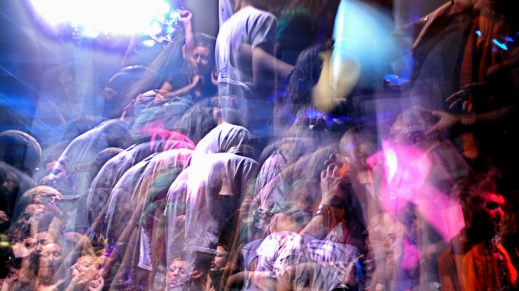
For those, such as myself, who have grown up as a part of sonic subcultures, it is not difficult to ponder sonic ontologies, for the simple reason that many of the most intense and powerful experiences we have had have occurred on dance floors or at clubs, as DJs, musicians, clubbers and/or listeners. I still remember the moment of first hearing Funkadelic’s “One Nation Under a Groove” blasting through the speakers at a Pop Group gig at the Electric Ballroom in London in the late 1970s: tumbling polyrhythms, polyphony, polysexuality, polyeverything. The feeling was: “wow, the universe contains this! And it contains other people who know what it is!” And contrary to the warnings of Slavoj Zizek concerning the “autistic jouissance” to be found at the limits of language, here we all were: high; the histories of Afrodiasporic displacement and solidarity echoing off the walls; our own implication in those histories illuminated; flickering between utopia and shame.
To quote Eric Satie: “When I was young they told me: You’ll see when you’re fifty. I’m fifty. I’ve seen nothing.” Me too. But I’ve heard a lot and I still experience that same power of sound in more or less the same way. If anything, sound’s power is more intense and surprising, each time it appears. Partly because I have learned how to be a social being through sound—how to love and be loved—enabling me to be more open to its impact than I was as an awkward youth. It makes me sad the way in Canada and elsewhere in el Norte people seem to lessen their involvement in the more intense aspects of sound cultures as they hit 30 or 40. It makes me sad that my four-year-old son rarely gets to hear a real sound system. I look for music at carnivals, weddings, community centers, on the beach. . .anywhere that those age barriers are ignored. Even as a DJ, I increasingly look for new or different kinds of publicness than that of club or dancehall.
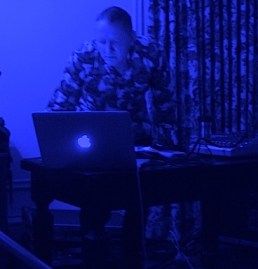
Marcus Boon DJ-ing, image by JSA
Still, I do wonder. Was the movement into sonic subcultures that my generation (and those that followed) made–especially in the UK where music (and intoxicants, and immigration) were one of the few escape routes from the brutalities of Thatcherism–a mistake, precisely because we accepted as ontological, a structure that in fact was smoothly integrated into the operations of late capitalism? From the Factory and Paradise Garage to Berghain or Ministry of Sound. . . how will history look on the era of the mega-club?
Although one could argue that the Internet put an end to the idea of subculture, since it breaks down the locality and secrecy around which particular subcultural communities grow, in fact what seems to be happening is an acceleration in the generation and dissolution of subcultural formations. Hip-hop has adapted very quickly to the internet. The cassettes or CD-Rs sold out of DJ Screw’s record store in Houston, Texas, for example, morph into the world of online mixtapes, Youtube clips and Twitter battles; the gray market availability of samples sounds a lacuna of time, appearing for a day on a hosting site rather than flying below the radar in some particular geographical location. At the same time, sonic subcultures are expanding around the world. If Jacques Attali was right that sound is prophetic, then #idlenomore was announced by Ottawa Native dubstep crew A Tribe Called Red; Tahrir Square by Chaabi and North African hip-hop.
In his book 1989, Joshua Clover describes popular music in the period of neo-liberal globalization as the sound of ideological containment. It’s true that popular music is full of ontological claims about sound, of music that celebrates setting us free. . .but which fails to actually do so. A quote from Ray Brassier just came up on my Twitter feed:

If true, this would suggest that the intensity of moments of sonic jouissance does not necessarily mean anything in terms of ontology or the truth about what’s Real. It could be entirely delusional.
All of which might be true. We might come to realize that, to put it in Heideggerian terms, we’ve been thrown into this, and that maybe there’s not much difference between being thrown and being played. But somehow I think people on dancefloors already know this. The dramas of seduction, commitment and loss are at the core of disco, and many other kinds of popular music too. To quote the disco classic “Lost in Music” by Sister Sledge (later covered by post-punks The Fall):
We’re lost in music; caught in a trap.
No turning back. We’re lost in music.
We’re lost in music. Feel so alive.
I quit my nine-to-five. We’re lost in music.
Other examples are not lacking.
Perhaps sound and music border on a vibrational ontology, rather than being truly the core of one. This is why, as Michael Taussig, Jayna Brown, and others have suggested, they can be concerned with healing. Perhaps any practice that is meaningful — and sonic subcultures are certainly a matter of practice, as Julian Henriques indicates in his book Sonic Bodies — must necessarily work at the boundary of a space that it can never entirely inhabit as a practice, but which it can push one towards, and also receive one from. The anticipation, fear, desire before one goes out, for example, but also the blinding daylight, the sensation of cool air on exposed skin when one leaves a dancehall or a party.

Lasers in a dance club, image by flickr user gabriel.jorby
Sound studies has not truly begin to explore these moments of exposure to and abjection from the vibrational core of sound. No doubt, Steve Goodman performed heroic work in Sonic Warfare—which sets out a proposal for a vibrational ontology in the midst of the commodification and militarization of the sonic —as have various explorations of the phenomenology of sound, such as those in Salome Voegelin‘s Listening to Noise and Silence. Yet in both cases, a full consideration of sonic ontology is in the end foreclosed. In Goodman’s case by Sonic Warfare’s emphasis on the militaristic applications of sound and vibration that are appropriated by sonic art and subcultures, which gives the violence of sound and vibration something like ontological status, while the aesthetic and cultural “uses” of the same have only a secondary, somewhat parasitic status. Conversely, in Voegelin’s work, an emphasis on the phenomenological rendering of the moment or event of sonic relationship forecloses a broader investigation of sonic ontology, because it “brackets” (to use Husserl‘s term) considerations beyond that of the subject-object relationship. In both cases, the sonic thing in itself, or indeed an ontology of vibration, risks being lost.
The recent turn to the speculative and to realism in philosophy has yet to make an impact in sound studies, despite the fact that the object of sound presents a provocative and very intimate entry point to that problematic. One of the more intriguing and improbable hypotheses emerging from the speculative realist movement is that of Quentin Meillassoux, who, in After Finitude, makes an argument that speculative knowledge of the real, unmediated by correlation with the Kantian subject, is possible through mathematics. It is roughly Alain Badiou‘s thesis in Being and Event too. As much as music is clearly about the contingency of sonic experience, there are strong arguments, going back to Pythagoras and beyond, about the relation of music to mathematics. Natural harmonics, rhythm: the elements of music express mathematical relationships. I am not interested in reducing music to a kind of vulgar scientism. But what if when we listen to music, we are exposed to a mathematical ontology and at the same time, the contingency of an unprecedented event? What if music is speculatively real? The word “speculative” here would refer not to philosophical propositions, but to the uncanny movement across subject/object individual/collective borders that the sonic matrix offers when “we” listen to “it.” Music not as the source of a speculative discourse on the real, but a speculative practice in which order and contingency meet.

A cymatic image, made by sound vibrations on a visible medium by flickr user evan grant
Genres, styles form around places of cohesion, of transport, of passage. Not an instrumental mathematics (though it can be that too), but a speculative one that seeks out locations of collective affect, of resonance between micro and macro spheres. It matters little whether a specific knowledge of mathematics is invoked here, since many traditional musics find their way to structures that, according to scholars such Alain Danielou, already express mathematical relationships. And in this way, music and musicians can be said to participate in a sonic ontology.
Reluctantly perhaps. Ready or not. The question remains: how many institutional, historical, disciplinary, intellectual, social and political barriers remain in order that a cultural artifact like “One Nation Under a Groove” can be considered to have ontological significance? That is what I mean by the politics of vibration, and in terms of borders, it’s an important set of borders for researchers in sound studies to consider.

Tyler, the Creator crowdsurfing, image by flicker user choe.brandon
Much of my current work focuses on tropes of abjection in recent hip-hop and RnB music, notably that of Odd Future members Tyler, the Creator and Frank Ocean, artists like Azealia Banks, and a new generation of queer rap MCs emerging out of New York City such as Zebra Katz, Le1f and Cakes Da Killa. All of their work is bracingly obscene, funny, violent. . .a tumbling deck of cards of performances of gender, race, sexuality, class and more. Of course, cursing to a beat is nothing particularly new, but the way in which these artists multiply and collapse identities to an ever more minimal, humming beat perhaps is.
Katz’s remarkable “Ima Read” and its equally remarkable video is a case in point. Although Katz occasionally claims dryly that the song is “pro education,” the “reading” in question mostly refers to the drag queen balls of the Harlem ballroom/voguing scene of the late 1980s/early 1990s, where to read meant to verbally trash, i.e. abject, someone at a ball. The song is rapped by male and female voices, crisply denouncing a “bitch” who they are going to “take to college.” The violence of the song is ironic, as much a marker of queer community and Eros as of sexual difference, of racial and trans-racial solidarity as much as racialized violence. It is performed over a minimal beat with a humming, in-your-face bass drum that is the only recognizable tonal element.
Why make the leap to talking about ontology in discussing this admittedly awesome Youtube clip? Both Judith Butler’s famous elaboration of the performativity of gender, one of the bases of queer theory, and Katz and friends play with taboos concerning gender, sexuality and race in contemporary hip-hop emerge from that moment of the ballroom scene.
But what if Butler’s emphasis on performance actually covered up or abjected the ontological nature of experiments at the balls? Perhaps we need to rethink why the ultimate ball anthem is Cheryl Lynn’s “Got To Be Real.” What is sonic ‘realness’? In restoring the sonic dimension to the ballroom scene, and learning, from Zebra Katz, to face that constitutive abjection that Kristeva amongst others has pointed us towards, we can begin to feel for ourselves what a vibrational ontology is.
—
My thanks to Catherine Christer Hennix, Steven Shaviro, Kevin Rogers and Ken McLeod for conversations that helped me in thinking this through, and to Jennifer Stoever-Ackerman for luminous remix skills.
—
Featured Image by Flickr User depinniped
—
Marcus Boon is associate professor of English at York University in Toronto, and was a Fellow at Cornell’s Society for the Humanities in 2011-12. He is the author of The Road of Excess: A History of Writers on Drugs (Harvard UP, 2002) and In Praise of Copying (Harvard UP, 2010). He writes about contemporary music for The Wire. He is currently co-editing a book on Buddhism and critical theory, and a new edition of William S. Burroughs and Brion Gysin’s The Third Mind. He is also working on a book entitled The Politics of Vibration.
Share this:

Orchestral Manoeuvers in the Afternoon
 I am not usually one to listen and tell, but this time I feel the need to publicly confess, Katy Perry-style. A few weeks ago, I heard a symphony orchestra. And I liked it. I might even go so far as to say it fairly delighted me. What warmth and depth of sound! What a potent tension between distinguishable instruments and commonly held notes! And oh, the violas! My pleasure in this experience, however, has thrust me in ethical, epistemological, and ontological crisis mode, leaving me to wonder: Who am I? and What on earth has happened to me?
If anyone had told me even six months ago that I would be making this declaration, they would have received a fairly withering sardonic look. Classical music has never been my thing—by politics, class, birth, or taste (of course, if you ask Pierre Bourdieu, taste is hopelessly bound up in the first three, anyway, whether we acknowledge it or not). My working class roots have eschewed Capital-C “Classical” music listening as far back as I can trace: most  immediately, “classical” to my father means one of his musical holy trinity: the Beatles, the Stones, or Hendrix. Next to the electrically-charged and vocally-driven musical traditions that raised me, classical has always seemed sonically uninteresting and unavailable, even as rebellion against Woodstock (unless of course it was the synth patch work of Wendy Carlos that was switching me on to Bach).
However, it wasn’t solely that classical music didn’t speak to me—it was also a matter of what it said when it did. I have encountered some version of classical in so many forbidden, intimidating, and privileged spaces that it often seemed as if the music itself drew borders around me, its booming kettle drums warning me to “keep out” while its mincing violins suggested I had better put on a uniform and grab the hors d’oeuvres tray should I decide to stay. From the report on Haydn I was assigned for 7th grade Music Appreciation to the metronymical Beethoven ticking off my many minimum wage hours at the mall—the lilting soundtrack to the security footage my boss collected every night from the cameras not-so-subtly trained on me—my encounters with classical have almost always been connected with the imposition of power. More recently, I found myself waiting for a bus in downtown L.A. around 2 a.m., where I was pummeled with high-volume classical music blasting from the doorways of high-end condos, echoing down the unusually empty streets. Apparently, building managers feel amplified classical deters homeless people from seeking shelter there, without annoying their well-heeled residents. According to the San Diego Union Tribune, “The music that seems to do the best job of driving people away. . . is baroque”. . .the music characteristic of Bach and my old friend Haydn. I wonder if my 7th grade teacher knows this.
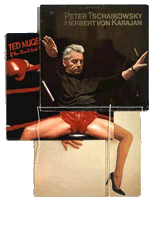
A Christian Marclay Classical
Given experiences like these, I have been unable to simply ignore classical music throughout my life, but I have officially considered myself “a hater.” I have been that punk rocker hooting and hollering for their cello-playing friend in the pin-dropping silences between movements, wishing that everyone would turn around and glare. I have actually called up my local NPR-classical combo station during pledge drives and told them I will increase my donation if and only if they banish the bassoons and switch to a full-time news format. Like all that classical vinyl clogging up the dollar bins at record shows, public classical programming is an ideological holdover from the turn-of-the-last-century, when classical was aligned with white middle class respectability. The streets of my neighborhood in Binghamton, for example—chock full of aging Victorians that were once a sign of industrial prosperity—are named after Schubert, Mozart, and Beethoven, which the local residents of these now crumbling buildings, since chopped up into rooming houses, defiantly call “Beeeeeth-oven.” In the early twentieth century, labels like Victor pumped out classical discs to convince Americans of the “respectability” of the gramophone—that the new machine wouldn’t be used solely to spread Tin Pan Alley, or worse yet, jazz—while offering a lower-cost alternative to expensive opera houses for poorer folks. Distilling orchestra onto portable 12-inch discs has the veneer of democratization and agency, sure—shouldn’t everyone have access to the listening habits of the rich and powerful in their very own homes?—but the practice enforced and upheld the 19th century split between so-called high and low cultures that we still wrestle with today.
Lawrence Levine described this as the division between “highbrow” and “lowbrow” culture. It deemed non-white and/or working class cultural production—categorized as “pop,” “folk,” and/or “vernacular” musics—as the gauche and corrosive soundtrack of lesser minds, while constructing the Eurocentric symphonic hall and the opera house as sacred cultural sites (long with museums and libraries—see Aaron Trammell’s recent post). Elite white gatekeepers in the 19th centuries drew both sonic and discursive borders between “high” and “low” culture, deliberately excluding African American artists, for example, from music’s elite spaces by using language to redact “Othered” sounds from the category of “music” itself. In the white press reception of the Fisk Jubilee Singers, for example—a touring group who combined black musical tradition with European concert performance styles in the 1870s, the first to do so on American stages—recurrent descriptors such as “weird” and “rude,” show white critics attempting to interpellate a new cultural force into their pre-existing musical value systems—marked of course, as “universal”—in ways that would neither threaten nor reveal the white cultural supremacy that undergirded them. The best efforts of the Jubilee Singers were repeatedly presented by white reviewers as uncultivated, emotional, ephemeral, racialized sound that, while
The Jubilee Singers Perform for Queen Victoria
mesmerizing, was not to be categorized as “music”—universal, eternal, artistic—alongside the German composers in vogue at the time. Levine argues that these elites constructed the physical and discursive sites of music as demanding a certain type of discipline, purpose and “most important of all—a feeling of reverence” (146). The term “classical” is part and parcel of this reverence, appearing in the early 19th century, and, according to Alex Ross—the classical music critic for The New Yorker who for the record hates the term—“mirrored the rise of the commercial middle class, which employed Beethoven as an escalator to social heights.”
From my first record purchase—The Go-Go’s Beauty and the Beat (1980)—to my latest, Cee Lo’s The Ladykiller (2010)—I have been on a search for reverence elsewhere, most often smashed up against a sweaty crowd of people, feeling the waves of the giant speaker stack reverberating through my body, shouting along until my vocal chords were completely raw. Jimi Hendrix called this form of reverence “the electric church” in 1969, and Paul Gilroy does a beautiful homage to its power in “Some Soundscapes of the Black Atlantic” describing Hendrix’s vision of music as an inclusive ritual event whose high volumes not only deliver a proper wake-up-call to those who need it, but “promote a direct encounter with the souls of the people involved” (383). Unlike the concert hall’s rarefied air, the sonic cervices of the “electric church” seemed to welcome all comers. Sadly, since moving to Binghamton—a smallish town in upstate New York—my tithes to the electric church have dwindled; against my will, I have become one of those Christmas and Easter types. I hadn’t realized my extreme musical privilege growing up in Los Angeles’ shadow until I found myself in the outer limits of America’s musical infrastructure. However, as my recent symphony encounter has proved, being locked out of the “electric church” has made me more open to the power of musical sound wherever I find it. Not to mention that, in my anxious mental deconstruction of my new appreciation of the orchestra’s roar, I couldn’t help but think that it was because—barring the Dolby soundsystem at the local movie theater—the symphony was easily the loudest thing I have experienced in almost a year.
And maybe that’s it. I have a new loud. Between moving to Binghamton and edging deeper into my 30s, my seemingly immovable aural palate has experienced a major tectonic shift. When I recently discussed my odd ecstatic experience over dinner with visiting sound artist and Binaural Fellow Maile Colbert, she suggested that age may have a lot to do with it. Colbert posited that we don’t fully understand the physical inscription of sound on the body, especially the connection between pleasure and the ways in which sound waves strike our bodies beyond the ear. So, shifting tastes in music may not just be a

Another Christian Marclay Classical
factor of nostalgia or just plain becoming uncool, as marketers would have us believe, but rather a visceral reaction to the new ways in which sound resonates with our thinning skin, hollowing bones, slackening muscles, and disintegrating organs. After turning 30, I found, inexplicably, that I suddenly liked black licorice, so maybe an affinity for the symphony is similarly inevitable. I almost surrendered to this promising explanation, as it meant liking the symphony was part of a natural process that was out of my control, but unfortunately I have read enough Judith Butler—and 19th century music writing—to know that my experience of the “natural” processes of my body are always affected by cultural narratives. Much of what we currently consider to be “old people’s music” was once thought to corrupt and inflame the passions of youth a century ago. So, if I could not safely blame my sudden symphonic pleasures on age, then what?
Before you offer up that perhaps I just heard the “right” performance, the Guinness experience of sound after a lifetime of the aural equivalent of Coors Light, I need to make a second confession. The symphony performance I heard was not the New York Philharmonic doing Mahler’s 6th Symphony, or even the Binghamton Phil’s recent performance of Enigma Variations. Actually, I took my almost-two-year-old to hear the Binghamton University Symphony Orchestra’s 2010 Children’s Concert All Creatures, featuring “Peter and the Wolf” and other pieces of music designed to evoke animals via sound. So the concert was perhaps not your typical orchestra experience, unless it has become common practice to let you touch a spitting cockroach from Madagascar on your way to your seven-dollar seat. I brought my little guy to All Creatures not out of a desire to impose “good music” on him, but because he loves sounds of all kinds and a.m. concerts are few and far between. Older folks like me were visibly in the minority at All Creatures, and the air was hardly rarified; not only was it the most diverse orchestra crowd I have seen to date, but you could wriggle in your seat and clap all you wanted. To the orchestra’s credit, they played as passionately for a sea of six-year-olds as I am sure they would for state dignitaries, and it was fairly stunning to watch young musicians so obviously still falling in love with their instruments.
I’d like to be able to conclude by telling you that I heard the orchestra anew through my son’s still-forming, wide-open ears—an experience I have imagined in an earlier blog—but I have to make one last confession: he was asleep within two minutes of the orchestra tuning up, a chip off the old block. His impromptu snooze left me alone to wrestle with my old nemeses Beeeth-oven and Haydn, as well as the questions rooting the blossoms of my newfound guilty pleasure. Given who I am and where I have come from, was it transgressive to be sitting in the third row of a symphony hall, letting the sound touch me? Or, perhaps, this listening experience was more about where I am now than where I started from. No longer waiting in the wings or cleaning the bathrooms, I am a university faculty member with a front row seat. Was I unconsciously giving in to the powerful (and Eurocentric) aural propaganda of the orchestra, with its visible hierarchies and overwhelming harmonic quest for everything in its “proper” place—precisely the privileged perspective that I daily attempt to dismantle? Or, more than likely, the suddenness of my errant desire simply allowed me to hear new traces of an old refrain: where listening is concerned, resistance and subjection can never be easily separated, let alone painlessly resolved.
Share this:


Current Top Posts





April 2021

January 2020

November 2019

October 2019

August 2019

April 2014

November 2017

March 2015

December 2017

October 2015
 Sounding Out!
Recent Comments