
SO! Reads: Danielle Shlomit Sofer’s Sex Sounds: Vectors of Difference in Electronic Music

Distance, therefore, preserves a European austerity in recorded musical practices, and electroacoustic practice is no exception; it is perhaps even responsible for reinvigorating a colonial posterity in contemporary music as so many examples in this book follow this pattern–Danielle Shlomit Sofer, Sex Sounds, 14.

Sex Sounds: Vectors of Difference in Electronic Music (MIT Press, 2022) by Danielle Shlomit Sofer brings a complex analysis for contemporary de-colonial, queer and feminist readers. This book did its best to sustain an argument diving into eleven case studies and strongly problematising the Western white cis gaze. Sofer offers readers a new perspective in both the history of music and the decolonisation of that history.
In a moment when discussions of consent, censorship, pleasure, and surveillance are reshaping how we think about media, Sofer asks: What does sex sound like, and why does it matter? Their analysis cuts across high art and popular culture, from avant-garde compositions to pop music to porn, revealing how sonic expressions of sex are never neutral—they’re deeply entangled in gendered, racialized, and heteronormative structures. In doing so, Sex Sounds resonates with broader critical work on listening as a political act, aligning with ongoing conversations in sound studies about the ethics of hearing and the politics of voice, noise, and silence

The main focus of Sex Sounds is the historical loop of sexual themes in electronic music since the 1950s. Sofer writes from the perspective of a mixed-race, nonbinary Jewish scholar specializing in music theory and musicology. They argue that the way the Western world teaches music history involves hegemonic narratives. In other words, the author’s impetus is to highlight the construction of mythological figures such as Pierre Schaeffer in France and Karlheinz Stockhausen in Germany who represent the canon of the Eurocentric music phenomena.
Sex Sounds specifically follows the concept of “Electrosexual Music,” defined by Sofer as electroacoustic Sound and Music interacting with sex and eroticism as socialized aesthetics. The issue of representation in music is a key research focus navigating questions such as: “How does music present sex acts and who enacts them? ” as well as: “how does a composer represent sexuality? How does a performer convey sexuality? And how does a listener interpret sexuality?” (xxiv & xxix). Moreover, Sofer traces: “the threats of representation, namely exploitation and objectification” (xxxvii) as the result of white male privilege and the historical harm and violence this means (xiix & 271).
By exploring answers to these questions, Sofer successfully exposes how electroacoustic sexuality has historically operated as a constant presence in many music genres, as well as proving that music and sound did not begin in Europe nor belongs only to the Anglo-European provincial cosmos. Sex Sounds gives visibility to peripheral voices ignored by the Eurocentric canon, arguing for a new history of music where countries such as Egypt, Ghana, South Africa, Chile, Japan or Korea are central.
Sofer further vivisects the meaning of sexual sounds as not only Eurocentric and colonial but patriarchal and sexist. What is the history behind sex sounds in the electroacoustic music field? Can we find liberation in sex sounds or have they only reproduced dominance? Which role do sex sounds play in the territories of otherness and racial representation? Are there examples where minoritized people have reclaimed their voice? Sex is part of our humanity. But how do sex sounds dehumanize female subjects? These are more of the fundamental questions Sofer responds to in this study.

I aim, first and foremost, to show that electrosexual music is far representative a collection than the typically presented electroacoustic figures -supposedly disinterested, disembodied, and largely white cis men from Europe and North America –Sofer, Sex Sounds,(xvi).
The time frame of the study ranges from 1950 until 2012, analysing four case studies. Sofer divides the book in two parts: Part I: “Electroacoustics of the Feminized Voice” and Part II: “Electrosexual Disturbance.” The first part contextualizes “electrosexual” music within the dominant cis white racial frame. The main argument is to demonstrate how many canonic electroacoustic works in the history of Western sound have sustained an ongoing dominance as a historical habit locating the male gaze at the center as well as instrumentalizing the ‘feminized voice’ as mere object of desire without personification and recognition as fundamental actor in the compositions. Under such a premise, Sofer vivisects sound works such as “Erotica” by the father of Musique Concretè Pierre Schaffer and Pierre Henry (1950-1951), Luc Ferrari’s “les danses organiques” (1973) and Robert Normandeu’s “Jeu de Langues” (2009), among other pieces.
Luc Ferrrari’s work from 1973 is one of many examples in which Sofer makes evident the question of consent, since the women’s voices he includes were used in his work without their knowledge, a pattern of objectivation that mirrors structures of patriarchal domination. Sofer “defines and interrogates the assumed norms of electroacoustic sexual expression in works that represent women’s presumed sexual experience via masculinist heterosexual tropes, even when composed by women” (xivii-xiviii). Sofer emphasises the existence of “distance” as a gendered trope in which women’s audible sexual pleasure is presented as “evidence” in the form of sexualized and racialized intramusical tropes. Philosophically speaking, this phenomena, Sofer argues, goes back to Friedrich Nietzsche and his understanding of the “women’s curious silence” (xxvii). In other words, a woman can be curious but must remain silent and in the shadows.
This is the case in Schaeffer and Henry’s “Erotica” (1950-1951), one of the earliest colonial impetus to electrosexual music in which female voices are both present and erased, present in the recording but erased as subjects of sonic agency, since the composers did not credit the woman behind the voice recordings. She has no name nor authorship, but her sexualized voice is the main element in the composition. This paradox shows the issue of prioritising the ‘Western’ white European cis male gaze. This gaze uses women’s sexuality as a commerce where only the composer benefits from this use. This exposes the problem of labor and exploitation within electroacoustic practice historically dominated by white men.
“Erotica” stands out for its sensual tension, abstract eroticism, and experimental use of the body as both subject and instrument. This work belongs to the hegemonic narrative of electroacoustic music with the use of sex sounds as aesthetic objects that insinuate erotic arousal as a construct of the male gaze.
Through examples like “Erotica” Sofer strongly questions the exclusion of women as active agents of aesthetic sonic creation since: “electroacoustic spaces have long excluded women’s contributions as equal creators to men, who are more typically touted as composers and therefore compensated with prestige in the form of academic positions or board dominations” (xxxix). This book considers: “the threats of representation, namely exploitation and objectification” (xxxvii). Here we navigate the questions of how something is presented, by whom, and with which profit or intention. In other words, how sounds: “are created, for what purposes, and in turn, how sounds are interpreted and understood” (xxxiii).These are problems rooted in both patriarchy and capitalism.
This book is a strong contribution to decolonize the history of music as we know it, although the citations here could be richer, including studies by Rachel McCarthy (“Marking the ‘Unmarked’ Space: Gendered Vocal Construction in Female Electronic Artists” 2014), Tara Rodgers (“Tinkering with Cultural Memory: Gender and the Politics of Synthesizer Historiography” 2015), and the work of Louise Marshall and Holly Ingleton, who used intersectional feminist frameworks to analyze the work of marginalized composers (including women of color) and the curatorial practices that shape electronic music history. Also, not to forget: Chandra Mohanty’s “Under Western Eyes: Feminist Scholarship and Colonial Discourses” (1988).
Musical artist Sylvester
I argue that, although many composers of color work in electronic music, the search term ‘electroacoustic’ remains exclusionary because of who declares themselves as an advocate of this music, and not necessarily in how their music is made–Sofer, Sex Sounds, (xiv).
After a deep dive into the genealogy of the patriarchal practices in electroacoustic music understood as electrosexual works (hence: “Sex is only re-presented in music p. xxix), Sofer moves to the territory of feminist contra-narratives. In the second part of their study, Sofer offers sonic practices and concrete examples that: “break the electroacoustic mold either by consciously objecting to its narrow constraints or by emerging from, building on, and, in a sense, competing with a completely different historical trajectory” (xlvi). Contra-narratives from the racialized periphery and underground landscapes appear in this book as case studies to hold the argument and expand the homocentric and patriarchal telos found even in the sonic archives as well as the Western theoretical corpus. These ‘Others’ reclaim their voices going a step further and gaining recognition.
After examining examples of racialisation and objectification, Sofer selects some case studies from 1975 to 2013 in the second chapter of this section titled: “Electrosexual Disturbance.” In this section, Sofer also points to new forms of exclusion and instrumentalisation via “racial othering,” specifically in the context of popular music such as Disco where we find an emphasis on the feminized voice. Disco, as a genre rooted in Black, queer, and marginalized communities, inherently grappled with racial and gendered dynamics. Donna Summer’s “Love to Love You Baby” (1975) exemplifies this tension.
The track’s erotic vocal performance (23 simulated orgasms over 16 minutes) became emblematic of the hypersexualization of Black women in popular music. Summer’s persona as the “first lady of love” reinforced stereotypes of Black female sexuality as inherently exotic or excessive, a trope traced to racist and sexist historical narratives. Simultaneously, disco provided a space for liberation: Black and LGBTQ+ artists like Summer, Sylvester, and Gloria Gaynor used the genre to assert agency over their identities and bodies, challenging mainstream exclusion. The tropes of sex and race are a paradoxical combination bringing both oppression as well as liberation.
Sofer argues that Summers was commercially recognized but her figure as a composer was destroyed, creating consequently a hierarchy of labor. She was acknowledged for her amazing sexualized voice and performance on stage, but not recognized as a musician or equal to music producers. Here we see the practice of epistemological discrimination and extreme racial sexualisation. On the positive side, Summer became the Black Queen idol for gay liberation. Nevertheless, she remained as the sexualized and racial voice of the seventies.
Sofer also presents the case of ex-sex worker, sex-educator and radical ecosex-activist Annie Sprinkle collaborating in a post-porn art video with the legendary Texan and lesbian composer Pauline Oliveros. For Sprinkle and Oliveros, Sofer offers a different phenomena at work, since both queer-women/Lesbian-women collaborated from the point of feminist independence and sexual liberation coming together for educational purposes.

Sluts & Goddesses (1992) is a porn film with an Oliveros soundtrack, produced by radical women– with only women–in a self-determined frame. The movie offers an example of collaboration moving from avantgarde sound composition expertise to trashy whoring and interracial lesbian power. This example was rare, but inspiring for the coming generations. Two lesbian Titans united for electrosexual disturbance from the feminist gaze, Sprinkle and Oliveros were a duo that broke silence.
This book revisits the acousmatic in its electronic manifestations to examine and interrogate sexual and sexualized assumptions underwriting electroacoustic musical philosophies.–Sofer, Sex Sounds, (xxi)
Sofer’s Sex Sounds enters into a vital and still-emerging conversation about how sound—particularly sonic expressions of sex and eroticism—shapes, disrupts, and reinscribes power. At a time when sonic studies increasingly reckon with embodiment, affect, and intimacy, Sofer brings a feminist and queer critique to the center of how we listen to, interpret, and culturally regulate the sounds of sex. Their book invites us to reconsider not only what we hear in erotic audio, but how we’ve been taught—socially, politically, morally—to hear it.
This book doesn’t just fill a gap—it pushes the field toward a more nuanced, bodily-aware mode of scholarship. For SO! readers, Sex Sounds offers both a provocation and a methodology: it challenges us to hear differently, to ask how power works not only through what is seen or said, but through what is moaned, whispered, muffled, or made to be heard too loudly.
—
Featured Image: “Stamen,” by Flickr User Sharonolk, CC BY 2.0
—
Verónica Mota Galindo is an interdisciplinary researcher based in Berlin, where they study philosophy at the Freie Universität. Their work goes beyond the academic sphere, blending sound art, critical epistemology, and community engagement to make complex philosophical ideas accessible to broader audiences. As a dedicated educator and sound artist, Mota Galindo bridges the gap between academic research and lived material experience, inviting others to explore the transformative power of critical thought and creative expression. Committed to bringing philosophy to life outside traditional boundaries, they inspire new ways of thinking aimed at emancipation of the human and non-human for collective survival.
—

REWIND!…If you liked this post, check out:
Into the Woods: A Brief History of Wood Paneling on Synthesizers*–Tara Rodgers
Ritual, Noise, and the Cut-up: The Art of Tara Transitory—Justyna Stasiowska
SO! Reads: Zeynep Bulut’s Building a Voice: Sound, Surface, Skin –Enikő Deptuch Vághy
Share this:

Cardi B: Bringing the Cold and Sexy to Hip Hop
 In “Asesina,” Darell opens the track shouting “Everybody go to the discotek,” a call for listeners to respond to the catchy beat and come dance. In this series on rap in Spanish and Sound Studies, we’re calling you out to the dance floor…and we have plenty to say about it. Your playlist will not sound the same after we’re through.
Throughout January, we will explore what Spanish rap has to say on the dance floor, in our cars, and through our headsets. We’ll read about trap in Cuba and about Latinx identity in Australia. And because no forum on Spanish rap is complete without a mixtape, we’ll close out our forum on Thursday with a free playlist for our readers. Today we continue No Pare, Sigue Sigue: Spanish Rap & Sound Studies with Ashley Luthers’ essay on femme sexuality in Cardi B’s music.
Liana M. Silva, forum editor
—
“Ran down on that bitch twice” was all I heard in this tight, dark basement filled with black and brown bodies, sweat dripping everywhere from everyone. Girls danced all over, yelling and shouting lyrics as they clapped and pointed along to the fast, upbeat rhythm of the song, feeling their own sensations and pleasure from the vibe, and rapping with the catchiness of the repeated phrase, “Ran down on that bitch twice!” As everyone was jumping, the space around me shook because there was so much body movement and flow; it was lit. This wasn’t the first time I heard Cardi B, but dancing along to her song “Foreva” was definitely the first I remember hearing her. Since that dark basement party, I realized that the attitude and energy Cardi B invokes through her raps and lyrics is addicting.
Listening repeatedly to “Foreva,” and the rest of her debut mixtape Gangsta Bitch Music Vol.1, has attuned me to Cardi B as a stone cold, gangster bitch: someone who is fearless, tough on the outside and inside. She doesn’t hesitate; she doesn’t bluff. She gets straight to the point and lets you know that she will fuck you up if and when necessary. A ‘G’ she is, as some would say when describing a person who shows no fear and is always hustling—except that someone is imagined as a black male from the so-called ‘hood who affiliates with drugs, gangs, etc. The music itself reflects this gangster feel, through the hard trap sounds and beats in every track. Trap music as a style and subset of Hip-Hop, and arguably a genre on its own, originated in Atlanta, and has over time become mainstream all across the U.S. specifically within the Northeast region. Within Cardi’s performed, stone cold bitch lyrical persona, she embodies an aggressive femme sexuality, a racialized femme hunger for sex with black men, and an emotional depth that makes her endearing to listeners. Her embodiment of this multiplicity—stone cold attitude, femme sexual thirst, and emotional complexity—can be heard in her music, through the explosion of beats, rhythms, and lyrics that keep listeners hooked to the sound of her self-image. In other words, Cardi B’s sonic and lyrical movements work in tandem with her audio-visual construction of black, Caribbean, Bronx femme desire.
Nowadays this audio-visual construction is visible across her music and social media, but I want to focus on the image of her debut mixtape cover, Gangsta Bitch Music, Vol.1. This image hailed me and continues to hold me in thrall after lengthy meditations on it. In it, Cardi B sits in the backseat of a car, high-rise apartments peering through the back window, with her legs spread wide open. Between her legs, a big, black, faceless, tatted man gives her head as she casually drinks her Corona. The man’s back sprawls in the place where we might imagine Cardi B’s junk/pussy; he’s her bitch. The audacity of displaying her desire mid-sex-act intrigues me and does more than merely assert black femme sexual desire. The media blew up when Nicki Minaj did her lollipop photoshoot in which her legs are wide open, and her crotch is heavily exposed. But Cardi B’s mixtape cover has a different impact, because of the positioning of its vulgarity and audacity.

I’ve seen pictures of Nicki Minaj and Lil’ Kim where they’re half naked, open to giving men pleasure, and completely distorting the expectation of respectable black women to cover their bodies and assets. But what makes Cardi’s mixtape visual different even from Lil’ Kim’s and Minaj’s visual constructions is that it shouts power from the position often occupied by cis-male desire. Cardi B is seizing her own sexual power and gangster agency while she asserts her business hustle from the seated position of power that is often assumed by cis-male gangster rappers and performers. In the angle and composition of the mixtape image, we, as viewers, are positioned to look up at her as we witness her experiencing pleasure. She’s above us, and her chosen sexual object, who is a big black man, a figure whose masculinity is historically challenged by normative and respectability-obsessed society, and who is historically susceptible to being emasculated, is situated beneath her: there’s a troubling of power’s embodiment, specifically through sex, in this image. She’s visually insisting on getting play.

I connect Gangsta Bitch Mixtape Vol. 1’s cover image to the sounds, vibes, and lyrics of Cardi B’s tracks within the mixtape. In “Foreva,” for example, she raps, “Silly muthafucka who raised you/ a nigga with a pussy how disgraceful.” It’s at this point that we realize that the “bitch” that she “ran down on,” “twice,” is also a dude. In the lyrics, she alternates between beefing with trifling chicks and dudes; for Cardi, bitches breach a gender dyad. She raps from a masculine position as a femme, which ultimately illustrates her mixtape cover’s reversal of who is in the receptive and dominant position of sexual power. In “Foreva,” she’s talking down on black men the same way that most of these men speak on black women in the Hip-Hop industry. Cardi twists the normative misogyny and disrespect that is often demonstrated towards black women in Hip-Hop and instead uses that towards apostrophic black men. The lyrics of “Foreva” and the Gangsta Bitch mixtape cover both sustain this idea of Cardi B working within masculine tropes as a woman in the industry. On the mixtape cover, she is the one who is receiving pleasure, instead of giving it to a man. Lyrically and physically, she’s in a place where she’s on top, looking down on her subject/object of sexual desire, and inviting her audience to watch.
Sonically, “Foreva” and other tracks fits within the genre of trap music. Many of the songs in the mixtape have aggressive beats. The genre is characterized by a deep, hard mood created by the fast beat: Justin Burton describes it as “one of the most iconic sonic elements of trap is the rattling hihat, cruising through subdivisions of the beat at inhuman rates.” This is what we hear and feel from Cardi’s music itself. Specifically, the BPM for “Foreva” is 161 which fits into the range of typical Trap music. The way she sounds is what she embodies. The flow of “Foreva” tells us as listeners that Cardi B isn’t here to play and she damn sure won’t let anybody stop her from making her money. The rest of the music on the mixtape takes a similar route, in that these crisp rhythms speak to her power, her urban upbringing, coming from the Bronx, and her days as a stripper. She owns her sexuality and claims it through the music. The cover reflects this: she is poised and looking directly at us, her stone-cold persona manifested in how she also appears utterly unbothered by you, us, looking at her, looking at us.
Cardi B’s a freak. Clearly. (As if we didn’t know this.) But the way she visually and sonically expresses her sexual yearning is more complicated than the word freak can capture. The thing with Cardi B is, she’s not afraid. In fact, she doesn’t care about respectability. Even when she raps about making money or callin’ shots on someone, she never hesitates to slide in something sex-related because she knows she’s good at getting and giving play, both sexually and musically: “Fuck him so good he gonna want to spend all that/ Pussy got him on the jugg he gonna re-up and come right back.” If you read the lyrics from “With That,” you could think the lyrical subject is a male rapper, like trap’s Future or Gucci Mane. In fact, this song is a remake from Young Thug’s “With That,” which comes from his album Barter 6. Young Thug is one of the big faces in the Atlanta Trap music scene and his track “With That” reflects the life of a rapper like him. Poppin pills, stacking money tall, Thug knows he’s killing the game and shitting on these other rappers with his sounds–Cardi B echoes that bravado in her remake.
Drugs, sex, money, hustle: Cardi B, in a way, replicates the masculine attachment to these tropes. But we are not listening to an abstract, masculinist lyrical subject on her mixtape; we are listening to a black femme subject. So, this goes beyond ‘replication’, as we may wonder whether it has ever historically not been the case in the Americas that black women also had to hustle, grind, find stimulation to escape normative constraints, and take care of their sexual desires. Which is to say, black men are not the OG hustlers; arguably, black women are, and Cardi B channels that historical force in her audio-visual construction of a stone-cold bitch who knows how to get play, and still have feelings in a hatin’ ass world.
We’re introduced to this hard, stone cold Cardi B inside and outside of her music’s lyrics as she repeatedly performs that she is not at all ashamed of the fact that she used to be stripper, aka, someone who hustles hard. Her choice of the trap genre, as a black Latina, acknowledges the existence of that hustle theme within it—even honors it. Her refusal of shame and respectability affects that take a specific toll on black women in the Americas, circles me back to the welcoming aura she displays on the mixtape cover. She wants viewers to see her in her happy place; she wants us listeners to hear how good she is in bed; she wants the world to know she’s a freak. This is her way of fucking with the mythical construction of masculinity in Hip-Hop where cis-men are the most badass, aka, the “most political” subjects; she acts on her own urges and desires, which does a lot more than just show femme as “sexy.” She’s sexy and she’s cold and so is her music too: the kick drums, synth lines, and hihats make her sonically ominous and cold.

In one of Cardi B’s latest tracks, “Money,” I still hear echoes of “Foreva,” but I’m hearing so much more. I find myself paying as much attention to the audio as to the visual constructions that Cardi B’s generous yet cutting aesthetic offers: in the cover image for “Money,” we see her naked body, positioned in a way that shows off her peacock thigh tattoo, suggesting but keeping her junk from you. She’s wearing a plethora of gold watches, almost as if they’re long-sleeve gloves, and a gold hat, the shape of which channels both Beyoncé’s in “Formation” and Jeffery’s (aka, Young Thug) on the cover of Jeffery. Unlike the cover of the first mixtape, Cardi does not give us her hair in this image, and she does not give us her gaze; while she directs her face at the camera, the hat dripping with diamonds conceals her hair and her eyes from us—or, she is giving her gaze to herself, to the inward rewards of her hustle. The ice is cold, but the image is warm as a swarm of gold bling and golden light surrounds her.
Lyrically, on “Money,” she’s doing what she does best, rapping about her hustle, her money, and still managing to throw in a little something about her love for sex. Sonically, this is pure trap. We hear an orchestration of keyboards, brass, and drums. As for us, listening viewers, we not only consume her music, but also continue to take in everything Cardi B has to offer because it fascinates and pleases us. She returns our pleasure (in her pleasure) to us, and nothing less than that.
—
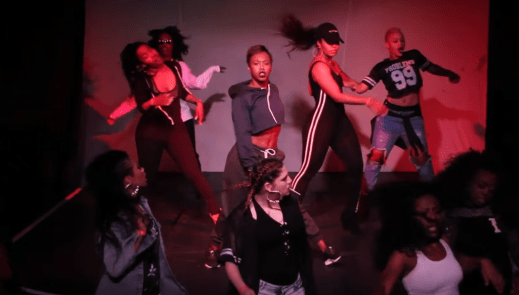
Featured Image: Still from “Cardi B ‘Foreva’ (Live) Choreography By- Hollywood”
—
Ashley Luthers is currently a Senior at Wesleyan University studying English and Economics. She has spent the past year researching and studying Cardi B inside and outside of the classroom. Her final senior essay revolves around Cardi B as a black femme artist in Hip-Hop through an analysis of different theories surrounding the black female body.
—
 REWIND! . . .If you liked this post, you may also dig:
“The (Magic) Upper Room: Sonic Pleasure Politics in Southern Hip Hop“–Regina Bradley
“What Feels Good to Me: Extra-Verbal Vocal Sounds and Sonic Pleasure in Black Femme Pop Music” -Robin James
“I Love to Praise His Name”: Shouting as Feminine Disruption, Public Ecstasy, and Audio-Visual Pleasure–Shakira Holt
Share this:


Current Top Posts





April 2021

January 2020

November 2019

October 2019

August 2019

April 2014

November 2017

March 2015

December 2017

October 2015
 Sounding Out!
Recent Comments