
On the Lower Frequencies: Norman Corwin, Colorblindness, and the “Golden Age” of U.S. Radio
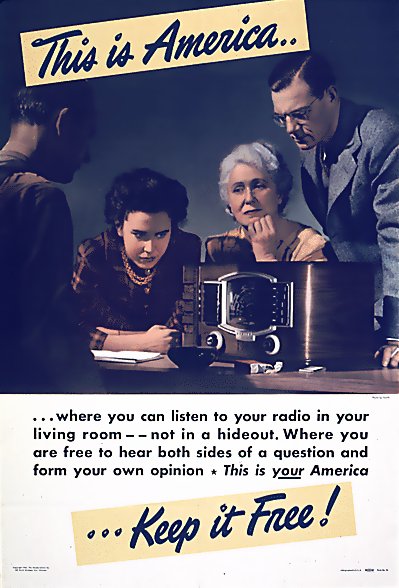
Editor’s Note: This is Liana, Managing Editor for Sounding Out!, introducing you to this special fall installment of our series “Tune Into the Past,” penned by our very own Editor-in-Chief and Guest Posts Editor, Jennifer Stoever-Ackerman. We at SO! have been waiting for months for Jennifer to share with us a brand-spanking new blog post! She’s back in action this month with a post that asks readers to listen to the cultural landscape that foregrounded Norman Corwin’s success as a radio writer and producer, inspired by her research on her book manuscript on the sonic color-line. In particular, Jennifer addresses the notion of colorblindness and its very real repercussions on radio artists and producers of color in the 1940s. Want to catch up on our series on Norman Corwin? Check out this summer’s posts by radio scholars Neil Verma, Shawn VanCour, and Alex Russo. If you’re all caught up, open your ears and your eyes then (to paraphrase Kurt Cobain). —LMS
—
Almost every day, I hear someone on the radio hailing America as the home of democracy. Yet almost every network is guilty of discrimination against the Negro performer. There are a few isolated cases of Negroes in broadcasting, but the lily-white policy is seldom violated.—Lena Horne, Chicago Defender 1940
The fine pieces in the “Tune in to the Past” series have thoughtfully considered the audible legacies of Norman Corwin: the “kaleidosonic” aesthetics that Neil Verma called the “Corwinesque,” the virtually seamless melding of artistic and commercial concerns that Shawn VanCour analyzed, and the echoes of Corwin remixed into WNYC’s Radiolab that Alexander Russo amplified. But the research I performed for my book manuscript, The Sonic Color-line: Race and the Cultural Politics of Listening, about the fraught relationship between race and 1940s radio, left me pondering the gaps and silences of Corwin’s soundscape. Radio’s “Golden Age” was also its most racially segregated: was the philosophy of “colorblindness” that Norman Corwin publicly espoused key to keeping it that way?
It’s not my goal to undermine Corwin’s work, but rather to enhance our understanding of it by embedding his broadcasts in the wider political, historical and sonic fields in which he was enmeshed. Just as Corwin’s sounded legacy left long-lasting traces in our media, so too have the silences and omissions fostered by the media executives, casting directors, union bosses, radio critics, and sonic auteurs of the “Golden Age.” If Corwin’s work is difficult to access save for far-flung archives and spotty collector’s catalogues, the exclusions of African-American producers, performers, and listeners are even harder to hear, in part because of his very insistence that radio’s microphones were colorblind. As the epigraph from Lena Horne testifies, the discourse of democracy is not mutually exclusive with segregation. In what follows, I discuss the intensely segregated history of the “Golden Age of Radio,” arguing that one of Corwin’s most far-reaching legacies may not have been set in motion by his virtuostic broadcasting, but rather by the World War II-era liberalism that shaped it.
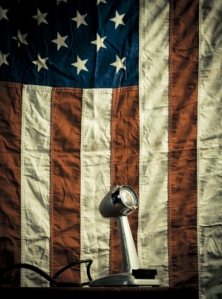 The apex of Corwin’s radio career coincided with a profound shift in America’s dominant racial formation, the beginnings of “colorblindness.” By colorblindness, I mean the belief that if individuals and institutions ignored skin color as a signifier and eliminating race as an official category of identity—particularly within governmental institutions—it would cease to matter in American life and all groups would have equitable access to the privileges, opportunities, and freedoms afforded by citizenship. The shift toward colorblindness—what Michele Hilmes calls America’s “wartime racial realignment” in Radio Voices—was predicated on creating a sense of unity that would inspire men across the color-line to sign up to fight what was dubbed a war to end racism and fascism, even as it raged on in their segregated hometowns. The Pittsburgh Courier’s Double V Campaign—Victory against fascism abroad and Victory against racism at home—addressed these ironies. Barbara Dianne Savage’s Broadcasting Freedom: Radio, War, and the Politics of Race details the suppression of many black newspapers on military bases due to the Double V Campaign, as well as the pressure it put on government radio programs to address race. However, she notes:
if black people had been forced to rely on radio as their primary means of communication about the failings of the federal government, they would have been on an impossible mission, since they were admitted to radio only as entertainers or as briefly invited guests expected to be on their best behavior (94).
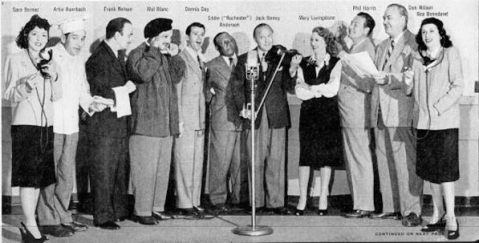
Cast Photo of the Jack Benny Program. Eddie Anderson, who played Benny’s valet, was one of only a handful of steadily working black radio actors in the 1940s
Despite high-profile protests in the black press, mainstream broadcasters constructed radio as an unmediated purveyor of equality and truth with increasing frequency during World War II—its “lofty aerials, symbols of freedom” according to New York Times radio critic Orrin Dunlap. In the case of Norman Corwin, he wrote a symptomatic (and nervy) editorial for Negro Digest in 1945 that depicted U.S. radio as a direct material and technological representation of colorblindness itself.
In “A Microphone. . . is. . . Color Blind”–what revealing ellipses!–Corwin assures black readers that “my feeling about Negroes in radio is that they belong as surely as the microphone.” This strange opening gambit compares black participation in radio to the mute technological presence of the microphone that, while absolutely central to broadcasting, is an object with no inherent agency. Unlike the proprietary, agenda-setting presence of whites in radio, a microphone amplifies the voices of others, while speaking not a word of its own. From his privileged vantage point, Corwin doesn’t quite realize how colorblindness enables him to use black people as tools.
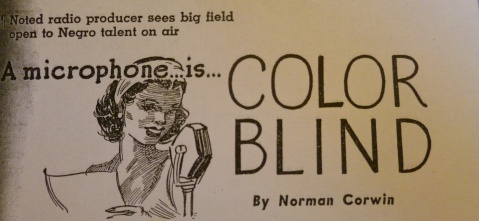
Norman Corwin’s “A Microphone is Color Blind” from Negro Digest (1945), Image by the author
And, while Corwin’s title insists on the microphone’s colorblindness, his article suggests otherwise. Much of his description of what America is missing without black people’s radio presence has to do with aural racial difference: “I have found the same thing that makes Negroes supremely great artists in song makes them great in speech. The color and warmth conveyed in the performance of a Negro artist is directly communicable by air. The microphone is a faithful reporter and says exactly what it hears.” In addition to perpetuating the old stereotype of black people as natural performers, Corwin’s realist depiction of the microphone as a “faithful reporter” that “says exactly what it hears” covers up exactly how much black voices were sculpted for white consumption during this period in radio; as actor Johnny Lee (“Algonquin C. Calhoun” on Amos ‘n’ Andy) told UCLA graduate student researcher Estelle Edmerson in 1954: “I had to learn how to talk as white people believed Negroes talked. Most of the directors take it for granted that if you’re a Negro actor, you’ll do the part of a Negro automatically.”

Johnny Lee as “Algonquin C. Calhoun” on Amos ‘n’ Andy
Whereas radio listeners were able to hear a wide range of white voices in a spectrum of roles—major and minor, comedic, dramatic, musical, informational—the sound and the content of black speech was circumscribed by the sonic color-line that marked it as “automatic,” essential, comedic, and potentially dangerous. Corwin’s use of the word “communicable” rather than “communicated,” for example, is a revealing flourish giving black sound a tinge of contagion and infectiousness. While ostensibly celebrating black voices, this passage simultaneously assures white listeners that they will still be able to unequivocally identify the race of any speaker over the “colorblind” airwaves and that this experience will be a pleasurable one for them. While the microphone may be color blind, it clearly is not color deaf.
That Corwin assumes a white audience becomes more obvious with his assertion a few lines later that “I have found too few Negroes who have taken an interest in radio. I suspect it’s because they don’t know about it.” This statement is fairly incredible, considering that the Research Company of America published a study in the radio industry magazine Sponsor that placed African American radio ownership at 87%, just shy of the national figure of 90% (October 1949, 25). Sponsor dubbed black audiences “The Forgotten 15,000,000.”
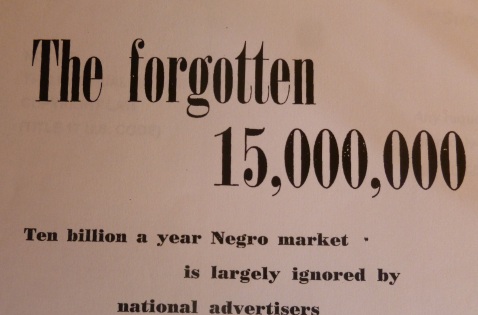
Sponsor, October 1949, Image by author
In addition to being inaccurate, Corwin’s suggestion that African Americans had limited knowledge of radio performs one of the signature moves of colorblindness; it makes institutional barriers to access—lack of training, networks, and mentorship, as well as straight up discriminatory hiring practices—invisible by asserting that black people only need to work harder to succeed in the American media industry. Under colorblindness, the failure to achieve success equitable to white citizens falls squarely on the shoulders of those oppressed. It also willfully mutes the protest of many black actors—such as Butterfly McQueen—who refused to participate in the segregated industry and the agency of all the black listeners who turned the dial on shows distasteful to them, allowing the fantasy of a unified (white) America to remain a powerful referent.
By and large, Corwin’s article paints colorblindness as already achieved. In his estimation, it is up to black people themselves to take advantages of the opportunities he suggests already await them via the colorblind microphone: “My attitude is not unique among radio directors—at least not in the main centers of radio[. . . ],“Corwin insists, “there is less prejudice in this field than in any other. It exists unfortunately, but you can get a hearing.” For someone whose bread and butter was rhetorical flourish, Corwin’s use of passive sentence construction to discuss racial prejudice is significant—he naturalizes it as something that merely “exists,” tooling along without any specific historical agent performing the discriminatory and oppressive actions. Such omission lets the white gatekeepers of the 1940s radio industry off the hook for both the institutional and individual forms of discrimination that kept the industry largely, as Lena Horne phrased it, “lily-white.”
Radio’s profound whiteness was aural as well as visual. In Corwin’s colorblind America, a radio “hearing” comes at a heavy price for African Americans. Without commenting on educational segregation, Corwin proclaimed: “Negro schools should have in their curriculum courses in public speaking, radio, theater. There is no reason why there should not be Negro announcers. It is important to study diction so that distinction in speech cannot be noted.” While Corwin begins “A Microphone. . . is. . .Color blind” by arguing that black voices should continue to retain the racial markings that are legible (and pleasurable) to white listeners, he then suggests they must also simultaneously sound enough like the white voices surrounding them in order to be heard and accepted as fellow American citizens. Radio didn’t just passively reflect the sounds of American citizenship during this period–it actively constructed them on a foundation of exclusion and silencing.
 There remains, then, a profound disconnect between the full exercise of American citizenship, the idealized discourse of colorblind equality forwarded by government officials, media critics, and prominent broadcasters exemplified here by Corwin, and the actual representation of African Americans as radio producers, performers, and listeners during and after this period. At the same time as state-sponsored colorblind ideology rose to prominence during the war years, the U.S.’s airwaves became almost exclusively white. There were no black writers regularly employed by any national radio station during the 1940s and there was not a single black member of the Los Angeles Writer’s Guild. While black authors Langston Hughes and Carlton Moss wrote occasional scripts on one-shot contracts, they were about topics deemed of black interest by the networks. Black radio critic Joe Bostic—who would later become one of the nation’s first black radio sportscasters—described the limited openings for black radio performers:
publication last week of the most authoritative and comprehensive of the radio polls showed not a single Negro entertainer placing in the first ten of any branch of radio entertainment. Such a compilation outlines, in bold relief the disturbing fact that the Negro, long a leader in every phase of entertainment, is being excluded in this newest and most lucrative branch (People’s Voice, 1942).
Regular on-site broadcasts from nightspots that featured black performers all but vanished after 1940, meaning that the vast majority of black musical performances broadcast over the American radio networks were conditioned and mediated by white announcers and sponsors as well as the sounds of white-oriented programming that introduced and followed them.
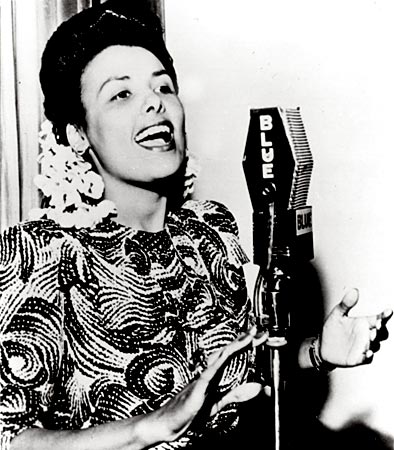
Lena Horne guesting for NBC’s Blue Network
To be clear, I don’t blame Corwin individually for the ideology of colorblindness and the world it has wrought, but I do think it is important to consider his role as a cultural producer in the “Golden Age” of segregated radio, and as a power broker who helped shape the media landscape with which we now contend. While we commemorate his labors as a sonic artist with high journalistic standards who undoubtedly worked to “glorify the ‘common man,'” we also have to consider the institutionalized privilege that enabled him to claim this role as his own, as well as the many people silenced by him doing so, inadvertently or not. Tuning in to the past demands a vigilant ear attentive to the profound silences of exclusion: the traces of words muted, mangled, disciplined and unsaid, as well as the subterranean reverberations ghosting the triumphant tones of the “Golden Age,” a shadow broadcast, on the lower frequencies, of all the sounds that might have been.
—
Jennifer Stoever-Ackerman is co-founder, Editor-in-Chief and Guest Posts Editor for Sounding Out! She is also Assistant Professor of English at Binghamton University and a former Fellow at the Society for the Humanities at Cornell University (2011-2012).
Share this:

Audio Culture Studies: Scaffolding a Sequence of Assignments

 Developed to explore the relationship between sound and learning, our fall forum on “Sound and Pedagogy” blends the thinking of our editors (Liana Silva), recruited guests (D. Travers Scott), and one of the winners of our recent Call For Posts (Jentery Sayers) to explore how listening impacts the writing process, the teachable moment, and the syllabus (and vice versa). If you need a make-up assignment for the first post by D. Travers Scott, click here, or for last week’s post by Liana Silva, click here. Otherwise, get ready to take some furious notes, because today’s post from Jentery Sayers offers a generously revealing—and unprecedented—glimpse inside the development of his audio culture course over several years. Chock full of suggestions, prompts, unique assignments, and troubleshooting tips, Sayers’s offering is refreshingly frank about the unique challenges facing sound studies scholars in the classroom. As in most classes, information this deep may need some time to settle in and effect some change, so we’ll check back with you in spring with a Sound and Pedagogy “refresher course.” It’s already on our syllabus.–JSA, Editor in Chief
—

This semester, I am teaching my fourth course in audio culture studies. Since students and faculty in the humanities rarely have the opportunity to intensively examine sound in the context of higher education, thus far I have learned that—even for teachers who are well-versed in sound studies—planning and structuring work in an audio culture course is more difficult than it may at first appear. For instance, to what degree should an audio culture course intersect with visual culture studies? What cultural assumptions about sound inform how students learn about it, not to mention how instructors teach it? When engaging histories of sound reproduction, how might students combine knowing and doing, or composing about and with sound? And how should work in an audio culture course be assessed? Through what sorts of learning outcomes? With what forms of student preparation and self-reflexivity in mind?
In the following paragraphs, I engage these questions by unpacking a portfolio-based assignment sequence from an undergraduate course I taught at the University of Washington-Bothell in 2010: “Technologies of Expression: Sound Reproduction Studies.”
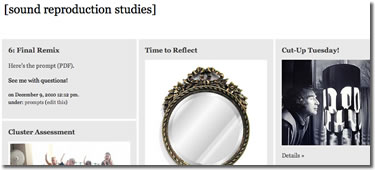
As I prepare for my “Audio Culture Studies” undergraduate course at the University of Victoria this semester, the above questions are guiding my lesson plans as well as my revisions of previous teaching materials. Yet more importantly, I imagine they—or variants of them—resonate with other instructors invested in sound studies, and I hope this post will spark a conversation about how to continue developing sound studies curricula in higher education. In one sense, such curricula should be and are distinct from work anchored in visual culture, print, film, and e-text studies. Nevertheless, there are a variety of suggestive intersections across these fields, and my approach to audio culture courses often builds upon them, especially since my training is in literary and cultural studies.
To begin “Sound Reproduction Studies” (heretoafter “205”) at the University of Washington-Bothell, I told students to let me know (in writing) how they were going to record sound during the course. After all, I did not know what technologies they could access, and I wanted to make sure that—with help from the University’s library and digital media services—recording equipment was available to them. I also informed them that, throughout the course, we would be focusing on basic recording and editing but not high fidelity techniques or post-production. In other words, I was not expecting them to gain competencies common in sound art and audio engineering, and my humanities-oriented assessment of their audio work would privilege content and composition over the aesthetics of recording and playback. For a course anchored primarily in cultural studies, they were welcome to use everyday audio equipment intended for consumers and amateurs, and fortunately that equipment was available on loan through the University.
After that request, I asked them to “crowdsource” a brief history of sound reproduction using SIMILE’s Exhibit 2 framework. While I have my reservations about crowdsourcing, for the purposes of the class—especially at the beginning of the quarter—it was appropriate. As the prompt suggests, I wanted to survey what students already knew about audio, together with where their interests in sound tended to constellate.

From the start of the course, I also wanted to situate visual and audio cultures in the same space, encouraging students to think about the tensions and intersections between them as well as the epistemologies and affects they enable. Here’s a screen grab of what students produced in a week (between two class meetings):
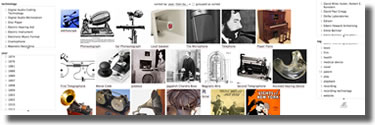
I used this crowdsourced exhibit as the basis for an introductory lecture on the vexed legacies of sound reproduction. It helped me identify gaps in student knowledge while also underscoring what was familiar to them (e.g., Edison’s phonograph, the turntable, and auto-tune). The exhibit became a handy vehicle for posing questions to explore for the balance of the course: How is noise defined differently over time, by whom, and for whom? How is sound naturalized, and to what effects on critical inquiry? How is sound embodied, and why is it so often associated with emotion, affect, and immersion? When studying the history of sound reproduction, what roles do old technologies and media play in our research? How has the composition and playback of audio changed from decade to decade?
In other words, the exhibit was a low-stakes launching pad into the course material. I found it instilled a bit of confidence in students by giving them some sense of authority over the material. And it gave them a concrete sense of what I meant by “audio culture” (as opposed to, say, “music history”). Early in the course, I also appreciated the opportunity to highlight the deep and rich history of sound reproduction, a history which no doubt informs contemporary obsessions with all things digital. Where I failed as an instructor was by not returning to the exhibit later in the quarter. In future courses, I’ll give them an opportunity to add, revise, and even remove content where appropriate. Such a gesture would add a layer of self-reflexivity and iterative knowledge-making to the learning process, premised on questions like: “Now that you’ve studied audio for seven weeks, how would you revise your contributions to the crowdsourced exhibit you helped compose earlier in the course? How has your perception of audio’s history changed and why?”
After the crowdsourced exhibit of sound reproduction, the students in 205 shifted toward composing with audio, exploring ways to combine knowing and doing sound studies. For this shift, I relied on another low-stakes assignment: the “audiography.”
Here, students had the opportunity to share “playlists” of sounds typical to their everyday lives. However, the ultimate motivation of the exercise was twofold: (1) for them to closely attend to those common soundscapes, organize them (around a theme of some sort), and record them; and (2) for them to develop some basic competencies in the free audio editor and recorder, Audacity (based on a workshop conducted during class). Although the very notion of a “soundscape” was likely new to them, and even though most of them had never recorded audio, the concept of a playlist was personal and familiar enough to make the assignment approachable. It also stressed the fact that, like images and texts, people design and structure arguments through sound. A playlist of everyday sounds involves rhetorical strategies not entirely distinct from, say, an academic essay or television broadcast.
For the audiography (as well as every other audio composition in 205), the students were given constraints (e.g., “no narration,” “no effects,” and “eight to fifteen recordings only”) similar to guidelines for academic essays. And once the audio files were composed, the students uploaded them to our class audio blog (using a WordPress theme that unfortunately is no longer supported or maintained). The benefit of the blog was that everyone in the course could hear everyone else’s audio work. Additionally, I could play student audio during class meetings, treating it as an object of inquiry for discussion. In so doing, I made sure that—during the quarter—we discussed every student’s audio work at least once.
Audiographies are great for getting at cultural assumptions about sound, especially when students are able to respond to them through repurposing, voice-over, or a similar strategy. For the “re: audiography” prompt, I asked students to do just this.

They downloaded a peer’s audiography (from the class audio blog), edited it, produced a story through it (including voice-over tracks), and circulated the final product. While, quite obviously, this exercise became a gateway into studying montage, cut-up, turntable, DJ, and laptop practices, it also gave students an opportunity to assess how an audience member might interpret their audio work, the soundscapes with which they are familiar, and the rhetorical strategies motivating their compositions. “Re: audiography” relies on re-situating audio in a new context, as it demands thinking about how setting, history, and ideologies all affect interpretation. In so doing, it also requires significant consideration of the risks, play, warrants, and claims involved in an audio composition relying heavily on existing work. As an instructor, I was sure to remind students that such play is not innocent; it is quite serious, and—in the context of 205—it was not intended to offend or mock another student’s work, interests, or background. Consequently, adding this line to the prompt was key: “Don’t be rude to them and recognize that they worked hard to make their audiographies. What’s more, the sounds involved mean something to them.”
As I plan for my audio culture studies course at the University of Victoria, I am revising the “re: audiography” prompt to make it more concrete, with clear parameters. In particular, Step 5 in the instructions is too vague; it lacks sufficient focus, without being anchored in a particular genre or example to which students can refer. As such, during 205 I ultimately worried that the flexibility in the prompt induced student anxiety. Without a genre in mind, they had too many avenues to explore, even if all of those avenues afforded ways of engaging cultural assumptions about sound.
After the audiography prompts in 205, I assigned students two “found sound” exercises, which furthered the combination of knowing and doing through a line of research. Both exercises were scaffolded toward the production of an audio documentary that was academic in character.
The first “found sound” prompt asked them to gather a series of historical audio clips related to a particular medium and begin formulating a research question about them.
The audio piece that resulted included not only the audio clips but also the student’s initial thoughts, questions, and concerns about the research. One significant benefit of this exercise was that it acted in conversation with other strategies for academic argumentation, namely how arguments involving actual audio differ from and intersect with arguments devoid of audio. In other words, it introduced students to the very notion of multimodal argumentation, including the ways in which audio functions in scholarly communications. Students also had to consider what it means for an argument to be heard, not read.
As an instructor, I find that I still tend to map norms for text- and image-based argumentation onto audio work. For instance, the language of the “found sound” prompt resonates with a prompt I would write for a text-based “thought piece.” It is a translation of modes, without much consideration for how audio-based arguments might actually serve distinct and perhaps divergent aims—aims premised on, say, affect or non-sequential arrangement. For future iterations of this prompt, I plan to highlight such possibilities, brushing against my own proclivities for validating audio-based arguments through text- and image-based conventions.
Comparable to the “re: audiography” prompt, the students in 205 responded to each other’s “found sound” exercises, this time through “re: found sound.”

Rather than repurposing or sampling a student’s work, in this case students recorded verbal feedback, which essentially acted as a form of peer review. Perhaps above all else, this exercise allowed students to articulate an understanding of how to structure and evaluate audio compositions, preparing them for the audio documentary. Yet one of the most effective components of the prompt is this request: “Identify at least one thing (but preferably more) that you think your peer is overlooking or not considering. This thing can be a concept (e.g., ‘speaking with’), an example work (e.g., film, audio recording, or text), or a perspective (e.g., conflicting opinions on the topic). When you make this gesture, explain why it’s relevant to not only his or her audio documentary, but also the history of sound reproduction.” From my perspective as an instructor, this intervention in a peer’s work is difficult yet rewarding. It is a response that demands its own research, as it asks the reviewer to more or less deconstruct what is being heard.
“Re: found sound” also requires students to meticulously consider how they are saying what they are saying when critiquing someone else’s work. For instance, tone, inflection, and dialogic gestures are foregrounded. To be sure, students make similar decisions when responding through text. Nonetheless, the shift in modality affords a learning experience arguably rare in higher education humanities.
For future iterations of “re: found sound,” I will ask students to submit written feedback in tandem with the audio, not only for accessibility purposes but also to stress correspondences between the media. Again, one of my ongoing concerns in audio culture courses is that I will—in a reactionary fashion—privilege speaking and listening over seeing, reading, and watching. Such reactionary approaches risk dividing critical approaches when they can instead be suggestively blended through interdisciplinary research.
The two “found sound” prompts guided students in 205 toward an audio documentary, which was steeped in a specific historical issue and informed largely by cultural studies approaches to audio technologies and media.

To prepare students for this genre, I provided example documentaries, and we also conducted several workshops on how to make and critique those documentaries. In the end, these documentaries were a real pleasure to hear, and one of the biggest difficulties is listening and re-listening to them closely. After all, the evaluation of audio operates through a different temporality than text, and often times it lends itself to focusing too much on production and post-production (rather than, in this case, the actual content of the audio documentary). Requesting transcripts, and even the original AUP files (or a similar format), can facilitate fair and thorough evaluation. I also try to listen to each documentary at least twice, with and without headphones. Finally, as an instructor I have learned that audio documentaries will always take students twice as long as I assume they will. Despite popular assumptions about the speediness and ease of digital production, the genre is labor-intensive and layered with samples, effects, voice-over, and transitions. It is also often new to students in higher education.
Even though the documentary was the most involved piece of the students’ audio portfolios in 205, it was not the final submission. In a self-reflexive fashion, the students were asked to submit a final remix of their work (PDF).

At its core, the final remix intersected audio theory, practice, and history. Intended for educated, non-expert audiences beyond the course, it asked students to provide specific examples of how they fulfilled particular outcomes in the course. Among other things, the samples in the remix were intended to demonstrate an awareness of: (1) audience, (2) the technocultural history of sound, (3) a theory of listening, (4) audio composition and post-production, (5) constructive, audio-based peer review, and (6) persuasive media strategies for audio-based argumentation.
Perhaps quite obviously, this reflective remix borrows from a long history in writing studies. And I have found it quite effective for identifying what and how students learned from the course. That said, what I enjoy most about it is how it requires thinking about sound as matter: its arrangement and manipulation, its existence in various iterations and formats, its function as tangible, audible evidence. For, when returning briefly to those questions in the first paragraph of this piece, I tend to think the greatest challenge facing sound studies curricula and pedagogy is the challenge of sound’s materiality. As sound studies scholars, how do we foster spaces and opportunities where people can learn about the history of sound as an object with its own fluctuations, politics, aesthetics, and material particulars? How do we teach audio culture as that which can be simultaneously inhabited and examined from a distance? As a thing, a mode of composition, and a way of thinking, feeling, and acting?
—
Featured Image “Burn Station @ inSIRACJE festival” by Flickr User Paula Rey
—
Jentery Sayers is an Assistant Professor of English at the University of Victoria, where he teaches cultural studies, digital humanities, and 20th-century U.S. fiction. His writing has appeared in Kairos: Rhetoric, Technology, and Pedagogy; The New Work of Composing; Computational Culture; The New Everyday; Writing and the Digital Generation; Off Paper; Collaborative Approaches to the Digital in English Studies; and ProfHacker. Among his other work involving audio, his current book project is a cultural history of magnetic recording. He’s grateful to Jennifer Stoever-Ackerman at Sounding Out! for feedback on drafts of this piece.
Share this:


Current Top Posts





April 2021

January 2020

November 2019

October 2019

August 2019

April 2014

November 2017

March 2015

December 2017

October 2015
 Sounding Out!
Recent Comments