
Sound + Vision: Andy’s Mick

Andy Warhol – Mick Jagger 1975, Image by Flickr User Oddsock
 Hello Internet! It’s great to be here in cyberspace! Are you ready to rock? Today’s dispatch from our Spring Series, Live from the SHC, finds Cornell’s Society for the Humanities Fellow Eric Lott jamming it out on the relationship between the early 70s sound and vision of one Sir Mick Jagger. If you happen to be thinking that Monday morning at 9:00 a.m. is the least rock and roll time slot possible, just remember that’s when Jimi Hendrix gave “The Star Spangled Banner” the business at Woodstock. To give earlier installments by Damien Keane, Tom McEnaney, and Jonathan Skinner a listen, click here. As May comes to a close and the “Sound: Culture, Theory, Practice, Politics” fellows reluctantly break up the A.D. White House house band, look for our final two dispatches from Jeanette Jouili and Society Director Tim Murray. Until then, we’ll keep turning it up to 11 here at Sounding Out! –JSA, Editor in Chief (and 2011-2012 SHC Fellow)
—
After we left the Carlyle I told Jerry I thought Mick had ruined the Love You Live cover I did for them by writing all over it—it’s his handwriting, and he wrote so big. The kids who buy the album would have a good piece of art if he hadn’t spoiled it. –Andy Warhol
Andy Warhol’s complaint in his Diaries captures the almost cartoonish play for artistic control between himself and Jagger in the 1970s—between painter and singer, portrait artist and subject (Jagger and the other Stones biting each other), the visual and the verbal (“he wrote so big”!): between sight and sound in the realm of popular music. Warhol was no stranger to sound artistry, of course, from his work with the Velvet Underground to the everyday taping he did with his portable cassette recorder, the machine he called his “wife.” But Warhol as visual conceptualist returns us to a moment when, through album art and other commercial iconography, the visual domain shaped our sonic experiences perhaps more immediately than it does in these digital days. At the recent EMP conference in New York, I raised the question of the visual/conceptual from the perspective of sound, looking and listening to how the modalities were conjoined during an excellent and rather brief (and nowadays mostly scorned) passage of Jagger time in the middle 1970s: Jagger in his thirties.

Andy Warhol designed cover for Sticky Fingers (1971)
A funny thing happened after Exile on Main St. in the early 1970s: the Rolling Stones became a New York band instead of a London and L.A.-based one, and their frontman Mick Jagger, always an outlandish presence, became a swishier one. The manner in which this happened owes a lot to their encounter with Andy Warhol. From his cover designs for Sticky Fingers (1971) and Love You Live (1977) to the Stones’ renting of his Montauk house to rehearse for their 1975 tour to conspicuous late-70s hanging out together at Studio 54 and New York dinner parties of the rich and not so fabulous, it’s clear the Stones, or at least Jagger (and for sure his wives, Bianca and Jerry Hall), steered ever closer to Warhol’s orbit.
Good writing about the Stones’ New York phase has recently begun to appear, including Cyrus Patel’s 33 1/3 book on Some Girls (2011) and Anthony DeCurtis’s liner notes to that record’s 2011 deluxe re-release; Ron Wood’s Ronnie: The Autobiography (2008) opens with the band’s famous promo stunt playing on the back of a flatbed truck rolling down lower Fifth Avenue on 1 May 1975 to advertise their upcoming tour.
.
But the influence on them of the Andy aesthetic has gotten far less attention, at least in pop music criticism (the Warhol Museum mounted a show, Starfucker: Andy Warhol and the Rolling Stones, in 2005, full of great stuff). In particular, Warhol’s 1975 Ladies and Gentlemen black drag queen series, and the draggy portrait series of Jagger done at the same time and in the same way, attest to their mutual influence on each other. The gain for the Stones was exponential: a new persona for a new decade and indeed a new town.
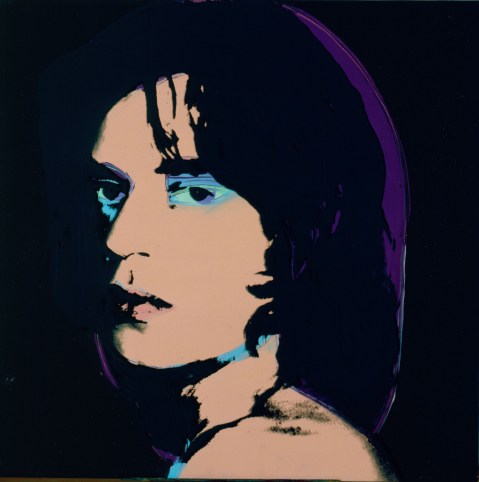
Andy’s Mick, Image by Flickr User Shreveport Bossier
The persona as influenced by Warhol arrives at the nexus of drag, hustling, and stardom, and Jagger in the 70s can be seen to be addressing and/or capitalizing on all three. Warhol’s Ladies and Gentlemen was originally referred to as simply the Drag Queen series. As Bob Colacello tells the story in Holy Terror: Andy Warhol Close Up, some Factory workers were sent to the Times Square gay bar The Gilded Grape to hire several hustlers there to sit for some Warhol Polaroids for fifty dollars a pop. (They later quipped that they were used to doing a lot more than that for fifty bucks.) As was his practice at the time, Warhol transferred these images to silkscreen for mechanical reproduction, over (or under) which he painted in unusually expressive fashion, at times applying collages of torn paper as well. Geometries of color in these pictures war with the photographic image; they signify on race as well as the drag queen’s everyday glamour and its defensive-aggressive thrust-and-parry. In any case, Times Square hustlers of color became stars in Andy’s hands. At this point the title was changed to Ladies and Gentlemen—perfect, since his subjects in the works can be thought of as both—and it may be that the title was taken from the 1974 Stones film of their celebrated 1972 tour, Ladies and Gentlemen, the Rolling Stones (it’s worth recalling lest we be tempted to discount such a film that almost everyone in a broad swath of the New York milieu saw it—in Just Kids (2010), for example, Patti Smith writes of seeing the film with Lenny Kaye and then going off to CBGB to catch a set by Television). What is certain is that Warhol at this same moment was giving Polaroids he had taken of Jagger in Montauk the exact treatment he gives the drag queens in Ladies and Gentlemen.
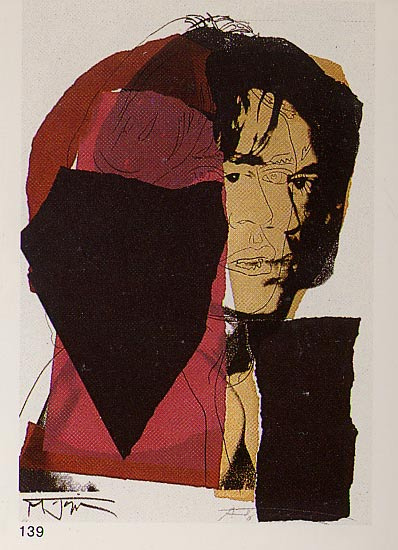
Andy Warhol’s Mick, 1975, Image by Flickr User Thomas Duchnicki
Being a drag queen is really hard work, Warhol famously wrote in The Philosophy of Andy Warhol (1975), and it is in part the connections between hard work, its celebrity remuneration, drag, and prostitution that link the Ladies and Gentlemen series with the portraits—paintings and then prints—of Jagger. These connections link this output with Warhol himself, making the portraits a sort of displaced self-portraiture. Their mechanics, if you will, seem homologous with drag, in fact. Starting with the Warhol-snapped Polaroid—not, say, with newspaper photos or commercial iconography as in Warhol’s 60s silkscreens—the works depend on Warhol’s presence, which then puts the images through the silkscreening process, after which (or before it) an uncharacteristically painterly (or collagist) procedure is applied, the latter akin to make-up itself. Where in some of the series the paint obscures the face, acting as a kind of negation or comment on the negation behind black queer hustling, in most of it the faces rise to a new form of presence or fabulousness, as if by repeating the act of drag the portraits affirm its “success.” Warhol’s make-over of Jagger, meanwhile, both drags the singer and makes him Warhol’s: Andy’s Mick.
According to a scheme worked out by Warhol and Jagger, the latter signed the portraits so that they could promote both artists. Which, if it doesn’t exactly make Jagger a co-author of the works, does signal his endorsement of Warhol’s vision of him. (Indeed the Warhol Museum has a facsimile of a 1983 letter from Jagger to Warhol asking for his assistance with Mick’s autobiography—a collaboration that boggles the mind.) As John Ashbery had it in Self-Portrait In a Convex Mirror, his multiple-prize-winning long poem of 1975:
Your [the artist Parmigianino’s] eyes proclaim
That everything is surface. The surface is what’s there
And nothing can exist except what’s there;
It [the surface] is not
Superficial but a visible core. . .
Your [Parmigianino’s] gesture . . . is neither embrace nor warning
But . . . holds something of both in pure
Affirmation that doesn’t affirm anything.
Not a bad definition of the Warholian image, this, and in the 1970s, as the Rolling Stones entered their second decade of performance and stardom, Jagger took the lesson and ran with it. A new self-consciousness about his own stardom enters Jagger’s (underrated) lyrics in the 70s; while self-reference is not unknown in the band’s 60s work (cf. 1968’s “Street Fighting Man”), and while one of their first hits takes on the culture industry itself (“Satisfaction”), in the 70s a new kind of meditation on rock-star celebrity enters the picture—I have seen the culture industry, and it is me: Jagger begins to write about himself as the culture industry. And this under the sign of Warhol, I think, which is to say, with a queerly knowing intimacy informed by a sense of the artist-star as a hustler for money in what we might call image-drag. Everything is surface, the surface is what’s there and nothing can exist except what’s there, and it’s not superficial but a visible core.
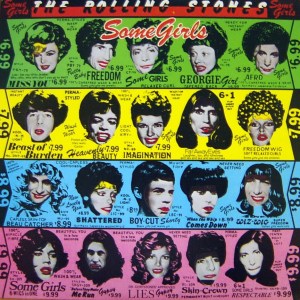
From 1973 forward, in the music from Goat’s Head Soup to Tattoo You (with It’s Only Rock n Roll, Black and Blue, Some Girls, and Emotional Rescue in between), and even more on the covers of these albums, culminating in the one for Some Girls with the Stones in drag—Andy in the Warhol Diaries: “[Mick] showed me their new album and the cover looked good, pull-out, die-cut, but they were back in drag again! Isn’t that something?”; the Some Girls cover, though Warhol didn’t do it, really does recall his drag queens, right down to the double drag of the inner-sleeve pull-out—to say nothing of the made-up glam of the 1975 and 1978 tour performances: in all this one sees a flouncier, queerer Mick, one that Jagger nodded to in various lyrics (for that demonstration you’ll have to wait for the longer version of this piece!). What this means in part is that the cliche we have of Jagger strutting like a neo-blackface soul man is due for revision: it’s much more precise to think of his aura as proximate to black femininity (icons like Tina Turner, say, who of course opened for the Stones), which he (re-)crafted through the adoption of a persona right out of Warhol’s colored drag queen sensibility.
.
So why the now-canonical assumption of the Stones’ decline at just this moment? Is their 70s sound discounted because of the queer reinvigoration of their visual/conceptual appeal? (One counter to this hegemony is Ellen Willis’s fine 1974 review of It’s Only Rock n Roll, included in her Out of the Vinyl Deeps.) Did the Stones’ sound change all that much, beyond new acquisitions of this reggae vibe or that funk riff or the other disco groove, or does the insistence on their fall come from a sense of their queening around? Is it this—not only this, I know, I know, Mick’s such an asshole, but still—that lies in part behind the (particularly post-Life) cult of Keith?
—
Eric Lott teaches American Studies at the University of Virginia. He has written and lectured widely on the politics of U.S. cultural history, and his work has appeared in a range of periodicals including The Village Voice, The Nation, New York Newsday, The Chronicle of Higher Ed, Transition, Social Text, African American Review, PMLA, Representations, American Literary History, and American Quarterly. He is the author of the award-winning Love and Theft: Blackface Minstrelsy and the American Working Class (Oxford UP, 1993), from which Bob Dylan took the title for his 2001 album “Love and Theft.” Lott is also the author of The Disappearing Liberal Intellectual (Basic Books, 2006). He is currently finishing a study of race and culture in the twentieth century entitled Tangled Up in Blue: The Cultural Contradictions of American Racism. This post is adapted from a talk Eric gave at the 2012 EMP POP Conference in New York City entitled “Andy’s Mick: Warhol Builds a Better Jagger.”
Share this:

Sound and Curation; or, Cruisin’ through the galleries, posing as an audiophiliac
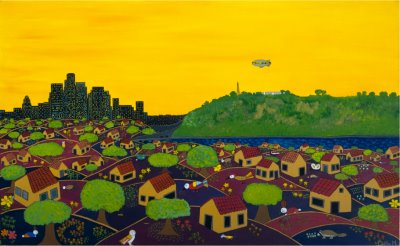
“L.A. Reimagined” by Dalila Paola Mendez (c), Mendez’ work will be featured in re:present LA, opening 5/3/12
But to love this turf is love hard and unrequited.
…
To love L.A. is to love more than a city
It’s to love a language.
–“L.A. Love Cry” (1996) by Wanda Coleman
Los Angeles, an enigmatic metropolis to many who arrive here with a dream in hand and hope for a better tomorrow, still challenges historians, artists, and troubadours on how to best represent it. Poet Wanda Coleman, born in Watts, captures the pain and wonder of loving this city in “L.A. Love Cry.” Because the city is “hard and unrequited” one must also be willing to love its nuances and see it as“more than a city.” To love this city, “it’s to love a language,” a cultural immersion that goes beyond the seeming ease of words into the complexities of sound and rhythm.
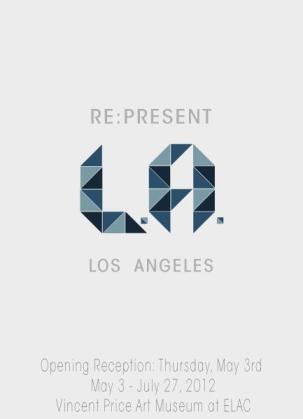
Through a Museum Studies course I teach at Claremont Graduate University entitled Welcome to L.A., I introduce students to varied texts in which scholars and artists challenge the imaginaries created by outsiders, boosters, and apocalyptic cinema. Instead, the course readings present how we in L.A. actively engage with one another by fostering communities of creative praxis. For the students’ final project, they curate and develop educational programming for an exhibition at a local museum or art center. On May 3, 2012, this semester’s project, re : present L.A., opens at the newly-renovated Vincent Price Art Museum (VPAM) located on the East Los Angeles College Campus. Showing works from over thirty artists from May 3-July 27, re : present L.A serves as an extension of the conversations we had in class, not only celebrating the interconnectedness of our communities but encouraging new associations and encounters within the visual and resonant space of VPAM’s Community Focus Gallery. For a look at the Virtual Exhibit Catalogue, click here.
In each exhibition for Welcome to L.A., I try to include something that challenges myself to think outside the white-box, per se, of the gallery. Given that we had read several texts that highlighted in the importance of music to build and uplift communities of color in Los Angeles, it was both important and necessary for me to include sonic elements in re: present LA that exhibits L.A.s vibrant musical legacy as intermingled with and fundamental to its visual culture. Among the challenges to document the cross-cultural connections between ethnic communities in Los Angeles is how to unpack what Anthony Macias calls “the cultural networks” that facilitated these exchanges through the music scenes at music halls, clubs, youth centers and record stores in Mexican American Mojo (10-11). Studies done by George Lipsitz, Macias, and Victor Viesca, provide readers a means to understand how the music in Los Angeles is much more than entertainment; it is political; it is a lifestyle; it defines spaces of multicultural interactions. In How Racism Takes Place, Lipsitz points out how integral the reclamation of space defined the political outlook and music in Horace Tapscott’s Arkestra based in South L.A. Viesca’s research documents the rise of an East L.A. rock sound, post-Los Lobos, that was defined by the activism of the Zapatista Movement and California’s Prop 187 through the work done at the Peace & Justice Center, Self-Help Graphics, and Regeneración.
Therefore, in order to engage both the history and the sound of Los Angeles’s musics with the city’s visual representations, I invited Rubén Funkhuatl Guevara from Ruben & The Jets, is a multi-threat musician, performer, writer, and producer, and Jennifer Stoever-Ackerman (of Binghamton University, Sounding Out!, and of course, Riverside, CA) to curate playlists for a “sound booth,” which will consist of a stationary iPod™ Nano that gallery visitors can use at their leisure. The classic circular wheel allows the viewer to advance tracks or play the playlists on shuffle. Headphones will be set up so that the viewer can either focus on their listening experience or, listen while viewing the artwork around them. Since the gallery is relatively small, the pieces on the opposite wall are recognizable though are distant. In addition, Maya Santos of Form Follows Function will screen their short documentary on Radiotron, a youth center that presented Hip-Hop shows during the 1980s.
Guevara’s playlist Los Angeles Chicano Rock & Roll is included in the exhibition thanks to the Museum of Latin American Art. Stoever-Ackerman’s playlist Off the 60, unites the two spaces of East L.A. and Riverside through a mix of intra- and trans-cultural musical experiences. Guevara’s rock & roll selections highlight many of the bands that emerged in East L.A. Both the musical listings and the liner notes for the sound presentations will be accessible on the re:present L.A website when the exhibit goes live on May 3rd, 2012.

Juan Capistran’s The Breaks (2000), Courtesy of the Artist
.
My sonic intervention in the white, often silent, spaces of the gallery was especially inspired by two recent precedents: the inclusion of the iPod™ in MEX/LA (2011) at the Museum of Latin American Art and Phantom Sightings (2008) at the Los Angeles County Art Museum. Both experiences invited me as a viewer to see the artwork through another sensory experience. The first time I saw music included in an exhibition not specifically about music (such as the Experience Music Project’s 2007 American Sabor: Latinos in U.S. Popular Music, or Marvette Peréz’s curation of ¡Azúzar! The Life and Music of Celia Cruz at the Smithsonian National Museum of American History) was LACMA’s Phantom Sightings, which garnered much critical acclaim and criticism due to the premise of presenting contemporary Chicano Art inspired ‘after’ the Chicano Movement. However, I want to focus on one aspect of the exhibition, a corner display with books that informed the curators’ conceptual approach and on the bookshelf was an iPod™. The iPod™ included playlists from some of the artists reflecting their inspiration for their artwork. I enjoyed listening and reminiscing while sitting in the gallery. However, I wanted the music to take more of a central role in the exhibition, especially because much of the artwork so obviously revealed traces of Los Angeles’ musical influences, partly due to the recent generation of artists who actively engaged in subcultural expressions and referenced it in their art. For example, as Ondine Chavoya describes in the Phantom Sightings catalogue, Juan Capistran’s The Breaks (2000) is a giclée print documenting the artist break-dancing on Carl Andre’s minimalist floor pieces. The guerilla performance then is presented through a series of twenty-five still images showing the various movements seen in how to break-dance books (125). Shizu Saldamando’s ink on fabric portraits of Siouxsie (2005) and Morrissey (2005) showcase how post-punk and new wave music from England is part of her life as an Angeleno (and that of her friends), yet the medium is reminiscent of pinto drawings. Saldamando also does portraits of her friends at clubs, backyard bbqs “documenting a world where identity is fluid” as Michele Urton describes in the catalog (197).

Shizu Saldamando’s Siouxsie (2005), Courtesy of the Artist
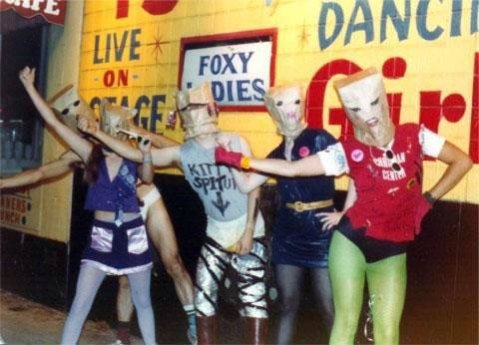
It would be another three years before MEX/LA would further marry music with art, now casting it in relation to the politics of Chicano and Mexican presence in Los Angeles. MEX/LA, among the many Pacific Standard Time exhibitions presented throughout Los Angeles, was among the best curated due to the range of artifacts representative of the city and the cultural production emerging in post-war L.A. Another striking element was the influence of Méxicano popular culture among Chicanos and vice-versa. As curator Rubén Ortiz-Torres, and associate curator Jesse Lerner write on the MoLAA website: “The purpose of the construction of a ‘Mexican’ identity in the South of California is not to consolidate the national unity of a post-revolutionary Mexico, but to recognize and be able to participate in an international reality, with all its contradictions and conflicts that this entails.” One of the ways this cultural exchange was embodied was in the playlists curated by Rubén Funkhuatl Guevara and Josh Kun that were prominently displayed alongside the artwork and heard in the interactive iPod™ “sound booths,” that invited viewers to sit on beanbags and listen. The music served to contextualize the art in relation to popular culture of the time. For example, Guevara presents a Chicano rock & roll genealogy that followed the chronology of the visual exhibit, 1930-1980, that begins with boogaloo and swing of the 1940s era culminating with the punk rock sounds of The Bags.
“Bag Parade,” 1977, Courtesy of Alice Bag
In both these exhibitions, the music served to complement the artistic elucidations of identity, race, and American popular culture seen in much of the artwork. The simplicity of the presentation was due to the inclusion of a familiar object like the iPod™. What is surprising is that more exhibitions have not incorporated more sonic elements to engage viewers’ other sensory experiences beyond the podcasts, or cell-phone audio listening tours set up at most major museums. While musical playlists can serve as another didactic component of an exhibition like the more established audio tours, I am arguing for a different use of sound in museum space, one that provides a wider sense of agency, connection, and encounter with the visual elements on display rather than a one-way transmission of information. In the cases of MEX/LA and Phantom Sightings, the inclusion of iPods™ provided a tool to understand the cultural production of a “post-Chicano movement” generation of artists while at the same time enabling an experience that recognized—and resonated with—my bicultural experience.

“Ancient Mexico in Ancient Mexico” by Yvonne Estrada (c), is featured in re:present LA, opening 5/3/12
Being that L.A. is a car culture moving to the rhythms of the radio waves, I’m always seeking to find synchronicity between music that feels me with joy and my work as a cultural worker. Part of my impetus to locate Los Angeles sonically in re : present L.A. was driven by the question: is it possible to capture my sonic landscape growing up in the city of Los Angeles that ranges from Hip-Hop – British Rock – Mexican Pop? The playlists curated by Guevara and Stoever-Ackerman are familiar to me personally. Stoever-Ackerman’s Off the 60, reminds me of the sounds of my youth, when KDAY and KROQ rocked the radio waves and my students banded together in my high school quad according to their favorite music – metal-heads, b-boys, alternative rock, and the cha-chas, who traveled across town every Friday night to Franklin High, where DJs spun L.A. disco. At home, the music was different. My mom and tías used to reminisce about their homeland every Sunday night through the variety show Siempre en Domingo, binding us to the t.v., religiously following the rising stars. Through the bi-lingual selections in Guevara’s Los Angeles Rock & Roll, there’s a familiarity of home and the music heard at backyard parties and quinceañeras.
By including my iPod™ nano, I bring together my lived experience as a cultural worker through the sounds of L.A. and activate the white walls of the museum. The playlists created by Guevara and Stoever-Ackerman serve to reflect the history of the community surrounding VPAM, as well capture the diversity of the city sonically re:presenting L.A. to our audiences. While the playlists can stand alone as audio curations in their own rights, I hope that they will engage audiences to rethink the relationship between music and art, and feel their lived experience inclusive within the museum.
—-
reina alejandra prado saldivar is an art historian, curator, and an adjunct lecturer in the Social Science Division of Glendale Community College in Glendale, California and in the Cultural Studies Program at Claremont Graduate School. As a cultural activist, she focused her earlier research on Chicano cultural production and the visual arts. Prado is also a poet and performance artist known for her interactive durational work Take a Piece of my Heart as the character Santa Perversa (www.santaperversa.com) and is currently working on her first solo performance entitled Whipped!
Share this:


Current Top Posts





April 2021

January 2020

November 2019

October 2019

August 2019

April 2014

November 2017

March 2015

December 2017

October 2015
 Sounding Out!
Recent Comments