
Love and Hip Hop: (Re)Gendering The Debate Over Hip Hop Studies
Today’s post from Cornell professor Travis Gosa (Africana Studies) marks the return of our “Sound and Pedagogy” Forum for a spring semester refresher course. It’s a hard time of the school year–fatigue can creep up in exponential relation to the sudden increase in sunshine. We at SO! want to put some spring back into your classroom with Gosa’s discussion of the relationship between hip hop and the university classroom–to sample De La Soul, stakes is high–followed up next week with Emmanuelle Sonntag and Bronwen Low‘s (McGill) exploration of hip hop pedagogies in the urban classroom in their joint post on “The Student as Broadcaster and DJ of Her Listening,” and rounded out with a hands-on self-assessment of how sound media can be a productive classroom tool in teaching black political history by Carter Mathes (Rutgers). Grab a new notebook, sharpen some pencils, and enjoy some (funky) fresh perspectives this spring. And now, I pass the mic to Dr. Travis Gosa–Editor-in-Chief Jennifer Stoever-Ackerman
—
The three-year appointment of DJ Afrika Bambaataa at Cornell University has caused me to think about the sexual politics of sound created by the artist-centered hip hop studies movement. College students have been reading hip hop textbooks since the early 1990s, and Arizona University students can now earn a minor in hip hop studies. However, the recent professorial appointments of artists like Bambaataa, Bun-B of UGK (Rice University), M1 of dead prez (Haverford College), Wyclef Jean (Brown University), and 9th Wonder (Harvard University) is shaping how hip hop is heard.
The embodied collision of instrumentation, lyricism, and experience in the artist-centered classroom can create spaces for empowerment and emancipatory learning. There is also a risk, however, that the artist-professors trend will reproduce the same sexist logic about hip hop and women that recirculates in mass-mediated rap music.
Since Common’s 1994 song “I Used to Love H.E.R,” the bodies of women of color have served as the sonic battlefield for wars over the authentic boundaries of hip hop culture. On the track, Common falls out of love with H.E.R (“hip hop”) when White corporations and West-Coast emcees gangbang his once virgin, “untampered” girl, and turn her into a promiscuous, weed-smoking “gangsta bitch.”
.
Compared to Lil’ Wayne’s lyrics about “beating the pussy up like Emmett Till,” or Rick Ross’ molly-infused date rap anthem, Common’s nostalgic back-in-the-day rhymes are tame. The love affair is sonically wrapped in the thick intertexuality of George Benson’s mellow jazz guitar of “The Changing World,” timeless emcee clichés like “yes yes ya’ll,” and classic quotables like Easy-E’s “Easily I approach…” (minus the punchline about having sex with your momma).
Rap legends Scarface and Nas use the H.E.R. trope to frame the appropriation of hip hop by colleges. On the DJ Khaled assisted track “Hip Hop,” they describe hip hop as a “middle-aged cougar,” and threaten to murder the “bitch” for being a gold digging “whore.”
.
According to Scarface, he has fallen out of love with Ms. Hip Hop because she is sleeping around with everyone, including college professors:
Now you all in the lectures
Being studied by the college’s professors
Now I regret the day I met ya, Bitch
I’ll be the first one to say it
She ain’t the one you want to play with
I fucked Hip Hop
When the imaginary borders of hip hop are expanded or violated by academia, Scarface defends hip hop by slut shaming Black women. The hegemonic masculine frame perpetuates the virgin/whore dichotomy of womanhood, justifies violence against women, and evaluates women (“hip hop”) according to their ability to fulfill the needs of men. DJ Khaled’s production reinforces the message by sampling Mott The Hoople’s “She Does It.” The 1975 British glam rock song is a little ditty about cocaine and/or rough sex with groupies.
Too often, loving hip hop involves remaining uncritical about sexualized violence and the silencing of women in the culture. “Sentimental attachment” to music, as Barry Shank described at the 2013 IASPM conference, is not the same as “interrogative listening,” the recognition that musical pleasure can involve dominance and oppression. Interrogative listening begins by acknowledging that being a member of a musical community comes with responsibility.
Hip hop studies professors face the monumental task of reeducating students in the art of interrogative listening. As scholar Tricia Rose noted in her keynote address at the opening of the Cornell Hip Hop Collection in 2008, the commercial rap industry has trained young people to nod to the beat while passively accepting misogyny and oppression. Rose writes in her book The Hip Hop Wars that pointing to real life “tricks” and “hoes” is often a strategy used to absolve male hip hop artists of their culpability in profiting from rape culture.
I have been impressed by the ability of pre-rap, 1970s hip hop artists to demonstrate a love for the culture without reproducing the woman-hating narrative found in rap music. The South Bronx DJs (i.e., BreakBeat Lou), graffiti artists (i.e., Carlos “Mare 139” Rodriguez), photographers (i.e., Joe Conzo, Jr.), and break-dancers (i.e., Richard “Crazy Legs” Colon and Jorge “Popmaster Fabel” Pabon) who make guest appearances in my courses explicitly disassociate themselves from the logic of commercial rap industry. Not surprisingly, it has been most intriguing to listen to the sexual politics created by the Afro-futuristic DJ Bambaataa.
Bambaataa is known for transforming the notorious Black Spades gang into the fledgling 1970s South Bronx hip hop scene. His Universal Zulu Nation has forcibly removed drug dealers from neighborhoods, rallied around political prisoners, and just last month, warned WorldStarHipHop.com to stop pandering violent and sexual images to youth.

Image by Pete Best, Courtesy of Cornell News
Less obvious is Bambaataa’s political work through sound performance. His signature soulsonic soundspace mocks the boundaries of music genre and the specificities of race, social class, and place, in favor of the universal. For example, when asked to explain early hip hop to my undergraduate class last fall, he sat back and played Ray Steven’s 1969 hit “Gitarzan” and The Music Man’s “Ya Got Trouble.” Hilarity and cognitive dissonance ensued, as the country-rock and Broadway tunes shattered the commonsense of hip hop as “rap music,” “black,” “youth,” or “urban.”
His universalism is not meant to obscure the contributions of women with a generic masculine narrative. Bambaataa has spent the first year of his appointment mapping out the centrality of women’s role in creating hip hop culture. Like Kyra Gaunt in Games Black Girls Play: Learning The Ropes from Double-Dutch to Hip Hop, Bambaataa traced rap and dance to double-dutch, hand-clipping, and rhythm games played by Black girls. To demonstrate how women pioneered rapping, he played Shirley Ellis’ The Name Game and The Clapping Song. During his first official sound lecture, a DJ set at an Ithaca nightclub, the music of Aretha Franklin and Miriam Makeba were interwoven into the more recognizable hip hop staples like James Brown.
Observing Bambaataa’s musical performances at Cornell gives me hope that sound and listening can be used to disrupt dominant modes of gender politics in the hip hop classroom. However, the ability of Black male artists to articulate the contributions of women is in no way a replacement for creating spaces which are actually inhabited by those who are not Black, male, or heterosexual. There is nothing universal about male bodies, thoughts, or voices. Unfortunately, this new trend of artists in the classroom is being constructed almost exclusively around Black/Brown, heterosexual men.
To date, no “b-girls,” “femcees,” or “flygirls” have been appointed to high profile positions in the academy. I struggle with this at my home institution, as Cornell’s “Born in the Bronx” archival project risks perpetuating the myth of a woman-less birth. This gender-limited vision of hip hop’s roots has been compounded by the silencing of legendary battle emcee Roxanne Shanté, whose relationship with Cornell ended after a witch-hunt surrounding her academic credentials back in 2009. MC Sha-Rock, an early female emcee, will end the four-year estrogen drought when she participates in Cornell’s 2013 Unbound From the Underground hip hop celebration on April 4-7, 2013.
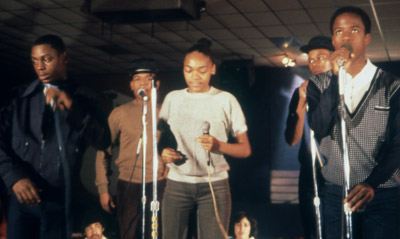
MC Sha-Rock in 1982’s Wild Style, Charlie Ahearn/Cornell Hip Hop Collection
Our efforts to connect academic hip hop studies to its cultural practitioners must honor women and empower female agency. The critical praxis has already been constructed by Black feminist scholars, such as Tricia Rose, Joan Morgan, Patricia Hill-Collins, Gwen Pough, Kyra Gaunt, Ruth Nichole Brown, and countless others. Hip hop feminism or “Crunk feminism” dictates that academic spaces support emancipatory gender politics, which starts with teaching and celebrating a truthful history focused on the agency of women of color. It does not involve participating in Black male violence under the guise of loving hip hop.
Every university that claims to teach or “preserve” hip hop should appoint female/feminist/queer artists. No doubt, fierce emcees like Yo-Yo, MC Lyte, Missy Elliott, and Lauryn Hill should be on the short list at many colleges. Still, we have to be wary of gender tokenism; the end-game should not be finding a honorary female artist to provide “a woman’s point of view.” Rather, the goal should be to create opportunities for women to narrate history, redefine the spaces occupied by hip hop, and to rearticulate the logic of critical listening.
Regendering hip hop studies will require a paradigm shift and a new soundtrack about love. Perhaps we can begin the work by replacing the H.E.R. tracks with Akua Naru’s “The World is Listening.” It is a dope, feminist homage to women’s journey through hip hop history, without all the slut shaming.
—
Featured Image by Flickr User LizSpikol
—
Travis L. Gosa is an Assistant Professor at Cornell University’s Africana Studies & Research Center. He teaches courses on hip hop culture, African American families, and education. He is an advisory board member of Cornell’s Hip Hop Collection, the largest archive on early hip hop culture in the United States. He can be reached at tlg72@cornell.edu and on Twitter @basedprof.
—
 REWIND! . . .If you liked this post, you may also dig:
“‘I’m on my New York s**t’: Jean Grae’s Sonic Claims on the City”––Liana Silva
“Ill Communication: Hip Hop Studies & Sound Studies @ Show And Prove”— J. Stoever-Ackerman
“The Victoria’s Secret Fashion Show and the Soundtrack of Desire“— Marcia Dawkins
Share this:

Radical Listening and the People’s Microphony: A Conversation with Elana Mann
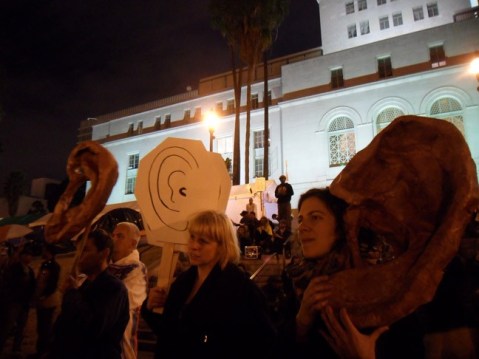
Members and collaborators of ARLA (Paula Cronan, Juliana Snapper, and Elana Mann) participating in a General Assembly at Occupy LA City Hall, November 11, 2011
Listen to everything all the time and remind yourself when you are not listening–Pauline Oliveros
“CAN YOU HEAR ME?!” “I CAN HEAR YOU!!” “IT’S A VAN GOGH PARADE!!” . . .were some of the enthusiastic replies when artist Elana Mann, musician Juliana Snapper, and other members of ARLA (Audile Receptives Los Angeles) arrived on the scene at Occupy LA with giant hand-made ears. Mann co-founded ARLA in the Spring of 2011 with Snapper, filmmaker Vera Brunner-Sung, and choreographer Kristen Smiarowski. After studying scores and techniques on listening developed by composer Pauline Oliveros, ARLA developed a workshop geared toward Occupy LA that included a listening parade in which they held up the giant ears and protest signs with ears on them. Snapper recalls, “The simple physical presence of people carrying large paper-mache ears was met with a kind of hungry recognition…recognition of what it meant that we were holding the symbols (giant ears).” They led workshops, listening sessions, and discussion groups. They performed Oliveros’ sonic meditation “Teach Yourself to Fly” and a composition written by Mann and Snapper entitled “People’s Microphony.” And a project was born. Through personal interviews and audio-visual examples, I document, contextualize, and analyze its work. 
Mp3=The People’s Microphony Camerata performing “Teach Yourself to Fly” Pauline Oliveros
I am happy that Elana Mann chose to use my Sonic Meditations for the People’s Microphony project. These pieces are meant for anyone that wants to perform them regardless of musical training.” –Pauline Oliveros
For Mann, active listening is “a process of tuning in simultaneously inward and outward. Active listening allows for an awareness of and an opening up to sounds around me and also a digestion of what is happening inside of me in relation to these sounds.” Much of the recent focus on this practice comes from the music and sound art worlds, as well as acoustic ecology, a field formed from the overlapping area between science and art that concentrates on the importance of experiencing and investigating our sonic surroundings with detailed care and respect to understand its importance on our world and our place within it. Mann’s work addresses a unique angle at the intersection of these fields: listening’s empathetic effect on those whom you are listening to, a consideration arising from a project she worked on between 2007-2010 with Iraq war veteran Captain Dylan Alexander Mack, called “Can’t Afford the Freeway.”
. “Can’t Afford the Freeway” highlights how her collaborations emerge as conversations between involved artists as well as the audience. Speaking to Mann about the project, she stated,Alex created some recordings for me and I kept listening to them over and over again trying to figure them out. I eventually produced more interviews with him and realized that he needed his story to be heard and I needed to try and understand his story. So I created a project in which I attempted to listen as best I could. Listening to his recordings made me feel close to him, but I also recognized that no matter how many times I heard his words they were still foreign to me. Still the very act of me struggling to listen was important for both of us, and I think this is true of many interpersonal/political and social situations. You can never experience what it is like to be someone else, but active listening opens up a space of empathy and connection. I also think we can see how a lack of active listening is affecting the political landscape in the United States so negatively, by producing a highly polarized and vitriolic environment.
And what about at Occupy LA?
At Occupy LA I was hopeful that there would be a place for listening to voices that had not been heard before and sometimes that happened. Other times people used the space for projecting, not receiving. I think that there needs to be strong voices making themselves heard, but I don’t want to lose the other part of that equation, which is those voices being quiet and listening to others, and themselves.

ARLA Ear Strengthening Workshop, Occupy LA site, November 11, 2011, Photo by Carol Cheh
Mann, thinking and researching about social, aesthetic, and political points of listening and voicing, felt there was something to be considered about the “radical receptivity and the core message of the OWS movement” and its global amplification of voices struggling to be heard. In the Spring of 2012, she formed The People’s Microphony Camerata with Snapper, a radical experimental choir based in Los Angeles exploring the process of the People’s Microphone. The exact history of the “People’s Microphone,” or “People’s Mic” is unclear, but its use in the Occupy Movement has already become iconic. Ted Sammons discusses the implications of the People’s Mic for communication in his October 2011 post, “‘I didn’t say look; I said listen’: The People’s Microphone, #OWS, and Beyond.” The human microphone is a way to deliver one person’s message to a large group of people in situations where amplification tools, such as bullhorns, are either not allowed or unavailable, or if the acoustics of a space distort amplification. The speaker calls, “mic check!” to alert their intentions. Those around them call back, “mic check!”, until the gathering understands something will be said. The speaker breaks their statement into short sentences, pausing to allow those around them, or the “first wave,” to repeat them in unison. They then pause for those further away, or the “second wave,” to repeat again…and so on until those in the back of the gathering have heard the statement.
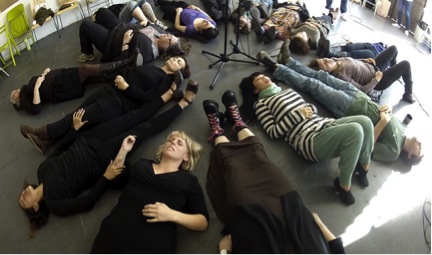
Members of People’s Microphony Camerata rehearsing in Los Angeles, April 15, 2012, Photo by Jean-Paul Leonard
The group’s trademark intensity sometimes carried over to the audience. Mann discovered such transference often had to do with prior associations with a location or context. Mann recalled a particular performance at the Occupy movement called “Chalkupy” that was formed in response to a protest running simultaneously with the LA Art Walk, in which activists had handed out chalk and told stories of police repression while chalk drawings were created on the walkways. The police shut down the art walk and a violent struggle ensued. The Occupy LA movement called for people globally to take to the street with chalk in protest, and the day was called “Chalkupy”. The audience of protestors was mixed and tense, and when the PMC began their performance of a highly emotive score called “Sob-Laugh” by Daniel Goode, people were either drawn to or repelled by the performance.
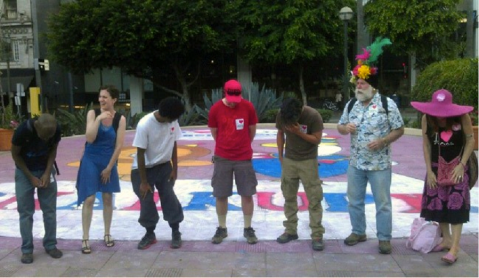
The PMC performing “Sob Laugh” at the “Chalkupy” protest in downtown Los Angeles, Image by Daniel Goode
I think there was some fear about the vulnerable revelation of emotions in the space of the protest. Many of the Occupy LA protests were so risky that everyone had to be extremely tough to exist in that activist space. I respect that. Still I think there are other things that can happen in a space of protest that bring out different feelings. Some activists wanted us to be more musically conventional, “why can’t you just sing some folk songs like normal protest choirs,” we were asked. But we really were not into that kind of thing. . .
In most protest situations, the audiences welcomed their activities. Many shared that it opened up a new space where people could meet each other as humans rather than adversaries or collaborators. Mann edited and published a monochromatic grassroots songbook with the various scores the PMC received for performance, opening up the circle for anyone and everyone to perform and feel that closeness.
Sometimes it was hard to translate a piece that worked during a group rehearsal to something for an audienceperformer situation. . .The PMC never fully developed how to deal with audience participation, but this is something I have been developing on my own in working with students on PMC materials. The scores from the People’s Microphony Songbook and the techniques Juliana and I developed when we first formed the PMC create an immediate closeness within a group, which is remarkable.

From the “People’s Microphony Songbook”: Many voices that were once silenced are now resonating through large crowds, not only of activists, but ordinary people all over the world, assisted by internet networks, and a simple technology called the People’s Microphone. The People’s Mic expressed the interrelated desires of collective and individual voices to speak and be heard, to hear one’s words spoken back through different mouths, and to digest someone else’s words through one’s own body. Beyond projecting an individual’s voice further then it can resonate on its own, the People’s Mic has implications for all of the bodies in its vicinity. It energizes listeners in ways the microphone or megaphone cannot by making listening active, vocal, and embodied. The project, like the Occupy movement, holds all the complexity, beauty, and drive of being human, whether you consider it “working” or not. When I asked Mann about how changes within and towards the Occupy Movement affected the choir, and whether they were winding down or taking a new form, she answered:
I think more than anything else, our group faced a lot of the same challenges that the Occupy Movement faced challenges in horizontality, in the push and pull between interior and exterior exploration, in the sometimes painful vulnerability of investigating the intimate personal and political space with others. I think the project is still developing. The choir still communicates, and some members are currently collaborating with composer Daniel Corral, but the PMC does not meet and rehearse like we used to I think it will continue to wax and wane. In the meantime, I am still working on ideas of active listening. I am currently creating a project called “Listening as (a) movement” within an under-served neighborhood in Pasadena, CA, exploring ideas of radical listening within a specific neighborhood.
In an age of constant bombardment of stimuli, our heads scream with thoughts, opinions, arguments, and expressions. With our current technology, our input and output can be a constant rush of snap reactions and impulses, which has a profound effect, of course, on our day-to-day lives, on our culture(s), on our politics. But these circles cannot be affectively complete without the other side. We need someone to hear us, and, more then that, we need someone to listen to us. And we, in turn, need to listen to them.
—
Maile Colbert is a multi-media artist with a concentration on sound and video who relocated from Los Angeles, US to Lisbon, Portugal. She is a regular writer for Sounding Out!
—
REWIND! . . .If you liked this post, you may also dig:
“Sensing Voice”–Nina Sun Eidsheim
“Within a Grain of Sand: Our Sonic Environment and Some of Its Shapers”–Maile Colbert
“Listening to #Occupy in the Classroom”–Travers Scott
Share this:


Current Top Posts





April 2021

January 2020

November 2019

October 2019

August 2019

April 2014

November 2017

March 2015

December 2017

October 2015
 Sounding Out!
Recent Comments