
Listening to the Beautiful Game: The Sounds of the 2018 World Cup

I heard them before I saw them. Walking to my apartment in Moscow’s Tverskoy District, I noticed a pulsating mass of sound in the distance. Turning the corner, I found a huge swath of light blue and white and—no longer separated by tall Stalinist architecture—was able to clearly make out the sounds of Spanish. Flanked by the Izvestiia building (the former mouthpiece for the Soviet government), Argentinian soccer fans had taken over nearly an entire city block with their revelry. The police, who have thus far during the tournament been noticeably lax in enforcing traffic and pedestrian laws, formed a boundary to keep fans from spilling out into the street. Policing the urban space, the bodies of officers were able to contain the bodies of reveling fans, but the sounds and voices spread freely throughout the neighborhood.
Moscow is one of eleven host cities throughout Russia for the 2018 FIFA World Cup, which runs from June 14 to July 15. Over one million foreign fans are expected to enter the country over the course of the tournament, and it is an important moment in Vladimir Putin’s attempt to reassert Russia’s power on the global stage. Already, it has been called “the most political tournament ever,” and discussions of hooliganism, safety concerns, and corruption have occupied many foreign journalists in the months leading up to the start. So gloomy have these preambles been that writers are now releasing opinion pieces expressing their surprise at Moscow’s jubilant and exciting atmosphere. Indeed, it seems as though the whole world is not only watching the games, but also listening attentively to try to discern Russia’s place in the world.

Police officers during World Cup 2018 in Russia, Image by Flickr User Marco Verch (CC BY 2.0)
Thus it comes as no surprise that the politics of sound surrounding the tournament have the potential to highlight the successes, pitfalls, and contradictions of the “beautiful game.” Be it vuvuzelas or corporate advertising, sound and music has shaped the lived experience of the World Cup in recent years. And this tournament is no exception: after their team’s 2-1 win over Tunisia on June 18, three England fans were filmed singing anti-semitic songs and making Nazi salutes in a bar in Volgograd. That their racist celebrations took place in Volgograd, formerly known as Stalingrad and the site of one of the bloodiest battles of World War II, added historical insult and even more political significance. The incident has shaped reception of England fans and their sounds across the country. As journalist Alec Luhn recently tweeted, police cordoned off singing England supporters in Nizhny Novgorod after their victory over Panama, ostensibly keeping the risk of hooliganism at bay. The incident stands in stark contrast with the police barrier around the Argentina fans, who were being protected not from supporters of other nationalities, but rather from oncoming traffic.
England fans in Russia sing songs…behind a line of police. Part of the reason there hasn’t been any hooligan violence pic.twitter.com/RwXz8XtLHf
— Alec Luhn (@ASLuhn) June 23, 2018
More than anything, however, sound has facilitated cultural exchange between fans and spectators. In recent years, historians and musicologists have paid more attention to the multivalent ways musical exchanges produce meaningful political and social understandings. Be it through festivals, diplomatic programs, or compositional techniques, music plays a powerful role in the soft power of nations and can cultivate relationships between individuals around the globe. More broadly, sound—be it organized or not—shapes our identity and is one of the ways by which we make meaning in the world. Sound, then, has the potential to vividly structure the experience of the World Cup—a moment at which sound, bodies, individuals, and symbolic nations collide.
At the epicenter of all of this has been Red Square, Moscow’s—and perhaps Russia’s—most iconic urban space. The site of many fan celebrations throughout the World Cup, Red Square’s soundscape brings together a wide variety of national identities, socio-economic considerations, and historical moments. To walk through Red Square in June 2018 is to walk through over five-hundred years of Russian history, emblematized by the ringing bells and rust-colored walls of the Kremlin; through nearly eighty years of Soviet rule, with the bustle and chatter of curious tourists waiting to enter Lenin’s tomb; and through Russia’s (at times precarious) global present, where fans from Poland join with those from Mexico in chants of “olé” and Moroccan supporters dance and sing with their South Korean counterparts. The past, present, and an uncertain future merge on Red Square, and the sonic community formed in this public space becomes a site for the negotiation of all three.

Map of Red Square
In the afternoon of June 19, I walked through Red Square to listen to the sounds of the World Cup outside the stadium. At the entrance to Red Square stands a monument to Grigory Zhukov, the Soviet General widely credited with victory over the Nazis in World War II. Mounted upon a rearing horse, Zhukov’s guise looms large over the square. In anticipation of that evening’s match between Poland and Senegal at Moscow’s Spartak Stadium, Polish fans were gathered at the base of Zhukov’s monument and tried to summon victory through chants and songs (Poland would end up losing the match 2-1.) Extolling the virtues of their star player, Robert Lewandowski, the fans played with dynamics and vocal timbres to assert their dominance. Led by a shirtless man wearing a police peaked cap, the group’s spirit juxtaposed with Zhukov’s figure reiterated the combative military symbolism of sporting events. Their performance also spoke to the highly gendered elements of World Cup spectatorship: male voices far outnumbered female, and the deeper frequencies traveled farther across space and architectural barriers. The chants and songs, especially those that were more militaristic like this one, reasserted the perception of soccer as a “man’s sport.” Their voices resonated with much broader social inequalities and organizational biases between the Women’s and Men’s World Cups.
From there, I walked through the gates onto Red Square and was greeted by a sea of colors and hundreds of bustling fans. Flanked by the tall walls of the Kremlin on one side and the imposing façade of GUM (a department store) on the other, the open square quickly became cacophonous. Traversing the crowds, however, the “white noise” of chatter ceded to pockets of organized sound and groups of fans. Making a lap of the square, I walked from the iconic onion domes of St. Basil’s cathedral past a group of chanting fans from Poland, who brought a man wearing a Brazil jersey and woman with a South Korean barrette into the fold. Unable to understand Polish, the newcomers were able to join in on the chant’s onomatopoeic chorus. Continuing on, I encountered a group of Morocco supporters who, armed with a hand drum, sang together in Arabic. Eventually, their song morphed into the quintessential cheer of “olé,” at which point the entire crowd joined in. I went from there past a group of Mexico fans, who were posing for an interview while nearby stragglers sang. The pattern continued for much of my journey, as white noise and chatter ceded to music and chants, which in turn dissipated either as I continued onward or fans became tired.
Despite their upcoming match, Senegalese fans were surprisingly absent. Compared to 2014 statistics, Poland had seen a modest growth of 1.5% in fans attending the 2018 World Cup—unsurprising, given the country’s proximity to Russia and shared (sometimes begrudgingly) history. Meanwhile, Senegal was not among the top fifty countries in spectator increases. That’s not to say, of course, that Senegalese supporters were not there; they were praised after the match for cleaning up garbage from the stands. Rather, geography and, perhaps, socio-economic barriers delimited the access fans have to attending matches live as opposed to watching them from home. With the day’s match looming large, their sounds were noticeably missing from the soundscape of Red Square.
Later that evening, I stopped to watch a trio of Mexico fans dancing to some inaudible music coming from an iPhone. Standing next to me was a man in a Poland jersey. I started chatting with him in (my admittedly not great) Polish to ask where he was from, if he was enjoying the World Cup so far, and so on. Curious, I asked what he thought of all the music and songs that fans were using in celebrations. “I don’t know,” he demurred. “They’re soccer songs. They’re good to sing together, good for the spirit.”
Nodding, I turned back toward the dancing trio.
“You are Russian, yes?” The man’s question surprised me.
“No,” I responded. “I’m from America.”
“Oh,” he paused. “You sound Russian. You don’t look Russian, but you sound Russian.”
I’d been told before that I speak Polish with a thick Russian accent, and it was not the first time I’d heard that I did not look Russian. In that moment, the visual and sonic elements of my identity, at least in the eyes and ears of this Polish man, collided with one another. At the World Cup, jerseys could be taken off and traded, sombreros and ushankas passed around, and flags draped around the shoulders of groups of people. Sounds—and voices in particular—however, seemed equal parts universal and unique. Emanating from the individual and resonating throughout the collective, voices bridged a sort of epistemological divide between truth and fiction, authenticity and cultural voyeurism. In that moment, as jubilant soccer fans and busy pedestrians mingled, sonic markers of identity fluctuated with every passerby.
I nodded a silent goodbye to my Polish acquaintance and, joining the crowd, set off into the Moscow evening.
—
Featured Image: “World Cup 2018” Taken by Flickr User Ded Pihto, taken on June 13, 2018.
—
Gabrielle Cornish is a PhD candidate in Musicology at the Eastman School of Music. Her research broadly considers music, sound, and everyday life in the Soviet Union. In particular, her dissertation traces the intersections between music, technology, and the politics of “socialist modernity” after Stalinism. Her research in Russia has been supported by the Fulbright Program, the Glenn Watkins Traveling Fellowship, and the Cohen-Tucker Dissertation Research Fellowship from the Association for Slavic, East European, and Eurasian Studies. Other projects include Russian-to-English translation as well as a digital project that maps the sounds and music of the Space Race.
—
 REWIND! . . .If you liked this post, you may also dig:
Cauldrons of Noise: Stadium Cheers and Boos at the 2012 London Olympics–David Hendy
Goalball: Sport, Silence, and Spectatorship— Melissa Helquist
Sounding Out! Podcast #20: The Sound of Rio’s Favelas: Echoes of Social Inequality in an Olympic City–Andrea Medrado
Share this:

Unapologetic Paisa Chingona-ness: Listening to Fans’ Sonic Identities


For the full intro to the series by Michelle Habell-Pallan, click here.
The forum’s inspiring research by scholars/practioners Wanda Alarcón, Yessica Garcia Hernandez, Marlen Rios-Hernandez, Susana Sepulveda, and Iris C. Viveros Avendaño, understands music in its local, translocal and transnational context, and insists upon open new scholarly imaginaries. . .
Current times require us to bridge intersectional, decolonial, and gender analysis. Music, and our relationship to it, has much to reveal about how power operates within a context of inequality. And it will teach us how to get through this moment. –MHP
—

Que Buena Epoca Instagram Post (reposted by El Original)
I am a self-identified Paisa, a Paisa Girl from Playa Larga – my home – in the Eastside of Long Beach, California. The term paisa/s is slang for paisanos (homies) and it references someone who takes pride in listening, dancing, and attending nightclubs where Banda music, corridos, and norteños are performed. I am part of a generation that has been referenced as the Chalinillos; youth with an urban gangsta aesthetic that was influenced by Chalino Sanchez, The Riveras, Saul Viera, Adan Sanchez, Los Dos Grandes, Tigrillo Palma, Los Amos; later came the Alterado, Progressivo (DEL) and now people like El Fantasma, Lenin Ramirez, Alta Consigna, Grupo Codiciado, Jesus Mendoza, and Los Perdidos de Sinaloa.
As they say, “Fierro Parriente!” “Andamos al Millon,” “Pa que vayan y digan” and “Puro Pa Delante!”
In the mid 2000s, besides partying hard in the paisa nightclub music scene, I also partied with several paisa party crews in Long Beach. The songs, “Las Malandrinas,” “Parrandera,” “Rebelde, y Atrevida,” and “Mi Vida Loca” by Jenni Rivera were my anthems. These songs described the music scene we were a part of, and how we situated ourselves within a male-dominated subculture. “La Malandrinas” for instance says that we make a lot of noise, we drink, ask for corridos at clubs (a masculine tradition) and do not care about what people say about us.
Thus, Jenni’s participation in this music genre was important because she created paisa sonic identities for the women in this subculture. “Sonic identities”, is a term that I use to describe the process fans engage in when they use a song to create a nickname and identity for themselves. This is a common practice among party crews and fan clubs. For instance, the nickname that I gave myself was “La Yaquesita” which is a title of a song. My participation in this nightlife shapes my analysis of this subculture. The gender dynamics and negotiations I had to engage with in this space made me an unapologetic feminist (although I did not call myself that at the time) who was fierce and defended herself but who—despite the slut shaming—approached this nightlife through a sex-positive attitude. Our attitude was “Fuck Haters!” and having this mentality was liberating. So, it makes sense that now I write about haters –or what Jonathan Gray calls anti-fans. I am interested in analyzing sonic haterism and how it tries to police Latina women-centered and sex-positive spaces like fan clubs and paisa party crews.

Las Malandrinas de Long Beach, 2008
In my dissertation entitled, “Boobs and Booze: Jenni Rivera, the Erotics of Transnational Fandom and Sonic Pedagogies,” the intertwined themes of sound and home emerges via a loud shout-out of my hometown that sounds like “Playa Larga, Baby” or a louder shout out that says “Son Ovarios de Playa Larga, Chaooowww, Baby.” Similar to “Fuck Haters!,” the latter shout-out implies a particular attitude and feminisms rooted in unapologetic paisa chingona-ness. Paisa Chingona-ness is the sonic condition, the rebellious and intoxicating state of being a chingona “rancherota.” Chicana feminists such as Sandra Cisneros and Josefina Lopez have defined and theorized being a chingona in multiple ways. In her poem titled “Chingona,” Lopez for instance defines a chingona as a sex-positive Chicana who refuses to be slut-shamed for owning her fat body, sexuality (literally she loves to be on top), and agency. There are overlaps with how Lopez, Jenni and her fans practice being chingonas; however, the added layer with Paisa Chingona-ness is that Jenni’s music and fandom shapes the way they embody it.
Activist and Writer, Raul Alcaraz Ochoa, has written a piece titled “Jenni Rivera y los 9 Puntos del Feminismo Chingona” here he acknowledges that Chingona Feminism is rooted in the barrio, the hood and is born from within and in response to a machista context, where the priority is always given to men. According to Ochoa, Chingona Feminism is also born from race oppression and class-struggle. Ochoa states that Jenni “dice lo que piensa sin pelos en la lengua, te agrede si eres injusto porque su lengua es una bala que te deja con los huevos estrellados.” My work shows how chingona feminism is also practiced and embraced among fans. I expand on Ochoa’s analysis to think through Paisa Chingona-ness which asks us to listen to the “details” that Chingonas make when they are surrounded by each other.
Heard through my experiences, identifications, and stance toward the world, it makes sense why home manifests itself in the approach that I use to study popular music: that of fandom, that prioritizes fans and their approach to what I call sonic pedagogies. Which is a concept that was inspired by scholars such as Deborah Vargas, Alicia Schmidt Camacho, Jillian Hernandez, Anya Wallace, Gloria Anzaldúa, and Martha Gonzalez. These scholars write about the power of music as “sung theory,” the power of music to create “sonic imaginaries,” or inspire teachings between the artists and the listener, that oftentimes creates “an erotic of feminist solidarity.”
For me, sonic pedagogies is a concept that centers the fan and what John Fiske has called their “textual, enunciative, and semiotic productivity.” Sonic pedagogies allows me to think about the affective and corporeal fan-to-fan teachings that are inspired even when the artist is dead and yet their legacy and conocimientos are being used to teach fans to understand each other. Sonic Pedagogies centers the practice that Lawrence Grossberg explains when he states, that fans give “authority to that which he or she invests in, letting the object of such investments speak for and as him or herself” (59).

A J-unit’s Altar: Andrea’s Jenni Collection, photo taken by author, 2015
Listening to sonic pedagogies asks us to write about music from a different perspective, from the perspective of its fans. Oftentimes we listen and write about music from the perspective, the voice, the body, and lyrics of the artist. But what if we start from their re-interpretation of a song in a YouTube video for instance? What if we start from a fan shout-out during a concert? What if we start from the conversations that emerge when fans talk about their favorite songs to non-fans? What if we make anti-fans our starting point to understand an artist or a music genre? Analyzing music in this way allows us to hear the multiple sonic layers that a song and music in general inspires.
I am also a filmmaker, so the way I understand sound and the reception of music is inspired by how I edit sound for a film. When we edit film, we layer the sound, we usually have at least three layers of sound: the interview (main story and Track 1), music (Track 2), and background noise (Track 3). However, sometimes you can have up to 20 sonic tracks layered at once and, actually, is how I have experienced fandom. There’s a song that we usually are listening to because we identify with it (Track 2), then we add our own conocimiento to the song (Track 1), that conocimiento or what many times turns into “archisme” provokes background noise of solidarity (Track 3), either to show the other fan that you understand, acknowledge, and relate to what they are sharing. Fans ask us to listen to the study of music from a perspective of “love” (Duffet), “magic” (Guy) and “erotics.”
Scholars in the field of fan studies such as Daniel Cavicchi have defined fandom as “not some particular thing one has or does. Fandom is a process of being; it is the way one is” (59 ). Alexandra Vasquez, in particular, reminds us of the importance of “listening to details” when thinking about fandom, music and performance. Sonic Pedagogies requires that I listen to the “details” of audience members, fans, and anti-fans that tell me about how Chicana/ Mexicana/Latina women resist structures of governmentality by questioning gender norms, and traditional ideas about sexuality. In Listening on Detail, Vasquez explains that details are “interruptions that catch your ear, musical tic that stubbornly refuse to go away. They are things you might first dismiss as idiosyncrasies. They are…saludos, refusals, lyrics, arrangements, sounds, grants, gestures, bends in voice” (19). In my work, Jenni chants, removal of clothing, mobile recordings, posters, fliers, fan shirts, and sing alongs, are the details that allows me to examine Jenni Rivera.
For instance, I analyze the deschichadera “removal of bra” ritual that both Jenni and her fans engaged in during concerts. I am fascinated by the deschichadera ritual and Jenni’s concerts in general because these fans are constantly redefining home, embodying Cherrie Moraga’s feminist praxis of “making familia from scratch” (58).
Thus for fans, home is found in the affective, erotic, collective, and intimate aspects of music reception and its sociality. Home is found in fan clubs, fan gatherings, tribute events, living room, and the travels of bumping music in the car. Listening to the details of fans allows me to view audience responses to Jenni’s performance part of Jenni’s own presentation and music, not separate from them. Engaging music through fans allows me to see that songs, concerts, and albums do not end when the music stops.
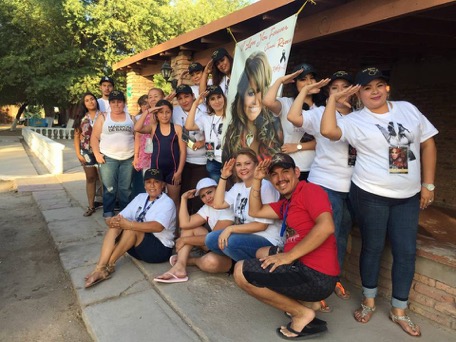
J-units in Mexicali celebrating Jenni’s Birthday, 2017
In “Boobs & Booze,” home also appears in murals, particularly their visual representations of Mexican music. In the vein of Deborah Paredes’s study of Selenidad, I write about the visual politics of Jenni’s remembering, particularly Jenni Rivera Memorial Park, dedicated by the city of Long Beach in 2015. Home appears in the fashion that we decide to dress our bodies in, especially the femme challinillo aesthetic, and homegirl/Pachuca/partygirl look that Jenni performed on stage. We also find home in the memories we make when we listen to a particular song. So for me, listening to” Mi Vida Loca” for instance always bring me back to Long Beach, the barrio that has shaped me as a chingona feminist, scholar, and artivist.

Sergio Ramirez working on the Jenni Rivera Mural (2015) photo taken by author.
Home is the music that we take with us, the music and sounds that we carry in our backs when we enter white or middle-class dominated spaces where our paisa music is not acknowledged or it is even looked down upon and critiqued for being “too Mexican,” “too chunti,” “too low.” Home and sound makes me think of how people of color co-exist with each other sonically. In the EastSide of Long Beach, for instance, home and sound is black and brown relations, tensions, and solidarity. Home and sound is acknowledging that both corridos, hip-hop, and G-Funk relationally, has formed paisas. I mean, I also get an adrenaline rush when I hear Snoop Dog, Warren G, Nate Dogg, O.T Genasis, and Ladies of Beach City referencing their roots to Long Beach, as Snoop says, “it’s an Eastside thang.”
The recent example of Playa Larga’s black and brown sonic solidarity is Snoop Dog’s recent Instagram video listening to Jenni’s music. Watching two Playa Larga finest artists being fans of each other, despite the differences in music genre, language, and spatial politics (East vs. West) is powerful, it tells us that we listen to each other even when they try to put us against each other. In this video, Snoop Dogg embodies the “We have each other” solidarity with which Gaye Theresa Johnson ends Spaces of Conflict, Sounds of Solidarity: Music, Race, and Spatial Entitlement in Los Angeles (189).
Rip jenni rivera- sweet lady n a beautiful voice she will b missed we were supposed to do a song together Im so sad!
— Snoop Dogg (@SnoopDogg) December 10, 2012
Listening to Chingona-ness pushes me to theorize a new framework for anti-fandom, one that centers race, class, sexuality, and is not only about an artist’s music– or what Gray calls the “text” – but also about their bodies and the bodies of the fans, their ontologies, and existence. Focusing particularly on Jenni and her fans allows me to think about gender, sexuality, class, pleasure, music reception in relation to anti-immigrant sentiments, war on drugs, war on poverty, and the war on Latina reproduction and fatness. Jenni as a case study allows me to explore how unapologetic paisa chingona-ness triggers anti-fans, exposes what I am calling agitations and their “agitated responses.” Agitated responses refers to the hater comments that anti-fans (or non-fans) make towards Jenni, (and there are many), while agitation is the carnal disgust that anti-fans display when they police the behavior of Jenni and her fans. In this anti-fandom framework, agitation is the disaffection – the visceral aggression or enmity – that people who hate Jenni and her fans express when they write, say, or gesture agitated responses towards them, a form of sonic haterism.
I entered academia to theorize my home and write the paisa girl epistemology since there is little literature written on our sonic identities, and to show how sonic haterism, in conversation with fandom, allows me to understand the historical, social, and cultural realities working-class Latinas face. Here is how Jenni Rivera once expressed this same intersection in the song “Mi Vida Loca,” which asks listeners to hear what Paisa Chingona-ness sounds like in Playa Larga, her sonic home, and mine too.
—
Featured Image: Paisa Party Crews in Long Beach, The Myspace Days , courtesy of author
—
Yessica Garcia Hernandez is a doctoral candidate and filmmaker in the Department of Ethnic Studies at the University of California San Diego. Her scholarship bridges fan studies, sound studies, women of color feminisms, fat studies, girl studies, and sexuality/porn studies to think about intergenerational fans of Mexican regional music. Yessica earned her B.A. in Chicanx Studies from University of California, Riverside and an M.A. in Chicanx and Latinx Studies at California State University Los Angeles. She has published in the Journal of Popular Music, New American Notes Online, Imagining America, Journal of Ethnomusicology, and the Chicana/Latina Studies Journal. Her dissertation entitled, “Boobs and Booze: Jenni Rivera, the Erotics of Transnational Fandom, and Sonic Pedagogies” examines the ways in which Jenni Rivera fans reimagine age, gender, sexuality, motherhood, and class by listening to her music, engaging in fandom, and participating in web communities. She explores the social element of their gatherings, both inside and outside the concert space, and probe how these moments foreground transmissions of Latina power. Yessica’s broader research interests includes paisa party crews, Banda Sinaloense, Contestaciones, and Gordibuena/BBW erotics. She is a co-founder and member of the Rebel Quinceañera Collective, a project that utilizes art, music, photography, creative writing, filmmaking, and charlas to activate spaces for self-expression and radical education by and for youth of color in San Diego.
—
 REWIND! . . .If you liked this post, you may also dig:
Deep Listening as Philogynoir: Playlists, Black Girl Idiom, and Love –Shakira Holt
Listening (Loudly) to Spanish-language Radio—Dolores Inés Casillas
Feeling Through the Keen and Grind: Team Dresch’s Personal Best –Gretchen Jude
New Wave Saved My Life—Wanda Alarcón
Share this:


Current Top Posts





April 2021

January 2020

November 2019

October 2019

August 2019

April 2014

November 2017

March 2015

December 2017

October 2015
 Sounding Out!
Recent Comments