
The (Magic) Upper Room: Sonic Pleasure Politics in Southern Hip Hop
DOI: https://doi.org/10.59350/73js0-34t03
After a rockin’ (and seriously informative) series of podcasts from Leonard J. Paul–a three part “Inside the Game Sound Designer’s Studio”– our summer Sound and Pleasure series keeps giving you the good stuff, this week with SO! Regular Regina Bradley, making it rain. . . with some serious knowledge. What is the connection between sound and enjoyment, and how might black women’s sexual freedom be manifested via sound? –-JS, Editor-in-Chief
—
At fifteen, while in church service, I learned how to clutch pearls after hearing a woman moan during the altar call.
It was not a “Jesus done found and saved me” moan, either. A friend forgot to turn his cell phone off for church. As the church prayed, his phone started to ring. It was not the usual digital beeping or quick calypso ring tone. His phone calls were annotated by a woman’s moan during sex. She moaned from his cell phone to pick up the call. Each ring the woman moaned louder and adamant until she hollered like she was just saved. The kids in the back snickered as the ushers – including my grandmother – silently and angrily screened each pew to see who would pick up the phone. Quaking church ladies and my grandmother’s wide-eyed glare and heaving chest suggested they were about to pass out from embarrassment. Wringing their white gloved hands and grabbing at their pearl necklaces in angst, they looked everywhere but at each other: the back of a man’s head, the cross at the front of the church, the stain glass windows. A flush of warmth entered my cheeks and neck as I tried to contain my laughter and creeping embarrassment. I was embarrassed for my grandmother and the ladies of the church because I was aware of the unspoken rule that women – especially middle-class black women – don’t do sex. Being embarrassed of sex is proper and “ladylike.”
Ashon Crawley’s contextualization of the praise and worship in Black Pentecostal church as a sonic public zone is useful for using sound to complicate the church as an erotic space. Crawley’s suggestion of sound as a “vessel. . .for the exchange of ecstasy and ecstatics” collapses the more tangible notions of gender and respectability via physical displays –i.e. the quaking church ladies and clutching pearls – to recognize the overlap of moaning as a marker of sexual joy, moaning as a form of praise and worship, and moaning as an indicator of shame. Crawley’s observations bring to mind Helga Crane’s run in with the storefront church in Nella Larsen’s Quicksand. It is not the physical aspect of the church and its embodiment of respectability that draws Helga into the space. Rather, it is the singing, weeping, and moaning – the sonic elements of praise and worship–that parallel her own suppressed sexual frustrations. Her weeping is not necessarily a “come to Jesus moment” but rather a sonic release acknowledging her sexual agency.
Looking back at when this dude’s phone went off in church, I realize the bulk of discomfort in acknowledging sexual pleasure exists in how it sounds. The woman’s moan highlighted an alarming reality for the women at my church: pleasure was being presented outside of its respectable physical and sonic boundaries. I wish to identify what I call sonic pleasure politics to address new developments in 21st century southern gender identity politics. Sonic manifestations of pleasure point to a younger generation’s rearticulation of sexuality as a site of agency and self-definition in an otherwise suppressed southern experience.
![Purity-Rings.jpg by Wikimedia user Bibleknowledge, CC-BY-SA-3.0 (http://creativecommons.org/licenses/by-sa/3.0)], via Wikimedia Commons](http://commons.wikimedia.org/wiki/File:Purity-Rings.jpg)
As a southern black woman, I’ve always been struck by the anxiety sex and pleasure invoked in the women in my life. Sex and pleasure were never articulated in the same breath, as sex was a wifely duty and responsibility for procreation. Pleasure was never synonymous with sexual joy, even when I snatched whispers of conversation about sex from my elders. Moreover, I was taught that sex (or even an interest in it) would plummet my stock as a good girl and put me in the ranks of “fast-tailed” girls who used sex as a desperate plea for attention. Nope, sex – pleasurable sex – was always for men’s gratification. Aside from the abstinence manifesto – “just don’t do it, chile” – for women, enjoying sex was the devil’s work. Respectable sex was quiet, for marriage, and never discussed outside of the house.
Sound as a signifier of sexual pleasure is considered by many to be counterintuitive because of the history of sexual trauma associated with black women’s bodies in the south. Reading sex as a genesis point of southern black women’s pleasure and empowerment is a difficult undertaking. The forced silence of slave women’s rapes and other physical violence that took place on southern soil parallels the silence that is deemed to be necessary for survival in a racist society. Further, the far-reaching residual effects of black women’s inferred lacking virtue lurk in how black folks navigate their southern experience and identities. Conservative attitudes towards sex in the southern black community are no doubt associated with the constructed attempts to humanize and validate blacks outside of hypersexual scripted blackness.
However, the sonic dimension of sex and pleasure in the south goes largely without analysis even though sound is a primary space in which recognition of sexual and nonsexual pleasure takes place. Consider blues women and, more recently, women in [southern] hip hop culture. The sounds of women’s giggles and moans as representative of sexual pleasure in bass music and the heavy use of moaning in the work of Trina, Jacki-O, Khia, Erykah Badu, Beyoncé, and Missy Elliott points to a need to recognize sound as a reservoir of pleasure, raunchiness, and sexual work—what I call “sonic pleasure politics.”
Studies of sonic pleasure including those of Robin James contextualize pleasure via the technical production of sound to induce a particular set of cultural and visceral responses. However, I ground my theorization of sonic pleasure politics in the growing body of scholarship offered by the “Pleasure Ninjas” collective consisting of Joan Morgan, Brittney Cooper, Treva Lindsey, Kaila Story, Yaba Blay, and Esther Armah. They utilize pleasure as a site of healing and reclamation of black women’s identities. Morgan’s interrogation of pleasure as a form of survival, for example, is especially useful in thinking about how southern women’s sexuality stems from the trauma of the transatlantic slave trade. She suggests pleasure’s palpability as an alternative space to reclaim slaves’ humanity. The Pleasure Ninjas’ construction of pleasure lends credence to my theorization sonic pleasure politics as a space for mediating the historical implications of abusive sexual power and the use of sexual pleasure as a form of resistance in the south.
Situating women’s pleasure in southern hip hop is messy as it reflects both men’s investment in women as objects of pleasure – i.e. bass music – and women’s subversion of this expectation of their sexuality a way to express themselves. For example, Lil Wayne’s lyrical affirmation of his sexual prowess via cunnilingus in songs like “Pussy Monster,” “She Will,” and “Lollipop” parallels singer Joi’s demonstration of pleasure as a form of sexual consent via the use of (presumably her) moans and sounds of cunnilingus on her popular song “Lick.” Sonic pleasure politics become a workspace for bridging the south’s historical construction of [black] women’s sexuality-as-respectability and the recent, more fluid form of younger women’s embrace of sex-as-empowerment heard in southern popular culture.
Sonic Pleasure Politics and Strip Club Culture
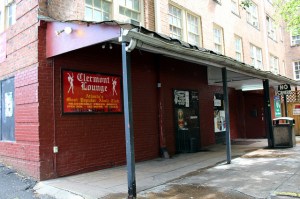
A primary space for teasing out the multi-layered significance of sounds and sexuality in southern hip hop is the strip club. The production of sonic and visual representations of strip clubs are inextricably linked: bass heavy musical tracks keep time with the “clapping cheeks” of exotic dancers. Further, the loudness of the strip club denotes patrons’ attempts to drown out the world while pivoting off of the fantasy of sexy women dancing, moaning, and sexually gesturing for their entertainment. The dominance of strip clubs in southern hip hop contribute to the erotic map(s) of a younger generation of southern black women. My contextualization of strip clubs as a cartographic point of interest pivots off of Kaila Story’s description of erotic maps as an entry point for recognizing black women’s sexual agency. Erotic maps are the touchstones through which people address sexual pleasure. Story uses black women’s social-historical narratives to map out black women’s use of sexuality as a measure of self-definition. These maps are complex as they are intertwined with historical-cultural biases and cultural preferences frequently outside of black women’s experiences.

Strip club anthems, like Memphis rapper Juicy J’s “Bandz a Make Her Dance,” riff on the sonic and physical components of strip club culture. The bass kicks complement what sounds like clapping hands, a signifier of strippers’ clapping butts. Juicy J talks at length about his love of the strip club, distinguishing between “real” and fake strip clubs by the amount of nakedness and strippers wrangling for high-paying patrons’ bands of money. The snapping sound of rubber bands holding wads of cash together authenticates the duality of the women’s sexual posturing as physically pleasurable for men and profitable – economically pleasurable – for women. “Bandz a Make Her Dance” is grounded in the appeal of strip clubs as spaces of empowerment for black men. From this perspective, the clapping heard across the track could also signify the snapping of rubber bands against money to sonically signify men’s power as a strip club patron. Yet the physical and sonic presence of black women’s bodies – i.e. grunting as they maneuver and climb the dancing pole – also makes strip club culture a useful space to pivot southernness and sonic pleasure.
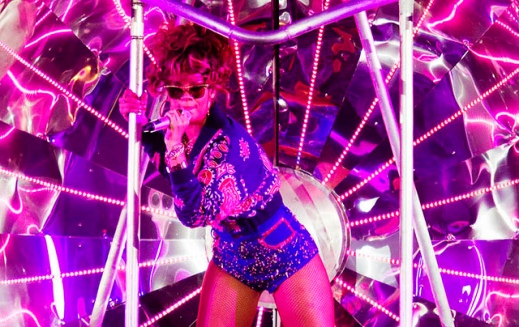
An example of establishing black women’s sonic pleasure narratives in strip clubs is singer Rihanna’s panning of “Bandz a Make Her Dance” titled “Pour It Up.” Although Rihanna is a pop singer from the “Global” South, she sonically signifies if not subverts southern hip hop gender politics via sampling the instrumental from Juicy J’s record. The majority of “Pour It Up’s” instrumental accompaniment is a subdued if not washed out sample of “Bandz a Maker Dance” that helps highlight Rihanna’s voice. The clarity of Rihanna’s voice “garbles” the accompaniment in the sense it is background noise to her narrative of enjoying herself and taking pleasure in the bodies of other women present in the club. The accompaniment serves as a brief nod to Juicy J’s initial intentions of crafting the strip club as a sexual space but ultimately uses the track as a testament to her own pleasure narrative.
In particular, Rihanna’s sing-song holler before the chorus “All I see is signs…all I see is dollar signs,” points to a subversion of the hypermasculinity in strip club culture to establish her own pleasure in a similar space. Parallel to Juicy J’s indulging of exotic dancers via throwing bands of money, Rihanna enjoys herself at the strip club using other people’s money:
Strip clubs and dolla’ bills (Still got mo’ money)
Patron shots can I get a refill (Still got mo’ money)
Strippers going up and down that pole (Still got mo’ money)
4 o’clock and we ain’t going home (Still got mo’ money)
Bands make your girl go down (Still got mo’ money)
Lot more where that came from (Still got mo’ money)
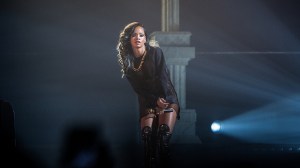
In particular, Rihanna’s verse not only demonstrates an alternative viewpoint of black women’s bodies in the strip club but destabilizes the idea of the strip club – and intercedes on the understanding of southern hip hop – as a heternormative hypermasculine space. The line “bands make your girl go down” alludes to not only a possible sexual encounter by Rihanna or for the girl in question but doubly signifies upon the potential for pleasure via the strip club culture for women and the hypersexuality of Juicy J’s track. “Pour it Up” reflects the messiness of [southern] hip hop gender politics because it builds upon the reputation of the strip club as a site for men’s pleasure to excavate women’s dancing as pleasurable for their own purposes. In addition to Rihanna’s sonic signifying of strip club culture, the “Pour It Up” reveres pole dancing as an art form rather than an exploitative practice. Rihanna’s pleasure in watching the dancers perform parallels the exertion of joy – and consent – that the dancers exhibit in their movement.
Trekking back to the sexy moaning phone in church, the sonic cue of sexual pleasure and joy conflicted with the gender norms associated with southern black women’s identities. Consideration of sonic pleasure narratives stirs discussion of the unarticulated experiences of southern black womanhood that may be overlooked in favor or a larger, more conservative, and familiar narrative of sex as tool of victimization. Sonic pleasure politics makes room to remap the contemporary southern social-cultural landscape as a complex yet living space of cultural production and sexual freedom.
–
Featured Image: “RIHANNA EM BELO HORIZONTE” by Flickr user http://www.rihannafentyforum.com, CC BY-NC-SA 2.0
–
Regina Bradley recently completed her PhD at Florida State University in African American Literature. Her dissertation is titled “Race to Post: White Hegemonic Capitalism and Black Empowerment in 21st Century Black Popular Culture and Literature.” She is a regular writer for Sounding Out!
–
REWIND!…If you liked this post, you may also dig:
Thrills, Chills, and Safe Sexuality: The Sounds of Michael Jackson’s “Thriller” – Osvaldo Oyola
“I Love to Praise His Name”: Shouting as Feminine Disruption, Public Ecstasy, and Audio-Visual Pleasure – Shakira Holt
I Like the Way You Rhyme, Boy: Hip Hop Sensibility and Racial Trauma in Django Unchained – Regina Bradley
—
Share this:

The Blue Notes of Sampling

DOI: https://doi.org/10.59350/mc118-qfk05
This is article 2.0 in Sounding Out!‘s April Forum on “Sound and Technology.” Every Monday this month, you’ll be hearing new insights on this age-old pairing from the likes of Sounding Out! veterano Aaron Trammell along with new voices Andrew Salvati and Owen Marshall. These fast-forward folks will share their thinking about everything from Auto-tune to techie manifestos. So, turn on your quantizing for Sounding Out! and enjoy today’s supersonic in-depth look at sampling from from SO! Regular Writer Primus Luta. –JS, Editor-in-Chief
—
My favorite sample-based composition? No question about it: “Stroke of Death” by Ghostface and produced by The RZA.
.
Supposedly the story goes, RZA was playing records in the studio when he put on the Harlem Underground Band’s album. It is a go-to album in a sample-based composer collection, because of the open drum breaks. One such break appears in the cover of Bill Wither’s “Ain’t No Sunshine”, notably used by A Tribe Called Quest on “Everything is Fair.”
.
RZA, a known break beat head, listened as the song approached the open drums, when the unthinkable happened: a scratch in his copy of the record. Suddenly, right before the open drums dropped, the vinyl created its own loop, one that caught RZA’s ear. He recorded it right there and started crafting the beat.
This sample is the only source material for the track. RZA throws a slight turntable backspin in for emphasis, adding to the jarring feel that drives the beat. That backspin provides a pitch shift for the horn that dominates the sample, changing it from a single sound into a three-note melody. RZA also captures some of the open drums so that the track can breathe a bit before coming back to the jarring loop. As accidental as the discovery may have been, it is a very precisely arranged track, tailor-made for the attacking vocals of Ghostface, Solomon Childs, and the RZA himself.
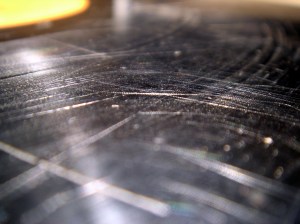
“Stroke of Death” exemplifies how transformative sample-based composition can be. Other than by knowing the source material, the sample is hard to identify. You cannot figure out that the original composition is Wither’s “Ain’t No Sunshine” from the one note RZA sampled, especially considering the note has been manipulated into a three-note melody that appears nowhere in either rendition of the composition. It is sample based, yes, but also completely original.
Classifying a composition like this as a ‘happy accident’ downplays just how important the ear is in sample-based composition, particularly on the transformative end of the spectrum. J Dilla once said finding the mistakes in a record excited him and that it was often those mistakes he would try to capture in his production style. Working with vinyl as a source went a long way in that regard, as each piece of vinyl had the potential to have its own physical characteristics that affected what one heard. It’s hard to imagine “Stroke of Death” being inspired from a digital source. While digital files can have their own glitches, one that would create an internal loop on playback would be rare.
*****
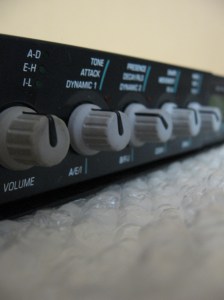
There has been a change in the sound of sampling over the past few decades. It is subtle but still perceptible; one can hear it even if a person does not know what it is they are hearing. It is akin to the difference between hearing a blues man play and hearing a music student play the blues. They technically are both still the blues, but the music student misses all of the blue notes.
The ‘blue notes’ of the blues were those aspects of the music that could not be transcribed yet were directly related to how the song conveyed emotion. It might be the fact that the instrument was not fully in tune, or the way certain notes were bent but others were not, it could even be the way a finger hit the body of a guitar right after the string was strummed. It goes back farther than the blues and ultimately is not exclusive to the African American tradition from which the phrase derives; most folk music traditions around the world have parallels. “The Rite of Spring” can be understood as Stravinsky ‘sampling’ the blue notes of Transylvanian folk music. In many regards sample-based composing is a modern folk tradition, so it should come as no surprise that it has its own blue notes.
The sample-based composition work of today is still sampling, but much of it lacks the blue notes that helped define the golden era of the art. I attribute this discrepancy to the evolution of technology over the last two decades. Many of the things that could be understood as the blue notes of sampling were merely ways around the limits of the technology. In the same way, the blue notes of most folk music happened when the emotion went beyond the standards of the instrument (or alternately the limits imposed upon it by the literal analysis of western theory). By looking at how the technology has evolved we can see how blue notes of sampling are being lost as key limitations are being overcome by “advances.”
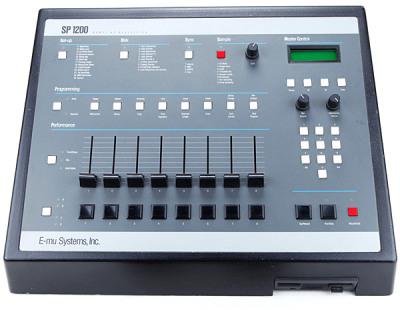
First, let’s consider the E-Mu SP-1200, which is still thought to be the most definitive sounding sampler for hip-hop styled sample-based compositions, particularly related to drums. The primary reason for this is its low-resolution sampling and conversion rates. For the SP-1200 the Analog to Digital (A/D) and Digital to Analog (D/A) converters were 12-bit at a sample rate of 26.04 kHz (CD quality is 16-bit 44.1 kHz). No matter what quality the source material, there would be a loss in quality once it was sampled into and played out of the SP-1200. This loss proved desirable for drum sounds particularly when combined with the analog filtering available in the unit, giving them a grit that reflected the environments from which the music was emerging.

On top of this, individual samples could only be 2.5 seconds long, with a total available sample time of only 10 seconds. While the sample and conversion rates directly affected the sound of the samples, the time limits drove the way that composers sampled. Instead of finding loops, beatmakers focused on individual sounds or phrases, using the sequencer to arrange those elements into loops. There were workarounds for the sample time constraints; for example, playing a 33-rpm record at 45 rpm to sample, then pitching it back down post sampling was a quick way to increase the sample time. Doing this would further reduce the sample rate, but again, that could be sonically appealing.
An under appreciated limitation of the SP-1200 however, was the visual feedback for editing samples. The display of the SP-1200 was completely alpha numeric; there were no visual representations of the sample other than numbers that were controlled by the faders on the interface. The composer had to find the start and end points of the sample solely by ear. Two producers might edit the exact same kick drum with start times 100 samples (a fraction of a millisecond) apart. Were one of the composers to have recorded the kick at 45 rpm and pitched it down, the actual resolution for the start and end times would be different. When played in a sequence, these 100 samples affect the groove, contributing directly to the feel of the composition. The timing of when the sample starts playback is combined with the quantization setting and the swing percentage of the sequencer. That difference of 100 samples in the edit further offsets the trigger times, which even with quantization turned off fit into the 24 parts per quarter grid limitations of the machine.
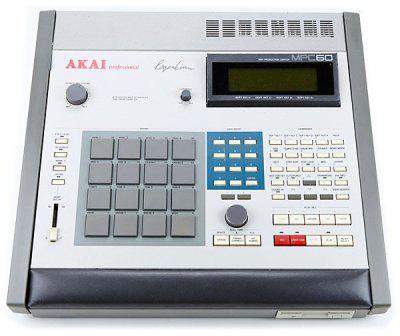
Akai’s MPC-60 was the next evolution in sampling technology. It raised the sample and conversion rates to 16-bit and 40 kHz. Sample time increased to a total of 13.1 seconds (upgradable to 26.2). Sequencing resolution increased to 96 parts per quarter. Gone was the crunch of the SP-1200, but the precision went up both in sampling and in sequencing. The main trademark of the MPC series was the swing and groove that came to Akai from Roger Linn’s Linn Drum. For years shrouded in mystery and considered a myth by many, in truth there was a timing difference that Linn says was achieved by delaying certain notes by samples. Combined with the greater PPQ resolution in unquantized mode, even with more precision than the SP-1200, the MPC lent itself to capturing user variation.
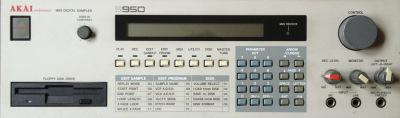
Despite these technological advances, sample time and editing limitations, combined with the fact that the higher resolution sampling lacked the character of the SP-1200, kept the MPC from being the complete package sample composers desired. For this reason it was often paired with Akai’s S-950 rack sampler. The S-950 was a 12-bit sampler but had a variable sample rate between 7.5 kHz and 40 kHz. The stock memory could hold 750 KB of samples which at the lowest sample rate could garner upwards of 60 seconds of sampling and at the higher sample rates around 10 seconds. This was expandable to up to 2.5 MB of sample memory.
.
The editing capabilities made the S-950 such a powerful sampler. Being able to create internal sample loops, key map samples to a keyboard, modify envelopes for playback, and take advantage of early time stretching (which would come of age with the S-1000)—not to mention the filter on the unit—helped take sampling deeper into the sound design territory. This again increased the variable possibilities from composer to composer even when working from the same source material. Often combined with the MPC for sequencing, composers had the ultimate sample-based composition workstation.
Today, there are literally no limitations for sampling. Perhaps the subtlest advances have developed the precision with which samples can be edited. With these advances, the biggest shift has been the reduction of the reliance on ears. Recycle was an early software program that started to replace the ears in the editing process. With Recycle an audio file could be loaded, and the software would chop the sample into component parts by searching for the transients. Utilizing Recycle on the same source, it was more likely two different composers could arrive at a kick sample that was truncated identically.
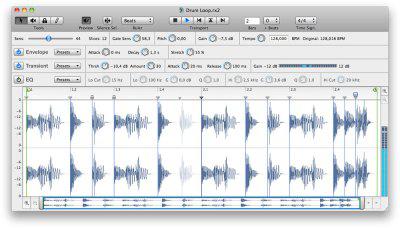
Another factor has been the waveform visualization of samples for editing. Some earlier hardware samplers featured the waveform display for truncating samples, but the graphic resolution within the computer made this even more precise. By looking at the waveform you are able to edit samples at the point where a waveform crosses the middle point between the negative and positive side of the signal, known as the zero-crossing. The advantage of zero-crossing sampling is that it prevents errors that happen when playback goes from either side of the zero point to another point in one sample, which can make the edit point audible because of the break in the waveform. The end result of zero-crossing edited samples is a seamlessness that makes samples sound like they naturally fit into a sequence without audible errors. In many audio applications snap-to settings mean that edits automatically snap to zero-crossing—no ears needed to get a “perfect” sounding sample.
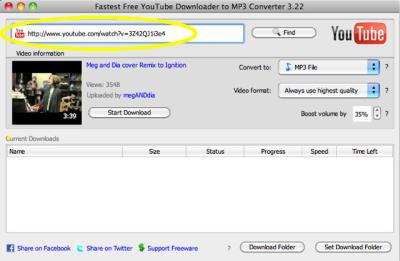
It is interesting to note that with digital files it’s not about recording the sample, but editing it out of the original file. It is much different from having to put the turntable on 45 rpm to fit a sample into 2.5 seconds. Another differentiation between digital sample sources is the quality of the files, whether original digital files (CD quality or higher), lossless compression (FLAC), lossy compressed (MP3, AAC) or the least desirable though most accessible, transcoded (lossy compression recompressed such as YouTube rips). These all result in a different degradation of quality than the SP-1200. Where the SP-1200’s downsampling often led to fatter sounds, these forms of compression trend toward thinner-sounding samples.
.
Some producers have created their own sound using thinned out samples with the same level of sonic intent as The RZA’s on “Stroke of Death.” The lo-fi aesthetic is often an attempt to capture a sound to parallel the golden era of hardware-based sampling. Some software-based samplers by example will have an SP-1200 emulation button that reduces bit rates to 12-bit. Most of software sequencers have groove templates that allow for the sequencers to emulate grooves like the MPC timing.
Perhaps the most important part of the sample-based composition process however, cannot be emulated: the ear. The ear in this case is not so much about the identification of the hot sample. Decades of history should tell us that the hot sample is truly a dime a dozen. It takes a keen composer’s ear to hear how to manipulate those sounds into something uniquely theirs. Being able to listen for that and then create that unique sound—utilizing whatever tools— that is the blue note of sampling. And there is simply no way to automate that process.
—
Featured image: “Blue note inverted” by Flickr user Tim, CC BY-ND 2.0
—
Primus Luta is a husband and father of three. He is a writer and an artist exploring the intersection of technology and art, and their philosophical implications. He maintains his own AvantUrb site. Luta was a regular presenter for Rhythm Incursions. As an artist, he is a founding member of the collective Concrète Sound System, which spun off into a record label for the exploratory realms of sound in 2012. Recently Concréte released the second part of their Ultimate Break Beats series for Shocklee.
—

REWIND!…If you liked this post, you may also dig:
“SO! Reads: Jonathan Sterne’s MP3: The Meaning of a Format”-Aaron Trammell
“Remixing Girl Talk: The Poetics and Aesthetics of Mashups”-Aram Sinnreich
“Sound as Art as Anti-environment”-Steven Hammer
—
Share this:




Current Top Posts





April 2021

January 2020

November 2019

October 2019

August 2019

April 2014

November 2017

March 2015

December 2017

October 2015


Recent Comments