
Beyoncé’s New Weave Swing, or How to Snatch Wigs With Hair Choreography


DOI: https://doi.org/10.59350/tmxye-1f965
This September, Sounding Out! challenged a #flawless group of scholars and critics to give Beyoncé Knowles-Carter a close listen, re-examining the complex relationship between her audio and visuals and amplifying what goes unheard, even as her every move–whether on MTV or in that damn elevator–faces intense scrutiny. Last week, Regina Bradley (writer, scholar, and freelance researcher of African American Life and Culture) introduced us to the sonic ratchetness of Baddie Bey; the week before you heard our Beyoncé roundtable podcast featuring our first two writers, Priscilla Peña Ovalle (English, University of Oregon) and Kevin Allred (Women and Gender Studies, Rutgers)–as well as Courtney Marshall (English, University of New Hampshire) and Liana Silva (Editor, Women in Higher Education, Managing Editor, Sounding Out!), who will close out our series next week. Today, madison moore gives us not only great face but killer hair choreo. Mic drop. Hair flip.–Editor-in-Chief Jennifer Stoever
—
“Which Beyoncé are you trying to do?,” a sale associate at Beauty Full, the largest beauty supply house in Richmond, Virginia, asked me. It was a good question, because the shop had whole rows of wigs and ponytails that conjured Beyoncé enough for what I needed to do. Choosing just one would be tough.
“This one is very Beyoncé,” he said, pointing to a style reminiscent of the huge, teased out curly Afro Beyoncé worked in the early 2000s. I wasn’t really feeling this particular style but I could tell my sales guy was living it. “It’s not fierce enough!” I told him. “I need something that really moves!” I’d been invited to give an hour-long lecture on Beyoncé at a university, one of my first gigs, and I was out at the last minute shopping for a wig to wear during my talk so that I could give the children a little sip of Beyoncé. That’s when I saw it: a long, black and dark brown two-toned wig with curls for eternity that I knew would look great on stage. Come on, wig!

I wanted to wear a wig “that really moves!” during this talk to demonstrate what I feel is the creative genius of Beyoncé’s performance persona: what I call “hair choreography.” Not unlike dance moves intended for the body, “hair choreography” is a mode of performance that uses hair to add visual drama to the overall texture of sound and it’s the special genius of Beyoncé’s stagecraft. On one occasion some friends and I were drinking wine and downing live Beyoncé videos on YouTube when one of us was like “I am living for her hair choreography!” I’m not sure we invented the concept but the phrase “hair choreography” has certainly stuck with me. Hair choreography is one of the secret weapons of the pop diva, those places in a live performance where she flips and whips her hair in exactly the right point, using “haircrobatics” to punctuate a moment, a feeling, raising the stakes, the sex appeal, and even the energy in the audience.
Hair choreography is exciting because it tells a story, but even more than telling a good story in performance “hair choreography” punctuates everything else happening on stage: the lights, the dance moves, the glitter, the sequins, the music. In this way, “hair choreography” becomes part of the spectacular offering of stage presence; a type of magnetism that, despite everything else happening on stage, draws us into a single performer – the star – whose single energy needs fill up the whole space. “Hair choreography” occurs in those moments of a live performance where the hair is flipped, whipped, dipped, spun and amplified during the most exciting, emotion-filled sounds and dance moves.
Even though many scholars still often approach them as separate practices, sound and motion are so fluidly entangled, as Jennifer Stoever has revealed. In this way, “hair choreography” builds on performance studies scholar Imani Kai Johnson’s call for the “aural-kinesthetic.” The “aural-kinesthetic” is not a method or a theory but simply a way for scholars to think about how music and movement happen at the same time. “Hair choreography” is about the relationship between sound, body and movement, and how each of those comes together to leave a visceral impact on an audience.
One video that shows the importance of hair choreography to Beyoncé’s package is her medley “If I Were A Boy/You Oughta Know,” a mélange of the soft hard rock her own track coupled up with the aggressive rock of Alanis Morissette’s iconic break-up jam of the same title. In the clip, as Beyoncé segues from “If I Were A Boy” into “You Oughta Know” the wind machines appear to blow her hair faster, and with every emotional note or beat she knocks her head to the side with attitude, forcing her straight hair with it. By the time Beyoncé sings “And I’m here, to remind you…,” the most emotional (and recognizable) transition of the song, the hair is already going full blast. Guitars and drums go off while strobe lights engulf the stage in a frenzy of chaos.
At “You, you, you oughta know” she falls to her knees and performs a choreographed head bang while sliding across the floor using only her knees. It’s important to note here that the singing has stopped because this is a moment of “hair choreography,” a transition indicating an impending change in mood.
Everyone loves Beyoncé’s hair. In her will the late comedian Joan Rivers requested “a wind machine so that even in the casket my hair is blowing just like Beyoncé’s.” There are countless YouTube tutorials showing young girls how they too can achieve that Beyoncé look with weaves, wigs and lace fronts. Even the comedian Sommore, who stared in the 2001 film Queens of Comedy , had something to say about Beyoncé’s hair:
Beyoncé is a bad motherfucker. Oh this bitch bad. Let me tell ya’ll how bad this bitch is. I went to see her concert in Atlantic City after she had her baby. I sat in the second row – this bitch was flawless. I mean I’m talking about the bitch was flawless. Only problem I had with Beyoncé…she had on too much hair! This bitch came out she had at least 18 packs of hair on. She came out I thought the bitch was the cowardly lion from The Wiz. I’m sitting there in awe of this bitch neck, I’m like, “This bitch neck is strong as a motherfucker!”
All jokes aside, the mystery of Beyoncé’s hair-–and all of the technologies involved in keeping it moving–is part of the genius of her brand image, particularly because it works to make her ethnically ambiguous.. Having various types of hairstyles allows her creole body to infinitely play with race, and this makes her marketable to nearly everyone. Is she black? Is she Spanish? Is she biracial? Could she be Brazilian or from Latin America? Yes. In this way, her hair choreography not only punctuates her sound, but it shapes the very way it is heard, enabling her to morph into more personalities and fit into more demographics than even Lady Gaga or Madonna. It’s why she’s able to sound sexy or inspirational, “hood” or “classy,” vampy or masculine, vocal or dance-y. Look at a video like “XO,” to me the most mass-marketable song on BEYONCE. First of all she looks fabulous, but I think it’s hard to watch that video and not feel like it’s specifically pitched to 15-year-old white girls in Connecticut. Everything about the video, especially her sweeping hair flourishes, positions Beyoncé as relatable to teenage girls all over the US.
As dance studies scholar Melissa Blanco Borelli sees it the mulatta body engages with a practice she calls “Hip(g)nosis,” or a type of hypnosis enacted by the yellow-bodied performer on fascinated audiences. This type of hypnotics, via the hips, “exposes the male gaze” by thinking through the “pleasure and consumption of the mulatta…” (She Is Cuba, forthcoming, Oxford University Press). Through hip(g)nosis Beyoncé has learned to use her ambiguous skin color and hair optics to her (monetary) advantage as a way to slide in and out of ethnic categories. Indeed, what does the fact that she is the lightest member of Destiny’s Child and also the groups’ most successful member have to do with her celebrity? The irony in all of this race play is that she was recently awarded the Michael Jackson Video Vanguard Award after her jaw-dropping 15-minute performance at the MTV Video Music Awards, and she is one of the few contemporary black pop singers who can play with race in the same way Michael Jackson did.

When I watched her recent MTV VMA performance I screamed a lot during her show, but the one moment I remember specifically, and still keep rewinding back to, happened right at the end of “Mine,” to me the best track on BEYONCE. She vamps “MTV, Welcome to My World,” and quickly spins and flips that hair back around baby, giving face to the camera, making millions of queens all over America scream YAASSS!!! at the top of their lungs. Beyoncé herself nodded back to queer performance and performers during a performance of “XO” this year on February 19th 2014 at the O2 Arena in London, after one overzealous fan threw a wig at Beyoncé as she sauntered off the stage and into the crowd (3:17).
When she turned around to pick the wig up she ad libbed “You got me snatching wigs, snatching wigs” into her microphone, knowing perfectly well that “Beyoncé snatching wigs” is one of the most popular fan-created Internet memes. In black gay male performance culture people often talk about “snatching wigs” or “coming for your wig,” and to this end scholars like E. Patrick Johnson and Marlon Bailey have done important work in theorizing the interplay between black gay colloquialisms and performance. If you’re “snatching wigs” then you’re performing better than everybody else while completely eradicating the competition. You’re seemingly indefatigable. Snatching a wig means a particular performance was highly effective or unique, and a snatched wig implies how an audience might surrender itself to a strong performer, as was the case with the aforementioned wig thrower. Beyoncé definitely understands the power of stage presence; a type of magnetism that, despite everything else happening on stage, draws us into a single performer – the star – whose single energy needs fill up the whole space. Filling up an empty stage with a single body is a lot of space to fill if you think about it. And making an audience focus on you when there are 10,000 other things are happening around you is an even more challenging task.

But “snatching wigs” can also mean you’re revealing someone’s deepest secrets, something you know they’re hiding. What’s underneath a wig but a secret – your real hair texture, a bald spot you don’t want anyone else to know about. A snatched wig can mean a break of the illusion. When I wore that wig during my Beyoncé talk to demonstrate hair choreography everyone knew it was fake – I put it on in front of them – but if the wig came off the illusion would have been broken nonetheless.
Part of Beyoncé’s monumental fame has to do with the fact that while she synchronizes, punctuates, captivates, and performs, she never lets us see underneath her wig. She just lets it whip.
—
madison moore (Ph.D., American Studies, Yale University, 2012) is a research associate in the Department of English at King’s College London. Trained in performance studies and popular culture, madison is a DJ, writer and pop culture scholar with expertise in nightlife culture, fashion, queer studies, contemporary art and performance, alternative subcultures and urban aesthetics. He is a staff writer at Thought Catalog, Splice Today, and his other writing has appeared in Vice, Interview magazine, Art in America, Dancecult: Journal of Electronic Dance Music Culture, the Journal of Popular Music Studies and Theater magazine. He is the author of the Thought Catalog original e-book How to Be Beyoncé. His first book, The Theory of the Fabulous Class, will be published by Yale University Press.
—
–

REWIND!…If you liked this post, check out:
Karaoke and Ventriloquism: Echoes and Divergences–Karen Tongson and Sarah Kessler
– Yvon Bonefant
“New Wave Saved My Life*”-Wanda Alarcon
—
Share this:

Sounding Out! Podcast #31: Game Audio Notes III: The Nature of Sound in Vessel
DOI: https://doi.org/10.59350/5vfyy-01a89
This post continues our summer Sound and Pleasure series, as the third and final podcast in a three part series by Leonard J. Paul. What is the connection between sound and enjoyment, and how are pleasing sounds designed? Pleasure is, after all, what brings y’all back to Sounding Out! weekly, is it not?
Part of the goal of this series of podcasts has been to reveal the interesting and invisible labor practices which are involved in sound design. In this final entry Leonard J. Paul breaks down his process in designing living sounds for the game Vessel. How does one design empathetic or aggressive sounds? If you need to catch up read Leonard’s last entry where he breaks down the vintage sounds of Retro City Rampage. Also, be sure to be sure to check out last week’s edition where Leonard breaks down his process in designing sound for Sim Cell. But first, listen to this! -AT, Multimedia Editor
–
CLICK HERE TO DOWNLOAD: Game Audio Notes III: The Nature of Sound in Vessel
SUBSCRIBE TO THE SERIES VIA ITUNES
ADD OUR PODCASTS TO YOUR STITCHER FAVORITES PLAYLIST
–
Game Audio Notes III: The Nature of Sound in Vessel
Strange Loop Game’s Vessel is set in an alternate world history where a servant class of liquid automatons (called fluros) has gone out of control. The player explores the world and solves puzzles in an effort to restore order. While working on Vessel, I personally recorded all of the sounds so that I could have full control over the soundscape. I recorded all of the game’s samples with a Zoom H4n portable recorder. My emphasis on real sounds was intended to focus the player’s experience of immersion in the game.
This realistic soundscape was supplemented with a variety of techniques that produced sounds that dynamically responded to the changes in the physics engine. Water and other fluids in the game were difficult to model with both the physics engine and the audio engine (FMOD Designer). Because fluids are fundamentally connected to the game’s physics engine, they takes on a variety of different dynamic forms as players interact with the fluid in different ways. In order to address this Kieran Lord, the audio coder, and I considered factors like the amount of liquid in a collision with anything, the hardness of the surface that it was colliding with, the type of liquid in motion, whether the player is experiencing an extreme form of that sound because it is colliding with their head, and, of course, how fast the liquid is travelling.
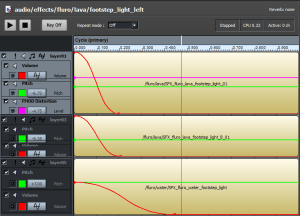
Although there was a musical score, I designed the effects to be played without music. Each element of the game, for instance a lava fluro’s (one of the game’s rebellious automatons) footsteps, entailed required layers of sound. The footsteps were composed of water sizzling on a hot pan, a gloopy slap of oatmeal and a wet rag hitting the ground. Finding the correct emotional balance to support the game’s story was fundamental to my work as a sound designer. The game’s sound effects were constantly competing with the adaptive music (which is also contingent on player action) that plays throughout the game, so it was important to provide an informative quality to them. The sound effects inform you about the environment while the music sets the emotional underscore of the gameplay and helps guide you in the puzzles.
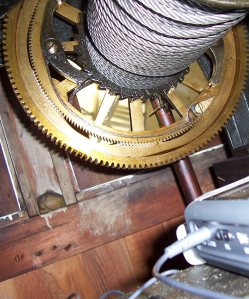
Defining the character of the fluros was difficult because I wanted players to have empathy for them. This was important to me because there is often no way to avoid destroying them when solving the game’s puzzles. While recording sounds in the back of an antique shop, I came across a vintage Dick Tracey gun that made a fantastic clanking sound when making a siren sound. Since the gun allowed me to control how quickly the siren rose and fell, it was a great way to produce vocalizations for the fluros. I simply recorded the gun’s siren sound, chopped the recording into smaller pieces, and then played back different segments randomly. The metal clanking gave a mechanical feel and the siren’s tone gave a vocal quality to the resulting sound that was perfect for the fluros. I could make the fluros sound excited by choosing a higher pitch range from the sample grains and inform the player when they approached their goal.
I wanted a fluid-based scream to announce a fluro’s death. I tried screaming underwater, screaming into a glass of water, and a few other things, but nothing worked. Eventually, when recording a rubber ear syringe, I found squeezing the water out quickly lent a real shriek while it spit out the last of the water. Not only did this sound really cut through the din of the gears clanking in the mix, but it also bonded a watery yell with the sense of being crushed and running out of breath.
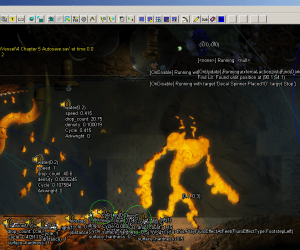
For the final boss, I tried many combinations of glurpy sounds to signify its lava form. Eventually I recorded a nail in a board being dragged across a large rusty metal sheet. Though it was quite excruciating to listen to, I pitched down the recording and combined it with a pitched down and granulated recording of myself growling into a cup of water. This sound perfectly captured the emotion I wanted to feel when encountering a final boss. Although it can take a long time to arrive at the “obvious” sound, simplicity is often the key.
Anticipation is fundamental to a player’s sense of immersion. It carves a larger space for tension to build, for instance a small crescendo of a creaking sound can develop a tension that builds to a sudden and large impact. A whoosh before a punch lands adds extra weight to the force of the punch. These cues are often naturally present in real-world sounds, such as a rush of air sweeping in before a door slams. A small pause might be included just for added suspense and helps to intensify the effect of the door slamming. Dreading the impact is half of the emotion of a large hit .
Recording all of the sounds for Vessel was a large undertaking but since I viewed each recording as a performance, I was able to make the feeling of the world very cohesive. Each sound was designed to immerse the player in the soundscape, but also to allow players enough time to solve puzzles without becoming annoyed with the audio. All sounds have a life of their own and a resonance of memory and time that stays with the them during each playthrough of a game. In Retro City Rampage I left a sonic space for the player to wax nostalgic. In Sim Cell, I worked to breathe life into a set of sterile and synthesized sounds. Each recorded sound in Vessel is alive in comparison, telling stories of time, place and recording with them, that are all their own.
The common theme of my audio work on Retro City Rampage, Sim Cell and Vessel, is that I enjoy putting constraints on myself to inspire my creativity. I focus on what works and removing non-essential elements. Exploring the limits of constraints often provokes interesting and unpredictable results. I like “sculpting” sounds and will often proceed from a rough sketch, polishing and reducing elements until I like what I hear. Typically I remove layers that don’t add an emotive aspect to the sound design. In games there are often many sounds that can play at once, so clarity and focus are necessary when preventing sounds from getting lost in a sonic goo.

In this post I have shown how play and experimentation are fundamental to my creative process. For an aspiring sound artist, spending time with Pure Data, FMOD Studio or Wwise and a personal recorder is a great way to improve their skill with game audio. This series of articles has aimed to reveal the tacit decisions behind the production of game audio that get obscured by the fun of the creative process. Plus, I hope they offer a bit of inspiration to those creating their own sounds in the future.
Additional Resources:
- My GDC 2012 talk – My site includes an MP3 recording of the talk and the full powerpoint presentation. A full video of the talk is in the GDC Vault but requires membership
- See the Jon Hopkins Soundtrack in the Video Game Vessel video game soundtrack video by me on YouTube – shows use of Lua with music in the custom level editor : https://www.youtube.com/watch?v=KOyjMPPvaY4
–
Leonard J. Paul attained his Honours degree in Computer Science at Simon Fraser University in BC, Canada with an Extended Minor in Music concentrating in Electroacoustics. He began his work in video games on the Sega Genesis and Super Nintendo Entertainment System and has a twenty year history in composing, sound design and coding for games. He has worked on over twenty major game titles totalling over 6.4 million units sold since 1994, including award-winning AAA titles such as EA’s NBA Jam 2010, NHL11, Need for Speed: Hot Pursuit 2, NBA Live ’95 as well as the indie award-winning title Retro City Rampage.
He is the co-founder of the School of Video Game Audio and has taught game audio students from over thirty different countries online since 2012. His new media works has been exhibited in cities including Surrey, Banff, Victoria, São Paulo, Zürich and San Jose. As a documentary film composer, he had the good fortune of scoring the original music for multi-awarding winning documentary The Corporation which remains the highest-grossing Canadian documentary in history to date. He has performed live electronic music in cities such as Osaka, Berlin, San Francisco, Brooklyn and Amsterdam under the name Freaky DNA.
He is an internationally renowned speaker on the topic of video game audio and has been invited to speak in Vancouver, Lyon, Berlin, Bogotá, London, Banff, San Francisco, San Jose, Porto, Angoulême and other locations around the world.
His writings and presentations are available at http://VideoGameAudio.com
—
Featured image: Courtesy of Vblank Entertainment (c)2014 – Artwork by Maxime Trépanier.
—
REWIND! . . .If you liked this post, you may also dig:
Sounding Out! Podcast #30: Game Audio Notes I: Growing Sounds for Sim Cell- Leonard J. Paul
Sounding Out! Podcast #31: Hand Made Music in Retro City Rampage– Leonard J. Paul
Papa Sangre and the Construction of Immersion in Audio Games- Enongo Lumumba-Kasongo
—
Share this:




Current Top Posts





April 2021

January 2020

November 2019

October 2019

August 2019

April 2014

November 2017

March 2015

December 2017

October 2015


Recent Comments