
Freedom Back: Sounding Black Feminist History, Courtesy the Artists
 Welcome to week four of our February Forum on “Sonic Borders,” a collaboration with the IASPM-US blog in connection with this year’s IASPM-US conference on Liminality and Borderlands, held in Austin, Texas from February 28 to March 3, 2013. The “Sonic Borders” forum is a Virtual Roundtable cross-blog entity that will feature six Sounding Out! writers posting on Mondays through February 25, and four writers from IASPM-US, posting on Wednesdays starting February 6th and ending February 27th. For an encore of weeks one through three of the forum, click here. And now, Tavia Nyong’o reviews Courtesy the Artist’s The Meeting, courtesy of Sounding Out! –JSA
—
Last October 2012, in tandem with the New York launch of the retrospective art show Now Dig This! Art and Black Los Angeles 1960-1980, curated by Kellie Jones and running through March 11, 2013, MoMA PS 1 invited the sounds and images of Black Power into their courtyard Performance Dome for a Sunday afternoon collaborative arts project called The Meeting curated by Courtesy the Artists. Courtesy the Artists is the collaboration of Malik Gaines and Alexandro Segade: two-thirds of the core members of the L.A.-based performance art collective My Barbarian (the third is Jade Gordon). For The Meeting, recently transplanted New Yorkers Gaines and Seagade opted to curate a gathering of local artists, dancers and musicians they wanted to get to know better, such as LaTasha Diggs, niv Acosta, and Samita Sinha.
Curation as collaboration was the ethos behind The Meeting in PS1; Gaines and Segade were much more than masters of ceremony, but performed alongside the artists and musicians they invited. At times The Meeting felt more like a jam session than anything else, following the improvisatory and ensemblic ethos of experimental jazz. Performance piece as musician’s jam was indeed a fitting form, given that the afternoon was built around Seize the Time, a 1969 album of agit-prop cabaret recorded by activist, musician, and erstwhile Black Panther leader, Elaine Brown.
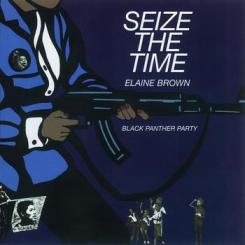
Each participant in The Meeting was invited to respond, in their chosen art form to a song from Brown’s album or another aspect of her legacy that moved them. And move them it did. If music held the event together — from Charles Gaines on the piano and drums to Matana Roberts on a haunting saxophone solo to Geo Wyeth closing down the evening with an astonishing version of “Seize the Time” intermixed with “Age of Aquarius” from the musical Hair — poetry, polemic, video, and dance sent it spinning off into a dozen scintillating tangents.
What those intersecting and diverging responses to Brown’s album shared was a concern with how the past resonates in the present, how a historical call might not always be muted over time, but sometimes amplified by its repetition across time. Given the predominance of the visual in contemporary culture — nowhere more glaring, perhaps, than in institutions devoted to visual art — what do we make of the role of the aural as a medium through which to register the reverberations of a past? The Meeting was held in a temporary structure, literally vestibular to the permanent edifice of the museum. Is the ear a similar vestibule to the institutions of culture, and, if it is, then wherein might the power of that vestibular flesh, as Hortense Spillers once named it, lie?
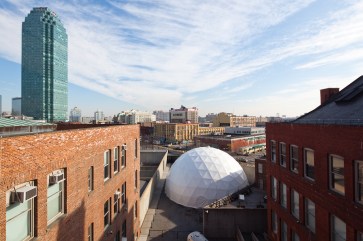
NYC MoMa Ps1’s Vestibular Performance Dome, image by http://momaps1.tumblr.com/
On Seize the Time, the mercurial Brown transposed the black revolutionary urgency of the 1960s into a musical idiom that sounded remarkable even in its day. It is slightly bemusing to settle into the jazzy opening of the title track “Seize the Time” with the knowledge that Marvin Gaye’s What’s Going On and Curtis Mayfield’s Super Fly were just around the corner. Certainly, despite their shared sonic defiance of American racism, Brown’s didactic sprechegesang would never be mistaken for Nina Simone’s soulful alto. Closer to the sonic mark would be singer-songwriters like Carole King, Janis Ian and Joni Mitchell, artists who broke the mold for women in pop in the late 1960s and early 1970s. Consider the rhetorical and musical twists and turns of the first verse of “The End of Silence,” a song that manages equal parts women’s liberation and black nationalism without ever teetering into blaxploitation supervixen territory:
Have you ever stood
In the darkness of night
Screaming silently you’re a man?
Have you ever hoped
That the time would come
When your voice could be heard
In the noonday sun?
Have you waited so long
Till your unheard song
Has stripped away your very soul?
Then believe it my friend
That the silence can end
We’ll just have to get guns and be men.
If The Meeting was a response to the call of that final line, it was one in which the shift from a single voice with backing band to a range of voices and positions was always audible. Some might call this postmodern fragmentation: dance choreographed to a repeating sample of Brown singing “freedom back,” a version of the album edited down to just the sequential instances of her singing the word “man,” played to projected images of every gun in the Panther arsenal she lists in her book. But these interventions arguably only expand our audition of the original album’s possibilities. More than 30 years on, The Meeting took advantage of Seize The Time’s musico-political incongruity to prise open new lines of affiliation between the past and our revanchist present. The question continuously hung in the air: How do we occupy our radical black and feminist legacies, especially given the fact that we cannot simply repeat those struggles in identical terms? How do we get freedom back?
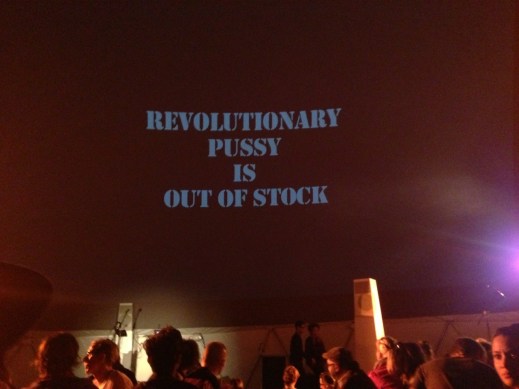
The Meeting courtesy of http://blackcontemporaryart.tumblr.com/
The declamatory cadences of black rhetoric were as central to the way The Meeting sounded as was its music. LaTasha Diggs’s barnburning performances stopped the show to inform us that revolutionary pussy was out of stock. With Charles Gaines on drums and Matana Roberts on sax, Malik Gaines scatted excerpts from President Obama’s “race speech” while excerpts from speeches Elaine Brown had given to the Panthers were read. Since the context of Obama’s speech had been his own attempt to surrogate the justified anger of the Black Power generation with a message of reconciliation, re-mixing it in this context meant it no longer had the privilege of temporal succession over Brown, but black feminist rhetoric and the improvisatory sax could invaginate his rhetoric with an eternal recurrence of radical insurgence.
It is important to note the predominantly queer and trans performance modalities through which the Meeting posed–if not fully answered–its questions regarding freedom in a contemporary context. Brown’s refrain “we’ll just have to get guns and be men” took on a new connotation when juxtaposed against the queer and trans bodies and voices in performance.
Here history revealed itself as palimpsest: images and icons were superimposed one upon the other to create dense, freighted symbols of masculinity and femininity. In a refrain originally meant to rally radical black women towards the community leadership roles tendentiously claimed by men, the gun was much more than a ‘phallic symbol.’ As Kara Keeling recounts in The Witch’s Flight (an important book containing a shrewd analysis of Seize the Time):
The appearance of the [Black Panther Party] allowed for the recognition of the black man in the Black. But this need not be understood as precluding black “females” from appearing in blacks with guns, nor does it necessarily indicate an inherent connection between “men” and “males.” What is perhaps most innovative about the BPP’s cinematic appearance is that it threw into doubt the validity of the common sense that linked “man” with “male” with “masculine” (85).
For Keeling, the innovative disruption of white supremacist racist sense — congealed in stereotypical images of black men and black women — set the stage, formed the backing track, for the historical emergence of queer and transmasculinities.
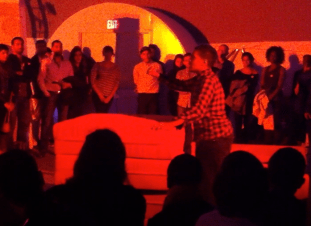
niv Acosta, image courtesy of the author
Transgender dancer and choreographer niv Acosta rhythmically ran his body against the cushioned seating of the performance dome, to the rhythmic sampling of “freedom back.” The phrase was curiously ambiguous: what actual historical freedom could Brown have possibly exhorted the panthers to claim? What imagined freedom do we think we can reclaim via our remixing of Black Power? The power of Acosta’s performance was to embody that question as a lived and livable improvisation.
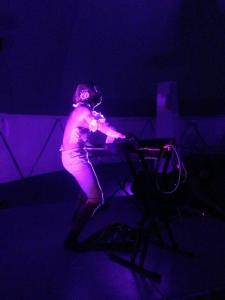
Geo Wyeth performs, image courtesy of @momaps1
The degree to which a musical legacy such as Brown’s can or should be appropriated beyond a black context was also pointedly staged that afternoon, perhaps most self-consciously by Alex Segade’s rendition of “The Meeting” — which Brown once called the Party’s anthem — in Spanish. Segade’s version captured the melodrama and romantic longing, staging the historical interconnections between black and brown power in California as a hall of mirrors and fleeting glances.
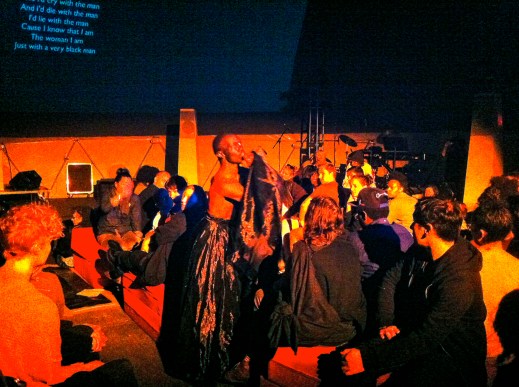
Geo Wyeth brought the house down with a funky final number that had the audience on the edge of their seats, perhaps awaiting the promised nudity a sign at the entrance warned the performance would contain. Wyeth’s onstage costume changes were anything but a striptease, however, as he instead fused the militancy of Seize the Time with the sexual revolution of Hair in an incompossible auditory portrait of the legacy of “the Sixties.” His performance left the audience with the emphatic reminder that it is less his generation’s challenge to prove adequate to the past than it is to retrieve from history’s shroud the pulsating star of their own desires.
—
[The Meeting included Simone Leigh, Samita Sinha, Matana Roberts, Charles Gaines, Malik Gaines, Adam Pendleton, niv Acosta, LaTasha Diggs, Xaviera Simmons, Jarrod Kentrell, Alex Segade, and Geo Wyeth].
—
Featured Image of Jarrod Kentrell performing to Elaine Brown’s “Very Black Man” at The Meeting, Courtesy of the author
—
Tavia Nyong’o is Associate Professor of Performance Studies at New York University, where he writes, researches and teaches critical black studies, queer studies, cultural theory, and cultural history. His first book, The Amalgamation Waltz: Race, Performance, and the Ruses of Memory (Minnesota, 2009), won the Errol Hill Award for best book in African American theatre and performance studies. Nyong’o has published articles on punk, disco, viral media, the African diaspora, film, and performance art in venues such as Radical History Review, Criticism, TDR: The Journal of Performance Studies, Women & Performance: A Journal of Feminist Theory, Women Studies Quarterly, The Nation, and n+1. He is co-editor of the journal Social Text.
Share this:

Hearing “Media-Capitalism” in Egypt

As I began researching my first book Ordinary Egyptians, a study of Egyptian culture from the 1870s until the eve of the 1919 revolution, sounds and early sound media were the last thing on my mind. However, When I dug more deeply into the historical sources, I realized the importance of music and the comedic theater in the urban culture of turn of the century Egypt. This made me expand the scope of my research to incorporate the vernacular culture of Egypt as an entire media-system, which as I showed in my book, was instrumental in constructing a modern Egyptian national identity. Music, songs, plays, chants, speeches, conversations and chatter, were very influential in forming an Egyptian national culture at the end of the nineteenth century, especially in a society with low literacy rates. By incorporating performance and sound media–especially the rising record industry–my book strives to expand the historical study of this period beyond just the visual and the printed to include sound, and aural/oral expressions of culture.
“Muski Street, Cairo, 1903.” Source: William Herman Rau. From Library of Congress Prints and Photograph Division.
Ordinary Egyptians also engages with some of the theories of nationalism and tests their applicability to Egypt and the Arab world. It introduces the concept of “media-capitalism,” which expands the historical analysis of Egyptian nationalism beyond just print and silent reading, through the incorporation of audiovisual, sound, and performance media. By integrating these new media, especially the burgeoning record industry, my book attempts to make room for both the “ear” and the “eye”—for the aural and oral alongside the visual—and in the process provides a more comprehensive explanation for how individuals and communities digest and embody cultural information. As this excerpt explains, cultural productions, in any form, are not socially relevant unless they are communally and socially activated; they must be discussed, breathed, and animated in the routine of everyday life.
The following is an excerpt from Ordinary Egyptians, with thanks to Stanford University Press. Notes have been included in the text to conform to Sounding Out!‘s style sheet.
—
Mundane Nationalism
Egypt’s new mass media reflected on relevant everyday political, economic, and cultural concerns, and amplified them on the national stage in a comprehensible, locally pertinent and entertaining form. The repeated themes of many of these media included: bemoaning the lack of economic opportunities for native Egyptians, portraying the economic exploitation of Egyptians by foreigners, warning of perceived declines in national “morality,” satirizing and at times insulting British and native officials, and rousing patriotism and a sense of collective national solidarity.
However, the most effective way that national identity and a sense of nationhood was ‘absorbed’ was not only through these overstated themes and methods, but through the mundane media portrayals and representations of everyday “national” life and the internalization of these modes in actual practice. As Michael Billig describes in Banal Nationalism, nationalist ideology “might appear banal, routine, almost invisible,” however, these “subconscious” matter-of-fact representations create a common sense “naturalness of belonging to a nation” (15-16). Billig explains that often there is “continual ‘flagging’, or reminding, of nationhood,” as on a daily basis, citizens are reminded of their national identity. This reminding however, is “so familiar, so continual, that it is not consciously registered as reminding” (8). Mundane and unstated representations of Egyptian-ness abounded in most forms of mass culture, where “Egyptians” distinctively spoke and acted and were clearly, though tacitly, differentiated from non-Egyptians. Most of the media examined in this study implicitly addressed their listeners, viewers and readers as members of an Egyptian “nation.” To be sure, the most influential aspect of vaudeville and the satirical press were not necessarily the outwardly nationalistic messages of many of their articles, cartoons, and dialogues, but the recurring and mundane representations of colloquial Cairene as the de-facto dialect of all Egyptians, and the implicit understanding that flawlessly speaking and understanding it was the basic marker of a “modern” Egyptian national identity. Only an “authentic” ibn or bint al-balad (son or daughter of the country) would employ Egyptian Arabic and grasp its multiple meanings and nuances and hence participate in this new mass-produced colloquial culture. In fact, many of the comedic dialogues depicted in political cartoons and vaudeville repeatedly contrasted the mispronunciations of foreigners—who often played unsympathetic or villainous roles—with the “correct” pronunciation of affable Egyptian characters. This repeated portrayal of Cairene as the only “authentic” Egyptian accent reified it as an unofficial dialect of all Egyptians, even if back in the villages and towns of the Sa‛id more localized modes of expression were employed. By way of media-capitalism, Cairo’s dialect and culture was overwhelming—colonizing, if you will— the multitude of other localized dialects and cultures in Egypt. Thus, paradoxically, Cairene Arabic was the primary tool for nationalist, anti-imperialist discourse, and simultaneously, through internal-colonialism, it imposed its own culture on the “nation” [Note: This is very similar to what was happening in France during roughly the same time period. See Eugen Weber’s Peasants Into Frenchmen: The Modernization of Rural France, 1870-1914, 486-88].

“Egyptian crowds with Italian flag during 1919 Revolution.” Source: From L’Illustration (Paris), May 3, 1919.
The Sensorium and the Public Sphere
The efficacy of the new mass media and its potential for mass mobilization was best demonstrated during times of national crisis. The 1906 Dinshaway Incident and the 1919 Revolution in particular reveal how all forms of mass media functioned together to effectively document, memorialize, celebrate, and mobilize on a national scale. The growth of popular Egyptian mass culture, articulated almost exclusively in colloquial Egyptian, was the pivotal factor in the popularization and dissemination of an Egyptian national identity. The evolution and universalization of a colloquial Egyptian middle culture, made possible especially through the utilization of sound and audiovisual media, allowed for a shared and “uniquely” Egyptian cultural landscape. It is primarily within this non-official web of colloquial Egyptian mass culture, driven in large part by media-capitalism, that Egyptian national identity was widely disseminated and popularized.
One crucial aspect of this study was the critical role coffee shops played as cultural hubs, where differing mass media from newspapers to recorded music were publicly merged, negotiated, and digested. Many of the songs initially written for musical and comedic plays were recorded and played, or performed by street musicians at coffee shops and even in the streets and sidewalks. The role of the thousands of urban cafés and other public meeting areas in the broadcasting and reception of these new cultural productions is central to understanding the potency and effectiveness of this developing nationwide culture. Indeed, coffeehouses, as Peter Burke has remarked in A Social History of the Media, “inspired the creation of imagined communities of oral communication” (30).
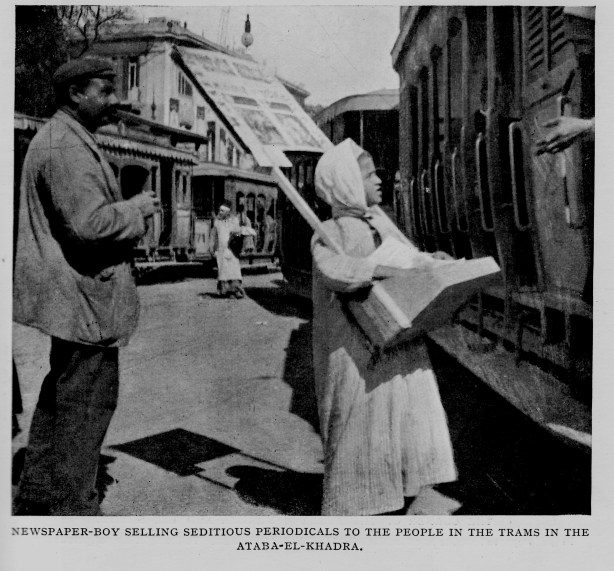
“Egyptian newspaper boy yelling out the latest headlines, Cairo, 1907.” Source: From Douglas Sladen, Oriental Cairo (London: 1911), 64.
However, as discussed in previous chapters, this was never a one way conversation, as writers of these vernacular media were plugged into the streets and public squares through these very same cafés. As we have observed in this study, it can be said that the entire vaudeville theater industry arose out of the cafés on ‘Imad al-Din Street, where most of the vaudeville theaters were housed [Note: See Ibrahim Ramzi, Masrahuna ’Ayyam Zaman wa Tarikh al-Fananin al-Qudama’ (Cairo: Matba‘at al-Salam (1984), 25. There were at least three major cafés in Imad al-Din Street that were frequented by actors, singers, writers, and musicians— Qahwat al-Fan (The Arts Café), Qahwat Barun (The Baron Cafés), and Qahwat Misr (The Egypt Café)]. It was through these dialogical “physical” interactions with the people in the streets, market places, and cafés that the writers, musicians and performers of these media (re)calibrated with the subtleties, textures, and flavors of everyday Egyptian life. As Mikhail Bakhtin cautions in The Dialogic Imagination, we must not ignore the “social life of discourse outside the artist’s study, discourse in the open spaces of public squares, streets, cities and villages;” for it is in these public spheres that Egyptian mass culture is embodied into everyday life, acquiring its socio-economic, political relevance, and more importantly perhaps, its perceived authenticity, and contemporaneity (259). Indeed, access to any form of knowledge— be it visual, aural, tactile, gustatory or olfactory—is corporally mediated and is acquired through a living dialogical engagement. Or as Bakhtin elaborates in Problems of Dostoevsky’s Poetics, “the single adequate form to verbally expressing authentic human life is the open ended dialogue . . . In this dialogue a person participates wholly and throughout his whole life, with his eyes, lips, hands, soul, spirit, within his whole body and deeds” (293). In other words texts alone are meaningless when viewed in isolation of the socially embodied realities of their production, and more importantly perhaps, their reception on the street. It is in their interrelationship with social life that texts become meaningfully activated and authenticated as genuinely reflecting popular concerns and realities. As we have seen throughout this book, colloquial Egyptian culture is better equipped in engaging in this dialogue with the everyday, and hence guaranteeing its circulation and popularity.
(Ordinary Egyptians, p. 170-172)
—
Featured Image: View 042: Egypt – Street in Native Quarter, Cairo., n.d., T. H. McAllister, Manufacturing Optician. 49 Nassau Street, New York. Brooklyn Museum Archives (S10|08 General Views_People, image 9785).
—
Ziad Fahmy is an Assistant Professor of Modern Middle East History at the department of Near Eastern Studies. Professor Fahmy received his History Ph.D. in 2007 from the University of Arizona, where his dissertation “Popularizing Egyptian Nationalism” was awarded the Malcolm H. Kerr Dissertation Award (2008) from the Middle East Studies Association. His first book, Ordinary Egyptians: Creating the Modern Nation through Popular Culture (Stanford University Press, 2011), examines how, from the 1870s until the eve of the 1919 revolution, popular media and culture provided ordinary Egyptians with a framework to construct and negotiate a modern national identity. His articles have appeared in the International Journal of Middle East Studies and in Comparative Studies of South Asia, Africa and the Middle East. Professor Fahmy is currently beginning another book project tentatively titled, Listening to the Nation: Sounds, Soundscapes, and Mass Culture in Interwar Egypt. In 2011-2012, he was a Faculty Fellow at the Society for the Humanities at Cornell University, where the focal theme was “Sound: Culture, Theory, Practice, and Politics.”
Share this:


Current Top Posts





April 2021

January 2020

November 2019

October 2019

August 2019

April 2014

November 2017

March 2015

December 2017

October 2015
 Sounding Out!
Recent Comments