
Sound at ASA 2014
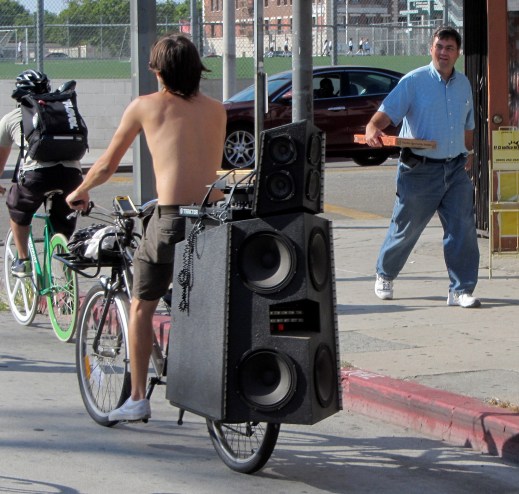
The 2014 American Studies Association meeting will be held in Los Angeles, an appropriate setting for this year’s theme, “Fun and the Fury: Dialectics of Pleasure and Pain in the Post-American Century.” The conference, which will take place from November 6-9, will offer panels of interest to Sound Studies scholars. The City of Angels has long served as a muse for artists and thinkers interested in creating innovative worlds. Los Angeles is a place of experimentation and futuristic transformation, or as Norman Mailer called it, a constellation of plastic. Part of Mexico until 1848, Los Angeles is a global metropolis that embodies the keen contradictions of national and capital in the 21st century, often exposing the nuts and bolts that hold together these structures. Fun, fury, and the “dialectics of pleasure and pain” are useful for conceptualizing the sharp contrasts that characterize the city of LA itself. A panel on Sunday, Central Avenue Breakdown: Gender, Race, and Coming of Age in a Los Angeles Jazz Community, will discuss the historical complexities of the city of Los Angeles by way of the African American entertainment district of Central Avenue (Sunday 2:00-3:45).
This year’s ASA program features an increase in sound and music-related papers in comparison to last year’s conference in Washington, D.C., which was concerned with the logic of debt. The upswing is partially due to the 2014 theme, which emphasizes the production of alternative spaces that counter repressive forces. As the program committee, comprised of co-chairs J. Jack Halberstam, Fred Moten, and Sandra Soto, writes, “The critical power of ‘fun’ in this unconventional convention theme seeks nothing less than the reimagining of possibility, impossibility, probability and freedom.” Sound Studies is already geared toward thinking about how careful listening can offer new ways of being-in-the-world, so the increase in music-themed panels this year is not surprising. As music scholars and listeners have long insisted, music is foundational to embodied experiences of pleasure and fun. Music’s ability to transport listeners and to cultivate collectivity makes it uniquely relevant to discussions of pleasure.
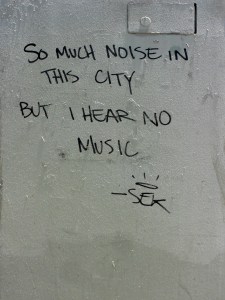
“So Much Noise” by Flickr user Doran, CC BY-NC-ND 2.0
One notable exception to the musical focus is the second of the two ASA Sound Studies Caucus panels, “The Racial Politics of Listening: ‘Accents,’ Hate Speech, and Language in the U.S. Media,” which will take place on Saturday from 2:00-3:45. Featuring Dolores Inés Casillas, Sara Hinojos, Marci McMahon, and SO! Editor-in-Chief, Jennifer Stoever, The panel will examine the role of speech and auditory cues in constructing racial representations. An individual paper by Craig Eley in the Environment and Culture Caucus panel Ecologies of Pleasure and Pain: Deviance, Destruction and Desire in Environmental History, entitled Psychologically Ultimate Seashores: Natural Sound, Personal Pleasure, and Recording Technologies is also worth mentioning (Sunday 10:00-11:45).
This year’s call for papers asked for participants to formulate creative modes for presenting their work, and Sound Studies scholars are stepping up. The first panel hosted by the ASA Sound Studies Caucus (Saturday 10:00-11:45) is an exciting listening dialogue entitled “Power Ballads and Blurred Lines: Songs from the Boundaries of Fun.” The commentators, Jeff Chang, Alice Echols, Evelyn McDonnell, Oliver Wang, and Rubén Martinez, will each play a song and discuss how pop music that is treated as harmless fun may nevertheless speak to social dynamics in real and important ways. A roundtable on Music, Fashion and the Power of (Queer) Nightlife (Friday 12:00-1:45) will include scholars of nightlife as well as party promoters and DJs, discussing the possibility for belonging in subcultural “nightworlds.”

“Hotel Bonaventure” by Flickr user S. N. Johnson-Roehr, CC BY-NC 2.0
This year there are a number of notable African American Studies panels, including After the Rain: Vanguardist Jazz in the Seventies (Thursday 10:00-11:45) organized in memory of Amiri Baraka, Stomp, Swerve, Rattle, and Roll: Fun and Pleasure as Political Resistance in American Blues Music (Thursday 4:00-5:45), What Words Can’t Do: Instrumentals, Identity, and Interpretation (Sunday 10:00-11:45), and Pleasure, Pain, Politics, and Performance: Black Women Artists and Their Fans (Sunday 12:00-1:45). The category of pleasure provides a framework for panels on The Aesthetics of Pleasure in California Funk (Sunday 10:00-11:45) and Performative Pleasures of Blackness: The Creation, Consumption, and Conflict of Pleasurable Blacknesses. Sound scholars also continue to investigate transnational modes of listening, in panels such as The Transnational Movements of Hip-Hop (Thursday 12:00-1:45), Fugitive Preludes: Chicana/o Popular Music and the Neoliberal City (Friday 10:00-11:45), and Performing Decolonial Aesthetics and the Politics of Pain and Pleasure in Music Across the Americas (Friday 12:00-1:45).
Two years ago, Jennifer Stoever mentioned that work in the field of Sound Studies was entering a period of reflection and becoming more nuanced and robust with sub-fields starting to develop. It is clear from this year’s program that the field is both broadening and deepening its focus. After two years of official recognition under the ASA Sound Studies Caucus and three years after the publication of Sound Clash, the special issue of American Quarterly, scholarship on sound in American Studies is developing in a myriad of ways and is coming into its own as a field.
Jump to THURSDAY, November 6
Jump to FRIDAY, November 7
Jump to SATURDAY, November 8
Jump to SUNDAY, November 9
—
Featured image: “Carmaheaven” by Flickr user waltarrrrr, CC BY-NC-ND 2.0
—
Please comment to let SO! know what you think–both before and after ASA 2013. If we somehow missed you or your panel in this round up, please let our Managing Editor know!: lms@soundingoutblog.com
—
Meghan Drury is a fifth-year Ph.D. candidate in the Department of American Studies at the George Washington University. She received an MA in ethnomusicology from UC Riverside in 2006. She is currently working on a dissertation tentatively titled “Aural Exotics: The Middle East in American Popular Music 1950-2011.” This project examines the interplay between popular music and American cultural representations of the Middle East from the mid-20th century to the present, illustrating how music and sound acted a means of consolidating and disseminating a range of ideas about Middle Eastern culture in the American mainstream. She is particularly interested in the way that sound increased the visibility of Arab Americans both before and after 9/11, offering a space for negotiations of identity. More broadly, Meghan’s interests include sound studies, U.S.-Middle East cultural relations, and Arab American cultural performance.
—
“Echo Park September 2010” by Flickr user Calvin Fleming
THURSDAY, November 6th, 2014
8:00 am – 9:45 am
Religiosity and Altered States
Westin Bonaventure, Los Feliz (L1)
—Richard Cullen Rath, University of Hawai’i, Manoa (HI)
Dangerous Fun in Puritan New England: Mary Ross and the Singing Quakers
Riots, Radios, and the Historical Record: Mass Media and Crisis in Twentieth American Literature and Art
Westin Bonaventure, San Bernardino (L1)
—Hadji Bakara, University of Chicago (IL)
Guernica on the Radio: Anti-Fascism, Mass Media, and the Emergence of Human Rights Activism
.
10:00 am – 11:45 am
Playing with Rules: Having Fun and Keeping Order in Mid-Century Racial Liberalism
Westin Bonaventure, San Fernando (L1)
—Yusuke Torii, Setsunan University (Japan)
S. I. Hayakawa’s Jazz Credentials and Racial Liberalism in Mid-Century America
—Masayoshi Yamada, Doshisha University (Japan)
Jazz, Fans, and the Pleasure of Listening during Turbulent Times
.
After the Rain: Vanguardist Jazz in the Seventies (in memory of Amiri Baraka)
Westin Bonaventure, San Gabriel C (L1)
CHAIR:
Ronald Radano, University of Wisconsin, Madison (WI)
PAPERS:
Paul A. Anderson, University of Michigan, Ann Arbor (MI)
“Thunder Blossoms Gorgeously”: Abstracting the Pastoral in Marion Brown’s Georgia Trilogy
Robert Maclean, The College of Wooster (OH)
Ensemble After Eventuality: Neoliberalism and the Duo Form
Brent Hayes Edwards, Columbia University (NY)
Notes Toward a “Loft” History of Jazz
COMMENT:
Ronald Radano, University of Wisconsin, Madison (WI)
.
12:00 pm – 1:45 pm
Fun in Public: The Cultures of Amateur Labor
Westin Bonaventure, Palos Verdes (L1)
—Alexander W. Corey, University of Colorado, Boulder (CO)
Impulsive Triads: Frédéric Chopin, Amateur Pianists, and The Autobiography of an Ex-Colored Man
.
The Transnational Movements of Hip-Hop
Westin Bonaventure, Santa Monica D (L3)
CHAIR:
Alexander Weheliye, Northwestern University (IL)
PAPERS:
Lenna Tayseer Odeh, University of California, San Diego (CA)
Acts of Sumud: Exploits of Resistance Through the Palestinian Hip-Hop Youth and Political Prisoner Movements
Najwa Mayer, Yale University (CT)
Muhammad was a punk rocker: Seeking Faith, Fun, and Form in Taqwacore
Elliott H. Powell, University of Minnesota, Twin Cities (MN)
The Sounds of Afro-South Asian Pleasure: Hip Hop, 9/11, and South-South Connections
Halifu Osumare, University of California, Davis (CA)
Play and Pain in Black Atlantic Hip-Hop: Hiplife in Ghana as Case Study
COMMENT:
Alexander Weheliye, Northwestern University (IL)
.
2:00 pm – 3:45 pm
alt. Black Musical History
Westin Bonaventure, San Gabriel C (L1)
CHAIR:
Courtney Michael Brown, California State University, Fullerton (CA)
PAPERS:
Matthew Hayden Anthony, Pennsylvania State University, Harrisburg (PA)
I Got Country Roots: Race, Identity and Black Country Singers in the 1970s
Kreg Abshire, Johnson & Wales University (CO)
On Sonic Nostalgia: Making Sense of alt.country’s Hip Traditionalism
Keith D. Leonard, American University (DC)
Who Stole the Soul: An Avant-Garde History of the Dark Room Collective
Christa Holm Vogelius, University of Alabama, Tuscaloosa (AL)
The Jennie C. Lee Archive and the Silent Musical History of the Tuskegee Institute
COMMENT:
Courtney Michael Brown, California State University, Fullerton (CA)
.
The Choreography of Protest
Westin Bonaventure, Santa Barbara B (L1)
—Sarah Ehlers, University of Houston (TX)
The Joys of the Picket Line: Reading the Rhythms of the Left
—Robert Michael Zecker, Saint Francis Xavier University (Canada)
A Mandolin Orchestra Could Attract a Lot of Attention: Interracial Fun with Radical Immigrants, 1930–1954
.
Empire of Funk: Hip Hop and Representation in Filipina/o America—A Roundtable
Westin Bonaventure, Santa Barbara C (L1)
CHAIR:
Dawn Bohulano Mabalon, San Francisco State University (CA)
PANELISTS:
Roderick Labrador, University of Hawai’i, Manoa (HI)
Mark Villegas, University of California, Irvine (CA)
Mario “Nomi” De Mira, Artist
Stephen Bischoff, Washington State University, Pullman (WA)
COMMENT:
Dawn Bohulano Mabalon, San Francisco State University (CA)
.
On Athletes and Outlaws: Asian Americans in Popular Culture and the Pleasures of Recognition
Westin Bonaventure, Santa Monica C (L3)
—Douglas S. Ishii, University of Maryland, College Park (MD)
Not about race, per se: Dave Boyle’s Asian American Music Film
.
4:00 pm – 5:45 pm
Love and Rage: Cultural Strategies in Postwar U.S. Anarchism
Westin Bonaventure, San Bernardino (L1)
—Shon MeckFessel, University of Washington, Seattle (WA)
From a Disavowal of Commitment to a Commitment of Disavowal: (Non)Left Positionalities in 1980s Post-Punk and Anarchy-Punk
.
Alternative Economies of Pleasure in Contemporary Southern Working-Class Cultures
Westin Bonaventure, San Pedro (L1)
—Nicholas Neil Gorrell, University of Mississippi (MS)
Economies of Scarcity and Abundance in Contemporary Southern Blues
—Anne Gessler, University of Texas, Austin (TX)
Second Lines, Creative Economies, and Gentrification: Music Cooperatives in Post-Katrina New Orleans
.
Stomp, Swerve, Rattle, and Roll: Fun and Pleasure as Political Resistance in American Blues Music
Westin Bonaventure, Santa Monica A (L3)
CHAIR:
Daphne Brooks, Yale University (CT)
PAPERS:
Mark Anthony Neal, Duke University (NC)
“Let Me Bang Your Box”: The “Erotic Life” of the Blues
Sonnet Retman, University of Washington, Seattle (WA)
Memphis Minnie’s Jukebox Blues
Kimberly Mack, University of California, Los Angeles (CA)
“That Natural Blues Man Look”: Black Elvis and the Demythologization of the Black Blues Figure
R. J. Smith, Independent Scholar
Calling All Freaks!: The Licentious Blues Spirit of the Rent Party and the Buffet Flat
COMMENT:
Adam Gussow, University of Mississippi (MS)
.
**Wildness: The Fun and the Fury of Anarchy**
Westin Bonaventure, San Gabriel C (L1)
CHAIR:
Mel Y. Chen, University of California, Berkeley (CA)
PAPERS:
Peter Coviello, Bowdoin College (ME)
The Wild Less Than the Good: Erotics and Biopolitics in Thoreau
Jack Halberstam, University of Southern California (CA)
‘Wildness at the End of the World’
Tavia Nyong’o, New York University (NY)
William Blake’s Wild America
COMMENT:
Mel Y. Chen, University of California, Berkeley (CA)
.

“Busker (street musician) #2” by Flickr user Sunny Lapin, CC BY-NC-SA 2.0
FRIDAY, November 7th
8:00 am – 9:45 am
Feeling Queer
Westin Bonaventure, San Gabriel B (L1)
—Elias Krell, Northwestern University (IL)
Mixing Sound: Technologies of Fem(me)ninity and Mixed Race in Kelly Moe
.
Life-Writing, Musical Lives
Westin Bonaventure, San Gabriel C (L1)
CHAIR:
Ulrich Adelt, University of Wyoming (WY)
PAPERS:
Nassim Winnie Balestrini, Karl-Franzens-University (Austria)
Fun, Fury, Fans: Affective Strategies in Intermedial Hip-Hop Life Writing
Mercy Romero, Sonoma State University (CA)
Two Lives in Music
Petra Rivera-Rideau, Virginia Polytechnic Institute and State University (VA)
The Pleasures and Pains of Love: Listening to La Lupe and Ivy Queen
Jessica Elaine Teague, University of Nevada–Las Vegas (NV)
Charles Mingus and the Serious Fun of Jazz Autobiography
COMMENT:
Ulrich Adelt, University of Wyoming (WY)
.
**Caucus: War and Peace Studies: Reconsidering the ‘R and R’: Dialectics of Violence and Pleasure in Militarism**
Westin Bonaventure, Santa Anita B (L1)
—Patricia Stuelke, University of Massachusetts, Boston (MA)
You’re a Criminal as Long as You’re Mind: The U.S. Invasion of Panama and the Sounds of Bad Romance
.
**ASA Program Committee: Uncontrolled Substances/Altered States**
Westin Bonaventure, Level 1, San Bernadino
—Josh Kun, University of Southern California (CA)
The Musical Más Allá: Narco/Necro/Anarco
.
10:00 am – 11:45 am
Fugitive Preludes: Chicana/o Popular Music and the Neoliberal City
Westin Bonaventure, San Gabriel C (L1)
CHAIR:
Christina Zanfagna, Santa Clara University (CA)
PAPERS:
Wanda Alarcón, University of California, Berkeley (CA)
Variations on a Theme: Performing América on the National Stage
Jonathan Gomez, University of California, Santa Barbara (CA)
Teen Post to Rainbow Alley: Facing Unexpectancy with Unexpectant Punk Rock Social Spaces
Kurt Newman, University of California, Santa Barbara (CA)
Undoing the Math: Chingo Bling, the “Not-All,” and the Politics of Parody
COMMENT:
Christina Zanfagna, Santa Clara University (CA)
.
Willful Subjects: Action, Agency, and Politics
Westin Bonaventure, San Anita B (L1)
—Neil Roberts, Williams College (MA)
It’s Bigger than Hip Hop: Decoding the Trayvon Martin Event
.
12:00 pm – 1:45 pm
Music, Fashion and the Power of (Queer) Nightlife
Westin Bonaventure, Los Cerritos (L1)
CHAIR:
Madison Moore, King’s College London (England)
PANELISTS:
Ananya Jahanara Kabir, King’s College London (England)
Matthew D. Morrison, Columbia University (NY)
Victor P. Corona, Fashion Institute of Technology (NY)
Gregory Alexander, Artist
Loren Granic, Artist
Amy Cakes Danky Dank, Artist
.
High on Crack: Surveillance, Loss and Addiction in Black Communities
Westin Bonaventure, San Fernando (L1)
—Andreana Clay, San Francisco State University (CA)
“Kick in the Bass”: Sonic Navigation of Pleasure and Pain in Crack Lyrics
.
Performing Decolonial Aesthetics and the Politics of Pain and Pleasure in Music Across the Americas
Westin Bonaventure, San Pedro (L1)
CHAIR:
Jaime Cardenas, Seattle Central Community College (WA)
PAPERS:
Marie “Keta” Miranda, University of Texas, San Antonio (TX)
Polka Dawgs: Tejana/o Dance as Pleasure in Response to Racial and Class Subordination
Marco Cervantes, University of Texas, San Antonio (TX)
Third Root Poetics Through Hip Hop Aesthetics: Performative Autoethnographies and Musical Empowerment
COMMENT:
Jaime Cardenas, Seattle Central Community College (WA)
.
2:00 pm – 3:45 pm
Twelve Years a Slave: Sounds and Spectacles of Slavery
Westin Bonaventure, Santa Anita A (L1)
—Paul Fess, City University of New York, Graduate Center (NY)
“The most excruciating noise”: Power Structures of Music in Solomon Northup’s Twelve Years a Slave
.
4:00 pm – 5:45 pm
Bittersweet: Remaking the Exhibit “American Sabor: Latinos in U.S. Popular Music” for the Smithsonian Institution
Westin Bonaventure, San Gabriel A (L1)
CHAIR:
Juan Flores, New York University (NY)
PANELISTS:
Marisol Berrios Miranda, Independent Scholar
Shannon Dudley, University of Washington, Seattle (WA)
Njoroge Njoroge, University of Hawai’i, Manoa (HI)
Victor Hugo Viesca, California State University, Los Angeles (CA)
.
We’re Listening: Surveillance Technologies and Non-Private Publics
Westin Bonaventure, Santa Monica B (L3)
CHAIR:
Gus Stadler, Haverford College (PA)
PAPERS:
Andrew Hamsher, University of Texas, Austin (TX)
Controlling Fantasyland: Surveillance and Freedom in Transmedia Storyworlds
Jason Farman, University of Maryland, College Park (MD)
Creative Misuse as Resistance: Surveillance, Mobile Technologies, and Locative Games
Brian Hochman, Georgetown University (DC)
Eavesdrop Nation: The Rise of ‘Private Ear’ Wiretap, 1959-1974
Stephen Knadler, Spelman College (GA)
Kerry’s OMG Washington: Re-Scandalizing Racial Surveillance in the Obama Era
.

“2nd Street Tunnel, Los Angeles — Dec 30, 2010” by Flickr user Ray_from-LA, CC BY 2.0
SATURDAY, November 8th
8:00 am – 9:45 am
Indigeneity and Difference
Westin Bonaventure, Santa Barbara B (L1)
Elizabeth Sine, University of California, San Diego (CA)
Native Jazz: Radical Multiraciality and the Politics of Desire in an Age of Global Crisis
.
10:00 am – 11:45 am
Caucus: Sound Studies: Power Ballads and Blurred Lines: Songs from the Boundaries of Fun
Westin Bonaventure, Santa Barbara C (L1)
CHAIR:
Eric Weisbard, University of Alabama, Tuscaloosa (AL)
PANELISTS:
Jeff Chang, Stanford University (CA)
Alice Echols, University of Southern California (CA)
Evelyn McDonnell, Loyola Marymount University (CA)
Oliver Wang, California State University, Long Beach (CA)
Rubén Martínez, Loyola Marymount University (CA)
.
2:00 pm – 3:45 pm
Caucus: Sound Studies: The Racial Politics of Listening: “Accents,” Hate Speech, and Language in the U.S. Media
Westin Bonaventure, San Fernando (L1)
CHAIR:
Isabel Molina-Guzman, University of Illinois, Urbana-Champaign (IL)
PAPERS:
Sara Veronica Hinojos, University of California, Santa Barbara (CA)
Reading Lupe Vélez, Mexicanness, and Her Fiery “Accent”
Dolores Inés Casillas, University of California, Santa Barbara (CA)
Inglés Sin Barreras, Rosetta Stone, and the Politics of Language Learning
Marci McMahon, University of Texas, Pan American (TX)
Staging the Sound of Citizenship in Josefina Lopez’s Detained in the Desert
Jennifer Stoever-Ackerman, State University of New York, Binghamton (NY)
“You. Got. To. Un. Der. Stand”: Rachel Jeantel, “Reasonable” Listening, and the Sonic Color-line
COMMENT:
Isabel Molina-Guzman, University of Illinois, Urbana-Champaign (IL)
.
To Be Young, Global, and Black: The Global Circulations of Blackness and Americanness
Westin Bonaventure, San Pedro (L1)
CHAIR:
Jeff K. Chang, Stanford University (CA)
PAPERS:
—Samir Meghelli, University of Illinois, Urbana-Champaign (IL)
Rapping and Race-ing Across the Atlantic: Hip Hop and Racial Politics in Postcolonial France
—H. Samy Alim, Stanford University (CA), Shaheen Ariefdien, Independent Scholar (South Africa)
Whaddup, San?: Hip Hop, “Colouredness,” and the Construction of Khoisan Identity in Post-Apartheid South Africa
.
4:00 pm – 5:45 pm
Racial Meanings and Musical Performance in Film: Uses of Folk, Calypso, and Jazz in Films, 1944–1965
Westin Bonaventure, Beaudry B (L1)
CHAIR:
Kevin Gaines, University of Michigan, Ann Arbor (MI)
PAPERS:
Geoffrey Jacques, Independent Scholar
Jazz, Film, and the Black Hipster
Shane Vogel, Indiana University–Bloomington (IN)
Trinidad Goes Hollywood: The Ersatz Epistemology of the Calypso Craze
Judith E. Smith, University of Massachusetts, Boston (MA)
Using, and Being Used by Hollywood: Harry Belafonte on Film, 1953–1959
Jacqueline Stewart, University of Chicago (IL)
The Cry of Jazz and The Corner: Filming Music of Everyday Black Life in Chicago
COMMENT:
Kevin Gaines, University of Michigan, Ann Arbor (MI)
.
Liberating Encounters: Cultural Consumption as Agent of Pleasure and Social Change in Contemporary Asian, Latin-American, and U.S. Popular Culture
Westin Bonaventure, San Fernando (L1)
—Patty Ahn, University of Southern California (CA)
Detours of Indebtedness: South Korean Pop Music and Neoliberal Logics of Race
.
Arab Worlds: Then and Now
Westin Bonaventure, Santa Monica C (L3)
—Meghan E. Drury, George Washington University (DC)
The Belly of the Wail: Feminism and Arab Hybridity in 1990s World Music
.
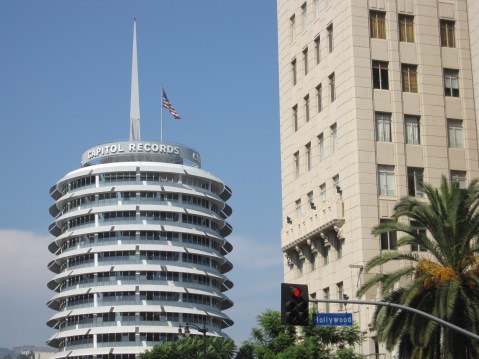
“Capitol Records Building” by Flickr user Wieland Van Dijk, CC BY-ND-SA 2.0
SUNDAY, November 9th
8:00 am – 9:45 am
Sports, Sex, and Music across the Pacific during the Cold War
Westin Bonaventure, Beaudry B (L1)
—Mari Yoshihara, University of Hawai’i, Manoa (HI)
Lenny Blows Up the World: Classical Musicians Play the Cold War
.
Sonics of Black Excess, 1940s to 1980s
Westin Bonaventure, Los Cerritos (L1)
CHAIR:
Imani D. Owens, Princeton University (NJ)
PAPERS:
Brian Lefresne, University of Guelph Canada
A Fool in Space: Sun Ra the Jester at the Carnival
Charles McGovern, College of William and Mary (VA)
I Want a Lavender Cadillac: Fun, Excess and Labor in Black Popular Music, 1940–1970
Terrion L. Williamson, Michigan State University (MI)
I‘m Not Your Superwoman: Black Female Embodiment and the Sites of Social Intimacy
Brian Edward Jones, College of William and Mary (VA)
Big Fun with the Prince of Darkness: Miles Davis and the Death of the American Dream
COMMENT:
Imani D. Owens, Princeton University (NJ)
.
10:00 am – 11:45 am
What Words Can’t Do: Instrumentals, Identity, and Interpretation
Westin Bonaventure, Los Cerritos (L1)
CHAIR:
Shana L. Redmond, University of Southern California (CA)
PANELISTS:
Shana L. Redmond, University of Southern California (CA)
Tsitsi Jaji, University of Pennsylvania (PA)
Guthrie Ramsey, Jr., University of Pennsylvania (PA)
Tamara Roberts, University of California, Berkeley (CA)
.
The Pleasures and Pains of Hip Hop Listening: New Aesthetic Approaches
Westin Bonaventure, San Bernardino (L1)
CHAIRS:
Jill Toliver Richardson, City University of New York, Borough of Manhattan Community College (NY)
James Ford, Occidental College (CA)
PAPER:
Karen Jaime, University of Illinois, Urbana-Champaign (IL), Jonathan Gray, City University of New York, John Jay College of Criminal Justice (NY), Candice Jenkins, City University of New York, Hunter College (NY), James Ford, Occidental College (CA)
The Pleasures and Pains of Hip Hop Listening: New Aesthetic Approaches
COMMENT:
Michael Jeffries, Wellesley College (MA)
.
“All the Way Live”: The Aesthetics of Pleasure in California Funk
Westin Bonaventure, Santa Barbara C (L1)
CHAIR:
Laura Harris, Pitzer College (CA)
PAPERS:
Scot Brown, University of California, Los Angeles (CA)
“All the Way Live”: The Live Funk Aesthetic of Lakeside
Cheryl L. Keyes, University of California, Los Angeles (CA)
From Mademoiselle Mabry to Betty Davis: The Reigning Funk Diva from the Underground
Tony Bolden, University of Kansas (KS)
Are You Funkified?: The Choreopoetics of Pleasure in the Music of Sly and the Family Stone
COMMENT:
Laura Harris, Pitzer College (CA)
.
**Caucus: Environment and Culture: Ecologies of Pleasure and Pain: Deviance, Destruction, and Desire in Environmental History**
Westin Bonaventure, Santa Barbara A (L1)
—Craig Eley, University of Wisconsin, Madison
Psychologically Ultimate Seashores: Natural Sound, Personal Pleasure, and Recording Technologies
.
12:00 pm – 1:45 pm
Pleasure, Pain, Politics, and Performance: Black Women Artists and Their Fans
Westin Bonaventure, Palos Verdes (L1)
CHAIR:
Gayle Wald, George Washington University (DC)
PANELISTS:
Ruth Feldstein, Rutgers University, Newark (NJ)
Emily Lordi, University of Massachusetts, Amherst (MA)
Cherise Smith, University of Texas, Austin (TX)
Gayle Wald, George Washington University (DC)
.
Performative Pleasures of Blackness: The Creation, Consumption, and Conflict of Pleasureable Blacknesses
Westin Bonaventure, San Fernando (L1)
—Danielle C. Heard, University of California, Davis (CA)
Feeling Good: Nina Simone and the Pleasures of Live Performance, Montreux 1976
—Scott Poulson-Bryant, Harvard University (MA)
The ‘Unruly Delights’ of the Great Black Way: Contradiction, Pleasure and Black Musicals of the 1970s
.
Can Black Women Have Fun?: Beyond Mammies and Martyrs
Westin Bonaventure, San Gabriel A (L1)
—Margo Crawford, Cornell University (NY)
Erykah Badu’s Black Fantastic Re-invigoration of Black Cultural Nationalism
.
2:00 pm – 3:45 pm
Central Avenue Breakdown: Gender, Race, and Coming of Age in a Los Angeles Jazz Community
Westin Bonaventure, Beaudry B (L1)
CHAIR:
Farah Jasmine Griffin, Columbia University (NY)
PAPERS:
Maxine Gordon, Fordham University (NY)
Dexter Gordon and Melba Liston: The ‘Mischievous Lady Session’, June 5, 1947, Dial Records
Monica Hairston-O’Connell, Columbia College (IL), Sherrie Tucker, University of Kansas (KS)
Revisiting Central Avenue through Melba Liston’s Oral Histories
Nichole T. Rustin, Independent Scholar
Playing with Dynamics: Racialized Masculinity, Jazz, and Coming of Age on 1940s Central Avenue
COMMENT:
Farah Jasmine Griffin, Columbia University (NY)
.
What Beyoncé (and Her Stans) Can Teach Us About The Pleasures of Intersectional Identity
Westin Bonaventure, Santa Barbara A (L1)
CHAIR:
Deborah Paredez, University of Texas, Austin (TX)
PANELISTS:
Clare Croft, University of Michigan, Ann Arbor (MI)
Micah Salkind, Brown University (RI)
Kristen Warner, University of Alabama, Tuscaloosa (AL)
Chelsea Bullock, University of Oregon (OR)
Deborah Paredez, University of Texas, Austin (TX)
.

“DSCN9630” by Flickr user Carsten Titibach, CC BY 2.0
Share this:

Speaking “Mexican” and the use of “Mock Spanish” in Children’s Books (or Do Not Read Skippyjon Jones)

Cinco de Mayo. ‘Tis the season when many Americans don sombreros, order their frozen margaritas, and, God help us, speak “Spanish.” We are well used to hyper Anglicized renditions of “amigo,” “adios,” and happy hour specials brought on by the commercialization of Cinco de Mayo. The holiday celebrates a significant event in Mexico’s history – the battle of Puebla and victory over France in 1862 – through narrowing ideas about language, culture, and tequila. That said, let’s not just blame Cinco de Mayo for the disconcerting use of Spanish. Unfortunately, the incessant use of phrases such as “ay caramba” and “no problemo” are heard much, much earlier in contemporary children’s books.
The New York Times recently published the startling figure that just 93 of the 3,200 children’s books published in 2013 were about African American children. Within these few 93 texts, African American children all-too-often read about themselves within the past tense, in reference to slavery and civil rights legacies. Children of color are left to identify with the adventures and imaginative stories of white characters amid white settings. Aptly characterized as an, “apartheid of children’s literature,” two moving first-person accounts from Walter Dean Myers and Christopher Myers detail the significance of incorporating more characters of color for all readers. One major effect of this dearth of representation, according to Christopher Myers,
…is a gap in the much-written-about sense of self-love that comes from recognizing oneself in a text, from the understanding that your life and lives of people like you are worthy of being told, thought about, discussed and even celebrated.
Just as significant, is the number of children’s books about Latino children from the 2013’s trove of 3,200 books: 53. That’s 5-3. As a reminder, the United States Census tallied 53 million Latinos in the United States, representing the nation’s youngest demographic (children!).
However, perhaps worse than the actual lack is the rise of stereotypic in-your-face representations of race within children’s books – award-winning ones, actually – and their role in teaching children troubling ideas about race, language, and “difference.”
My name is Skippito Friskito. (clap-clap)
I fear not a single bandito. (clap-clap)
My manners are mellow,
I’m sweet like the Jell-O,
I get the job done, yes indeed-o.
Case in point: Skippyjon Jones, a Siamese cat that pretends to be a Chihuahua superhero. Skippyjon speaks English, but his super hero alter ego speaks in Mock Spanish in his recurring and imaginative quests. Speaking “Spanish” in hyperanglized fashion recasts Skippyjon from an English-speaking (white) cat to a Spanish-accented (brown) dog. His auditory performance of Mexicanness, what Reina Prado considers “sonic brownface,” reeks of white privilege as he code-switches from cat/white/English to dog/brown/”Spanish.” What’s worse, as a children’s book, directed at those between the impressionable ages of 4-8, Skippyjon encourages both adult readers and young readers to read out loud and perform sonic brownface. Listening to the book’s trite word choice (amigos, adios, frijoles), fake Spanish (indeed-o, mask-ito) and embellished accents (“ees” for is) trains the ear on how to speak “Mexican,” presumably, of course, for the listening amusement of non-Mexicans.

Image by Flickr user Howard Lewis Ship
“I am El Skippito, the great sword fighter,” said Skippyjon Jones.
Apparently, these tried and true tactics sell quite well. This award-winning children’s book character, by Judy Schachner, has spawned into a lucrative empire that includes fourteen books, a coordinating plush toy figure, online webisodes of the books’ stories, CDs of Schachner reading out loud, the obligatory Ipad app, a starring role in the department store Kohl’s “We Care” charity campaign in 2012, and get this, a children’s musical. Of course, Skippyjon is not really recognized as a book series about Latinos (like fellow television darlings, Dora the Explorer, Handy Manny, or Dragon Tales) yet it taps into every flinching stereotype we know of, and should avoid, about Mexicans. Equating Mexicans and Mexican tales to the canine of a Chihuahua is hardly new but it does not make it less problematic.
For instance, in the inaugural self-titled Skippyjon Jones book, the cat’s adventures take place “far, far away in old Mexico.” Much like the perpetual placement of African Americans in the past tense within children’s books, situating Mexico in the imaginative past reinforces perceptions of all-things-Mexican as distant, foreign, and old. Skippyjon and his chimichangos – his sidekicks (good guys) –set out to save their rice and beans from Alfredo Buzzito and Bumblebeeto Bandito (bad guys). Zorro-esque masks, swords, fiestas followed by siestas, fellow Chihuahuas, piñatas, plenty of cacti, and lots of clap-clap cues frame the rice-and-bean rescue. His adventures, book after book, via a Skippito brown identity sends a disquieting message about power and privilege. Skippito, even when masked, still plays the role of Great White Hero to the masses of “Mexican” dogs.
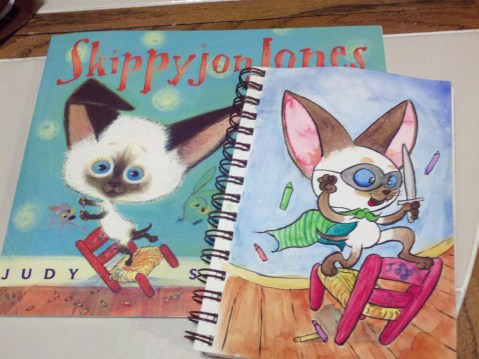
Image by Flickr user Tomas Quinones
Then all of the Chimichangos went crazy loco.
Several of Schachner’s Skippyjon books have received notable accolades including, for instance, the 2004 E.B. White Read Aloud Award and a spot on the coveted “Teachers’ Top 100 Books for Children” by the National Education Association in 2007. The former comes with an adorning gold seal on future editions of honored books. A sampling of the series’ laudatory press, from the E.B White Read Aloud press release, “Peppered with Spanish expressions and full of energized fun, SkippyJon Jones is not only entertaining for the listener, it’s also enjoyable for the reader.” And from the author’s webpage: “Each of my adventures are ay caramba, mucho fun but they’re educational too!” The insinuation that the Skippyjon Empire teaches Spanish not only ignores the richness of Spanish but it also feeds popular ideals that Spanish is an “easy” and “fun” language to learn.
Schachner’s recurrent use of “Spanish,” in particular, not only structures the silly narrative adventures of Skippyjon as he imagines himself to be Skippito but the racialized language play has also become the hallmark element of Skippyjon. Written and read out loud by parents and teachers, some of Skippyjon’s signature phrases include “Holy Guacamole!” and “Holy Frijoles!” – textbook examples of Jane Hill’s renowned writings on Mock Spanish (or fake, incoherent Spanish uttered and deemed “funny” by non-native Spanish speakers). Because we already hold native Spanish-speakers (U.S. Latinos) with such little regard in the first place, Mock Spanish done for laughs, as argued by Hill, comes quite easily. Carmen Martínez-Roldán takes the Skippyjon Jones series to task in necessary detail; see her analysis of Mock Spanish in the equally troubling, Skippyjon Jones in the Doghouse. Her emphasis on the cultural representations of Mexicans vis-a-vis language in children’s books supports my tirade against this cat/dog. Martínez-Roldán found that several teachers, particularly those from the Southwest, expressed a sense of inexplicable uneasiness to these books. Amazon ratings are (painfully) positive for Skippyjon, yet, according to Martínez-Roldán, those who expressed low ratings were “accompanied by lengthy explanations, mostly related to misrepresentations of Mexicans and the poor use of Spanish.” Her research calls for more diversity within children’s literature but, central to this essay, reminds us that U.S. Latinos hold both a personal and political relationship to Spanish.
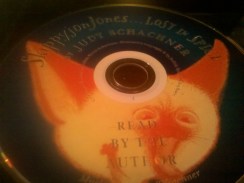
Image by Flickr User John Graham
Anthropologist Bonnie Urciuoli explains how Spanish, when overheard in designated public spaces (think: Cinco de Mayo or Mexican restaurants) is safely “ethnified,” yet Spanish is regarded as out of place or “racialized” when heard as bilingual announcements at local grocery stores or school sites. When heard by monolingual English speakers outside of its designated spaces in the U.S., Spanish carries “racialized” connotations such as “impoliteness” and “danger.” The insistence many American employers place on speaking English and prohibiting non-English language conversations at workplaces, for instance, speaks to the public boundaries imposed on Spanish and Spanish-speakers. (Yes, Whole Foods. I am looking at you.)
Jane Hill’s provocative argument, built from Uricuolli’s writings, examines Whites’ use of Spanish (Mock Spanish). Unlike Latinos, who learn early on to self-monitor where and how they speak English and Spanish, non-native speakers of Spanish do not carry this same burden, according to Hill. In fact, they have the privilege of speaking grammatically incorrect Spanish, in hyper Anglicized Spanish, or mockingly (by adding a stupid “o” or prefacing a phrasing with “el”) without surveillance.
Then, using his very best Spanish accent, he said, “My ears are too beeg for my head.
My head ees too beeg for my body. I am not a Siamese cat… I AM A CHIHUAHUA!”
In addition to overplayed colloquial expressions, Schachner demarcates a racial line with “visual accents” (“beeg” for big) (see Jennifer Stoever-Ackerman, Priscilla Peña Ovalle and Sara V. Hinojos). In line with Uricuolli’s ideas, even Skippito’s English is accented and marked while in “Mexican” character. Readers stammer through “ees” and “beeg” in an effort, as prepped, to use their “very best Spanish accent.” The practice teaches children that accents are performative and easy to take on and off rather than hear accents as indicative of someone’s larger family histories of migration and culture.

The Frito Bandito, Image by Flickr user Bill Futreal
For children unfamiliar with Mexicans and Latinos, these books cast Spanish with archaic imageries of Mexican bandits and modern-day Frito Banditos. Spanish is not used as a language to communicate given its incoherence. Instead, Schachner uses Spanish to laugh at Skippito and by extension, Mexicans and Latinos in the U.S.; its runaway success is indicative of how “funny” Spanish and Mexicans continue to be to White and/or monolingual English speakers.
For Latinos, these books plant early attitudes about their own language differences. For children positioned as the family translator or struggling to maintain a bilingual, bicultural existence, these books teach children to shun their accent and those of their families. These books are clearly not for my two kids, whose young ears are already familiar with their grandmother’s Spanish-accented English and their own mother’s English-accented Spanish.
“Vamos, Skippito- or it is you the Bandito will eato!”
Reading children’s books out loud and listening to race through scripted accents sends troubling messages about “difference” at an early age. Educators have long argued that children’s books serve as both mirrors and maps to affirm and inspire readers’ identities, experiences, and future motivations. True. But I would also argue that the woeful absence of more diverse children’s tales mirrors a number of campaigns directed at working-class, communities of color; namely, our nation’s shaky commitment to universal preschool, lack of public support for Women Infant and Children (WIC) and Food Stamp programs, and outdated approaches to parental leaves (six measly weeks). In particular, Skippyjon Jones is a kid’s rendition of grownup racial and language politics, a pint-size version of NAFTA and English-only propositions presented for five-year old audiences. These policies, like the woeful crop of contemporary books, do little to provide a map for the livelihoods of children of color. Instead, Skippyjon’s use of language, a reincarnation of Speedy Gonzalez normalizes English, white characters (even in brown drag), and helps keep Cinco de Mayo antics alive.
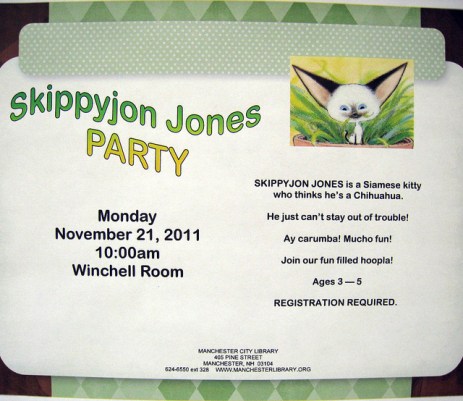
Image by Flickr user Manchester City Library
—
NOTE: On 5-8-14, the author added a passage to this article to reflect the relationship of her work to Carmen M. Martínez-Roldán’s “The Representation of Latinos and the Use of Spanish: A Critical Content Analysis of Skippyjon Jones” published in The Journal of Children’s Literature (2013).
Featured Image by Flickr user The Long Beach Public Library, CC BY-NC-ND 2.0
—
Dolores Inés Casillas is an assistant professor in the Department of Chicana and Chicano Studies and a faculty affiliate of Film & Media Studies at the University of California, Santa Barbara. She writes and teaches courses on Latina/o sound practices, popular culture, and the politics of language. Her book, Sounds of Belonging: U.S. Spanish-language Radio and Public Advocacy will be published this fall by New York University Press as part of their Critical Cultural Communication series.
—
 REWIND!…If you liked this post, you may also dig:
This Is How You Listen: Reading Critically Junot Díaz’s Audiobook-Liana Silva
Óyeme Voz: U.S. Latin@ & Immigrant Communities Re-Sound Citizenship and Belonging -Nancy Morales
Sonic Brownface: Representations of Mexicanness in an Era of Discontent–reina alejandra prado saldivar
Share this:


Current Top Posts





April 2021

January 2020

November 2019

October 2019

August 2019

April 2014

November 2017

March 2015

December 2017

October 2015
 Sounding Out!
Recent Comments