
SO! Reads: Alexis McGee’s From Blues To Beyoncé: A Century of Black Women’s Generational Sonic Rhetorics

From Blues To Beyoncé: A Century of Black Women’s Generational Sonic Rhetorics (SUNY Press, 2024) by Alexis McGee explores Black women’s creative labor and cultural production. The book offers a searing critique of both record industry exploitation and sound studies’ white gaze. By focusing on quotidian engagement with sound, McGee speaks simultaneously to linguists, rhetoricians, and ethnomusicologists, demonstrating how each discipline has overlooked Black women’s fundamental contributions to our understanding of language and cultural expression. This is not merely an additive project seeking inclusion within existing frameworks, but rather a fundamental reconceptualization of how we study Black women’s sounds.
McGee, currently Associate Professor at the University of British Columbia’s School of Journalism, Writing, and Media, mobilizes her training in linguistics, rhetoric, and composition to analyze everyday communicative practices and generational knowledge systems passed down between Black women. McGee joins other recent texts such as Earl Brooks’s On Rhetoric and Black Music (2024) in critical conversations around “sonic rhetoric.” In From Blues to Beyoncé, McGee theorizes sonic rhetoric as a collection of cultural technologies for storytelling that “act as methods of communicating knowledge that can be used to persuade or inform (younger) generations about topics like survival, liberation, and care” (6). Examining artists from the 19th, 20th, and 21st centuries through personal experience, archival material, biographies, interviews, and popular media, McGee demonstrates the critical necessity of taking seriously the generational cultural knowledge embedded in Black women’s creative practices within an anti-Black and misogynist world.
At its core, the book introduces “sonic sharecropping” as a term that illuminates the lopsided relationship between Black women creatives (tenants), their sonic and musical creations (crops), and wealthier, more powerful recording industry players (landlords, music labels, copyright holders). The sharecropping metaphor reveals how the music industry extracts value from Black women’s cultural labor while denying them ownership and fair compensation. McGee further develops the concept of “audibility of advice” to name the intergenerational mentorship and fugitive pedagogy that Black women practice as they navigate this exploitative system—showing how even the transmission of survival knowledge between generations becomes entangled in the same structures designed to profit from Black women’s creative work.
The book’s chapters traverse an impressive range of cultural moments. Opening with Cardi B’s attempted trademark of “okurrr,” McGee demonstrates how legal and social structures systematically prevent Black women from securing intellectual property rights over cultural innovations that white industry executives appropriate without restriction.
This contemporary case illuminates sonic sharecropping: Black women are expected to create cultural property that record labels then own and sell back to them. McGee then traces these dynamics historically, analyzing business practices of major labels like Atlantic Records. By drawing parallels between sharecropping contracts and recording agreements, the analysis reveals how the music industry has historically relied on discretionary ethical conduct by executives rather than equitable contractual structures, perpetuating exploitative relationships reminiscent of post-Reconstruction economic arrangements.
In what is perhaps the book’s most compelling chapter, McGee examines successive performances of “Strange Fruit,” tracing how Nina Simone and later artists like Missy Elliott and Janelle Monáe have reinterpreted Billie Holiday’s haunting meditation on lynching.
McGee builds on Amiri Baraka’s concept of the “changing same”, to show that antiblackness persists throughout time though it changes form. McGee demonstrates how Black women performers resist being treated as interchangeable vessels for Black cultural expression. Rather than presenting generic renditions, each artist asserts her distinctive voice and perspective that reiterates the enduring violence perpetuated against Black bodies.
Each performance carries its own rhetorical power while participating in “sankofarration,” a neologism from artist, writer, and media studies professor John Jennings that combines “sankofa” (a West African concept symbolizing learning from the past to move forward) with “narration” to describe a rhetorical worldview premised on understanding time as cyclical rather than linear. Sankofarration positions past and future as interconnected forces that actively shape the present. Crucially, McGee connects Lawrence Beitler’s commercial sale of lynching photographs (depicting the hanged bodies of Thomas Shipp and Abram Smith) to the visual and sonic rhetorical devices in these musical works. Through this framework, Black women artists transform historical trauma into ongoing political commentary and visions for future liberation. Black women’s creative work, she argues, consistently foregrounds documented histories of racial violence alongside the willful ignorance that upholds white supremacy and patriarchy. By listening critically to Black women’s sonic rhetorics, we can access pathways toward collective liberation.

Despite the book’s title, McGee’s engagement with Beyoncé focuses narrowly on the lemon-to-lemonade metaphor in the album, Lemonade. Her analysis of other Black women artists, however, anticipated critiques later directed at Cowboy Carter, highlighting a double standard: as a Black woman, Beyoncé faces moral scrutiny for engaging with country music—positioned as both capitalist enterprise and white cultural property—while white and male artists have participated in the same commercial structures for centuries without comparable ethical condemnation.
This defense raises the book’s most provocative question, one McGee gestures toward but leaves unresolved: if the inequitable standards applied to Black women artists are symptoms of a fundamentally exploitative system, what would liberation from that system actually entail? Does it require dismantling existing structures of cultural ownership and profit, or can it be achieved through expanded access and recognition within them?
While McGee does not directly engage Matthew Morrison’s recent work Blacksound: Making Race and Popular Music in the United States, her analysis clearly converses with his examination of how Black cultural products have been reproduced for white consumption, particularly through the ongoing afterlives of blackface minstrelsy. McGee’s focus on Black women specifically adds crucial gender analysis to ongoing scholarly conversations about racial capitalism and cultural appropriation.
McGee acknowledges that capitalism itself, rather than Black women’s participation in it, constitutes the fundamental problem. However, the analysis stops short of fully theorizing alternatives to existing structures of Western sound production and commodification. Readers familiar with Sylvia Wynter’s insistence on distinguishing the map from the territory, or Audre Lorde’s warning that “the master’s tools will never dismantle the master’s house,” may desire more sustained engagement with radical alternatives and additional tool building necessary for Black liberation from existing antiblack social and political structures. What might Black women’s sonic practices look like in anticapitalist frameworks of collective ownership and exchange? How might Black femme and queer performances expand or complicate these intergenerational transmissions of knowledge? How might Black women’s intergenerational knowledge systems point toward alternative epistemologies that refuse the terms of racial capitalism altogether?

This theoretical restraint appears strategic rather than accidental. From Blues to Beyoncé navigates carefully between colleagues unfamiliar with Black feminist and womanist theory, who require accessible entry points, and specialists seeking new takes on traversing multiple disciplines at once. In threading this needle, McGee prioritizes disciplinary bridge-building before radical dismantling of capitalist structures and academic knowledge production systems.
These limitations notwithstanding, the book represents an essential contribution to multiple fields. It insists that scholars of sound studies, rhetoric, and Black feminist thought must engage one another—that these conversations can no longer proceed in isolation. Methodologically, it offers both theoretical sophistication and practical analytical tools, making it intellectually substantive for non-specialists while providing specialists a compelling model for interdisciplinary synthesis. Most importantly, McGee demonstrates that we cannot understand American culture, sound, or rhetoric without recognizing Black women’s voices as foundational rather than supplementary.
This book transforms its disciplines by interrogating their foundational assumptions, asking us not simply to include Black women in sound studies, but to recognize how their systematic exclusion has rendered the entire field epistemologically incomplete. In raising these questions, even without fully resolving them, McGee provides both rigorous foundation and invitation to continue the work.
—
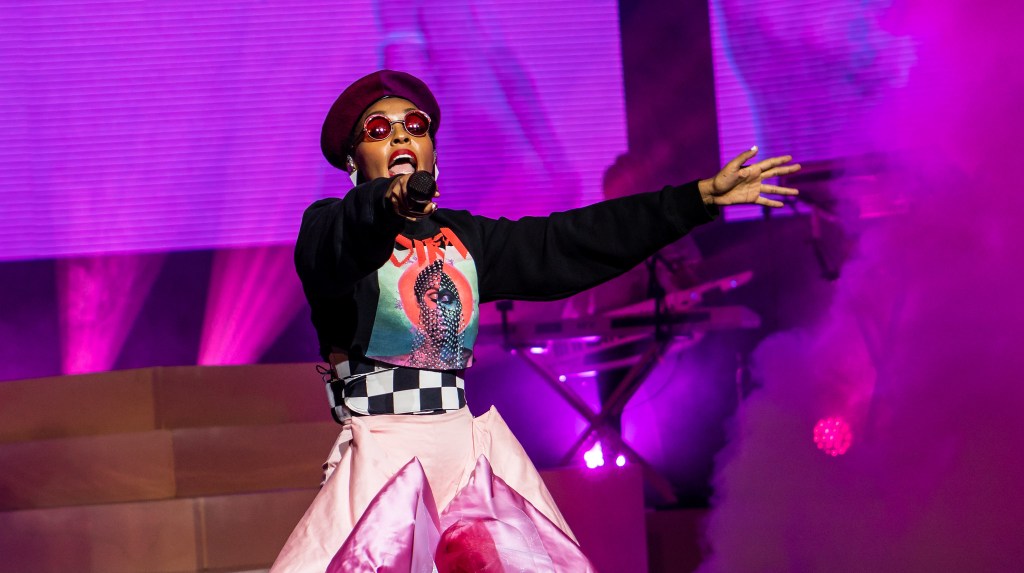
Featured Image: Janelle Monae on the Dirty Computer Tour at Madison Square Garden in 2018 by Flickr User Raph_PH. License: CC BY 2.0
—
Joe Zavaan Johnson (he/they) is a multi-instrumentalist, arts educator, and Black music researcher. Currently an Ethnomusicology Ph.D. Candidate at Indiana University-Bloomington, he examines the Black banjo renaissance through Black studies, human geography, folklore, and ethnomusicology. Johnson frequently collaborates with grassroots organizations focused on coalition building, community healing, and cultural reparations, bridging scholarship with community-engaged practice. His forthcoming dissertation, Black Banjo Bodylands: Recovering an African American Instrument, explores the relationship between Black people, lands, and banjos as ancestral technology.
—

REWIND!…If you liked this post, check out:
SO! Reads: Marisol Negrón’s Made in NuYoRico: Fania Records, Latin Music, and Salsa’s Nuyorican Meanings –Vanessa Valdés
SO! Reads: Justin Eckstein’s Sound Tactics: Auditory Power in Political Protests––Jonathan Stone
“I’m on my New York s**t”: Jean Grae’s Sonic Claims on the City--Liana Silva
Love and Hip Hop: (Re)Gendering The Debate Over Hip Hop Studies--Travis Gosa
My Music and My Message is Powerful: It Shouldn’t Be Florence Price or “Nothing”-Samantha Ege
I Been On: BaddieBey and Beyoncé’s Sonic Masculinity — Regina Bradley
Cardi B: Bringing the Cold and Sexy to Hip Hop–Ashley Luthers
Share this:

Finding Resonance, Finding María Lugones
I am always listening for María: I find her most in the traces of words.
Trained as a literary scholar, I relish in the contours of stories; I savor the nuances found between crevices of language and the shades of implication when those languages are strung together. It is no surprise, then, that since the death of my friend and mentor María Lugones, I have turned to many books, particularly her book, Pilgrimages/Peregrinajes: Theorizing Coalition Against Multiple Oppression, to feel connected to her. I have struggled, though, to write about her, talk about her, even think about her for many years. It wasn’t until I found a passage about spirits and hauntings in Cuban-American writer and artist Ana Menéndez’s novel The Apartment that I found language to describe a way through the grief of the last five years.

Menéndez’s novel follows many characters that all, at some point in time, come to live in apartment 2B in Miami Beach. While each person is seemingly disconnected from the next, they all leaves sonic traces of themselves for the next person’s arrival. Each new tenant leaves behind the creak of a dented floorboard, or the rumbling of the air conditioner, the faint melody of a piano, or the swish of spirits looking for a place to sit down. The climax of the novel revolves around Lenin García, a young Cuban migrant who commits suicide in the Miami apartment shortly after arriving. Anna, a journalist who migrated to the US from the Czech Republic during their communist regime, prepares the apartment for rental after the suicide. When looking through Lenin’s belongings she explains that the “Spirits pressed down on her, and again and again she rejects them. Sends them packing, back to the pre-rational past. Not a haunting, but an echo. The boy’s life a gesture pointing back to her own. A dream of a thousand iterations” (131). These spirits that surround her, that remind her of her own life’s ghosts, provide a particularly sonic connection; the tethers that connect one migration tragedy to another is an echo of commonality that creates a kin experience.
The three years I learned with and from María are overshadowed by the physical distance the pandemic required of me in her final moments. When I try to write about her, my hair stands on end, my eyes water, my nose drips, and I stretch out my hand toward a presence I feel, just out of reach. I know it’s her, I just can’t seem to touch her. I have described María’s death as a haunting—as something that haunts me. I defined this haunting as a physical presence that I could not see, but I could feel, sense. But what if, like Anna, I am feeling, not a haunting, but an echo; or more accurately, the resonances of María that echo around me constantly? What Menéndez’s passage provides is the necessity of reinterpreting my awareness of María from one of general sensing to one of specific aural attunement. If I am listening for her, how, then do I keep her with me?

Lenin, from The Apartment, provides a potential answer: when meeting with a curandera in Cuba, she tells him “The ancestors speak to you from the home of your inner life. When your inner life is spare, there is nowhere for the ghosts to sit. When you furnish your spirit, the ancestors will once again find rest in you” (143). Echoes become an analytic that provide furnishings ‘in the soul’ for sustained company of those who have passed. The reverberation of echoes—reverberations as a prolonged sense of resonance that stretches the meeting of two energies—can, quite literally, allow a reader to connect back to people across space and time. My tether to María is a resonance that simultaneously locates and disperses spatially and temporally. I hear this connection as my harmony to her melody. To further the metaphor, that resonance is the strumming of a guitar, where I am the guitar and she is the musician, and that moment where we both hear for each other, even when we do not know the other exists, is the note.
What happens when I use literary methods of analysis to find people in the interstices of sound? To search for María in what she calls the “enclosures and openings of our praxis” as a reader of her text? Now that I had to search the histories of her echo, I turned to her book, Pilgrimages/Peregrinajes.
When María recommends “to women of color in the United States that we learn to love each other by learning to travel to each other’s ‘worlds’,” (78) I imagine our first few encounters; encounters that were strange, difficult, and lessons in learning to listen to her on her terms. I had been invited to her home in Binghamton, New York for a meeting of a political-intellectual group she hosted, and was nervous to meet the woman I had written my Master’s thesis on, and who was the reason I applied to Binghamton for a PhD program. Her voice rang through the room, slow and clear; her mouth pursed a bit as she thought through her next sentence, her finger pointed as she spoke her next idea. In trying to stay out of her way, I became a barrier when she moved backward; she bumped into me and said simply ‘you must be careful not to trip me’ and moved along. I was mortified.
Our next few encounters were similarly odd, and lead me to think that, maybe, María was not the right choice for my mentoring needs. A few months into this first year in graduate school—where tenured male professors were violent toward me, and I was not sure I should stay in academia—I confessed to a friend in the same political-intellectual group that I was not sure María liked me or that I should work with her. Her response changed everything: this friend, who had worked with María many, many years said: “don’t do that. Don’t make her mother you. It’s not who she is. Travel to her, learn her.” I finally understood that traveling to María’s world meant listening to her from her perspective, not my own. That shift in me “from being one person to being a different person” (89) is how I first found María in the haptic world. I learned to listening to her: I learned the catch in her throat meant she wanted tea; I learned the increase in sighs meant she was in more pain that usual; I learned the shuffling of papers probably meant she was looking for her handkerchief to wipe her forehead as she had a hot flash. Each of these sonic gestures, I could respond to—could show up for her.

But with María’s death, this kind of listening is no longer available to me; I could not listen for hem or hmm or tchps. I had to learn to listen differently. In re-reading Pilgrimages/Peregrinajes I learn that it does not just contain her philosophical interventions for liberatory futures. It is a series of stories; her stories of the echoes that resonate inside of her; stories that she weaves together that happen to name philosophical practices of relationality. It is through the coerced placement of her by her father in an asylum that she finds other woman who teach her to resist; this resistance is sonic: a woman repeating over and over “I am busy, I am busy” as they electroshock her (i). It is through wanting desperately to love her mother that she finds ways her mother taught her to listen differently in order to name the capacity of ‘world’-traveling. What I had felt when I first read her work over a decade ago was a resonance; a sonic reverberation across space and time that connected my to her before our physical meeting, during our time as friends and mentor/mentee, and now after her physical death.
Connecting to María through echoes feels effortless now that I have the language. I hear now María’s warning against the dangers in the primacy of the visual. In “Hablando Cara a Cara/Speaking Face to Face: An Exploration of Ethnocentric Racism,” she explains:
I exercise this playful practice. The appreciation of my playfulness and its meaning may be realized when the possibility of becoming playful in this way has been collectively realized, when it has become realized by us. It is here to be appreciated or missed and both the appreciation and the missing are significant. The more fully this playfulness is appreciated, the less broken I am to you, the more dimensional I am to you. But I want to exercise my multidimensionality even if you do not appreciate it. To do otherwise would be to engage in self-mutilation, to come to be just the person that you see. To play in this way is then an act of resistance as well as an act of self- affirmation (41).
What she taught me here is that being herself meant a practice that was more than being seen. To be what others could only see was an act of mutilation to her multidimensionality. That reminder was crucial to becoming her friend during my time at Binghamton, but even more crucial now that she is gone from this world.

I’ll leave you with the most important story she left behind: she provided a method of learning that was based on the senses and focused primarily on the sonic—what she called “tantear.” This tantear has become instrumental in my own research. It is a fumbling around in the dark, a feeling around tactically that focuses on searching “for meaning, for the limits of possibility; putting our hands to our ears to hear better, to hear the meaning in the enclosures and openings of our praxis” (1). The embodied experience of stumbling, of careful and intense feeling for and with others, requires a capacity of listening deeply. It is listening that undergirds the learning. The language of the sonic provides the understanding of the feelings within the body. Listening becomes a profound practice of relationality; echoes become a mechanism of connection; and resonance becomes the confirmation that I can still be with María.
—
Images courtesy of the author, except where noted.
—
Daimys Ester García is a Latinex writer, artist and educator from Miami. She earned her PhD in Comparative Literature at SUNY Binghamton. She is currently an Assistant Professor in English at the College of Wooster, where her research and teaching is at the intersections of Latinx literatures & studies, Native literatures & studies, women of color feminisms, and decolonial praxis with a focus on coalitional politic. She is working on a book manuscript, tentatively titled Comfort is Colonialism: Coalitional Commitments for Cuban-American Women Writers, which offers a repertoire of practices to re-connect Cuban-Americans with other histories of resistance in the US.
—
Thank you to Wanda Alarcón for care in the form of editorial labor.
—

REWIND!…If you liked this post, you may also dig:
Faithful Listening: Notes Toward a Latinx Listening Methodology–Wanda Alarcón, Inés Casillas, Esther Díaz Martín, Sara Veronica Hinojos, and Cloe Gentile Reyes
Enacting Queer Listening, or When Anzaldúa Laughs–Maria Chaves Daza
“Oh how so East L.A.”: The Sound of 80s Flashbacks in Chicana Literature–Wanda Alarcón
Xicanacimiento, Life-giving Sonics of Critical Consciousness–Esther Díaz Martín and Kristian E. Vasquez
Share this:


Current Top Posts





April 2021

January 2020

November 2019

October 2019

August 2019

April 2014

November 2017

March 2015

December 2017

October 2015
 Sounding Out!
Recent Comments