
Won’t Back Down: Tom Petty, Jason Aldean and Masculine Vulnerability

October 2017: a week after a Las Vegas gunman killed 58 people at an outdoor festival during a Jason Aldean set, Aldean squared up to the Saturday Night Live mic and soldiered through then-recently deceased Tom Petty’s “I Won’t Back Down.” In a short statement before the song, Aldean mentioned that he was “strugglin to understand what happened that night,” and he reiterated this general sense of confusion about what to make of everything in ensuing interviews. It’s unsurprising that Aldean struggled to make sense of the shooting; traumatic experiences like the one he and his audience endured often don’t fit into any ready-made understanding we have about the world. But Aldean, who seemed uncomfortable publicly displaying the kind of emotional vulnerability the trauma produced in him, was eager to resolve the dissonance: with platitudes like “be louder than the bad guys,” with assurances that “when America is at its best, our bond and our spirit – it’s unbreakable,” with an admission of his own hurt only as an empathic response to others’ rather than as his own, and with a cover song borrowed from one of his idols. Here, I’m listening to the compensatory work the cover of “I Won’t Back Down” performs in the face of the kind of vulnerability Aldean wrestles with in the wake of violence. To hear this as clearly as possible, I’ll contextualize Aldean’s performance by comparing it to a similar use of the song by Tom Petty 16 years earlier, then contrast it with Ariana Grande’s performance of “One More Time” at her One Love Manchester benefit a few months before the Las Vegas shooting.

Screen capture from Cal Vid’s youtube video “Jason Aldean SNL Tom Petty I Won’t Back Down Live Tribute”
Though the song’s titular line, “I won’t back down,” is a fairly direct lyrical idea about maintaining one’s resolve, the rest of the song still manages to paint a rather vague picture. The singer isn’t backing down, sure, but beyond “a world that keeps on pushin [him] around,” there aren’t many specifics about what he’s not backing down from. This is a kind of pop genius: capture a core sentiment that registers with a large audience, then present it in ambiguous enough terms that listeners can fill in the blanks with their own very personal experiences. So, despite Petty’s own analysis that he “laid [the song] out, you know, with no ambiguity at all,” “I Won’t Back Down”’s lyrics are incredibly broad, leaving space for practically anyone to insert themselves into the role of protagonist. Your boss might be a jerk, but you won’t back down. Your employee might think you’re a jerk, but you won’t back down.
Moreover, the sound of the song undermines even its most resolute lyrics. When Petty sings “I won’t back down,” which he does often in the verses and the hook, he scoops all around the pitches of “won’t,” “back,” and “down” so that they sound more interrogative than declarative. Rhythmically, these words sit on weak beats and upbeats in the verses, and in the chorus, the final word, “down,” comes just before – not on – a strong downbeat (see figure below). The effect of the syncopation is similar to the effect of Petty’s pitch bends; lyrical resolve becomes musical uncertainty. Finally, George Harrison’s guitar solo – as George Harrison guitar solos tend to do – plays pensively with the song’s forward momentum, again reining in the lyrics’ more direct message. In all, “I Won’t Back Down” works in a good deal of uncertainty that makes it unclear exactly what the threat is and whether the singer really is as resolute as he’d like us to believe.
| + | 1 | + | 2 | + | 3 | + | 4 | + | |
| verse | I | won’t | back | down | |||||
| hook | I | won’t | back | down |
What a song means or how it works changes with the times, though, and the defiance lurking in the lyrics of “I Won’t Back Down” crystallized after the destruction of the Twin Towers on September 11, 2001. When Petty performed “I Won’t Back Down” at the benefit concert America: A Tribute to Heroes on September 21, the context of a nation rallying around itself to defeat some yet-unknown foreign enemy overwhelmed any of the sonic signifiers that might otherwise temper the song’s resolve. This concert, which was aired virtually on every channel to a country still reeling from a collective trauma, subsumed Petty’s vocal scoops, the lyrics’ offbeat kilter, and the guitar’s sanguine solo under the clarity of a lyrical sentiment that aligned neatly with the politics of the moment: the US won’t back down. The shift in focus in “I Won’t Back Down” just after September 11 is similar to a dolly zoom effect: the threat referenced by the song’s lyrics feels as if it comes nearer and into sharper focus even as the protagonist broadens from an individual to a collective identity.
This sort of shift in the song’s narrative tracks with Christine Muller’s account of the overarching changes in cultural narratives that happened in the wake of the Twin Towers’ destruction. In September 11, 2001 as Cultural Trauma (2017), Muller argues that the broad perception of the fracture of the “American Dream” – “good things happen to good people, and bad things happen to bad people…come to the United States, and you will have opportunity; work hard, and you will succeed; follow the rules, and you will be rewarded” – harkened the rise of cultural media focused on “no-win scenarios…a fascination with anti-heroes who do the wrong things for the right reasons” (9-10). In the case of “I Won’t Back Down,” a song that was once broadly resolute and unfocused on any particular foe, sung by an artist who sent a “Cease and Desist” letter to George W. Bush when the then-candidate used the song for his presidential campaign morphed into an anthem that became narrowly resolute in the face of a named threat (“terror”), woven into a larger political tapestry that aided in the demonization of Muslims and the Islamic countries targeted by the “global war on terror” – an interminable war fought for vaguely defined reasons started at multiple sites by the same Bush Petty had previously defied.
Aldean’s Saturday Night Live performance 16 years later would emulate Petty’s, as faithful a cover as Aldean and his band could do. Though his vocals lack Petty’s high-end nasal clarity, Aldean dutifully hits all the scoops, honors the syncopations, and even yields to a guitar solo that follows George Harrison’s lead from decades previous. For Aldean, who was 40 at the time, and many millennials, the SNL performance would likely resonate with Petty’s iconic Tribute performance. And in the space of those 16 years, another frequently repeated line in the song would take on a political life of its own, recognizable to younger listeners who may not have immediately registered the post-9/11 context of “I Won’t Back Down.” While “I’ll stand my ground” would’ve been as broadly meaningful as “I won’t back down” when Petty released the song in 1989, the 2012 murder of Trayvon Martin pushed the idea of Stand Your Ground laws into public consciousness. These laws nullify one’s “duty to retreat,” to avoid violence if a safe passage away from a threat is reasonably available, instead allowing a person who feels threatened to use violence against their perceived threat. Research shows that Stand Your Ground laws tend to protect white people and endanger Black people, holding up long-standing social norms that cast Blacks as always already violent. So by the time Aldean sang “I’ll stand my ground, and I won’t back down” in 2017, the song had passed through social and political filters that gave its lyrics an anti-Muslim and anti-Black edge.

“Stand Your Ground” By Flickr User Seattle.roamer, CC BY-NC-ND 2.0
At first blush, all this context makes “I Won’t Back Down” a bizarre choice for Aldean to sing in response to the Las Vegas shooting. The identity of the gunman – a white man around retirement age – made him only a bit older than the demographic most responsible for mass shootings in the US. Instead of addressing the fact that mass shootings are a distinctly USAmerican problem, or that country music fosters a close and financial relationship with the NRA (which lobbies against the sorts of regulations that would curb mass shootings), Aldean remained unwilling to offer any thoughts on guns and gun control, even after experiencing the shooting firsthand. While we might reasonably excuse the singer’s lack of reflection on social and political problems in recognition that Aldean was surely traumatized himself, the singer’s performance of “I Won’t Back Down” still performs a specific kind of rhetorical work that relies on Petty’s performance at America: A Tribute to Heroes 16 years earlier. Specifically, Aldean’s rendition of “I Won’t Back Down” places the Vegas shooting in the same political arena used to demonize Muslims after September 11 and to criminalize Black people in political discourse surrounding Stand Your Ground laws. As I mentioned at the top of the essay, Aldean admitted and demonstrated his discomfort with the emotional vulnerability the shooting provoked in him, and I hear his performance of “I Won’t Back Down” as an effort to compensate for that public vulnerability by providing a retreat to a more familiar masculine pose: protective, resolute, stoic.
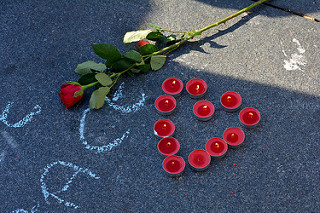
“Liverpool vigil for victims and families of MEN Manchester” by Flickr User James O’hanlon, CC BY-NC-ND 2.0
I published a piece that revolves around the idea of self-care with Sounding Out! in 2017, and one of the two central musical examples I consider there is Ariana Grande’s performance of “One More Time” at the One Love Manchester benefit concert just after the Manchester bombing. Grande’s circumstances run parallel to what Aldean would face a few months later: a traumatic act of violence that disrupted, injured, and killed the artist’s fans as the terror of the event rippled through the community. The two performances are gendered completely differently, however. Grande sings “One Last Time” surrounded by other musicians she invited to participate in the benefit concert. She frequently chokes up and relies on her fans to carry the song forward. She offers no answers or solutions beyond sentiments of love and the need to hold one another close in times of crisis. Grande’s is a performance of feminized care that contrasts sharply with Aldean’s masculinized resolve. Unwilling to publicly grapple with the emotional vulnerability created by the Vegas shooting, Aldean retreats from any public displays of grief and settles into an expression of care rooted in aggressive defense. His performance of “I Won’t Back Down” compensates for the feminized vulnerability triggered by the gunman and provides a masculine space for defiance that shifts attention away from white criminality and toward the US’s usual suspects: Black people and Muslims.

“#Ferguson protest in Memphis” by Flickr User Chris Wieland, CC BY-NC 2.0
Saturday Night Live has scrubbed the internet of any full videos of the performance (the single is available on Spotify), but we can see and hear Aldean running through the same rendition a couple weeks later at the Louisville Yum! Center. It’s worth noting how Aldean embodies the resolve of the song’s lyrics. While Petty always approached a microphone like he was going to whisper something in its ear, his shoulders slouched and knees bobbing to the beat, Aldean squares his shoulders, plants his feet to form a broad base, and confronts the mic straight on. Some of this boils down to style. Jason Aldean’s stage presence is different from Tom Petty’s. But it also captures the distance “I Won’t Back Down” has traveled since the late 1980s, from a largely empty signifier that listeners could fill with their own meaning to an anthem used for rallying listeners in the wake of mass violence. Here, feminized vulnerability and trauma are recast as masculinized aggression and resolve until the song fills with the politics of the moment: the US’s anti-Black, anti-Muslim refusal to back down from standing its ground.
_
Featured Image: “Tom Petty & The Heartbreakers, Oracle Appreciate Event “Legendary”, JavaOne 2011 San Francisco” by Flickr user Yuichi Sakuraba, CC BY-NC 2.0
_
Justin Adams Burton is Assistant Professor of Music at Rider University. His research revolves around critical race and gender theory in hip hop and pop, and his book, Posthuman Rap, is available now. He is also co-editing the forthcoming (2018) Oxford Handbook of Hip Hop Music Studies. You can catch him at justindburton.com and on Twitter @j_adams_burton. His favorite rapper is one or two of the Fat Boys.
_
 REWIND! . . .If you liked this post, you may also dig:
SO! Reads: Hiromu Nagahara’s Tokyo Boogie-Woogie: Japan’s Pop Era and Its Discontents – Shawn Higgins
Spaces of Sound: The Peoples of the African Diaspora and Protest in the United States – Vanessa K. Valdés
SO! Reads: Shana Redmond’s Anthem: Social Movements and the Sound of Solidarity in the African Diaspora – Ashon Crawley
Share this:

“How Many Latinos are in this Motherfucking House?”: DJ Irene, Sonic Interpellations of Dissent and Queer Latinidad in ’90s Los Angeles

How Many Latinos are in this Motherfucking House? –DJ Irene
At the Arena Nightclub in Hollywood, California, the sounds of DJ Irene could be heard on any given Friday in the 1990s. Arena, a 4000-foot former ice factory, was a haven for club kids, ravers, rebels, kids from LA exurbs, youth of color, and drag queens throughout the 1990s and 2000s. The now-defunct nightclub was one of my hang outs when I was coming of age. Like other Latinx youth who came into their own at Arena, I remember fondly the fashion, the music, the drama, and the freedom. It was a home away from home. Many of us were underage, and this was one of the only clubs that would let us in.
Arena was a cacophony of sounds that were part of the multi-sensorial experience of going to the club. There would be deep house or hip-hop music blasting from the cars in the parking lot, and then, once inside: the stomping of feet, the sirens, the whistles, the Arena clap—when dancers would clap fast and in unison—and of course the remixes and the shout outs and laughter of DJ Irene, particularly her trademark call and response: “How Many Motherfucking Latinos are in this Motherfucking House?,” immortalized now on CDs and You-Tube videos.
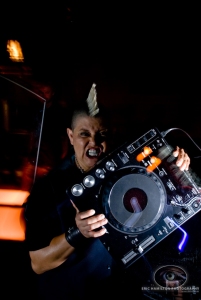
DJ Irene
Irene M. Gutierrez, famously known as DJ Irene, is one of the most successful queer Latina DJs and she was a staple at Arena. Growing up in Montebello, a city in the southeast region of LA county, Irene overcame a difficult childhood, homelessness, and addiction to break through a male-dominated industry and become an award-winning, internationally-known DJ. A single mother who started her career at Circus and then Arena, Irene was named as one of the “twenty greatest gay DJs of all time” by THUMP in 2014, along with Chicago house music godfather, Frankie Knuckles. Since her Arena days, DJ Irene has performed all over the world and has returned to school and received a master’s degree. In addition to continuing to DJ festivals and clubs, she is currently a music instructor at various colleges in Los Angeles. Speaking to her relevance, Nightclub&Bar music industry website reports, “her DJ and life dramas played out publicly on the dance floor and through her performing. This only made people love her more and helped her to see how she could give back by leading a positive life through music.”
DJ Irene’s shout-out– one of the most recognizable sounds from Arena–was a familiar Friday night hailing that interpellated us, a shout out that rallied the crowd, and a rhetorical question. The club-goers were usually and regularly predominately Latin@, although other kids of color and white kids also attended. We were celebrating queer brown life, desire, love in the midst of much suffering outside the walls of the club like anti-immigrant sentiment, conservative backlash against Latinos, HIV and AIDS, intertwined with teen depression and substance abuse.
From my vantage today, I hear the traces of Arena’s sounds as embodied forms of knowledge about a queer past which has become trivialized or erased in both mainstream narratives of Los Angeles and queer histories of the city. I argue that the sonic memories of Arena–in particular Irene’s sets and shout outs–provide a rich archive of queer Latinx life. After the physical site of memories are torn down (Arena was demolished in 2016), our senses serve as a conduit for memories.
As one former patron of Arena recalls, “I remember the lights, the smell, the loud music, and the most interesting people I had ever seen.” As her comment reveals, senses are archival, and they activate memories of transitory and liminal moments in queer LA Latinx histories. DJ Irene’s recognizable shout-out at the beginning of her sets– “How Many Latinos are in this House?”–allowed queer Latinx dancers to be seen and heard in an otherwise hostile historical moment of exclusion and demonization outside the walls of the club. The songs of Arena, in particular, function as a sonic epistemology, inviting readers (and dancers) into a specific world of memories and providing entry into corporeal sites of knowledge.
Both my recollections and the memories of Arena goers whom I have interviewed allow us to register the cultural and political relevance of these sonic epistemologies. Irene’s shout-outs function as what I call “dissident sonic interpolations”: sounds enabling us to be seen, heard, and celebrated in opposition to official narratives of queerness and Latinidad in the 1990s. Following José Anguiano, Dolores Inés Casillas, Yessica García Hernandez, Marci McMahon, Jennifer L. Stoever, Karen Tongson, Deborah R. Vargas, Yvon Bonenfant, and other sound and cultural studies scholars, I argue that the sounds surrounding youth at Arena shaped them as they “listened queerly” to race, gender and sexuality. Maria Chaves-Daza reminds us that “queer listening, takes seriously the power that bodies have to make sounds that reach out of the body to touch queer people and queer people’s ability to feel them.” At Arena, DJ Irene’s vocalic sounds reached us, touching our souls as we danced the night away.
Before you could even see the parade of styles in the parking lot, you could hear Arena and/or feel its pulse. The rhythmic stomping of feet, for example, an influence from African-American stepping, was a popular club movement that brought people together in a collective choreography of Latin@ comunitas and dissent. We felt, heard, and saw these embodied sounds in unison. The sounds of profanity–“motherfucking house”–from a Latina empowered us. Irene’s reference to “the house,” of course, makes spatial and cultural reference to Black culture, house music and drag ball scenes where “houses” were sites of community formation. Some songs that called out to “the house” that DJ Irene, or other DJs might have played were Frank Ski’s “There’s Some Whores in this House,” “In My House” by the Mary Jane Girls, and “In the House” by the LA Dream Team.
Then, the bold and profane language hit our ears and we felt pride hearing a “bad woman” (Alicia Gaspar de Alba) and one of “the girls our mothers warned us about” (Carla Trujillo). By being “bad” “like bad ass bitch,” DJ Irene through her language and corporeality, was refusing to cooperate with patriarchal dictates about what constitutes a “good woman.” Through her DJing and weekly performances at Arena, Irene contested heteronormative histories and “unframed” herself from patriarchal structures. Through her shout outs we too felt “unframed” (Gaspar de Alba).
Dissident sonic interpellation summons queer brown Latinx youth–demonized and made invisible and inaudible in the spatial and cultural politics of 1990s Los Angeles—and ensures they are seen and heard. Adopting Marie “Keta” Miranda’s use of the Althusserian concept of interpellation in her analysis of Chicana youth and mod culture of the 60s, I go beyond the notion that interpellation offers only subjugation through ideological state apparatus, arguing that DJ Irene’s shout-outs politicized the Latinx dancers or “bailadorxs” (Micaela Diaz-Sanchez) at Arena and offered them a collective identity, reassuring the Latinxs she is calling on of their visibility, audibility, and their community cohesiveness.
Perhaps this was the only time these communities heard themselves be named. As Casillas reminds us “sound has power to shape the lived experiences of Latina/o communities” and that for Latinos listening to the radio in Spanish for example, and talking about their situation, was critical. While DJ Irene’s hailing did not take place on the radio but in a club, a similar process was taking place. In my reading, supported by the memories of many who attended, the hailing was a “dissident interpolation” that served as recognition of community cohesiveness and perhaps was the only time these youth heard themselves publicly affirmed, especially due to the racial and political climate of 1990s Los Angeles.
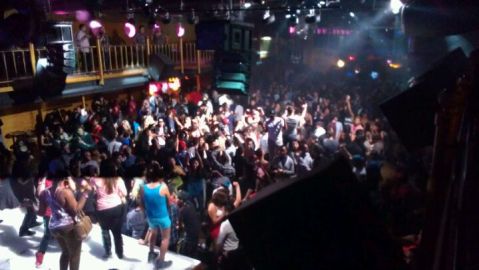
Vintage photo of Arena, 1990s, Image by Julio Z
The 1990s were racially and politically tense time in Los Angeles and in California which were under conservative Republican leadership. At the start of the nineties George Deukmejian was finishing his last term from 1990-1991; Pete Wilson’s tenure was from 1991-1999. Richard Riordan was mayor of Los Angeles for the majority of the decade, from 1993- 2001. The riots that erupted in 1992 after the not guilty verdict for the police officers indicted in the Rodney King beating case and the polarizing effect of the OJ Simpson trial in 1995 were indicative of anti-black and anti-Latinx racism and its impacts across the city. In addition to these tensions, gang warfare and the 1994 earthquake brought on its own set of economic and political circumstances. Anti-immigrant sentiment had been building since the 1980s when economic and political refugees from Mexico and Central American entered the US in large numbers and with the passing of the Immigration Reform and Control Act in 1986, what is known as Reagan’s “Amnesty program.” On a national level, Bill Clinton ushered in the implementation of the “Don’t Ask, Don’t Tell” policy in the military, which barred openly LGB people from service. In 1991, Anita Hill testified against Clarence Thomas’s nomination to the United States Supreme Court due to his ongoing sexual harassment of her at work; the U.S. Senate ultimately browbeat Hill and ignored her testimony, confirming Thomas anyway.
In the midst of all this, queer and minoritized youth in LA tried to find a place for themselves, finding particular solace in “the motherfucking house”: musical and artistic scenes. The club served a “house” or home to many of us and the lyrical references to houses were invitations into temporary and ephemeral sonic homes. Counting mattered. Who did the counting mattered. How many of us were there mattered. An ongoing unofficial census was unfolding in the club through Irene’s question/shout-out, answered by our collective cheers, whistles, and claps in response. In this case, as Marci McMahon reminds us, “Sound demarcates whose lives matter” (2017, 211) or as the Depeche Mode song goes, “everything counts in large amounts.”
Numbers mattered at a time when anti-immigrant sentiment was rampant, spawning white conservative sponsored legislation such as Prop 187 the so-called “Save Our State” initiative (which banned “undocumented Immigrant Public Benefits”), Prop 209 (the ban on Affirmative Action), and Prop 227 “English in Public Schools” (the Bilingual Education ban). Through these propositions, legislators, business people, and politicians such as Pete Wilson and his ilk demonized our parents and our families. Many can remember Wilson’s virulently anti-immigrant 1994 re-election campaign advertisement depicting people running across the freeway as the voiceover says “They keep coming” and then Wilson saying “enough is enough.” This ad is an example of the images used to represent immigrants as animals, invaders and as dangerous (Otto Santa Ana). As Daniel Martinez HoSang reminds us, these “racial propositions” were a manifestation of race-based hierarchies and reinforced segregation and inequity (2010, 8).
While all of this was happening— attempts to make us invisible, state-sponsored refusals of the humanity of our families—the space of the club, Irene’s interpellation, and the sounds of Arena offered a way to be visible. To be seen and heard was, and remains, political. As Casillas, Stoever, and Anguiano and remind us in their work on the sounds of Spanish language radio, SB 1070 in Arizona, and janitorial laborers in Los Angeles, respectively, to be heard is a sign of being human and to listen collectively is powerful.
Listening collectively to Irene’s shout out was powerful as a proclamation of life and a celebratory interpellation into the space of community, a space where as one participant in my project remembers, “friendships were built.” For DJ Irene to ask how many Latinos were in the house mattered also because the AIDS prevalence among Latinos increased by 130% from 1993 to 2001. This meant our community was experiencing social and physical death. Who stood up, who showed up, and who danced at the club mattered; even though we were very young, some of us and some of the older folks around us were dying. Like the ball culture scene discussed in Marlon M. Bailey’s scholarship or represented in the new FX hit show Pose, the corporeal attendance at these sites was testament to survival but also to the possibility for fabulosity. While invisibility, stigma and death loomed outside of the club, Arena became a space where we mattered.
For Black, brown and other minoritized groups, the space of the queer nightclub provided solace and was an experiment in self-making and self-discovery despite the odds. Madison Moore reminds us that “Fabulousness is an embrace of yourself through style when the world around you is saying you don’t deserve to be here” (New York Times). As Louis Campos–club kid extraordinaire and one half of Arena’s fixtures the Fabulous Wonder Twins–remembers,
besides from the great exposure to dance music, it [Arena] allowed the real-life exposure to several others whom, sadly, became casualties of the AIDS epidemic. The very first people we knew who died of AIDS happened to be some of the people we socialized with at Arena. Those who made it a goal to survive the incurable epidemic continued dancing.
The Fabulous Wonder Twins
Collectively, scholarship by queer of color scholars on queer nightlife allows us entryway into gaps in these queer histories that have been erased or whitewashed by mainstream gay and lesbian historiography. Whether queering reggaetón (Ramón Rivera-Servera), the multi-Latin@ genders and dance moves at San Francisco’s Pan Dulce (Horacio Roque-Ramirez), Kemi Adeyemi’s research on Chicago nightlife and the “mobilization of black sound as a theory and method” in gentrifying neighborhoods, or Luis-Manuel García’s work on the tactility and embodied intimacy of electronic dance music events, these works provide context for Louis’ remark above about the knowledges and affective ties and kinships produced in these spaces, and the importance of nightlife for queer communities of color.
When I interview people about their memories, other Arena clubgoers from this time period recall a certain type of collective listening and response—as in “that’s us! Irene is talking about us! We are being seen and heard!” At Arena, we heard DJ Irene as making subversive aesthetic moves through fashion, sound and gestures; Irene was “misbehaving” unlike the respectable woman she was supposed to be. Another queer Latinx dancer asserts: “I could fuck with gender, wear whatever I wanted, be a puta and I didn’t feel judged.”
DJ Irene’s “How many motherfucking Latinos in the motherfucking house,” or other versions of it, is a sonic accompaniment to and a sign of, queer brown youth misbehaving, and the response of the crowd was an affirmation that we were being recognized as queer and Latin@ youth. For example, J, one queer Chicano whom I interviewed says:
We would be so excited when she would say “How Many Latinos in the Motherfucking House?” Latinidad wasn’t what it is now, you know? There was still shame around our identities. I came from a family and a generation that was shamed for speaking Spanish. We weren’t yet having the conversation about being the majority. Arena spoke to our identities.
For J, Arena was a place that spoke to first generation youth coming of age in LA, whose experiences were different than our parents and to the experiences of queer Latinxs before us. In her shout-outs, DJ Irene was calling into the house those like J and myself, people who felt deviant outside of Arena and/or were then able to more freely perform deviance or defiance within the walls of the club.
Our responses are dissident sonic interpellations in that they refuse the mainstream narrative. If to be a dissident is to be against official policy, then to be sonically dissident is to protest or refuse through the sounds we make or via our response to sounds. In my reading, dissident sonic interpellation is both about Irene’s shout out and about how it moved us towards and through visibility and resistance and about how we, the interpellated, responded kinetically through our dance moves and our own shout outs: screaming, enthusiastic “yeahhhhs,” clapping, and stomping. We were celebrating queer brown life, desire, love in the midst of much suffering outside the walls of the club. Arena enabled us to make sounds of resistance against these violences, sounds that not everyone hears, but as Stoever reminds us, even sounds we cannot all hear are essential, and how we hear them, even more so.
Even though many of us didn’t know Irene personally (although many of the club kids did!) we knew and felt her music and her laughter and the way she interpellated us sonically in all our complexity every Friday. Irene’s laughter and her interpellation of dissent were sounds of celebration and recognition, particularly in a city bent on our erasure, in a state trying to legislate us out of existence, on indigenous land that was first our ancestors.
In the present, listening to these sounds and remembering the way they interpellated us is urgent at a time when gentrification is eliminating physical traces of this queer history, when face-to face personal encounters and community building are being replaced by social media “likes,” and when we are engaging in a historical project that is “lacking in archival footage” to quote Juan Fernandez, who has also written about Arena. When lacking the evidence Fernandez writes, the sonic archive whether as audio recording or as a memory, importantly, becomes a form of footage. When queer life is dependent on what David Eng calls “queer liberalism” or “the empowerment of certain gay and lesbian U.S. citizens economically through an increasingly visible and mass-mediated consumer lifestyle, and politically through the legal protection of rights to privacy and intimacy,” spaces like Arena–accessed via the memories and the sonic archive that remains– becomes ever so critical.
Voice recordings can be echoes of a past that announce and heralds a future of possibility. In their Sounding Out! essay Chaves-Daza writes about her experience listening to a 1991 recording of Gloria Anzaldúa speaking at the University of Arizona, which they encountered in the archives at UT Austin. Reflecting on the impact of Anzaldúa’s recorded voice and laughter as she spoke to a room full of queer folks, Chaves-Daza notes the timbre and tone, the ways Anzaldúa’s voice makes space for queer brown possibility. “Listening to Anzaldúa at home, regenerates my belief in the impossible, in our ability to be in intimate spaces without homophobia,” they write.
Queer Latinxs coming across or queerly listening to Irene’s shout out is similar to Chaves-Daza’s affective connection to Anzaldúa’s recording. Such listening similarly invites us into the memory of the possibility, comfort, complexity we felt at Arena in the nineties, but also a collective futurity gestured in Chaves-Daza’s words:. “Her nervous, silly laugh–echoed in the laughs of her audience–reaches out to bring me into that space, that time. Her smooth, slow and raspy voice–her vocalic body–touches me as I listen.” She writes, “Her voice in the recording and in her writing sparks a recognition and validation of my being.” Here, Anzaldúa’s laughter, like Irene’s shout-out, is a vocal choreography and creates a “somatic bond,” one I also see in other aspects of dancers, bailadorxs, remembering about and through sound and listening to each other’s memories of Arena. Chaves-Daza writes, “sound builds affective connections between myself and other queers of color- strikes a chord in me that resonates without the need for language, across space and time.”
In unearthing these queer Latin@ sonic histories of the city, my hopes are that others listen intently before these spaces disappear but also that we collectively unearth others. At Arena we weren’t just dancing and stomping through history, but we were making history, our bodies sweaty and styled up and our feet in unison with the beats and the music of DJ Irene.“ How Many Latinos in the Mutherfucking House?”, then, as a practice of cultural citizenship, is about affective connections (and what Karen Tongson calls “remote intimacies”), “across, space and time.” The musics and sounds in the archive of Arena activates the refusals, connections, world-making, and embodied knowledge in our somatic archives, powerful fugitive affects that continue to call Latinx divas to the dancefloor, to cheer, stomp and be counted in the motherfucking house: right here, right now.
—
—
Featured Image: DJ Irene, Image by Flickr User Eric Hamilton (CC BY-NC 2.0)
—
Eddy Francisco Alvarez Jr. came of age in the 1990s, raised in North Hollywood, California by his Mexican mother and Cuban father. A a first generation college student, he received his a BA and MA in Spanish from California State University, Northridge and his PhD in Chicana and Chicano Studies from University of California, Santa Barbara. A former grade school teacher, after graduate school, he spent three years teaching Latinx Studies in upstate New York before moving to Oregon where he is an Assistant Professor in the Departments of Women, Gender, and Sexuality Studies and University Studies at Portland State University. His scholarly and creative works have been published in TSQ: Transgender Studies Quarterly, Aztlan: A Journal of Chicano Studies, Revista Bilingue/Bilingual Review, and Pedagogy Notebook among other journals, edited books, and blogs. Currently, he is working on a book manuscript titled Finding Sequins in the Rubble: Mapping Queer Latinx Los Angeles. He is on the board of the Association for Jotería Arts, Activism, and Scholarship (AJAAS) and Friends of AfroChicano Press.
—
 REWIND!…If you liked this post, check out:
“Music to Grieve and Music to Celebrate: A Dirge for Muñoz”-Johannes Brandis
On Sound and Pleasure: Meditations on the Human Voice-Yvon Bonenfant
Music Meant to Make You Move: Considering the Aural Kinesthetic– Imani Kai Johnson
Black Joy: African Diasporic Religious Expression in Popular Culture–Vanessa Valdés
Unapologetic Paisa Chingona-ness: Listening to Fans’ Sonic Identities–Yessica Garcia Hernandez
Share this:


Current Top Posts





April 2021

January 2020

November 2019

October 2019

August 2019

April 2014

November 2017

March 2015

December 2017

October 2015
 Sounding Out!
Recent Comments